Category Archives: Best and Worst

The best and worst of February 1918: Magazines, stories, cover art, and jokes

Two months into My Year in 1918, I feel like I used to feel two months into a Foreign Service posting: completely at home in some ways but totally bewildered in others. I know who Viscount Morley was*, and which author every critic trots out to bemoan the sad state of fiction**, but there are references that go right over my head. Who is Baron Munchausen? What is Fletcherizing? And the jokes. I’ll never get the jokes.

Best magazine: The Crisis
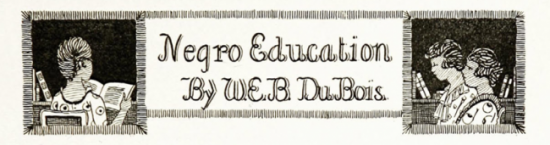
Banner reading Negro Education by W.E.B. DuBois with illustrations of women reading, The Crisis, 1918.

The Crisis, February 1918

 This is a repeat, but no other magazine approaches The Crisis in terms of quality of writing and importance of subject matter. Aside from W.E.B. Du Bois’ autobiographical essay, which I wrote about last week on the 150th anniversary of his birth, the February issue includes Du Bois’ scathing take-down of a government-sponsored study on “Negro Education” that advocated the replacement of higher education institutions with manual, industrial, and educational training. There’s a horrifying account of the mob murder of an African-American man in Dyersburg, Tennessee—so brutal, the magazine reports, that some white townspeople felt he should have had a “decent lynching.” On the literary side, there’s “Leonora’s Conversion,” a slight but engaging story about a wealthy young black woman’s brief flirtation with the church.

I’m not awarding a Worst Magazine this month. Good Housekeeping was a contender again—dialect-talking black maid Mirandy has the month off, but Japanese manservant Hashimura Togo*** expounds on his employer’s marital problems in equally fractured English. (“‘You have left off kissing me as usually,’ she dib. ‘O.’ He march and deliver slight lip.”) The magazine redeems itself somewhat, though, with an article by suffragist Anna Kelton Wiley called “Why We Picketed the White House.”
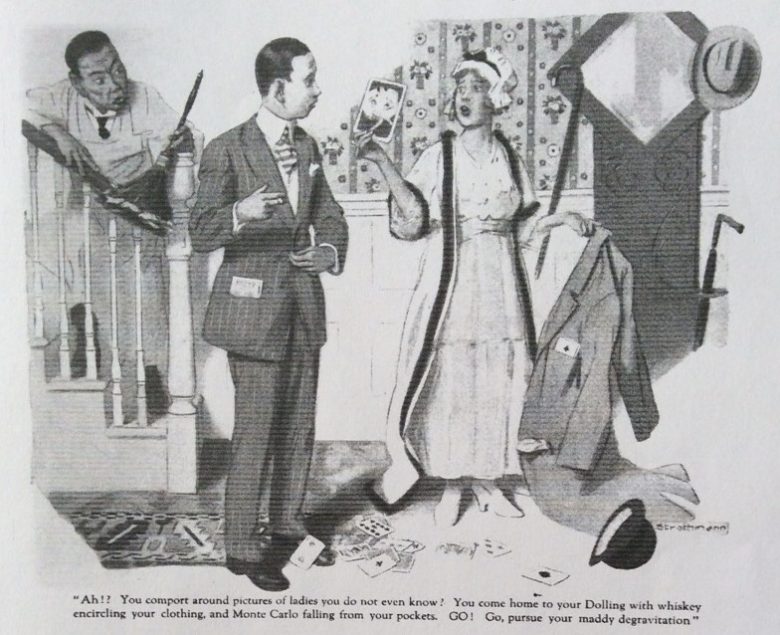
Illustration of story about Togo by Wallace Irving, Good Housekeeping, February 1918.

Good Housekeeping, February 1918

Best short story: “A Sordid Story,” by J., The Egoist

February wasn’t a great month for short stories. Most of the ones I read, including two that made it into The Best American Short Stories of 1918, started out promisingly but ended with pathos or a gimmicky twist. “A Sordid Story,” in the January**** Egoist, isn’t great literature, but it has daring subject matter and lots of atmosphere. It features a Cambridge student named Alphonse, whose life is described in the most British sentence I’ve ever read:

He made friends easily and took friendship seriously; so seriously that he spent nearly the whole of the Michaelmas term following the taking of his degree in reading Aeschylus’s Prometheus Bound and The Gospel according to St. Luke in the Greek with a much younger man—a certain Roderick Gregory—who was in his second year, but had hitherto failed to pass his Little-Go.
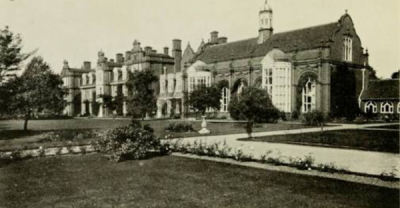
Photograph of Cambridge University by Maxwell Armfield, Cambridge and Its History, 1912.

Maxwell Armfield, from “Cambridge and its History,” 1912

Alphonse falls for Roderick’s sister Beatrice, who “used to have a pet pig, and she called him Shakespeare, because he would be Bacon after his death.” But he spends the night with a working-class girl who grabs his arm as he’s walking near Midsummer Common and says, giggling, “Can yer tell me what o’clock it is?” Horrified with himself the next day, he goes back to her lodgings to pay her off. She tells him that he was her first lover, then, when he tells her it’s over, says, “Yer weren’t the first, then!” Relieved “not to be the first to help send a woman downward,” he goes back to his rooms, where Roderick is playing the cello and twenty-five copies of the Quarterly Journal of Mathematics, in which he has published a paper, await him. It’s only years later that he figures out that he was, in fact, the first.

Worst short story: “A Verdict in the Air,” J.A. Waldron, Judge
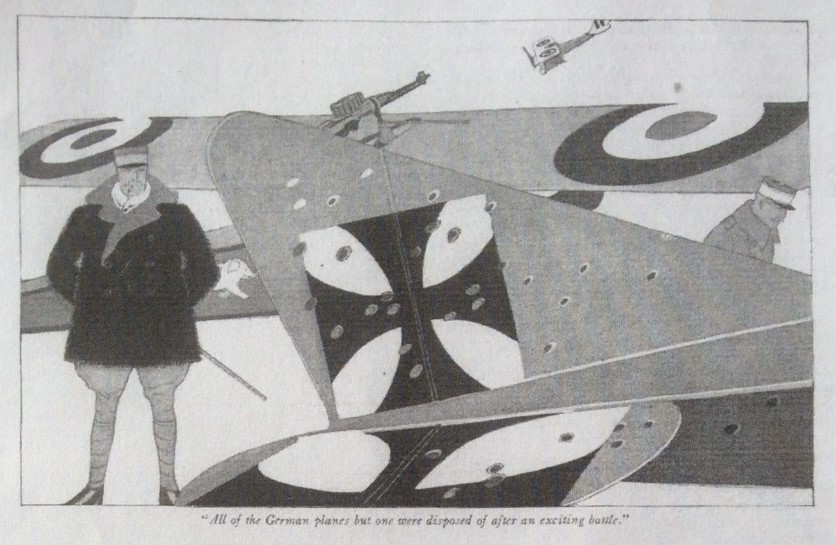
Lawrence Fellows illustration, Judge magazine, 1918, man standing near airplanes.

Lawrence Fellows, Judge, February 9, 1918

Harwood, on leave from aviation training, goes to a cabaret in Chicago. To his surprise, one of the singers is his childhood sweetheart Bessie Dean, who left their Ohio hometown to pursue a career in opera. She introduces Harwood to her husband Grindel, who takes a dislike to him. A few days later, Harwood is training on the Pacific Coast, when who should show up as a mechanic but Grindel! Harwood has a series of flying accidents, and Grindel is suspected, but he goes AWOL. Harwood is sent to fight with the French army. He visits a friend at a field hospital, where the nurse is none other than Bessie, who has escaped her husband. Back at the front, there’s a heated battle. Harwood pursues the last remaining German plane and hits its rudder after a lively skirmish. As the plane plunges to the ground, he sees that the pilot is—you guessed it—Grindel!

Well, the illustration is kind of cool.

Best magazine covers:

February was a great month for magazine covers. I just wish that the insides of the magazines were half as good. Besides the ones from Harper’s Bazar and Vanity Fair that I’ve mentioned already, there’s this Helen Dryden cover from Vogue,

Helen Dryden Vogue cover, February 1918, woman in pink hoop skirt looking into mirror.

Helen Dryden, February 1918

 and this one, which Norman Rockwell sold to Judge after the Saturday Evening Post turned it down. I can kind of see why.

Norman Rockwell Judge magazine cover, girl grabbing tartan skirt from brother dressed as a Scottish soldier.

Norman Rockwell, Judge, February 9, 1918

Best joke:

 This isn’t exactly a joke, but it made me laugh. It’s the opening of Louis Untermeyer’s review of poetry collections by Edna St. Vincent Millay, Samuel Roth, and Edwin Curran in the February 14 issue of The Dial.

These three first volumes, with their curious kinship and even more curious contrasts, furnish a variety of themes. They offer material for several essays: on “What Constitutes Rapture”; on “The Desire of the Moth for the Star”; on “The Growing Tendency among Certain Publishers to Ask One Dollar and Fifty Cents for Seventy Pages of Verse”; on “A Bill for the Conservation of Conservative Poetry”; on “Life, Literature, and the Last Analysis”; on “Why a Poet Should Never be Educated.”
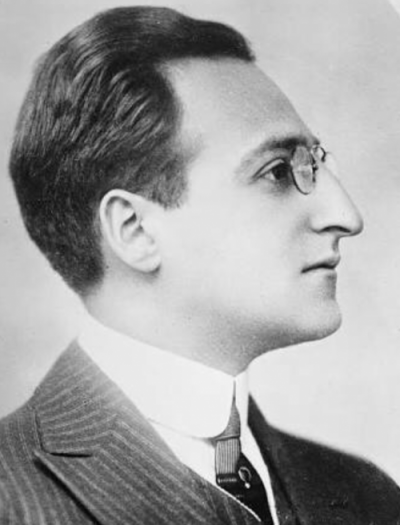
Studio photograph of Louis Untermeyer, ca. 1910-1915.

Louis Untermeyer, ca. 1910-1915, Library of Congress

The Growing Tendency among Certain Publishers to Ask One Dollar and Fifty Cents for Seventy Pages of Verse! That Louis Untermeyer is such a card!

Not amused? Okay, then, you go back to 1918 and try to find something funnier.

Worst joke:
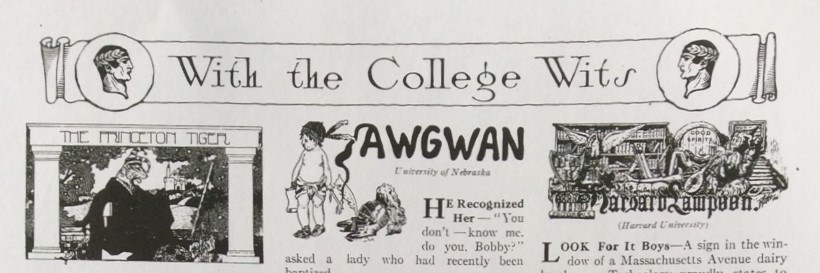
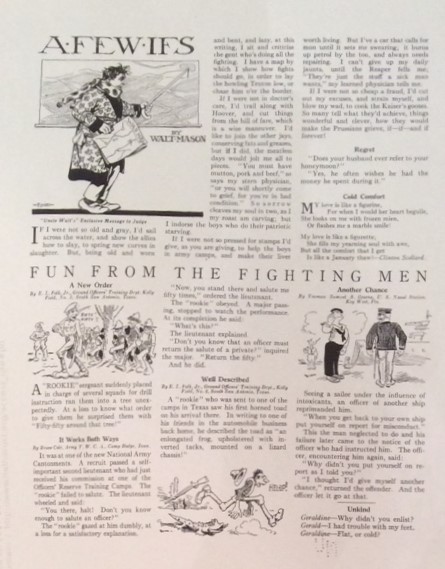
Judge magazine banner, With the College Wits, February 9, 1918.

Judge magazine, February 9, 1918

 Once again, hard to choose. Maybe this, from the February 9 issue of Judge:

“You don’t—know me, do you, Bobby?” asked a lady who had recently been baptized.
“Sure I do,” piped the youth. “You’re the lady what went in swimming with the preacher, last Sunday.”

On to March!

*A British diplomat

**Mrs. Humphrey Ward

***Really Wallace Irwin, who made a career of writing about Togo. Mark Twain was a fan.

****I was reading The Egoist a month late on the principle that it would have taken time for the magazine to get to the United States, which I’ve since decided is ridiculous.
The best and worst of January 1918: Magazines, stories, thinkers, and jokes

 I made it! One month of reading books, magazines, and the news as if I were living in 1918. It’s been even more fun than I expected. The 1918 New York Times at breakfast, printouts of The Dial and The Egoist for on-the-go reading, and Edith Wharton at bedtime. I don’t miss 2018 at all.

Here are some of the month’s highs and lows.

Best magazine: The Crisis

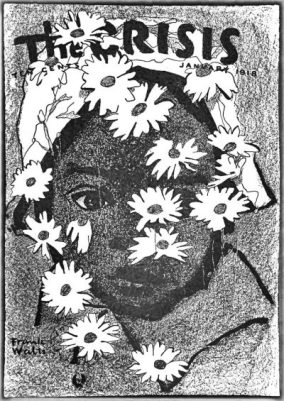
The Crisis cover, January 1918, drawing of African-American woman and daisies

The Crisis, January 1918, Frank Walts

I expected the NAACP’s magazine, edited by W.E.B. Du Bois, to be historically interesting. It was–and it also turned out to be the month’s most compelling read, full of top-quality explanatory journalism, social criticism, personal essays, and fiction.

Runner-up: The New Republic. When I’m befuddled by something I read about in the New York Times—like, was the American war effort as pathetic as Wilson’s critics make it sound, or did Harry Garfield really have to shut down the entire East Coast—all I have to do is wait a few days and the New Republic will provide a clear, convincing explanation. And then explain it again. And then, in case I still don’t get it, spend another couple of pages making the same point. Illuminating? Yes. Concise? No.

Worst magazine: Good Housekeeping

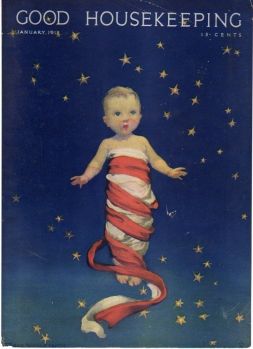
Good Housekeeping cover, January 1918, baby wrapped in flag with starry sky

Good Housekeeping, January 1918, Jessie Willcox Smith

Good Housekeeping was already in the lead for this category because of the horrible Marie Corelli article about cleansing the world through eugenics. Then I read “Mirandy on the One We Didn’t Marry,” by Dorothy Dix. I knew of Dix as a pioneering advice columnist. I’m a big fan of advice columns, and I was eager to find out what she had to say to the women of 1918. But Mirandy turns out to be Dix’s monthly impersonation of an African-American woman who provides her views on life in heavy dialect. “Ef you ’grees wid a woman ‘bout her husban’s faults an’ weaknesses she is lak enough to up an’ lambast you wid de fust thing dat is handy,” Mirandy says. There’s an illustration of a kerchiefed woman with an umbrella giving a talking-to to her pop-eyed friend. If you want to hear a real African-American woman’s take on family life, check out the lovely “A Mother’s New Year’s Resolutions” by Josephine T. Washington, in, where else, The Crisis.

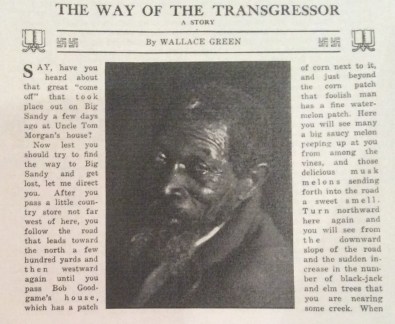
 Best short story: “The Way of the Transgressor,” by Wallace Green

Headline and photograph illustration, The Way of the Transgressor, The Crisis, January 1918.

The Crisis, January 1918

I wrote about this story, which ran in the January 1918 issue of The Crisis, earlier this month. It’s vivid, unformulaic, funny, and moving. Unfortunately, I haven’t been able to find out anything about Green (if that was his real name), or to find anything else that he wrote. I’ll keep looking.

Runner up: “The Policewoman’s Daughter,” by Ben Hecht (Smart Set, January 1918). Agatha is an innocent young woman with a domineering mother (a figurative, not a literal, policewoman), and the story takes place entirely in her head as she waits in the parlor of a seedy hotel for an assignation with a violinist. As the minutes tick by and it becomes clear that he isn’t going to show up, she falls into a state of anguish, followed by relief that God has saved her from ruin. Then she realizes that she got the date wrong, and her joyful anticipation returns. Hecht, who was twenty-three when this story was written, would go on to be one of Hollywood’s top screenwriters. His many credits include His Girl Friday, which is one of the talkiest films ever made. In “The Policewoman’s Daughter,” no one says a word. Talk about versatility!

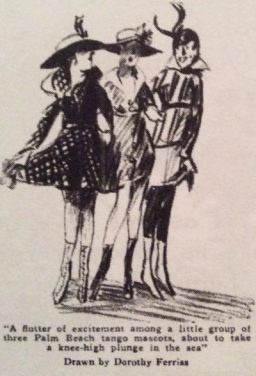
Worst short story: “A Palm Beach Honeymoon,” author unknown

Vanity fair illustration, Palm Beach Honeymoon, January 1918

I opened up Vanity Fair and, after 23 pages of ads, seven of them for dogs, finally got to some editorial copy. Or so I thought. “A Palm Beach Honeymoon” is the story of, well, a Palm Beach honeymoon. Robert is smitten with Mabel, his stunning bride, but he gradually becomes aware that, from her perspective, something in the marriage is amiss. Desperate to find out what it is, he asks his friend, who has been flirting with Mabel’s maid, to see what he can find out. His friend reveals that, during the train ride down, the porter threw away Mabel’s copy of Vanity Fair. Really, Vanity Fair? That’s what I get after all those ads? An advertorial?

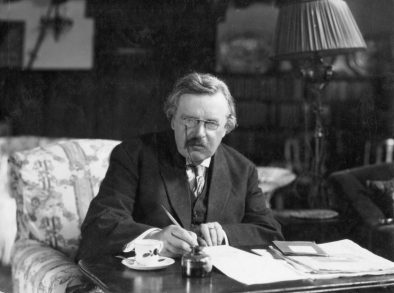
 Most famous thinker no one cares about today: G.K. Chesterton

Portrait photograph of G.K. Chesterton sitting at desk.

G.K. Chesterton, date unknown

 1918 was a bad year, great thinker-wise. Mark Twain died in 1910. So did William James, followed by his brother Henry in 1916. Walter Lippmann was starting to make his mark, but he was still in his twenties in 1918, and in any case he was on hiatus from journalism, working as an assistant to the Secretary of War. So that leaves…G.K. Chesterton. He’s probably best known today for his Father Brown detective stories, but back then he was known for, well, everything. He was a critic and a historian and a theologian and a bunch of other things. Everyone was always quoting him or criticizing him or reviewing his books. There could be a reading-in-1918 drinking game where you take a shot every time someone mentions him. Luckily there isn’t, because I’d be sozzled all the time.

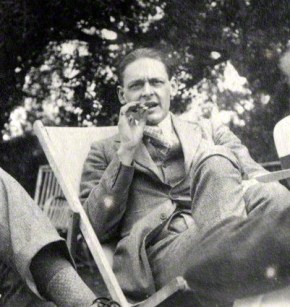
 Least famous thinker everyone cares about today: T.S. Eliot

Photograph of T.S. Eliot in lawn chair, Otteline Morrell, 1923.

T.S. Eliot, 1923 (Lady Ottoline Morrell)

 Okay, Eliot, who was 30 in 1918, wasn’t completely unknown. “The Love Song of J. Alfred Prufrock” had been published in Poetry magazine in 1915, and The Egoist, where he was assistant editor, put together a small collection of his poems in 1917. He was publishing reviews in The Egoist and elsewhere. But he was still working as a banker, and no one, except maybe Ezra Pound, suspected that he’d end up as the century’s most important poet and critic.

 Best joke:

 Geraldine—Why didn’t you enlist?
Gerald—I had trouble with my feet.
Geraldine—Flat, or cold?
(Judge, January 5, 1918)

Judge magazine, January 5, 1918

I know what you’re thinking: “This joke is not funny at all. I wish I could go back in time and never have heard this joke.” But, believe me, this is the best joke I could find. I know. It’s sad.

 Worst joke:

It’s pretty much a tie between all the other jokes  I read this month. They’re either corny, like this one:

“I’d like to have Simpkins’ yellow streak.”
“Why you coward!”
“It’s in a gold mine.”

or incomprehensible, like this one:

He—What music are you going to have at your dance?
Other he—The fraternity hat-band.

(Both from Judge, January 5, 1918)

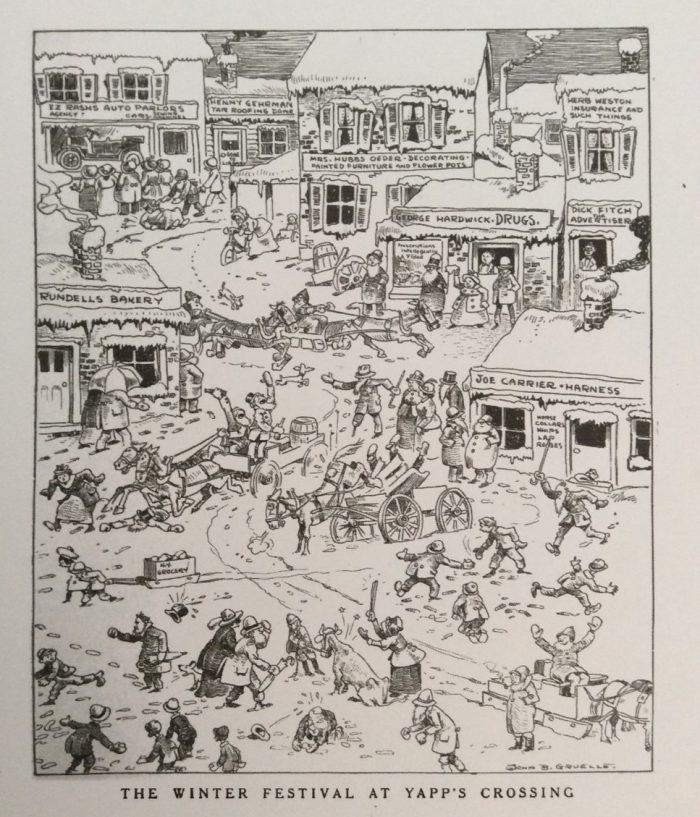
Okay, I can’t end on that note. As I’ve noted before, Judge did have excellent illustrators. I’ll close out the month with another Yapp’s Crossing illustration from John Gruelle, who, it turns out, was the creator of Raggedy Ann and Raggedy Andy.

On to February!