Category Archives: Nonfiction

The best and worst of April 1918: Magazines, stories, faint praise, and neologisms

A third of the way through!

After four months in 1918, I’ve become both more optimistic and more pessimistic about our present world. More optimistic because so many problems that seemed intractable back then, like the acceptability in mainstream circles of overt racism, sexism, and antisemitism, are gone now. More pessimistic because of all the new problems, like global warming, that people back then couldn’t have conceived of.

Okay, enough philosophizing. On to the best and worst of April 1918.

Best magazine: The Dial

The Dial is one of the most reliably interesting reads of 1918. It started out in 1840 as an outlet for the Transcendentalists (Louisa May Alcott’s father came up with the name) and was now a Chicago-based political and literary journal. H.L. Mencken wasn’t a fan—he ridiculed the “insane labeling and pigeon-holing that passes for criticism among the gifted Harvard boys of the Dial and the Nation”—but staff writer Randolph Bourne gave as good as he got, saying that Mencken and Theodore Dreiser “beat at a straw man of puritanism which, for the younger generation, has not even the vitality to be interesting.”*

The Dial did have a tendency to review seemingly every book that showed up on its doorstep, like Colorado, the Queen Jewel of the Rockies. But when a single (April 11) issue includes John Dewey on education, historian Charles Beard (who had recently resigned in protest from Columbia) on universities and democracy, Conrad Aiken on poetry,** and Bourne on immigrant fiction, I can forgive a lot.

Best short story: “The Swimming Pool” by Evelyn Campbell, Smart Set
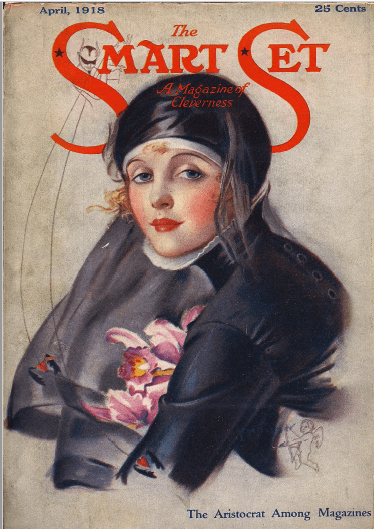
I haven’t read many magazine short stories this month. In fact, I’ve read just one: this one. And I wouldn’t call it a great story. So this might strike you as a shoddy bit of best-and-worst selecting. But something about this story by Evelyn Campbell, a 22-year-old screenwriter and Ziegfeld Follies girl, got to me.

A woman, swimming in a pool as darkness falls, strikes up a conversation with a man. They’re both natural swimmers, creatures of the water, and during their brief conversation they fall a little in love.

Suddenly it was dusk. Not in the enclosure made brilliant by white bulbs, but up above in the oblong of dark blue sky where newly awakened stars began to show timid faces to their bolder rivals. They were in the deep water which lay densely beneath them. Again they turned upon their backs and floated.

As the woman leaves the country club with her horrible rich husband and their children, she passes the man, who’s wearing an ill-cut suit. Her daughter says, Oh, look, the new janitor. A typical Smart Set snappy ending. In most stories, though, the twist at the end is the point—the rest is just setup. Here, the spell that the water casts on the swimmers is the point, and the ending is just the resolution.

Some of Campbell’s descriptions work better than others—I can’t picture what “in the middle of the pool a big golden square turned the water to bright emerald” looks like—but she’s trying something other writers just weren’t doing in 1918. That is, Imagist poets were, but not magazine short story writers.

Best magazine cover: The Crisis

Even by 1918’s high standards, this was an exceptional month for magazine covers. I’ve posted pictures of several of them already (here and here and here). The standout, though, is the cover of the April issue of The Crisis, the NAACP magazine edited by W.E.B. Du Bois. It features a copy of a painting called “Lead Kindly Light,” made for the magazine by 34-year-old William Edouard Scott (and now owned by the Huntington Museum of Art in West Virginia).

Here’s how the magazine’s editorial, probably written by Du Bois, interprets the painting.

It is just an old lantern, filled with grimy oil. It cannot lead anywhere, yet its light leads. Its golden light streams through the night.

Whose is the light?

It is not the lantern’s. It simply seems to be the lantern’s radiance. It is the Light of the World and it leads not toward the millennium in the North, but out of the insult and prostitution and ignorance and lies and lynchings of the South—up toward a chance, a new chance,—nothing more. But thank God for that…

Lead, Kindly Light.

Worst magazine cover: Ladies’ Home Journal

This is a repeat, but nothing was going to beat this Ladies’ Home Journal cover, titled (by me) “Oh, how sweet! My boyfriend killed someone!”

Best poem: “Is It Worth While,” Violet Hunt, Poetry

Violet Hunt, ca. 1900

Reading Poetry magazine, you can see how living in 1918 was like living in two worlds. In the April 1918 issue, there’s page after page of purple mountains, and it could be 1868, and suddenly there’s Violet Hunt mourning her relationship with Ford Madox Hueffer (Ford), and it could be 1968.

You can read the rest of the poem here.

Faintest praise in a book review: T.S. Eliot, The Egoist
archive.org

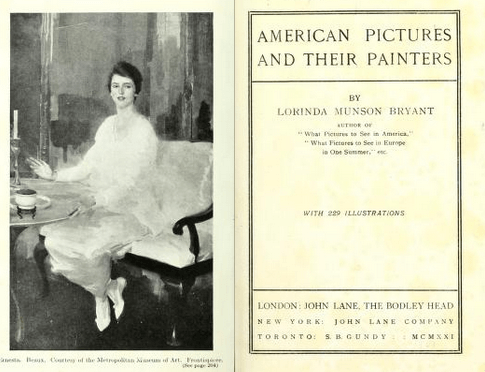
This was a surprisingly competitive category. At first, this unsigned review in the April 11 Dial, of Lorinda Munson Bryant’s American Pictures and their Painters, looked like a shoo-in:

One sincerely wishes that Mrs. Bryant in her enthusiasm for nature, both inanimate and human, had focused her numerous descriptions of the subject matter of the paintings. That the painter has chosen to paint a wintry landscape…is surely no excuse for a genteel panegyric on winter, or that the artist has selected a human being…is no excuse for a general eulogy of mankind. In the family circle a little girl, it is true, may be a “darling,” but in a painting that may be the least interesting of her attributes….If the subject is a woman, and a thin one at that, the author thinks the artist would have been wiser to select a plumper and rosier model…Aside from these minor defects the book is a handy and valuable compendium.
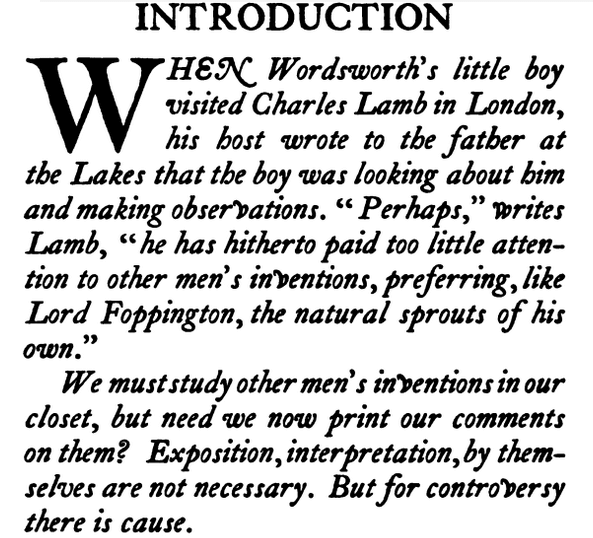
From “Hearts of Controversy,” by Alice Meynell, second edition, 1918

But then I came across this review of Alice Meynell’s Hearts of Controversy by Apteryx, AKA T.S. Eliot, in the April issue of The Egoist, and we had a winner.

In its peculiar anti-style, Mrs. Meynell’s book, like all her books, is extremely well written, and she can incidentally pick out good bits from authors. If we can accept this attitude, we shall enjoy the book very much. And people who have a taste for that antiquated genre, that parlour-game, the Polite Essay—which consists in taking a tiny point and cutting figure eights around it, without ever uttering one’s meaning in plain words—will find in Mrs. Meynell’s last essay (“Charmain”) an almost perfect example of a forgotten craft which indeed had its attractions.

*                                              *                                              *

But we must learn to take literature seriously.

(Asterixes Apteryx’s.)

Best neologism: Surréaliste
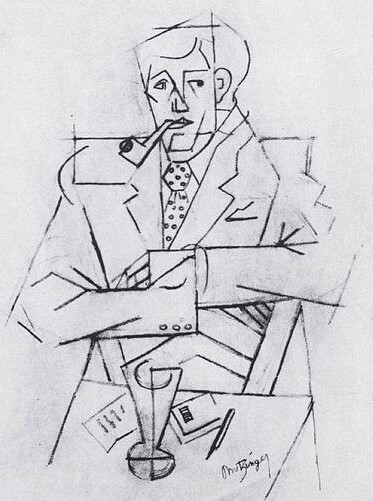
Study for a portrait of Guillaume Apollinaire, Jean Metzinger, 1911

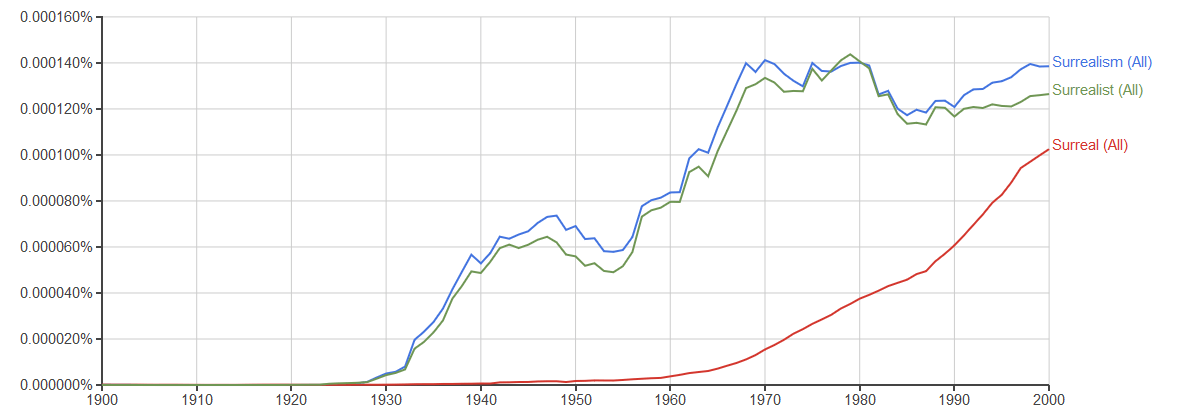
“SURRÉALISTE is the denomination M. Guillaume Apollinaire—there is no doubt his astounding name continues to have good reason for keeping well in evidence—has attached to his play, Les Mamelles de Tirésias,” the Paris correspondent for The Egoist tells us. I knew that the surrealist movement was just getting underway in 1918, but it seemed strange to think of the word itself being a novelty. So I crunched some big data—that is, did a Google Books N-Gram***—and it’s true, surreal and its variants were pretty much non-existent at that point. So what did people say when things were, you know, surreal? (UPDATE 1/16/2021: It turns out that “stream of consciousness” in a literary context was also coined this month, by May Sinclair in an article about novelist Dorothy Richardson in The Egoist, which I actually read without realizing “stream of consciousness” was making its debut.)
Best humor: 

In The Bookman, there’s a report about the mystery surrounding the identity of the author of The Book of Artemas, a bestselling British spoof relating current events in biblical style. Was it G.K. Chesterton? J.M. Barrie? Hilaire Belloc? George Bernard Shaw? (It would turn out to be someone no one ever heard of named Arthur Telford Mason.) Here’s an excerpt:

5. Whilst Wudro, the son of Wyl, was tending his flock of young men in the pasture that is knowledge, and after he had taught them how they should go and what things they should know,
6. Behold, the men of Amer came unto him, saying, We have chosen thee for to rule over us; and we have
brought thee an high hat for to wear as the badge of thine office; and the size of the hat, it is six and seven-eights.
7. And because he knew not what he was letting himself
in for, he gave way to their importuning, and did put on the high hat, the size whereof was six and seven-eights.
8. And it came to pass that when the men of En fought against the men of Hu, they did send messengers unto the land of Amer for to buy them munitions for the war. And they took
with them gold in great quantity wherewith to satisfy the merchants that did sell unto them. Therefor did the land of Amer prosper exceedingly.

Worst joke:
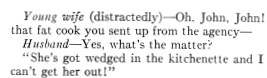
Judge, April 27, 1918

On to May!

*Kind of harsh, since Bourne was only six years younger than Mencken.

**He agrees with me about Christopher Morley’s goopiness.

***Which is really fun—you should try if you’re off Facebook and looking for new ways to waste time.
Insurgent Youth: The literary generation gap in 1918

“There is a vendetta between the generations.”

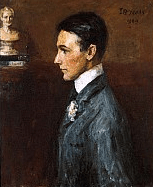
John Butler Yeats portrait of Van Wyck Brooks, 1909.

Portrait of Van Wyck Brooks by John Butler Yeats, 1909

So said critic Van Wyck Brooks in The Dial on April 11, 1918. (UPDATE 12/22/2020: Reading this again, I see that the actual quote is “There is a vendetta between the two generations.”) Randolph Bourne, a colleague of Brooks’ at the magazine, addressed the same theme in his March 28 essay “Traps for the Unwary,” asking

What place is there to be for the younger American writers who have broken the “genteel” tradition?…Read Mr. Brownell on standards and see with what a bewildered contempt one of the most vigorous and gentlemanly survivals from the genteel tradition regards the efforts of the would-be literary artists of today.*

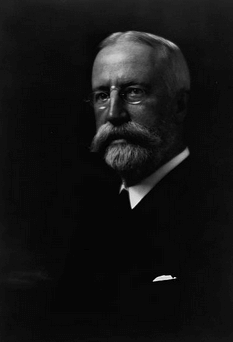
William Crary Brownell, date unknown (Library of Congress)

So I read Mr. Brownell on standards. (William Crary Brownell, that is. 1918 writers have an irritating habit of referring to people on first introduction as Mr. or Mrs. or Miss Last Name.) He was, it seems, a founding figure in American literary criticism, having sought to raise the country’s level of criticism as Matthew Arnold had in Britain. H.L. Mencken called Brownell “The Aristotle of Amherst”—not one of his better sallies, IMHO.

Brownell’s thesis in a nutshell: standards are important, but the younger generation doesn’t have them. He singles out “a recent clever novel—by a lady—that has evoked a very general chorus of cordial appreciation.” After quoting from a passage about a guy clipping his toenails, without providing the name of the book or author (another annoying 1918 habit), he says that

the picture is manifestly less a gem of genre than a defiance of decorum…One must draw the line somewhere and it is decorous to draw it on the hither side of the purlieus of pornography.

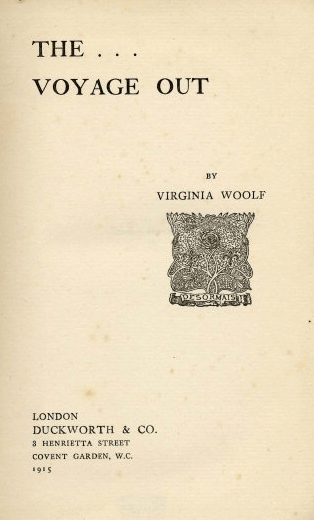
The lady writer, it turns out, is Virginia Woolf, and the book is her first novel, The Voyage Out.

First edition of Virginia Woolf’s The Voyage Out, Duckworth & Co., London, 1915

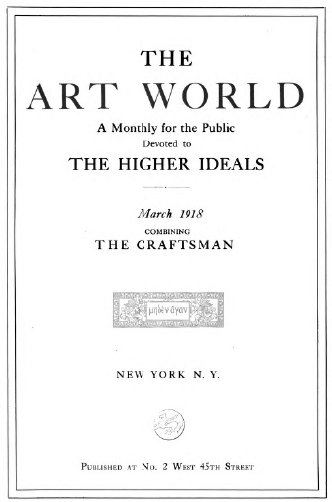
Brownell’s pretty boring, to be honest. Columbia professor Brander Matthews is a more entertaining old fogey. In his essay “The Tocsin of Revolt”,** in the March 1918 issue of The Art World, he says that

when a man finds himself at last slowly climbing the slopes that lead to the lonely peak of three-score-and-ten he is likely to discover that his views and his aspirations are not in accord with those held by men still living leisurely in the foothills of youth…If he is wise, he warns himself against the danger of becoming a mere praiser of past times; and if he is very wise he makes every effort to understand and to appreciate the present and not to dread the future.

Brander Matthews, date unknown

The young and old have clashed since time immemorial, Matthews says—and the survival of art depends on these very battles. This is all very sensible, and I wondered what Matthews was doing in such a reactionary magazine.

But!

But at the present moment, and perhaps more especially in our own country, there are signs of danger.

Uh-oh! Like what?

In this new century we have been called upon to admire painting by men who have never learned how to paint, dancing by women who have never learned how to dance, verse by persons of both sexes who have never acquired the elements of versification.

Matthews ends on a hopeful note. Ultimately, he believes, the younger generation

will tire of facile eccentricity and of lazy freakishness, of unprofitable sensationalism and undisciplined individualism. They will again seek the aid of tradition and they will toil to master the secrets of technic.***.

Bourne, a Columbia graduate himself, says of Matthews in a March 14 review of his autobiography that he was “incorrigibly anecdotal, genial, and curious.” He marvels, though, at his portrait of Columbia, then being torn apart by a free-speech controversy, as a paradise of harmoniousness. Ultimately, he delivers a damning verdict:

If there was ever a man of letters whose mind moved submerged far below the significant literary currents of the time, that is the man revealed in this book.

Columbia University library, 1917 (librarypostcards.blogspot.com)

Of Brownell, Bourne says in “Traps for the Unwary” that

one can admire the intellectual acuteness and sound moral sense…and yet feel how quaintly irrelevant for our purposes is an idea of the good, the true, and the beautiful.

Bourne agrees with Brownell and Matthews that standards are important, and that young people are turning out a lot of junk. The problem, he says, is that the older critics lump all young people together. What’s needed is a new criticism, focused on the younger generation, that

shall be both severe and encouraging. It will be obtained when the artist himself has turned critic and set to work to discover and interpret in others the motives and values and efforts he feels in himself.

In the natural order of things, Bourne could have been a standard-bearer for this new criticism after Brownell and Matthews passed on. But the two elders would survive for another decade, while Bourne had only months to live. Having battled disability and chronic illness throughout his life, he succumbed to influenza on December 22, 1918.****

If Bourne didn’t have the chance to build this new criticism, though, others did—first and foremost T.S. Eliot, who, across the Atlantic, was perfecting his craft as both a poet and a critic.

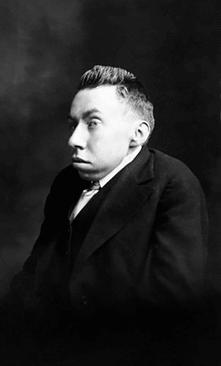
Randolph Bourne, date unknown

*The young generation was, I should note, fairly long in the tooth. Brooks was 32 and Bourne was 31. Other members of this literary youthquake included Ezra Pound (32), Margaret Anderson (31), T.S. Eliot (29), and John Reed (30). Meanwhile, much of the actual younger generation—21-year-old F. Scott Fitzgerald and 18-year-old Ernest Hemingway, for example—was off fighting in France. (UPDATE 11/17/1918: Actually, neither of them was fighting in France. Fitzgerald a lieutenant in the army but the war ended before he was sent overseas. Hemingway was an ambulance driver in Italy.)

**I think he means toxin. Matthews was an advocate of simplified spelling, so that may be the issue, although I never thought of “toxin” as particularly complicated. (UPDATE 12/16/1918: I came across “tocsin” in the New York Times and it turns out to mean a warning bell. Some dictionaries now consider it archaic.)

***Or technique, as we old-fashioned spellers call it.

****You can learn more about this brilliant thinker, and also about Walter Lippman, Alice Paul, John Reed, and Max Eastman, in Young Radicals, a wonderful book by Jeremy McCarter, co-author of Hamilton: The Revolution.

My 1918 Bedside Bookshelf

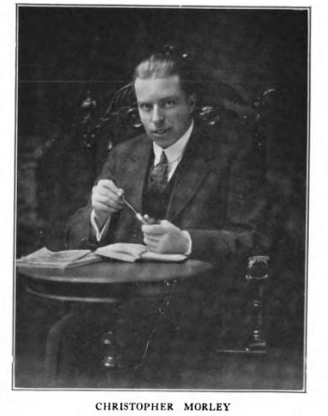
Christopher Morley was one of those famous-in-their-time people no one has heard of today.* In 1918, the hardworking twenty-seven-year-old had just published Parnassus on Wheels, his first novel, and a book of light verse called Songs for a Little House,** and he had a book of essays coming out. He was also the literary editor of Ladies’ Home Journal.

The Bookman, February 1918

In a piece in the February 1918 issue of The Bookman (originally published in the New York Sun), Morley stirred up quite a kerfuffle. The issue: what books you should choose for your guest room. “Let us assume that many of your guests are of the male sex and have the habit of reading in bed,” he writes. “You keep a reading lamp by the bed, of course, and a bookshelf. What thirty volumes would you choose to fill that shelf?”

Of course, Morley doesn’t really want to know what books YOU’D choose. He wants to tell you what books HE’D choose. As advertised, they’re pretty manly. Robert Louis Stevenson, Arthur Conan Doyle, Joseph Conrad, Rudyard Kipling. Plus some manly-sounding books I never heard of, like The Adventures of Captain Kettle and Casuals of the Sea. You can read the rest of the list here. Morley writes that

I find that for such strollers, wastrels and errant persons as frequent my house, this is a fairly well-selected guest-room library. I wonder if your readers will concur.

They didn’t. Harold Crawford Stearns sent in a list, published in March, that only had one duplicate with Morley’s, the Bible. It was equally manly, though. In April, D.M.T. Willis argued that Morley had chosen not bedtime books but “books that one wants to read when wide awake on a cold afternoon before the fire, or in a hammock under trees in warm weather.”

Bedtime reading, he says,

seems to me like the intense desire to eat candy one experiences immediately after church service, a sort of reactive indulgence, a kind of “now-I-can-do-as-I-please-for-the-rest-of-the-night” feeling.

My sentiments exactly!

Willis includes little blurbs with his list, like, “The Rubaiyat. Because every man and most women sometime at night want to feel as happy-go-lucky and sentimental as Omar,” and “The Bible, because some one might read it and become a poet.” His list is as lacking as Morley’s in women authors, but he’s such a charming blurber that I would totally stay at his house.

As for the contribution from Edward O’Brien, the editor of the Best American Short Stories series, all I can say is, really, Edward? The Canterbury Tales? At bedtime? I checked out another one of his choices, Religio Poetae, by Coventry Patmore. Here’s how the title essay starts:

No one, probably, has ever found his life permanently affected by any truth of which he has been unable to obtain a real apprehension, which, as I have elsewhere shown, is quite a different thing from real comprehension.

Zzzzzz.

The Bookman, to its credit, is snarky about Morley’s gender policy, saying in April that

Mr. Morley’s guest-room is apparently adapted solely to the needs of his male friends—or is it that his women visitors are of the kind that do not read?***

Finally, some women, identifying themselves as “Two Old Maids,” weigh in, and at last we have a handful of women authors: Jane Addams, Edna Ferber, and Lady Montagu.

Of course, I’m just like Christopher Morley: the real reason I’m writing about this is to give you MY 1918 guest room bookshelf list.

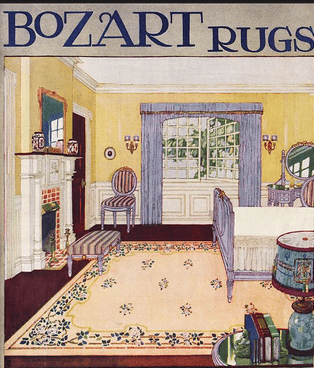
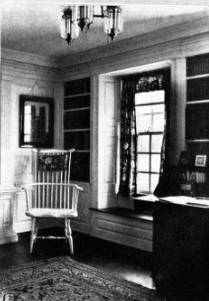
First I need a 1918 guest bedroom, though. Luckily I found one that’s perfect:

Screenshot (251)-2

Ladies’ Home Journal, May 1918

Okay, now for my list. It includes a mix of  books I’ve read for this project, other 1918-era books I’ve been wanting to read, and a few earlier classics. In the spirit of D.M.T. Willis, I’ve included blurbs explaining why I picked each one.

  1. Bab: A Sub-Deb by Mary Roberts Rinehart. Because this story about a rebellious, hapless teenager is hilarious, and short enough that you’ll be able to read the whole thing during your visit.
  2. Emma by Jane Austen. Because somehow it seems more 1918-ish than the rest of Austen.
  3. Mrs. Spring Fragrance by Sui Sin Far. Because I just finished this fantastic collection of short stories about the Chinese community in Seattle and San Francisco, and I can’t wait to tell you about it.
  4. The Age of Innocence by Edith Wharton. Because being a houseguest with a well-stocked bookshelf at hand is such an Edith Wharton thing to do.
  5. The Magic City by E. Nesbit. Because every guest room bookshelf needs some magic, and I missed this one during my E. Nesbit years.
  6. Tendencies in Modern American Poetry by Amy Lowell. Because I want to take a deeper look into what was happening in poetry in 1918, and who better to explain it than Lowell?
  7. The Tree of Heaven by May Sinclair. Because it was one of the big books of 1918, but when I ordered a print-on-demand version they sent me a book with Sinclair’s name on the cover but a 1907 Robert Chambers book with the same title inside.
  8. Pointed Roofs by Dorothy Richardson. Because May Sinclair said in The Egoist that she’s a great modernist but I’d never heard of her.
  9. Villette by Charlotte Brontë. Because I’ve been wanting to read it and it seems more bedtimey than Jane Eyre.
  10. Renascence, and Other Poems by Edna St. Vincent Millay. Because Louis Untermeyer panned it in The Dial and I’m in the mood to pick a fight.
  11. Marion: The Story of an Artist’s Model by Winnifred Eaton. Because the story of a half-white, half-Chinese artist’s model sounds intriguing, plus she’s Sui Sin Far’s sister.
  12. Anne of Green Gables by L.M. Montgomery. Because, shamefully, I’ve never read it.
  13. Daddy-Long-Legs by Jean Webster. Because this breezy epistolary novel, which I wrote about here, is the perfect bedtime read.
  14. Personality Plus by Edna Ferber. Because the Two Old Maids sound like they know what they’re talking about.
  15. O Pioneers! by Willa Cather. Because it’s one of the best books I’ve ever read. Just don’t read the ending right before you turn off the light, like I did.
  16. The Last Ditch by Violet Hunt. Because her wonderful poem in Poetry magazine about her breakup with Ford Madox Hueffer (Ford) made me want to read more of her work.
  17. The Story of an African Farm by Olive Schreiner. Because I really need to read this South African classic.
  18. Behind the Scenes, or, Thirty Years a Slave and Four Years in the White House, by Elizabeth Keckley. Because Keckley’s amazing journey sounds well worth reading about.
  19. The Circular Staircase by Mary Roberts Rinehart. Because this was Rinehart’s first best-seller, and if her mysteries are as good as Bab: A Sub-Deb I can’t wait to get started.
  20. Understood Betsy by Dorothy Canfield Fisher. Because I read this when I was very young and I’d love to see if I remember anything.
  21. The God by H.D. Because I need to start actually reading the Imagist poets instead of just reading about their love lives.
  22. Married Love by Marie Carmichael Stopes. Because, who knows, this British sex manual might come in handy for my houseguests.
  23. Parnassus on Wheels by Christopher Morley. Because Jeff O’Neal raved about it, but mostly because I love the idea of Morley sitting on the bookshelf with all these women.

Of course, what I’ve really done is put together a list of books I want YOU to have when I stay in YOUR guest room. I’ll be traveling a lot over the next few months, so get ready!

(And there’s still room on the bookshelf–I haven’t reached Morley’s 30 volumes yet–so I’d welcome your suggestions.)

The House Beautiful, September 1917

*Except for Jeff O’Neal of Book Riot, who talked about Morley’s novel Parnassus on Wheels on last year’s holiday book recommendation podcast.

**It’s just like it sounds. He writes so goopily about his wife that I assumed, based on previous 1918 experience, that she would run off with a female Imagist poet in short order. But no, they were still married when he died in 1957.

*** This can’t possibly mean what it sounds like. If it did, she wouldn’t be sleeping in the guest room, would she?

A forgotten early 20th-century Betty Friedan

Quick: where do these sentences come from?

[The housewife] masters in a year or two years at most details which must nevertheless be repeated, although all the freshness and interest have gone out of them, as long as life lasts.

In a vague and unanalyzed way she feels the inexorable effects of child training and housekeeping upon her own mental life and powers.

She has a sense of injury that she has fallen upon a career so uninteresting and uncongenial.

Betty Friedan, right? The Feminine Mystique. The problem that has no name.

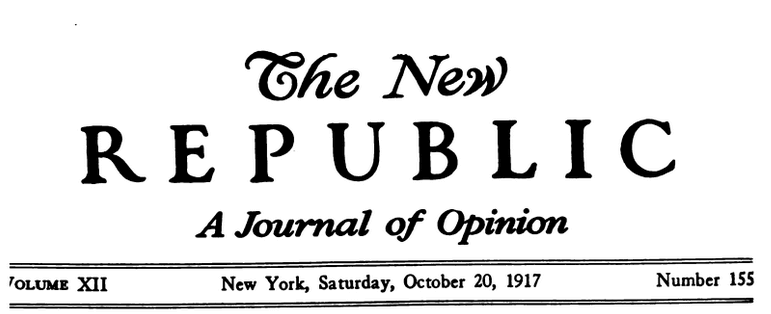
No, not right—as you’ve probably guessed, since this blog isn’t called “My Year in 1963.” (The post title may have been a tip-off as well.) They come from an October 20, 1917,* article in the New Republic called “The Price of a Home,” by Julia Clark Hallam.

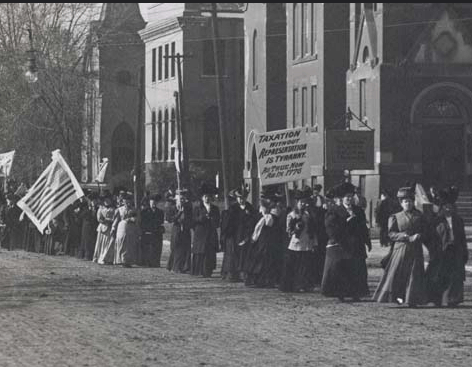
Parade staged by the Iowa Woman’s Suffrage Association. Boone, Iowa. October 29, 1908. Photographer: Moxley. (State Historical Society of Iowa, Des Moines)

There were feminists back then, of course. For the most part, though, they were fighting for the vote, not talking about bored housewives. In fact, in order to win men over to the suffragist cause, they were deliberately not rocking the gender equality boat.

Julia Clark Hallam was a suffragist, too—she headed the Iowa Equal Suffrage Society from 1909 to 1910. But she wasn’t having any of this “one battle at a time” business.

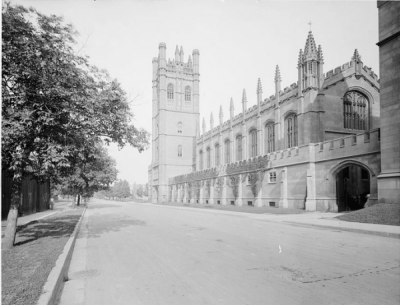
Hutchison Hall, University of Chicago, ca. 1910-1920 (Library of Congress)

“The Price of a Home” starts with the tale of a woman (clearly Hallam herself) who applies to graduate school twenty-five years after graduating from college with honors. In the years in between, she has raised four children. The school’s dean agrees to admit her, but he predicts that she won’t succeed. She asks why.

“Because,” replied the dean, after taking a moment or two for reflection, “our experience has compelled us to realize that the occupation of home making, important as it is, does not prepare the mind for its higher activities and attainment.”

Hallam sees the dean’s point.

Lack of intellectual content in experience and constant repetition arrest mental development as certainly as newness, freshness and interestingness make for mental growth.

The way she describes this problem leaves little doubt that she’s experienced it first-hand.

There are days when [the housewife] feels she must throw all the dishes on the scrap heap rather than wash them, and as for breaking an egg, which has to be done so endlessly in cooking, she clenches her teeth lest she jam the whole sack of eggs into the garbage pail.

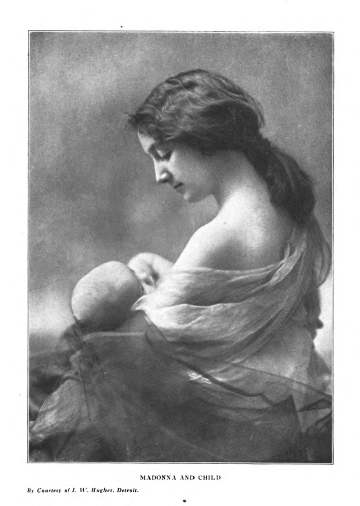
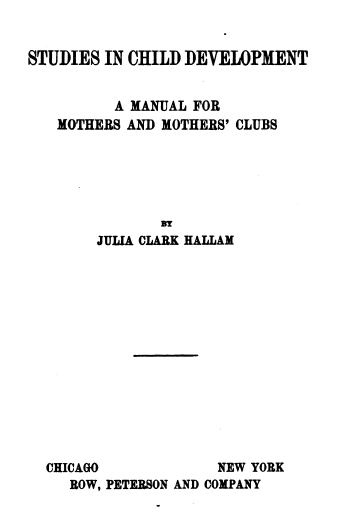
Frontispiece, Studies in Child Development, Julia Clark Hallam

In a follow-up article the next week, Hallam takes on the argument that, while keeping house might be tedious, raising children is intellectually stimulating.

Doubtless there are elements of truth in this argument, yet I wonder if those who press it realize how often a child has to be bathed? Let us admit that the first ministrations of this kind bring the thrill of the mentally fresh and the emotionally pleasurable. But after the act has been repeated several hundred times the thrill refuses to report for duty.

Again sounding very much like Friedan, she says that technology is not the solution.

I am inclined to believe that mechanical inventions are proving thought-killers rather than thought-producers, and that the time they save is wasted unless it can be given to activities which have a real mental content.

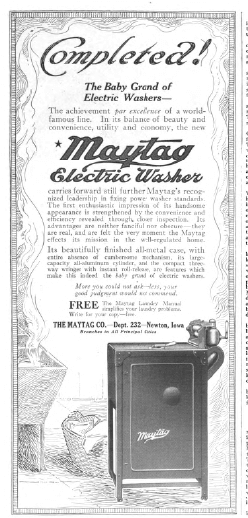
Good Housekeeping, January 1918

It’s too late for the present generation of homemakers, Hallam says. But she’s optimistic about the future.

My most earnest hope and conviction is that through the influence of continued intellectual rebellion on their parts against the present conditions, we shall blaze a trail which for our daughters and granddaughters will lead out to a reconstructed society where all individuals shall have equal share in grasp of mind and freedom of spirit.

In the debate sparked by the article, Hallam comes in for a fair amount of condescension. But not all of her critics are men. Elizabeth Childe of Washington, D.C., says that, after searching through “a mind darkened by twenty years of homemaking,” she has found the flaw in Hallam’s argument: her failure to distinguish between housework and the rewarding—to Childe, at least—occupation of homemaking. Friedan, too, was criticized for saying that no one could possibly enjoy being a housewife. (Another criticism of Friedan, that of class bias, could also be applied to Hallam. Her husband’s work—he was a lawyer—might seem enviable, but would she want to trade places with a male assembly line worker?)

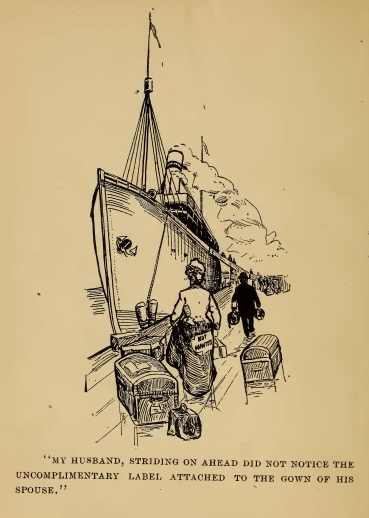
Frontispiece, The Story of a European Tour, Julia Clark Hallam

Hallam did earn her degree, an M.A. from the University of Chicago, in 1910. In addition to her work as a suffragist, she taught high school in the United States and the Philippines. She wrote several books as well. The Story of a European Tour (1900), is, sad to say, even more boring than it sounds.** In Studies in Child Development (1913), we learn about “The Boy’s Greatest Danger,” which is, you guessed it, “onanism, or self-pollution.” You can read what she has to say about this life-threatening problem, and how to solve it, here.*** But most of her advice is more sensible, and she was described as a pioneering advocate for sex education (or social hygiene, as it was then known).

Hallam died in 1927, at the age of 67. Her occupation, as listed on her death certificate: housewife.

*Granted, this blog isn’t called “My Year in 1917” either. But the debate over Hallam’s article continued for months in the letters to the editor, which is how I came across her.

**The height of the action, judging from my quick skim: she and her husband think they’ve lost their train tickets, find them at the last minute, are separated on the platform in the confusion, and are brought together by a nice young man from Princeton.

***If you’re pressed for time, here’s a sample: “Everyone has seen an electric battery which has spent its force. It is a dead thing. So the body, with its splendid life forces wasted—not to speak of the moral and spiritual and degradation that follows. It is one of the great tragedies of life.”

A Caruso fan on the factory floor

Remember Elizabeth Hasanovitz, the Hebrew school teacher’s daughter who fled Russia for a better life in New York? (If not, you can read about her here.) She’s back, in the second installment of her memoir in the February 1918 Atlantic.

Banner, The Atlantic Monthly, February, 1918.

Elizabeth attempted suicide at the end of the last installment, ground down by her life as a seamstress. She recovers quickly and gets a job in a non-union factory, making the princely sum of ten dollars a week.

My cheerfulness returned. Again I went among my friends, entertaining them with song and infecting them with my joyousness. Even in the shop I felt happy.

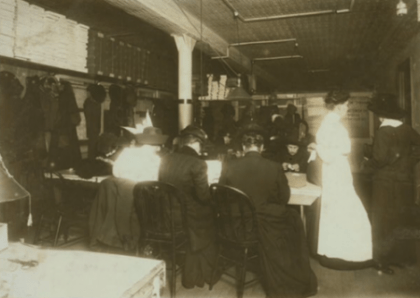
Women factory workers sitting at table.

She starts saving up to send for her younger brother, and her friend Clara helps out with a fifty-dollar loan. Even the conversation at work has improved.

Very little talk about “fellers,” swell evening pumps, lace petticoats that the six dollar wage-earners were constantly discussing, in the sweater shop. Here we talked about questions of the day, world-happenings, music, art, literature, and trade questions.

Once she pays her debt to Clara, Elizabeth starts thinking about the finer things in life.

I at once went to the Opera House, secured tickets for five dollars at twenty-five cents each, so that I was provided with opera tickets for the next few weeks.

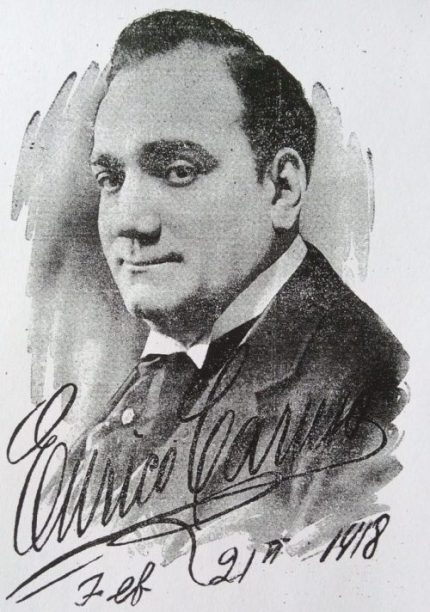
Photograph of Enrico Caruso above autograph and date, Feb 21st 1918.

Enrico Caruso, New York Times, February 24, 1918

She sees Enrico Caruso sing and Anna Pavlova dance. Her tickets are standing room*, and she often goes straight from work.

If it happened to rain, my dress would be soaked through and through, and with wet clothes I would stand through the performance, changing from foot to foot, while there were often plenty of empty seats in the orchestra. Very often I would pay with a cold the next day.

Back at the factory, Elizabeth tries to get her co-workers interested in joining the Dress-and-Waist-Makers’ Union. The good conditions they enjoy, she argues, were won by activists in unionized factories. The other girls say, “You better shut up; if you don’t you will get fired.” She pays a visit to the union, and word gets back to her colleagues and her boss. They warn her that union leaders are nothing but grafters, after the members’ money.

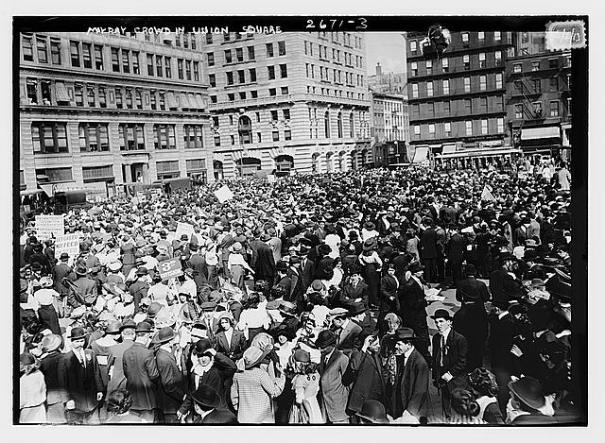
Crowd of workers marching in Union Square, New York, 1913.

May Day march, Union Square, 1913 (Bain News Service, Library of Congress collection)

Elizabeth decides to attend the May Day workers’ march.

The day fell on Thursday**, a bright warm spring day. The many thousands of young girls, in uniforms of white waists with red collars, all in line, were ready to march on. The sun illuminated their pale but happy faces as they walked through the avenues and streets. Looking up at the skyscrapers where they slaved all year, their shiny eyes would gleam with pride and hope, as if they would speak and warn the world, “behold you who keep us in the darkness, no more are we to slave for you!”

 The next day, in high spirits, Elizabeth sets out for work, humming a favorite Russian song.

“Good morning,” said I merrily to the foreman, who happened to be the first to meet me when I entered the shop.***

 “Good morning,” came an angry sound from his nose.

That Saturday, Elizabeth receives her pay–and a dismissal notice.

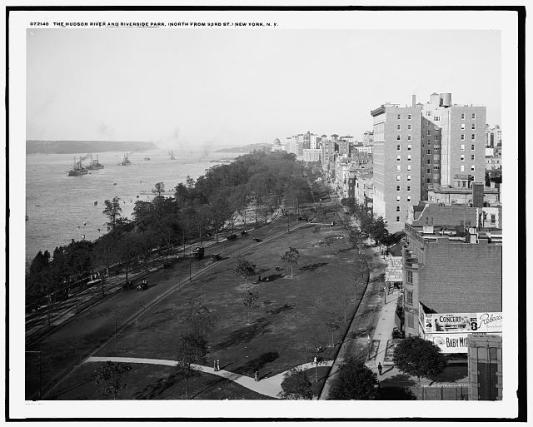
Aeriel view of Riverside Park, New York, ca. 1909.

Riverside Park, New York, ca. 1909 (Detroit Publishing Company, Library of Congress collection)

It’s the slow season, and Elizabeth has no luck finding a new job. She wonders how she will provide for her brother when he arrives. She sits on a bench in Riverside Park, looking out at the Hudson and thinking very Russian thoughts.

Life, life—O Happiness, where is thy sweetness, murmured I, in such mortal anguish for life.

 (To be continued.)

Elizabeth is still a drama queen. And she’s as snooty as ever. When her mother sends her a poem that her sixteen-year-old brother Nathan has written for her, she criticizes his grammar. She says of her friend Clara, who took her in after her suicide attempt and lent her the money for her brother’s passage,

Her spiritual development was on a much smaller scale than mine, and she would easily be inspired by things that did not interest me at all. My temper was a more revolutionary one, and I was more sensitive.

But, amid the flippancy of the fashionable magazines of 1918 and the dullness of the mainstream press, she’s a fresh, genuine voice.

(If you want to read about Elizabeth in her own words, her autobiography is available in several versions at Amazon. The issues of the Atlantic that it was serialized in (January – April 1918) can be accessed at Hathitrust Digital Library here.)

*in a parterre, maybe!

**So it was probably 1913.

***A different translator or editor apparently took over midway through the article, and Elizabeth in inverted sentences begins always to talk.

On W.E.B. Du Bois’ 150th birthday, a look back at his “Jubilee”

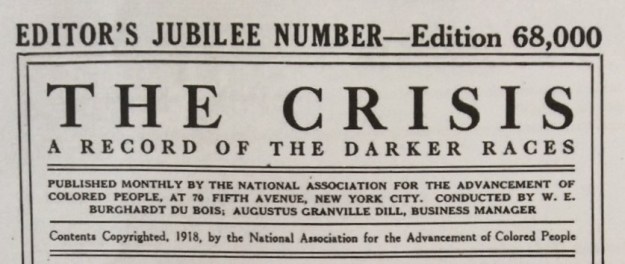
The February 1918 issue of the NAACP magazine The Crisis, headlined EDITOR’S JUBILEE NUMBER, starts with this note: “The Editor of the CRISIS will celebrate his fiftieth birthday on the twenty-third of February, 1918. He would be glad on this occasion to have a word from each of his friends.” The editor was W.E.B. Du Bois, born 150 years ago today.

Top of title page of The Crisis, February 1918, Editor's Jubilee Number.

The Crisis, February 1918

The issue includes an autobiographical essay by Du Bois called “The Shadow of Years.” He tells of his ancestry:

a flood of Negro blood, a strain of French, a bit of Dutch, and thank God! No “Anglo-Saxon”

—his childhood in Great Barrington, Massachusetts, playing comfortably with his white friends and largely unaware of the country’s vast racial divide:

I think I probably surprised my hosts more than they me, for I was easily at home and perfectly happy and they looked to me just like ordinary people, while my brown face and frizzled hair must have seemed strange to them

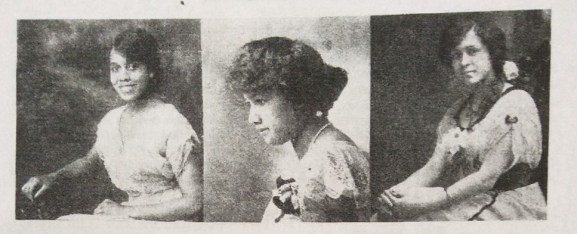
Three photographs of African-American women in The Crisis magazine, 1918.

The Crisis, February 1918

—encountering other African-Americans in large numbers for the first time at Fisk College in Tennessee:

Lo! My people came dancing about me—riotous in color, gay in laughter, full of sympathy, need, and pleading; unbelievably beautiful girls—“colored” girls—sat beside me and actually talked to me while I gazed in tongue-tied silence

—and the “Days of Disillusionment” that fueled his desire to work for the upliftment of his people:

I began to realize how much of what I had called Will and Ability was sheer luck. Suppose my good mother had preferred a steady income from my child labor, rather than bank on the precarious dividend of my higher training?…Suppose Principal Hosmer had been born with no faith in “darkeys,” and instead of giving me Greek and Latin had taught me carpentry and the making of tin pans?

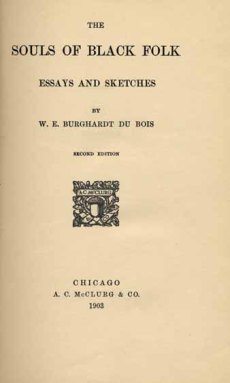
The Souls of Black Folk, title page, second edition, 1903.

Second edition, 1903

If you want to learn more about the human side of this towering (and sometimes intimidating) thinker, you can find the “The Shadow of Years” here. Or you can read “Of the Meaning of Progress,” the essay in Du Bois’ 1903 classic The Souls of Black Folk about his days as a young teacher in a rural Tennessee community. (I’ve been listening to the audiobook, wonderfully narrated by Rodney Gardiner.)

In “The Shadow of Years,” Du Bois presents himself as an old man. “The most disquieting sign of my mounting years is a certain garrulity about myself, quite foreign to my young days,” he begins. He ends the essay as follows:

Last year, I looked death in the face and found its lineaments not unkind. But it was not my time. Yet, in nature sometime soon and in the fullness of days, I shall die; quietly, I trust, with my face turned South and Eastward; and dreaming or dreamless, I shall, I am sure, enjoy death as I have enjoyed life.
But Du Bois lived almost long enough to celebrate another Jubilee, dying in Ghana in 1963 at the age of ninety-five.
As for his request in The Crisis for a word from each of his friends, I’ll just say this, from the distance of a hundred years:

Thank you.

(You can read more about The Crisis here and here.)

Who do you love? Walter Lippmann vs. H.L. Mencken

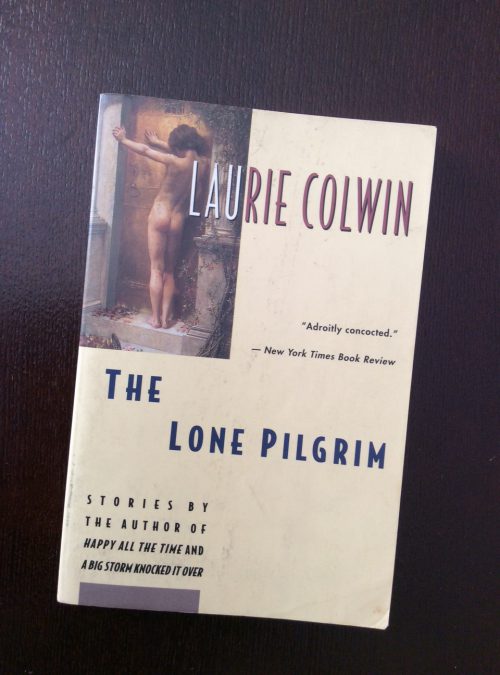
There’s a short story by the wonderful, much-missed writer Laurie Colwin called “An Old-Fashioned Story.” It’s about a rebellious young woman named Elizabeth whose horrible rich parents decided when she was a child that she should marry Nelson, the upstanding son of their equally horrible best friends. Elizabeth isn’t having any of it. Nelson’s ne’er-do-well older brother James sounds more up her alley, but he’s always off somewhere and she hasn’t seen him since she was a child. He finally shows up at his family’s holiday party, and she leaves with him, scandalizing everyone. But, as she sits in a bar listening to him drone on about his wicked ways, she realizes he’s a bore. A few weeks later, Nelson shows up at her apartment when she’s suffering from a cold. He turns out to be a secret rebel, and to be the one for her.

I thought of this story after reading (or listening to) social commentary by Walter Lippmann and H.L. Mencken, two of the top pundits of the 1918 era. I’ve tuned out of 21st century podcasts, and the audio accompaniment to my walks lately has been Lippmann’s 1912 book of essays A Preface to Politics. In it, Lippman, who was only twenty-three when the book was published, goes on sensibly about what’s wrong with politics in the United States: basically, that our system is organized around a notion of how people should be, rather than how they really are. He builds his case methodically, quoting William James and Nietzsche and G.K. Chesterton. He’s sensible, persuasive, and intelligent—Harvard Phi Beta Kappa intelligent. He’s the golden boy. Your mom would love him. But you wouldn’t say he was exciting.

Portrait photograph of Walter Lippmann, 1914.

Walter Lippmann (Pirie MacDonald, 1914)

Then, in the January 1918 issue of Smart Set, I came across H.L. Mencken. Mencken was the magazine’s co-editor, and after 136 pages of jocular stories of varying quality there’s a piece by him called “Seven Pages about Books.” Reviewing a book called Success Easier than Failure, by E. W. Howe, he writes that it’s “the first forthright exposure, so far as I know, of the working philosophy of the American people—not the moony philosophy they serve with the lip, but the harsh, realistic, Philistine philosophy they actually practice.” He goes on:

This fundamental dualism, this disparity between what is officially approved and what is privately done, is at the heart of the American character; it sets our people off from nearly all other peoples. It is the cause of the astonishing hypocrisy that foreigners see in us, and it is the cause, too, of our constant failure to understand those foreigners and their ways.

Portrait photograph of H.L. Mencken.

H.L. Mencken, date unknown

Mencken, the high school-educated son of a cigar factory owner, is as scruffy as Lippmann is urbane, as direct as Lippmann is deliberate. Reading him after weeks of 1918 journalism felt like stepping out into the fresh air from an overheated parlor. Finally—a writer who felt contemporary.

Then I read on. Mencken complains about how we “save the [racial slur] republics from themselves” and then try to turn them into democracies. In a supposed tribute to the Jewish people, he says that any flaws they may possess are due to “corruption of blood” through intermixing with Greeks, Arabs, and Armenians. “The shark that a Jew can be at his worst is simply a Greek or Armenian at his best,” he says.

Meanwhile, in A Preface to Politics, Lippmann has turned his attention to a report on vice in Chicago. Prostitution, he says, isn’t a problem that takes effort to focus on, like trusts, or the poor. Instead, it “lies close to the dynamics of our own natures. Research is stimulated, actively aroused, and a passionate zeal suffuses what is probably the most spontaneous reform enthusiasm of our time.” Get it? Stimulated? Aroused? Passionate? Lippmann has sex on the brain! (I wonder if his editor noticed the puns. They might have slipped by me if the otherwise sedate narrator hadn’t had such a good time with them. He does all but say “heh heh heh.”)

It’s not just the puns. Lippmann argues that the preventive approach the Chicago commission advocates—more enforcement, putting lights in public parks, etc.—will never work. The only effective solution to prostitution, he says, is to get rid of the stifling morality that forces sex underground—to allow it to be enjoyed by people other than couples in lifelong monogamous marriages. Now that’s contemporary.

Mencken, as he winds up, takes a direct swipe at Lippmann, mocking his “sonorous rhapsodies.” Maybe he has a point.

But sorry, H.L., it’s too late.

Walter, you’re the one.

Factory work by day, Yiddish drama by night: the Lower East Side life of Elizabeth Hasanovitz

Headline, One of Them, Elizabeth Hasanovitz, Atlantic, January 1918.

It’s only been two weeks, but I already hate 1918 rich people. They’re imperious, self-absorbed, and shallow. When a New Jersey judge makes an incognito coal delivery during a cold snap, the lady of the house threatens to have him fired if he doesn’t take it up to the second floor. (He does, and dumps it in the parlor.) Vanity Fair praises the unsurpassed valor of soldiers from “great schools like Exeter, St. Paul’s, and Groton.” Rich characters in short stories yammer endlessly about their personal dramas, and I say, “You know what you need? A job.” So it was refreshing to come across decidedly-not-rich Elizabeth Hasanovitz, whose serialized autobiography “One of Them” begins in the January 1918 Atlantic.

Born into a large and loving family in Russia, Elizabeth began teaching in her father’s Hebrew school at fourteen—illegally, since she lacked a teaching certificate. All she wanted in life was to go on teaching with her father, but it wasn’t to be. When she took the teachers’ exam, fifty-five of the sixty Yiddish candidates failed, including Elizabeth; all nine Russian candidates passed. Meanwhile, the family fell on hard times because of the police chief’s frequent demands for bribes. And there was the constant danger of anti-Jewish violence from drunken peasants.

One night, as the family sat down for the Sabbath meal, Elizabeth said, “I have been thinking and I have decided that—that—I—shall go—to America.” Her mother and sisters burst into tears, and her father rejected the idea out of hand. Elizabeth pleaded with her parents for days. She could send for the rest of the family, she said. “Think of the children going to free schools, growing up free citizens!” But her father wouldn’t budge. Finally, she resorted to a hunger strike. After three days, her father got her a passport.

Lower East Side street, ca. 1910

Lower East Side, ca. 1910 (New York Times photo archive, public domain photo)

Elizabeth ended up in Canada, where she got a factory job. The pay was decent, but she left because of the country’s “provincial mental atmosphere.” Chicago was no more to her liking, so she set out for New York. There, things went well at first. She was making ten dollars a week at a knitting mill and saving five for her brother’s ticket. She joined the Dramatic Club, which aimed to provide higher fare than the “trash” that most Yiddish theaters fed the public. All was well, except for the “common and vulgar” atmosphere in the factory. The other girls’ “frankness in manner and speech would make me blush, and I became an object of their teasing.”

But the good times didn’t last. Business slowed, and Elizabeth was laid off. Luckily, a fellow member of the Dramatic Club had a home textile enterprise, and he took Elizabeth on as a trainee. The atmosphere was congenial—the family members sang merry Russian songs as they worked—but Elizabeth was a hopeless seamstress, constantly sewing a front where a sleeve was supposed to be. Eventually she improved, but she was slow, and she earned only five or six dollars a week, barely enough to live on. Exhausted at night, she abandoned her dream of studying. When she was down to her last two dollars, she fell into despair.

Posed photo of striking shirtwaist factory workers, 1910.

Striking shirtwaist factory workers, 1910 (Library of Congress, public domain photo)

Elizabeth went to a flower shop and bought a funeral bouquet for $1.50. Back at her rooming house, she turned on the gas. To speed her death along, she soaked matches and drank the liquid. She woke up in the hospital, her friend Clara from the Dramatic Club at her side. Clara invited Elizabeth to live with her, and out of options, she agreed.

To be continued!

Elizabeth has her flaws. She’s a terrible snob, with her haughty dismissal of Canada and her airs and graces on the factory floor. She claims to have almost starved to death on the ocean journey because the other passengers grabbed all the food, but her real problem seems to have been with their disgusting table manners. And she’s quite the drama queen. The hunger strike! The funeral bouquet!

Still, she’s a compelling heroine, and she paints a vivid picture of immigrant life in the Lower East Side. I look forward to reading her further adventures. If you want to know more, you can find her entire autobiography online. Just don’t tell me what happens!

Good-bye to All That

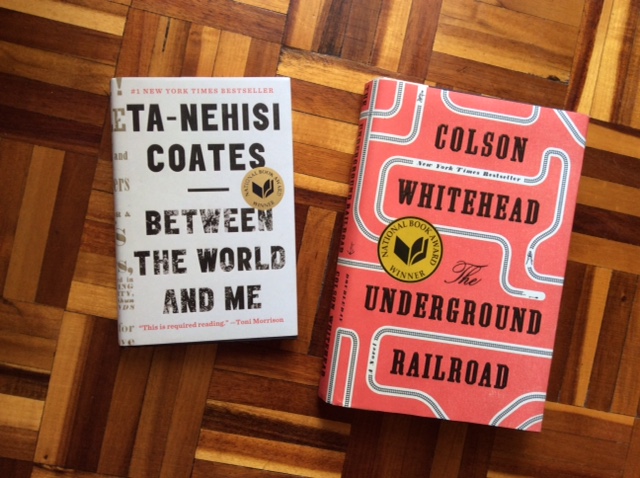
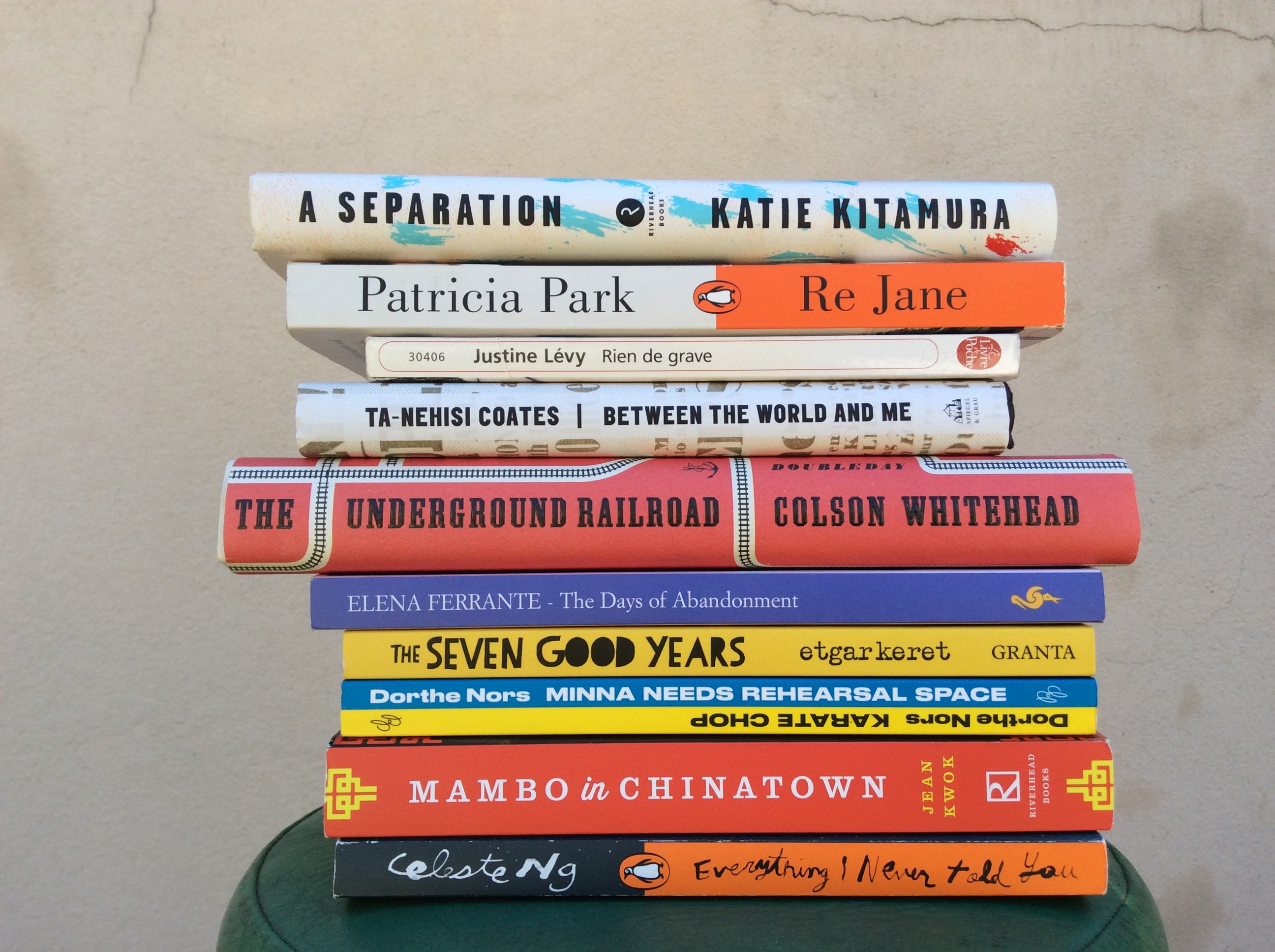
I fell into a reading rut in 2017. I would read a book I saw reviewed in the New York Times, or buy a new book by a favorite author. That was about it. It’s not that the books I read weren’t good. Some of them were even great. I expect that people a hundred years from now will still be reading The Underground Railroad and Between the World and Me. I only disliked one book—and I’m not going to say what it was.

Photograph of Between the World and Me by Ta-Nehisi Coates and The Underground Railroad by Colson Whitehead.

Future classics

I checked off eight of the twelve categories in Modern Mrs. Darcy’s Reading for Growth challenge, including ten books by #ownvoices or #diversebooks authors, five immigrant stories, and six books in translation (plus one in French). I didn’t particularly care about most of the other categories: a Newbery Award honoree, a book over 600 pages, or three books by the same author.

Pile of books with Katie Kitamura's A Separation on top.

Some of my reading challenge reads

But the other category I missed…there’s where the trouble lies. I didn’t read any books published before I was born. And it’s not like I narrowly missed this goal. The oldest book I read in 2017 was Justine Lévy’s Rien de Grave, which was published in 2004. That’s right, I managed to read forty books last year without reading anything published before the millennium. The books I read in 2017 were published, on average, in 2015.

I wasn’t always that kind of reader. In 1987, the books I read were published an average of 21 years before. Henry James’s Washington Square is on that list, along with books by Philip Roth and Edith Wharton. I discovered Laurie Colwin, still one of my favorite writers, and read five of her books. I read a book on Elizabethan thought published in the 1940s and a bunch of classic mysteries. There’s junk on the list, too; Judith Krantz features prominently. But, unlike my 2017 self, I was open to anything. (Well, except when it comes to diversity. All of the books I read in 1987 were by white authors except The Golden Gate by Vikram Seth, which features mostly white characters. I can blame this only partly on a less diverse publishing market.)

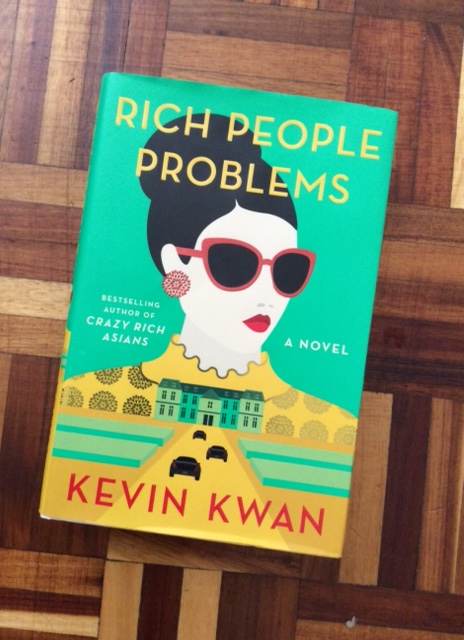
Well, My Year in 1918 will solve this problem. But it won’t be easy to give up contemporary books for a year. I enjoy a challenging read, but when I want to relax I default to my comfort zone, well-written novels by writers like Elinor Lipman, Meg Wolitzer, Curtis Sittenfeld, and Marisa de los Santos. Except for Lipman, they all have books coming out this year. I was having a great time reading Kevin Kwan’s Rich People Problems, but I was only halfway through on December 31, so I’ll have to wait until next January to find out who inherits Tyersall Park. I’ll have to wait for Dinner at the Center of the Earth by my wonderful NYU professor, Nathan Englander. I got Christmas presents that will have to wait for another Christmas to roll around. The current affairs books in my to-read pile won’t be so current next January.

Photograph of Rich People Problems by Kevin Kwan.

So good-bye, crazy rich Asians and befuddled New Yorkers, painfully innocent college students and hyper-observant Londoners! Farewell, innovative economists and eccentric Japanese tidiers! See you in 2019.