Tag Archives: Holiday Shopping Guide

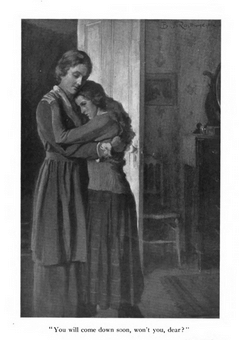
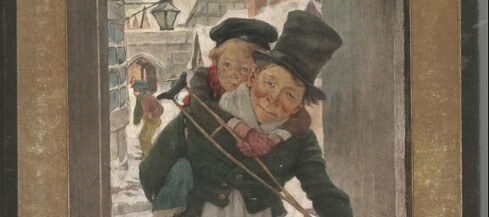
cropped photo from The Children of Dickens, 1925, Tiny Tim with crutch

Children’s Books: Your 1925 Holiday Guide

1925 is the best children’s book year ever!

Or a total washout!

New York Times headline, New Books for Children Herald The Holiday Season
New York Times, November 8, 1925

It depends on whether you believe the New York Times, whose anonymous critic tells us in its November 8 holiday children’s book roundup that “never since man began to make books, have there been so many and such beautiful books for young readers,” or The Outlook, where Edmund Pearson, writing in the November 11 issue, agrees about the abundance of beautiful books but adds, “but—and this is a perennial but—the number of juvenile books of merit is exceedingly small.”*
Headline, Outlook: The Book Table, Edited by Edmund Pearson
The Outlook, November 11, 1925

I had no choice, then but, to go through the books and make up my own mind, which I did with such excessive thoroughness that I’ve blasted right past Christmas. This might have stressed me out more, with seven on-time holiday children’s book roundups under my belt,** if I hadn’t heard the wise counsel, on the holiday episode of Caroline O’Donaghue’s*** podcast Sentimental Garbage, that we should stop stressing out about traditions and instead think of them as “things we like to do sometimes.” So, sometimes I like to post my children’s books holiday roundup in time for Christmas.

For the Youngest Readers
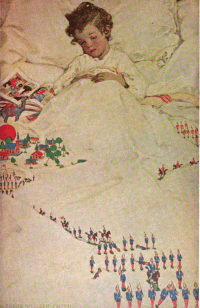
Jessie Willcox Smith, A Child’s Garden of Verses

There are always a lot of reissued classics by noted illustrators, and 1925 was no exception. The year’s crop includes A Child’s Garden of Verses, Robert Louis Stevenson’s 1885 collection, with illustrations by Jessie Willcox Smith. Smith’s black-and-white illustrations aren’t particularly memorable, and some of the poems
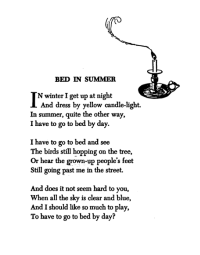
hold up better today than others,
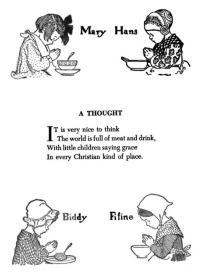
but Smith’s color plates do Stevenson’s poems justice.
Henriette Willebeek LeMair, A Gallery of Children

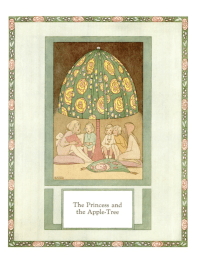
A.A. Milne, who had a huge success with When We Were Very Young in 1924, is all over the place in 1925. A Gallery of Children is a collection of stories with illustrations by Henriette Willebeek LeMair. Pioneering children’s librarian Annie Carroll Moore**** tells us in an October roundup in The Bookman that Milne wrote the stories to go with the pictures rather than the other way around, and it shows. The pictures are indeed wonderful, but the stories are a mixed bag.
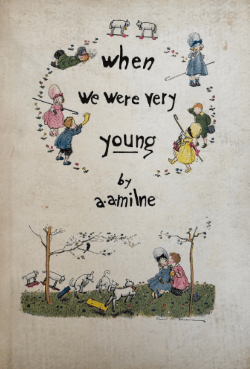
Cover illustration by E.H. Shepard

So if you’re going to go with Milne this season you might want to opt for When We Were Very Young, which is out in a new holiday edition, larger in size, and, as Marcia Dalphin is all excited to tell us in a December holiday children’s book roundup in The Bookman, with a picture of Christopher Robin as a frontispiece. I couldn’t find the original edition, so I don’t know if the frontispiece wasn’t there in that one or if Dalphin just wasn’t paying attention back in 1924. So that we can all share in the excitement, here it is.

E.H. Shepard, When We Were Very Young

For Middle-Grade Readers

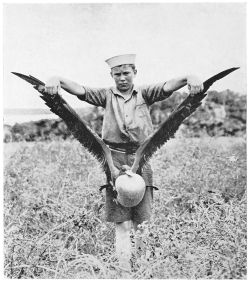
Photograph of David Binney Putnam, David Goes Voyaging

David Goes Voyaging, written by twelve-year-old David Binney Putnam, is the story of his experience as a cabin boy on the Arcturus expedition, a six-month-long journey to the Sargasso Sea and the Galapagos islands led by naturalist William Beebe. David’s age led me to suspect that he was yet another fake child author, but a look at the text convinced me that it was written by an actual twelve-year-old: “The writing took quite a long time, and I think being a naturalist would be more fun than being a writer. Anyway, my stories help me remember the fun we had on the Arcturus. I don’t see how it could have been much better.” David’s father was the promoter George Palmer Putnam, who married Amelia Earhardt in 1931, and David would go on to have a number of other adventures dreamed up by his publicity-hungry father.
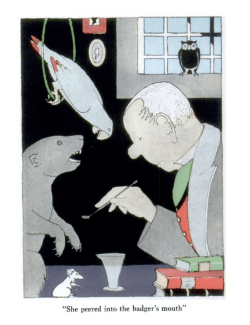
Hugh Lofting, Dr. Dolittle’s Zoo

At the beginning of Dr. Dolittle’s Zoo, written and illustrated by Hugh Lofting, Dr. D’s parrot Polynesia bemoans the addition of yet another installment to the series, the fifth since the publication of Dr. Dolittle in 1920. This one, about a cageless zoo where the animals can leave whenever they want, seems to be one of the more innocuous installments in the sometimes horribly racist series.
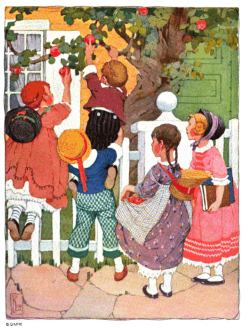
Gertrude A. Kay, Adventures in Our Street

Adventures in Our Street, written and illustrated by by Gertrude A. Kay, starts promisingly with these endpapers,
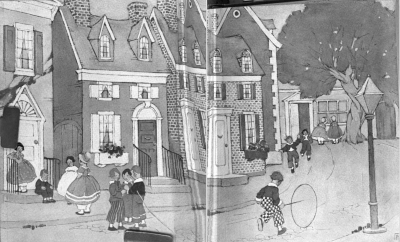
but the characters are all referred to by names like Two-Braids and the Door Slammer, which I took as a bad sign at first. The book turns out to be witty, though, as well as being beautifully illustrated. I even warmed up to some of the children’s epithets, especially The-Children-Who-Broke-All-Their-Toys-on-Christmas.

In Dorothy Canfield Fisher’s Made-to-Order Stories, it’s the author’s 10-year-old son Jimmy who’s giving the orders. He draws the line at fairies “because they’re foolish,” hates things that couldn’t possibly have happened, and despises stories that try to teach you something without your knowing it. Jimmy shows up at the beginning of each story, giving instructions, and again at the end, quibbling about plot holes. Jimmy went on to be an army surgeon in World War II and, sadly, died in the Philippines in 1945.
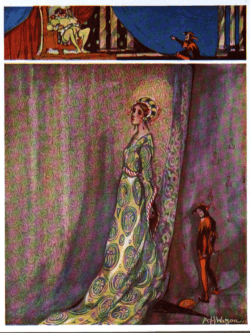
Illustration by A.H. Watson from “The Princess Who Could Not Laugh,” Number Three Joy Street

The Joy Street anthology series is coming off a rough year: Anticipating the third volume, Annie Carroll Moore says in her Bookman roundup that Number Two was “so disappointing to children that we reluctantly withhold our recommendation until we have sampled its contents with children under ten years old.” I checked out one story in Number Three Joy Street, “The Princess Who Could Not Laugh” by, you guessed it, A.A. Milne. What finally made the princess laugh was someone slipping on a plate of butter. Not being a fan of slapstick, I’m withholding my recommendation too.
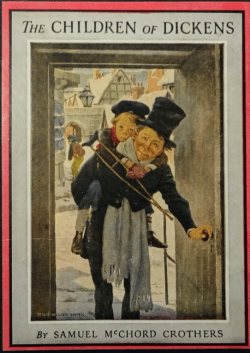
Jessie Willcox Smith

Reading The Children of Dickens by Samuel McChord Crothers is like being stuck next to someone at a dinner party who insists on recounting the plots of one Dickens novel after another. Jessie Willcox Smith contributes charming illustrations, though.
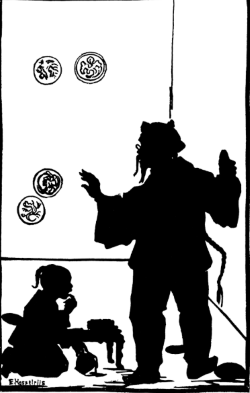
Else Hassleriis, Shen of the Sea

Shen of the Sea by Arthur Bowie Chrisman is the year’s Newbery Medal winner, but I had a hard time getting into it. People say “honorable” a lot. The author of a post on the book on the blog Orange Swan, who had more perseverance than I did, called both Chrisman’s stories and Else Hassleriis’s illustrations “faux Chinese” and noted that Chrisman had never visited China.
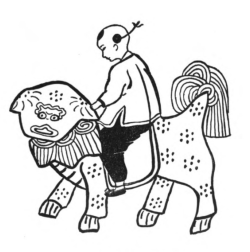
Ling Jui Tang, “The Rabbit Lantern”

The Rabbit Lantern, a collection of stories about Chinese children, didn’t appear in any reviews, let alone win a Newbery (I spotted it in an ad alongside the roundup in The Outlook). Author Margaret Rowe and illustrator Ling Jui Tang have way better China credentials than Chrisman, though. Rowe grew up in China, the daughter of missionaries, and Ling Jui Tang, according to the ad, was Chinese. I’m not qualified to judge the tales’ authenticity, but the book’s a lot livelier than Shen of the Sea.*****
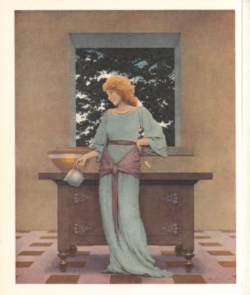
Maxfield Parish, The Knave of Hearts

“Worth all it costs,” the Independent’s D.R. tells us of Louise Saunders’ The Knave of Hearts, with illustrations by Maxfield Parrish. Someone tore out the part of the page where the price was listed, though, so I don’t know how much that is. The illustrations by Parrish make up for the text, which is in the form of a long, tedious play.
Boris Artzybasheff, The Forge in the Forest

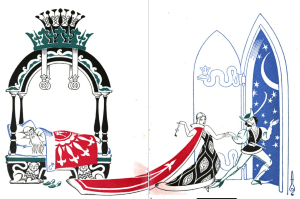
Marcia Dalphin tells us in The Bookman that The Forge in the Forest by Padraic Colum is “a book with a fine stirring atmosphere in it, and the stroke of iron and iron.” Alice M. Jordan tells us in the Independent that Boris Artzybasheff’s illustrations have “a half-barbaric quality.” My brain can’t absorb another folk tale at this point, so I’ll take their word for it.

For Older Readers

Dalphin comments that, for older children, “stories of distinction are hard to come by”—a problem I’ve observed year after year in this age group. There are a number of re-illustrated classics on offer, including James Fenimore Cooper’s The Deerslayer, with illustrations by N.C. Wyeth,
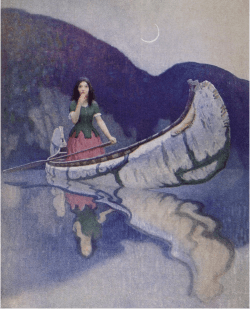
N.C. Wyeth, The Deerslayer

an abridged edition of Victor Hugo’s Les Miserables, with illustrations by Mead Schaeffer,
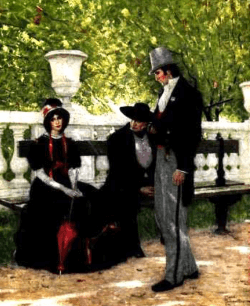
Mead Schaeffer, Les Miserables

and Lewis Carroll’s Alice’s Adventures in Wonderland, with illustrations by Arthur Rackham.
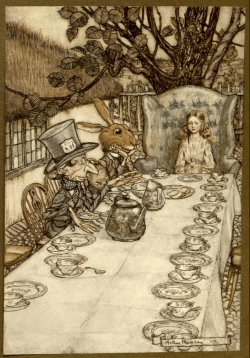
Arthur Rackham, Alice’s Adventures in Wonderland

The Flying Carpet, an anthology of poems and stories by noted writers, has been getting a lot of buzz. Contributors include Thomas Hardy, with just a short poem at the beginning, and, again, A.A. Milne, with a poem that will appear in his 1927 collection Now We Are Six.
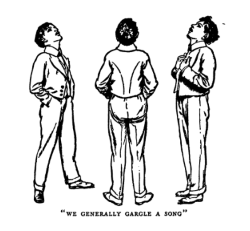
Illustration from “Neil and Tintinnabulum,” The Flying Carpet

The highlight for me, though, is a story by Peter Pan author James M. Barrie called “Neil and Tintinnabulum,” about a seven-year-old boy who’s sent off to boarding school. Barrie tells it in a meta way, saying at one point of a plot twist, “The situation is probably unparalleled in fiction.”
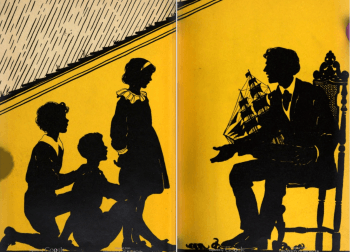
Edith Ballinger, Rain on the Roof

Every year I check out the latest Cornelia Meigs book, and every year I regret it. Rain on the Roof starts out with, yes, rain, and then the sun comes out, and then there’s a swallow, and…I’m done. The endpapers are cool, though.
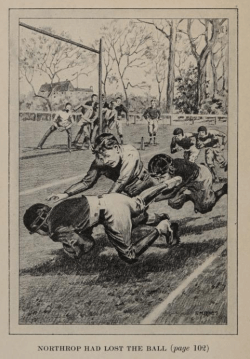
Frank M. Rines, Friends and Rivals

Alice M. Jordan, writing in the Independent, has this generic praise for Friends and Rivals by Arthur Stanwood Pier: “A real story with real characters.” After initially thinking, “Wait, isn’t that the gay hockey show?” (no, that’s Heated Rivalry), I checked it out and found myself getting into the story, about a sickly young man with a coddling mother who goes to boarding school and presumably—I didn’t get that far—joins the football team.
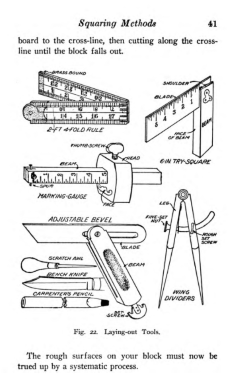
Chelsea Fraser, The Practical Book of Home Repairs

For the mechanically minded, there’s The Practical Book of Home Repairs by Chelsea Fraser, which Edmund Pearson, writing in The Outlook, calls “a severely practical volume” for boys and men. If the young person in your life is into soldering and repairing the water supply, this is just the thing.
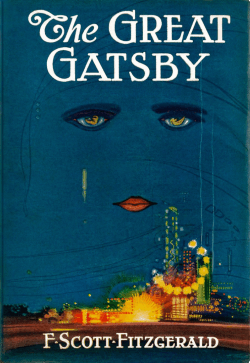
Cover illustration by Francis Cugat

If not, how about giving your young friend a book full of love and parties and heartbreak and jazz and flowing white dresses? It got so-so reviews, but trust me on this one.

For All Ages
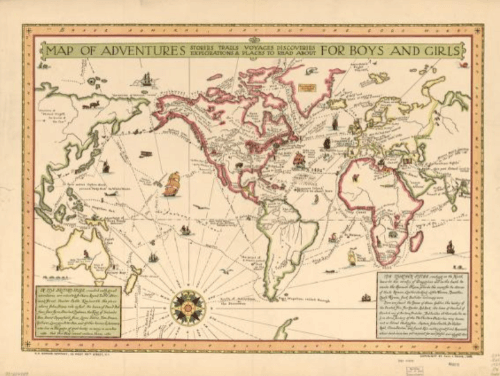
World Map of Adventures for Boys and Girls

If you can’t choose just one book, this Map of Adventures for Boys and Girls features 150 fictional and real-life adventures from children’s books throughout the ages. It is, Library Journal tells us, available free of charge from the Syracuse Public Library. Many of the adventures don’t hold up to contemporary sensibilities, but as an illustrated guide to the history of children’s reading it’s a marvel.

The Verdict

I have to say that I agree with Pearson that the number of children’s books of genuine merit published in 1925 is small. It’s an era of brilliant illustrators, and of advances in printing technology that allow for numerous color pages in vivid hues. With a few exceptions, though, it’s not an age of brilliant children’s writers. There aren’t any new books on this list that children are still reading today. But that’s not unusual—most years don’t give us a children’s book that will stand the test of time.

Some years do, of course—stay tuned for 1926!

*Pearson, a librarian and true-crime writer best known for a book about the Lizzie Borden case, does not seem to have been in a particularly good mood when he wrote the Outlook column. It ends with this writeup of The Fat of the Cat, and Other Stories by Gottfried Keller, translated by Louis Untermeyer: “My informant told me that it was one of the very best books of the season. I pass this information on for those who like to read about cats. I don’t. In my opinion, there are only two good cats in literature; one of them is in ‘Huckleberry Finn’ and the other is in ‘Penrod:’ one is dead and one is down a well.”

**Granted, sometimes it was down to the wire—last year’s roundup appeared on Christmas night.

***O’Donaghue is also the author of The Rachel Incident, one of my favorites of the books I read this year—high praise since this was one of my best reading years ever.

****Annie Carroll Moore, whose first name was actually Annie, officially changed it to Anne in her fifties to avoid confusion with another woman named Annie Moore who, what are the odds, was also writing about children’s libraries. Personally, I think she should have gotten dibs on Annie, having basically invented the profession of children’s librarian. In any case, she’ll always be Annie to me.

*****Rowe later ended up in a tragic love triangle involving her husband, who was a curator of Asian art, and a visiting linguist who, according to an account of the affair in the New York Times, was beguiled by the “Orientalism” of the Marches’ Detroit home.

Children’s Books: Your 1923 Holiday Shopping Guide

Welcome to the fifth annual children’s books holiday shopping guide! It’s been a hectic holiday season, including a trip from Washington, D.C., to Cape Town less than a week ago (I split my time between the two cities), so this is a pared-down edition.

My research this year started out with a big disappointment: it turns out that the 1922 edition of Publisher’s Weekly’s annual Christmas Bookshelf issue, which had been one of the highlights of my My Life 100 Years Ago year, was the last. Why, Publisher’s Weekly? Why?

Luckily, there’s still a lot of coverage, including holiday roundups in the New York Times, one on children’s books and another buone on books for the general reader with lots of books older children might enjoy. And, as always, pioneering children’s librarian Annie Carroll Moore weighs in in The Bookman, this time with not just one but two articles on holiday books, in the October and December issues.

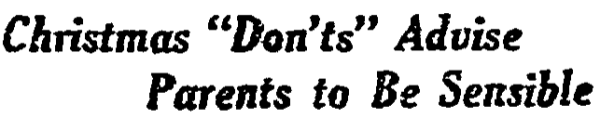
New York Times, December 23, 1923

In non-book news, the Times also provides some helpful advice on keeping your children healthy over the holidays, including, “Don’t overdress them with their new sweaters or furs, just because it is Christmas.”

For Young Readers

From The A B C Book by Charles B. Falls

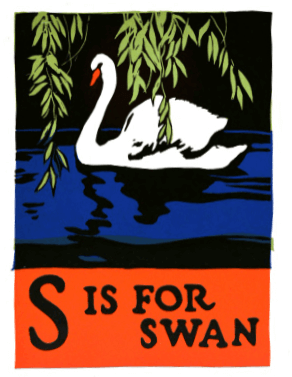
A piece of all-around good news: there are more pictures, and in particular more color pictures, in books for young children than there were just a few years ago. There’s even a book with color illustrations on every page, the first I’ve seen: Charles B. Falls’ The A B C Book, a book of woodcuts with an animal for each letter. (If you’re wondering what he did about X, it’s for xifius, which turns out to be Greek for swordfish.) It’s a favorite of Moore’s, and of mine.

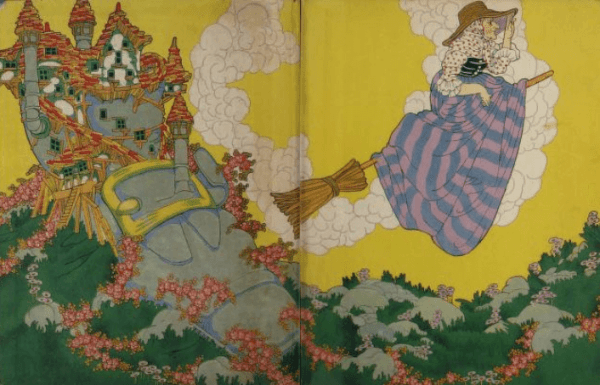
From The Six Who Were Left in a Shoe by Padraic Colum

The New York Times recommends Padraic Colum’s The Six Who Were Left in a Shoe, and, although I found the story kind of silly, their praise for the endpapers is justified.

For Middle-Grade Readers and Older Children

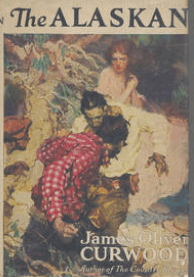
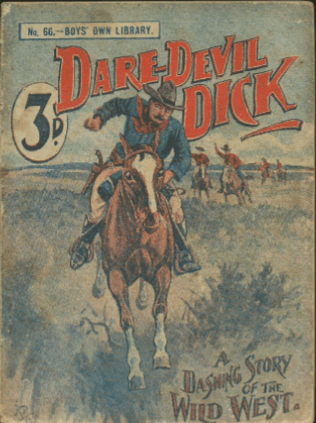
There was a bit of a moral panic going on regarding children’s reading in 1923, including in an article in the October 1 issue of The Library Journal by librarian Wilhelmina Harper. Harper’s bottom line: children are reading too much sensational adult literature, like Daredevil Dick and Seven Buckets of Blood (neither of which, sadly, I was unable to find),* and should be directed to high-quality children’s literature instead. I wondered whether Harper was being excessively prim and proper until I found The Alaskan: A Novel of the North, a 1923 novel by James Oliver Curwood, whose books, Harper tells us with concern, fifth- and sixth-grade boys have been asking for. Flipping through it, I found the following sentence: “He hurried back, seized a loaded gun, and sprang to the window, knowing that he must continue to deal death until he was killed.” Maybe Harper has a point.

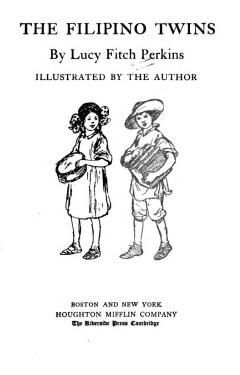
So what does Harper think children should be reading? Books published before 1923, mostly, which doesn’t do me much good. She speaks highly of Lucy Fitch Perkins’ series about twins from around the world, but I had a bad feeling about the 1923 installment, The Filipino Twins, When I skimmed through the first few chapters, though, I found it surprisingly lacking in racism. Unfortunately, the same thing can’t be said for the 1931 installment, which is about a pair of African American twins. So I’ll pass on Perkins.

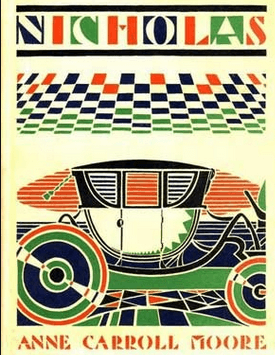
Nicholas: A Manhattan Christmas Story, by Anne Carroll Moore

I would have been more impressed by Annie Carroll Moore’s positive write-up about Nicholas, A Manhattan Christmas Story in the October 1923 Bookman roundup if the book hadn’t been written by…Moore herself.** Then, in the December issue, she waxes lyrical about writing Nicholas. According to my research for my post about Moore, it is not exactly a forgotten classic. Luckily for present-day me, though, it wasn’t actually published until 1924, so I can wait until next year. Cool Art Deco cover, though.

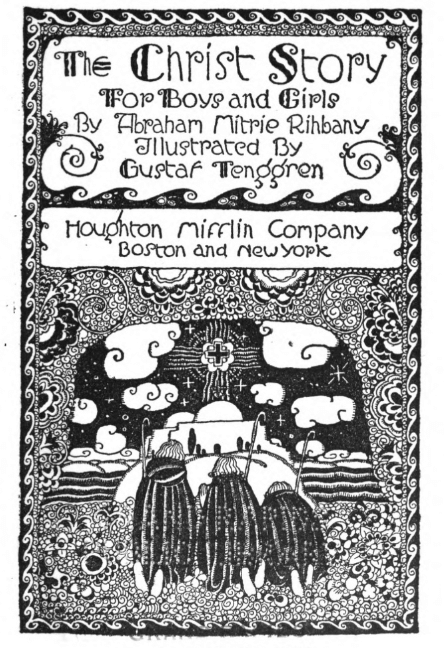
The Christ Story for Boys and Girls, featured in the New York Times roundup (which not very inclusively refers to Jesus as “our Savior”), is described as attempt by Abraham Mitrie Ribhany, a Lebanese Christian who moved to the United States as a young man, to draw on his own childhood experiences with Palestinian traditions to give children an idea of what Jesus’ life was like. I was intrigued by the premise, but I’m leery of a book that refers to Jesus repeatedly as Syrian*** without ever mentioning that he was Jewish.

From A Child’s Story of American Literature

The Times raves about A Child’s Story of American Literature by Algernon Tassin and Arthur Bartlett Maurer, although the reviewer calls the title “deplorable,” since it’s for older readers who would turn up their noses at the word “child.” Also, they think Tassin and Maurer have assigned insufficient importance to the works of Sidney Lanier. I’m okay with that, but, skipping through the book, I found a number of things to give me pause. For example, this passage:

You are a child of culture. Is it not your affair to make sure that, a hundred years hence, the story of which you are the first chapter will not have the same regrettable thing to record?

My hundred-years-hence ears perked up. It turns out that the regrettable thing is how, just as America has not made enough of an effort to Americanize her aliens, there has been insufficient appreciation of the United States of America’s own literature. I took issue with the first part, since, whatever you think of Americanization as a concept, my own experience of the world of 100 years ago is that people never shut up about. I do agree about the low self-esteem regarding American literature, though. Be that as it may, I’m not adding this book to my gift list.

A number of poetry anthologies for young people are on offer. I summarily disqualified The Boy’s Book of Verse, edited by Mary Gould Davis, which is the follow-up to her 1922 volume titled, you guessed it, The Girl’s Book of Verse. Moore and the Times both recommend This Singing World: Modern Poems for Young People, edited by Louis Untermeyer. “Hardly any boy or girl in the teens, or even for a few years earlier, but will find much in the volume to enjoy,” the Times raves.****

I wouldn’t bet money on that, but it is a nice selection, featuring poets including William Butler Yeats, Carl Sandburg, H.D., and, um, Louis Untermeyer and his wife, Jean Starr Untermeyer. This one’s going on my list. And the great thing about getting a poetry book as a present is that you don’t have to pretend to have read the whole thing.

Happy holidays, everyone, and happy reading!

squiggle

*UPDATE 12/27/2023: An enterprising reader found a listing for Dare-Devil Dick on Abe Books.

**The only reason that Moore even kind of gets away with this is that she only mentions the illustrator in the text of the article, with her name listed as the author in the list of books at the end.

***The Christ Story for Boys and Girls is based on Ribhany’s influential 1916 adult book The Syrian Christ.

****It took me a while to get my head around that syntax.

Children’s Books: Your 1919 Holiday Shopping Guide

Happy holidays, everyone! This year’s Holiday Shopping Guide is devoted to books, because who doesn’t love a book? Well, lots of people, but, when I looked for gift ideas in the December 1919 issue of Vanity Fair, this monogrammed humidor ($30.00)

Humidor, Vanity Fair, December 1919.

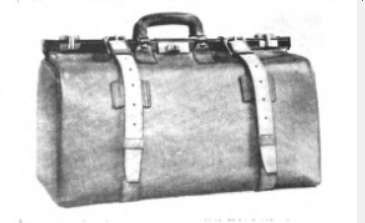
and this kit bag ($118.50)    

Kit bag, Vanity Fair, December 1919.

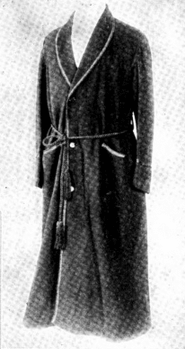
and this vicuna bath robe ($70.75),

Vicuna bathrobe, Vanity Fair, December 1919.

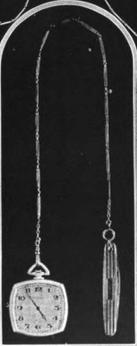
to say nothing of this solid platinum opera watch with gold hands and numerals ($800.00, plus $96.00 for the chain),

Platinum watch and chain, Vanity Fair, December 1919.

all cost more than the average weekly wage  of $25.61. I’m feeling more egalitarian than that this season, so books it is.

My original plan was to review books for all ages, but the children’s books ended up taking up a whole post. I have the books for grown-ups all picked out and will try to write about them as well, but I’ve learned not to commit myself to future posts because they hardly ever happen. (UPDATE 12/13/2020: This one didn’t either.) 

Banner, Bookman, From the Child's Holiday Books of 1919, November 1919.

I had a lot of help with this gift guide. New York chief children’s librarian Annie Carroll Moore, whom I wrote about earlier this year, has a holiday book roundup in the November issue of The Bookman. Boston chief children’s librarian Alice Jordan* has recommendations in House Beautiful, and Elementary School Journal and Literary Digest chime in as well. Library Journal, taking its sweet time about it, published the results of a vote among children’s librarians on the best children’s books of 1919 in its December 1920 issue.

Books With Color Illustrations

Children’s picture books as we think of them today, with a color illustration on every page, didn’t exist in 1919. Even books for very young children consisted mostly of text, with occasional line illustrations and a few color plates. If my own experience of reading to children is any guide, small children of a hundred years ago would push the pages impatiently to get to the pictures, leaving the adult reader to come up with a highly abridged version of the story on the fly. So the pictures are the key.

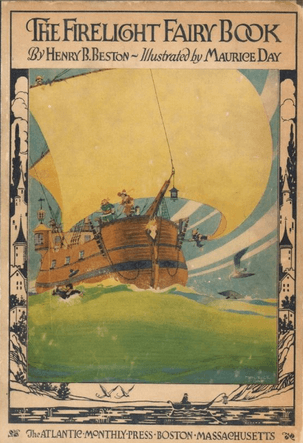
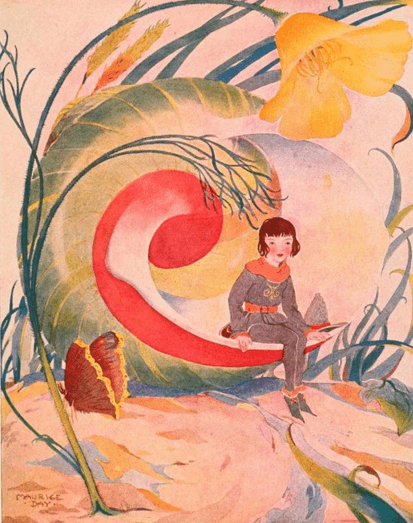
Cover, The Firelight Fairy Book, Henry Beston, illustrated by Maurice Day, 1919.

Moore was so entranced by The Firelight Fairy Book by Henry Beston, with illustrations by Maurice Day, that she went to Boston to meet Beston. He turned out to be a World War I veteran who started writing one of the tales, “The City Under the Sea,” IN A SUBMARINE IN ACTIVE PURSUIT OF GERMAN SUBMARINES, which is a great story, if not exemplary military tradecraft.

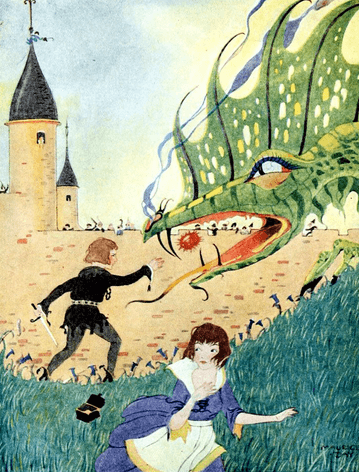
Maurice Day illustration, boy and girl with dragon, The Firelight Fairy Book.

Maurice Day, The Firelight Fairy Book

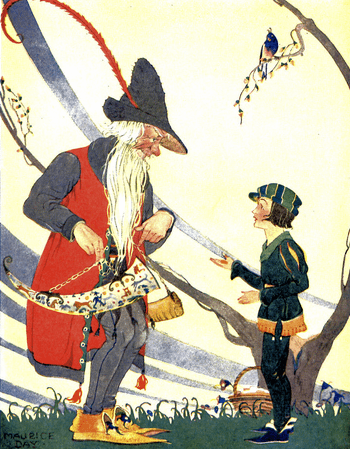
Illustration by Maurice Day, boy and old man, The Firelight Fairy Book.

Maurice Day, The Firelight Fairy Book

Moore wasn’t as big a fan of Day’s illustrations in a new edition of Horace E. Scudder’s Fables and Folk Stories—“his animals might be stronger”—but I was quite taken with this one:

Fables and Folk Stories, illustration by Maurice Day.

Maurice Day, Fables and Folk Stories

Some other illustrated books Moore discusses with varying levels of enthusiasm:

Czechoslovak Fairy Tales by Parker Fillmore, with illustrations by Jan Matulka,

Illustration by Jan Matulka for Czechoslovak Fairy Tales

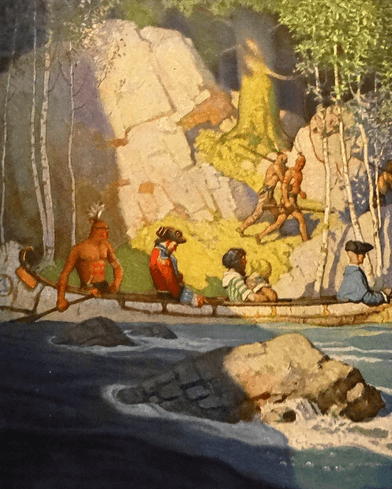
The Last of the Mohicans by James Fenimore Cooper, with new illustrations by N.C. Wyeth,

Illustration by N.C. Wyeth, The Last of the Mohicans

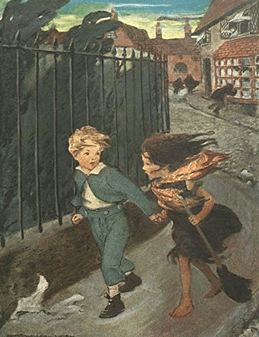
At the Back of the North Wind by George MacDonald, with new illustrations by Jessie Willcox Smith,**

Illustration by Jessie Willcox Smith from At the Back of the North Wind.

a new edition of The Water Babies by Charles Kingsley, also illustrated by Jessie Willcox Smith,

Illustration by Jessie Willcox Smith from The Water Babies.

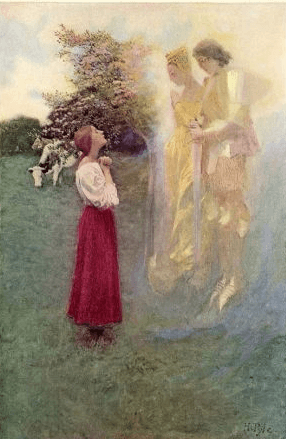
Saint Joan of Arc by Mark Twain, with new illustrations by Harold Pyle,

Illustration by Harold Pyle, Saint Joan of Arc by Mark Twain.

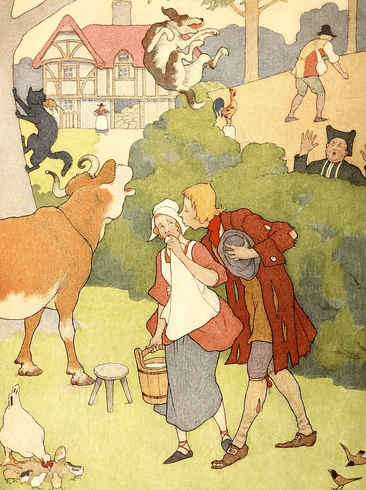
and Mother Goose Nursery Rhymes, with illustrations by Boyd Smith.

Illustration by Boyd Smith, Mother Goose Nursery Rhymes.

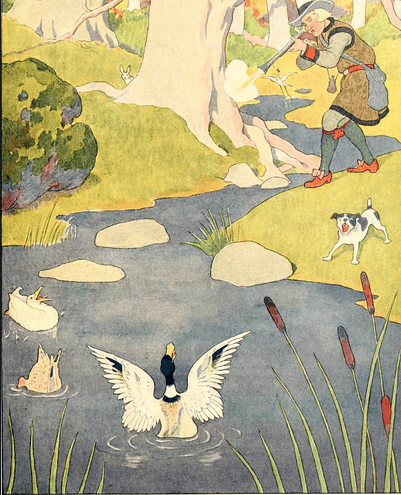
Caveat emptor on this last one. As I was perusing Smith’s illustrations, finding them quite charming, I came across this one,

Man shooting duck, illustration by Boyd Smith, Mother Goose Nursery Rhymes.

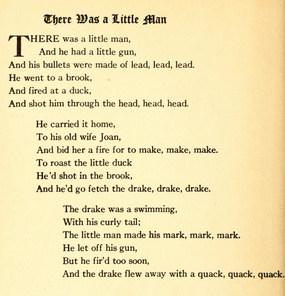
which turns out to illustrate this poem,

There Was a Little Man from Mother Goose Nursery Rhymes, text.

which I don’t recall my mother ever reciting as she lulled me to sleep.

Cover, The Burgess Bird Book.

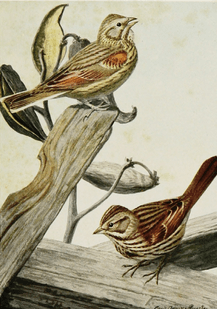
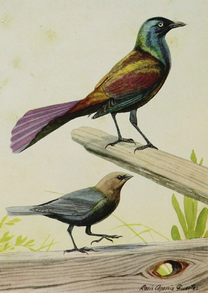
I imagined Thornton Burgess’s The Burgess Bird Book for Children as a reference for budding Audubons. It turned out to be full of twee tales, such as one in which Jenny Wren meets up with Peter Rabbit, who was Beatrix Potter’s intellectual property, right? The pictures by the Dutch-Puerto Rican artist Louis Agassiz Fuertes*** are wonderful, though.

Illustration by Louis Agassiz Fuertes from The Burgess Bird Book for Children.

Illustration by Louis Agassiz Fuertes from The Burgess Bird Book for Children.

Alice Jordan had good things to say about A Chinese Wonder Book by Norman Hinsdale Pitman, illustrated by Li Chu-T’ ang. I was intrigued, especially because Jordan said that Li was Chinese. I loved the illustrations,

Illustration by Li Chu-T' ang, A Chinese Wonder Book.

Illustration by Li Chu-T' ang, A Chinese Wonder Book.

Illustration by Li Chu-T' ang, A Chinese Wonder Book.

but I wondered whether Pitman was one of those people who make up stories and claim they’re foreign folk tales. He turned out, though, to be an American professor who spent many years teaching in China and won several awards from the Chinese government, so presumably he knew what he was talking about.

This is as multicultural as children’s books get in 1919, so I was inclined to declare it my #1 recommendation in this category. To make sure I wasn’t leading you astray, I read one of the tales, “Lu-San, Daughter of Heaven.”

Illustration by Li Chu-T' ang, A Chinese Wonder Book.

What young person wouldn’t relate to the story of a girl whose parents don’t appreciate her (that’s putting it mildly—they’re always trying to sell Lu-San into slavery or kill her) but end up having to kiss her feet and watch as she ascends to heaven on a golden throne? I liked the girl-power theme (Lu-San’s brothers are treated like kings) and the realistic way her parents respond after Lu-San is transformed into a radiant princess and their dingy houseboat into a majestic ship:

At first they did not know how to live as Lu-san had directed. The father sometimes lost his temper and the mother spoke spiteful words; but as they grew in wisdom and courage they soon began to see that only love must rule.

So it’s official: A Chinese Wonder Book is my #1 recommendation.

For Middle-Grade Readers

There is a lot of blurring between these categories; many of the books mentioned above are appropriate for middle-grade readers as well. Here are some selections specifically for this age group.

Or not. Sometimes Moore just makes me scratch my head.

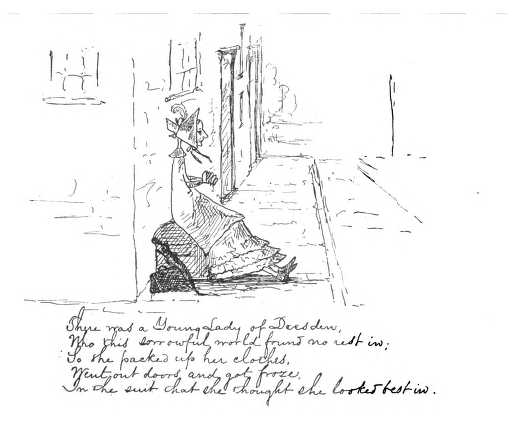
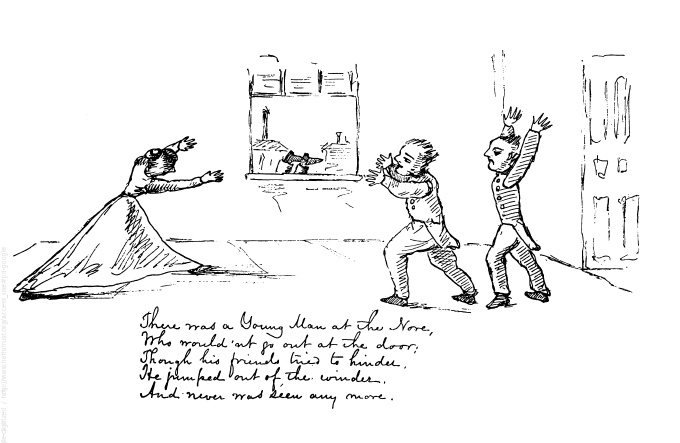
For example, what is Susan Hale’s Nonsense Book doing in a children’s book roundup? That the handwritten limericks are illegible is the best thing that can be said about them.**** Would you read this tale of death by jumping out a window

Illustrated limerick from Nonsense Book by Susan Hale.

or this one of suicide by exposure

Illustrated limerick from Nonsense Tales by Susan Hale.

to your favorite nephew?

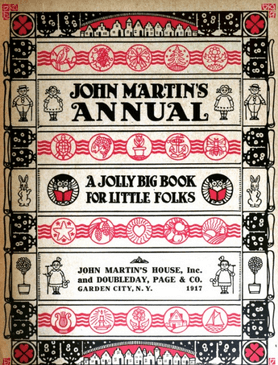
Cover, John Martin's Annual, 1917.

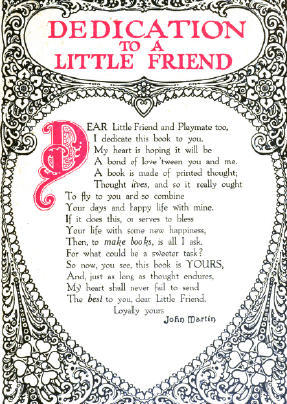
Moore pans John Martin’s Big Book for Little Folks, No. 3. I couldn’t find it, but I did find the 1917 volume. It starts out with this poem,

Dedication to a Little Friend from John Martin's Annual, 1917.

which reminds me of the fairy tales that simpering old ladies inflict on the kids in the Edward Eager books (now THERE are some great books for middle-grade readers).

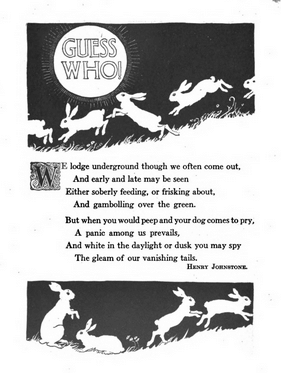
Next up is the world’s least challenging riddle.

Riddle from John Martin Annual, 1917. Answer is rabbits and there are pictures of rabbits.

So I’m on board with Carroll even before she quotes from Martin’s story about Thoreau:

He was so kind! and he was a busy man too. He built his own house. He had a garden. He made lead pencils. He wrote books. Most likely we never did know a busy man who was more kind than he was to everybody—animals and all—children and all. No wonder he became a very famous man.

As we will see below, kindness to animals and fame do not always go hand in hand.

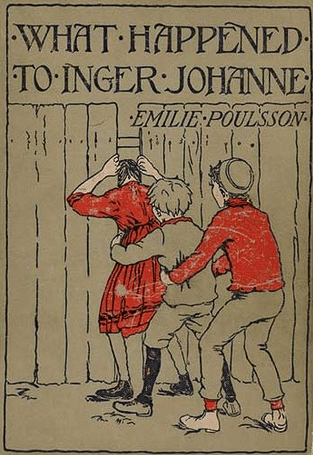
Cover of What Happened to Inger Johanne by Dikken Zwilgmeyer.

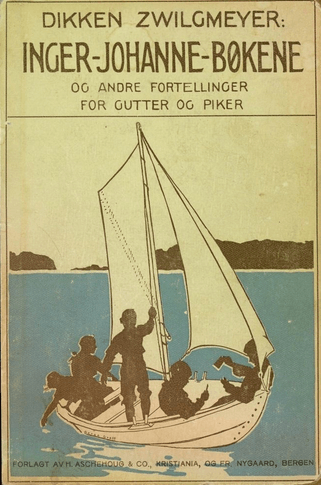
Moore describes What Happened to Inger Johanne, a translation of an 1890 book by the Norwegian writer Dikken Zwilgmeyer (UPDATE 12/22/2019: who turns out to be a woman, real name Barbara Hendrikke Wind Daae Zwilgmeyer),  

Cover of Inger Johanne Bokene by Dikken Zwilgmeyer.

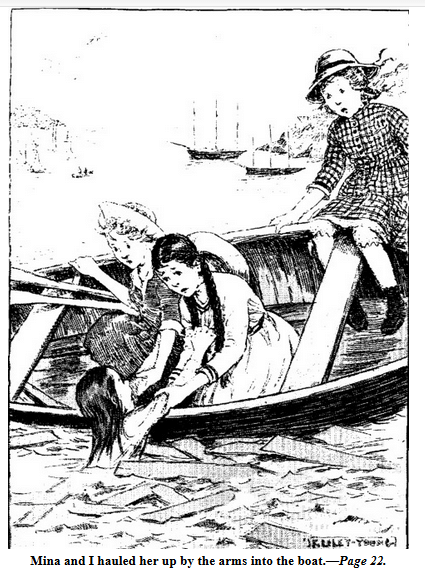
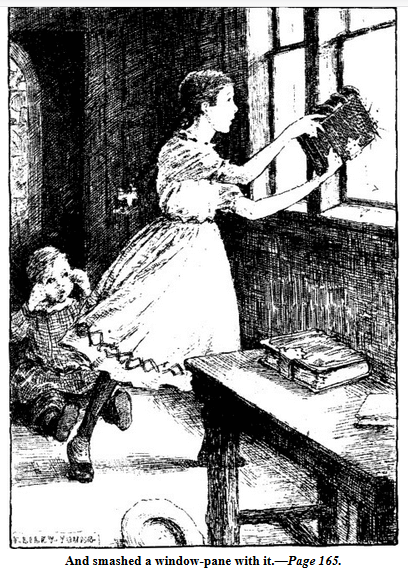
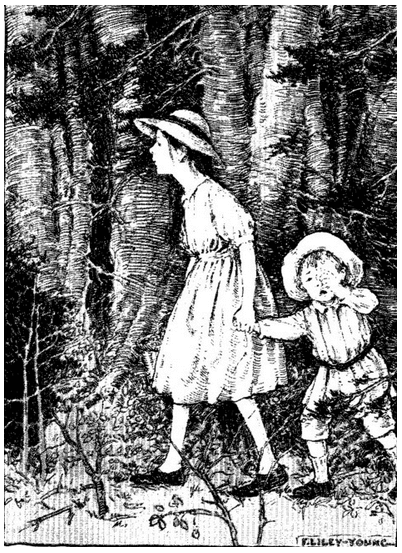
as “alive from beginning to end.” It’s a miracle that Inger herself is alive from beginning to end. In the illustrations by Florence Liley Young, she and her friends fall out of a boat,

Illustration by Florence Liley Young from What Happened to Inger Johanne.

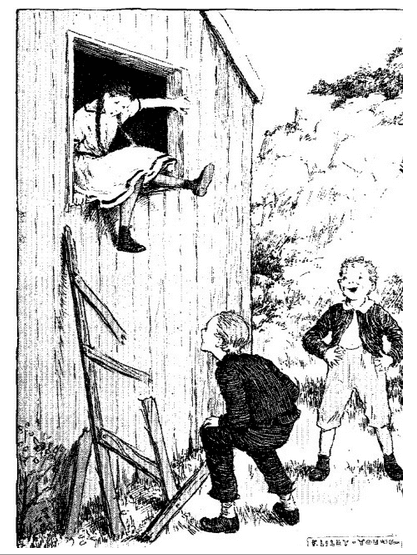
get stuck in a barn window when the ladder breaks,

Illustration by Florence Liley Young from What Happened to Inger Johanne.

smash a window with a book,

Illustration by Florence Liley Young from What Happened to Inger Johanne.

and get lost in the woods.

Illustration by Florence Liley Young from What Happened to Inger Johanne.

The chapter on Christmas mumming is less harrowing. My favorite part is where the children speak P-speech, which turns out to be a Norwegian version of Pig Latin. It goes (in the English translation) like this: “Can-pan you-pou talk-palk it-pit?”

A “child of ten”—who I assume is our old friend Edouard from last year’s holiday roundup—says that Inger sounds more like Tom Sawyer than anyone else. I trust Edouard’s judgment, and a girl Tom Sawyer is just the thing. So What Happened to Inger Johanne is my #1 recommendation for middle-school readers.*****

For Older Children

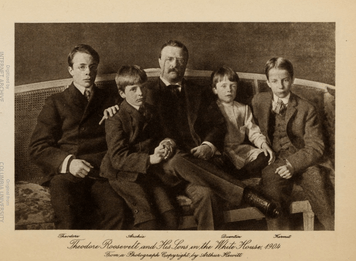
Theodore Roosevelt and sons, from Theodore Roosevelt's Letters to his Children, 1919.

Frontispiece, Theodore Roosevelt’s Letters to His Children

 The children’s book of the season is Theodore Roosevelt’s Letters to his Children. It’s the only unanimous choice on the librarians’ list, and it did sound promising: whatever you think of Roosevelt, he had (according to my childhood reading, anyway) some of the most fun presidential children in history. I was merrily scrolling to get to a letter about Christmas in the White House when I was stopped in my tracks by the words “kill” and “stabbed.” They turned out to be from a 1901 letter to Roosevelt’s twelve-year-old son Theodore III, titled “A Cougar and Lynx Hunt.”  

Theodore Roosevelt with hunting party, Colorado, 1905.

Theodore Roosevelt hunting in Colorado, 1905 (Denver Library Digital Collections)

Theodore (père) is out hunting with his friend Phil in Colorado when their dogs run up a tree after a cougar. Theodore has a clear shot at it, but Phil is taking a picture. The cougar jumps out of the tree, the dogs chase it and get into a big fight, and the cougar

bit or clawed four of them, and for fear that he might kill them I ran in and stabbed him behind the shoulder, thrusting the knife you loaned me right into his heart. I have always wanted to kill a cougar as I did this one, with dogs and the knife.

Banner, Reviews of New Books, Some of the Seasons Best Juvenile Books

After that, I just wasn’t feeling the Christmas in the White House spirit. I decided to move on to Literary Digest and “Some of the Seasons [sic] Best Juvenile Books.”

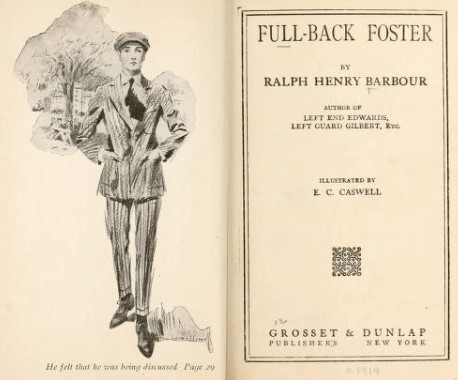
Title page and frontispiece of Full-Back Foster by Ralph Henry Barbour.

Full-Back Foster by Ralph Henry Barbour: “Describes how a ‘sissy’ is turned into a most serviceable full-back.”

Pass!

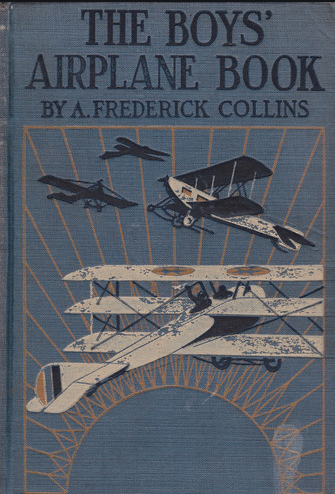
Cover, The Boys' Airplane Book, A. Frederick Collins.

The Boys’ Airplane Book by A. Frederick Collins. “It…behooves all ambitious boys to know the mechanism of the airplane, and to be able to construct one which not only will fly but will carry a human passenger….One feels that it would be impossible to go astray under such guidance.”

One would just as soon not test this theory. Pass!

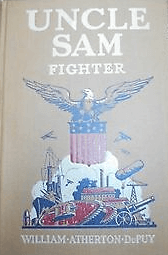
Cover, Uncle Sam: Fighter, William Atherton DuPuy.

Uncle Sam: Fighter by William Atherton DuPuy. “Describes graphically how we prepared our draft army in the recent war, and how we mobilized our energies efficiently for the most expeditious service to ourselves and our allies. Navy purchases, railroad administration, the minimizing of waste…”

Yawn! And all lies—the U.S. war mobilization was totally inept. Pass!

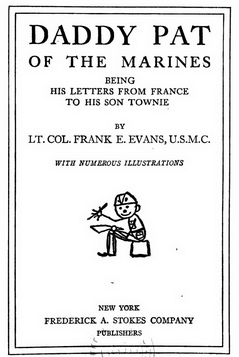
Title Page, Daddy Pat of the Marines, Lt. Col. Frank E. Evans.

Daddy Pat of the Marines by Lieut. Col Frank E. Evans (U.S.M.C.) “Even the six-year-olds must have their war books.”

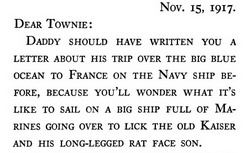
Begins thus:

Text from Daddy Pat of the Marines referring to "the old Kaiser and his long-legged rat face son."

 Pass!

Illustration, Rosemary Greenaway.

Rosemary Greenaway by Joslyn Gray. “The sentimental spirit which pervades this story will be liked by a certain type of girl reader.”

Pass!

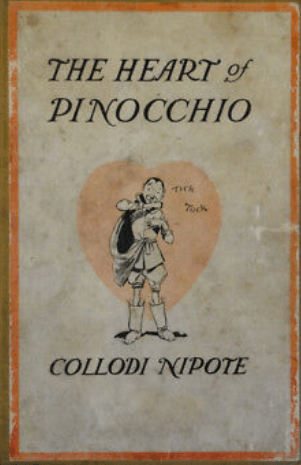
Cover, The Heart of Pinocchio, Collodi Nipote.

The Heart of Pinocchio by Collodi Nipote. The author of the original Pinocchio “is dead, but fortunately another member of the Lorenzini family has skillfully introduced Pinocchio into a story of war.”

Pass!

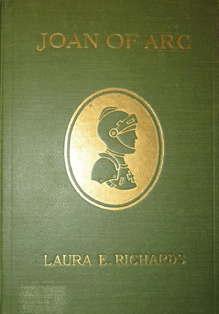
Cover, Joan of Arc, Laura E. Richards.

Joan of Arc by Laura E. Richards. “She has entered more thoroughly into the historical aspects of her heroine than most writers for girls and boys; her sources are carefully noted throughout.”

I’ll stick with Mark Twain. Pass!

These are the best juvenile books? I’d hate to see the worst.

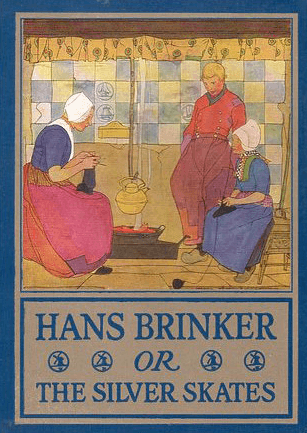
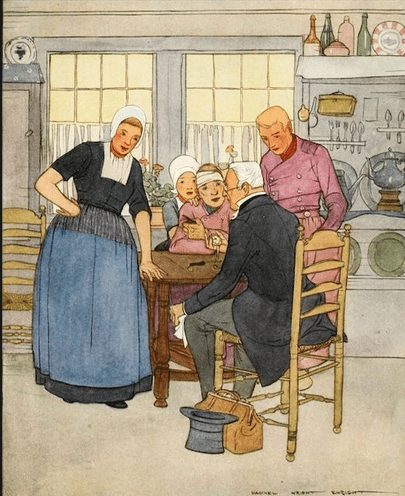
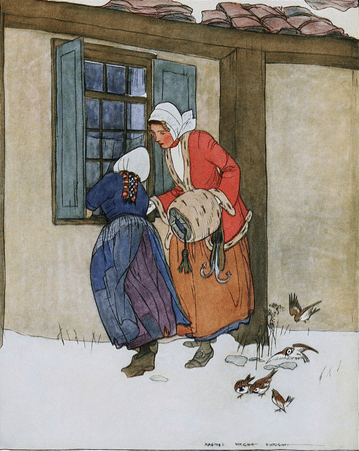
Cover of Hans Brinker or the Silver Skates, illustrated by Maginel Wright Enright.

Then I checked out a new edition of Mary Mapes Dodge’s 1865 children’s classic Hans Brinker, or, The Silver Skates, described by Elementary School Journal as a “beautiful gift ed.”

I had thought of Hans Brinker as a middle-grade book. The story turns out to be more harrowing than I imagined, though, with an amnesiac father and a doctor with a dead wife and a missing son. There’s also a scene in which someone draws a knife across a robber’s throat and threatens to kill him. Weary of violence by now, I almost disqualified it. But it has ice skating! And wooden shoes! And the Festival of Saint Nicholas, during which Dutch children become “half wild with joy and expectation”! And tulips! (A footnote about tulip mania quotes from Extraordinary Popular Delusions and the Madness of Crowds.****** You can’t accuse Dodge of talking down to children.)

Not to mention the wonderful new illustrations by Maginel Wright Enright, who turns out to be the sister of Frank Lloyd Wright and the mother of children’s writer Elizabeth Enright, author of Gone-Away Lake and The Four-Story Mistake.

Maginel Wright Enright illustration, Hans Brinker, people skating on canal.

Maginel Wright Enright illustration, Hans Brinker, people around table.

Maginel Wright Enright illustration, Hans Brinker, people standing next to house.

So, finally, a book to recommend to older readers!

Not all children are alike, though. What to give to the kind of child (often a boy) who would open a book, even one as amazing as Hans Brinker, with a wan thank you and a sigh?

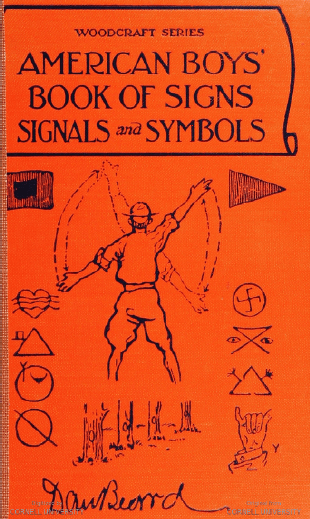
Cover, American Boys' Book of Signs, Signals and Symbols, by Daniel Beard.

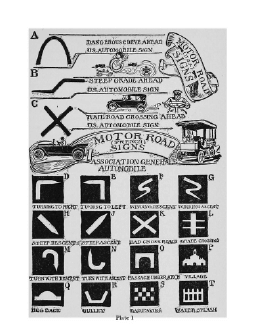
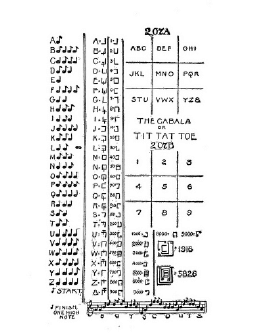
Well, you (and he) are in luck! There’s American Boys’ Book of Signs, Signals and Symbols, by Daniel Carter “Uncle Dan” Beard, a founding figure in American Boy Scouting.******* According to Elementary School Reader, it

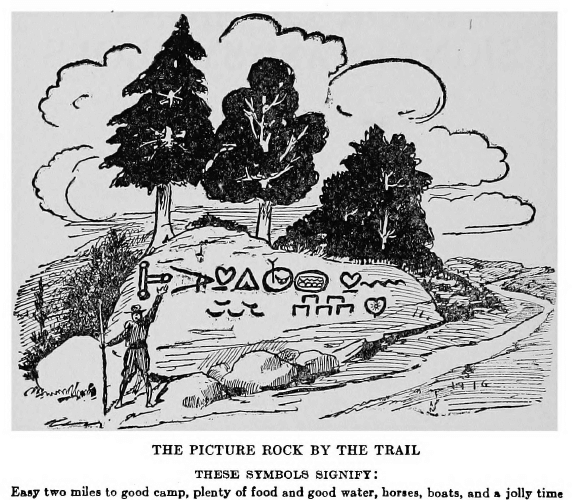
explains simply all kinds of signs including danger signs, trail signs, signs of the elements, secret writing, gesture signals, deaf and dumb alphabet, signal codes, railway signals, hobo and Indian signs, and Boy Scout signs and signals.

This book is guaranteed to have your child running outside as soon as the presents are opened to set trail signs and communicate with his friends in steamer toot talk.

Signs from American Boys' Book of Signs, Signals, and Symbols.

Automobile signs from American Boys' Book of Signs, Signals, and Symbols.

Illustration from American Boys' Book of Signs, Signals, and Symbols.

(Be forewarned that the book includes swastika-like symbols and hobo signs to note the presence of “white, yellow, red, and black men,” along with some discussion of American Indians that, while intended to be respectful, wouldn’t pass muster today.)

So that’s it—a gift for every kid on our list.

Oh, wait! What about that dreamy teenaged girl who’s longing for a good book to curl up with while her siblings are outside drawing hobo signs?

Henri Matisse, Young Woman in the Garden, 1919.

Henri Matisse, Young Woman in the Garden, 1919

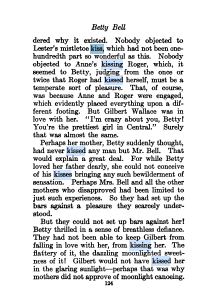
Betty Bell by Fannie Kilbourne sounded promising at first. Moore describes it as “a very readable, thoroughly sophisticated, and well written analysis of a cross-section of Betty Bell at sixteen.” She warns, however, that “we do not recommend the book for children’s reading. In the libraries its title would immediately attract girls from ten to twelve whose mothers would object to it.”

Naturally I immediately downloaded it and started skimming to find the objectionable parts. The book is indeed an exceptionally accurate description of what goes on in an adolescent girl’s brain, but I was soon reminded that inside an adolescent girl’s brain is not a place anyone except the owner of that particular brain would want to spend much time.

Page from Betty Bell by Frances Kilbourne, with "kiss" highlighted eight times.

Our dreamy young woman would think Betty was an idiot.********

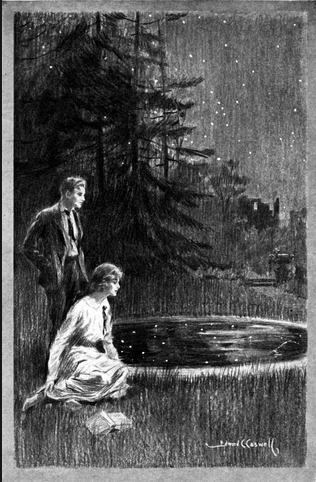
Frontispiece of The Pool of Stars, illustration by Edward C. Caswell.

Frontispiece of The Pool of Stars, Edward C. Caswell

There was a lot of buzz around The Pool of Stars by Cornelia Meigs, which Moore calls “a very well-written story.” I remembered Meigs from those lists of Newbery Award winners they were always inflicting on us in elementary school,********* so I spent an hour reading it on my Kindle.

Betsey, our heroine, is agonizing as the book begins about whether to go to college next year or go to Bermuda with her rich aunt, which would (for reasons that are not explained) permanently put the kibosh on college. Studying is so EXHAUSTING, Betsey keeps thinking. All those geometrical shapes and Barbary pirates! I’d rather go to the beach!

I’m starting to suspect that Betsey is not a true intellectual.

She does decide to go to college, though, and spends the rest of the book pondering the mystery of why a young woman living nearby always looks so sad. I. DO. NOT. CARE., I kept saying, before finally giving up.
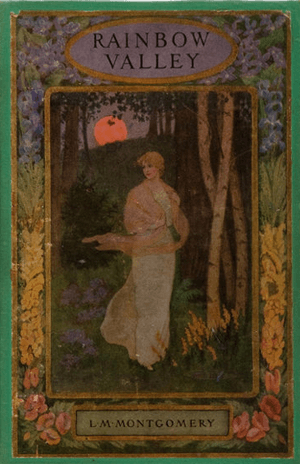
Cover of Rainbow Valley, Anne of Green Gables No. 7, L.M. Montgomery.

There’s also Rainbow Valley, the fifth volume in L.M. Montgomery’s Anne of Green Gables series. (Now it’s considered the seventh, but two volumes covering earlier parts of Anne’s life were published in the 1930s.) It didn’t appear on any of the best-of-1919 lists, maybe because it was published late in the year, but, hey, it’s Anne of Green Gables, right?

Except that Anne has, in the two years since Anne’s House of Dreams was published, somehow been transformed from a newlywed (and, by the end of the book, mother of two) to a mother of six who spends all her time thinking about the problems of the town’s new minister.**********

Note to children’s authors: happy newlyweds are one thing, but mothers of six are (to young girls) just squalid.

So what to give to our dreamy girl? In desperation I turned to H.L. Mencken, even though I knew perfectly well that books for girls are not his thing.
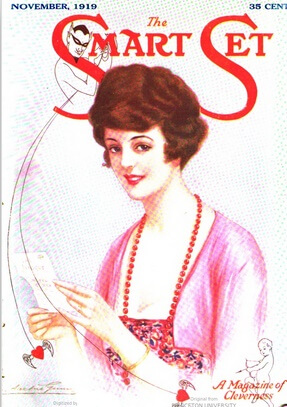
And there, miraculously, it was, in a November 1919 Smart Set article called “Novels for Indian Summer.”

Cover of Smart Set, November 1919.

The best of them, and by long odds, is “The Moon and Sixpence” by W. Somerset Maugham,

Mencken begins.

It has good design; it moves and breathes; it has a fine manner; it is packed with artful and effective phrases. But better than all this, it is a book which tackles head-on one of the hardest problems that the practical novelist ever has to deal with, and which solves it in a way that is both sure-handed and brilliant. This is the problem of putting a man of genius into a story in such fashion that he will seem real—in such fashion that the miracle of him will not blow up the plausibility of him.

The Moon and Sixpence is the story of Charles Strickland, a middle-aged British stockbroker who abandons his family and goes to Paris and then to Tahiti to pursue his dream of becoming a great artist. He succeeds (the story is based loosely on the life of Paul Gaugin), but at a tremendous cost to those around him, and, ultimately, himself.

Sacred Spring, Paul Gauguin, 1894.

Sacred Spring, Paul Gauguin, 1894.

Really? you may be thinking. Your top recommendation for a dreamy teenaged girl is about an egocentric middle-aged stockbroker? Based on the life of a painter who was so reprehensible, even by the standards of 19th-century painters, that the New York Times ran an article last month headlined, “Is It Time Gaugin Got Cancelled?”

All I can tell you is this: I was that dreamy girl, and I loved The Moon and Sixpence.

Happy holiday reading, everyone!

squiggle

*I pictured Moore and Jordan as bitter enemies, but Moore turns out to have described Jordan as the best librarian-reviewer, which is especially gracious considering that Moore invented the profession.

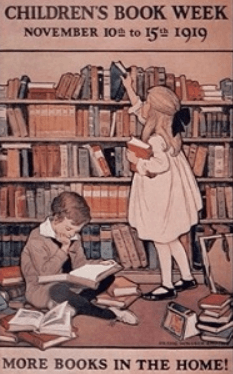
**Moore mentions, apropos of nothing, that Smith also designed the color poster for Children’s Book Week in 1919, which, as I’ve mentioned, is the first time Children’s Book week was celebrated.

Children's Book Week Poster, 1919, Jessie Willcox Smith, children with bookshelf.

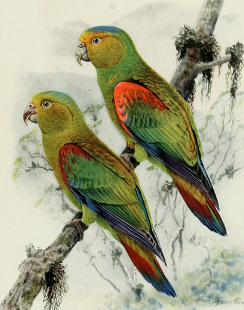
***Fuertes (who was only named after, not related to, famed but racist naturalist Louis Agassiz) was one of the most prolific bird illustrators of his time. Two bird species were named after him, including the Fuertes’s parrot, which is now critically endangered.

Illustration of Fuertes parrot from American Museum Journal, 1918.

American Museum Journal, 1918

****Hale’s brother Edward Everett Hale of “The Man Without A Country” fame clearly got all the literary talent in the family.

*****Note to Norwegian readers (okay, reader): Is this book still famous? And is P-speech an actual thing?

******Extraordinary Popular Delusions and the Madness of Crowds was written by Charles Mackay, the father of our old friend Marie Corelli.

*******Beard was the founder of the Sons of Daniel Boone, which merged into the Boy Scouts in 1910.

Ernest Thompson Seton, Robert Baden-Powell, and Dan Beard, date unknown.

Ernest Thompson Seton, Robert Baden-Powell, and Dan Beard, date unknown

********Much in the way I couldn’t stand the supposedly universally beloved but, to me, vapid heroine of Judy Blume’s Are You There, God? It’s Me, Margaret.

*********Meigs won for her 1933 book Invincible Louisa, a biography of Louisa May Alcott.

**********Could this have been related to problems in Montgomery’s own marriage to a depressed minister, who, she complained in her diary in 1924, would stare blankly into space for hours with a “horrible imbecile expression on his face”?