Category Archives: Fiction and Poetry

Women spies of 1918

I was going to write about women artists in honor of Women’s History Month, but then I opened the March 19, 1918, New York Times and saw that women were hatching international conspiracies all over Manhattan. Change of plan!

First, this:
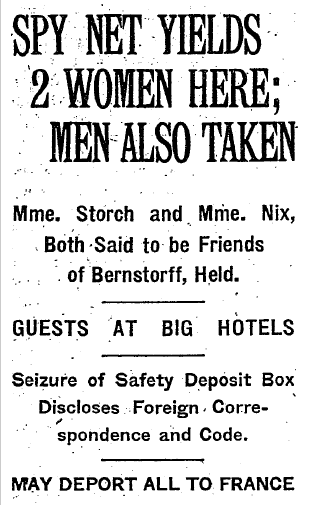
Two men and two women were arrested, the Times reports, for alleged participation in an international German spy ring. The principal suspect is Despina Davidovitch Storch, the 23-year-old Turkish ex-wife of a French army officer. The Times said of Storch that

she is in appearance a strikingly handsome woman, and in the year that she made her home at the Waldorf-Astoria numbered among her friends many well-known persons, some of whom it was intimated yesterday are not at all anxious now to appear to have been among her admirers.
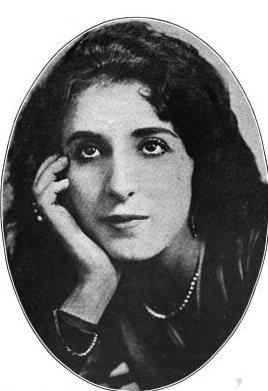
Despina Storch, 1917 (Underwood & Underwood, N.V.)

Mme. Storch was arrested in Key West with a young Frenchman, the Baron Henri de Beville, as the two were preparing to flee to Cuba. The Baron’s father, according to the apparently sympathetic Times, was “broken hearted as a result of his son’s arrest,” and felt that his son was “a victim of the ‘charms’ of the Turkish woman.”

(This account of masculine helplessness comes from a paper that, remember, wasn’t particularly sympathetic to women getting the vote.)

The pair had been living a peripatetic life. They were taken into custody in Madrid in 1915 as suspected enemy agents, sailed to Cuba after their release, and went on to the United States. They had also lived in Paris and Lisbon, where they amassed bills of $1000 a month. Their equally lavish New York lifestyle attracted the attention of the American authorities, who also found a safe deposit box in Mme. Storch’s name containing “a mass of foreign correspondence and a code.”
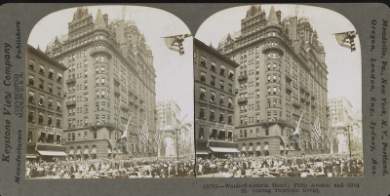
Waldorf-Astoria, 1917 (Library of Congress)

Their alleged co-conspirators were picked up in New York. Mrs. Elizabeth Charlotte Nix, who, according to the Times, “is about 40 years of age, but looks ten years younger,” had received a $3000 payment from the German ambassador before he left the country when war was declared, but she denied that it was a spy payment. The principal crime of “Count” Robert de Clairmont, as far as I can tell, was his dubious claim to his title.

The Justice Department official who announced the arrests, Charles F. De Woody,* recommended that the four suspects be deported to France. The problem with trying them in the United States was that—oops!—the espionage law only applied to men. President Wilson had mentioned this problem in his State of the Union address, and Congress was taking action, but not in time to go after Mme. Stroch and Mrs. Nix.

Meanwhile, down in Greenwich Village, a very different sort of (alleged) German-sponsored conspiracy was uncovered.
Agnes Smedley, the twenty-six-year-old “girl,” was arrested with Sailendra Nath Ghose, a “highly educated Hindu” who was already under indictment in San Francisco, for fomenting rebellion against British rule in India. (Uncharacteristically, the Times makes no mention of Smedley’s level of attractiveness.) Their activities were allegedly part of a “worldwide German-directed plot to cause trouble in India” and thereby weaken British war efforts. They sought assistance from several Latin American countries (Ghose lived for a time in Mexico, under the implausible pseudonym of Sanchez) and from Leon Trotsky.
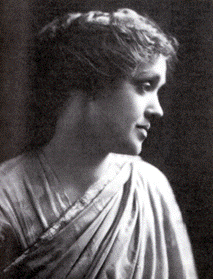
Agnes Smedley

“First women arrested in New York for enemy activities” might not be your idea of an inspiring Women’s History Month first. Well, then, there’s Annette Abbott Adams, the San Francisco-based Assistant U.S. District Attorney who spoke to the Times about the Ghose indictment. She would go on to be the first woman Assistant Attorney General and later a high-ranking California judge.

Annette Abbott Adams, 1914

The indictment against Smedley was eventually dropped. She spent many years in China as a sympathetic chronicler of the Communist Party, and wrote a well-regarded autobiographical 1929 novel, Daughter of the Earth. She counted a Soviet spymaster among her lovers. She died in England at the age of 58, and is buried in Beijing.

As for Despina Storch…stay tuned! (UPDATE: Find out what happened to her here.)

*Even the bureaucrats in this story have picturesque names.

Ulysses is 100!

The Little Review, March 1918

Happy 100th anniversary, Ulysses! This week, more or less, marks the centennial of the first publication of its opening chapter in the American journal The Little Review.

The reason for the “more or less” is that The Little Review wasn’t the world’s most prompt publication. The February issue, according to an announcement in the January issue, was published on February 10. Ezra Pound, who was the magazine’s foreign editor, wrote to Joyce on March 29 that the March issue was in print and thirty copies had reached him in London, so mid-month seems a reasonable estimate. (If anyone has a more exact publication date, please let me know!)

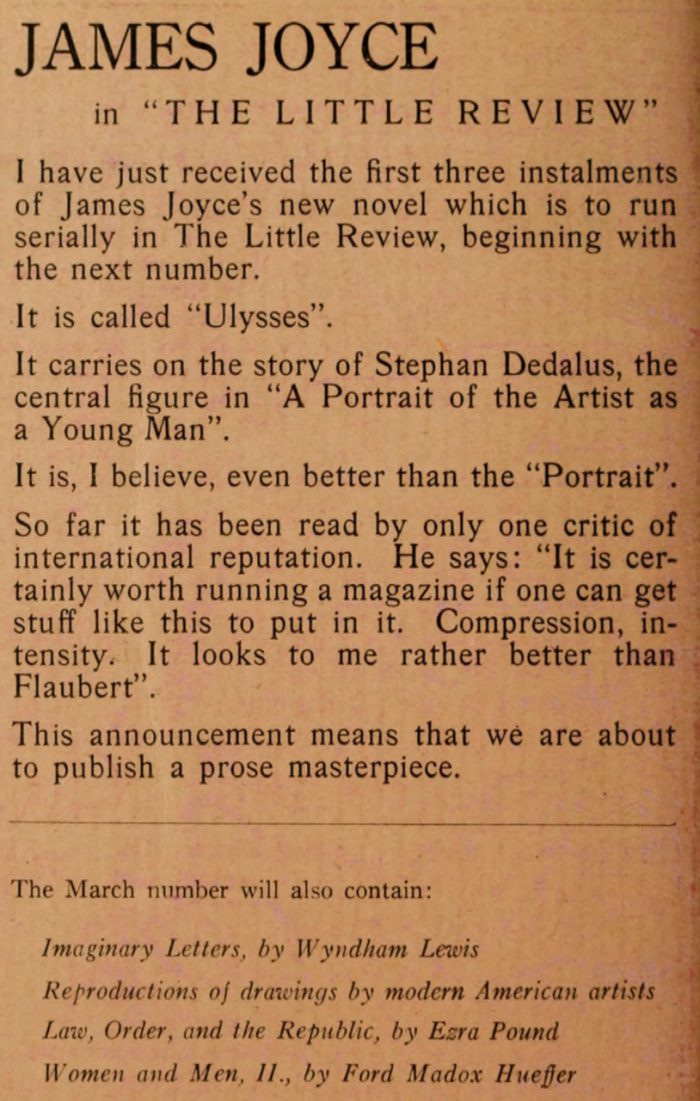
Not hedging any bets, the Little Review announced in its January issue, and again in February, that “we are about to publish a prose masterpiece.”

Little Review, February 1918

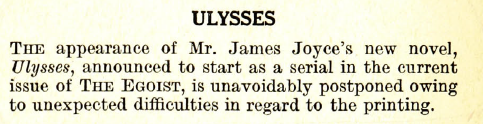
The Egoist also announced the upcoming serialization, but with British reserve rather than American braggadocio.

But The Egoist had to back out because its printer refused to print the issue.

Egoist, March 1918

So the Little Review had to go it alone.

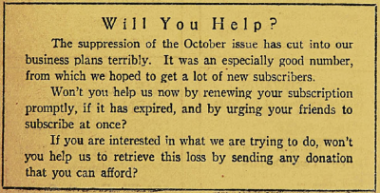
The magazine’s editors knew they were taking a risk. As I recently noted, the October 1917 issue had been suppressed after the Postmaster General declared Wyndham Lewis’s story “Cantleman’s Spring-Mate” obscene*—a disappointing and expensive blow.

Little Review, December 1918

They knew that publishing Ulysses could get them into even more trouble. But they went ahead anyway.

Who were these people? I wondered.

Ezra Pound, 1913 (Alvin Langdon Coburn)

I knew who Ezra Pound was, of course. He was everywhere in 1918, working himself into a state of exhaustion as the foreign editor of the Little Review and Poetry magazine, an editor at the Egoist, and a contributor to New Age, another modernist journal. He wrote prolifically—sometimes at the expense of coherence**—for these and other publications, and did translation as well. And, oh right, he was a poet. It’s Pound who is best remembered as the creative mind behind The Little Review.

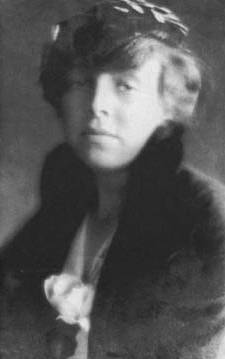
But it was the magazine’s editor, Margaret Anderson, who had the most at stake. She would be responsible for any criminal charges regarding its content while Pound was safe in London.

Margaret Anderson

Like a surprisingly large number of people I’ve come across in my 1918 reading, Anderson was from Indiana***.  She grew up in various towns, including Columbus (Indiana, not Ohio), where I lived for a few years as a child, and which is way less boring now than it was in Anderson’s time. The rebellious daughter of wealthy parents, she dropped out of the genteel women’s college where she was being groomed for life as a society matron and moved to Chicago just as the Chicago literary renaissance was getting underway. She worked as a book critic for a Chicago newspaper and literary editor at a religious publication before joining the staff of Dial magazine, where she learned the ropes of magazine publishing.

In 1914, at the age of twenty-seven, Anderson founded The Little Review with financial support from Breeder’s Gazette editor DeWitt Wing, whom she met at a party. (Everyone who wrote about Anderson mentioned her physical attractiveness, which might have played a role in Witt’s impetuous decision.)  Money was always tight, though. Accounts of Anderson’s life make much of a six-month period that she and her colleagues spent living in a tent on Lake Michigan after she was forced out of her apartment—although most don’t mention the wooden floors, or the servants.

Anderson’s partner at the magazine, and also in life, was Jane Heap, a former lover of Djuna Barnes. They moved briefly to San Francisco and then relocated to Greenwich Village in 1917.  Pound joined the magazine that year. Its table of contents during that period is a Who’s Who of modernism.

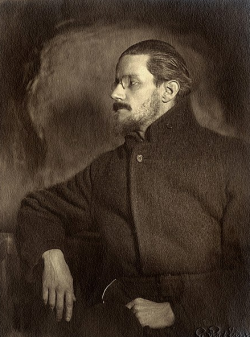
James Joyce, ca. 1918 (Cornell Joyce collection)

Reading the chapter in the Little Review was my own first encounter with Ulysses, and it wasn’t as difficult as I’d been led to believe.**** I had read A Portrait of the Artist of the Young Man, and its main character, Stephen Dedalus, features in the opening section. Stephen and Buck Mulligan, his roommate (towermate, actually—they live in a former military fort), are bickering as they get ready for work. It’s not exactly Bab: A Sub-Deb, but it’s not any more difficult than some of the mannered, faux-archaic novels of the time.

Obscenity-wise, it’s pretty tame stuff, unless the sexual references went over my head, which is quite possible. The most risqué passages I could find were this description of a milk seller:

He watched her pour into the measure and thence into the jug rich white milk, not hers. Old shrunken paps.

and this song sung by Buck Mulligan:

—For old Mary Ann
She doesn’t care a damn
But, hising up her petticoats……

 Way tamer than “Cantleman’s Spring-Mate.” The Postmaster General apparently thought so too, and the March issue made it through the mail. The Little Review was safe—for now.

James Joyce Tower and Museum in Sandycove, Dublin, Ireland (YvonneM)

*A recap, in case you missed it: Cantleman, going off to war, sees animals rutting, gets into the spirit, does same with local lass.

**If you can make any sense of his overview of popular magazines in the January 3, 1918 issue of New Age—Part XVIII in a series—you’re a better 1918 reader than I am.

***Other influential Hoosiers: novelist Booth Tarkington, food safety pioneer Harvey Wiley, and folksy poet James Whitcomb Riley, who died in 1916 but was still much written about in the stodgier magazines. Janet Flanner was working as a film critic in Indianapolis but in a few years would step onto the national stage as the Paris correspondent of the New Yorker.

****Of course, I realize that this is like saying after the first mile that running a marathon is a piece of cake.

Wednesday Miscellany: Paper doll servants, a puzzling puzzle, and a bad ad

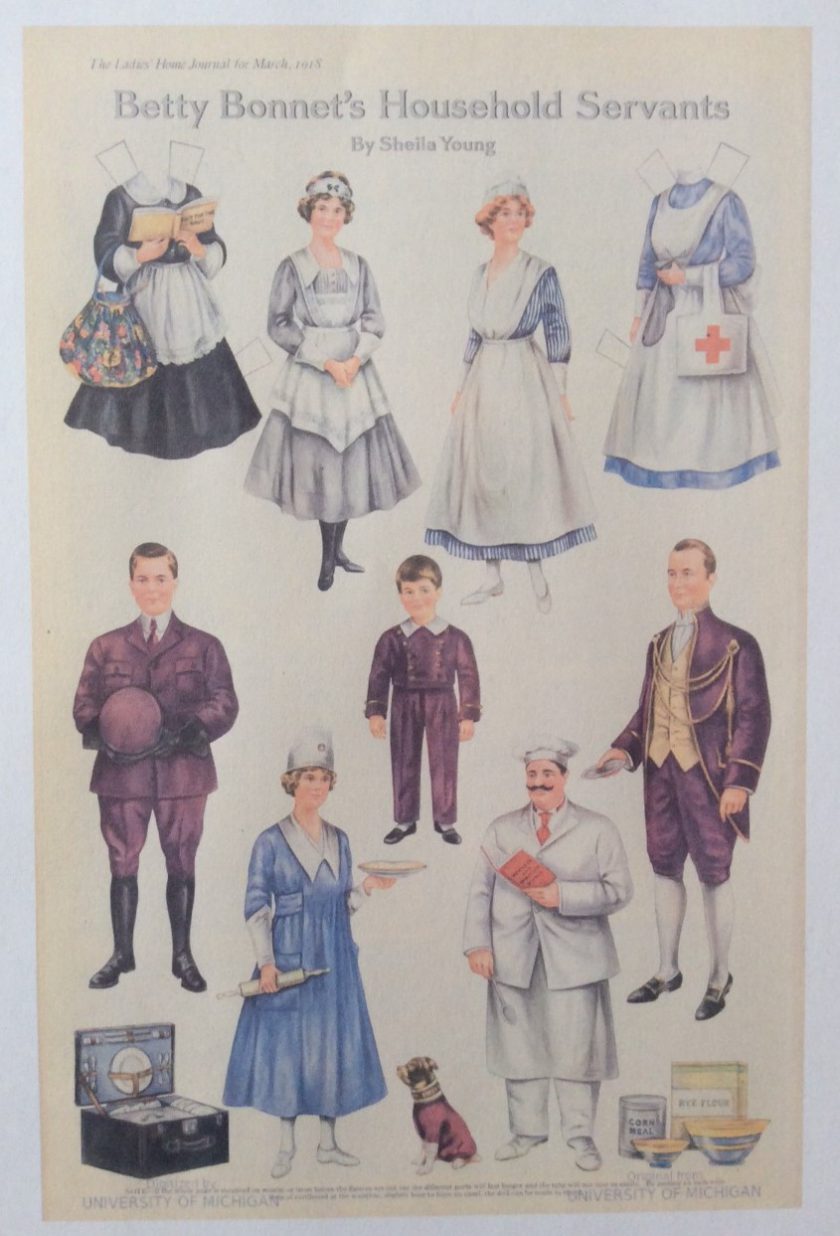
Look, kids! Paper doll servants to order around!

Paper doll servants, Ladies' Home Journal, 1918.

Ladies’ Home Journal, March 1918

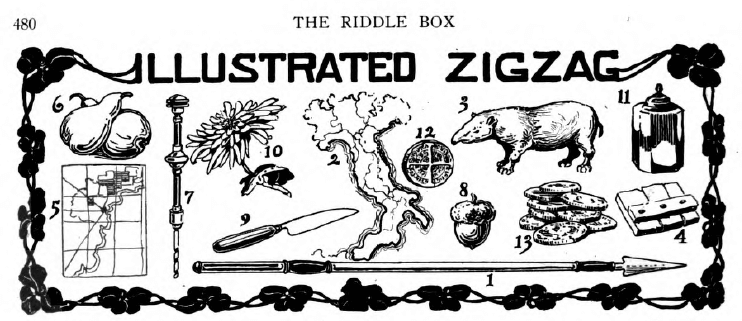
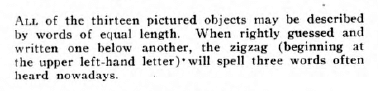
Can someone help me out with this Illustrated Zigzag? STICT RICK SUES can’t possibly be right.

Illustration for Illustrated Zigzag puzzle, St. Nicholas magazine, 1918.

St. Nicholas magazine, March 1918

I wonder how many people had to sign off on this before it was green-lighted.

Fisk Tires ad with dark-skinned men carrying things on their heads next to palm trees, 1918.

Harper’s Bazar, March 1918

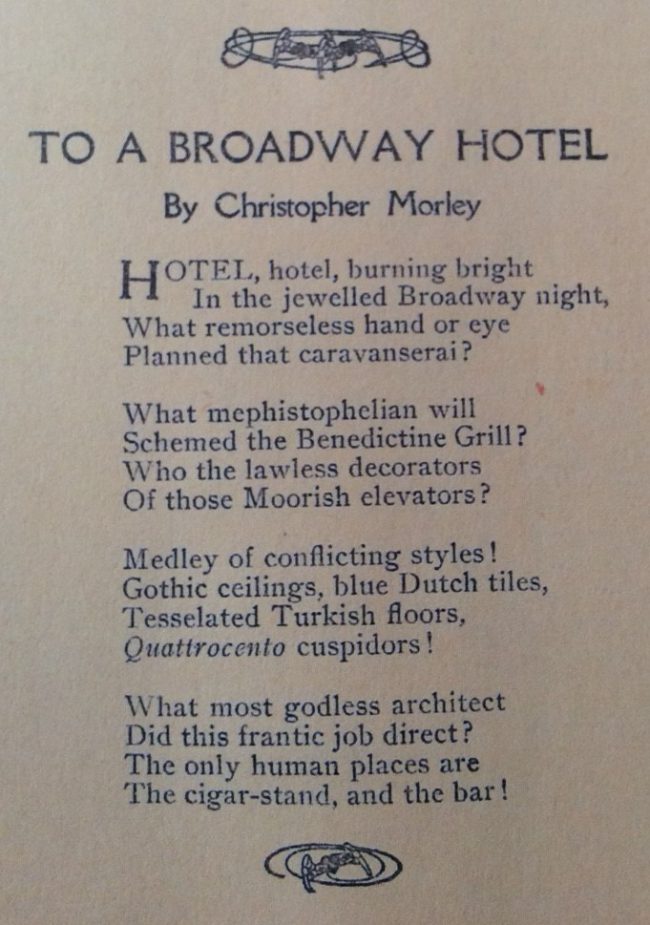
Garish New York hotels are apparently not just a contemporary phenomenon.

Christopher Morley poem, To a Broadway Hotel, Smart Set magazine, 1918.

Smart Set, March 1918

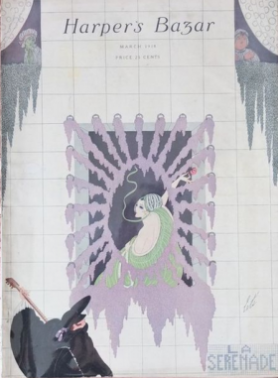
And finally, an Erté serenade.

Harper's Bazar cover by Erté showing masked man serenading a woman, March 1918.

Harper’s Bazar, March 1918

Oh snap! The modernists’ cringe-inducing criticism

The writers who were reviewed in the modernist journals of 1918 are all long dead. But, when I read what T.S. Eliot, Ezra Pound, and their fellow critics had to say about them, I can’t help cringing on their behalf.

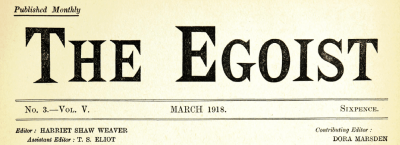
The Egoist banner, March 1918

Take this review, in the March 1918 issue of The Egoist, of a collection called Georgian Poetry, 1916-1917. The reviewer, who calls himself Apteryx but is really T.S. Eliot, sums up the work of five contributors as follows:

Mr. Graves has a hale and hearty daintiness. Mr. Gibson asks, “we, how shall we…” etc. Messrs. Baring and Asquith, in war poems, both employ the word “oriflamme.” Mr. Drinkwater says, “Hist!”

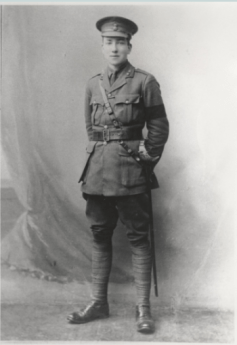
Photo portrait of poet Robert Graves in military uniform, 1914

Robert Graves, 1914

These few sentences give us a good sense of what’s in the poems. Under the circumstances, though, this criticism seems a bit cruel. Robert Graves, who would go on to fame as a poet, novelist, and memoirist, was a 23-year-old soldier in 1918. “David and Goliath,” written in memory of his friend David Thomas, is a reversal of the Bible story, ending:

‘I’m hit! I’m killed!’ young David cries.
Throws blindly forward, chokes…and dies.
And look, spike-helmeted, grey, grim,
Goliath straddles over him.

Maurice Baring, Wilfrid Wilson Gibson, Herbert Asquith (the son of the Prime Minister), and John Drinkwater were older, in their thirties or forties, but they were all in uniform except Gibson, who tried to enlist but was turned down because of ill health.

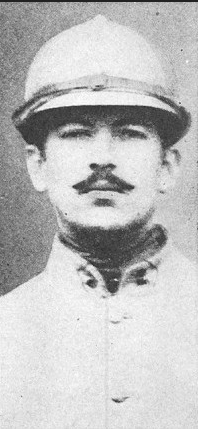
Poet Alan Seeger in military uniform with helmet.

Alan Seeger

Even dying in the war didn’t spare a writer from The Egoist’s sharp scrutiny. The December 1917 issue included an unsigned review of a book of poems by Alan Seeger, who had joined the French Foreign Legion and died in the Battle of the Somme in 1916. Seeger, best known now for the poem “I Have a Rendezvous with Death,” was a Harvard classmate of T.S. Eliot, who may have written the review.* (UPDATE 10/16/2019: Robert Crawford says in his biography Young Eliot that he did.) According to the Egoist,

Seeger’s poems are not unworthy of the attention they have attracted. The book has not much to offer to the small public which wants nothing twice over, but it has a good deal to give to the public which will take what it likes in any amount.

The Egoist was dismissive toward popular novelists. In a discussion in the February 1918 issue of James Joyce’s A Portrait of the Artist as a Young Man, reprinted from an Italian publication and apparently translated by Joyce himself, Diego Angeli says:

To tell the truth, English fiction seemed lately to have gone astray amid the sentimental niceties of Miss Beatrice Harraden, the police-aided plottiness of Sir Conan Doyle, the stupidities of Miss Corelli or, at best, the philosophical and social disquisitions of Mrs. Humphrey Ward.**

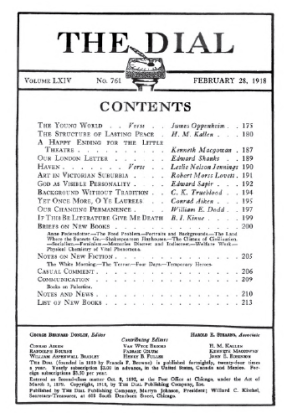
The Dial cover page, February 23, 2019.

Across the Atlantic, The Dial, which wasn’t a modernist journal but had modernist sympathies,*** shared The Egoist’s contempt for popular novelists. You don’t really have to read further in B.I. Kinne’s review of Hugh Walpole’s The Green Mirror than the title: “If This Be Literature Give Me Death.” If you do, you’ll read that

Mr. Walpole’s most irritating fault is his adherence to the court reporter’s method of observing and recording. This is the fault of many of the contemporary novelists. It is their belief, apparently, that the mere writing down of lists of things, whether dishes of food, toilet articles on the heroine’s dressing-table, books and objects d’art on the drawing-room tables, or the furnishings of a room, constitutes vivid literature.

Novelist Hugo Walpole, 1915.

Hugh Walpole, 1915 (The Independent)

The modernist critics reserve their most scathing criticism for literary luminaries. In an article on Henry James (whom he admired) in the January 1918 Egoist, Eliot writes that G.K. Chesterton’s “brain swarms with ideas; I see no evidence that it thinks.” Ezra Pound, also writing admiringly about James in the same issue, says of recent writing that

we may throw out the whole [H.G.] Wells-[Arnold] Bennett period, for what interest can we take in instruments which must of nature miss two-thirds of the vibrations in any conceivable situation.

The modernists’ criticism may be harsh, but, unlike H.L. Mencken’s, it doesn’t seem mean-spirited. Eliot and Pound and the other modernist critics took their work with tremendous seriousness. They thought that the ossified literary world of their time had to die, and that it was their job to kill it. They didn’t just rip into bad writing; they explained how it exemplified what was wrong with the literature of the day. And they had a vision of what should come in its place: modernist writing by the likes of Joyce, Wyndham Lewis, and of course themselves.

This wasn’t exactly trench warfare, but it had its risks. Eliot reported in the March 1918 Egoist that the October 1917 issue of the American modernist journal The Little Review had been declared obscene and seized by the post office, the offending item being a story by Wyndham Lewis. The journal’s legal complaint against the post office had failed.****

The March 1918 issue of the Egoist contained the following announcement:

Item from The Egoist announcing the postponement of the serialization of James Joyce's Ulysses, 1918.

 That is, no printer in England would touch it. But it was scheduled to be serialized in the Little Review as well.

Bigger battles lay ahead.

squiggle

*He was also folk singer Pete Seeger’s uncle.

**See! I told you!

***It later became a modernist journal, and was the first place “The Waste Land” was published in the United States.

****The story was called “Cantleman’s Spring-Mate.” Naturally, I immediately tracked it down. Summary: a young man about to go to war sees animals rutting all around, joins in the action with a village girl, and feels that he has defeated death. (Except that makes the story sounds life-affirming, which it’s not. It’s modernist!)

The best and worst of February 1918: Magazines, stories, cover art, and jokes

Two months into My Year in 1918, I feel like I used to feel two months into a Foreign Service posting: completely at home in some ways but totally bewildered in others. I know who Viscount Morley was*, and which author every critic trots out to bemoan the sad state of fiction**, but there are references that go right over my head. Who is Baron Munchausen? What is Fletcherizing? And the jokes. I’ll never get the jokes.

Best magazine: The Crisis

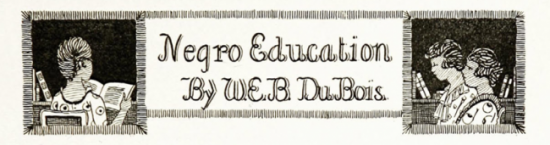
Banner reading Negro Education by W.E.B. DuBois with illustrations of women reading, The Crisis, 1918.

The Crisis, February 1918

 This is a repeat, but no other magazine approaches The Crisis in terms of quality of writing and importance of subject matter. Aside from W.E.B. Du Bois’ autobiographical essay, which I wrote about last week on the 150th anniversary of his birth, the February issue includes Du Bois’ scathing take-down of a government-sponsored study on “Negro Education” that advocated the replacement of higher education institutions with manual, industrial, and educational training. There’s a horrifying account of the mob murder of an African-American man in Dyersburg, Tennessee—so brutal, the magazine reports, that some white townspeople felt he should have had a “decent lynching.” On the literary side, there’s “Leonora’s Conversion,” a slight but engaging story about a wealthy young black woman’s brief flirtation with the church.

I’m not awarding a Worst Magazine this month. Good Housekeeping was a contender again—dialect-talking black maid Mirandy has the month off, but Japanese manservant Hashimura Togo*** expounds on his employer’s marital problems in equally fractured English. (“‘You have left off kissing me as usually,’ she dib. ‘O.’ He march and deliver slight lip.”) The magazine redeems itself somewhat, though, with an article by suffragist Anna Kelton Wiley called “Why We Picketed the White House.”

Illustration of story about Togo by Wallace Irving, Good Housekeeping, February 1918.

Good Housekeeping, February 1918

Best short story: “A Sordid Story,” by J., The Egoist

February wasn’t a great month for short stories. Most of the ones I read, including two that made it into The Best American Short Stories of 1918, started out promisingly but ended with pathos or a gimmicky twist. “A Sordid Story,” in the January**** Egoist, isn’t great literature, but it has daring subject matter and lots of atmosphere. It features a Cambridge student named Alphonse, whose life is described in the most British sentence I’ve ever read:

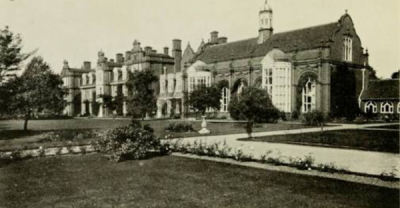
He made friends easily and took friendship seriously; so seriously that he spent nearly the whole of the Michaelmas term following the taking of his degree in reading Aeschylus’s Prometheus Bound and The Gospel according to St. Luke in the Greek with a much younger man—a certain Roderick Gregory—who was in his second year, but had hitherto failed to pass his Little-Go.

Photograph of Cambridge University by Maxwell Armfield, Cambridge and Its History, 1912.

Maxwell Armfield, from “Cambridge and its History,” 1912

Alphonse falls for Roderick’s sister Beatrice, who “used to have a pet pig, and she called him Shakespeare, because he would be Bacon after his death.” But he spends the night with a working-class girl who grabs his arm as he’s walking near Midsummer Common and says, giggling, “Can yer tell me what o’clock it is?” Horrified with himself the next day, he goes back to her lodgings to pay her off. She tells him that he was her first lover, then, when he tells her it’s over, says, “Yer weren’t the first, then!” Relieved “not to be the first to help send a woman downward,” he goes back to his rooms, where Roderick is playing the cello and twenty-five copies of the Quarterly Journal of Mathematics, in which he has published a paper, await him. It’s only years later that he figures out that he was, in fact, the first.

Worst short story: “A Verdict in the Air,” J.A. Waldron, Judge

Lawrence Fellows illustration, Judge magazine, 1918, man standing near airplanes.

Lawrence Fellows, Judge, February 9, 1918

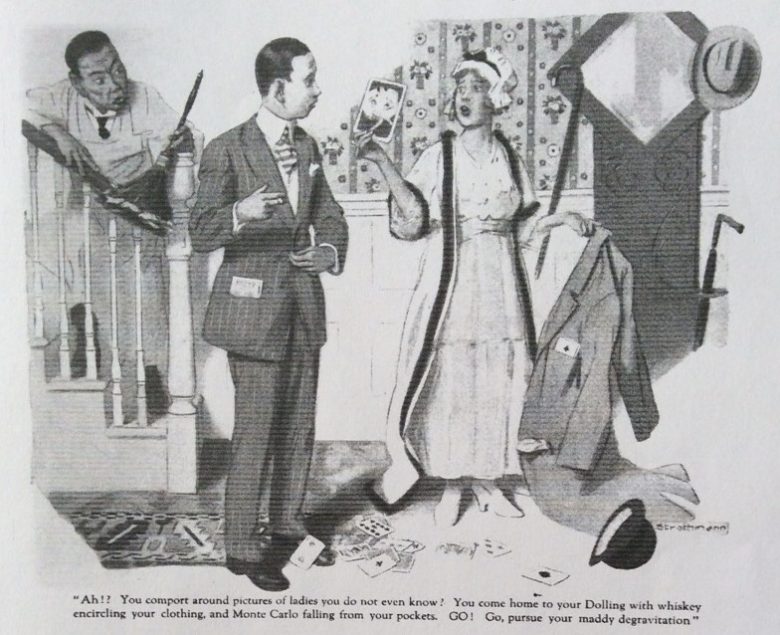
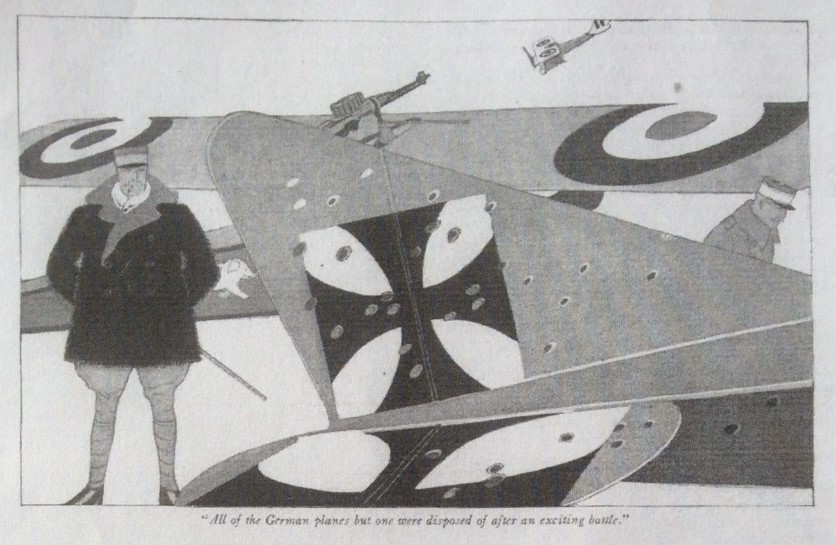
Harwood, on leave from aviation training, goes to a cabaret in Chicago. To his surprise, one of the singers is his childhood sweetheart Bessie Dean, who left their Ohio hometown to pursue a career in opera. She introduces Harwood to her husband Grindel, who takes a dislike to him. A few days later, Harwood is training on the Pacific Coast, when who should show up as a mechanic but Grindel! Harwood has a series of flying accidents, and Grindel is suspected, but he goes AWOL. Harwood is sent to fight with the French army. He visits a friend at a field hospital, where the nurse is none other than Bessie, who has escaped her husband. Back at the front, there’s a heated battle. Harwood pursues the last remaining German plane and hits its rudder after a lively skirmish. As the plane plunges to the ground, he sees that the pilot is—you guessed it—Grindel!

Well, the illustration is kind of cool.

Best magazine covers:

February was a great month for magazine covers. I just wish that the insides of the magazines were half as good. Besides the ones from Harper’s Bazar and Vanity Fair that I’ve mentioned already, there’s this Helen Dryden cover from Vogue,

Helen Dryden Vogue cover, February 1918, woman in pink hoop skirt looking into mirror.

Helen Dryden, February 1918

 and this one, which Norman Rockwell sold to Judge after the Saturday Evening Post turned it down. I can kind of see why.

Norman Rockwell Judge magazine cover, girl grabbing tartan skirt from brother dressed as a Scottish soldier.

Norman Rockwell, Judge, February 9, 1918

Best joke:

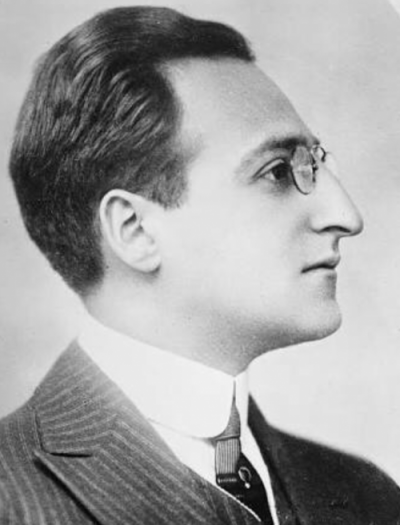
 This isn’t exactly a joke, but it made me laugh. It’s the opening of Louis Untermeyer’s review of poetry collections by Edna St. Vincent Millay, Samuel Roth, and Edwin Curran in the February 14 issue of The Dial.

These three first volumes, with their curious kinship and even more curious contrasts, furnish a variety of themes. They offer material for several essays: on “What Constitutes Rapture”; on “The Desire of the Moth for the Star”; on “The Growing Tendency among Certain Publishers to Ask One Dollar and Fifty Cents for Seventy Pages of Verse”; on “A Bill for the Conservation of Conservative Poetry”; on “Life, Literature, and the Last Analysis”; on “Why a Poet Should Never be Educated.”
Studio photograph of Louis Untermeyer, ca. 1910-1915.

Louis Untermeyer, ca. 1910-1915, Library of Congress

The Growing Tendency among Certain Publishers to Ask One Dollar and Fifty Cents for Seventy Pages of Verse! That Louis Untermeyer is such a card!

Not amused? Okay, then, you go back to 1918 and try to find something funnier.

Worst joke:

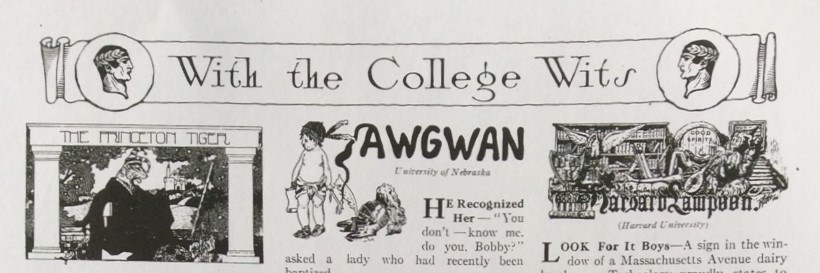
Judge magazine banner, With the College Wits, February 9, 1918.

Judge magazine, February 9, 1918

 Once again, hard to choose. Maybe this, from the February 9 issue of Judge:

“You don’t—know me, do you, Bobby?” asked a lady who had recently been baptized.
“Sure I do,” piped the youth. “You’re the lady what went in swimming with the preacher, last Sunday.”

On to March!

*A British diplomat

**Mrs. Humphrey Ward

***Really Wallace Irwin, who made a career of writing about Togo. Mark Twain was a fan.

****I was reading The Egoist a month late on the principle that it would have taken time for the magazine to get to the United States, which I’ve since decided is ridiculous.

Wednesday Miscellany: Virile modernists, “quotation marks,” and a masterpiece on the way

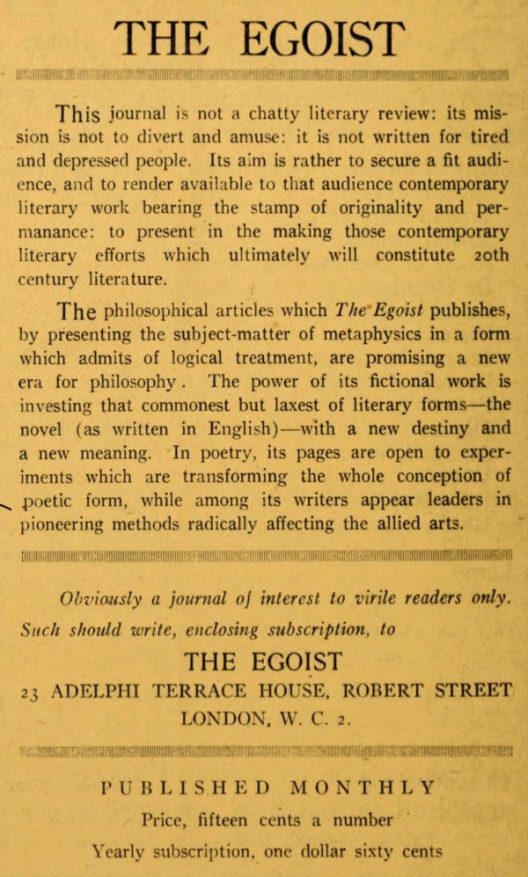
An ad for The Egoist in The Little Review: “Obviously a journal of interest to virile readers only.”  In that case, I want my $1.60 back.

Also: “It is not written for tired and depressed people.” Sorry, Egoist, but in our day only tired and depressed people read T.S. Eliot.

“Transforming the whole conception of poetic form.” Okay, I’ll give you that one.

Little Review ad for The Egotist, "obviously a journal of interest to virile readers only."

Little Review, February 1918

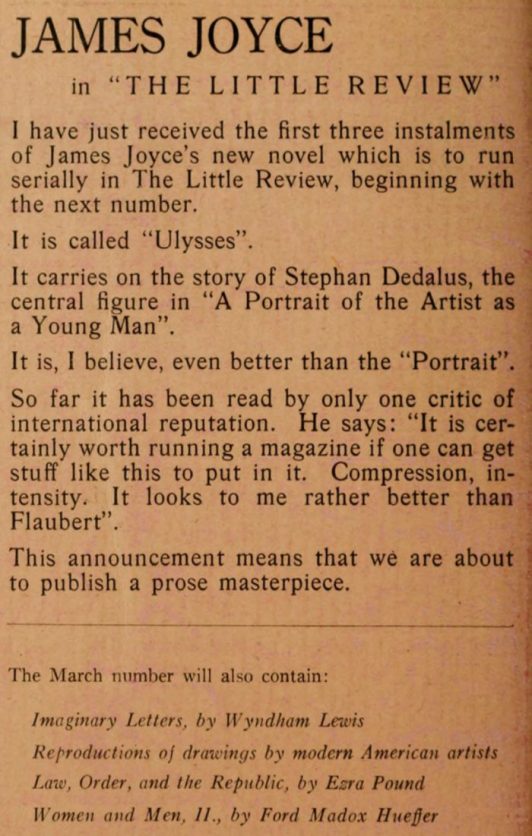
An ad for next month’s Little Review: “We are about to publish a prose masterpiece.” Okay, if you’re publishing Ulysses, and your other contributors are Wyndham Lewis, Ezra Pound, and Ford Madox Hueffer (aka Ford), then you’re entitled to a little attitude.

(In case you’re wondering what they had in store for February that made them reduce Ulysses to a footnote, it was a full issue devoted to French poets, in French. Cool, but no Ulysses.)

Little Review ad for Ulysses serialization, February 1918.

Little Review, February 1918

One last Little Review ad, showing us that “overuse” of “quotation marks” is not a strictly “contemporary” phenomenon. I do like “Solve Your Food Problem” as a restaurant slogan, though. Sometimes, it’s just that simple.

Little Review, February 1918

Dear Daddy-Long-Legs, Drop dead!

If you’ve followed My Year in 1918 since the beginning, you may be thinking around now, “What’s with this person? She said she was going to read her way through 1918, but all she does is sit around looking at magazines. She’s mentioned one book so far, and it wasn’t exactly Dostoevsky.”
As my Book List will attest, I have, in fact, read other books. I just haven’t had much to say about them. But now I’ve read a book that I have a lot to say about—Jean Webster’s 1912 epistolary novel Daddy-Long-Legs.
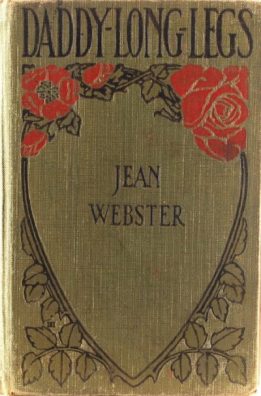
Daddy-Long-Legs by Jean Webster, first edition cover, 1912.

First edition, 1912

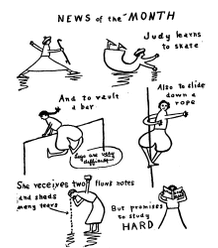
Daddy-Long-Legs—which I’d read before, when I was twelve or so—is the story of Jerusha Abbott, a foundling who was raised, if that’s the word for it, in the grim John Grier Home. A trustee of the home offers to put her through college. She’s supposed to write him a letter every month, and he keeps his identity secret. She renames herself Judy and—despite never having seen the inside of a house—adapts quickly to college life. She sends her benefactor cheery, breezy missives, illustrated with whimsical drawings. She saw his elongated shadow in the hallway once, so she nicknames him “Daddy-Long-Legs.”

Daddy-Long-Legs illustration, News of the Month.

Daddy-Long-Legs, illustration by Jean Webster

Judy tells Daddy-Long-Legs everything—about her (quickly overcome) academic struggles, her fun-loving roommate Sally McBride of Worcester, Mass.*, her snooty roommate Julia Pendleton, and her growing fondness for Julia’s young uncle, Jervie, who’s a socialist and not at all like the rest of his clan.

If you haven’t read Daddy-Long-Legs, and are planning to, and are the world’s densest reader**, then stop here, because I’m going to give away the ending.

JERVIE AND DADDY-LONG-LEGS ARE ONE AND THE SAME!

Judy discovers this after she writes to Daddy-Long-Legs, broken-hearted after turning down Jervie’s marriage proposal because of the vast social divide between them, and begs for a meeting. Her last letter, written after she discovers the truth and accepts his proposal, is an outpouring of joy.

From a twenty-first-century perspective: No. Just…no.

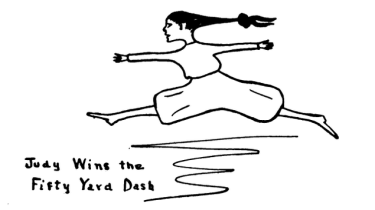
Daddy-Long-Legs illustration, Judy Wins the Fifty Yard Dash.

Run, Judy, run! (Daddy-Long-Legs, illustration by Jean Webster)

How about this instead?

Dear Whoever,

Of all the sick mind games anyone ever played, yours is the sickest. I came from nowhere. I had nobody. Nobody, that is, except the benefactor who lifted me from poverty—in spite of everything, thank you for that—and the man I loved. I told my benefactor all about him—his generosity, his liveliness, but also his little inconsiderate acts (showing up at inconvenient times and expecting everyone to drop everything) and his horrible family. And you let me do this—for FOUR YEARS—even as our friendship turned to love.

Two men in the world cared about me. Now it’s just one. Daddy-Long-Legs is dead. No, worse—he never existed. I can always find another lover, but I’ll never have another father. I’ll miss him, Jervie, more than I’ll miss you.

And all that string-pulling along the way…making me spend the summer at your old nanny’s farm when I begged to go to the McBride family camp in the Adirondacks. “It’s the kind of nice, jolly, care-free time that I’ve never had; and I think every girl deserves it once in her life,” I said. But no, to the farm it was—so that I could keep you entertained during your brief visit. I’m not your plaything, Jervie.

You probably think I’m going to run off and marry Jimmie McBride. But you know what? I’m twenty-one. I’ve never lived anywhere but in a foundling asylum and a girls’ college. I’m not going to marry anyone. I need some time on my own.

 Not yours, not anyone’s,

 Judy

 There. That’s better.

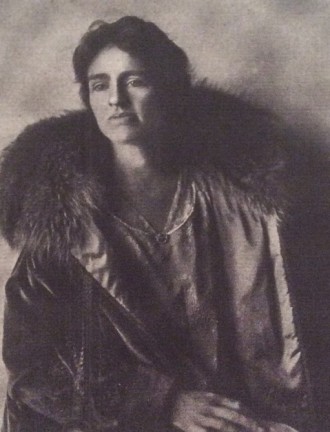
Portrait photograph of Jean Webster, Bookman magazine, 1916.

Jean Webster, Bookman magazine, July 1916

The ending aside, though, Daddy-Long-Legs was my most enjoyable read of the year so far—bright and breezy and fun. Jean Webster seems like she would have been bright and breezy and fun too. But her life was shadowed with tragedy. Her father started a publishing business with Samuel Clemens (AKA Mark Twain), who was his wife’s uncle, but it ended up going broke, and he committed suicide when Jean was fourteen. She had a long affair with Standard Oil heir Glenn Ford McKinney, whose wife suffered from severe mental illness. They finally married in 1915, after his divorce, but she died in childbirth the next year, at the age of thirty-nine. Her daughter was named Jean in her memory.

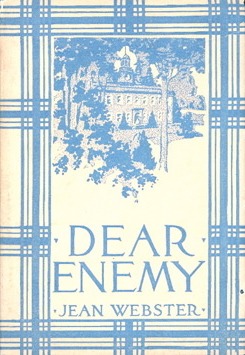
Dear Enemy by Jean Webster, first edition cover, 1912.

First edition, 1915

A bright light, gone far too soon. But she left a lot of books behind. There’s a sequel to Daddy-Long-Legs called Dear Enemy, which I’ll read later in the year.*** For now, on to more serious fare—Willa Cather’s O Pioneers!

 I’m sure it will be great, but I miss Judy already.

*Shout out!

**Well, tied with twelve-year-old me

***UPDATE 4/2019: I did, and wrote about it here and here.

Sound familiar? Book chat, 1918-style

If you spend as much time reading about books online as I do (or did, before I went back to 1918), there are certain topics that you come across again and again. I knew that these debates had been around for a while. But I had no idea that they’d been around for a hundred years. Here’s the 1918 take on a couple of book-chat perennials.

Can writing be taught?

Can creative writing be taught? Do writing classes really make students’ writing better? As a recent MFA grad, I’ve grown tired of this seemingly endless debate. (No one ever asks MBAs this type of question, and I don’t recall MFAs ever causing an international financial crisis.) But MFA programs weren’t around in 1918, so I thought I’d get a break.

But no, here’s Edward J. O’Brien, founding editor of The Best American Short Stories, weighing in in the January 1918 issue of The Bookman. “Experience with many short story writers who had completed courses in short-story writing under competent critics had left me frankly sceptical as to the value of endeavouring to teach the technique of a developing and changing literary form,” he says. He’s reviewing a book called A Handbook on Story-Writing by Blanche Colton Williams of Columbia University. After such an education, he goes on, “The last state of the pupil seemed worse than the first.” Oh no.

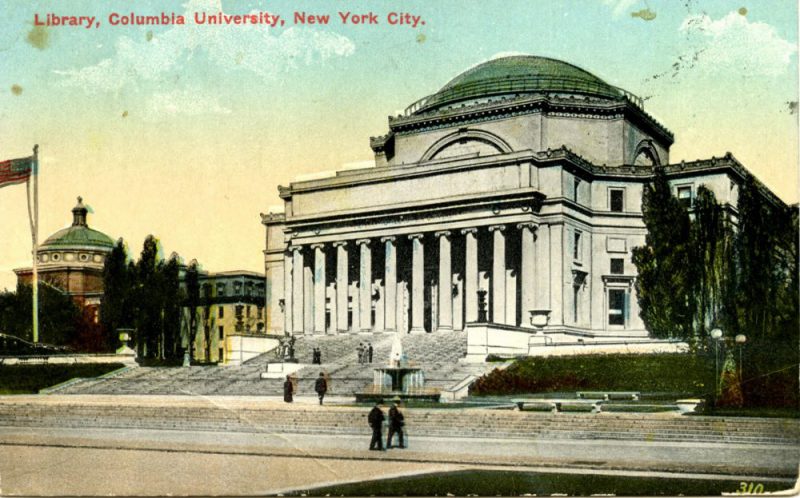
Postcard of Columbia University library, 1917.

Columbia University library, 1917 (librarypostcards.blogspot.com)

But then one day he’s bad-mouthing writing classes to a short story writer he admires, and the writer reveals that he’s studying writing at Columbia. He invites O’Brien to tag along, and he wins a convert. “What I found in this class was a free play of critical intelligence, taking actual stories as its point of departure…Here was a true academy, in which the teacher learned from the pupil.” This approach, he says, is skillfully presented in Williams’ book. Plot, point of view, character, and dialogue—all are lucidly discussed.

Score one for Team MFA!

Should adults read books written for children?

If there’s any debate in book-talk-land that’s even more heated than the one over MFAs, it’s the question of whether adults should read books written for children. Ruth Graham took up the anti-YA banner in a 2014 Slate article called, succinctly, “Against YA.” “Read whatever you want,” she said. “But you should be embarrassed if what you’re reading was written for children.” A raucous argument ensued, with writers like Meg Wolitzer coming to the defense of adult YA readers.

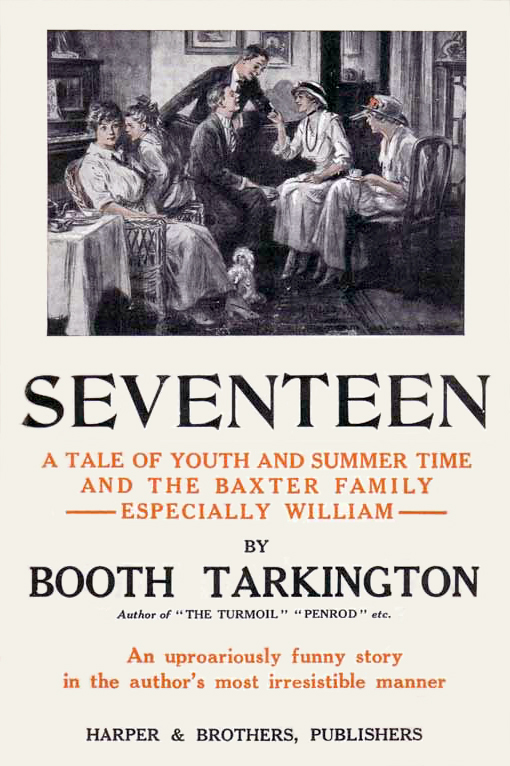
Seventeen by Booth Tarkington, first edition cover, 1916.

First edition cover, 1916

Again, not a topic I’d expect to have much currency in 1918, when grown-ups were grown-ups and children wore sailor suits. But, writing in The Bookman in February 1918, children’s writer and anthologist Montrose J. Moses notes that books for boys are popular among soldiers. The low level of literacy among enlisted men could be part of the reason, he says. But he thinks it’s more than that. “I believe—and I have followed the trend of juvenile literature for many years,—that this tendency on the part of the soldier to read boys’ books is only another evidence of the fact that juvenile literature, since it has come under the influence of out-door sports and modern inventions, has in it a degree of expertness which appeals to no age and to all interest.”

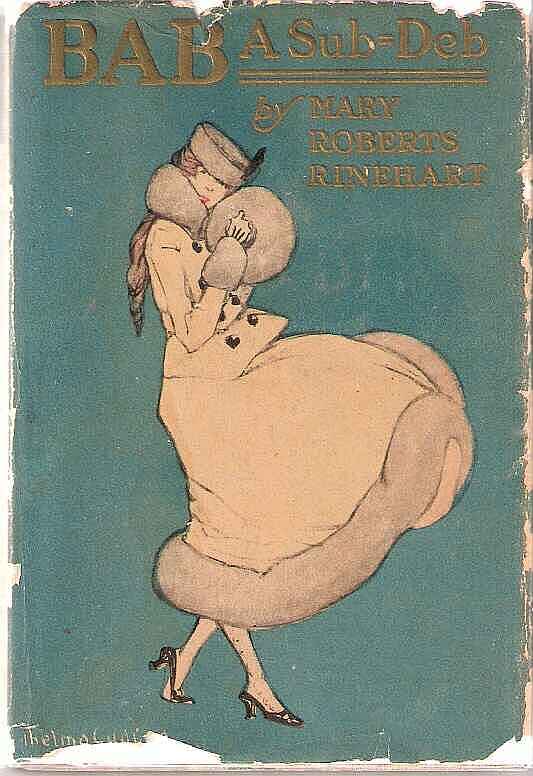
Cover, Bab A Sub-Deb by Mary Roberts Rinehart, 1917

First edition, 1917

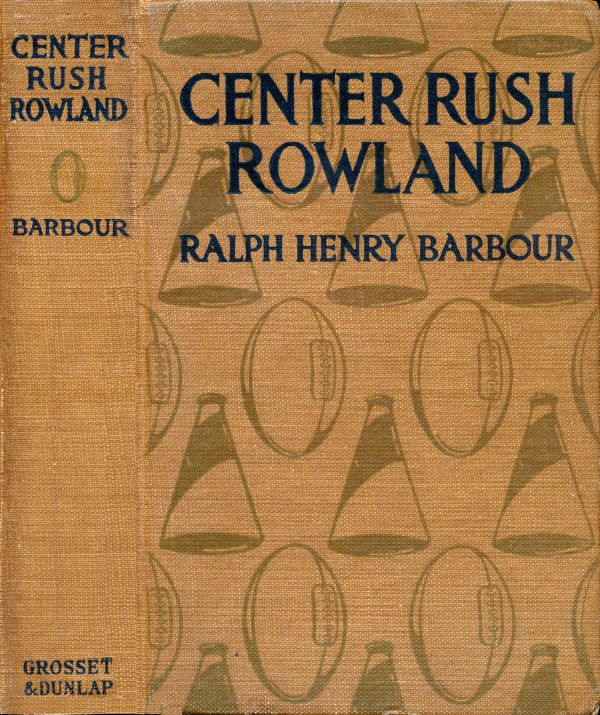
It’s not only soldiers who were reading about children. A surprisingly high percentage of 1918-era books for adults have child protagonists. Booth Tarkington’s Seventeen (1916) and Mary Roberts Rinehart’s Bab: A Sub-Deb (1917) were adult best-sellers by well-established writers. But John Walcott, writing in The Bookman in December 1917, says that children don’t share their parents’ enthusiasm for these books. “Have you chanced to note the rueful grin with which a real Bab or [Seventeen’s] Willie Baxter scans those delightful and too-revealing records?” he asks. “The relief with which they turn to the latest number of St. Nicholas, or the latest ‘corker’ by Mr. Ralph Henry Barbour?” Young people, he says, take themselves with deadly seriousness, “and it behooves those who cater for [their] favour to do likewise.” That’s what Barbour does, with his tales of schoolboy athletics. “Just now,” Walcott says, “he is working his way methodically through the line-up, so that after Left End Edwards, Left Tackle Thayer, and Left Guard Gilbert, we have naturally arrived at Center Rush Rowland, and we have the right side of the line to look forward to in the near future. Heroes all!”

Cover of Center Rush Rowland, 1917.

It’s Barbour and his schoolboy athletes, Moses says, that the soldiers are clamoring for. And I can see why. For young men going off to fight for a cause that even the Allied countries’ leaders were having trouble articulating, it’s easy to understand the appeal of a tale in which the hero competes, as Moses puts it, in “the season’s decisive event upon the modern field of academic glory.”

The best and worst of January 1918: Magazines, stories, thinkers, and jokes

 I made it! One month of reading books, magazines, and the news as if I were living in 1918. It’s been even more fun than I expected. The 1918 New York Times at breakfast, printouts of The Dial and The Egoist for on-the-go reading, and Edith Wharton at bedtime. I don’t miss 2018 at all.

Here are some of the month’s highs and lows.

Best magazine: The Crisis

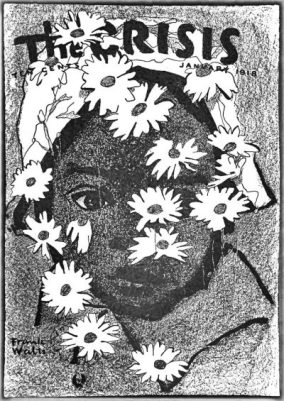
The Crisis cover, January 1918, drawing of African-American woman and daisies

The Crisis, January 1918, Frank Walts

I expected the NAACP’s magazine, edited by W.E.B. Du Bois, to be historically interesting. It was–and it also turned out to be the month’s most compelling read, full of top-quality explanatory journalism, social criticism, personal essays, and fiction.

Runner-up: The New Republic. When I’m befuddled by something I read about in the New York Times—like, was the American war effort as pathetic as Wilson’s critics make it sound, or did Harry Garfield really have to shut down the entire East Coast—all I have to do is wait a few days and the New Republic will provide a clear, convincing explanation. And then explain it again. And then, in case I still don’t get it, spend another couple of pages making the same point. Illuminating? Yes. Concise? No.

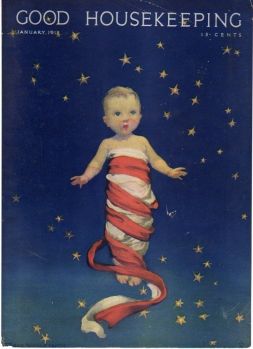
Worst magazine: Good Housekeeping

Good Housekeeping cover, January 1918, baby wrapped in flag with starry sky

Good Housekeeping, January 1918, Jessie Willcox Smith

Good Housekeeping was already in the lead for this category because of the horrible Marie Corelli article about cleansing the world through eugenics. Then I read “Mirandy on the One We Didn’t Marry,” by Dorothy Dix. I knew of Dix as a pioneering advice columnist. I’m a big fan of advice columns, and I was eager to find out what she had to say to the women of 1918. But Mirandy turns out to be Dix’s monthly impersonation of an African-American woman who provides her views on life in heavy dialect. “Ef you ’grees wid a woman ‘bout her husban’s faults an’ weaknesses she is lak enough to up an’ lambast you wid de fust thing dat is handy,” Mirandy says. There’s an illustration of a kerchiefed woman with an umbrella giving a talking-to to her pop-eyed friend. If you want to hear a real African-American woman’s take on family life, check out the lovely “A Mother’s New Year’s Resolutions” by Josephine T. Washington, in, where else, The Crisis.

 Best short story: “The Way of the Transgressor,” by Wallace Green

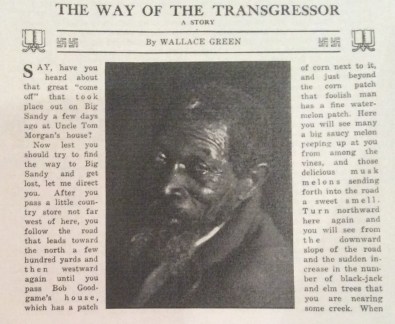
Headline and photograph illustration, The Way of the Transgressor, The Crisis, January 1918.

The Crisis, January 1918

I wrote about this story, which ran in the January 1918 issue of The Crisis, earlier this month. It’s vivid, unformulaic, funny, and moving. Unfortunately, I haven’t been able to find out anything about Green (if that was his real name), or to find anything else that he wrote. I’ll keep looking.

Runner up: “The Policewoman’s Daughter,” by Ben Hecht (Smart Set, January 1918). Agatha is an innocent young woman with a domineering mother (a figurative, not a literal, policewoman), and the story takes place entirely in her head as she waits in the parlor of a seedy hotel for an assignation with a violinist. As the minutes tick by and it becomes clear that he isn’t going to show up, she falls into a state of anguish, followed by relief that God has saved her from ruin. Then she realizes that she got the date wrong, and her joyful anticipation returns. Hecht, who was twenty-three when this story was written, would go on to be one of Hollywood’s top screenwriters. His many credits include His Girl Friday, which is one of the talkiest films ever made. In “The Policewoman’s Daughter,” no one says a word. Talk about versatility!

Worst short story: “A Palm Beach Honeymoon,” author unknown

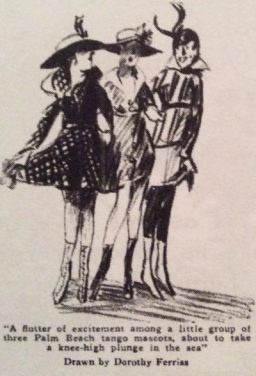
Vanity fair illustration, Palm Beach Honeymoon, January 1918

I opened up Vanity Fair and, after 23 pages of ads, seven of them for dogs, finally got to some editorial copy. Or so I thought. “A Palm Beach Honeymoon” is the story of, well, a Palm Beach honeymoon. Robert is smitten with Mabel, his stunning bride, but he gradually becomes aware that, from her perspective, something in the marriage is amiss. Desperate to find out what it is, he asks his friend, who has been flirting with Mabel’s maid, to see what he can find out. His friend reveals that, during the train ride down, the porter threw away Mabel’s copy of Vanity Fair. Really, Vanity Fair? That’s what I get after all those ads? An advertorial?

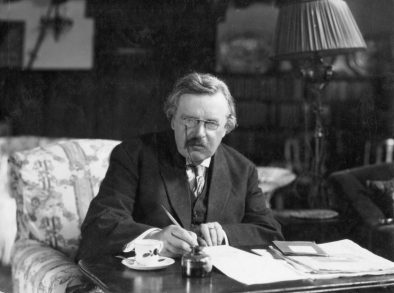
 Most famous thinker no one cares about today: G.K. Chesterton

Portrait photograph of G.K. Chesterton sitting at desk.

G.K. Chesterton, date unknown

 1918 was a bad year, great thinker-wise. Mark Twain died in 1910. So did William James, followed by his brother Henry in 1916. Walter Lippmann was starting to make his mark, but he was still in his twenties in 1918, and in any case he was on hiatus from journalism, working as an assistant to the Secretary of War. So that leaves…G.K. Chesterton. He’s probably best known today for his Father Brown detective stories, but back then he was known for, well, everything. He was a critic and a historian and a theologian and a bunch of other things. Everyone was always quoting him or criticizing him or reviewing his books. There could be a reading-in-1918 drinking game where you take a shot every time someone mentions him. Luckily there isn’t, because I’d be sozzled all the time.

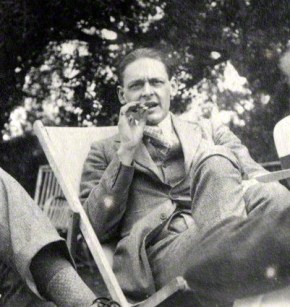
 Least famous thinker everyone cares about today: T.S. Eliot

Photograph of T.S. Eliot in lawn chair, Otteline Morrell, 1923.

T.S. Eliot, 1923 (Lady Ottoline Morrell)

 Okay, Eliot, who was 30 in 1918, wasn’t completely unknown. “The Love Song of J. Alfred Prufrock” had been published in Poetry magazine in 1915, and The Egoist, where he was assistant editor, put together a small collection of his poems in 1917. He was publishing reviews in The Egoist and elsewhere. But he was still working as a banker, and no one, except maybe Ezra Pound, suspected that he’d end up as the century’s most important poet and critic.

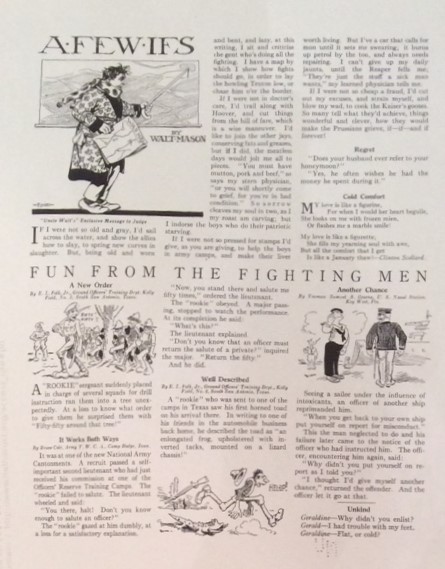
 Best joke:

 Geraldine—Why didn’t you enlist?
Gerald—I had trouble with my feet.
Geraldine—Flat, or cold?
(Judge, January 5, 1918)

Judge magazine, January 5, 1918

I know what you’re thinking: “This joke is not funny at all. I wish I could go back in time and never have heard this joke.” But, believe me, this is the best joke I could find. I know. It’s sad.

 Worst joke:

It’s pretty much a tie between all the other jokes  I read this month. They’re either corny, like this one:

“I’d like to have Simpkins’ yellow streak.”
“Why you coward!”
“It’s in a gold mine.”

or incomprehensible, like this one:

He—What music are you going to have at your dance?
Other he—The fraternity hat-band.

(Both from Judge, January 5, 1918)

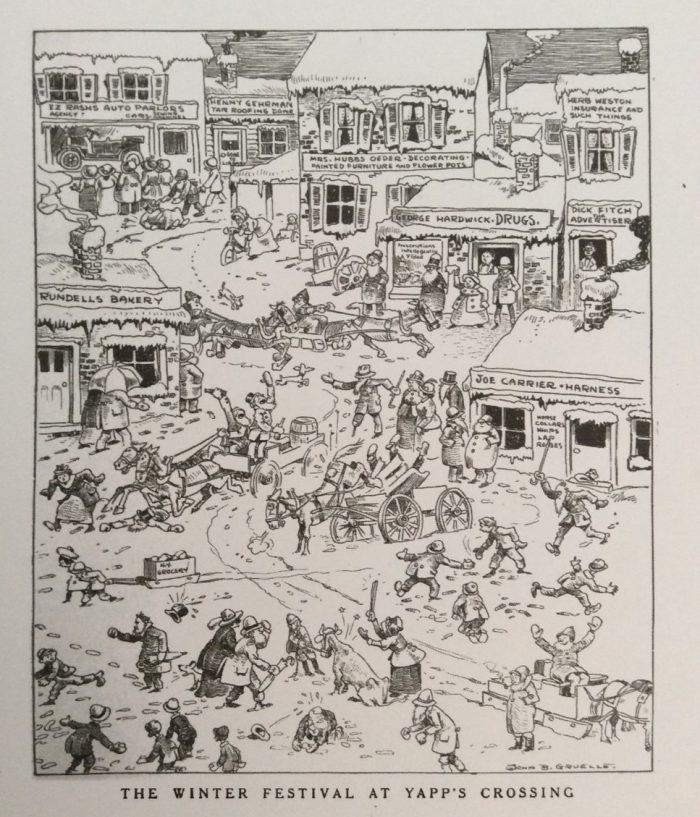
Okay, I can’t end on that note. As I’ve noted before, Judge did have excellent illustrators. I’ll close out the month with another Yapp’s Crossing illustration from John Gruelle, who, it turns out, was the creator of Raggedy Ann and Raggedy Andy.

On to February!

crop

A 1918 story gets the MFA workshop treatment

For a recent MFA graduate like me, the 1918 writers’ market inspires huge envy. There were dozens of mass-circulation magazines, and all of them were full of short stories. Quality was a different matter—the poet and critic Louis Untermeyer summed up the critical consensus when he said in the January 17, 1918, issue of The Dial that the magazines offer the public “a series of pink and white heroines with perfume in their veins, endless variations of the Cinderella-Zenda romances, wax dummies with virile pretentions on their lips and riding breeches on their soul.” So I wasn’t expecting much. Most of the stories I’ve read have been pretty entertaining, though. The biggest problem is that, almost without exception, they end abruptly with a “surprise” twist that anyone could have seen coming.

The core of an MFA program is the workshop. Students read each other’s stories and—in my program, anyway—write letters commenting on them. I decided to give this treatment to one of the stories I read this month, “Between the Cat’s Paws,” by Elizabeth Jordan, which appeared in the January 1918 issue of Woman’s Home Companion.

Banner, Woman's Home Companion, January 1918.

Dear Elizabeth:

I enjoyed reading “Between the Cat’s Paws.” You did a good job of portraying the main character, Penfield “Penny” Hewett, a 23-year-old lover of “golf sticks and polo ponies,” who, to the unflattering astonishment of his friends and family, has found success as an architect. We see the increasing sense of entrapment caused by his long engagement to his college classmate Arabella, who’s a suffragist in the East and rarely writes these days. And we see how he’s torn apart by his feelings for Ruth, the sister of Ralph, his business partner and pal. I wish I’d learned more about Ruth, though, beyond that she’s an “awfully nice girl” who keeps Penny and Ralph “comfy.”

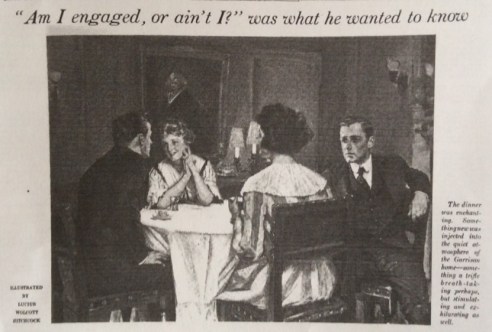
Illustration, Woman's Home Companion, January 1918.

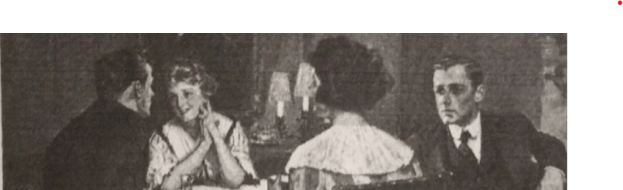
The climax of the story, when Arabella shows up in town after failing to respond to Penny’s subtle (he thinks) inquiries as to whether the engagement is still on, mostly works. I would have liked to see more of the interplay between Penny, Arabella, Ruth, and Ralph at the tea he arranges at Arabella’s insistance, and at the dinner that follows. You can’t just say that “the best in each of the four at the table came out and fused into a perfect comradeship,” we need to see this happening.

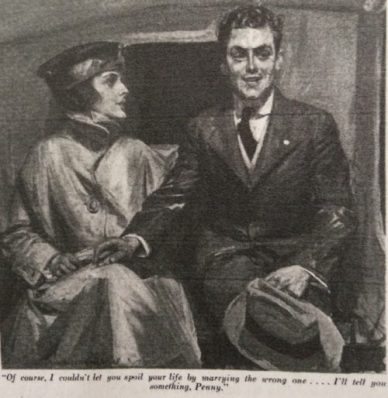
The next scene, with Penny and Arabella alone in a taxi, worked better for me. I believed that Arabella, having seen through Penny’s description of Ruth as “a peach” and “the sort of girl that makes a perfect friend,” would want to check Ruth out before setting Penny free, and I smiled when, to Penny’s bemusement, she said, “Well, Penny, it’s all right. You can have her.” I didn’t believe it, though, when she said that she would have gone ahead with the marriage if she hadn’t approved of Ruth. This seems like a case of the story driving the character, rather than the other way around.

Illustration, Woman's Home companion, January 1918.

I also didn’t buy it when Arabella and Ralph fell in love. Arabella seems too sophisticated and ambitious for Ralph. And Ralph is clearly in love with Penny. You say that his eyes “usually rested on Penny with the deep, dumb devotion that shines in the eyes of a splendid collie,” and that Ralph “adored his chum and did not care who knew it.” I can imagine Arabella (who may be gay as well, given that, pre-Ralph, she was planning to devote her life to her career once she was free of Penny) forming an alliance of convenience with Ralph. But true love? I don’t think so.

Thanks for a good read, and I look forward to more of your stories.

Best,

Mary Grace

Portrait photograph of Elizabeth Jordan, 1901.

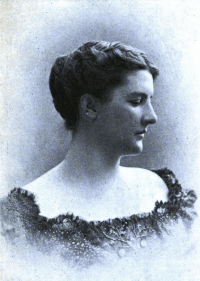
Elizabeth Jordan in 1901

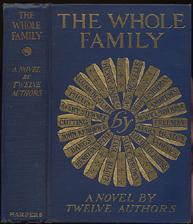
Elizabeth Jordan is—like practically everyone I’ve come across in 1918—an intriguing character. In addition to being a prolific short story writer, she was a noted journalist and editor. She accepted and edited Sinclair Lewis’s first novel for the publishing house Harper & Brothers (now HarperCollins), and she was the long-time editor of Harper’s Bazaar. She was a close friend of Henry James, and she convinced him to contribute a chapter to a 1908 round-robin novel called The Whole Family.

Cover of The Whole Family, 1908.

Jordan was a suffragist herself, and one of my favorite things about “Between the Cat’s Paws” is that ambitious, socially engaged Arabella isn’t a villain or figure of fun, as some writers might have made her. She’s the smartest character in the story (okay, that’s not saying a whole lot), and she pulls all the strings. As for the homoerotic subtext, this is something I’ve seen a surprising amount of, even in The Melting of Mollyespecially in The Melting of Molly. More on this subject later.

I enjoyed “Between the Cat’s Paws.” If Jordan had been free to write a story about the world as she really lived in it, though—now, that’s a story I’d like to read.