Category Archives: In the News

The best and worst of May 1918: Short stories, cover art, ads, and cartoons

I’m back! I’ve been traveling during the past few weeks–from Cape Town to DC to Boston to DC to Boston again and back to DC. Now, belatedly, for the best and worst of May 1918.

Best short story: “The Man Who Came Back,” from Buttered Side Down: Stories, by Edna Ferber (1912)


I decided to expand this category to include any short story I read, not just magazine stories from the “current” month. Just in time, because I’m loving this Edna Ferber collection. Ferber, who is best known for later novels like Show Boat and Cimarron and Giant—or, more accurately, for the movies and shows adapted from them—was twenty-seven when Buttered Side Down was published. She writes about ambitious young people from small towns whose big dreams haven’t panned out. They’re the most real people I’ve come across in my 1918 reading.

In “The Man Who Came Back,” Ted Terrill, our handsome hero, has returned to his small town after spending three years in prison. Here’s how, trying to keep up with the smart set, he met his downfall:

In a mad moment he had attempted a little sleight-of-hand act in which certain Citizens’ National funds were to be transformed into certain glittering shares and back again so quickly that the examiners couldn’t follow it with their eyes. But Ted was unaccustomed to these now-you-see-it-and-now-you-don’t feats and his hand slipped. The trick dropped to the floor with an awful clatter.

Ted is planning to stop in town just long enough to visit his mother’s grave—she died of heartbreak while he was in prison—and make a new start in Chicago, but on the train he runs into Joe Haley, the owner of a fashionable hotel. Joe offers him a job as a bookkeeper, saying that he’d be better off facing up to his crime at home than living in fear of discovery in a new place.
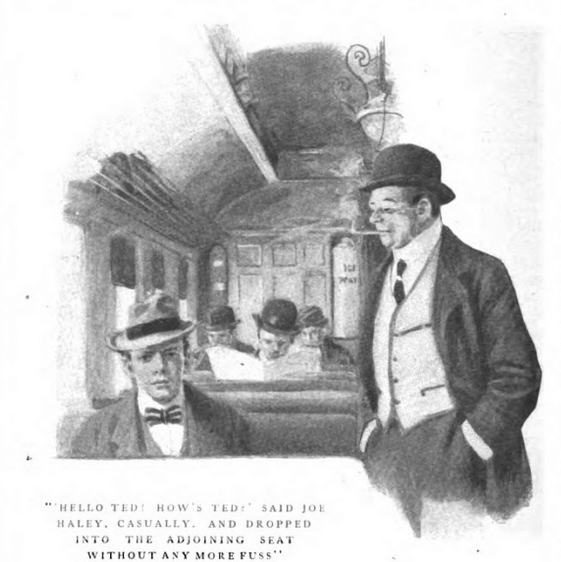
Illustration from “The Man Who Came Back,” American Magazine, April 1911

Ted is trained by his predecessor, Minnie Wenzel, who is marrying a “swell fellow.” His family’s former servant, Birdie, whose face “looked like a huge mistake,” works at the hotel as a waitress. All goes well until one day Joe tells Ted $300 is missing. “Ted, old kid,” he says sadly, “what’n’ell made you do it again?’” Birdie bursts in and unmasks the real culprit, Minnie, who has been pocketing the money for her trousseau. Ted asks Birdie if he can walk her home. But Birdie—and this is what elevates the story from good to great—turns him down. If she let him, she says,

“inside half a year, if yuh was lonesome enough, yuh’d ask me to marry yuh. And b’gorra,” she said softly, looking down at her unlovely red hands, “I’m dead scared I’d do it. Get back to work, Ted Terrill, and hold yer head up high, and when yuh say your prayers to-night, thank your lucky stars I ain’t a hussy.”

Edna Ferber, date unknown

Best magazine covers:

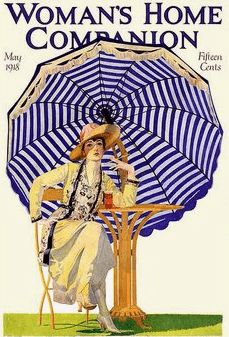
Two favorites in indigo: this one from Woman’s Home Companion, artist unknown,
…and, as always, Erté. This one’s called “Fireflies.”

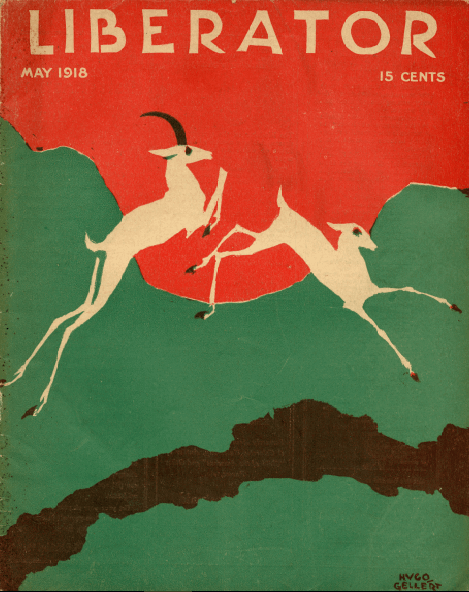
Also, a paean to spring from The Liberator’s wonderful Hugo Gellert.
Best ad:

May wasn’t a sensational month ad-wise, but I always have a soft spot for Old Dutch Cleanser.
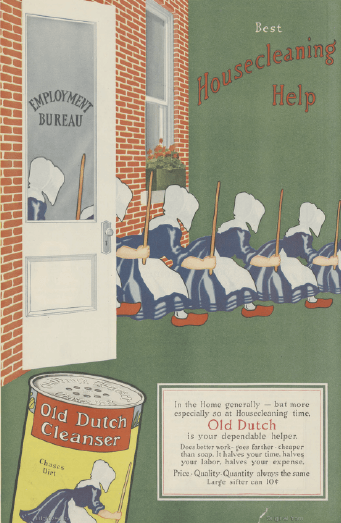
Ladies’ Home Journal, May 1918

Worst ad:

Even without the benefit of hindsight, this ad for asbestos looks ominous.
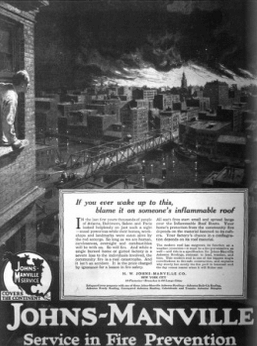
Literary Digest, May 11, 1918

(Although not as ominous as this 1917 ad I came across in Scientific American.)
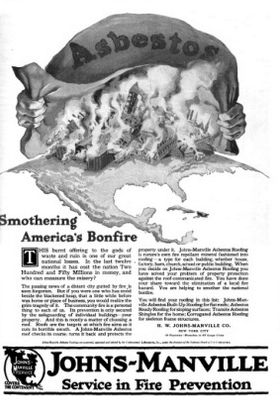
Scientific American, April 28, 1917

Best cartoon:

Cartooning was in its infancy in 1918, but I don’t think the artistry of that era has ever been surpassed.
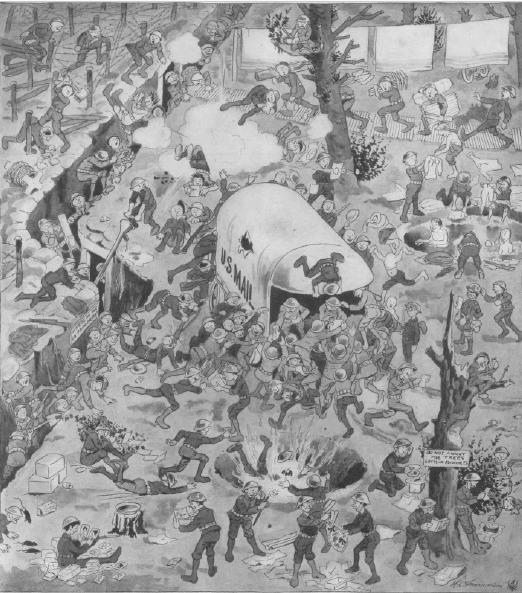
“The Mail from Home Arrives,” H.C. Greening, Judge magazine, May 11, 1918

Worst cartoon:

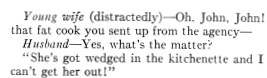
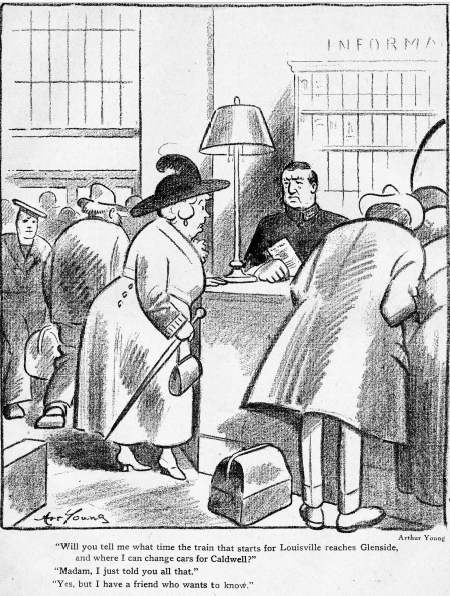
 Captions, though, still left a lot to be desired.

“Will you tell me what time the train that starts for Louisville reaches Glenside, and where I can change cars for Caldwell?”
“Madam, I just told you all that.”
“Yes, but I have a friend who wants to know.”
Screenshot (729)-2

Arthur Young, The Liberator, May 1918

 On to (okay, the middle of) June!

squiggle

*UPDATE 12/7/2019: It’s Coles Phillips, most famous for his Fadeaway Girl illustrations. I wrote about him here.

Coles Phillips Vogue cover, woman with hat,


In search of a good mother poem

Mother’s Day has come and gone with no acknowledgement from me.* But better late than never, right?

Mothers were a big deal in 1918. Of course, they never exactly go out of fashion, but, with American soldiers just beginning to be in harm’s way, they were on everyone’s mind.

President Wilson paid tribute to the

patriotic sacrifices which are being most freely and generously made by the mothers of this land in unselfishly offering their sons to bear arms, and, if need be, die in defense of liberty and justice.

Clifford Berryman, Washington Evening Star, May 2, 1918

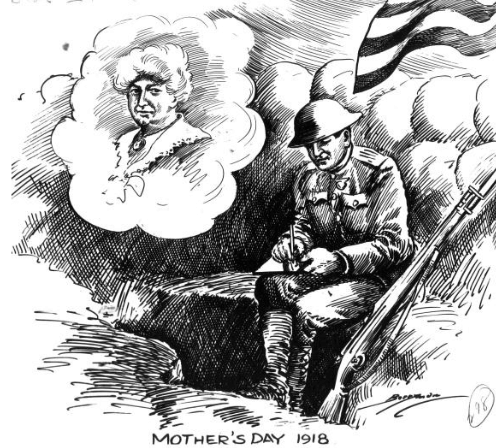
According to the New York Times, General Pershing called on his troops to write home on Mother’s Day. The Y.M.C.A. in France took stationery to the trenches and delivered the letters to the army postal service, where they were marked “Mother’s Mail” and given top priority. “Mother booklets” were distributed to the soldiers, containing Rudyard Kipling’s “Mother o’ Mine,”** Henry van Dyke’s “Prayer for a Mother’s Birthday,” and “a typical letter written from any mother to any soldier.”***

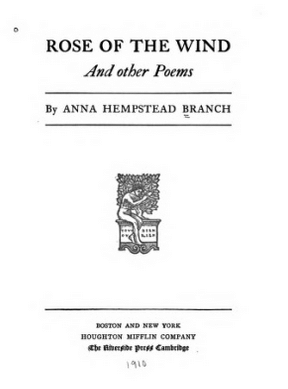
There was a lot of poetry about mothers, most of it, as in any era, pretty bad. So I was intrigued when William Lyon Phelps, author of a seemingly endless series of articles in The Bookman called “The Advance of English Poetry in the Twentieth Century” (we’re on Part VIII now), praised some poems on motherhood by Anna Hempstead Branch. Phelps, an author, critic, and scholar whose lectures drew enthralled throngs,**** called Branch’s poems “as beautiful in their uncrowded simplicity as an eighteenth century room.”

I didn’t get my hopes up too high, though, since, according to Phelps, Branch was the only contemporary poet James Witcomb Riley could stand. The Hoosier Poet has a special place in my heart—he was imprinted on me during a few impressionable childhood years in Indiana—but even Phelps, who was no avant-gardist, called him “the most conservative man I ever knew.” My expectations were lowered further when I read on Wikipedia that Phelps “was regarded as a major poet during her life,” which always has a subtext of “but we all know better now.”

Here’s the first part of Songs for My Mother, called “Her Hands.”

My mother’s hands are cool and fair,
They can do anything.
Delicate mercies hide them there
Like flowers in the spring.

When I was small and could not sleep,
She used to come to me,
And with my cheek upon her hand
How sure my rest would be.

For everything she ever touched
Of beautiful or fine,
Their memories living in her hands
Would warm that sleep of mine.

Her hands remember how they played
One time in meadow streams, —
And all the flickering song and shade
Of water took my dreams.

Swift through her haunted fingers pass
Memories of garden things; —
I dipped my face in flowers and grass
And sounds of hidden wings.

One time she touched the cloud that kissed
Brown pastures bleak and far; —
I leaned my cheek into a mist
And thought I was a star.

All this was very long ago
And I am grown; but yet
The hand that lured my slumber so
I never can forget.

For still when drowsiness comes on
It seems so soft and cool,
Shaped happily beneath my cheek,
Hollow and beautiful.

With all due respect to Phelps, and to Branch’s fragrant mother—no. It’s not just that this poem has nothing to do with where poetry was going.***** Try to read that last stanza out loud. For it to work, you have to pronounce the last line “hollOW and beatiFOOL.” It’s fine to bend the rules on rhyming and scanning if your structure is looser—for example, “Streets that follow like a tedious argument/Of insidious intent,” from T.S. Eliot’s “The Love Song of J. Alfred Prufrock,” doesn’t scan particularly well—but if you’re locked into your scheme as tightly as Branch is, you’ve got to stick with it. I did like “I…thought I was a star,” but I got lost trying to follow the cloud/pasture/cheek/mist trajectory.

Then I stumbled upon William Carlos Williams’ 1917 poem “Dedication for a Plot of Ground.” Once again, I didn’t get my hopes up. For one thing, WCW and I have a history, dating back to the early days of this blog when I denounced his foray into poetic Cubism. Plus, have you ever come across a more boring title?

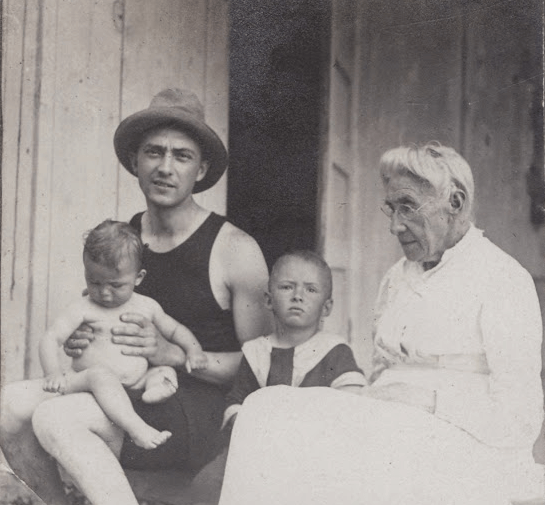
William Carlos Williams with his two sons, Paul and William, and his grandmother, Emily Dickinson Wellcome, circa 1918 (Beinecke Library, Yale, University)******

The poem is about Williams’ maternal grandmother. Here it is:

This plot of ground
facing the waters of this inlet
is dedicated to the living presence of
Emily Dickinson Wellcome
who was born in England; married;
lost her husband and with
her five year old son
sailed for New York in a two-master;
was driven to the Azores;
ran adrift on Fire Island shoal,
met her second husband
in a Brooklyn boarding house,
went with him to Puerto Rico
bore three more children, lost
her second husband, lived hard
for eight years in St. Thomas,
Puerto Rico, San Domingo, followed
the oldest son to New York,
lost her daughter, lost her “baby,”
seized the two boys of
the oldest son by the second marriage
mothered them—they being
motherless—fought for them
against the other grandmother
and the aunts, brought them here
summer after summer, defended
herself here against thieves,
storms, sun, fire,
against flies, against girls
that came smelling about, against
drought, against weeds, storm-tides,
neighbors, weasels that stole her chickens,
against the weakness of her own hands,
against the growing strength of
the boys, against wind, against
the stones, against trespassers,
against rents, against her own mind.

She grubbed this earth with her own hands,
domineered over this grass plot,
blackguarded her oldest son
into buying it, lived here fifteen years,
attained a final loneliness and—

If you can bring nothing to this place
but your carcass, keep out.

Now, THAT’s a poem. It’s fierce. And Emily Dickinson Wellcome was a fierce mother. What a life! Look at it in geographic terms*******:

And so much loss and heartbreak along the way.

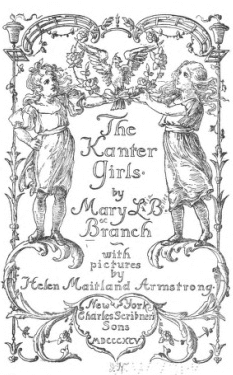
If I had to pick a mother from between these two, I’d choose Phelps’s mom, Mary L.B. Branch. When she wasn’t caressing Anna’s brow, she was a poet and children’s author (although not a very good one, from my brief look at her work). She and her husband raised Anna in Connecticut, where her family had lived since 1640. There’s something to be said for stability.

But a poem about a mother? I’ll take Emily, any day.

[UPDATE 9/25/2019: I subsequently found the worst mother poem of all. Read about it here.]

Title page, The Kanter Girls, by Mary L.B. Branch, 1895

*My Year in 1918-wise, that is. IRL I was on it.

**Which I just read and it’s all about dying and is a terrible poem to give to a soldier!

***1918 mothers were surprisingly interchangeable. American soldiers were apparently known for their need for mothering and their tendency to glom on to the nearest French woman of appropriate age. (But the French apparently thought it was pretty cool, since they followed the American soldiers’ example and celebrated Mother’s Day for the first time that year.)

****People supposedly sat outside packed churches to listen to him through the windows. Those were the days!

*****For an interesting discussion of how a poem can have nothing to do with where poetry is going and still be great, read Frank Hudson’s recent post on Sara Teasdale’s “Union Square.” He sings it too!

******CORRECTION 9/4/2019: I originally identified the woman in this photograph as Williams’ mother after seeing her identified as such in several places, including a blog post published by Yale’s Beinecke library, which owns the photograph. When I saw her identified as Williams’ grandmother Emily Dickinson Wellcome in the Williams biography Something Urgent I Have to Say to You, I inquired with Beinecke Library and was told it is Wellcome.

******Not completely accurate geographic terms, apparently—E.D.W. was not the most truthful of grandmothers.

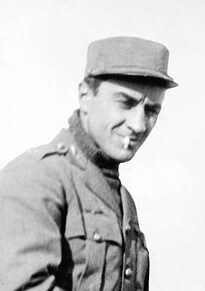
James Hall in the Lafayette Escadrille, 1917

The fate of Captain Jimmy Hall

You know how, when someone disappears following an apparently fatal accident, everyone talks about their prospects with fake hope belied by occasional slippage into the past tense? That’s what happened when American aviator Captain James “Jimmy” Hall was shot down by the Germans.

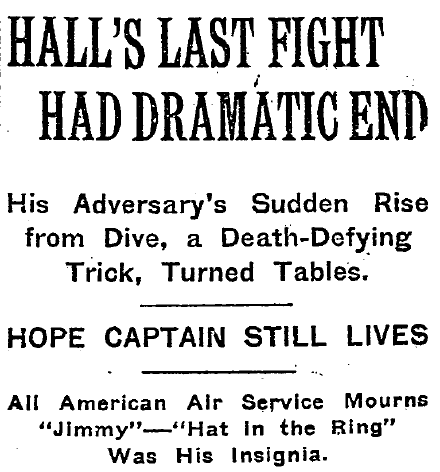
According to a May 9, 1918 story in the New York Times, Hall was “popular throughout the army” and “had won admiration by his daring, coolness, and skill in handling his machine.” But his luck ran out. He was on the brink of victory in an air battle over Pagny-sur-Mosselle when his desperate German foe attempted

a manoeuvre unheard of, so far as American and French pilots in this part of France are concerned. It has been considered dangerous to the last degree to bring up a machine sharply from a downward plunge, because the strain is almost certain to cause the collapse of some vital part of the plane.*

But it worked, and the German pilot “thus was enabled to pour a stream of bullets into the bottom of Hall’s machine.”

Jimmy’s companions watched as his plane plunged toward the ground. They waited for several hours before returning to the hangar, where they talked bravely of his possible survival.

New York Times, May 9, 1918

At the time of Hall’s crash, the American air force was in its infancy. It went by the uninspiring name of “Aviation Section, Signal Corps,” although it would be rebranded the United States Army Air Service later in the month. The first American air squadrons had just arrived in April. Before that, a few American aviators, like Hall, had flown with allied forces. The Times noted that Hall’s plane bore the American aviators’ newly created “Hat in the Ring” insignia.

I didn’t see much hope for Jimmy. Nor did the Times, which ran a short obituary-like item below the story:

Flight Captain James Norman Hall, reported as missing in France, fulfilled an oft-repeated wish for, after fighting under French and British colors, his final combat was as an American. Hall was 30 years old and his home was in Colfax, Iowa, where his parents live.

But I figured that Hall’s story was interesting enough that, even if he had died, I might be able to learn more about him. So I Googled him and…

Hat in the Ring insignia, Air Service, U.S. Army, 1918

…JIMMY LIVES!!!!!

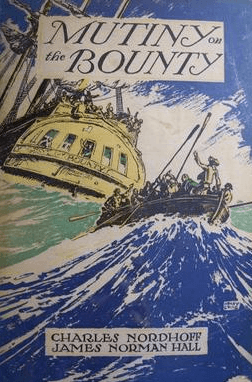
Not only does he live, he goes on to co-write Mutiny on the Bounty. I bet you didn’t see that coming!

Before we come to that, though, I’ll get you up to speed on Hall’s pre-war life. After attending Grinnell College in Iowa, he moved to Boston to be a social worker, studied for a master’s degree at Harvard, happened to be on vacation in England when the war broke out, enlisted in the army by posing as a Canadian, went to the trenches, got kicked out when his ruse was discovered, went back to the United States and began a career as a writer, was sent to France by the Atlantic Monthly to report on Americans fighting for France, got caught up in the cause and joined the Lafayette Flying Corps,** and joined the American army when the United States entered the war.

After spending the rest of the war in German prisons, Hall was awarded the French Légion d’Honneur and the American Distinguished Service Cross. He moved to Tahiti and resumed his writing career. With fellow veteran and Tahiti resident Charles Nordhoff,*** he wrote Mutiny on the Bounty and its sequels, along with numerous other books.

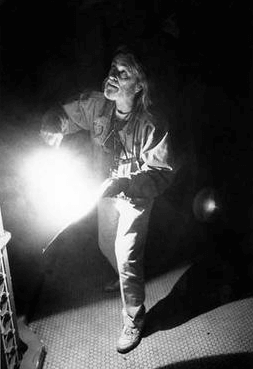
Conrad Hall, American Cinematographer, 2003

Hall and his wife, who was part Polynesian, had a daughter named Nancy and a son named Conrad. Conrad would go on to win three Academy Awards as a cinematographer, for Butch Cassidy and the Sundance Kid, American Beauty, and Road to Perdition.

It’s one thing to realize in the abstract that each life lost in World War I, or in any war, erases what the person might have achieved in later life, the children they might have had, what their children might have achieved, and so on through time. But I’ve never seen this illustrated so vividly as it is here. If Hall had died in that crash, we wouldn’t have Mutiny on the Bounty, or any of his other books, or any of the movies based on his books, or, at least in their current form, any of Conrad Hall’s movies. And that’s just one person. Ten million soldiers and five million civilians died in World War I.

It makes you stop and think, doesn’t it?

Little, Brown, and Company, 1932

*Of course this is old hat to us because we’ve seen it a million times in the movies.

**Which you’d think the Atlantic Monthly could have seen coming given his track record.

***whom he had or hadn’t met during the war depending on whose Wikipedia entry you believe (UPDATE: According to Hall’s family’s fascinating website about him, they met in November 1918 after Hall’s release.)

On Marx’s 100th birthday, a surprising New York Times tribute

It’s May 5, 1918, the 100th anniversary of Karl Marx’s birth. There’s an admiring article about him in the New York Times Magazine.

My first reaction: What?

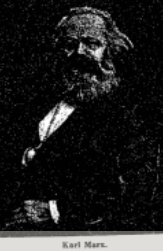
Karl Marx, New York Times, May 5, 1918.

Illustration for John Spargo’s article on Karl Marx, New York Times Magazine, May 5, 1918

The New York Times was so conservative that it had recently let the president of Columbia University write the Times’ good-riddance editorial himself after renowned historian Charles Beard resigned from the university’s staff over free speech issues. If you’re having trouble disentangling this sentence, you can read all about this episode here. Or you can just take my word for it: the Times was really, really conservative.

Then I started reading about John Spargo, who wrote the article, and got even more confused. The British-born Spargo was a leading socialist thinker and a founding member of the Socialist Party of America. He was the author of Karl Marx: His Life and Work.

What was going on here?

John Spargo, Midweek Pictorial, October 7, 1919.

John Spargo, Midweek Pictorial, October 7, 1919

As I learned more about Spargo, it started to make sense. It turned out that he had resigned from the Socialist Party in 1917 after his attempt to get it to support U.S. participation in the war was roundly defeated. He started his own short-lived socialist party and helped found the American Alliance for Labor and Democracy, a pro-war labor organization led by AFL president Samuel Gompers.

In 1918, it all came down to where you stood on the war. Being a socialist was a less serious offense than being a pacifist. The defunct socialist magazine The Masses was on trial, but for obstructing conscription, not for advocating socialism (although that probably didn’t help).* Also, Wilson had until recently been trying to keep Russia’s Bolshevik government in the war (they made peace with Germany in March), so a hard-line anti-socialist stance hadn’t been in the national interest.

New York Times headline, Today is 100th Anniversary of Marx's Birth.

New York Times Magazine, May 5, 1918

In Spargo, the Times had found a prominent socialist who would argue in favor of the war in Marx’s name. Kind of, anyway. The headline of Spargo’s article reads “Today is 100th Anniversary of Marx’s Birth: Bitterly Opposed to Prussia and an Ardent Admirer of America—his Record Shows Where He Would Have Stood in the Present War.” Which overstates Spargo’s case, kind of.

Spargo writes that

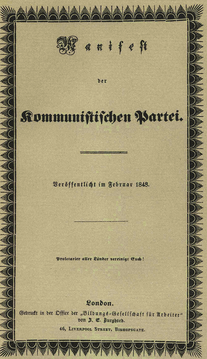
because Marx wrote in the famous “Communist Manifesto” that “the workingmen have no country,” and because he was a strong advocate of internationalism, it has been generally supposed that Marx did not believe in nations or nationalism. This is a profound misconception.

Cover of German edition of Communist Manifesto, first edition, 1848.

Communist Manifesto, first edition, in German, 1848

According to Spargo, Marx was a strong German nationalist, and was no pacifist—favoring, for example, vigorous action against France in the 1870 Franco-Prussian War. He hated militarism, though, “with all the fierce passion of which he was so magnificently capable.” His view on war was nuanced:

Always he asked himself whether a particular war, or the triumph of one or the other side in a particular war, made for human progress or against it.

Marx was also a “a great friend of America,” and a big Abraham Lincoln fan. According to Spargo, he played an influential role in Britain’s decision to stay out of the Civil War instead of siding with the south.

Therefore, Spargo says,

Having regard to his life’s record, we are justified in believing that, if Marx were alive today, he would hold in scorn those Socialists who, in the name of Socialist Internationalism, have proclaimed their opposition to America’s participation in the great struggle for freedom, democracy, and that independence and integrity of nations without which there can be no internationalism.

That’s a bit of a leap of logic. But it got Marx into the New York Times on his centenary.

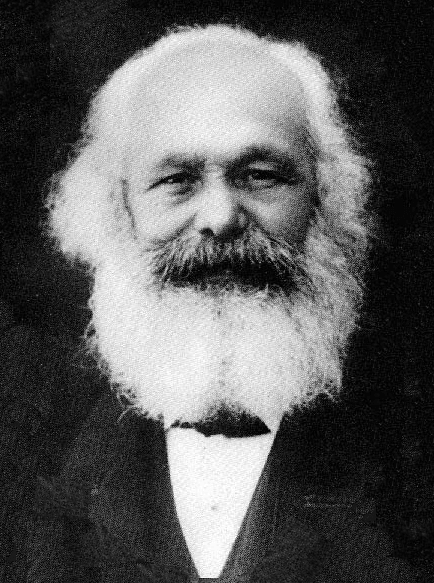
Karl Marx, 1882.

Karl Marx, 1882

*Actually, it was between trials—Judge Augustus Hand (cousin of Learned) had declared a mistrial on April 27 after the jurors failed to reach agreement. One juror held out for acquittal and eventually persuaded one or two others (accounts vary) to side with him. When his fellow jurors found out that he was of Austrian descent, they threatened to have him lynched. “If I had noticed that man’s jaw, I never would have let him on the jury,” the prosecutor later said. A new trial was scheduled for later in the year.

The best and worst of April 1918: Magazines, stories, faint praise, and neologisms

A third of the way through!

After four months in 1918, I’ve become both more optimistic and more pessimistic about our present world. More optimistic because so many problems that seemed intractable back then, like the acceptability in mainstream circles of overt racism, sexism, and antisemitism, are gone now. More pessimistic because of all the new problems, like global warming, that people back then couldn’t have conceived of.

Okay, enough philosophizing. On to the best and worst of April 1918.

Best magazine: The Dial

The Dial is one of the most reliably interesting reads of 1918. It started out in 1840 as an outlet for the Transcendentalists (Louisa May Alcott’s father came up with the name) and was now a Chicago-based political and literary journal. H.L. Mencken wasn’t a fan—he ridiculed the “insane labeling and pigeon-holing that passes for criticism among the gifted Harvard boys of the Dial and the Nation”—but staff writer Randolph Bourne gave as good as he got, saying that Mencken and Theodore Dreiser “beat at a straw man of puritanism which, for the younger generation, has not even the vitality to be interesting.”*

The Dial did have a tendency to review seemingly every book that showed up on its doorstep, like Colorado, the Queen Jewel of the Rockies. But when a single (April 11) issue includes John Dewey on education, historian Charles Beard (who had recently resigned in protest from Columbia) on universities and democracy, Conrad Aiken on poetry,** and Bourne on immigrant fiction, I can forgive a lot.

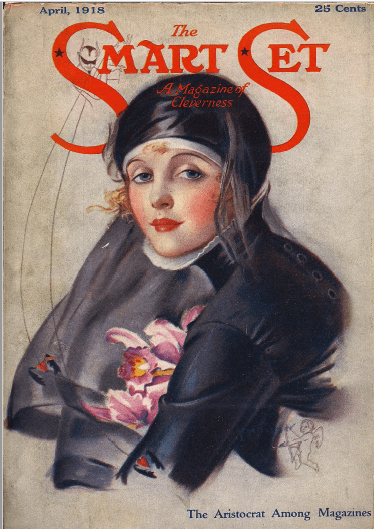
Best short story: “The Swimming Pool” by Evelyn Campbell, Smart Set

I haven’t read many magazine short stories this month. In fact, I’ve read just one: this one. And I wouldn’t call it a great story. So this might strike you as a shoddy bit of best-and-worst selecting. But something about this story by Evelyn Campbell, a 22-year-old screenwriter and Ziegfeld Follies girl, got to me.

A woman, swimming in a pool as darkness falls, strikes up a conversation with a man. They’re both natural swimmers, creatures of the water, and during their brief conversation they fall a little in love.

Suddenly it was dusk. Not in the enclosure made brilliant by white bulbs, but up above in the oblong of dark blue sky where newly awakened stars began to show timid faces to their bolder rivals. They were in the deep water which lay densely beneath them. Again they turned upon their backs and floated.

As the woman leaves the country club with her horrible rich husband and their children, she passes the man, who’s wearing an ill-cut suit. Her daughter says, Oh, look, the new janitor. A typical Smart Set snappy ending. In most stories, though, the twist at the end is the point—the rest is just setup. Here, the spell that the water casts on the swimmers is the point, and the ending is just the resolution.

Some of Campbell’s descriptions work better than others—I can’t picture what “in the middle of the pool a big golden square turned the water to bright emerald” looks like—but she’s trying something other writers just weren’t doing in 1918. That is, Imagist poets were, but not magazine short story writers.

Best magazine cover: The Crisis

Even by 1918’s high standards, this was an exceptional month for magazine covers. I’ve posted pictures of several of them already (here and here and here). The standout, though, is the cover of the April issue of The Crisis, the NAACP magazine edited by W.E.B. Du Bois. It features a copy of a painting called “Lead Kindly Light,” made for the magazine by 34-year-old William Edouard Scott (and now owned by the Huntington Museum of Art in West Virginia).

Here’s how the magazine’s editorial, probably written by Du Bois, interprets the painting.

It is just an old lantern, filled with grimy oil. It cannot lead anywhere, yet its light leads. Its golden light streams through the night.

Whose is the light?

It is not the lantern’s. It simply seems to be the lantern’s radiance. It is the Light of the World and it leads not toward the millennium in the North, but out of the insult and prostitution and ignorance and lies and lynchings of the South—up toward a chance, a new chance,—nothing more. But thank God for that…

Lead, Kindly Light.

Worst magazine cover: Ladies’ Home Journal

This is a repeat, but nothing was going to beat this Ladies’ Home Journal cover, titled (by me) “Oh, how sweet! My boyfriend killed someone!”

Best poem: “Is It Worth While,” Violet Hunt, Poetry

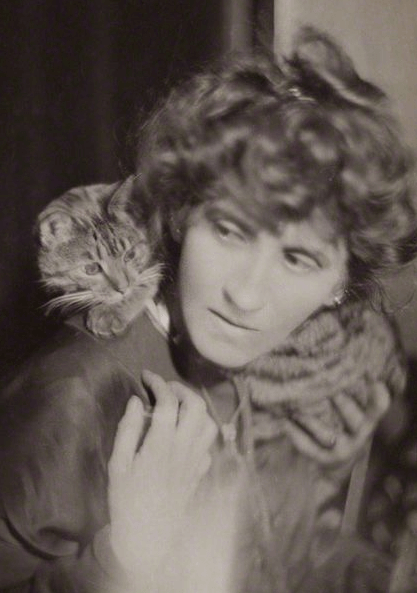
Violet Hunt, ca. 1900

Reading Poetry magazine, you can see how living in 1918 was like living in two worlds. In the April 1918 issue, there’s page after page of purple mountains, and it could be 1868, and suddenly there’s Violet Hunt mourning her relationship with Ford Madox Hueffer (Ford), and it could be 1968.

You can read the rest of the poem here.
Faintest praise in a book review: T.S. Eliot, The Egoist

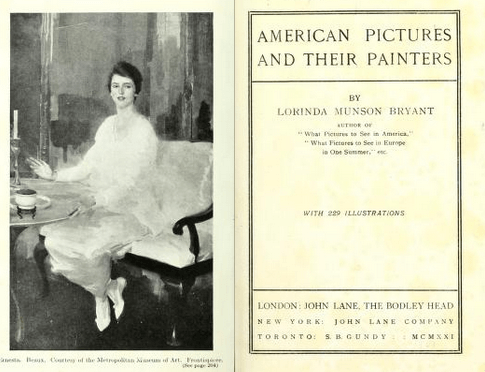
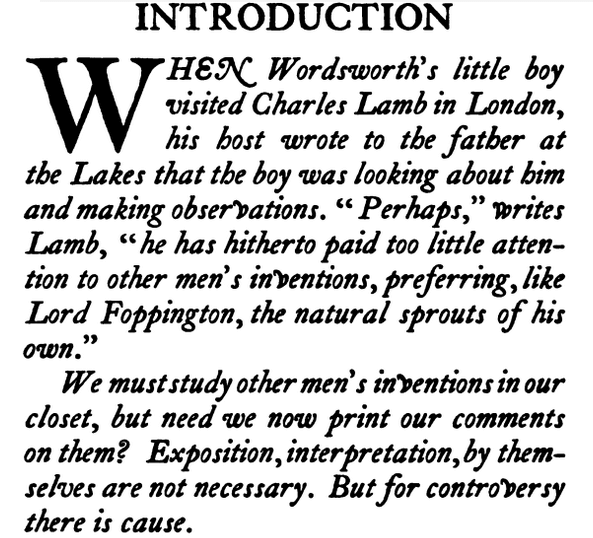
archive.org

This was a surprisingly competitive category. At first, this unsigned review in the April 11 Dial, of Lorinda Munson Bryant’s American Pictures and their Painters, looked like a shoo-in:

One sincerely wishes that Mrs. Bryant in her enthusiasm for nature, both inanimate and human, had focused her numerous descriptions of the subject matter of the paintings. That the painter has chosen to paint a wintry landscape…is surely no excuse for a genteel panegyric on winter, or that the artist has selected a human being…is no excuse for a general eulogy of mankind. In the family circle a little girl, it is true, may be a “darling,” but in a painting that may be the least interesting of her attributes….If the subject is a woman, and a thin one at that, the author thinks the artist would have been wiser to select a plumper and rosier model…Aside from these minor defects the book is a handy and valuable compendium.

From “Hearts of Controversy,” by Alice Meynell, second edition, 1918

But then I came across this review of Alice Meynell’s Hearts of Controversy by Apteryx, AKA T.S. Eliot, in the April issue of The Egoist, and we had a winner.

In its peculiar anti-style, Mrs. Meynell’s book, like all her books, is extremely well written, and she can incidentally pick out good bits from authors. If we can accept this attitude, we shall enjoy the book very much. And people who have a taste for that antiquated genre, that parlour-game, the Polite Essay—which consists in taking a tiny point and cutting figure eights around it, without ever uttering one’s meaning in plain words—will find in Mrs. Meynell’s last essay (“Charmain”) an almost perfect example of a forgotten craft which indeed had its attractions.

*                                              *                                              *

But we must learn to take literature seriously.

(Asterixes Apteryx’s.)

Best neologism: Surréaliste

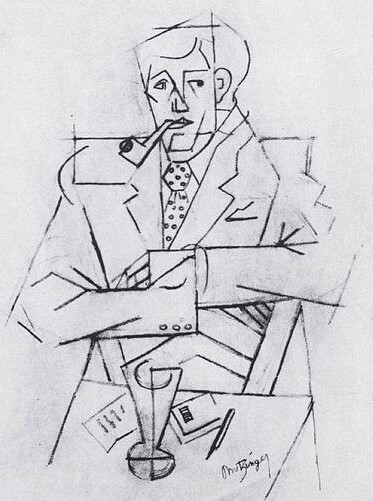
Study for a portrait of Guillaume Apollinaire, Jean Metzinger, 1911

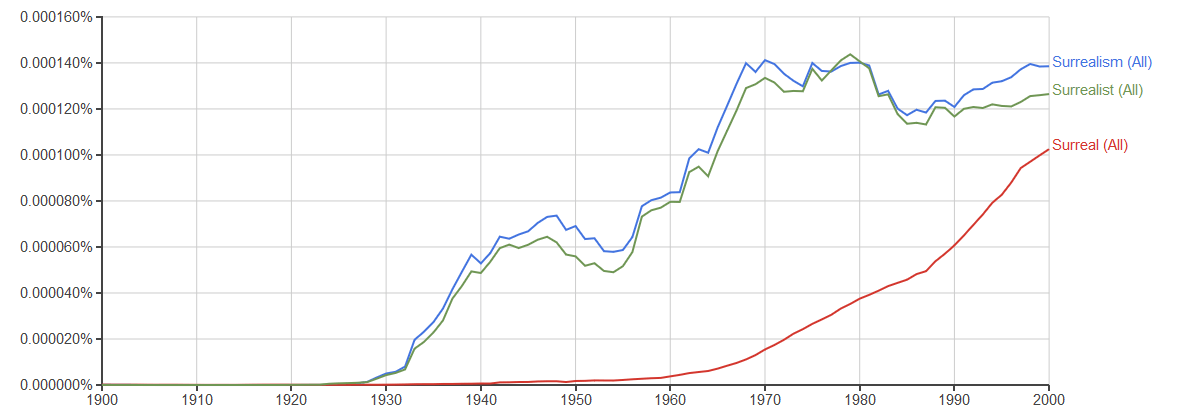
“SURRÉALISTE is the denomination M. Guillaume Apollinaire—there is no doubt his astounding name continues to have good reason for keeping well in evidence—has attached to his play, Les Mamelles de Tirésias,” the Paris correspondent for The Egoist tells us. I knew that the surrealist movement was just getting underway in 1918, but it seemed strange to think of the word itself being a novelty. So I crunched some big data—that is, did a Google Books N-Gram***—and it’s true, surreal and its variants were pretty much non-existent at that point. So what did people say when things were, you know, surreal? (UPDATE 1/16/2021: It turns out that “stream of consciousness” in a literary context was also coined this month, by May Sinclair in an article about novelist Dorothy Richardson in The Egoist, which I actually read without realizing “stream of consciousness” was making its debut.)

Best humor: 

In The Bookman, there’s a report about the mystery surrounding the identity of the author of The Book of Artemas, a bestselling British spoof relating current events in biblical style. Was it G.K. Chesterton? J.M. Barrie? Hilaire Belloc? George Bernard Shaw? (It would turn out to be someone no one ever heard of named Arthur Telford Mason.) Here’s an excerpt:

5. Whilst Wudro, the son of Wyl, was tending his flock of young men in the pasture that is knowledge, and after he had taught them how they should go and what things they should know,
6. Behold, the men of Amer came unto him, saying, We have chosen thee for to rule over us; and we have
brought thee an high hat for to wear as the badge of thine office; and the size of the hat, it is six and seven-eights.
7. And because he knew not what he was letting himself
in for, he gave way to their importuning, and did put on the high hat, the size whereof was six and seven-eights.
8. And it came to pass that when the men of En fought against the men of Hu, they did send messengers unto the land of Amer for to buy them munitions for the war. And they took
with them gold in great quantity wherewith to satisfy the merchants that did sell unto them. Therefor did the land of Amer prosper exceedingly.

Worst joke:

Judge, April 27, 1918

On to May!

*Kind of harsh, since Bourne was only six years younger than Mencken.

**He agrees with me about Christopher Morley’s goopiness.

***Which is really fun—you should try if you’re off Facebook and looking for new ways to waste time.

1918 campus wars: Academic freedom at Columbia

Tension is high at the universities. Some say the war is unnecessary and immoral; those who support it cry “treason.” There’s a raging debate over free speech. Columbia University is at the epicenter.

Yes, 1968—but 1918 as well.

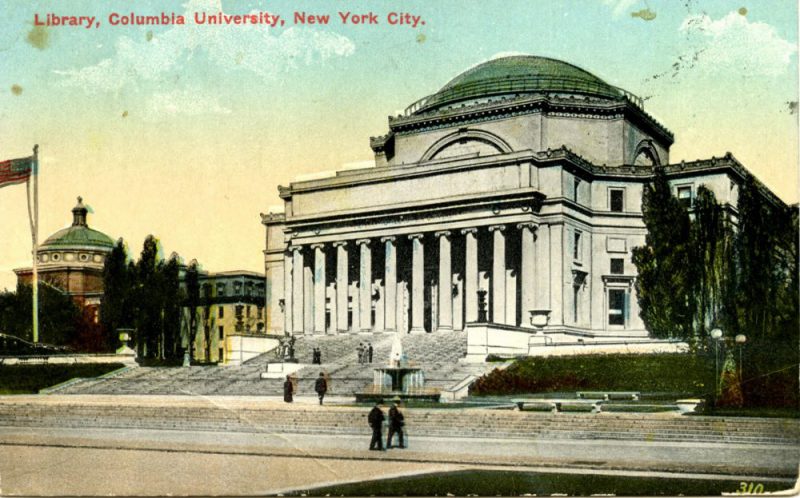
Columbia University library, 1917 (librarypostcards.blogspot.com)

In 1917, the Columbia board of trustees came up with a plan to investigate the teachings of the university’s faculty members, in order to determine “whether the influence of a given teacher is injurious to private morals or dangerous to public order and security.”

The idea was eventually dropped amid widespread opposition—law professor Ellery Stowell called it “Prussianistic”—but in October the trustees fired two faculty members, James McKeen Cattell and Henry Wadsworth Longfellow Dana, for anti-war activities. Their crimes: Cattell had written to Congress asking that conscientious objectors be exempted from service, and Dana was involved with the People’s Council, a pacifist organization.

Cattell had been the first American to publish a dissertation in psychology, and was the first American psychology professor.* Dana was a comparative literature professor and a grandson of both Henry Wadsworth Longfellow and Richard Henry Dana, the author of Two Years Before the Mast.**  To the Philadelphia Ledger, that was the worst part: “The distressing feature of the situation is that both these men bear eminent names and come from long strains of patriotic ancestors.”

Charles Beard in 1917 (Library of Congress)

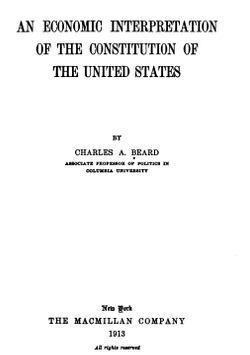
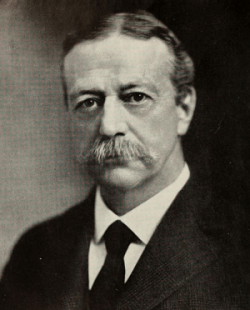
On October 8, noted historian Charles A. Beard resigned from the Columbia faculty in protest. Beard was one of America’s most prominent historians; his 1913 book An Economic Interpretation of the Constitution of the United States remains famous (and controversial) today. He was pro-war himself, but, as he said in his resignation letter to Columbia president Nicholas Butler,

thousands of my countrymen do not share this view. Their opinions can not be changed by curses or bludgeons. Arguments addressed to their reason and understanding are our best hope. Such arguments, however, must come from men whose disinterestedness is above all suspicion…I am convinced that while I remain in the pay of the trustees of Columbia University I can not do effectively my humble part in sustaining public opinion in support of the just war on the German Empire.

Good riddance, the New York Times said in an October 10 editorial. In resigning, the paper snarked, Professor Beard “has just rendered the greatest service it was in his power to give.” About An Economic Interpretation of the Constitution of the United States, the Times said that

it was pointed out to him at the time, with due kindness but frankly, that his book was bad, that it was a book that no professor should have written since it was grossly unscientific…It was a book that did Columbia much harm, just as the two professors who were recently dropped for seditious utterances did the university much harm.

If this type of nonsense was allowed to go on, the Times said, “we would soon see the doctrine of economic determinism applied to everything from the binomial theorem to the Lord’s prayer.” The trustees, the Times said,

have been very tolerant, very patient, and the university has suffered through the acts, the utterances, and the teachings of some of its professors who mistook the chairs they occupied for pulpits from which doctrines might freely be preached that are dangerous to the community and the nation.

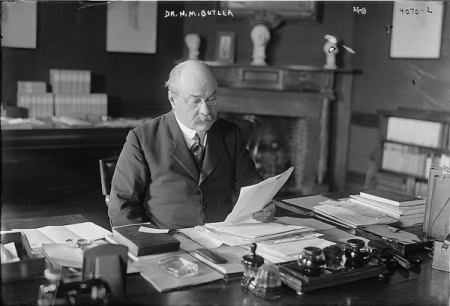
Nicholas Murray Butler in 1916 (Library of Congress)

If you’re thinking that the Times is taking this way too personally, you might be onto something. According to a 1958 article in Columbia’s newspaper, the Daily Spectator, it was widely believed that Times publisher Adolph Ochs let Butler, who was a friend of his, write the editorial himself. That seems plausible. For one thing, the Times editorial board displays a surprising amount of knowledge about the inner workings of Columbia University. Also, the turnaround between Beard’s October 8 letter and the October 10 publication of the editorial was awfully speedy.

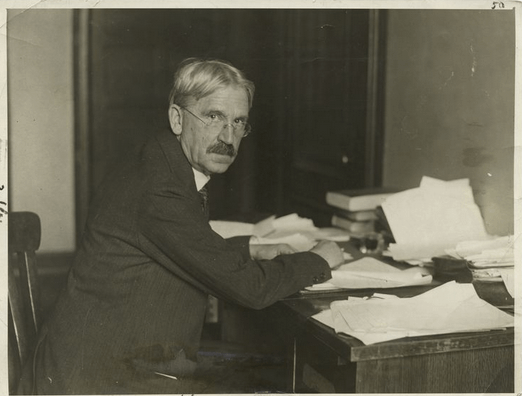
John Dewey, date unknown (New York Public Library Digital Archive)

Writing in The Dial on November 8, educationist John Dewey, who was also on the university’s (apparently very illustrious) faculty, said that the press had falsely portrayed the controversy as a free speech issue because the real issue, administrative control of the universities, was too boring. But just because it’s boring doesn’t mean it’s not important:

It is not too much to say that the final issue is how much the American people cares about the integrity and responsibility of the intellectual life of the nation.

Ellery Stowell in 1917 (Library of Congress)

In February 1918, Ellery Stowell, the law professor who had called the inquiry “Prussianistic,” submitting his own resignation. Stowell himself supported not only the war but the firing of Cattell and Dana. Like Dewey, though, he believed that the issue should have been left up to the faculty rather than the trustees.

Beard himself weighed in in the Dial on April 11:

At bottom and forever, the question of academic freedom is the question of intellectual and spiritual leadership in American democracy. Those who lead and teach, are they free, fearless, and worthy of trust?

If the trustees take over, Beard says,

men who love the smooth and easy will turn to teaching…Men of will, initiative, and inventiveness, not afraid of falling into error in search for truth, will shun such a life of futile lubricity, as the free woman avoids the harem.

Abbott Lawrence Lowell, “The World’s Work,” 1919

Beard praised Harvard president Abbott Lawrence Lowell, who wrote in the university’s annual report in December 1917 that

the teaching by the professor in his class room on the subjects within the scope of his chair ought to be absolutely free. He must teach the truth as he has found it and sees it. This is the primary condition of academic freedom, and any violation of it endangers intellectual progress.

Well said, President Lowell!***

The debate over free speech (or whatever you want to call it) wasn’t the only battle raging on the campuses. Also at issue was the whole essence of what a university, and the country’s intellectual life as a whole, should be about. Here, too, Columbia was at the center of the action.

But that’s an issue for another post.

Widener Library, Harvard University, 1914 (Harvard University Archives)

*He was also a eugenicist. He offered his children a cash gift of $1000 if they married the offspring of a professor.

**That ought to be worth at least $2000 to Cattell’s kids.

***I’d be a lot prouder on my alma mater’s behalf, though, if Lowell–who was the brother of poet and critic Amy Lowell–didn’t have such a sorry record on treatment of black, Jewish, and gay students.

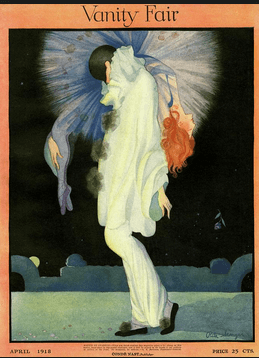
Thursday Miscellany: an eight-year-old writer, a Vanity Fair harlequin, and toasted cigarettes

(I’m changing my schedule from M-W-F to Tu-Th-Sat, so Wednesday Miscellany is now Thursday Miscellany.)

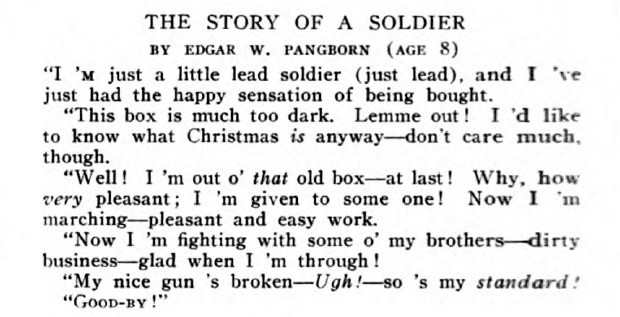
This story was a submission to a contest in St. Nicholas magazine. Even if you don’t read it as an allegory of a doomed WWI soldier–and it’s hard not to–it seems way too good to have been written by an eight-year-old. I Googled Edgar Pangborn,  and it turns out that he went on to become a science fiction writer who was one of the founders of the “humanist” school and served as an inspiration to Ursula Le Guin.*

St. Nicholas magazine, April 1918

Oh, how sweet! My boyfriend killed someone!

Ladies’ Home Journal, April 1918

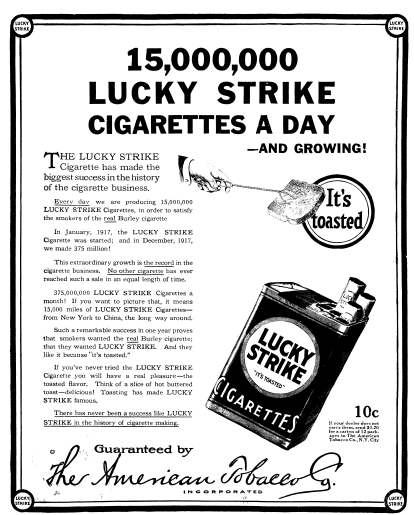
In case you thought, like I did, that Don Draper made up “It’s toasted” in 1960.

Judge magazine, March 2, 1918

And finally, a harlequin and a ballerina on Rita Senger’s April 1918 Vanity Fair cover.

*He’s going to be hard to top as the youngest person I run across in My Year in 1918 who will go on to later fame.

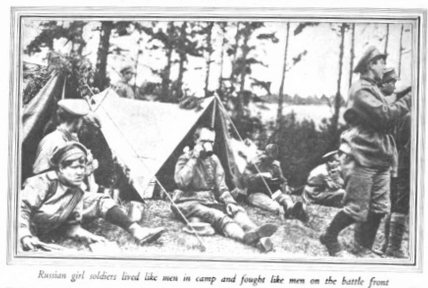
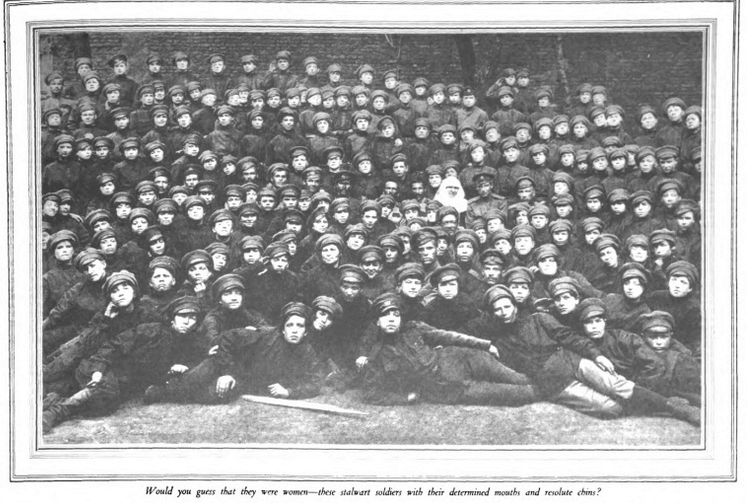
The giggling battalion: Russian women soldiers through the eyes of an American war correspondent

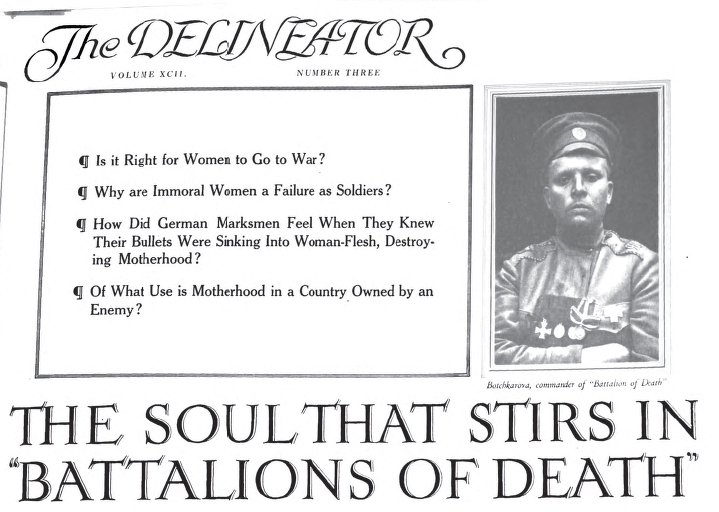
Reporting about Russia’s battalions of women soldiers in the March 1918 issue of The Delineator, war correspondent William G. Shepherd asks everyone the same question.

What about motherhood?

I thought of how it must feel to be a soldier and know that your bullets were sinking into woman-flesh, destroying motherhood; and of how, in spite of all this, you must shoot to kill these women soldiers lest they kill you.

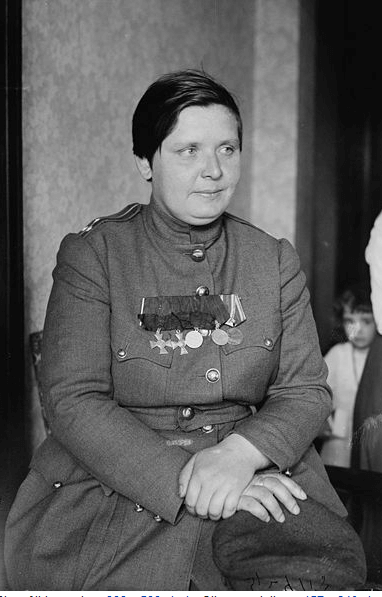
He gets an interview with Maria Bochkareva, the commander of the First Women’s Battalion. Amid the chaos of the Russian Revolution, her soldiers have deserted her, and she’s hospitalized in Petrograd (now St. Petersburg). He asks her why she went into the war. Weren’t the men fighting well enough to suit her?

“Yes, indeed,” she exclaimed…“But I can’t see why there should be any difference between men and women in this war and so I enlisted and went to the front.”

“But women have got something that men haven’t,” Shepherd mansplains. “They have potential motherhood, and if you kill that, you kill the whole race.”

Maria Bochkareva and her soldiers with British suffragist leader Emmeline Pankhurst, 1917

Bochkareva, who at age twenty-eight has left two abusive husbands and fought in two wars, has a less sentimental take on the matter. “What is the use of motherhood in a country which is owned by an enemy?”

To Bochkareva, Shepherd marvels, the “girl” soldiers

are mere sets of brains that go to war. They are mere pairs of legs that can march, pairs of arms that can carry rifles, and most of all they include index fingers that can pull triggers, and good right eyes that can see marks.

Imagine!

Another issue weighing almost as heavily on Shepherd’s mind is the girl soldiers’ sex lives. He meets a deserter from Bochkareva’s battalion and asks her why she left.

“I left because there were too many bad girls in our company,” explained this seventeen-year-old miss in riding breeches who sat in a chair on the sidewalk before my hotel with her knees crossed.

“But I didn’t think morals had anything to do with fighting,” said my interpreter, who happened to be a celebrated Russian writer.

“Nothing to do with fighting!” exclaimed the girl. “Why, do you know you can never trust a bad girl in the firing-line?…I’ll fight for Russia, but not for that crowd.”

A light goes on in Shepherd’s head.

This was the first idea we got of the fact that in the girl legions of Russia, good girls make good soldiers and bad girls make poor ones.

The seventeen-year-old soldier goes on,

“Love hasn’t got any place in war, and when it comes to the other thing, it not only ruins girl soldiers, but the men soldiers, too.”

“But don’t the girls ever talk of their sweethearts at the front?” asked my interpreter.

“The girls who are in earnest don’t,” she said. “As soon as a girl begins to get sentimental or to talk about some man she likes, we just remind her that within a few days, if she is a good soldier of Russia, she may be dead.”

The Delineator, March 1918

Another thing about the girl soldiers: they’re so girly! In the barracks of another newly formed women’s battalion (made up, its leaders assure Shepherd, entirely of good girls),

Some of them were reading, some were knitting, and several of them were romping girlishly. One was trying to stick another with a hatpin and another was chasing a girl with a glass of water with which she threatened to deluge the fugitive. It was just such a romp as one might have expected in the hallways of an exclusive girls’ boarding school. Only the clipped heads and the trousers seemed out of place.

Earlier, he watched Bochkareva’s equally girly soldiers decamping for the front.

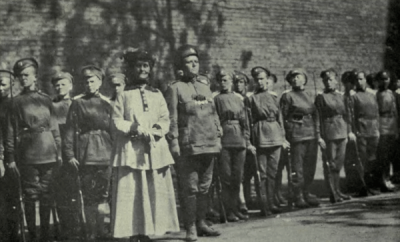
Men soldiers do not giggle when they climb into cars, but I must admit that these girl soldiers did. They helped each other remove their packs from their backs; they threw their short, stubby rifles into the cars and then boosted each other in as best they could. There was giggling a-plenty and even little shrieks of mirth; when a girl fell, there was a shout of laughter.

For all his condescension, Shepherd ends up respecting the soldiers of the “Battalion of Death,” as Bochkareva’s soldiers were known. They fought courageously against the Germans, dodging bullets as they took ammunition to the front lines. For military security reasons, he can’t provide the names of the heroes, but

I can say that it was Bochkareva’s band that captured a hundred Germans and forced them to throw down their rifles and throw up their hands and exclaim, “Ach Gott! The Russian women!”

The Delineator, March 1918

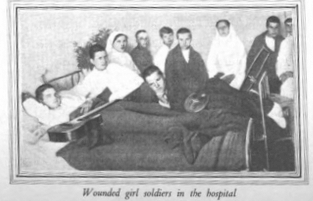
Shepherd visits some wounded veterans of the battle in the hospital and spots a German helmet. His interpreter asks the owner where she got it.

“I took it from a German soldier who tried to shoot me after he was wounded,” she said. “I was trying to help him, when suddenly he raised himself to his elbow and fired at me with his revolver.”

“What did you do?” we asked her.

“I shot him,” she said simply. “What else could I do?”

The Czar’s government, Shepherd tells us, authorized the women’s battalions in order to shame war-weary men into joining the army. But the situation was changing fast. On March 3, 1918, just as Shepherd’s story was hitting the newsstands, Russia made peace with Germany.

Maria Bochkareva (date unknown)

Bochkareva ended up on the wrong side of history. Branded an “enemy of the working class,” she was executed by the Soviet secret police in May 1920, at the age of thirty. The execution was against Lenin’s orders, and her killers were later put to death themselves.

As Bochkareva’s troops headed to the front, a Jewish seamstress stood sentinel on the train. At each stop, the soldiers faced insults and leers from men on the platform. At one station, a group of male soldiers tried to peer inside, saying, “We have come to see the girls.” The sentinel

made no outcry. She simply raised her rifle toward them and said:

“There are no girls here; only soldiers of Russia.”

(UPDATE: You can see Maria Bochkareva at a July 4 ceremony in Washington, D.C. in the last few seconds of this video, which I included in my post on the July 4 loyalty parade in New York.)

Despina Storch: The sad fate of a woman of intrigue

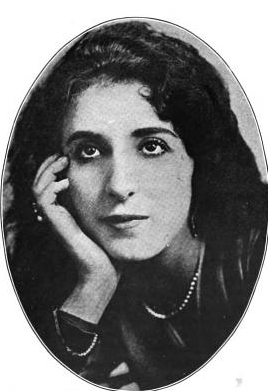
Remember Despina Storch, the beautiful Turkish woman who was arrested by the Secret Service as the suspected head of a German spy ring and sent to Ellis Island to be deported? (UPDATE 1/2/2019: For readers looking for information on Storch who were directed here by Google, I suggest that you start with my earlier post, which you can find here.)

Despina Storch, 1917 (Underwood & Underwood, N.V.)

She never made it to France. She died on Ellis Island on March 30, 1918, at the age of 23. The cause was pneumonia.

Or was it? Some suspected suicide, especially since two of her three accused co-conspirators, Elizabeth Nix and “Baron”* Robert de Clairmont, had also fallen seriously ill.

An immigration inspector denied the rumors, saying of Mme. Storch, “She made a brave fight for her life and every effort was made to save her. She was physically unable to overcome the ravages of pneumonia. I wish to state positively that she did not commit suicide.”

The suicide theory would have been plausible, though, since Mata Hari’s October 1917 execution by a French firing squad must have been on the group’s mind.

Mata Hari, 1906

Despina Storch’s funeral took place on April 1. Her companion and co-accused, the Count de Beville, was allowed to leave Ellis Island to attend, accompanied by his parents and a Secret Service agent. According to a report in the New York Sun, Beville “bore a plaque of roses and some lilies which he tenderly placed in the folded arms of the dead woman.” He knelt by the casket, praying, for two hours.

He murmured over and over again, and some say the words were “Forgive me,” and others, “Cherie, Cherie, and like French words of endearment.

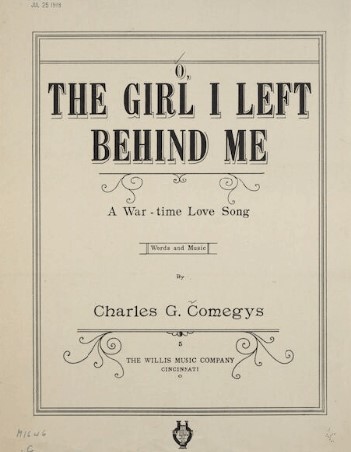
Willis Music Company, 1918 (Library of Congress)

Outside, a “morbidly inquisitive crowd” milled around the hearse. When the coffin was borne out of the funeral parlor,

the chatter of the crowd hushed, and all that stirred the quiet was the music of “The Girl I Left Behind Me,” which echoed into the street, as the subway band, on an army recruiting bus, rolled through Fifth avenue, close by.

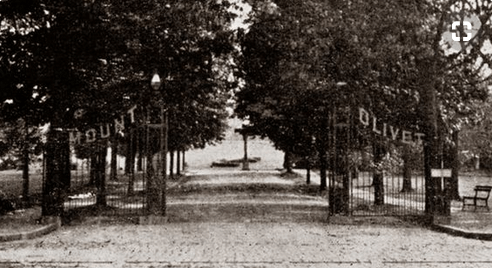
Mount Olivet Cemetery, date unknown

The Count and his parents accompanied the hearse to Mount Olivet Cemetery in Queens, where Mme. Storch’s “exquisitely carved white coffin” was placed in a vault. Beville “wept silently and cast a last look at the vault as he was led back to the car.”

Thus ended the brief life of the woman the Sun called “the most romantic spy suspect America has yet known.”

Despina Storch in Spain, adapted from an illustration in the Washington Times, June 16, 1918

*The New York Times was dubious about his claim to this title.

The best and worst of March 1918: Magazines, essays, cover art, and humor

When I was in the Foreign Service, living in Cambodia or Honduras or wherever, people used to ask, “But don’t you miss home?” I never knew what to say. The honest answer was, “I miss some things, sometimes, but it’s way more interesting here. Don’t you get bored living in the same place all the time?” That seemed kind of rude, though.

A quarter of the way through, that’s how I feel about my life in 1918. I’ll see, for example, that Meg Wolitzer, Curtis Sittenfeld, and Rebecca Harrington all have books coming out, and for a second I’ll wish that I could read them, but then I’ll pick up Mrs. Spring Fragrance or the latest issue of The Dial, and the feeling goes away. I can read those books next year. In the meantime, it’s way more interesting here.
Now for the best and worst of March 1918:

Best Magazine: The Little Review

Ulysses, as I wrote earlier this month, made its first appearance in the Little Review in March 1918. The issue also includes Ezra Pound writing on Marianne Moore, fiction by Wyndham Lewis, and an essay by Ford Madox Hueffer (a.k.a. Ford) that contains the sentence “The Englishman’s mind is of course made up entirely of quotations.” But the rest of the issue could have been blank (which wouldn’t have been unprecedented—the first thirteen pages of the September 1916 issue were blank, an expression of editor Margaret Anderson’s frustration over the lack of quality submissions) and it still would have been the best magazine of the month, if not the year.

Worst Magazine: The Art World

The Art World, as I noted last week, had nothing good to say about impressionism or anything that came after. To put that into perspective, the first major exhibition of impressionist art was in 1874. So an art magazine taking this stance in 1918 is like Rolling Stone saying in 2018 that this rock-and-roll music is just a lot of noise.
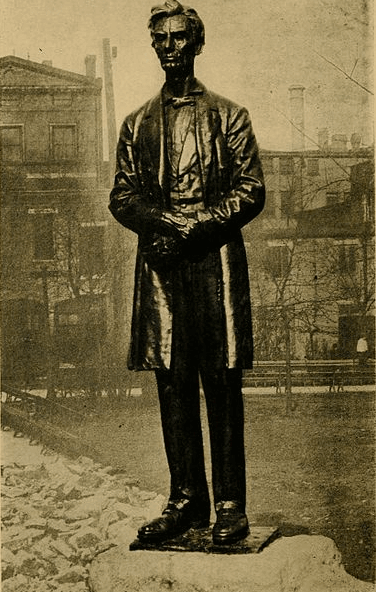
Statue of Lincoln, George Grey Barnard, Lytle Park, Cincinnati (1917)

In its March 1918 issue, the last before it merged into another magazine, The Art World criticized George Grey Barnard’s statue of Lincoln in Cincinnati, saying that Barnard

does not show the majestic Lincoln at the bar of history being judged and admired, but a slave Lincoln at the block, being sold and pitied…let us hope that Mr. Barnard will now deign to accept the advice we gave him in June 1917 and make a new Lincoln—virile, heroic, and majestic.
The magazine approvingly quotes portraitist Cecilia Beaux saying of the 1913 Armory Show in New York, the first large exhibition of modern art in the United States, that

“It was like a sudden windstorm that raises no little dust, noise, and confusion for the moment; when the wind dies down you discover that much that was of no real value has blown away, leaving a clearer, wholesome atmosphere.”

The Art World branches out to the written word in this issue, calling a modernist poem “speech worthy of a yapping maniac.”

Best humorous essay: “Making the Nursery Safe for Democracy,” by Harold Kellock, The Bookman


Essays about family life in 1918 are generally steeped in sarcasm (if they’re by men) or sentimentality (if they’re by women). It’s hard to find a family that seems real. Then I came across Harold Kellock’s essay about his four-year-old son being bombarded with royalist propaganda through his nursery reading. Every night, Kellock is forced to read his son a story about some heroic king. “In a world wherein we are pouring out our blood and treasure that democracy may live safely,” he complains, “our children scarcely out of the cradle are being made into staunch little monarchists.” He takes a stab at democratizing the stories, but it doesn’t work, and he resigns himself to nursery royalism.

“Then,” I read, “the king took Gretel to his palace and celebrated the marriage in great state. And she told the king all her story, and he sent for the fairy and punished her.” Think of having the power of punishment over fairies! The King und Gott! But my son swallows it complacently. He does not question the divine right of kings.

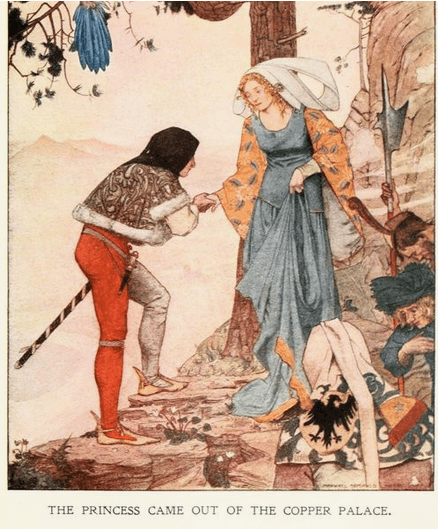
Faery Tales from Hans Christian Andersen, Maxwell Armfield, 1910

Kellock reassures himself that, when the time comes, he can turn his child into a democrat by showing him photographs “of some vacuous king, discreetly bearded to hide his recessional features,” or “a typical princess, whose hat and features alike seem so unfortunately chosen, opening a Red Cross bazaar.”

But not for a while, he says.

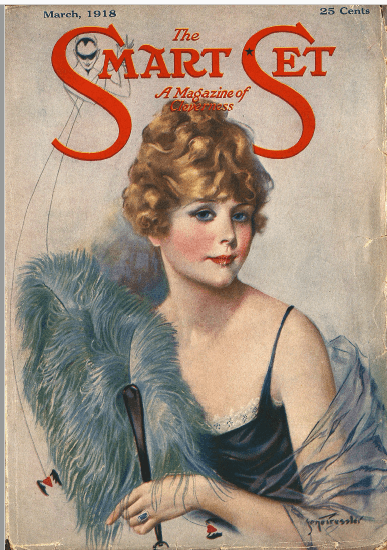
Worst humorous essay: “I Must Have Been A Little Too Rough,” by George B. Jenkins, Jr., Smart Set

I hope this is the worst thing I read all year. There must be an anti-gender violence message hidden somewhere, but…well, read it for yourself.

I must have been a little too rough.

“Women,” her father had told me, “are tired of the courteous treatment of the average man. They are bored by the vapid compliments, the silly lies, the stupid chatter of pale youths with gardenias in their lapels. If you want to be a success with women, be rude! Be violent! Overpower them, assert your physical superiority! If necessary, beat them!” He became quite excited. “Pound them! Assault them! Half-murder them!”

I listened to him respectfully, though I did not care for him at all. Yet I believed him, for he is notoriously successful in his affaires.

I decided to test his theories. Striding into the next room, I grasped his daughter about the waist.

“I love you!” I roared, squeezing her until her face was purple.

“You belong to me!” I shouted, dragging her around the room by her hair, and overturning several chairs in our progress.

“Damn you!” I shrieked, striking her on the shoulder, where the blow left a blue welt, “I will fight the world for you.”

She began to whimper.

“Shut up!” I ordered, in my rudest manner, and slung her across the room.

But I must have been a little too rough, for she fell out the window.

Best magazine cover: The Liberator

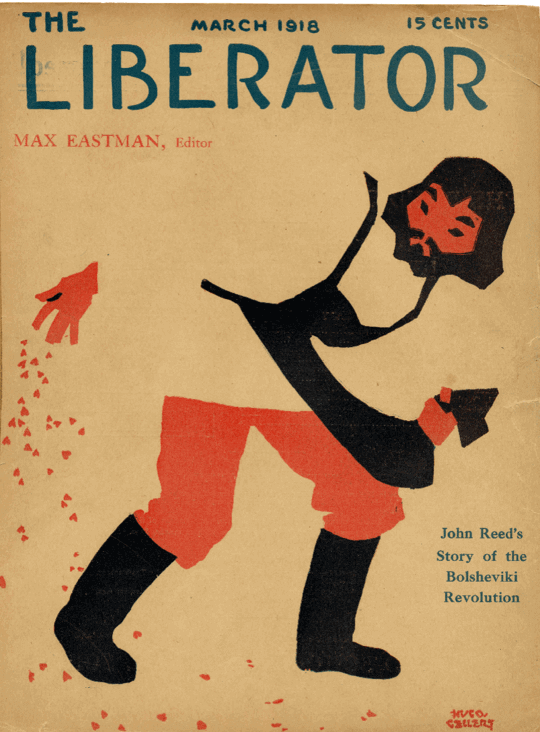
The first issue of The Liberator was published in March 1918. Its predecessor, The Masses, had closed down in 1917 after being declared treasonous by the government for its anti-war stance. The debut issue included reporting from Russia by John Reed, whose Ten Days that Shook the World was published the next year (and who died in Russia in 1920 at the age of 32). I’ll write more about The Liberator later. For now, here’s its inaugural cover, by Hungarian-American artist Hugo Gellert.

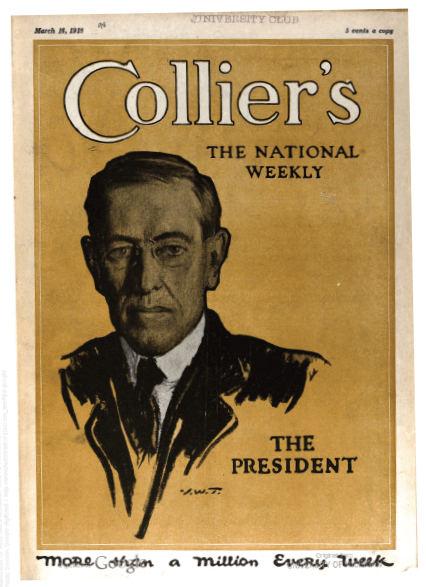
Worst magazine cover: Collier’s

I’m imagining the meeting where this cover was conceived.

Art director: How about…the President?
Editor: What would he be doing?
Art director: Nothing, just a picture of his face, in black and white. With a caption that says [stretches his hand into the air dramatically], “The President.”
Editor: I like it!

Best humor:


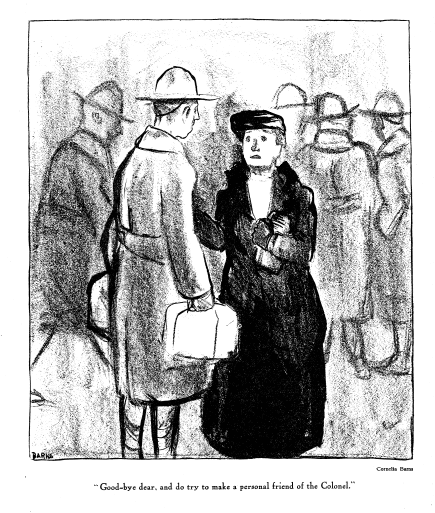
As I’ve noted before, there are no good jokes in 1918 magazines. But I liked this Cornelia Barns Liberator cartoon, featuring the world’s most coldhearted mother seeing her son off to war.

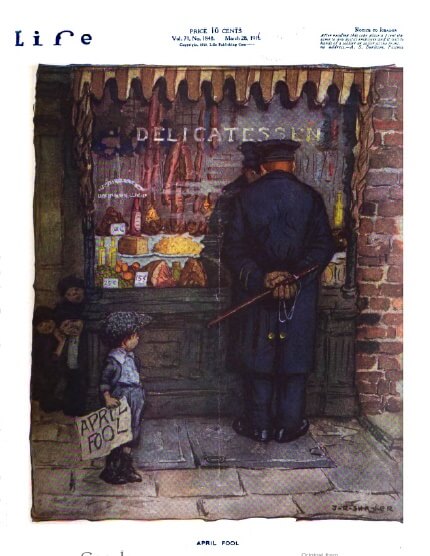
Worst humor:

First dog: How is brother collie over there? Is he in your set?
Second: Oh, yes; we visit the same garbage pails.

(Life magazine, March 28, 1918)

And, in honor of Women’s History Month, the most inspiring women:

I came across so many! Novelists Edith Wharton, Willa Cather, and Mary Roberts Rinehart; artist Elizabeth Gardner; dancer Irene Castle; Little Review editor Margaret Anderson; suffragist Anna Kelton Wiley; prosecutor Annette Abbott Adams; rebellious housewife Julia Clark Hallam; and the anonymous woman who wrote about how divorce saved her sanity.

But every month is Women’s History month at My Year in 1918, and there are lots more inspiring women to come. (Sneak preview: a pioneering British sexologist and a witty Chinese-American writer.) On to April!