Category Archives: In the News

Wednesday Miscellany: Grotesque wallpaper, a Locomobile, and a Rockwell Easter cover

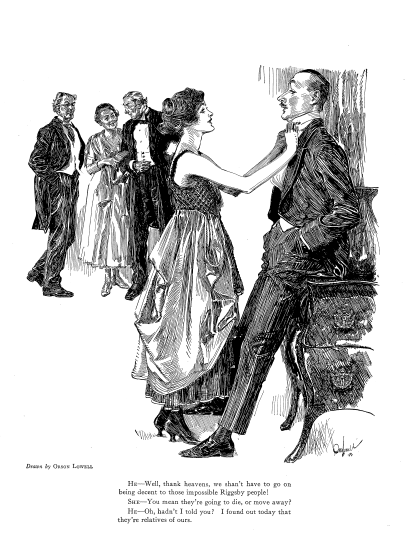
He—Well, thank heavens, we shan’t have to go on being decent to those impossible Riggsby people!
She—You mean they’re going to die, or move away?
He—Oh, hadn’t I told you? I found out today that they’re relatives of ours.

The punch line’s only so-so, but I love “You mean they’re going to die, or move away?”

Judge magazine, March 16, 1918

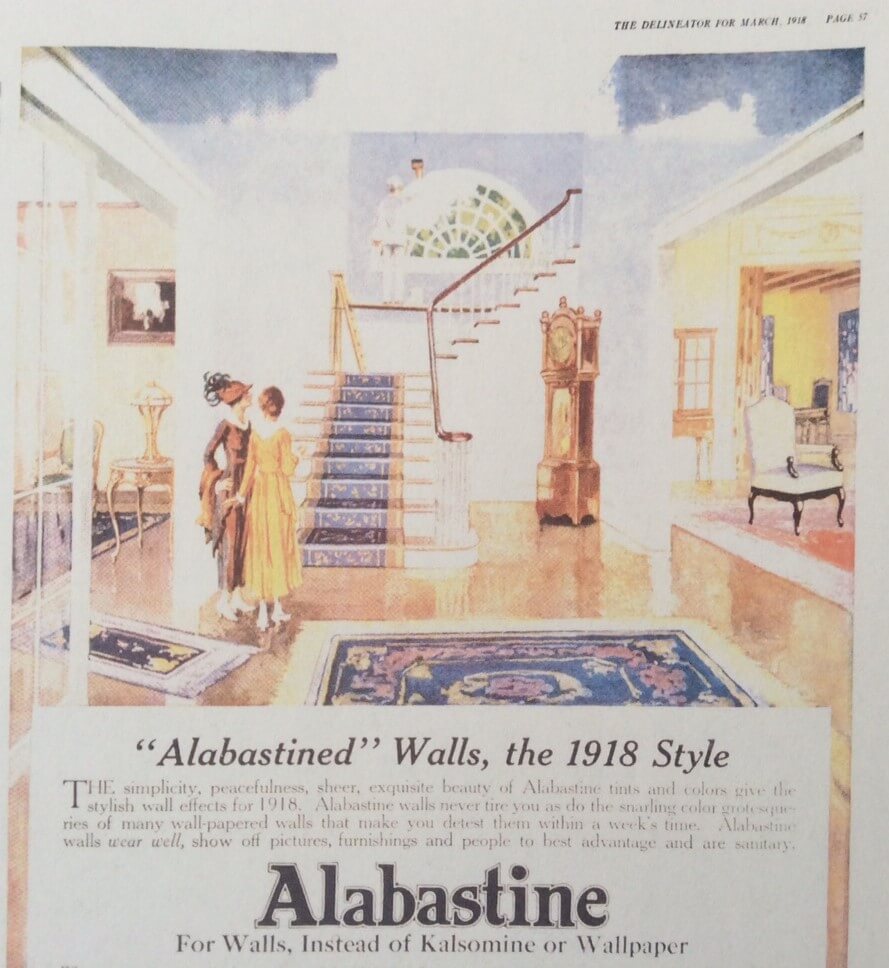
I know, right? The snarling color grotesqueries of wallpaper are the worst.

The Delineator, March 1918

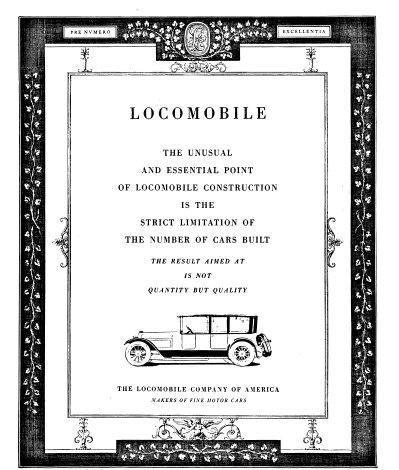
Um, if your car is so serious that it has its own Latin motto, maybe don’t call it the Locomobile?

Life magazine, March 28, 1918

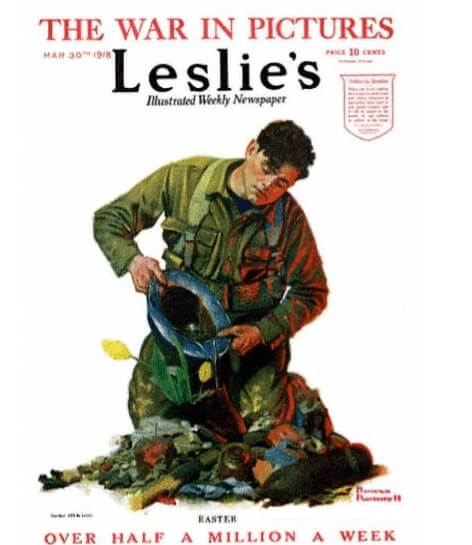
And finally, a soldier uses his helmet to water tulips on this Norman Rockwell cover, titled “Easter.”

Wednesday Miscellany: Pacifist nightmares, a sad funny page, and a widowed dancer

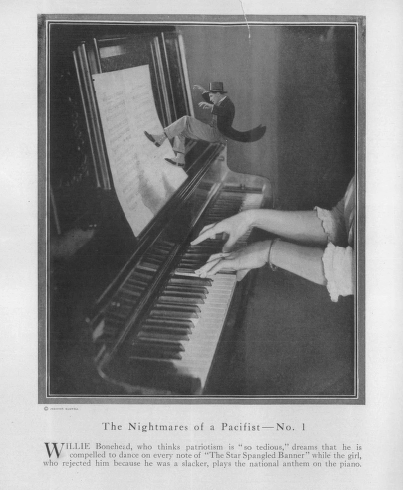
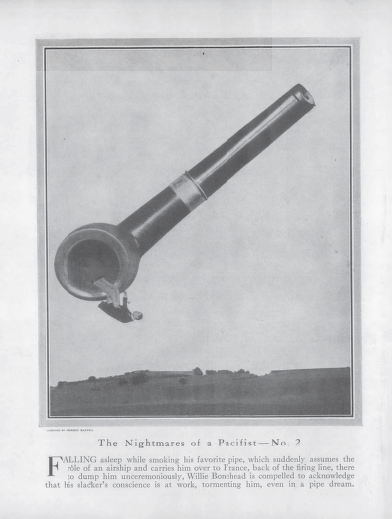
Judge magazine has been running a series called “The Nightmares of a Pacifist,” featuring conscientious objector Willie Bonehead, whose guilty subconscious places him in a series of horrific scenarios. First he is “compelled to dance on every note of the ‘Star Spangled Banner,’ while the girl, who rejected him because he was a slacker, plays the national anthem on the piano.”

Judge magazine, March 2, 1918

Next he falls asleep while smoking his pipe, which transports him to the front line.

Judge magazine, March 9, 1918

The political message is pretty heavy-handed, but I like the proto-surrealist art.

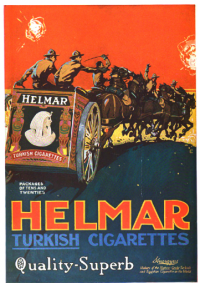
Turkish cigarettes join the fight against…the Turks.*

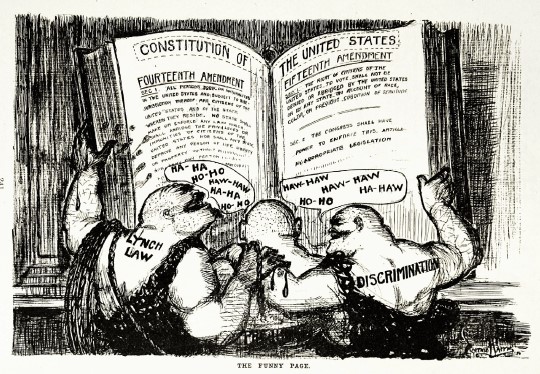
The table of contents of the March 1918 issue of The Crisis, the NAACP magazine edited by W.E.B. Du Bois, has a listing for “The Funny Page.” The Crisis isn’t exactly a barrel of laughs, so I wondered what this could be. Here’s the answer:

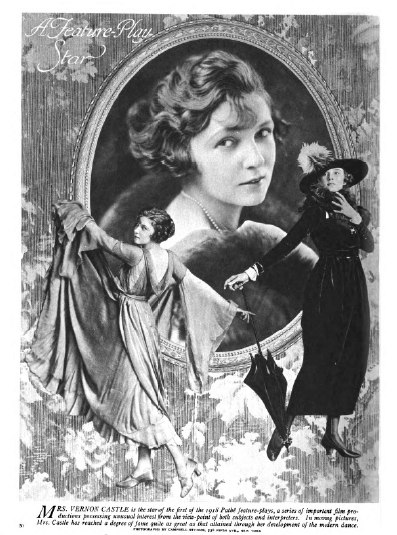
I can’t stop looking at this picture of dancer Irene Castle, which appeared in Cosmopolitan in  March 1918. Just as the issue was hitting the newsstands, her husband and dancing partner Vernon died in an aviation training accident in Texas. He had completed 300 missions as a Royal Air Corps pilot. The Castles were the subject of a 1939 Astaire-Rogers biopic.

*Yes, yes, I know, the United States was not actually at war with the Ottoman Empire.

Women spies of 1918

I was going to write about women artists in honor of Women’s History Month, but then I opened the March 19, 1918, New York Times and saw that women were hatching international conspiracies all over Manhattan. Change of plan!

First, this:

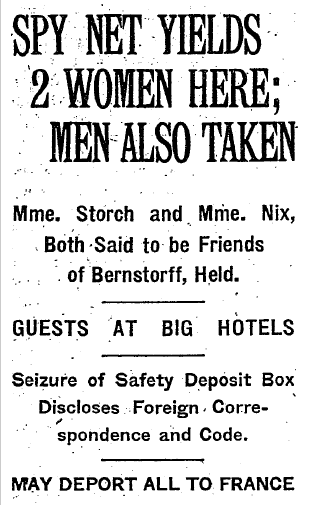
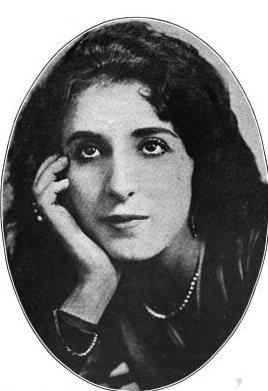
Two men and two women were arrested, the Times reports, for alleged participation in an international German spy ring. The principal suspect is Despina Davidovitch Storch, the 23-year-old Turkish ex-wife of a French army officer. The Times said of Storch that

she is in appearance a strikingly handsome woman, and in the year that she made her home at the Waldorf-Astoria numbered among her friends many well-known persons, some of whom it was intimated yesterday are not at all anxious now to appear to have been among her admirers.

Despina Storch, 1917 (Underwood & Underwood, N.V.)

Mme. Storch was arrested in Key West with a young Frenchman, the Baron Henri de Beville, as the two were preparing to flee to Cuba. The Baron’s father, according to the apparently sympathetic Times, was “broken hearted as a result of his son’s arrest,” and felt that his son was “a victim of the ‘charms’ of the Turkish woman.”

(This account of masculine helplessness comes from a paper that, remember, wasn’t particularly sympathetic to women getting the vote.)

The pair had been living a peripatetic life. They were taken into custody in Madrid in 1915 as suspected enemy agents, sailed to Cuba after their release, and went on to the United States. They had also lived in Paris and Lisbon, where they amassed bills of $1000 a month. Their equally lavish New York lifestyle attracted the attention of the American authorities, who also found a safe deposit box in Mme. Storch’s name containing “a mass of foreign correspondence and a code.”

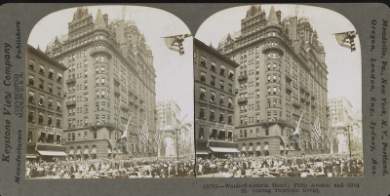
Waldorf-Astoria, 1917 (Library of Congress)

Their alleged co-conspirators were picked up in New York. Mrs. Elizabeth Charlotte Nix, who, according to the Times, “is about 40 years of age, but looks ten years younger,” had received a $3000 payment from the German ambassador before he left the country when war was declared, but she denied that it was a spy payment. The principal crime of “Count” Robert de Clairmont, as far as I can tell, was his dubious claim to his title.

The Justice Department official who announced the arrests, Charles F. De Woody,* recommended that the four suspects be deported to France. The problem with trying them in the United States was that—oops!—the espionage law only applied to men. President Wilson had mentioned this problem in his State of the Union address, and Congress was taking action, but not in time to go after Mme. Stroch and Mrs. Nix.

Meanwhile, down in Greenwich Village, a very different sort of (alleged) German-sponsored conspiracy was uncovered.

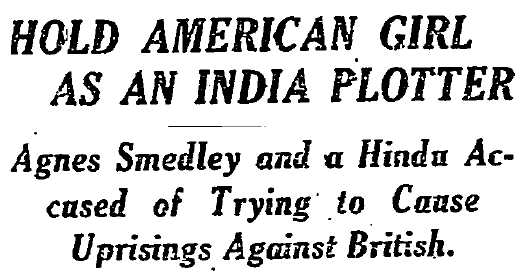
Agnes Smedley, the twenty-six-year-old “girl,” was arrested with Sailendra Nath Ghose, a “highly educated Hindu” who was already under indictment in San Francisco, for fomenting rebellion against British rule in India. (Uncharacteristically, the Times makes no mention of Smedley’s level of attractiveness.) Their activities were allegedly part of a “worldwide German-directed plot to cause trouble in India” and thereby weaken British war efforts. They sought assistance from several Latin American countries (Ghose lived for a time in Mexico, under the implausible pseudonym of Sanchez) and from Leon Trotsky.

Agnes Smedley

“First women arrested in New York for enemy activities” might not be your idea of an inspiring Women’s History Month first. Well, then, there’s Annette Abbott Adams, the San Francisco-based Assistant U.S. District Attorney who spoke to the Times about the Ghose indictment. She would go on to be the first woman Assistant Attorney General and later a high-ranking California judge.

Annette Abbott Adams, 1914

The indictment against Smedley was eventually dropped. She spent many years in China as a sympathetic chronicler of the Communist Party, and wrote a well-regarded autobiographical 1929 novel, Daughter of the Earth. She counted a Soviet spymaster among her lovers. She died in England at the age of 58, and is buried in Beijing.

As for Despina Storch…stay tuned! (UPDATE: Find out what happened to her here.)

*Even the bureaucrats in this story have picturesque names.

Oh snap! The modernists’ cringe-inducing criticism

The writers who were reviewed in the modernist journals of 1918 are all long dead. But, when I read what T.S. Eliot, Ezra Pound, and their fellow critics had to say about them, I can’t help cringing on their behalf.
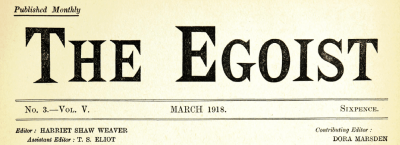
The Egoist banner, March 1918

Take this review, in the March 1918 issue of The Egoist, of a collection called Georgian Poetry, 1916-1917. The reviewer, who calls himself Apteryx but is really T.S. Eliot, sums up the work of five contributors as follows:

Mr. Graves has a hale and hearty daintiness. Mr. Gibson asks, “we, how shall we…” etc. Messrs. Baring and Asquith, in war poems, both employ the word “oriflamme.” Mr. Drinkwater says, “Hist!”
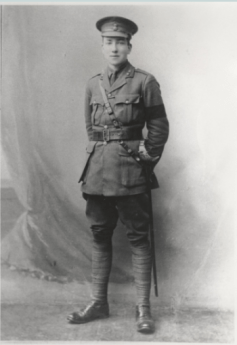
Photo portrait of poet Robert Graves in military uniform, 1914

Robert Graves, 1914

These few sentences give us a good sense of what’s in the poems. Under the circumstances, though, this criticism seems a bit cruel. Robert Graves, who would go on to fame as a poet, novelist, and memoirist, was a 23-year-old soldier in 1918. “David and Goliath,” written in memory of his friend David Thomas, is a reversal of the Bible story, ending:

‘I’m hit! I’m killed!’ young David cries.
Throws blindly forward, chokes…and dies.
And look, spike-helmeted, grey, grim,
Goliath straddles over him.

Maurice Baring, Wilfrid Wilson Gibson, Herbert Asquith (the son of the Prime Minister), and John Drinkwater were older, in their thirties or forties, but they were all in uniform except Gibson, who tried to enlist but was turned down because of ill health.
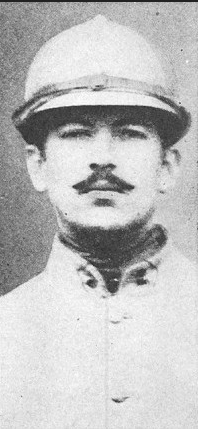
Poet Alan Seeger in military uniform with helmet.

Alan Seeger

Even dying in the war didn’t spare a writer from The Egoist’s sharp scrutiny. The December 1917 issue included an unsigned review of a book of poems by Alan Seeger, who had joined the French Foreign Legion and died in the Battle of the Somme in 1916. Seeger, best known now for the poem “I Have a Rendezvous with Death,” was a Harvard classmate of T.S. Eliot, who may have written the review.* (UPDATE 10/16/2019: Robert Crawford says in his biography Young Eliot that he did.) According to the Egoist,

Seeger’s poems are not unworthy of the attention they have attracted. The book has not much to offer to the small public which wants nothing twice over, but it has a good deal to give to the public which will take what it likes in any amount.

The Egoist was dismissive toward popular novelists. In a discussion in the February 1918 issue of James Joyce’s A Portrait of the Artist as a Young Man, reprinted from an Italian publication and apparently translated by Joyce himself, Diego Angeli says:

To tell the truth, English fiction seemed lately to have gone astray amid the sentimental niceties of Miss Beatrice Harraden, the police-aided plottiness of Sir Conan Doyle, the stupidities of Miss Corelli or, at best, the philosophical and social disquisitions of Mrs. Humphrey Ward.**
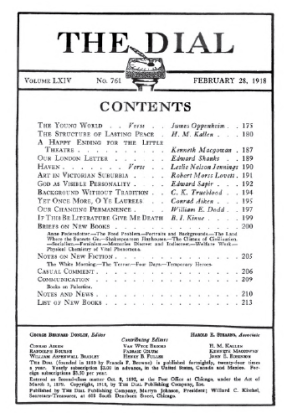
The Dial cover page, February 23, 2019.

Across the Atlantic, The Dial, which wasn’t a modernist journal but had modernist sympathies,*** shared The Egoist’s contempt for popular novelists. You don’t really have to read further in B.I. Kinne’s review of Hugh Walpole’s The Green Mirror than the title: “If This Be Literature Give Me Death.” If you do, you’ll read that

Mr. Walpole’s most irritating fault is his adherence to the court reporter’s method of observing and recording. This is the fault of many of the contemporary novelists. It is their belief, apparently, that the mere writing down of lists of things, whether dishes of food, toilet articles on the heroine’s dressing-table, books and objects d’art on the drawing-room tables, or the furnishings of a room, constitutes vivid literature.
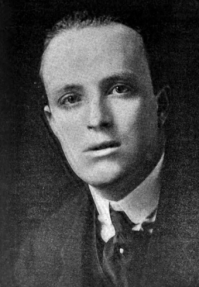
Novelist Hugo Walpole, 1915.

Hugh Walpole, 1915 (The Independent)

The modernist critics reserve their most scathing criticism for literary luminaries. In an article on Henry James (whom he admired) in the January 1918 Egoist, Eliot writes that G.K. Chesterton’s “brain swarms with ideas; I see no evidence that it thinks.” Ezra Pound, also writing admiringly about James in the same issue, says of recent writing that

we may throw out the whole [H.G.] Wells-[Arnold] Bennett period, for what interest can we take in instruments which must of nature miss two-thirds of the vibrations in any conceivable situation.

The modernists’ criticism may be harsh, but, unlike H.L. Mencken’s, it doesn’t seem mean-spirited. Eliot and Pound and the other modernist critics took their work with tremendous seriousness. They thought that the ossified literary world of their time had to die, and that it was their job to kill it. They didn’t just rip into bad writing; they explained how it exemplified what was wrong with the literature of the day. And they had a vision of what should come in its place: modernist writing by the likes of Joyce, Wyndham Lewis, and of course themselves.

This wasn’t exactly trench warfare, but it had its risks. Eliot reported in the March 1918 Egoist that the October 1917 issue of the American modernist journal The Little Review had been declared obscene and seized by the post office, the offending item being a story by Wyndham Lewis. The journal’s legal complaint against the post office had failed.****

The March 1918 issue of the Egoist contained the following announcement:
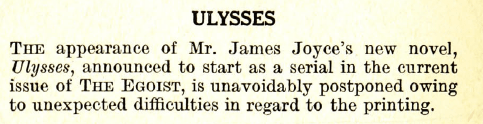
Item from The Egoist announcing the postponement of the serialization of James Joyce's Ulysses, 1918.

 That is, no printer in England would touch it. But it was scheduled to be serialized in the Little Review as well.

Bigger battles lay ahead.

squiggle

*He was also folk singer Pete Seeger’s uncle.

**See! I told you!

***It later became a modernist journal, and was the first place “The Waste Land” was published in the United States.

****The story was called “Cantleman’s Spring-Mate.” Naturally, I immediately tracked it down. Summary: a young man about to go to war sees animals rutting all around, joins in the action with a village girl, and feels that he has defeated death. (Except that makes the story sounds life-affirming, which it’s not. It’s modernist!)

Wednesday Miscellany: Congressional courtesy, $100 apartments, and other bygone notions

I’ve been neglecting the New York Times lately. Here are some recent snippets.

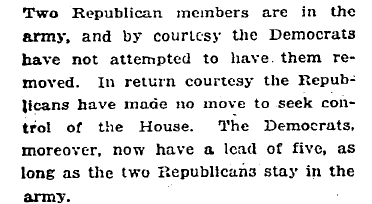
With four special elections in New York, control of the House of Representatives, held by the Democrats in coalition with some small parties, was on a knife-edge. The result? A Democratic sweep, and courtesy all around.

Paragraph from New York Times about congressional balance of power, March 6, 1918.

New York Times, March 6, 1918

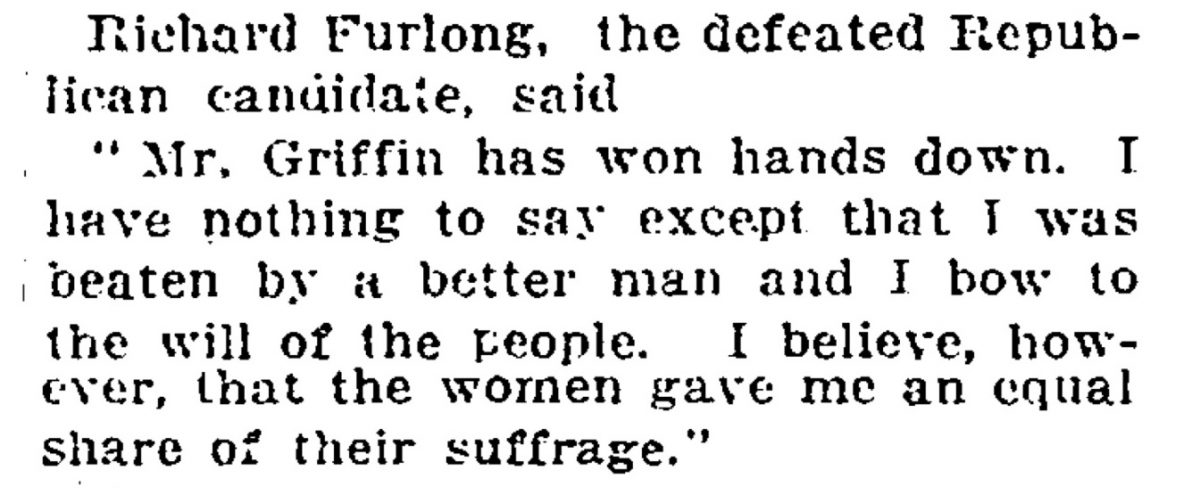
A defeated Republican candidate’s gracious response:

New York Times article quoting a defeated Republican candidate saying "I was beaten by a better man," 1918.

New York Times, March 6, 1918

Sigh…

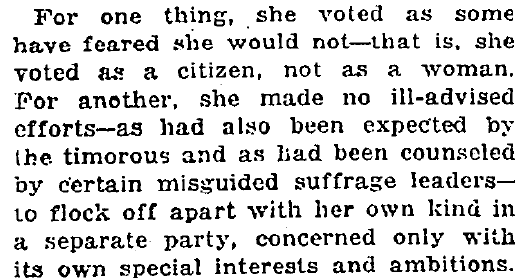
This was the first time women in New York were able to vote. They did so in large numbers and–good news!–did not get up to all kinds of silly nonsense.

New York Times editorial discussing how New York women voted, March 1918.

New York Times, March 7, 1918

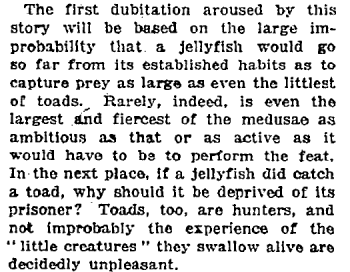
Now for some fact checking. John Francis Hylan, the Tammany mayor of New York, has told a story about a kind man on the shore at Palm Beach rescuing a toad that was being eaten by a jellyfish. Dubitation ensues.

New York Times editorial discussing dubitation over a story the mayor told, March 1918.

New York Times, March 6, 1918

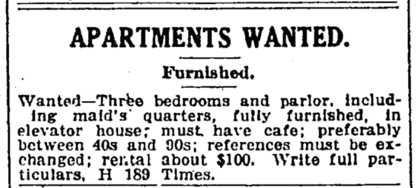
On to the classified ads. Hey, I want one of those too!

New York Times ad for a three-bedroom furnished apartment, $100 a month, March 1918.

New York Times, March 6, 1918

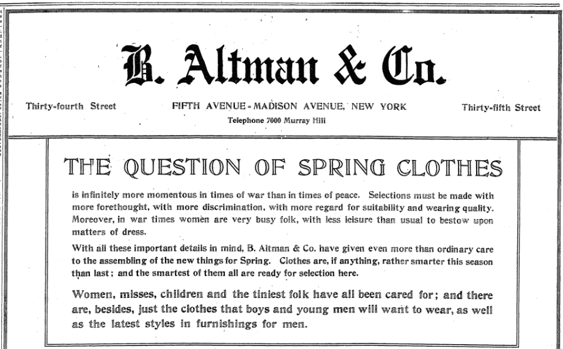
Now that you’re caught up on the news, it’s time to party! Make a momentous decision on what to wear,

B. Altman ad, The Question of Spring Clothes, March 1918.

New York Times, March 3, 1918

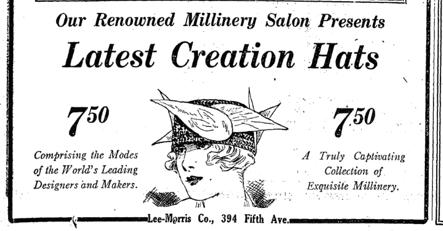
put on your favorite hat,

Hat ad, New York Times, March 1918.

New York Times, March 3, 1918

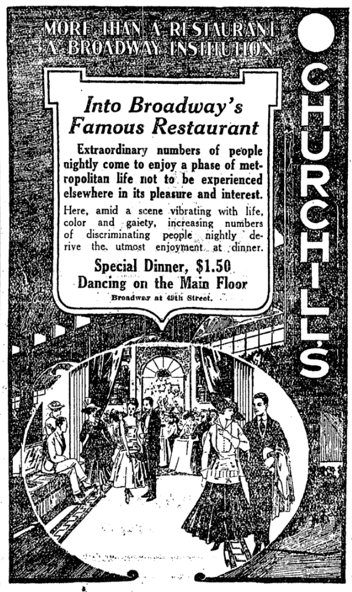
and head on out to the the hottest joint in town!

Churchill's Restaurant ad, New York Times, 1918.

New York Times, March 3, 1918

(These articles were accessed at https://timesmachine.nytimes.com/browser. I make fun of the Times a lot, but I’m very grateful for this valuable resource.)
Wednesday Miscellany: Romantic magazine covers and a Hoover-themed valentine

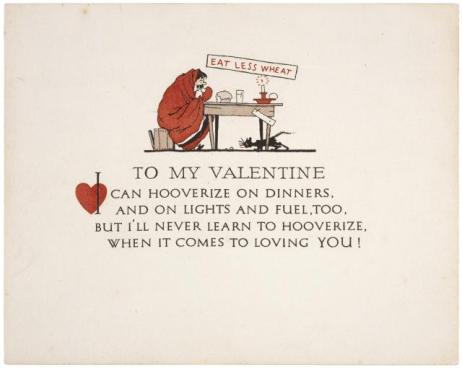
Strange as it sounds, government administrators were huge celebrities in 1918. And none was more famous than Herbert Hoover, head of the U.S. Food Administration. (Yes, that Herbert Hoover.) To reduce consumption so that food could be sent to Europe, he led campaigns for “Meatless Mondays” and “Wheatless Wednesdays.” Ads for food and cooking equipment touted their effectiveness in helping housewives “Hooverize.” Good Housekeeping magazine called him–with a wink, presumably–“the man who made food famous.”

In that spirit, here’s a 1918 valentine to all of you:

1918 Hooverizing-themed valentine.

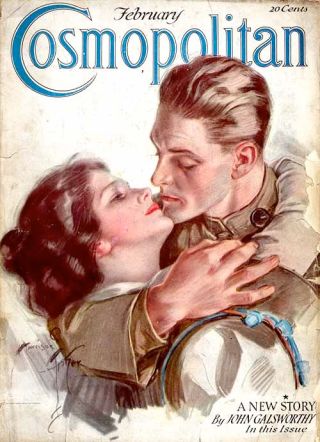
Magazines in 1918 were pretty conservative about portraying any kind of romantic activity, but judging from the cover of the February 1918 Cosmopolitan, soldiers got a free pass.

Harrison Fisher Cosmopolitan cover, soldier kissing wife, February 1919.

Harrison Fisher, Cosmopolitan, February 1918

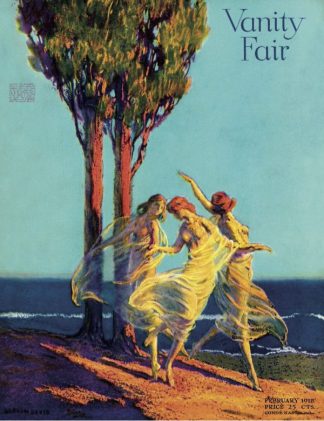
Finally, the February 1918 cover of Vanity Fair…not Valentine’s-themed, but definitely romantic.

Vanity fair cover, three topless nymphs dancing in front of a tree, February 1919.

Warren Davis, Vanity Fair, February 1918

Happy Valentine’s Day, everyone!

Celebrating Valentine’s Day, 1918-style

Valentine’s Day in 1918 was nothing like the holiday we celebrate today, with couples going out for stressful dinners at crowded restaurants while single people sit at home wanting to die. Part of the reason was the war—there was much less attention to such frivolous topics than in previous years.

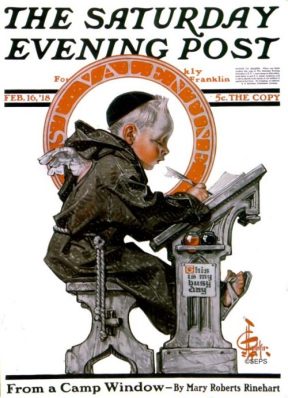
To the extent that it was celebrated, Valentine’s Day was a holiday for children, who exchanged handmade cards at parties, and single women, who got up to all sorts of hijinks with their friends. Men, apparently, refused to have anything to do with it. The February 16 cover of the Saturday Evening Post, which was a men’s magazine at the time, did have a Valentine’s theme, though,

J. C. Leyendecker Saturday Evening Post cover, St. Valentine writing, February 16, 1918.

J. C. Leyendecker, February 16, 1918

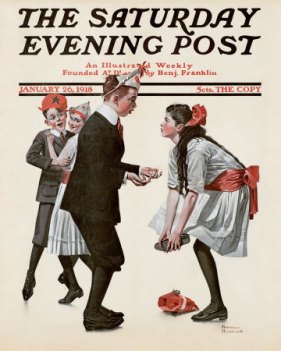
and its January 26 Norman Rockwell cover celebrates young romance:

Norman Rockwell Saturday Evening Post cover, boy stepped on girl's toe at dance, January 26, 1918.

Norman Rockwell, January 26, 1918

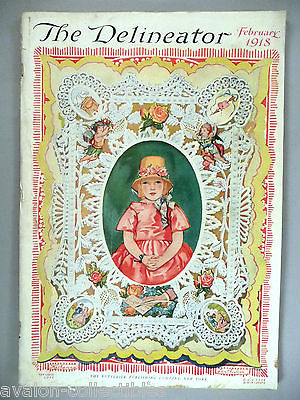
The Delineator tells us in its February issue that

Saint Valentine’s Day offers wide latitude for ingenuity and artistic skill, both to the wee tot in kindergarten, whose baby fingers have been newly trained to paste and weave and prick, and her grown-up sisters who can, with pen or brush, evolve delightful valentines with the personal touch, or design charming place-cards and dance programs, and contrive cunning nut and bonbon dishes.

Katherine Southwick Delineator cover, girl in bonnet with lacy border, February 1918.

Katherine Southwick, February 1918

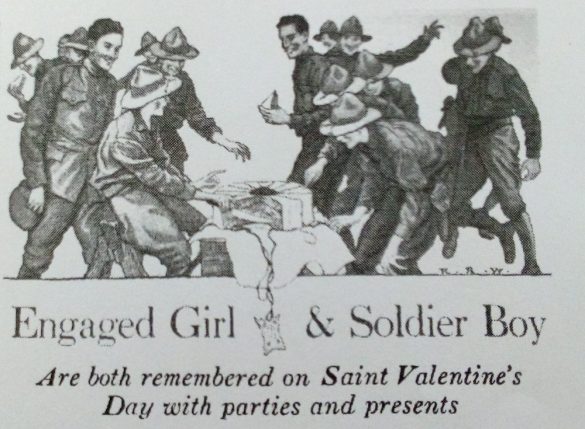
According to The Delineator, the day “lends itself most happily for luncheons for brides-to-be and announcement parties.” One such party features a game called heart archery. A large heart is mounted on an easel, with a bulls-eye and numbered sections. Gifts are placed in a box, “tied with crimson ribbons and with the number on a tiny dangling red heart.”

Armed with a bow and arrow (handed to the guest by Cupid himself if possible), the guest tries out her skill in hitting the bull’s eye. If she is successful she should find that her number draws a package containing a ring, indicating that she will be the next bride. Other gifts, all significant, fall to the less fortunate: a mitten for rejection, a coin for wealth*, a rabbit’s foot for luck, a toy boat for a sea journey**, an automobile, a thimble for the spinster, etc. Any hostess will have the ingenuity to work out little fortunes for her guests, and if they fall to the right people, all the merrier.

Woman's Home Companion illustration, Engaged Girl and Soldier Boy Valentine's Day parties, February 1918.

Delineator, February 1918

Woman’s Home Companion tells us about some small-town girls who sent Valentine’s Day treats to the boys in khaki. (How, I’m not quite sure, given that the February issue must have been printed well in advance, and the United States wasn’t at war yet the February before.) They baked a huge spice cake, divided it into fifteen sections, one for each of the soldiers from their town, and iced it in white and red, “with an appropriate red heart as a centerpiece.” A good-luck charm (four-leaf clover, wishbone, or horseshoe) was baked into each piece. Small gifts, such as homemade cookies, chocolates, and khaki-colored initialed handkerchiefs, were “distributed impartially.”

So happy Valentine’s Day everyone, brides, spinsters, and rejects alike! Watch out for flying arrows, and don’t break your tooth on a good luck charm!

*You know, because being wealthy is way less lucky than getting married at age twenty.

**Maybe not such a great idea in 1918?

America at war: Suddenly, it’s real

I didn’t learn much about World War I in school. It was the seventies, and there was a backlash underway against the rote memorization of battle dates and that sort of thing. It was all about cause and effect. One day we’d be learning about Archduke Ferdinand and the alliances, and the next day the teacher would say, “Now, after the Allied victory…” We’d say, “Wait, what about the war?” and the teacher would ask us if we really wanted to learn about a bunch of battles. We’d say no and that would be that—on to Versailles.

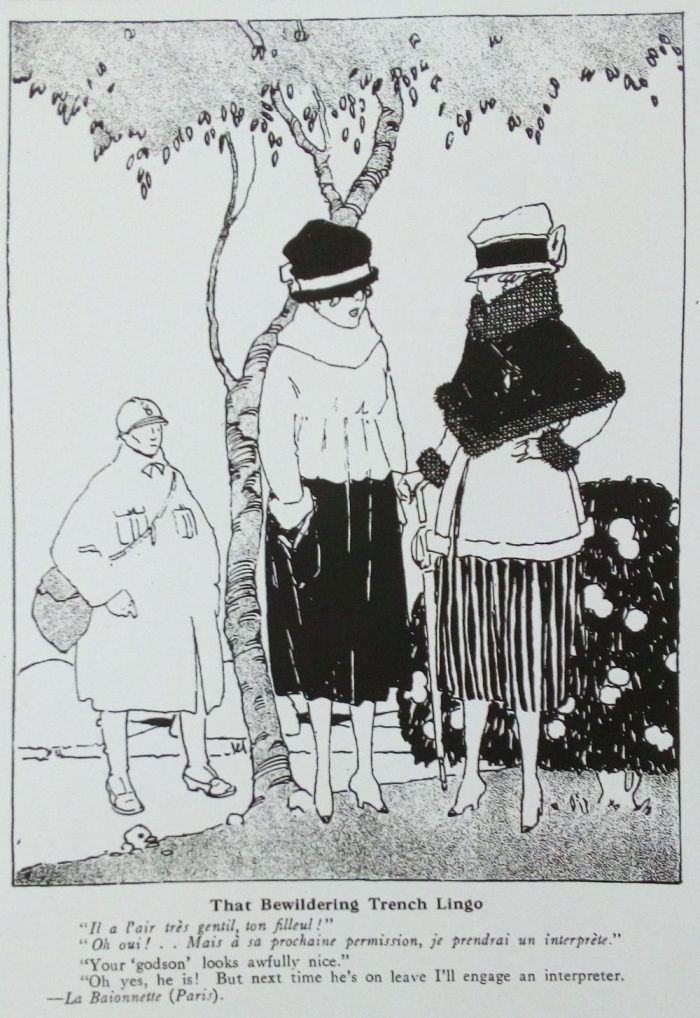
So my vague impression was that the Americans came in in 1917 and gave new energy to the exhausted Allies, who won fairly quickly. A month of reading the 1918 news set me straight. As depicted in the press, the early stage of the American war effort was a colossal screw-up. American soldiers in France, short on weapons and supplies, did little but consume scarce food supplies and—judging from the humor magazines—hit on French women.*

French cartoon in Judge magazine, That Bewildering Trench Lingo, 1918.

Judge magazine, February 9, 1918

The Wilson administration’s handling of the war was universally regarded as inept. The New Republic said in its January 19 issue that “any friend of the administration who fails at the present time to speak frankly about the effect produced by the breakdown of management of the war upon the state of mind of the public is doing to President Wilson a most indifferent service.” The fuel shortage, it said, is creating a sense that the country is “helplessly drifting into a succession of similar crises, which if they are allowed to develop will continue to paralyze American ability to assist our Allies and do harm to Germany, and which will react balefully on the morale of the nation.” And that’s what the administration’s friends were saying! (New Republic founding editor Walter Lippmann was serving as an aide to Secretary of War Newton Baker.)

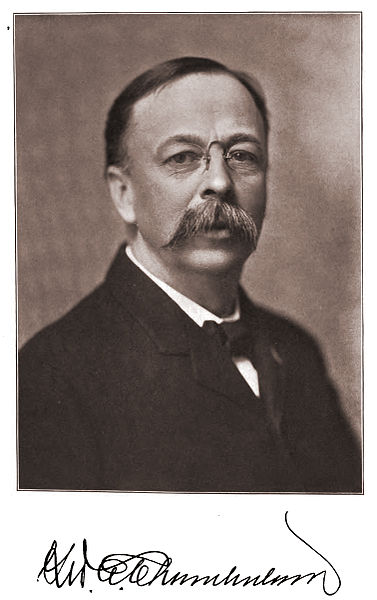
Photo portrait of Senator George Chamberlain, 1904.

Senator George Chamberlain, 1904

Congress was so fed up that Republican Senator George Chamberlain introduced a bill to reorganize the government’s conduct of the war through the establishment of a War Council with sweeping powers, accountable only to the President. “The military establishment of America has fallen down,” Chamberlain said in a January 20 speech, because of “inefficiency in every bureau and department of the Government of the United States.”  The New Republic denounced this “crude, ill considered, and indefensible measure,” but said that, if Wilson didn’t come up with better structures for the conduct of the war, “the existing mechanism will continue to creak, and groan and exasperate its victims.”

As January ended and February began, though, American soldiers completed their training and moved to the front lines. A Times correspondent reported that, as they did so, “Every man was happy just because he was going to fight at last, and as the regiments marched along the men sang joyously until they reached a point where all further operations were carried out in complete silence.”

On January 30, there was heavy shelling on an American position on the French front. Two soldiers were killed and one was captured. The Associated Press interviewed one of the wounded, a sandy-haired youth from Bismarck, North Dakota, who “said with a smile to the correspondent, ‘Did you ever hear of such bad luck? Now I’ve got a piece bit out of my leg by a shell splinter…believe me, if I ever get back to that line again—well, all I want is another chance.”

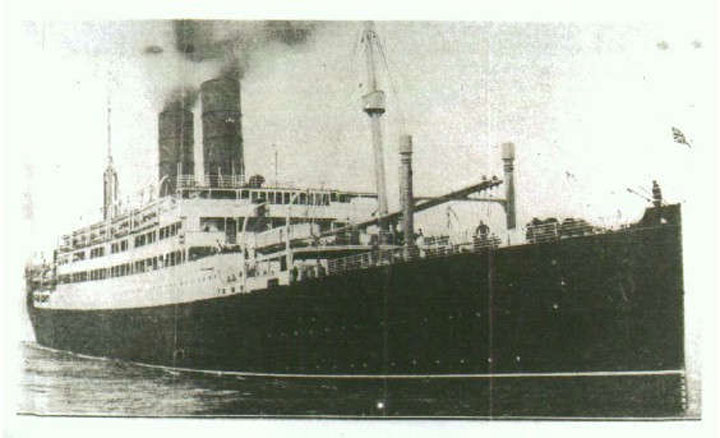
Photograph of British ship SS Tuscania, 1914.

SS Tuscania, 1914

Then, on February 5, the SS Tuscania, a British ship transporting American soldiers across the Atlantic, was torpedoed by a German submarine and sunk in the Irish Sea. The British and American governments were slow to produce casualty lists, and relatives waited anxiously for days. Among them were the cartoonist Richard F. Outcault, creator of Buster Brown and the Yellow Kid, and his wife. “I am expecting hourly to hear from Dick,” Mrs. Outcault told the New York Times, “and I expect to get news soon. He is a level-headed boy, and I am sure he knew how to take care of himself in an emergency.” Richard F. Outcault, Jr., was among the survivors. 210 other families were not so lucky.

The strange air of unreality was gone. America was at war.

*UPDATE 4/1/2019: Remember when I promised to make mistakes? This is one of them. First of all, the soldier is French. And he’s not hitting on the women–one of them is his marraine, or (honorary) godmother. Marraines served as substitute mothers to soldiers without families or whose families were out of reach in German-occupied areas.

Who do you love? Walter Lippmann vs. H.L. Mencken

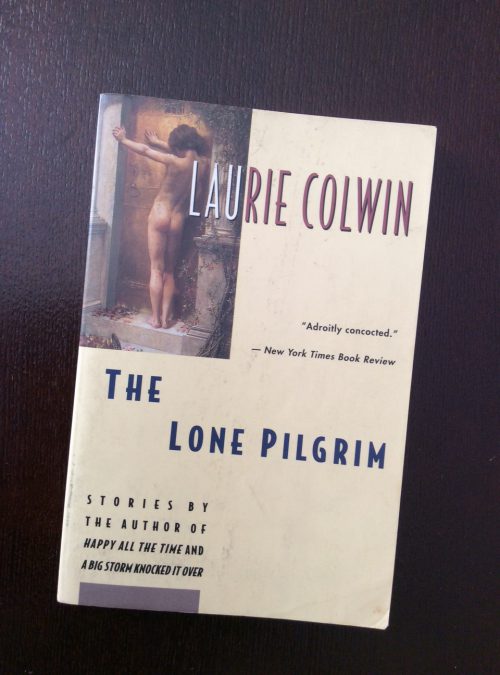
There’s a short story by the wonderful, much-missed writer Laurie Colwin called “An Old-Fashioned Story.” It’s about a rebellious young woman named Elizabeth whose horrible rich parents decided when she was a child that she should marry Nelson, the upstanding son of their equally horrible best friends. Elizabeth isn’t having any of it. Nelson’s ne’er-do-well older brother James sounds more up her alley, but he’s always off somewhere and she hasn’t seen him since she was a child. He finally shows up at his family’s holiday party, and she leaves with him, scandalizing everyone. But, as she sits in a bar listening to him drone on about his wicked ways, she realizes he’s a bore. A few weeks later, Nelson shows up at her apartment when she’s suffering from a cold. He turns out to be a secret rebel, and to be the one for her.

I thought of this story after reading (or listening to) social commentary by Walter Lippmann and H.L. Mencken, two of the top pundits of the 1918 era. I’ve tuned out of 21st century podcasts, and the audio accompaniment to my walks lately has been Lippmann’s 1912 book of essays A Preface to Politics. In it, Lippman, who was only twenty-three when the book was published, goes on sensibly about what’s wrong with politics in the United States: basically, that our system is organized around a notion of how people should be, rather than how they really are. He builds his case methodically, quoting William James and Nietzsche and G.K. Chesterton. He’s sensible, persuasive, and intelligent—Harvard Phi Beta Kappa intelligent. He’s the golden boy. Your mom would love him. But you wouldn’t say he was exciting.

Portrait photograph of Walter Lippmann, 1914.

Walter Lippmann (Pirie MacDonald, 1914)

Then, in the January 1918 issue of Smart Set, I came across H.L. Mencken. Mencken was the magazine’s co-editor, and after 136 pages of jocular stories of varying quality there’s a piece by him called “Seven Pages about Books.” Reviewing a book called Success Easier than Failure, by E. W. Howe, he writes that it’s “the first forthright exposure, so far as I know, of the working philosophy of the American people—not the moony philosophy they serve with the lip, but the harsh, realistic, Philistine philosophy they actually practice.” He goes on:

This fundamental dualism, this disparity between what is officially approved and what is privately done, is at the heart of the American character; it sets our people off from nearly all other peoples. It is the cause of the astonishing hypocrisy that foreigners see in us, and it is the cause, too, of our constant failure to understand those foreigners and their ways.

Portrait photograph of H.L. Mencken.

H.L. Mencken, date unknown

Mencken, the high school-educated son of a cigar factory owner, is as scruffy as Lippmann is urbane, as direct as Lippmann is deliberate. Reading him after weeks of 1918 journalism felt like stepping out into the fresh air from an overheated parlor. Finally—a writer who felt contemporary.

Then I read on. Mencken complains about how we “save the [racial slur] republics from themselves” and then try to turn them into democracies. In a supposed tribute to the Jewish people, he says that any flaws they may possess are due to “corruption of blood” through intermixing with Greeks, Arabs, and Armenians. “The shark that a Jew can be at his worst is simply a Greek or Armenian at his best,” he says.

Meanwhile, in A Preface to Politics, Lippmann has turned his attention to a report on vice in Chicago. Prostitution, he says, isn’t a problem that takes effort to focus on, like trusts, or the poor. Instead, it “lies close to the dynamics of our own natures. Research is stimulated, actively aroused, and a passionate zeal suffuses what is probably the most spontaneous reform enthusiasm of our time.” Get it? Stimulated? Aroused? Passionate? Lippmann has sex on the brain! (I wonder if his editor noticed the puns. They might have slipped by me if the otherwise sedate narrator hadn’t had such a good time with them. He does all but say “heh heh heh.”)

It’s not just the puns. Lippmann argues that the preventive approach the Chicago commission advocates—more enforcement, putting lights in public parks, etc.—will never work. The only effective solution to prostitution, he says, is to get rid of the stifling morality that forces sex underground—to allow it to be enjoyed by people other than couples in lifelong monogamous marriages. Now that’s contemporary.

Mencken, as he winds up, takes a direct swipe at Lippmann, mocking his “sonorous rhapsodies.” Maybe he has a point.

But sorry, H.L., it’s too late.

Walter, you’re the one.

Wednesday Miscellany: Oh and by the way we’re publishing Ulysses

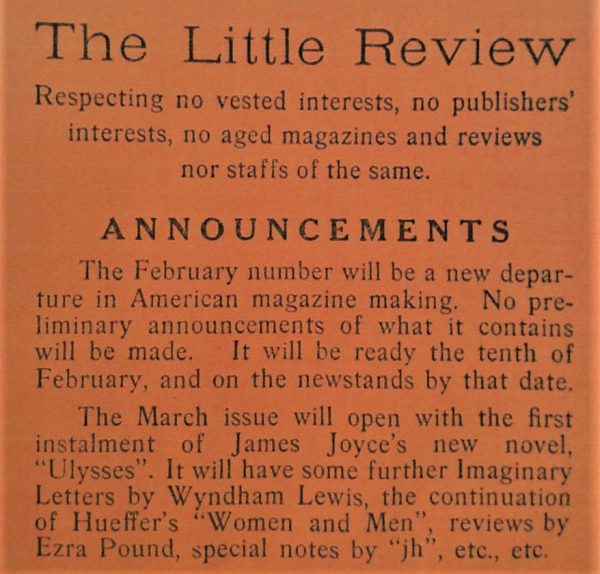
I can’t wait to find out what surprise the Little Review has in store for February 1918 that’s so huge that they can casually toss off “oh, and we’re publishing the first installment of Ulysses in March.”

The Little Review announcement of Ulysses publication, 1918

The Little Review, January 1918

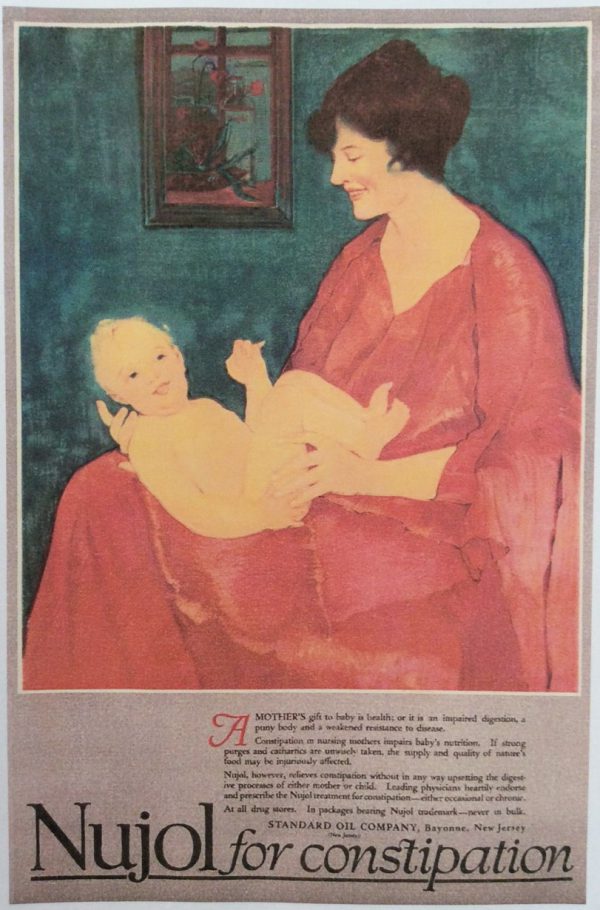
The best art of 1918 is found in some surprising places. For example, ads for constipation medicine.

Nujol constipation ad, painting of mother holding baby. 1918.

Woman’s Home Companion, January 1918

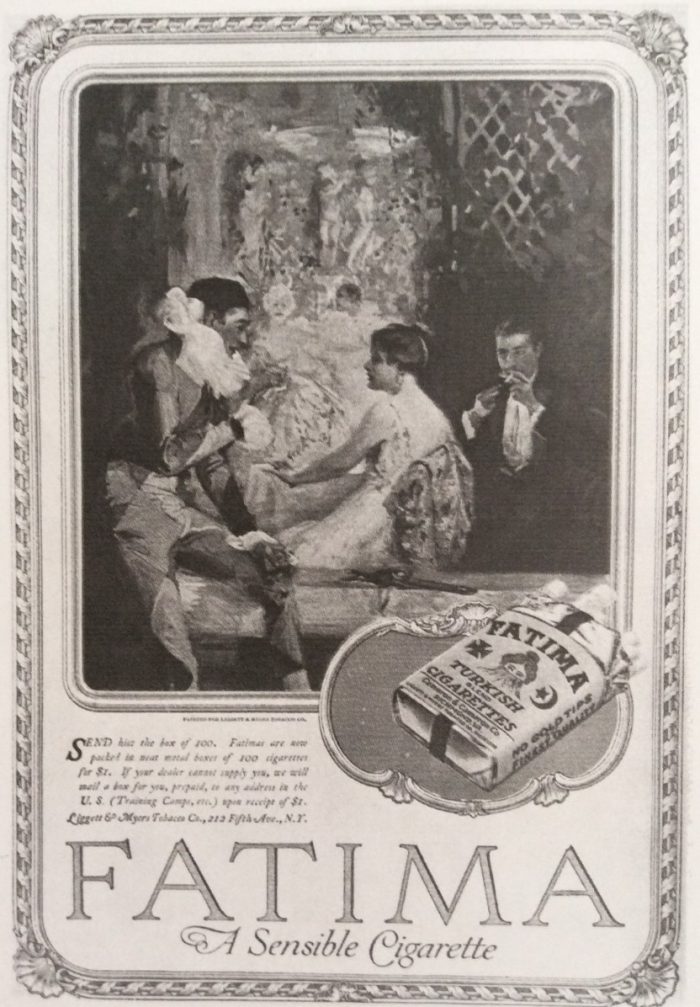
Support the troops! Send them cigarettes from the enemy!*

*Actually just pretend-Turkish: really Liggett & Myers tobacco.