Category Archives: In the News

When half the country shut down

There seems to be a pattern: when something bad happens in 2018, it turns out that a similar, but way worse, thing happened on the same day in 1918. First the cold weather, now the shutdown.

Believe me, I know how bad a government shutdown is—I went through several of them during my Foreign Service career. But on January 21, 1918, half the country shut down.

The problem: ships full of war supplies destined for Europe were sitting idle because they didn’t have coal to fuel them. The fuel couldn’t get through because of congestion on the railways. So, on January 16, Fuel Administrator Harry Garfield ordered manufacturers east of the Mississippi and in Louisiana and Minnesota to shut down for five days beginning on January 18. In addition, all business establishments, with a few exceptions, were ordered to shut down for the next five Mondays.
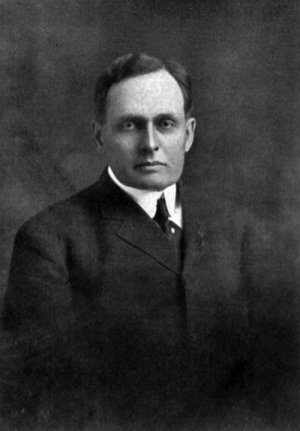
posted photo of Harry Garfield, ca. 1911

Harry Garfield, ca. 1911

The order, according to the New York Times, “came with an abruptness which left official Washington gasping.” Surprisingly, not many people asked, “What gives you the right to do this? You’re the fuel administrator, not the economic commissar.” But there were a lot of objections. The Times editorial page questioned Garfield’s competence, saying that “chloroforming a nation to spare it the pangs of hunger is not good therapeutics, it is malpractice.” The Senate, which was controlled by the Democrats but you’d never know it by the way they treated President Wilson, voted 50 to 19 in favour of a resolution requesting suspension of the order for five days to allow time to evaluate it. Too late! By the time the resolution was approved at “6:05 o’clock,” Garfield had signed the order and it “was flashed to every city in the country.” The Times noted that, after a day that “had been enough to try to nerves of every one,” Garfield seemed unperturbed. (It could be that, having been an eyewitness to the assassination of his father, President Garfield, at age 17, nothing seemed all that bad after that.)

In response to objections that workers would lose their wages, Garfield suggested that their employers could pay them. The board of U.S. Steel, though, decided that this was not such a good idea. Chairman E.H. Gary, who, according to the Times, “did one of the hardest day’s work in his busy life,” said that to pay idle workers “would establish a precedent that would eventually be unfair to the employer and the employe.” The New York State Federation of Labor estimated that 80 percent of the state’s 600,000 workers would lose their pay during the shutdown.
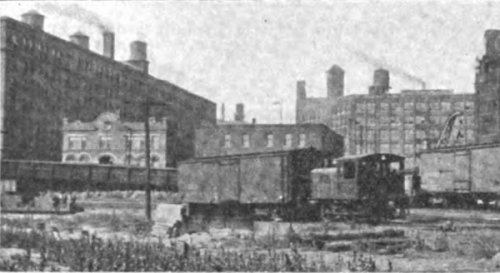
photograph of train in rail yard

Railway Age

For the first few days, things went all right. More coal was making its way to the ports, despite freezing temperatures and snowstorms. But then came the first Monday shutdown. Disaster! Federal officials had mobilized longshoremen to unload the thousands of tons of coal that had been rushed to the piers, but they were stopped by police and soldiers because they didn’t have photo IDs. The rule requiring the IDs wasn’t supposed to go into effect until February 1, but it was implemented early because of bomb threats. By the time it was lifted, most of the workers had gone home. Meanwhile, merchandise that arrived by train couldn’t be moved out of the rail yards to make room for the coal because, oops, the department store warehouses they were destined for were closed under Garfield’s order. The result of all the chaos: less than half the normal daily supply of coal arrived in New York.
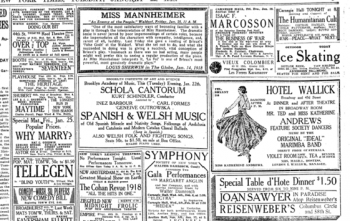
Some theatrical fare on offer (January 22, 1918)

At least the idle workers had something to entertain them. Theaters had been given permission to stay open on Mondays and close on Tuesdays instead. On the first workless Monday, it was standing room only in the theaters and the vaudeville, motion-picture, and burlesque houses.
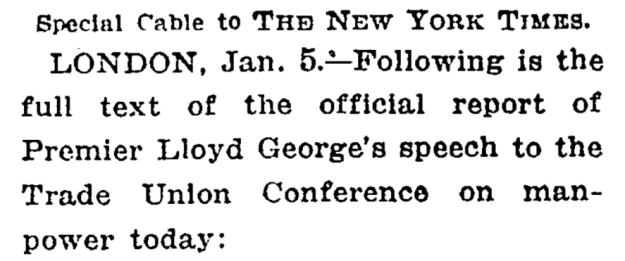
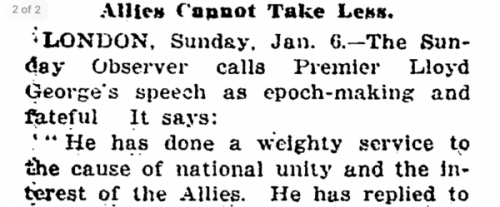
How to be a New York Times war correspondent, 1918-style

So you got hold of a time machine and you want be a New York Times war correspondent in 1918? Here are some tips.

1. If the British Prime Minister gives an important speech on the war, don’t worry about analyzing it. Just send in the official report.

New York Times text, January 6, 1918

New York Times, January 6, 1918

2. To be on the safe side, you might also want to quote a British newspaper’s analysis of the speech in its entirety.

New York Times text, January 6, 1918

New York Times, January 6, 1918.

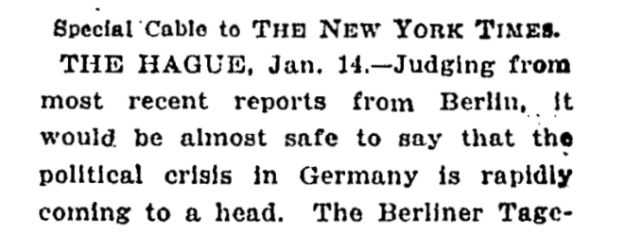
3. If you don’t know what’s going on, open with a vague statement.

New York Times text, "Judging from most recent reports from Berlin..." January 15, 1918.

New York Times, January 15, 1918

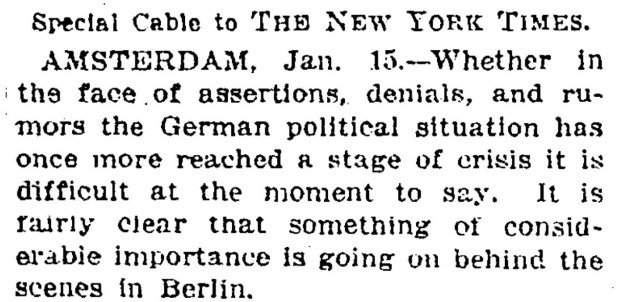
4. Or just come out and admit that you don’t have a clue.

New York times text, "it is fairly clear that something of considerable importance is going on in Berlin."

New York Times, January 16, 1918

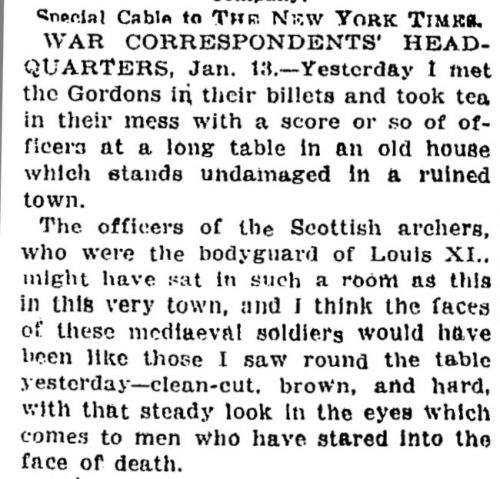
5. If you manage to talk with someone who’s actually involved in the war but all he does is spout generalities, throw in lots of atmospherics.

New York Times text, "Yesterday I met the Gordons in their billets and took tea..."

New York Times, January 14, 1918

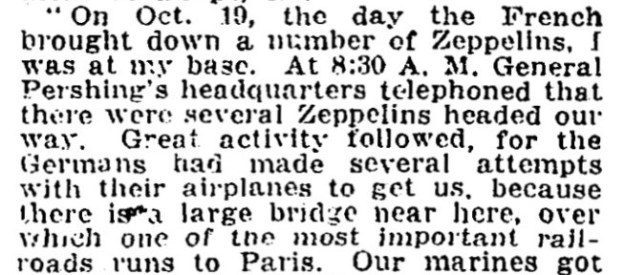
6. Don’t worry about sending in war news. This will be provided by your colleagues, like a reporter covering the unveiling of a plaque at the Biltmore Hotel honoring its employees at the front, who will come across a letter from one of these employees containing actual war news.

New York Times text, January 1918.

New York Times, January 14, 1918

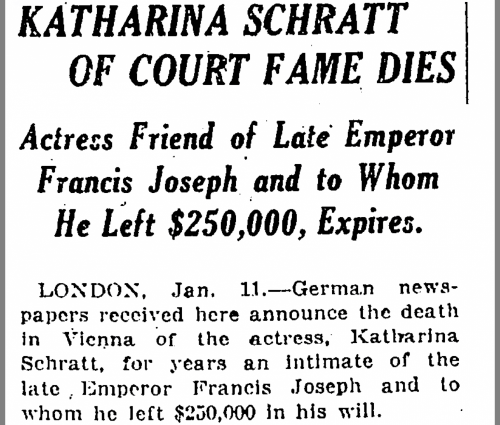
7. Human interest is also good! If the German press reports that the mistress of the former German emperor has died, write about that. Don’t worry about getting confirmation. The Times can just run another obituary in 1940, when she actually does die.

New York Times headline, Katharina Schmitt of Court Fame Dies.

New York Times, January 12, 1918

I know that reporters in Europe faced censorship and restrictions on their movements. And the Western Front was quiet in January 1918. Still, I have to believe it was possible to do better than this. I can see now why the public was so eager for soldiers’ personal accounts of life at the front, provided in books and public lectures. I hope that, as the war heats up and American lives are increasingly on the line, the Times will provide the public with better information.

African-American voices of 1918

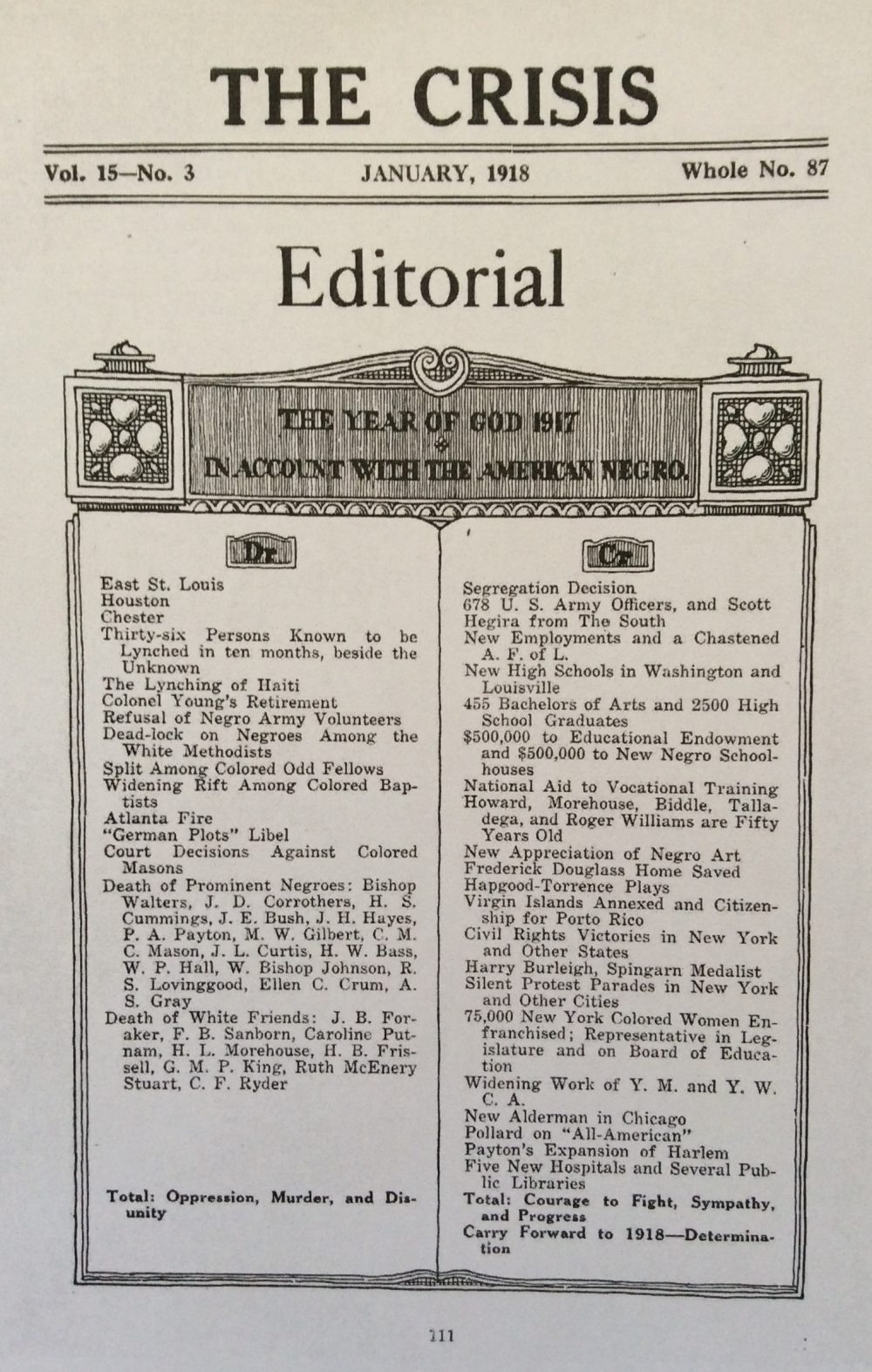
The Crisis editorial page, January 1918.

In 1918, African-Americans were almost invisible in the mainstream press. The New York Times, in a January 6 story called “Problems in Training Negro Soldiers,” groused that the “friends of the negro” were pressuring the War Department, which had drafted 83,600 black soldiers, to solve the “so-called race question in America.” The only other reference to African-Americans I’ve seen so far in the Times was the inclusion of an “unidentified Negro woman” on a list of New Yorkers—the rest were all named—who died of exposure during a cold snap.

I sought out African-American voices in honor of Martin Luther King Day, and found them in the January 1918 edition of The Crisis, the NAACP magazine, which was edited by W.E.B. Du Bois. It’s the best-written and most interesting magazine of the time that I’ve come across, and it feels the most contemporary.

An article by Lindsey Cooper on the 1917 East St. Louis race riots is the closest thing I’ve seen to modern long-form journalism. Framed as a report on the congressional investigation into the riots—which was conducted, of course, exclusively by white men—it provides an in-depth discussion of the social forces that sparked them. Across the Mississippi from St. Louis and home to many of the area’s African-Americans, East St. Louis, Illinois, was a cesspool of vice. The city subsided mainly by means of saloon licenses (376 saloons for a population of 75,000) because a separate municipality—the nation’s richest per capita—had been carved out for nearby factories.

When the white workers of St. Louis tried to unionize, factory owners thwarted their efforts by hiring black workers arriving from the South. This led to a cauldron of racial resentment that boiled over in an explosion of violence in May and July 1917. At least forty African-Americans were killed as police stood by ineptly or indifferently; some encouraged the violence. The National Guard was called, to little effect.  Cooper recounts the story of a man and his son who were dragged out of a car and killed as they passed through East St. Louis on the way home from a fishing expedition. A member of Congress, told of the incident during the hearing, commented, “Indians could have done no worse.”

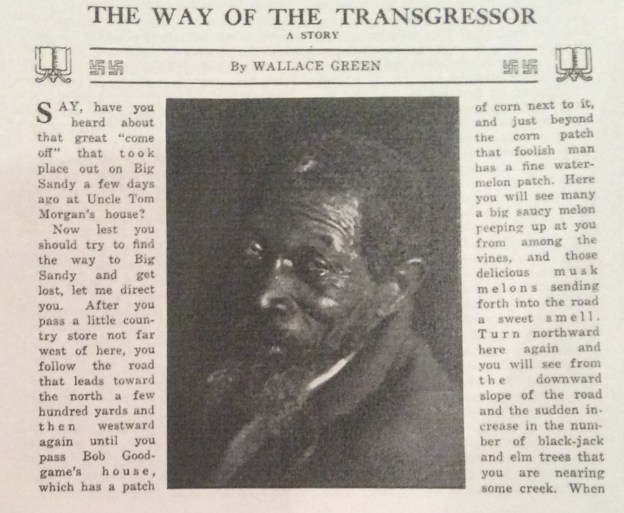
Headline and photograph illustration, The Way of the Transgressor, The Crisis, January 1918.

The Crisis also includes the best short story I’ve seen so far, “The Way of the Transgressor,” by Wallace Green. Green doesn’t try any fancy literary tricks, but the story is refreshingly lacking in the archness and overwriting of the day. It tells of a rural square dance that ends in a blaze of violence, but the best part is the depiction of the dance before the guns come out. I felt like I was there at Uncle Tom Morgan’s two-room log house, watching handsome Jack Sutton and tender-eyed Sealy Green walk down the center of the yard arm in arm “like two monarchs upon streets paved with gold, singing ‘You can’t turn the tea like me.’” Young men longed to swing in the beautiful arms of Pet Henderson, in “a red garment that fit her so well that she seemed to have been just taken out of the melting pot.”

And there’s more. A blazing indictment of the hypocrisy of racist white Christians. A letter from “A Voice from the Orient” calling Wilson out for racism. Another letter, apparently from a white Cuban-American soldier, telling of his experience under the inspiring leadership of the Afro-Cuban general Antonio Maceo in the Cuban Army of Liberation. And a refreshingly unsentimental “Mother’s New Year’s Resolution”: “I will live with my children, not merely for them; since such companionship is worth more than divergent ways, marked by needless sacrifices on the one side and a growing selfishness on the other…I will impart to my children the facts of life, that they may look with reverence upon their bodies.”

You can find The Crisis online, thanks to the Modernist Journals Project, at https://modjourn.org/journal/crisis/. It’s well worth a read, on Martin Luther King Day or any day.

Our daughters’ daughters will adore us…

1918 opened with a bang in Congress. On January 10, two days after President Wilson announced the Fourteen Points at a joint sitting, the House of Representatives approved a constitutional amendment to give women the right to vote.

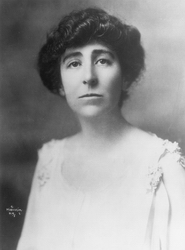
Jeannette Rankin.

Jeannette Rankin

Republican Representative Jeannette Rankin of Montana, the first woman member of Congress, opened the debate. “Is it not possible that the women of the country have something of value to give the nation at this time?” she asked. “It would be strange indeed if the women of this country through all these years had not developed an intelligence, a feeling, a spiritual force peculiar to themselves, which they held in readiness to give to the world.” Representative Walter Chandler, Republican of New York, reassured listeners that, despite what they might have heard, the suffragist movement was not in fact led by socialists and German sympathizers.

The public gallery was packed with women. The New York Times noted that “nearly every woman who journeyed to the House carried a knitting bag.” Most were confiscated, but a few women succeeded in knitting their way through the debate, as suffragist leaders looked on intently.

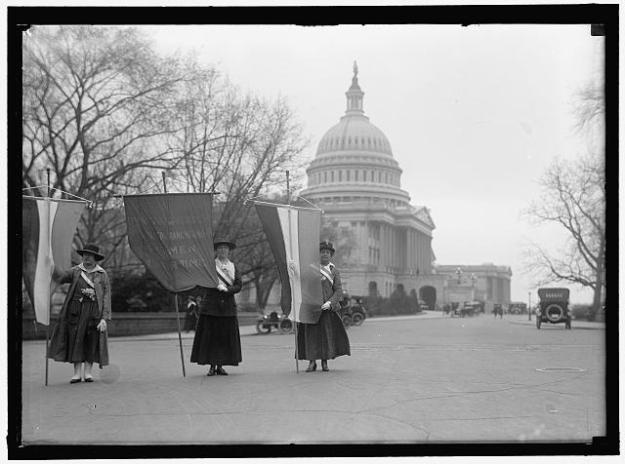
Suffragists picketing the Capitol, 1918.

Suffragists picketing Capitol, 1918 (www.loc.gov)

It didn’t look good at first. Democrat after Democrat voted against the amendment, the Times reported, seemingly dashing hopes that President Wilson’s endorsement the day before would turn the tide. “We are defeated,” suffragists in the gallery whispered. But the amendment’s supporters had mustered all of their strength. Republican leader James Mann came to the House from his sickbed in Baltimore; Thetus Sims of Tennessee, badly injured, staggered to his seat. When the final count of 274 to 136 was announced, exactly the two-thirds majority needed, “the people in the galleries arose en masse and cheered,” and “members on the floor joined in the jubilation.” A challenge to the vote count was unsuccessful. Outside the Capitol, a thousand women cheered “with all the enthusiasm of collegians after a football victory.”

While the Times reporter seems to have been swept up in the celebratory mood, the editorial page accepted the outcome with resigned huffiness. The issue, it said, was purely political. With the House almost evenly divided, and more and more states allowing women to vote, the Republicans had seen the political wisdom of taking up the suffragist cause. The Democratic Party, despite the “reasonable apprehensions” of its southern members, saw which way the wind was blowing. Wilson abandoned his long-held (and in the the Times’ opinion, correct) view that suffrage was a state, not a federal, issue. In wartime, the Times said, “woman suffrage is but a piffling and subminor matter.” Oh well. The amendment would find “harder sledding” in the Senate.

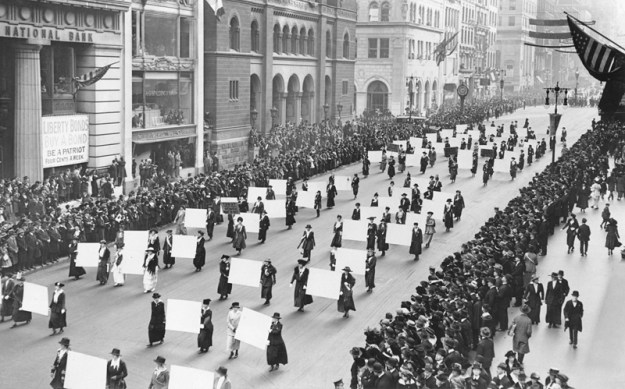
Suffragist Parade, Fifth Avenue, 1917.

Suffragist Parade, Fifth Avenue, 1917

Indeed it would. But, on the centennial of this crucial step forward, those of us who can fight sexual harassment because our great-great-grandmothers fought for the vote can, in the words of Mrs. Banks in Mary Poppins, sing in grateful chorus:

WELL DONE, WELL DONE, SISTER SUFFRAGETTE!

The 14 Points: I flunk a pop quiz

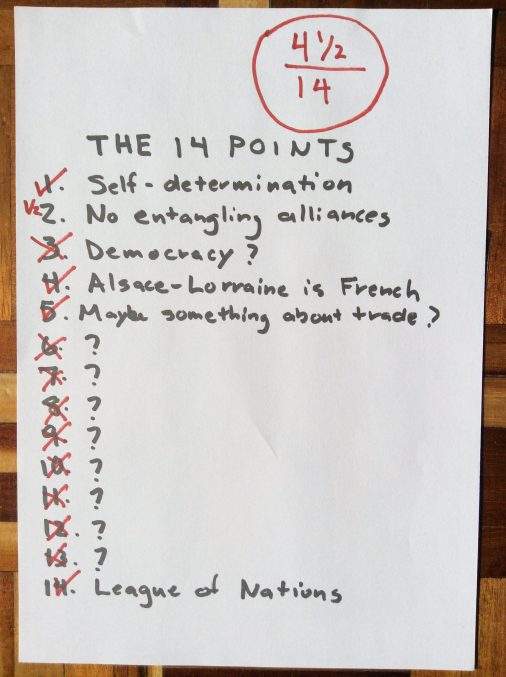
President Wilson’s speech to Congress on January 8, 1918, outlining the Fourteen Points—his statement of principles for peace—took Washington by surprise. There was barely enough time for the House and Senate to make arrangements for a joint session. I, on the other hand, knew it was coming, and for the first time My Year in 1918 felt like homework. I decided I might as well turn it into actual homework, and I gave myself a pop quiz: how many of the points could I remember? You can do this too! Just get a piece of paper, write down the numbers 1 to 14, and give it a go!

No? Okay, here they are:

  1. Open covenants of peace, openly arrived at.
  2. Absolute freedom of navigation upon the seas.
  3. The removal of economic barriers and establishment of equal trade conditions.
  4. Reduction of armaments.
  5. Free, open-minded, and impartial adjustment of colonial claims.
  6. The evacuation (by the Germans) of all Russian territory.
  7. The evacuation of Belgium.
  8. The restoration of French territory, including Alsace-Lorraine.
  9. A readjustment of Italy’s borders along the lines of nationality.
  10. Autonomy for the peoples of Austria-Hungary.
  11. The evacuation of Rumania, Serbia, and Montenegro.
  12. Sovereignty for the Turkish people and autonomy for other peoples under Turkish rule.
  13. An independent Polish state.
  14. A general association of nations.

Here’s what I managed to come up with:

Pop quiz on the 14 Points.

Not very impressive, especially since I was a government major. 32 percent! But I did get some key principles right. On second thought, flunking seems kind of harsh. I’ll bump my grade up to a D+.

If President Wilson hadn’t forced my hand, I would have waited a while to write about World War I. I’m starting to get the gist of what was going on—mostly, totally chaos in Russia—but it’s so complicated. When I was in school, World War I was treated like World War II: The Prequel. A slightly different line-up of combatants, a less morally clear-cut conflict. Afterwards, I read about the tremendous human cost of the war in books like Ernest Hemingway’s The Sun Also Rises and Vera Brittain’s Testament of Youth. But I never understood the war itself very well.

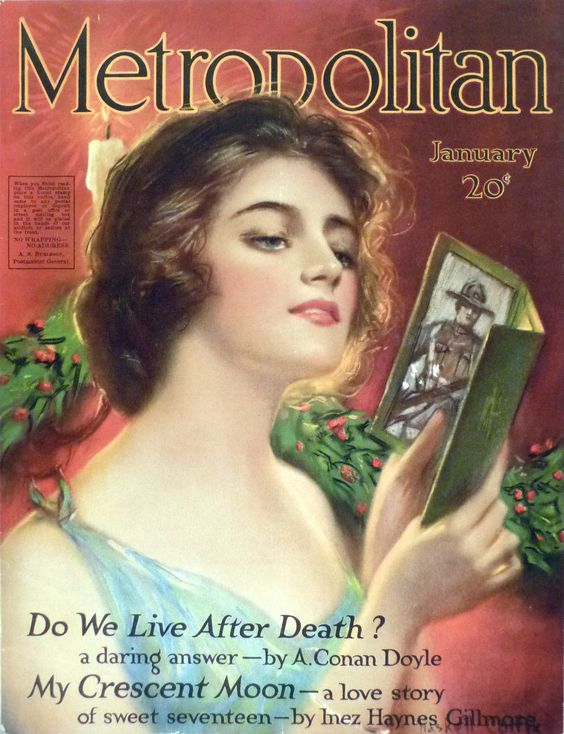
Here, then, are some early thoughts. On the one hand, the American press is completely consumed by the war. Children’s magazines explain the intricacies of U-boat fighting. Women’s magazines talk about doing your bit by cutting down on butter and sugar. (I’m not sure exactly how this helps.) There’s a war-related illustration on almost every magazine cover.

On the other hand, there’s a tremendous sense of confusion and ambivalence. What exactly are we fighting for, and why? There’s lots of carping in the press about the ineffectiveness of the Allied forces. A few days before Wilson’s address, British Prime Minister Lloyd George gave a speech to trade unionists that struck me more as an effort to maintain the loyalty of his people than as a rallying cry. In this context, Wilson’s speech seems as much a justification for the war as a path to peace.

It will be interesting to see how people in 1918 respond to the 14 points. In the meantime, I’d better brush up on my European geography. You never know when there’s going to be another quiz!

The bonkers world of Marie Corelli

I promised in my first post that there would be heroes and villains. I haven’t found any heroes yet, other than the railroad workers who shot steam at locomotives to defrost them. But I’ve found my first villain: the wildly popular British novelist Marie Corelli.

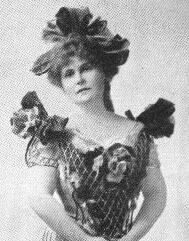
1909 photograph of Marie Corelli.

Marie Corelli, 1909

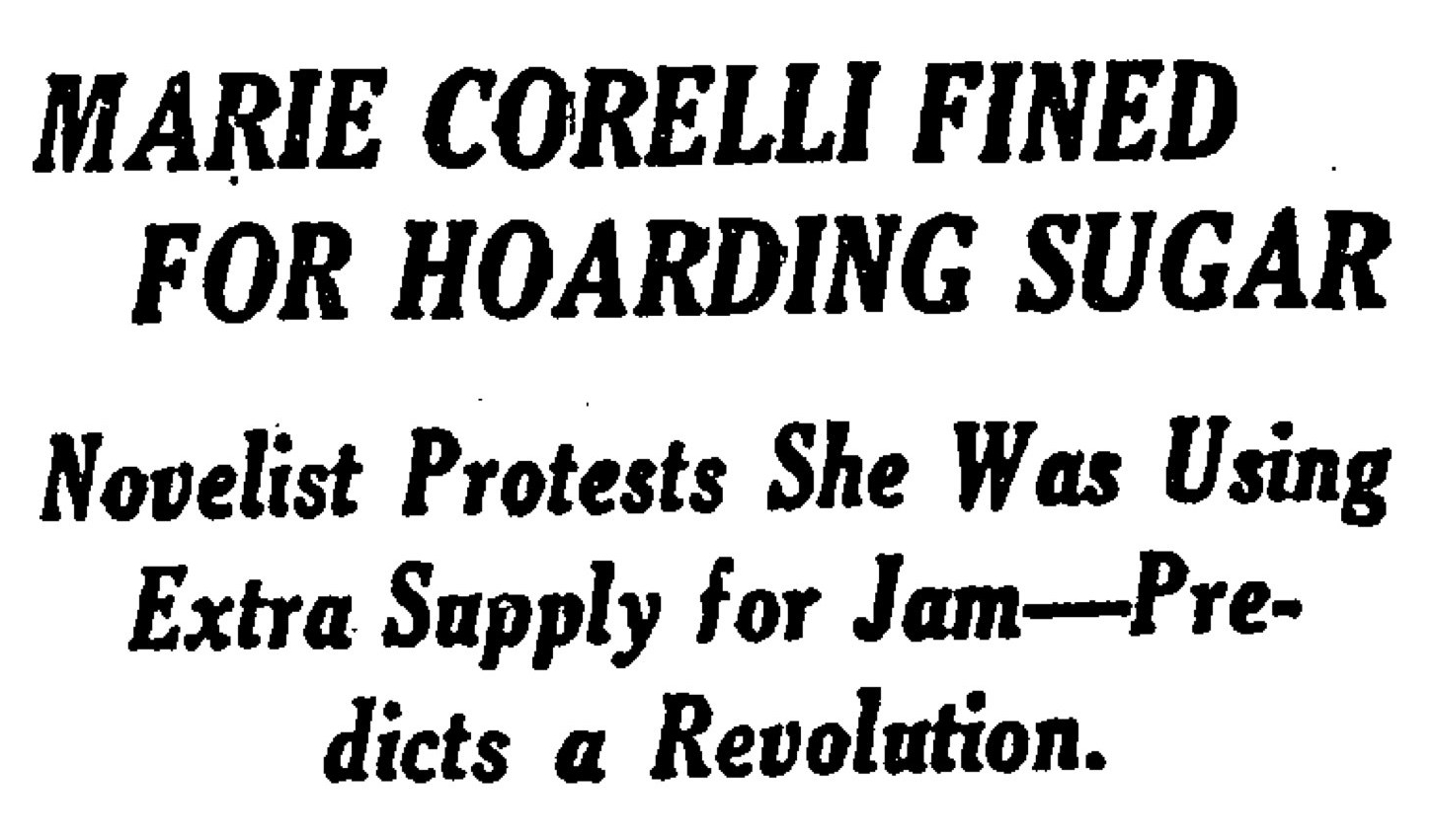
According to the January 3, 1918, New York Times, Corelli was fined £71 by the Stratford-on-Avon Police Court for hoarding sugar. Authorized 32 pounds in a ten-week period, she obtained 179 pounds, plus 50 pounds of preserving sugar. The court didn’t buy her lawyer’s argument that she had acted out of patriotism in preserving fruit for future use. When the police showed up at her house, she said, “You are upsetting the country altogether with your food orders. Lloyd George will be resigning tomorrow, and there will be a revolution in less than a week.”

New York Times headline, Marie Corelli Fined for Hoarding Sugar.

New York Times, January 3, 1918

Who was this woman? I decided to learn more, and I found an article she wrote for the January 1918 issue of Good Housekeeping called “The World’s Great Need.” The world’s great need, according to Corelli, is sanity—something that is sorely lacking in this article, aside from a well-argued condemnation of corporal punishment. Corelli writes that that the desire to “wallow in blood and slaughter” has prevailed over reason. That’s an understandable sentiment in 1918; it’s her solution that’s a problem. Anyone who violates the peace and progress of the world, she says, “should either be shot like mad-dogs as incurable and dangerous, or imprisoned for life in asylums for the criminally insane.”

Corelli thinks a lot of people are insane. There’s the Scottish woman who, “after accepting many useful kindnesses from a friend” (could it have been Corelli?), cut the friend out of her prayers following a minor disagreement. Not to mention the Futurists, the Cubists, Debussy, writers of “revoltingly sexual fiction,” and other producers of art that is “utterly opposed to truth and nature.” How to return sanity to the world? Simple—just require everyone wishing to marry to submit to “a searching health examination, so that union may be forbidden to the unfit.”

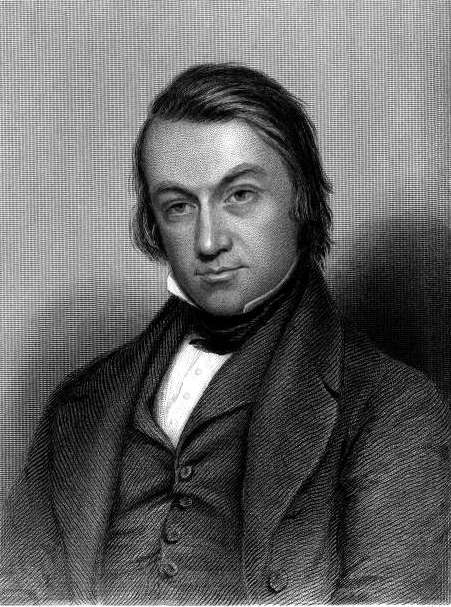
Portrait of Charles Mackay.

Charles Mackay, Marie’s father (The Modern Scottish Minstrel, Volumes I-VI)

Corelli was an ardent spiritualist; her books deal with mystical and extrasensory phenomena. (If her predictions to the police about Lloyd George and the revolution are any indication, though, she wasn’t a very gifted prognosticator.) Ironically, she was the daughter, by a household servant, of Charles Mackay, whose 1841 classic Extraordinary Popular Delusions and the Madness of Crowds debunks hocus-pocus of all types.

It can’t have been easy to be Marie Corelli. She was born with the stigma of illegitimacy and mocked by the literary establishment. She may have had a decades-long same-sex relationship with her father’s caretaker; if so, she had to keep it secret. (UPDATE 10/31/2020: Read more about this here.) Still, she chose what beliefs to espouse, and she chose some of the worst elements of 1918 thinking—eugenics, superstition, and reactionary literary taste. Not to mention the sugar hoarding!

You think YOU’RE cold…

It’s easy for me to say that things could be worse. I’m in Cape Town, where it’s 72°F, while my friends in the United States are shivering in the bitter cold. But, as glad as I am that I’m not there, I’m even more glad not to be suffering through the December 1917-January 1918 cold spell.

The New York Times reported on January 1 that New Year’s Eve, with a low of -7°F, was the second coldest day on record in New York, surpassed only by the day before, when it was -13. It was even colder if you went by the big thermometer in front of Perry’s Drug Store in Park Row, apparently the go-to place to check the temperature.

There was a severe coal shortage, so going inside didn’t provide much relief. The Times reported on the front page that some occupants of private houses and apartments had been forced to check in to hotels to keep warm. On Wall Street, bankers were working in their overcoats. The District Attorney’s office ran out of coal, so staff members finished their work by candlelight. You had to turn to the second page to read about the twelve people, mostly in poor neighborhoods in Brooklyn, who died from exposure.

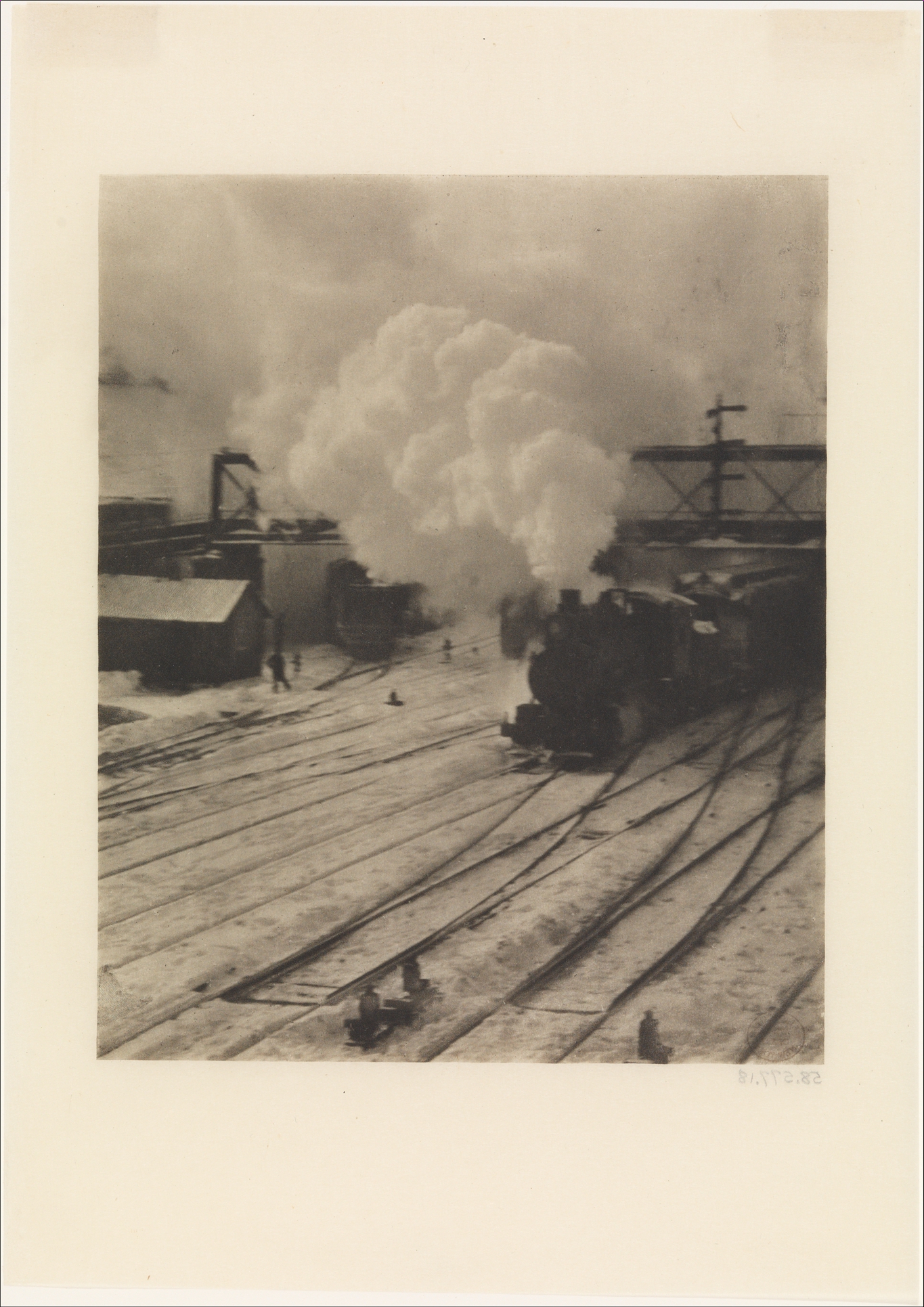
Alfred Stieglitz photograph of New York Central Yards, 1903.

In the New York Central Yards, Alfred Stieglitz, 1903 (metmuseum.org)

Rail service was paralyzed. Locomotive boilers froze solid and pistons were encased in giant slabs of ice. Rail yard workers shot jets of steam to thaw the engines, but their clothes quickly froze. Coal trains finally made it into the city on New Year’s Day, after passenger service was suspended to let them through. When trains full of coal arrived at the 119th St. rail yard near the East River, hundreds of poor men, women, and children arrived with buckets. When they were told that the coal was reserved for city government buildings, they became enraged and attacked the wagons. Several tons of coal fell into the street, and a “wild scramble” ensued. Finally, the local police captain “used his reserves reluctantly and gently to disperse the crowd.”

So keep warm, and be grateful for the miracle of electricity!