The Year Mandela was Born: South Africa in 1918

A couple of months into this project, I was chatting with my 13-year-old nephew during an outing to Simon’s Town, a coastal village south of Cape Town. He’s a YouTuber, and we were talking about building an audience. He had a bigger following than I did, and I was hoping he could give me some tips.

“What do you write about again?” he asked me.

“Things that happened a hundred years ago,” I said.

“Kids don’t care about that,” he told me.

“I don’t write for kids,” I said.

“Who do you write for?” he asked. “Old people?”

“Yes,” I said.*

“Then you should write about things that old people care about, like Mandela,” he said.

Four months later, on the 100th anniversary of Nelson Mandela’s birth, I’m taking his advice.
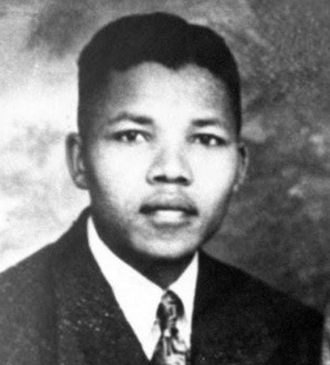
Nelson Mandela, ca. 1941 (Nelson Mandela Foundation)

A baby being born in a village in the eastern Cape is not the stuff of international headlines, of course, so I can’t tell you about the birth itself. I can tell you, though, about the South Africa Nelson Mandela was born into and would grow up to transform.

With war raging in Europe, the outside world wasn’t paying much attention to South Africa. There was a fascinating article about the country’s “native problem,” though, in the December 8, 1917, issue of the New Republic. It was written by R.F. Alfred Hoernlé, who, despite his Afrikaans-sounding last name, was a British academic (with a German grandfather) who had taught for three years at what is now the University of Cape Town.**

R.F. Alfred Hoernlé, date unknown

Hoernlé gets to the crux of the problem right away:

The native problem dominates the South African scene. Whatever political issues and movements show in the foreground, it supplies the permanent background. However much the white population of South Africa may be absorbed in the racial*** and economic rivalries of the immediate present, it cannot but be profoundly apprehensive about its future, as long as the native problem remains unsolved.

Hoernlé points out that

Though in name a democracy, South Africa is in fact a small white aristocracy superimposed on a large native substratum.

Not that he’s advocating anything crazy, like making it a real democracy.

It is not a question, mainly, of the natives’ present unfitness for the vote, which everyone must readily grant.**** It is a question of political development. No policy which would ultimately involve that the white should admit the mass of the blacks to political power has any chance of acceptance, on the face of the unalterable numerical superiority of the blacks.
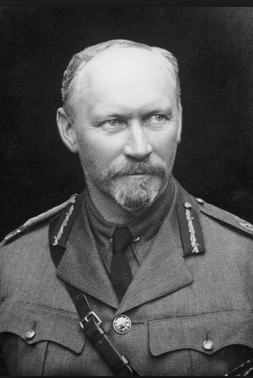
Jan Smuts, Elliott & Fry, 1917 (National Portrait Gallery)

So what to do?

To that question a speech which General [Jan] Smuts delivered in London, in May of this year, furnishes an answer. He rightly characterizes the problem as one of maintaining “white racial unity in the midst of the black environment.” This depends, in part, on avoiding two mistakes, viz., mere exploitation of the natives, and racial intermixture. The white races, Smuts insists, must strictly observe the racial axiom, “No intermixture of blood between the two colors,” and the moral axiom, “Honesty, fair-play, justice, and the ordinary Christian virtues must be the basis of all our relationship with the natives.”*****

And how does Smuts plan to achieve this?  Hoernlé tells us that

Any incorporation of the black into the structure of white society is bound to raise, in the long run, the problem of admitting them to citizenship, giving them the vote, and treating them as the white man’s political equals. There is only one way of avoiding this result, and that way is segregation of the native—the creation of the land in a chequered pattern of white and black areas. This is the policy to which General Smuts pins his hopes…

The idea is, wherever there are large bodies of natives, to assign to them definitive areas within which no white man may own land. The native, on his side, is to be forbidden to own land in white areas, though he is to be free to go and work for the white man. The races having been thus territorially separated, each is to live under its own political institutions…

A beginning has so far been made by the Natives’ Land act of 1913, a purely temporary measure designed chiefly to prevent speculation in land in anticipation of later legislation.
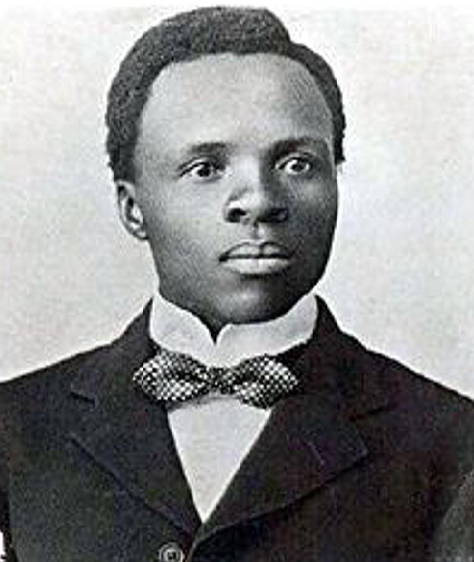
Sol Plaatje, ca. 1900 (From “Native Life in South Africa”)

That’s one take on the Natives Land Act. Another comes from black writer and activist Sol Plaatje, who wrote in the 1914 classic Native Life in South Africa that

Awaking on Friday morning, June 20, 1913, the South African native found himself, not actually a slave, but a pariah in the land of his birth.

Map showing areas allocated to black South Africans under the Natives Land Act of 1913

The Natives Land Act prevented South Africans from buying land in 93% of South Africa. It would also have disenfranchised non-white voters in the Cape, the only place where they had the right to vote (some of them, that is—there were education and property qualifications), but the courts struck that provision down. As far as the law’s “purely temporary” nature goes, its impact continues today: under post-apartheid land restitution legislation, South Africans have the right to claim land taken from their ancestors only after its passage.

Hoernlé calls the partition/self-determination scheme “promising in principle.” The challenge, he says, is to come up with a fairer division of land than the one proposed by a recent commission, which allocates South Africa’s five million black inhabitants a little over 12% of South Africa’s territory and reserves the rest to the 1,250,000 whites. (This was exactly the breakdown when the black “homelands” were created during apartheid.)

If the “natives” are treated justly, Hoernlé said, there is a path to peace. But he’s not hopeful.

At present, the eye that would pierce the future, sees the deepening shadow of the native problem creep slowly but surely over the sunny spaces of South Africa.

Me in Pretoria (in flowery sundress), December 1989

People often ask me if 1918 reminds me of our world today. For the most part it doesn’t, at least as far as the United States is concerned. There are similarities, of course, but a country where lynchings were commonplace and women couldn’t vote and want ads specified Christians only is, thankfully, not one I recognize. The South Africa Hoernlé describes, on the other hand, differs hardly at all from the country I arrived in as a young diplomat in 1988.

It would take over seven decades for the South Africa Mandela was born into to change fundamentally—decades during which he would grow up, become a lawyer, join the liberation struggle, spend 27 years in prison, and emerge to lead his people to freedom.
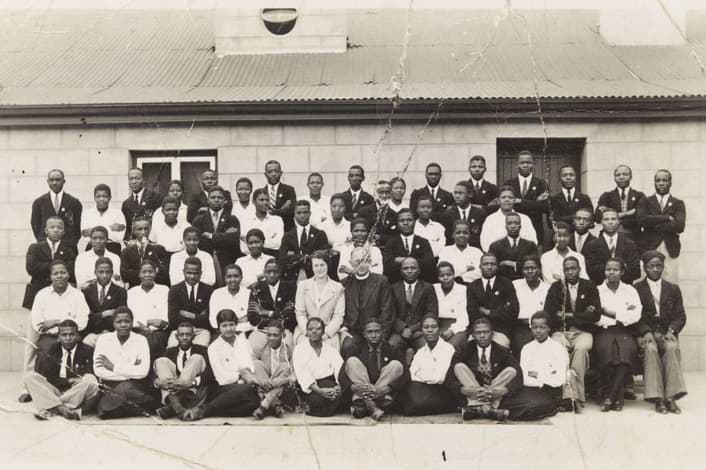
Earliest known photo of Nelson Mandela (back row, fifth from right), Healdtown Secondary School

*No offense! The baseline here is 13.

**UPDATE 11/09/2019: Hoernlé popped up in Young Eliot, Robert Crawford’s biography of T.S. Eliot. He taught Eliot as a visiting professor at Harvard and later joined the Harvard philosophy faculty. Hoernlé was a (laudatory) reviewer for Eliot’s Ph.D. dissertatation and was chair of the  philosophy department when it considered, but ultimately decided against, offering Eliot a position.

***That is, English vs. Afrikaner.

****“Everyone” meaning whites, of course. Black South Africans don’t have a say in this matter because…well, they don’t have the vote. (Mostly. We’ll get to that.)

*****Jan Smuts was the Woodrow Wilson of South Africa, renowned statesman abroad and racist at home. He was considered a liberal in South Africa, which gives you an idea of why “liberal” remains a swear word among black South Africans today.
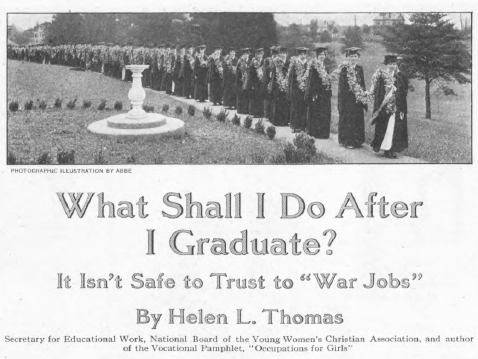
What’s Your 1918 Girl Job? Take This Quiz and Find Out!

One of the (few) disappointments about reading in 1918 is that nothing’s interactive. Of course, I understood when I started this project that my days of discovering what secondary Jane Austen character I most resemble were over for a while.* And I knew that crossword puzzles were a few years away from being invented.

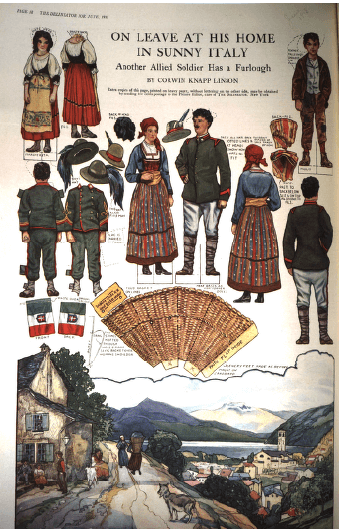
But still, there could be quizzes, or personality tests, or…something. But no. The year peaked with the vocabulary-based intelligence test in the Literary Digest in February. After that, nada. Unless you were a kid, in which case you got to enter St. Nicholas magazine contests, and cut out paper dolls from women’s magazines, and make this actually extremely cool diorama that I am definitely going to get to one of these days.

Delineator, June 1918

Being a grownup, I was left to make my own entertainment. Which I did when I came across this article in the June 1918 Ladies’ Home Journal:

What’s a girl to do, LHJ asks, when the war’s over and the boys come home and want their jobs back? Answer: find yourself a girlier one.

But which one’s for you? LHJ helps you figure it out by providing questions where you match your skills and personality traits with each job.

Which, to the modern sensibility, screams QUIZ. So I added a scoring system and turned it into one.

Here’s how it works: Rank yourself on each attribute. If you have no basis for assessing yourself, estimate how you would score. Add up your points.

Okay, here goes! Get your 1918 pencils out.**

Who Will Make a Good Teacher?

Teacher and students standing next to the Lamoine [Washington] School in 1918 (Library of Congress)

THE GIRL WITH—

Steady nerves (1-5 points) and a sound body (1-5 points).

Clear brain (1-5 points), warm heart (1-5 points), and sympathetic imagination (1-5 points).

Power to build the school into the community (1-5 points).

Enthusiasm for boys and girls that will keep her from becoming a machine (1-5 points).

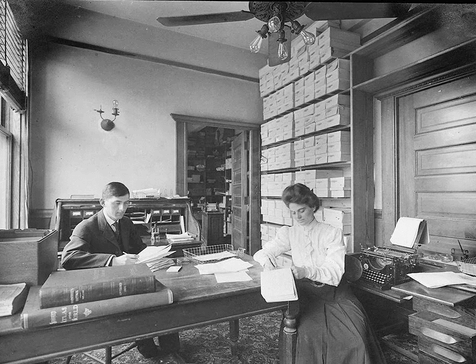
What Makes a Good Office Worker

American Lumberman, 1907

THE GIRL WHO HAS—

Swift, careful fingers (1-5 points) and an agile brain (1-5 points).

Good eyesight (1-5 points), good hearing (1-5 points), and good memory (1-5 points).

Good judgment (1-5 points) and a sense of responsibility (1-5 points).

The Successful Saleswoman

Loras College, Center for Dubuque History

THE SALESWOMAN YOU LIKE IS—

Alert (1-5 points), courteous (1-5 points, then double your score), and energetic (1-5 points).

Interested in her customer’s needs (1-5 points, then double your score).

Thoroughly acquainted with her stocks (1-5 points).

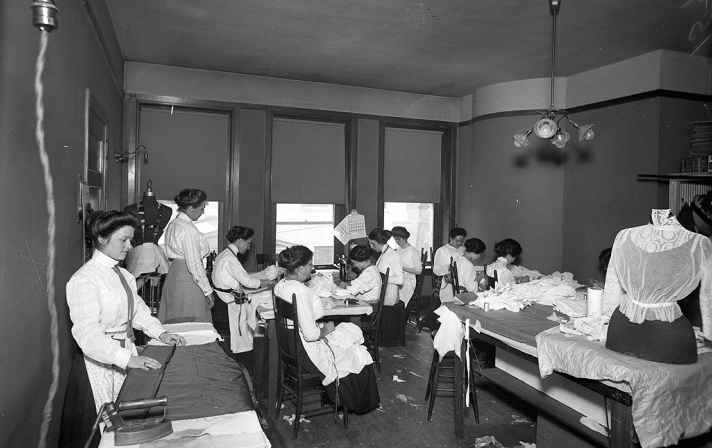
The Dressmaker and The Milliner

Loras College, Center for Dubuque History

TYPES OF ABILITY REQUIRED—

The seamstress must have skill in hand (1-5 points) and machine (1-5 points) sewing.

The dressmaker needs not only technical skill (1-5 points) but creative (1-5 points) and artistic (1-5 points) ability.

The milliner has need of artistic skill (do not score; included under dressmaker) and business sense (1-5 points).

The sewing teacher should combine technical knowledge (do not score; included under dressmaker) and ability to teach others (1-5 points).

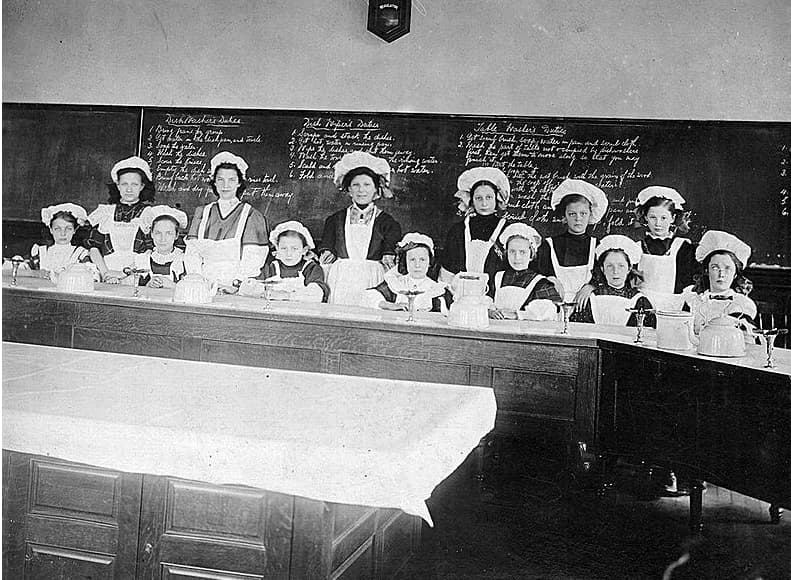
 The Broad Field of Domestic Science

Home economics class, Toronto, 1911 (Archives of Ontario)

FOR THE WOMAN WITH—

Skilled hands (1-5 points, then double your score).

A practical turn of mind (1-5 points, then double your score) and the best training (1-5 points).

Ability to command the respect of other people (1-5 points, then double your score).

Got your score? Okay, here’s what, according to LHJ, you can expect from your girl profession. (The assumption being, of course, that you’re white and Christian.)

Teacher

New York Times, July 14, 1918

OPPORTUNITIES FOR TEACHERS—

Teaching is the oldest profession*** for girls outside the home. It offers greater variety of choice to-day than ever before and is especially attractive to the girl with social vision. It is a vocation, not a bread-and-butter job. Salaries are not high, but advancement is certain for the teacher that makes good.

Office Worker

New York Times, July 14, 1918

POSITIONS AND PAY—

Experienced stenographer, $10-25 a week;

Court stenographer, $2000-3000 a year;

Private secretary, $900-1800 a year.****

THE OUTLOOK—

The field is overstocked with half-trained, incompetent stenographers. But for girls with good general education and technical skill there is always room. There are too many $8 a week girls, too few $25 a week ones. For the girl with executive ability, broad education and business experience there are many new openings.

Saleswoman

New York Times, July 14, 1918

KIND OF PERSON IN STORES—

Errand and cash girls;

Cashiers and examiners;

Saleswomen;

Hands of stock and buyers.

WAGES AND CONDITIONS—

The average pay is low, hours long, and the work is not easy, but employment is steady for the competent worker. Hours have been shortened, however, and conditions improved by the activity of the Consumers’ League. Chances for advancement are good, however, for the ambitious girl in the employ of a good firm.

Dressmaker and Milliner

WAGES AND CONDITIONS—

A first-class seamstress or dressmaker is always in demand at $1.50 to $3.50 a day;

The millinery season is short and the hours long. The average milliner needs another trade for the dull season;

The salary for assistant sewing teachers is small, but good for heads of department.

Domestic Science

New York Times, July 14, 1918

SOME OF THE KINDS OF POSITIONS—

Matron or house mother in college dormitory;

Superintendent, purveyor, or dietitian in an institution;

Domestic science teacher in school or Y.W.C.A.;

Manager of a small hotel, summer or all the year;

Visiting housekeeper employed by private families or by the city;

Director of cafeteria, tea, or lunch rooms.

SALARIES—

Teacher, domestic science, $800 and up;

Cafeteria director, $700-1800;

Assistant matron, $200-600, plus board;

Matron, $600-1200, plus living expenses.

FUTURE—

The field of domestic science is not crowded and kinds of positions are multiplying.

I got TEACHER! (30/35.)

Which was a huge relief because, when I took the test before recalibrating it to make the points in each category match up, I got OFFICE WORKER. (27/35 this time around.) Being a court stenographer might be all right, given the interesting crimes I’m always reading about, like painting your pencil a treasonous color and wearing a second lieutenant’s uniform after being discharged for setting your yacht on fire to collect the insurance money. And being a half-trained, incompetent stenographer sounds appealing in a screwball comedy kind of way. But the problem with OFFICE WORKER is that the crucial question is missing: How well would you deal with taking orders all day from a man you’re way smarter than, for a fraction of his pay? I would get a 0 for that.

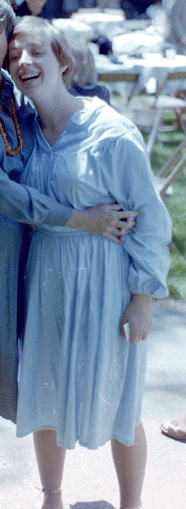
I got a terrible score in DOMESTIC SCIENCE. (18/35.) Being a matron in a college dormitory might be fun, though. Or director of a tea room. Reading Edna Ferber’s stories rid me of any ambitions I might have had of being a SALESWOMAN (24/35). As for DRESSMAKER (22/35), well, this picture of me in a dress I made in high school says it all:

If I were a middle-class American woman in 1918, I imagine that I would have been a teacher. Probably a pretty happy and capable one.

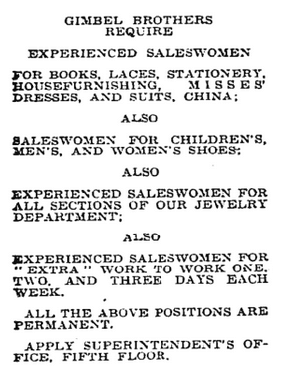
Or maybe I would have gone for a war job, like this one.

New York Times, July 15, 1918

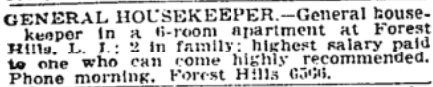
Or this one—big enough for any intelligent man!

New York Times, July 15, 1918

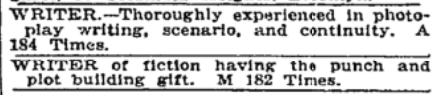
Or—top choice—one of these.

New York Times, July 15, 1918

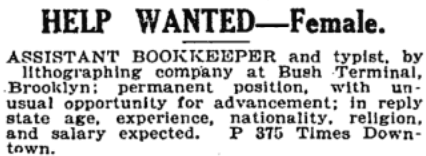
(All of these jobs were advertised in the “Help Wanted – Female” section—there were no gender-neutral want ads.)

Judging by what happened to most women, though, I’m not optimistic about my chances of hanging on after the men came home. It’s lucky, then, that I’m living a time when women can be diplomats. And late-in-life creative writing students. And time-traveling bloggers.

So…what’s YOUR 1918 girl job?

* The insipid Captain Benwick from Persuasion. Which is crazy. I’m totally Jane Fairfax.

** Don’t worry, I checked, and pencils weren’t made of lead back then, or ever. The reason we call the graphite in pencils lead is that graphite was mistaken for lead when it was first discovered.

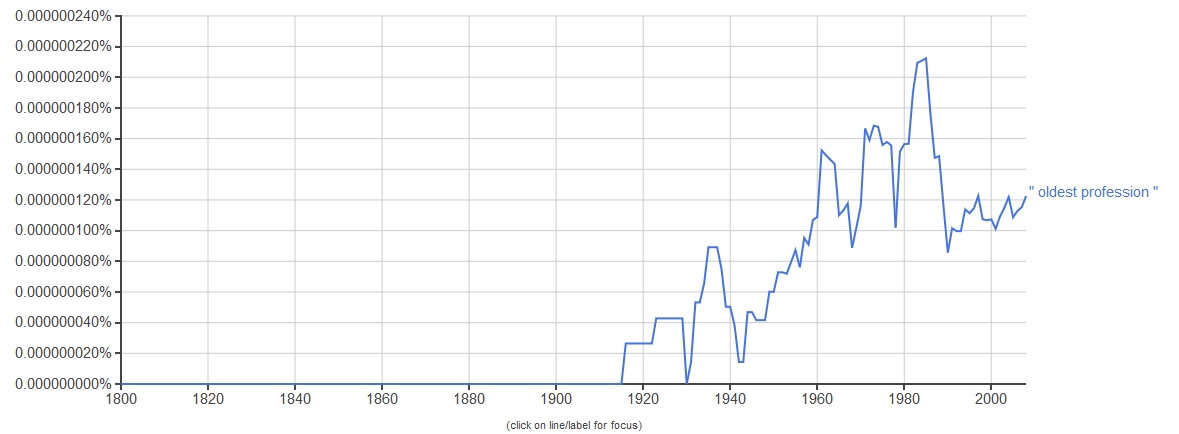
*** “Oldest profession” struck me as an unfortunate choice of words, so I did a Google NGram,

which showed that this phrase has only been around since—about 1918, actually. I did some research (okay, looked on Wikipedia) and found that the phrase began making its way into the language after Kipling referred to “the most ancient profession” in an 1889 short story. This is the kind of discovery that makes all those hours of photo file size reduction worthwhile for the weary blogger.

**** A surprising omission from this list is bookkeeper. A lot of women had this job, including my grandmother (on my mother’s side–it was my grandmother on my father’s side who may have marched with the Czechoslovakians in the July 4 parade).

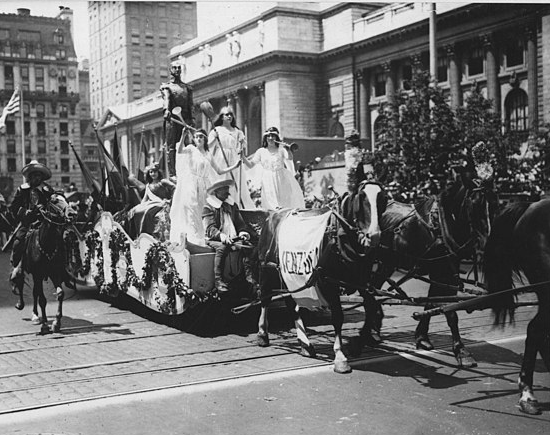
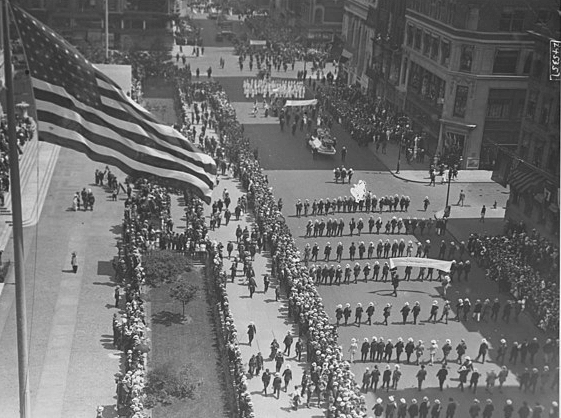
The Parade of the Century: New York, July 4, 1918

I was all set to get working on the best and worst of June 1918—belatedly, due to my ruminations on reaching the midpoint of this project—when they had a humongous 4th of July parade in New York. Change of plan! June was a slow month for bests and worsts anyway, so I’ll roll it into July.

So! The parade!

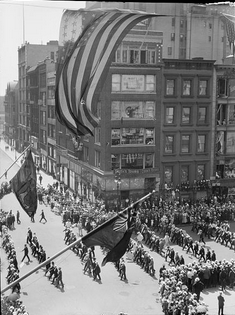
New York, July 4, 1918 (International Film Service)

The theme was loyalty—specifically, how loyal all the different nationalities living in our land are to the U.S.A. But a mini-WWI broke out during the planning, with other delegations objecting to the Hungarian historical display, what with Hungary being at war with their nationalities and also with the United States. So a deal was struck: Hungarian historical characters out, Hungarian national costumes in. But the Italian Four-Minute Men* objected to the costumes, and the Hungarians said if they couldn’t wear costumes they weren’t coming, and finally the Grand Marshal brokered another deal whereby no one would wear national costumes. Which seems to defeat the purpose of a parade of nationalities.

In the end, the New York Times said,

the reflection of European antagonisms did not appear in the parade, and nationalist displays which had been found objectionable when the advance program was made known had been censored to fit the demands of the spirit of the day.

Because what expresses the spirit of the Glorious Fourth like censorship?

4th of July parade, New York, 1918, Arnold Genthe (Library of Congress)

There were political machinations as well. William Randolph Hearst invited practically all of congress—members, the New York Times said, of “both the Republican and Democratic faiths”—to come up from Washington for the parade and other amusements, including the Ziegfeld Follies and a gala dinner at the Astor Hotel. Even though no one cared about conflict of interest, this seemed to be beyond the pale for some, because “a great many declinations were given.” In the end, 33 members of congress showed up. Seven railroad cars from Washington to New York were reserved for “Mr. Hearst’s excursionists,” but that’s not as impressive as it sounds because, the Times said, “it was apparent that many of those who accepted Mr. Hearst’s invitation were women.” But don’t feel too bad for WRH—John Francis Hylan, the Tammany Hall mayor, abandoned the reviewing stand that had been built for him, declared Hearst’s stand the official stand, and decamped there to hang out with him and the congressmen.

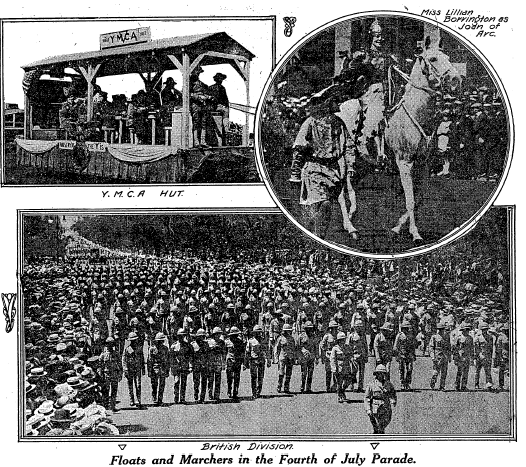
New York Times, July 5, 1918. (A rare photograph in the daily newspaper–in general they only appeared in the Sunday Rotogravure.)

I was afraid, that, given the size of the parade—75,000 marchers, plus 150 bands, plus 123 floats, plus American, French, British, Italian, and Polish soldiers—there would be no one left to watch it. But no, the streets were thronged with spectators. The Times waxed poetic:

It was more than a pageant, more than a parade; it touched on more than Independence Day; it went further than a mere display of the loyalty of citizens born abroad. It was more than a military display, more than a picturesque pageant, though those who have seen all of New York’s great parades in recent years said that it surpassed them all in the brilliancy of the color and the variety of figures represented.

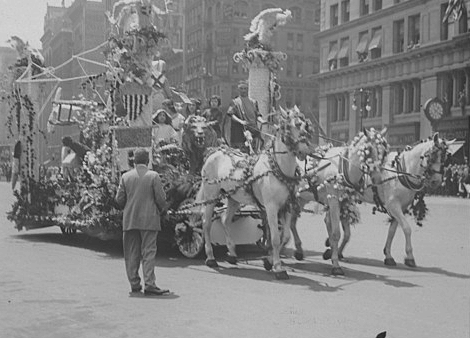
Farmerettes float, New York, July 4, 1918 (National Archives)

The weather was perfect, and the staging went like clockwork, from the assembly point at the arch in Washington Square Park to the end point at Fifth Avenue and Seventy-Somethingth Street. (There were typsetting issues with the article, and this sentence was cut off.)

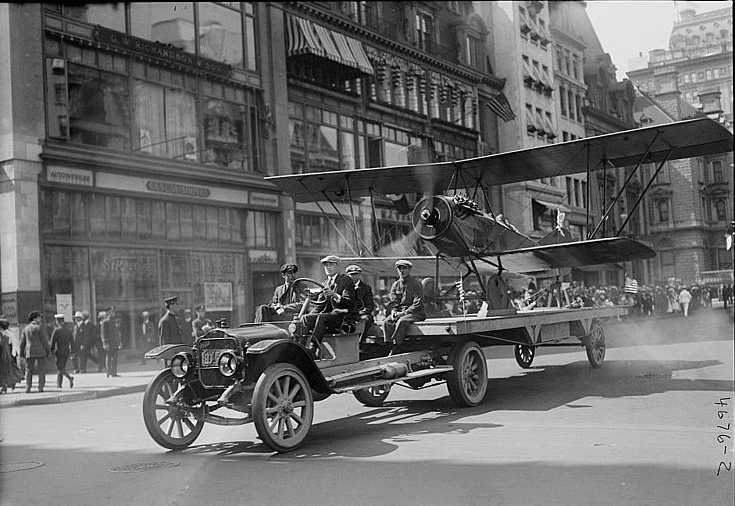
There was a squadron of twenty-two airplanes flying over the parade, “a sight never before seen in New York.” The planes

flew up and down over the city, breaking up to amuse the million upturned eyes with flying tricks, while the aviators dropped leaflets bearing the words and music of the “Star-Spangled Banner.”

“The sole Curtiss S-1 mounted on a White truck for the New York Independence Day Parade in 1918” (Bain News Service)

And get this:

Regarded purely as a pageant, the parade was remarkable in bringing out a greater variety of display of national spirit and national costume than the city has perhaps ever seen before.

That’s right, national costumes! Either the organizers backed down or the participants, having worked their fingers to the bone sewing their costumes, just didn’t care what the Hungarians and Italians and Jugoslavs had negotiated among themselves.

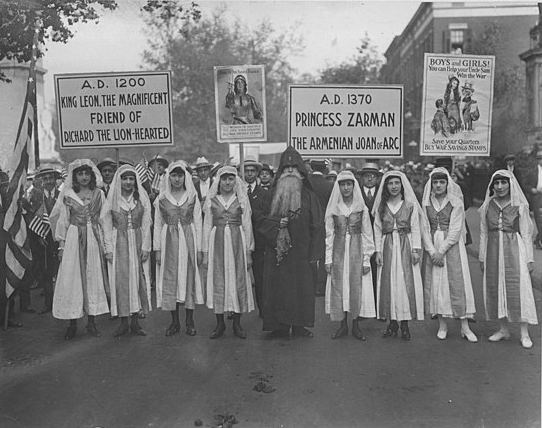
The brilliant pageantry of the Slav races had to some extent been anticipated, but what had not been expected by the public**, at least, was the remarkable exhibitions put forth by Armenia, Syria, Switzerland, Spain, Venezuela, and other nations whose floats and marchers were on a plane of artistic effect that is not often found in a street parade.

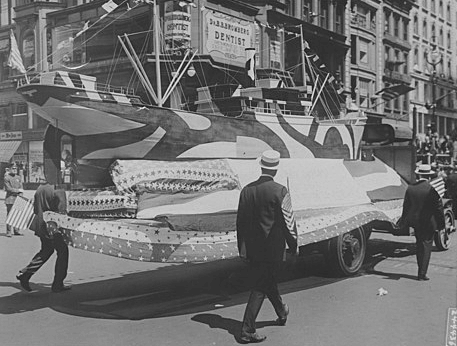
Camouflaged ship float, New York, July 4, 1918, Underwood & Underwood (National Archives)

Highlights among the floats were

a miniature battleship, perhaps twenty feet long, rolling along on invisible wheels and firing little shots from its toy guns as it went along

and one by the Mayor’s Committee on National Defense with the Statue of Liberty surrounded by armed men and

about twenty-five children of the streets, picked up at the last moment as part of the committee’s Americanization display.

Also, the Salvation Army threw donuts out to the crowd.

July 4 parade, New York, 1918 (National Archives)

The nationalities section of the parade was headed by Joan of Arc, followed by Zoroastrian Parsee Dinsshan F. Chadiali, who was the only Zoroastrian Parsee-American as far as he knew, and his son. After that,

a group of Bulgarians of American origin***—citizens of the blood of the nations of the German were thus indicated instead of simply the name of the nationality, as were Allies and neutrals—came in motor cars.

A huge group of Czechoslovaks “tramped past the reviewing stand for nearly half an hour.”

Italian float, July 4 parade, New York, 1918, Underwood & Underwood (National Archives)

Switzerland had a guy carrying a giant Swiss cheese over his shoulder. Also the best motto: “For Modesty and Against Pretension.”

Syria’s float had Christ and the Apostles, with a banner reading “The First Syrian expedition to conquer the world.”

Daughters of Armenia, July 4 parade, New York, 1918 (International Film Service)

A piece of interesting trivia on the Danish banner: “Bronck, a Dane, founded the Bronx.”

The French delegation wasn’t provided with a military band as promised, and was pissy about it. Huge cheers, though!

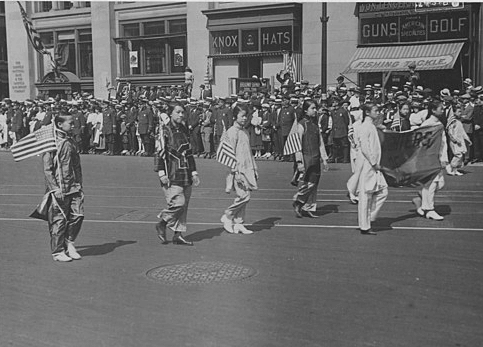
Chinese girls marching, New York, July 4, 1918 (National Archives)

“Jewish” was considered a nationality, and there was a float with Judah Maccabee’s army fighting for freedom alongside Jewish soldiers in the American army.
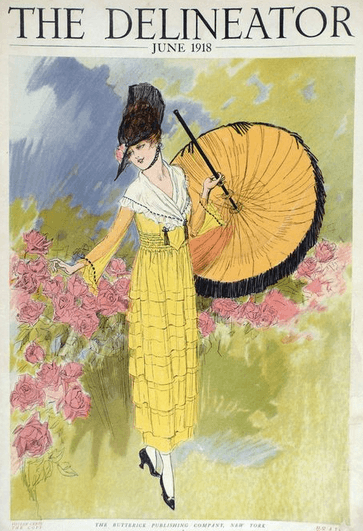
Palestine, somehow, was represented by Miss Sally Bergman.
A Russian banner bore the slogan “We Do Not Accept the Infamous Peace of Brest-Litovsk.”

The Hungarians, after all the hoopla, marched as “ordinary citizens in civilian dress.” IMHO the Hungarians got shafted.

Venezuelan float, July 4 parade, New York, 1918 (International Film Service)

All in all, a remarkable event—although one that may be more fun to read about it would have been to attend. As spectacular as the costumes were, watching Czechoslovaks tramp by for half an hour must have gotten kind of old, no offense to my grandmother, who, if I have my family history right, may have been one of them. And I’m not clear about the bathroom situation.

But—good news!—you can watch the parade from the comfort of your own home. It was filmed so that soldiers overseas could watch it. Here’s a six-minute excerpt, followed by two minutes of footage of the celebration in Washington, D.C., which I wasn’t as into until I realized that it features, in the final seconds, All-Woman Battalion of Death Commander Maria Bochkareva, who was in town to plead with President Wilson for help.

From a 2018 perspective, the idea of having a giant parade around the theme “recent immigrants are not traitors to our country!”—with prizes given for the best loyalty pledge****—sounds a little off. Especially given that, the day after the parade, there was a big roundup of people of German descent who had committed treasonous acts like painting their pencils the wrong color.

On the other hand, living as we are—and as people in 1918 also were—at a time when immigrants are being used as political punching bags, there’s something refreshing about the spectacle of hundreds of thousands of people celebrating all the different ways there are to be American.

Parade passing the New York Public Library, July 4, 1918, Underwood and Underwood (National Archives)

*Four-minute men gave four-minute speeches on topics provided to them by the Committee on Public Information.

**”The public,” in situations like this, generally seems to mean “me, the unbylined New York Times reporter.”

***“Bulgarians of American origin” seems backwards to me, but whatever.

****As of July 6, the judges were still holding out. Smart money is on the Poles. (UPDATE 7/12/18: I was right!!! Poles #1, Syrians #2, Portuguese #3. The awards turn out to be for the floats and marchers as a whole, not just the loyalty pledge. The Hungarians got an honorable mention–I think the organizers just felt guilty.)

My Year in 1918: Some thoughts at the halfway point

I’m halfway through My Year in 1918!

Which seems about right. I feel at home in 1918, and I’m in no hurry to leave. I’ve settled into a routine, with my go-to magazines (The Dial, The Bookman, The Crisis), don’t-miss monthly reads (T.S. Eliot in The Egoist, H.L. Mencken in Smart Set, Randolph Bourne in The Dial, and Dr. Wiley’s Question Box in Good Housekeeping—plus there’s a bright new spark at Vanity Fair named Dorothy Parker I’ll be writing about soon), and guilty pleasures (Murad cigarette ads, children’s puzzles in St. Nicholas magazine).

I’ve probably settled into too much of a routine, in fact. It’s been pointed out that I’ve completely fallen down on the job recipe-wise. I could blame the dispiriting nature of 1918 recipes, which tend to focus on food rationing, but ahundredyearsago.com manages to do a whole blog focused on 1918 (or so) recipes. (This week: Old-Fashioned Sour Banana Ice Cream.) So I’ll get out my apron, and I’ll shake things up in other ways as well. There’s more to life than modernism and Erté covers!

What have I learned in six months? First of all, that it’s harder than I thought to identify any kind of trajectory going through history. I do still believe that we’ve made tremendous progress in the last hundred years. The hardest thing to take in my reading has been the ubiquity of casual sexism and racism. (Judge magazine, for example, has a monthly jokes section called “Darkies.”) We have a long way to go, but I don’t think anyone would want to go back to that time.

On the other hand, none of the progressive battles of 1918 have been unambiguously won. (Other than the right to buy alcohol, if you consider that progressive.) The fights for racial and gender equality, reproductive freedom, and immigrants’ rights are still going on, just in different ways.

I knew all these things before, in a general sense. I hadn’t thought much, though, about all the problems that were invisible in 1918 to all but the most far-seeing observers. Magazines were full of ads for unknown killers—cigarettes and asbestos and radium clock dials and lead-based paint. No one was worried about man-made climate change or the sustainability of the oceans. For me, that’s the biggest lesson—for all the obvious problems of today (as numerous and troubling as they are), there must be other grave dangers, already present or on the horizon, that we’re not even thinking about.

As for the tuning-out-of-2018 aspect of this project, that’s been mostly a good thing, and much easier than I expected. There’s a New Yorker cartoon making its way around Facebook with a doctor telling his patient that his problem is that he’s paying too much attention to the news. I’m definitely not that guy. But neither am I the man in Ohio the New York Times wrote about who decided after the 2016 election to cut himself off from all news.

I didn’t read that article, naturally, I just heard about it. I decided at the beginning of the year that, while a total news blackout wasn’t feasible or desirable, I’d read the bare minimum amount of news required to be a responsible citizen. I get news alerts on my iPad and occasionally glance at an article to get the gist. If something really important happens, I’ll read a whole article about it—just one—in the New York Times. I’ve read a few stories about what’s going on in the State Department, where I worked for many years. And, okay, there was that emergency situation when I had to settle an argument about what rock critics think about Jim Morrison. But I haven’t read a contemporary op-ed or magazine article or book review all year, other than a handful of pieces by friends. No current fiction either, except for exchanges of work with writer friends and a few published pieces, like this and this, by my NYU creative writing classmates. (Congrats, guys!)

I do read blogs, because that’s only fair if I want people to read my blog. And Twitter, although my feed these days is mostly focused on World War I and literary modernism and, for some reason, how horrible it is to be an academic in the UK.* I look at Facebook, but I don’t click on articles. I’ve spent more time than I expected doing research for blog posts (confession: LOTS of Wikipedia), and I’ve had to bone up on the technical aspects of blogging. (Notice how much clearer the pictures have become?) With contemporary resources like this, I follow the rule that Catholics are supposed to follow about impure thoughts: they’re unavoidable, but don’t dwell on them.

A couple of months ago, I was eating dinner in a Cape Town food hall and reading an article from the WTOP Radio website about the D.C. boundary stones as research for a blog post. This was one of the few times this year—maybe the only time—that I printed out a contemporary article and read it from start to finish. As I read, a disoriented sensation came over me. “This article is weird,” I kept thinking. But I couldn’t figure out why. I reread it later, and identified the problem. There’s a quote that starts, “One thing that gets really funky with these things is, the Park Service owns the little piece that’s the fence enclosure and the stone, but then [one of the stones] is on Metro ground…” and continues in this colloquial vein. No one in 1918 talked like that! I was experiencing the same kind of reverse culture shock that I used to have in the Foreign Service when I returned to the United States from overseas.

Has my withdrawal from the news made me a less informed person? Well, yes, by definition. Has it made me a worse citizen? I don’t think so. In fact, I think it’s made me a better one. I analyze what’s happening on my own, rather than through the lens of an op-ed columnist. I focus on what’s going on in the longer term, not on the twists and turns of the daily news cycle. And it’s definitely been good for my well-being. I’ve lost that jittery feeling that comes with compulsively following the news. The troubling things that are happening today make me sad, but I don’t have the sense of lingering depression that many of my friends are experiencing.

When another six months have passed and I reengage with the contemporary world, I think—at least, I hope—that I’ll read more discriminately, more mindfully, and with a better sense of our place on the long arc of history.

* Some favorite blogs and Twitter accounts:

Connie Ruzich on World War I poets (Behind Their Lines,  @wherrypilgrim)

Pamela Toler on fascinating footnotes to history (History in the Margins, @pdtoler)

Leah Budke on modernist anthologies (ModMarkMake, @modmarkmake)

Whatever It Is, I’m Against It (@wiiiai), an indispensable and entertaining source of day-to-day 100-years-ago news.

Daniel Mulhall, who, in addition to his day job as Irish Ambassador to the United States, writes about Irish writers, including Yeats and Joyce (Ambassador’s Blog, @danmulhall)

Frank Hudson, who writes about (mostly) modernist poets and puts their work to music (The Parlando Project)

Sheryl Lazarus, who started out publishing her grandmother’s diaries a hundred years to the day after she wrote them, but since the diary ran out has been publishing recipes and writing about food-related topics at A Hundred Years Ago.

Thursday Miscellany: Crossdressing soldiers, infinite nurses, and ham to the rescue

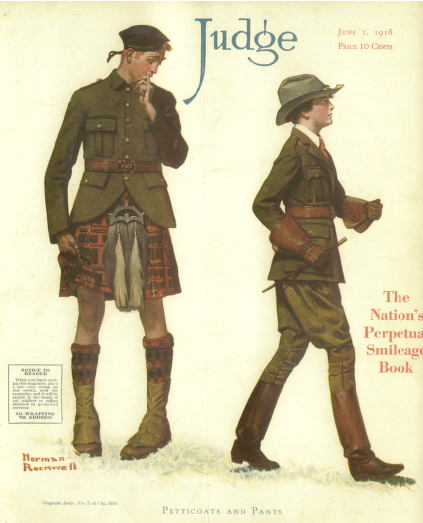
I have a love-hate relationship with this Norman Rockwell cover.

Judge magazine, June 1, 1918

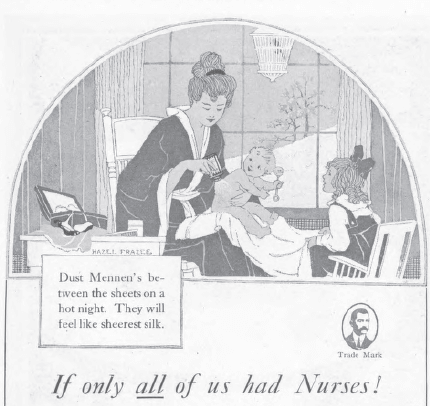
Mennen’s talcum powder ad, Ladies’ Home Journal, June 1918

…we would be living in a world of mathematical impossibility!

Pioneering the “make women feel bad about themselves so you can sell them stuff” ad…

Ladies’ Home Journal, May 1918

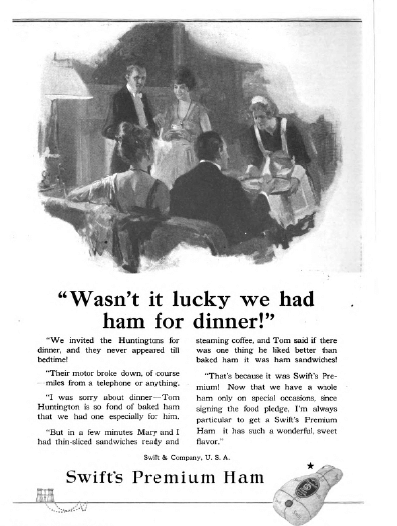
…and the “our product saved the day in this fake situation” ad.

Good Housekeeping, May 1918

Solid choice.

Good Housekeeping, June 1918

I love how literally this kid takes the concept of writing a letter to a magazine: “I read the advertisements in you.”

St. Nicholas magazine, March 1918

And, finally, some summer color to brighten a wintery Cape Town day.

The surprisingly ubiquitous lesbians of 1918: A Pride Month salute

When I started my reading-in-1918 project, one of the first things that struck me was that just about every woman I came across was, or appeared to be, a lesbian. Of course, this being 1918, they weren’t waving rainbow flags or announcing their nuptials in the New York Times. Still, they were everywhere. Here are the stories of some of the women I’ve run into along the way.

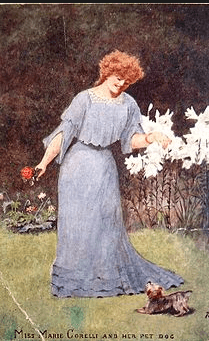
Marie Corelli

Portrait of Marie Corelli, artist and date unknown

Corelli, who was Britain’s best-selling novelist in her heyday (which was waning by 1918), didn’t self-identify as gay. A number of writers, though, have claimed her for Team Lesbian, pointing to the eroticized depictions of women in her writing, which strikes me as pretty flimsy evidence, and, more convincingly, to her decades-long cohabitation with her companion, Bertha Vyver. Their initials were carved, intertwined, on their mantlepiece alongside the words “amor vincit,” and they exchanged rings.*

If Corelli was in fact a lesbian, she’s an awfully sorry example—as I’ve noted, she advocated forced sterilization and was the source for the homophobic “Cult of the Clitoris” article I wrote about in my last post. Also, she was a pretty bad writer. But, as I’ve also noted, it can’t have been easy to be Corelli, who was the illegitimate daughter of Charles McKay, author of Extraordinary Popular Delusions and the Madness of Crowds, and a household servant. Growing up with both your parentage and your sexuality treated as sources of shame would be enough to warp any mind.

Maria Thompson Daviess

Portrait of Maria Thompson Daviess by Ella Sophonisba Hergesheimer, date unknown

Daviess, the author of the Bridget Jones-like 1912 bestseller The Melting of Molly, is a more inspiring, though also ambiguous, example. She’s not famous enough today to have sparked much speculation about her sexuality, but just take a look at her writing. The Melting of Molly, which is narrated by 25-year-old widow Molly, is full of passages like this:

With [Molly’s aunt] came a long, tall, lovely vision of a woman in the most wonderful close clingy dress and hat that you wanted to eat on sight. I hated her instantly with the most intense adoration that made me want to lie down at her feet.

And this:

Miss Chester [the aforementioned tall, lovely vision] and I exchanged little laughs and scraps of conversation in between time and I fell deeper and deeper in love with her.

And especially this:

First I went to see Madam Courtier for corsets. I had heard about her and I knew it meant a fortune. But that didn’t matter! She came in and looked at me for about five minutes without saying a word and then she ran her hands down and down over me until I could feel the flesh just crawling off of me. It was delicious!

I’d really, really like to know what 1918 readers made of this. More on Daviess later.

Margaret Anderson

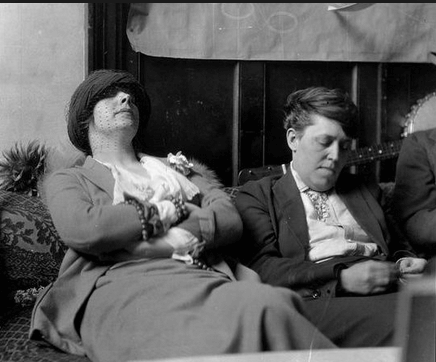
Margaret Anderson and Jane Heap, date unknown

All this digging into people’s private lives was making me feel kind of creepy, so it was a relief to turn to Margaret Anderson, the editor of the ground-breaking modernist journal The Little Review, which published the first chapter of Ulysses in March 1918. She and Jean Heap, her partner in work as well as life, lived openly as a couple. Heap wore men’s clothing and sported a short haircut. “I am no man’s wife, no man’s delightful mistress, and I will never, never, never, be a mother,” Anderson wrote proudly.

Willa Cather

Willa Cather and Edith Lewis, 1926

Cather, the author of O Pioneers! and My Antonia, was fiercely private about her personal life, but she and editor Edith Lewis lived together for decades. The only letter from Cather to Lewis that is known to have survived—Cather burned most of them—begins, “My Darling.”

Amy Lowell

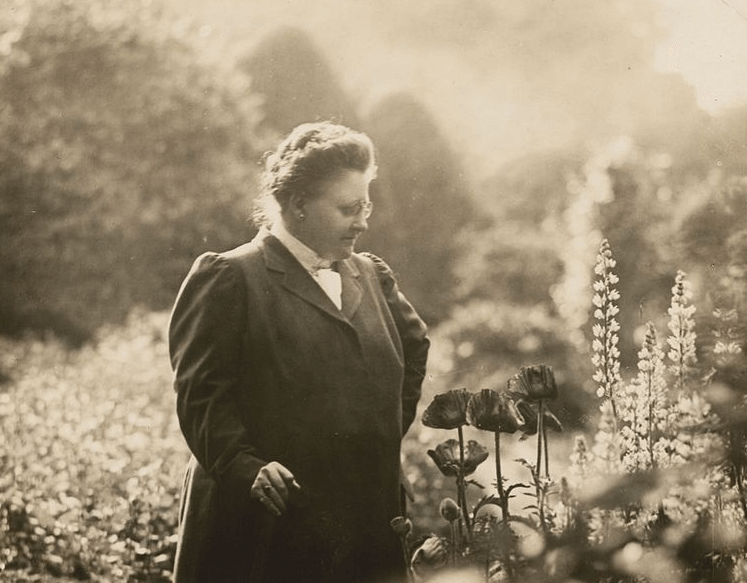
Amy Lowell (Bachrach, ca. 1916)

Poet Amy Lowell (the much younger sister of Abbott Lawrence Lowell, the academically progressive but homophobic Harvard president I wrote about here) didn’t self-identify as a lesbian, but that seems like a mere technicality if you read her work. Here’s “Madonna of the Evening Flowers,” which was published in the North American Review in February 1918 and appeared in the 1919 collection Pictures of the Floating World.

North American Review, February 1918

The subject of this and Lowell’s other love poems is Ada Dwyer Russell. The two lived together from 1914 until Lowell’s death in 1925. (Cohabiting relationships like this, sexual or not, were known—appropriately, in this case—as “Boston marriages.”) Russell’s father, by the way, deserves a place in the PFLAG hall of fame—he was kicked out of the Mormon church in 1913 for arguing that sex between people of the same sex was not a sin.

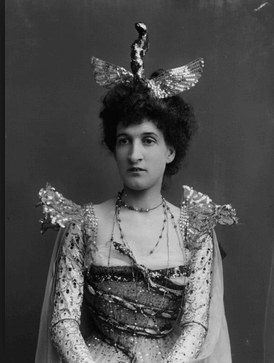
Maud Allan

Maud Allan

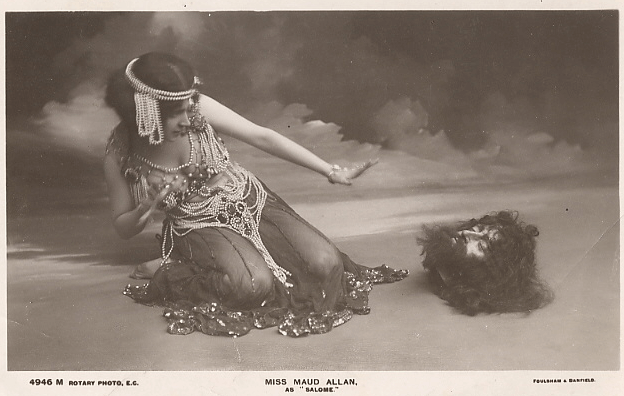
And, of course, there’s dancer Maud Allan, the performer in Oscar Wilde’s Salome, who, as I wrote in my last post, sued British MP Noel Pemberton-Billing for supposedly accusing her, in an article headlined “The Cult of the Clitoris,” of engaging in unspeakable vice. Allan lived for three decades with Verna Aldrich, her secretary and partner.

…And the rest

These are only a few of the many women I came across who were not married and are not known to have had serious relationships with men. Others include writer Edna Ferber, first woman member of congress Jeannette Rankin, short story writer Elizabeth Jordan, portrait painter Cecilia Beaux, and actress Emily Stevens, who played the single-mother-by-choice in Alan Dale’s controversial play The Madonna of the Future.**

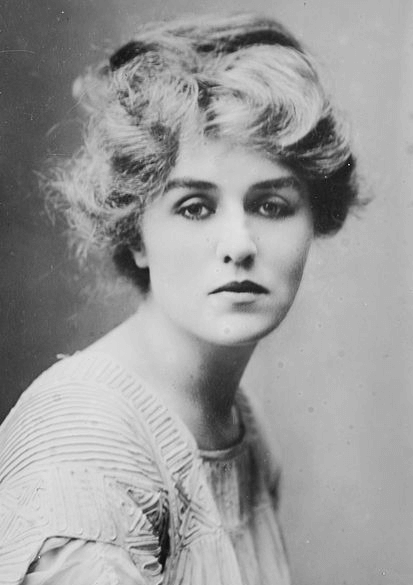
Emily Stevens

As I read about these women’s lives, certain patterns started to emerge. One is the “fell so deeply in love as an adolescent that no man could ever measure up” trope. Stevens’ Wikipedia entry says that she developed a girlhood crush on theatrical producer Harrison Fiske, her cousin’s husband, and “seems to have stayed true to her feelings for [him] as she did not pursue relationships with other men.” Maria Thompson Daviess fell at age 13 for her pervy male camp counselor, with whom, according to her autobiography, Seven Times Sevenshe exchanged the

profoundest kiss kiss ever bartered between two of the human race…That exchange, my first, also set standards for me and I am dimly afraid that is one of the reasons I write myself spinster today.***

Or something like that! Seven Times Seven is still under copyright, and the snippet Google Books displays begins, infuriatingly, with “profoundest kiss.” In any case, Daviess told a friend that this infatuation was not as “glamorous”—which seems to be 1918-speak for “passionate”—as her crush on a woman teacher.

Do you have friends who have gone on to live a life of celibacy because they never got over their high school crush? If so, fine, feel free to buy this.****

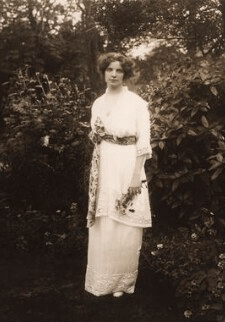
Annette Abbott Adams, date unknown

Then there are the marriages of convenience. Groundbreaking California lawyer Annette Abbott Adams got married, according to friends, only because she wanted a “Mrs.” in front of her name, having found that professional doors were more open to married women. She and her husband lived apart for most or all of their marriage but never divorced.

There’s a reason, obviously, why lesbians and women without a (visible) man in their lives are found so often on the 1918 political and cultural scene. For most women, it was a choice of one or the other—marry, or have a career. Lesbians were, of course, more likely to opt against marriage than heterosexual women (although many lesbians, including Ada Dwyer Russell, did marry). But there must have been lots of heterosexual women, as well, who opted for a career over marriage and a family.

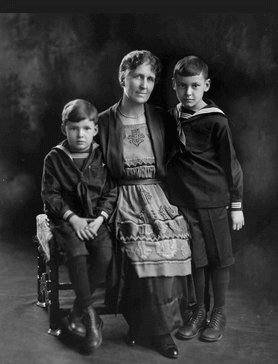
Anna Kelton Wiley with her sons, ca. 1920

Judging from the lives of the relatively few married women I’ve come across, career over marriage seems like the sensible choice. Edith Wharton’s husband suffered from crippling depression, and she divorced him after 28 years of marriage. E. Nesbit’s husband kept having children with other women. Artist Elizabeth Gardner endured a 17-year engagement because her lover and mentor William-Adolphe Bouguereau didn’t want to upset his mother by marrying her. Julia Clark Hallam wrote about how deadening the work of a wife and mother was. Suffragist Anna Kelton Wiley married food safety pioneer Harvey Wiley when she was 34 and he was 67. Married Love author Marie Carmichael Stopes’ first marriage was unconsummated. Daddy-Long-Legs author Jean Webster’s marriage was apparently happy, but she had to wait for years for her husband’s divorce from his first wife to come through. Also, her husband was an alcoholic. Webster died in childbirth the year after their marriage.*****

So here’s to the lesbian women of 1918—and to all the women, gay and straight, who were forced by an intolerant society to hide or suppress important parts of who they were.

[UPDATE 9/25/2019: I wrote about Swedish lesbian writer Selma Lagerlöf, the first woman to win the Nobel Prize in Literature, here.]

*There are two schools of thought on how to interpret this type of thing. They can be summarized as, on the one hand, “Duh,” and, on the other hand, “But romanticized, non-sexual relationships between women were a thing.”

**Dale—who was married—made LGBT history himself by writing the first-ever gay-themed novel in English, A Marriage Below Zero, in 1889.

***This reminds me of an anecdote I read decades ago in a memoir by screenwriter Anita Loos, best known today as the author of the novel Gentlemen Prefer Blondes. George Gershwin’s buddies have noticed that he never has a girl, and one day she asks him why. He spins a tragic tale of the one who got away. Loos asks him what happened. “She moved to Detroit,” he says. Loos marvels at the spinelessness of a guy who couldn’t overcome such a minor obstacle. A modern reader might interpret this differently.

****Of course, there could be other reasons for claiming to be off the dating market, like a long affair with a married man.

*****A more fun fact about Jean Webster and her husband: Theodore Roosevelt invited himself along on their honeymoon at their camp in Canada, saying, “We can put up a partition in the cabin.” No word on whether he actually showed.

Unmentionable vice, a secret German book, and a camarilla: The (looniest) trial of the century

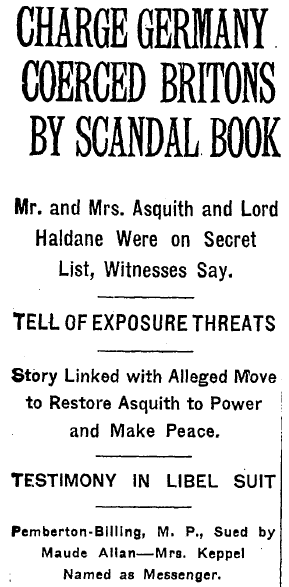
 As I was catching up on the 1918 news over breakfast at a Cambridge, Massachusetts B&B during my recent vacation, I came across the following headline in the May 31 New York Times, right below a humongous banner headline about the German offensive:

I was confused.

I read the article, and I was still confused. British MP Noel Pemberton-Billing, apparently, was on trial for defaming dancer Maud Allan, who had appeared in a private dance production based on Oscar Wilde’s play Salome, and the play’s producer, Jack Grien of the Independent Theatre. (Grien was also the drama critic for the Sunday Times, because no one cared about conflict of interest in 1918.) According to prosecutor Travers Humphreys, Pemberton-Billing had made an attack on Allan in his right-wing magazine The Vigilante that was “unworthy of any man to make upon any woman.” Humphreys said that

the coupling of the name of Miss Allan, or any woman, with the heading of the paragraph could only mean one thing—that the lady, either in her private or professional capacity, was associated with something that could not be regarded as otherwise than disreputable.

Studio portrait of Noel Pemberton-Billing, 1916

What heading? What paragraph? The Times isn’t telling. Humphreys goes on to say that, if Allan had failed to challenge this mysterious allegation,

some of those persons whose mental food was garbage might be able to say hereafter, ‘You have this said of you, and you took no steps to stop it, and therefore, there must be something in it.’

Have what said? This was getting frustrating.

Portrait of Maud Allan by Alexander Bassano, 1913

Oh, and there was a list. Which the Times does explain. (Well, the British Telegraph does—the Times, as was its habit, quotes large chunks of the Telegraph’s reporting verbatim.) In an earlier article, the Vigilante had reported that

there exists in the cabinet noir of a certain German Prince a book compiled by the secret service from the reports of German agents who have infested this country for the past twenty years, agents so vile and spreading debauchery of such a lasciviousness as only German minds could conceive.*

Okay, so there’s an evil German plot to perversify English society. But what does it have to do with Maud Allan et al.? Humphreys explains that the other Vigilante article, the one with the mysterious headline, made

a cryptic suggestion that if Scotland Yard were to seize a list of the members subscribing to the Independent Theatre there was no doubt they would secure the names of several thousands of the first 47,000.

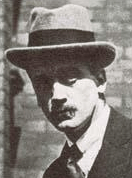
Captain Harold Spencer (date unknown)

No one had actually managed to produce a copy of this book. But a lot of people had seen it. Or said they had. Including the author of the article, former American navy captain Harold Spencer. Spencer was the aide-de-camp to Prince William of Wied**, who he said had shown him the book in Albania. Another witness, Mrs. Villiers Stewart, said that she had seen former Prime Minister Asquith’s name in the book.*** Spencer said he hadn’t, but he had seen Asquith’s wife’s name.

Guess who else Mrs. Villiers Stewart said she saw in the book? Justice Darling, who was presiding over the case! Sensation in the court. But it apparently didn’t occur to him to stop the trial and recuse himself, because, like I said, conflict of interest.

Noel Pemberton-Billing and Eileen Villiers Stewart arriving at court

Spencer testified that the Vigilante had been tipped off about the Salome production by—I bet you didn’t see this coming!—Marie Corelli, the purple-prose novelist who was last seen here espousing forced sterilization in Good Housekeeping and hoarding sugar. (And who, by the way, was almost certainly a lesbian herself.)

Lord Alfred Douglas, Oscar Wilde’s lover-turned-nemesis, also testified for the defense, although I couldn’t for the life of me make out what he had to do with anything, and was later kicked out of the courtroom for heckling.

And there was a camarilla! A word that, despite my superior-adult score on a 1918 vocabulary-based intelligence test, I had to look up. It turns out to mean a secret group of plotting courtiers. This particular camarilla, allegedly, was aimed at getting Asquith back into power and making peace with Germany. (Which was seen as a bad thing–right-thinking people wanted to beat them.)

Margot Asquith, date unknown

The pieces were starting to fall together, but I still wasn’t clear on the unspeakable vice. Oscar Wilde + vice, I figured, had to = something about homosexuality. But what exactly?

As I sipped my tea and reflected on the situation, I had an inspiration. “You know who will be all over this story?” I said to myself. “My fellow 100-years-ago blogger, Whatever it is, I’m Against It.” And I was right! As WIIIAI explains here and here, the crux of the matter is the title of the Vigilante article, which the Times was too delicate to reprint: “The Cult of the Clitoris.” Aha! The insinuation, then, was that Allan was at the heart of a giant pro-German lesbian cabal.****

Now I was up to speed on why the Times was skirting around the headline. Armed with this information, I was able to track down the full text of the Vigilante article:

The Cult of the Clitoris

To be a member of Maud Allan’s private performances in Oscar Wilde’s ‘Salome,’ one has to apply to a Miss Valetta, of 9, Duke Street, Adelphi W.C. If Scotland Yard were to seize the list of these members I have no doubt they would secure the names of several of the first 47,000.

That’s it!

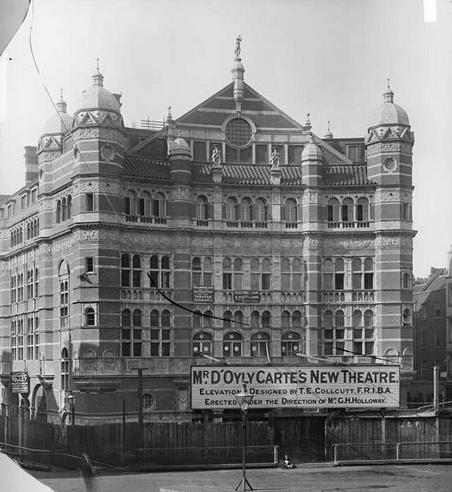
London’s Palace Theater, where Salome was performed, date unknown

Fast forward a few days, to a June 5 piece in the Times. As Humphreys was making his closing arguments, Pemberton-Billings interrupted him to say that he’d never accused Allan of engaging in vice herself, only of pandering to it. He was acquitted.

In the first draft of this post, I wrote that the good guys lost. And it’s true that I’ll root for scandalous lesbian dancers (Allan was in fact a lesbian, which was the only true allegation in the whole trial as far as I can tell) and cutting-edge theater producers over homophobic right-wing politicians and conspiracy-peddling ex-military officers any time. But, even by the standards of British defamation law, which is much stricter than its American equivalent, the penning of the Vigilante story doesn’t seem like a criminal act. It’s just a piece of vague, sloppy insinuation. Not something that people should go to jail for, however despicable they might be.

The real crime here—twenty-three years after Oscar Wilde was sentenced to two years in jail for homosexual acts, and eighteen years after he died, impoverished and disgraced, in Paris—is that homophobia was still so deeply rooted in British society that it was fodder for ridiculous conspiracy theories (the book of 47,000, of course, never surfaced), scurrilous newspaper reporting, and farcical trials.

Not a very inspiring way to commemorate Pride Month. But there are positive LGBTQ stories as well. (Mostly L, actually.) I’ll get to them in an upcoming post.

Oscar Wilde and Lord Alfred Douglas, 1893

* Because everyone knows that Germans and hot-bloodedness are virtually synonymous.

**Arguably the best name in a story full of great ones.

***Mrs. Villiers Stewart was subsequently jailed for bigamy, but that’s another story.

****Because, you know, there’s nothing lesbians like so much as living under right-wing militaristic rule.

An academic interlude: Harvard’s Widener Library

I live in Cape Town, which has a lot of advantages, like this

and this,

but presents certain challenges My Year in 1918-wise. Online resources like Google Books’ Hathitrust and the Modernist Journals Project are a godsend for online researchers–I get all my magazines there–and most of the books I read are available on Kindle, but there’s no substitute for holding an actual, physical book in your hand.*

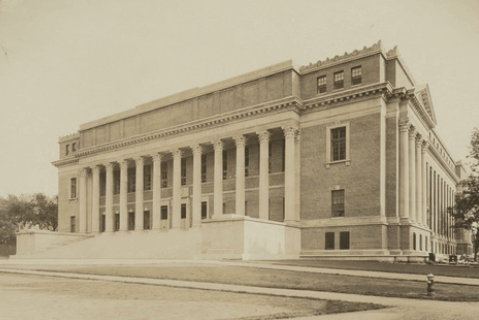
So when I went to my Harvard reunion last month, I stayed on and spent a couple of days in Widener Library, which (together with the university’s other, smaller libraries) is home to the world’s third-largest collection of books. My ideal vacation destination!

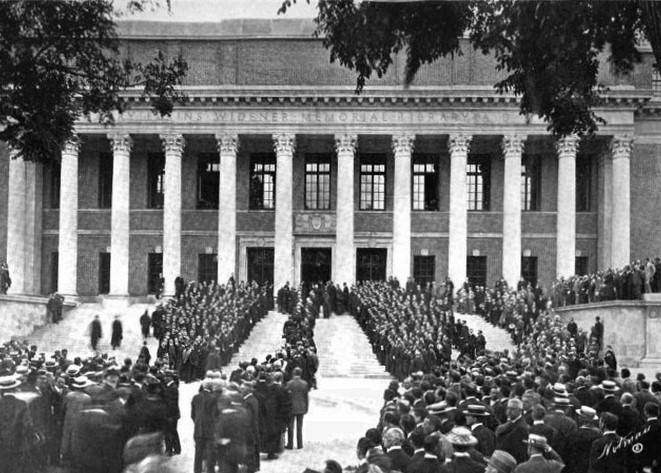
Widener is a great place to channel 1918. The library, which was dedicated on commencement day in 1915,

Dedication of the Harry Elkins Widener Memorial Library, Harvard University, 24 June 1915 (Harvard Graduates’ Magazine, Vol. 24)

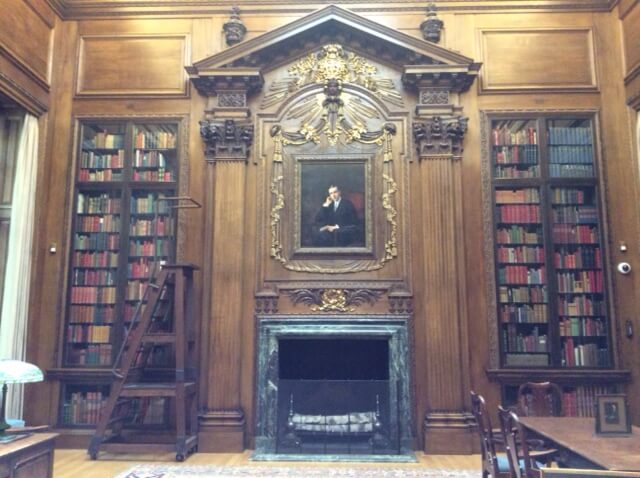
was donated to the university by Eleanor Elkins Widener in memory of her son, Harry Elkins Widener of the class of 1907, who died on the Titanic. Harry was, despite his youth, an accomplished book collector**, and there’s a room in the library dedicated to his memory.***

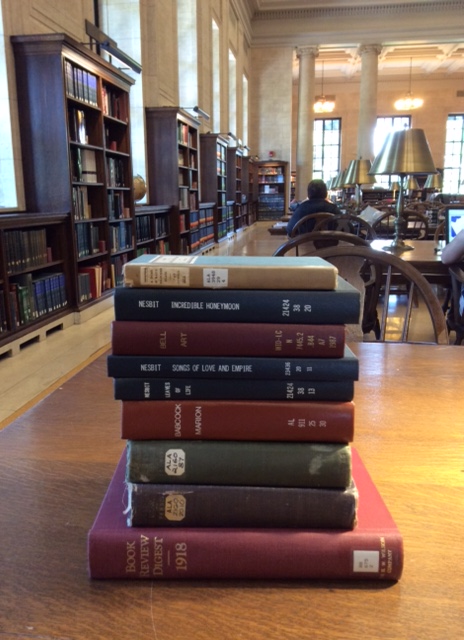
That room is roped off, but I did get to browse the stacks (which is just as fun and creepy as it was when I was an undergrad), grab a pile of 1918-era books, and peruse them in this less luxurious but still very cool reading room.

Conclusions: E. Nesbit was kind of boring when she wasn’t writing for children. Winnifred Eaton’s Marion: The Story of an Artist’s Model seems like it’s worth reading (good thing, since it’s on my 1918 bedside bookshelf). So does Clive Bell’s Art.

I also did some literary detective work, continuing my pursuit of the script of Alan Dale’s 1918 play The Madonna of the Future, which, as I wrote in April, shocked audiences with its depiction of a wealthy woman who becomes a single mother by choice. There was no trace of it in the National Union Catalogue, although there were lots of other works by Dale, whose real name was Alfred J. Cohen.

With the help of a research librarian, I did find an article in Puck magazine in which Dale, who was a prominent (but, according to Smart Set’s George Jean Nathan, very, very bad) drama critic, interviewed his play’s star, Emily Stevens. Bottom line: Stevens thinks Dale is kind of a moron.

If anyone has advice on where else I might turn to find the elusive script, please let me know. The Library of Congress pointed me in the direction of a copyright records archive, but no luck there either. I’m starting to think it might not exist.

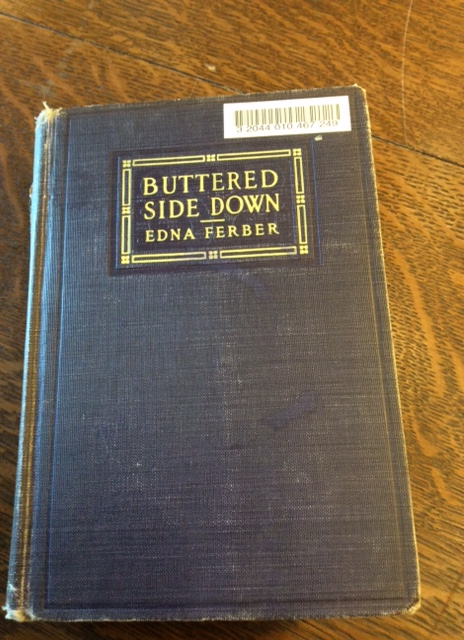
Just when I was winding up my visit to Widener, thinking that it had been fun but a bit lacking in serendipity, I came upon, in this copy of Edna Ferber’s Buttered Side Down,*****

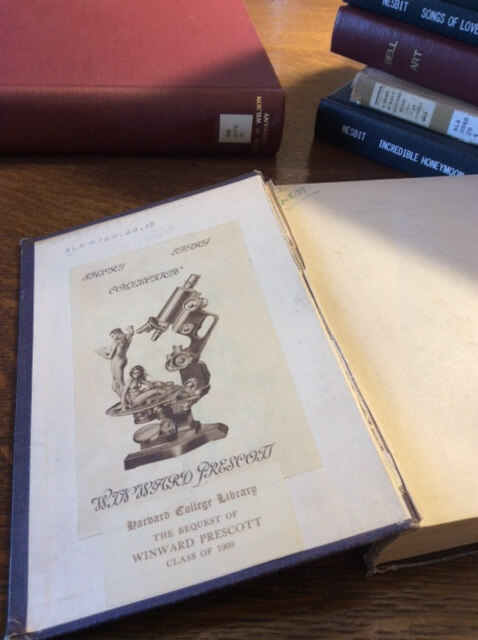
a real-life copy of a Winward Prescott naked microscope bookplate!

Which, in case the excitement of this is eluding you (although a naked microscope bookplate should be exciting enough in its own right), I discovered a while back in an online scan of a Harvard library book and wrote about here.

Two afternoons well spent! Next stop, when I’m back in D.C. in July: The Library of Congress.

*Yes, I know there are some great South African books from that era, and I will get to them.

**An area of accomplishment that is, of course, available only to very rich people.

***There’s a myth at Harvard that, in memory of her drowned son, Eleanor Elkins Widener demanded that the university require that all students pass a swimming test in order to graduate. During the reunion, several classmates reminisced about dutifully going to the athletic center to take the test–which does (or did) in fact exist, but is not a graduation requirement and has nothing to do with Widener. Luckily, some upperclassmen clued me in before I got all wet for nothing.

****Although not as many as I wanted, since, unlike during my student days, much of Harvard’s collection is now stored offsite, including–who would have thought it!–a high percentage of obscure books from 100 years ago.

*****which I subsequently raved about

The best and worst of May 1918: Short stories, cover art, ads, and cartoons

I’m back! I’ve been traveling during the past few weeks–from Cape Town to DC to Boston to DC to Boston again and back to DC. Now, belatedly, for the best and worst of May 1918.

Best short story: “The Man Who Came Back,” from Buttered Side Down: Stories, by Edna Ferber (1912)


I decided to expand this category to include any short story I read, not just magazine stories from the “current” month. Just in time, because I’m loving this Edna Ferber collection. Ferber, who is best known for later novels like Show Boat and Cimarron and Giant—or, more accurately, for the movies and shows adapted from them—was twenty-seven when Buttered Side Down was published. She writes about ambitious young people from small towns whose big dreams haven’t panned out. They’re the most real people I’ve come across in my 1918 reading.

In “The Man Who Came Back,” Ted Terrill, our handsome hero, has returned to his small town after spending three years in prison. Here’s how, trying to keep up with the smart set, he met his downfall:

In a mad moment he had attempted a little sleight-of-hand act in which certain Citizens’ National funds were to be transformed into certain glittering shares and back again so quickly that the examiners couldn’t follow it with their eyes. But Ted was unaccustomed to these now-you-see-it-and-now-you-don’t feats and his hand slipped. The trick dropped to the floor with an awful clatter.

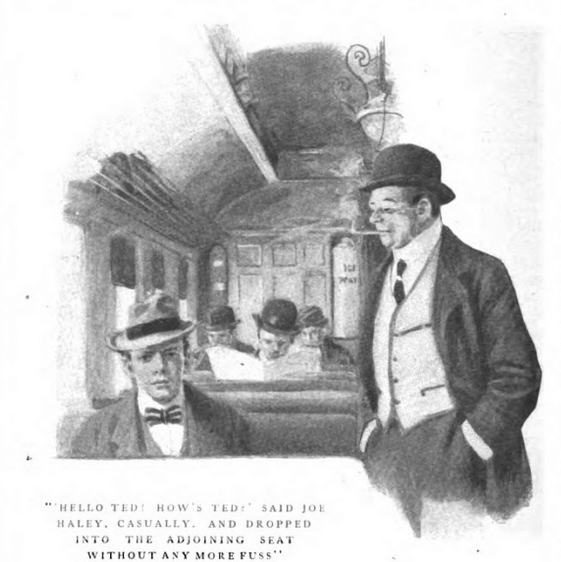
Ted is planning to stop in town just long enough to visit his mother’s grave—she died of heartbreak while he was in prison—and make a new start in Chicago, but on the train he runs into Joe Haley, the owner of a fashionable hotel. Joe offers him a job as a bookkeeper, saying that he’d be better off facing up to his crime at home than living in fear of discovery in a new place.

Illustration from “The Man Who Came Back,” American Magazine, April 1911

Ted is trained by his predecessor, Minnie Wenzel, who is marrying a “swell fellow.” His family’s former servant, Birdie, whose face “looked like a huge mistake,” works at the hotel as a waitress. All goes well until one day Joe tells Ted $300 is missing. “Ted, old kid,” he says sadly, “what’n’ell made you do it again?’” Birdie bursts in and unmasks the real culprit, Minnie, who has been pocketing the money for her trousseau. Ted asks Birdie if he can walk her home. But Birdie—and this is what elevates the story from good to great—turns him down. If she let him, she says,

“inside half a year, if yuh was lonesome enough, yuh’d ask me to marry yuh. And b’gorra,” she said softly, looking down at her unlovely red hands, “I’m dead scared I’d do it. Get back to work, Ted Terrill, and hold yer head up high, and when yuh say your prayers to-night, thank your lucky stars I ain’t a hussy.”

Edna Ferber, date unknown

Best magazine covers:

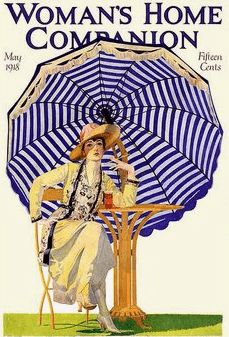
Two favorites in indigo: this one from Woman’s Home Companion, artist unknown,

…and, as always, Erté. This one’s called “Fireflies.”

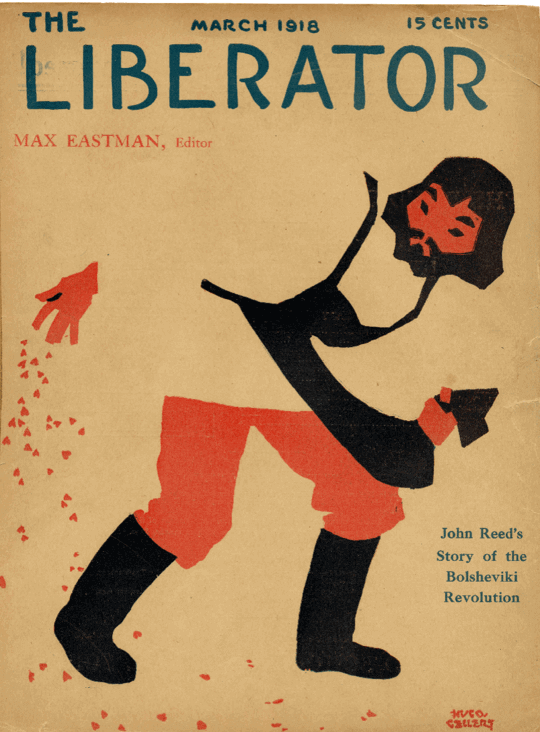
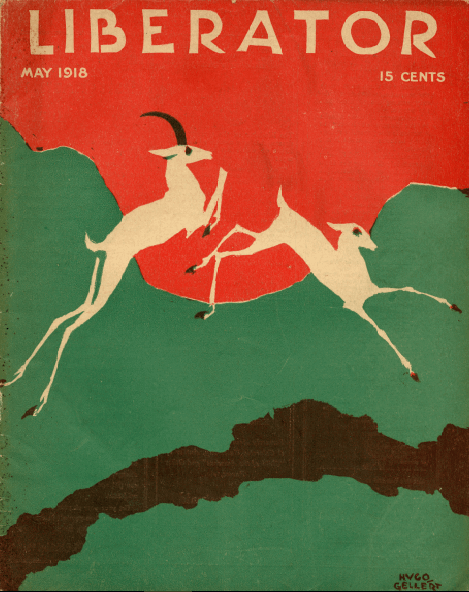
Also, a paean to spring from The Liberator’s wonderful Hugo Gellert.

Best ad:

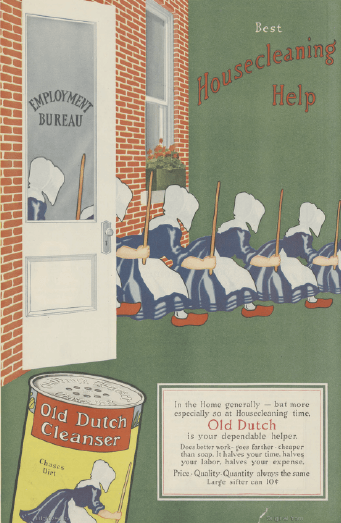
May wasn’t a sensational month ad-wise, but I always have a soft spot for Old Dutch Cleanser.

Ladies’ Home Journal, May 1918

Worst ad:

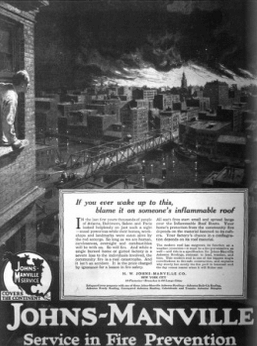
Even without the benefit of hindsight, this ad for asbestos looks ominous.

Literary Digest, May 11, 1918

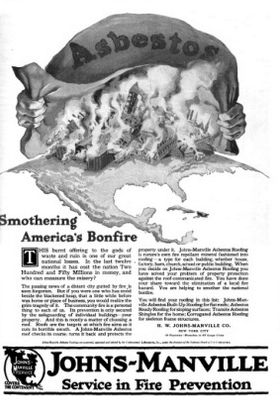
(Although not as ominous as this 1917 ad I came across in Scientific American.)

Scientific American, April 28, 1917

Best cartoon:

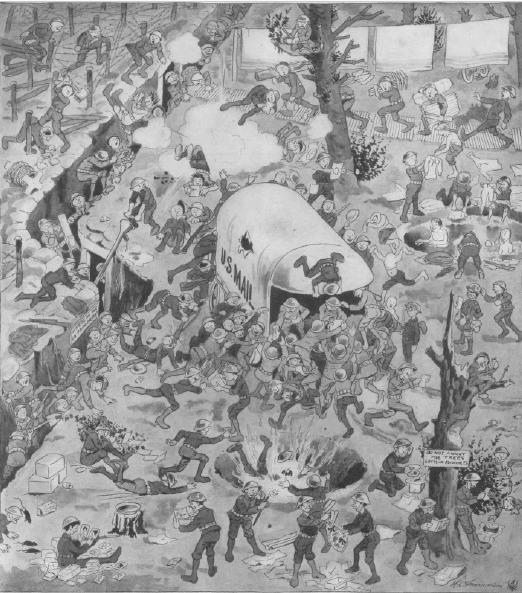
Cartooning was in its infancy in 1918, but I don’t think the artistry of that era has ever been surpassed.

“The Mail from Home Arrives,” H.C. Greening, Judge magazine, May 11, 1918

Worst cartoon:

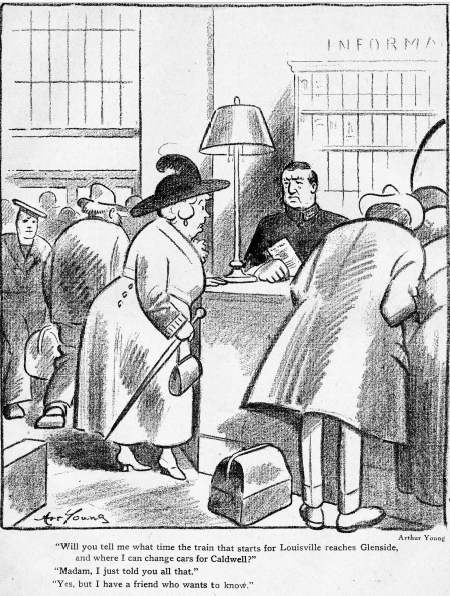
 Captions, though, still left a lot to be desired.

“Will you tell me what time the train that starts for Louisville reaches Glenside, and where I can change cars for Caldwell?”
“Madam, I just told you all that.”
“Yes, but I have a friend who wants to know.”

Screenshot (729)-2

Arthur Young, The Liberator, May 1918

 On to (okay, the middle of) June!

squiggle

*UPDATE 12/7/2019: It’s Coles Phillips, most famous for his Fadeaway Girl illustrations. I wrote about him here.

Coles Phillips Vogue cover, woman with hat,


The Uncrowned King of Bohemia: The fascinating story of a not-so-great poet

Illustration by Adelaide Hanscom Leeson, “The Rubaiyat of Omar Khayyam,” 1905, with George Sterling as model

There I was, thinking I was all done with bad mother poems, when I discovered the worst one of all, by George Sterling–in the same issue of The Bookman, as it happens, as I found hitherto bad-mother-poem champion Anna Hempstead Branch.

Until a few months before, The Bookman had been running a series called “The Masque of Poets.” I came in in the middle, couldn’t make much sense of it, and filed it away under Incomprehensible 1918 Things. But the “Masque’s” editor, Best American Short Stories founder Edward O’Brien*, had published a book based on it, and there was a review by Bookman poetry critic Jessie Rittenhouse.**

The gimmick in “The Masque of the Poets”: each month, The Bookman ran a few poems by famous writers, published anonymously. This wasn’t much of a gimmick, as Rittenhouse pointed out—it would have been more fun, she said, to have a contest where people guessed the poets’ identities. On the whole, she was lukewarm about “The Masque,” reckoning that the poets hadn’t submitted their best work. There were some pleasant surprises, though. Like George Sterling’s poem “The First Food,” which she called “poignant and intimate.”

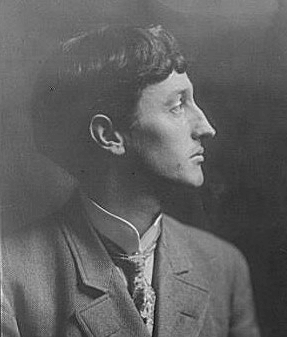
Portrait photograph of George Sterling by Arnold Genthe, 1904

I was skeptical. The 49-year-old Miss Rittenhouse was a big deal on the poetry scene—secretary of the Poetry Society of America and former poetry editor of the New York Times Book Review—but, poetry-wise, she was stuck in 1865.

Here’s “The First Food.” Judge for yourself.

Mother, in some sad evening long ago,
From thy young breast my groping lips were taken,
Their hunger stilled, so soon again to waken,
But nevermore that holy food to know.

Ah! nevermore! for all the child might crave!
Ah! nevermore! through years unkind and dreary!
Often of other fare my lips are weary,
Unwearied once of what thy bosom gave.

(Poor wordless mouth that could not speak thy name!
At what unhappy revels has it eaten
The viands that no memory can sweeten, —
The banquet found eternally the same!)

Then fell a shadow first on thee and me,
And tendrils broke that held us two how dearly!
Once infinitely thine, then hourly, yearly,
Less thine, as less the worthy thine to be.

(O mouth that yet should kiss the mouth of Sin!
Were lies so sweet, now bitter to remember?
Slow sinks the flame unfaithful to an ember;
New beauty fades and passion’s wine is thin.)

How poor an end of that solicitude
And all the love I had not from another!
Peace to thine unforgetting heart, O Mother,
Who gavest the dear and unremembered food!

I know—creepy, right?

I was all set to file this away for use as Worst Poem of the Month when I decided to look into Sterling’s life to see whether by any chance he killed his father and married his mother. He didn’t, but his actual story is almost as weird.

Mary Austin, Jack London, George Sterling, and Jimmie Hooper (Arnold Genthe, ca. 1902-07)

Sterling was born in 1869 in Sag Harbor, Long Island, the first of nine children of a doctor who tried to get him to become a priest—which, as we will see, would have been a very bad fit. He followed his uncle to California, worked in real estate for a while, made a name for himself locally with a book of poetry published in 1903, and moved to the sleepy town of Carmel-by-the-Sea in 1905. Sterling quickly put Carmel on the map as a center of literary, artistic, and Bohemian life, earning himself the sobriquet “The Uncrowned King of Bohemia.” An exodus from San Francisco following the 1906 earthquake increased the town’s popularity.

Sterling was no exception to the rule that all the people we’ve ever heard of from back then were friends with each other. He was the protégé of The Devil’s Dictionary author Ambrose Bierce, who followed him to Carmel, and his best friend was Jack London***. Writers Upton Sinclair, Gelett Burgess, Sinclair Lewis, Robinson Jeffers, and Mary Austin and photographer Arnold Genthe were among those who came to Carmel for temporary or permanent stays. (Okay, I’d never heard of the last two.)

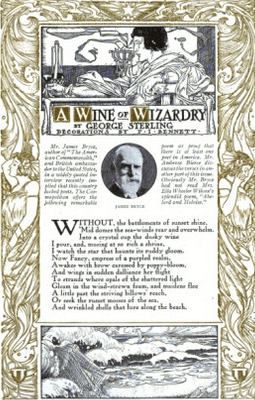
Cosmopolitan, September 1907

Cosmopolitan published Sterling’s poem “A Wine of Wizardry” in 1907, and Bierce proclaimed him the heir to Keats, Coleridge, and Rossetti. Many others begged to differ. There was apparently a low bar for controversy in 1907, because this one was huge. Meanwhile, things were getting pretty wild in Carmel. There were, or so rumor had it, nude beach parties, free love (gay and straight), wife-swapping, and opium dens.

Nora May French (Arnold Genthe, ca. 1907)

Then the tragedies began. In November 1907, Nora May French, a glamorous young poet who was staying with Sterling and his wife, committed suicide by drinking cyanide that she had obtained on the pretext that she needed to polish some silver. News accounts varied as to whether French had been sleeping in the same room as Sterling’s wife. (Sterling was away.) This, and tales of French’s “nymphomaniac” ways, increased Sterlings notoriety. Others in the circle also met sad ends. London died following a morphine overdose in 1916 (accidental, apparently, but there were rumors of suicide), and Bierce disappeared in Mexico in 1914.

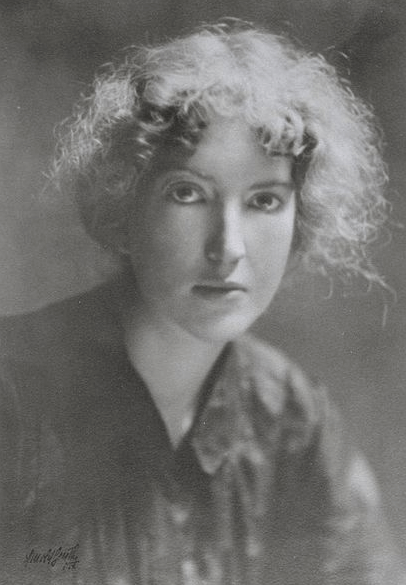
Caroline “Carrie” Rand Sterling, George Sterling’s wife, date unknown****

Sterling began drinking heavily. His wife filed for divorce in 1913, citing non-support, idleness, and dissipation. In August 1918, she too committed suicide by taking cyanide. Sterling began carrying around a vial of cyanide himself, saying, “A prison becomes a home if you have the key.” He finally took a lethal dose in November 1926, while H.L. Mencken was visiting him in San Francisco. (Yes, the Uncrowned King of Bohemia was friends with the Sage of Baltimore too. A volume of their correspondence was published in 2001.)

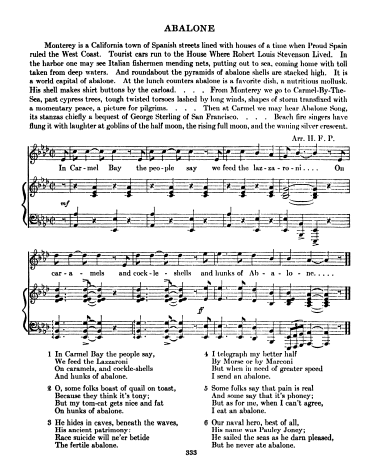
But let’s not leave Sterling on this sad note. He and his crowd had a lot of good times. Like when they were pounding abalone to tenderize it. This was the only time that it was permissible to sing the Abalone Song, which was composed mostly by Sterling, with contributions by London, Lewis, Bierce, Burgess, and others. There were many versions. This one is from Carl Sandburg’s 1927 folk song anthology The American Songbag:

From “The American Songbag” by Carl Sandburg, 1927

*Edward O’Brien had recently started a new feature in The Bookman called “War Echoes.” It generated a lot of mail, and the nearest post office in South Yarmouth, Massachusetts, was two miles away, so he asked the postal service to open a new post office closer to his house. And they did!

**The Bookman was incestuous like that. Rittenhouse’s first book of poetry had been reviewed in the previous issue—lukewarmly, which must have stung.

***Sterling was portrayed in two London novels that I never heard of, Martin Eden and Valley of the Moon.

****UPDATE 8/31/2024: A college professor who published a book about Sterling and his circle says that she is certain that this photograph is not of Sterling. See the discussion in the comments section.