How to be a New York Times war correspondent, 1918-style

So you got hold of a time machine and you want be a New York Times war correspondent in 1918? Here are some tips.

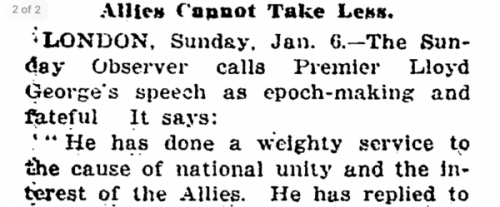
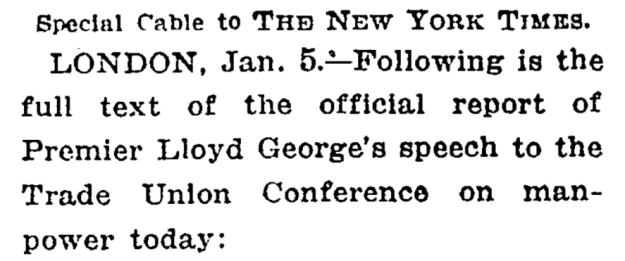
1. If the British Prime Minister gives an important speech on the war, don’t worry about analyzing it. Just send in the official report.

New York Times text, January 6, 1918

New York Times, January 6, 1918

2. To be on the safe side, you might also want to quote a British newspaper’s analysis of the speech in its entirety.

New York Times text, January 6, 1918

New York Times, January 6, 1918.

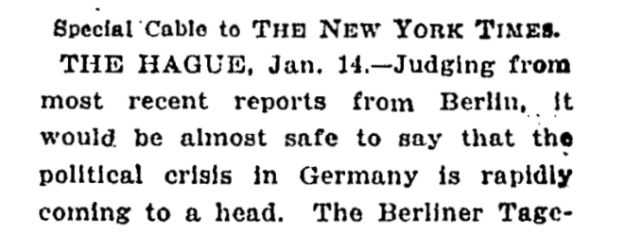
3. If you don’t know what’s going on, open with a vague statement.

New York Times text, "Judging from most recent reports from Berlin..." January 15, 1918.

New York Times, January 15, 1918

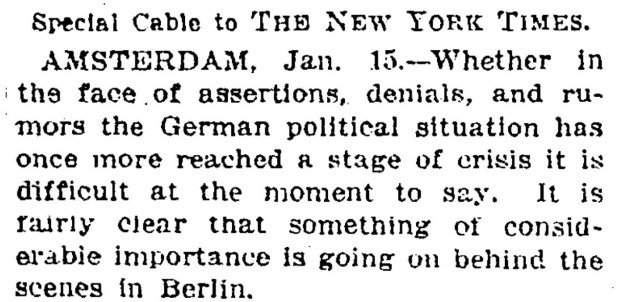
4. Or just come out and admit that you don’t have a clue.

New York times text, "it is fairly clear that something of considerable importance is going on in Berlin."

New York Times, January 16, 1918

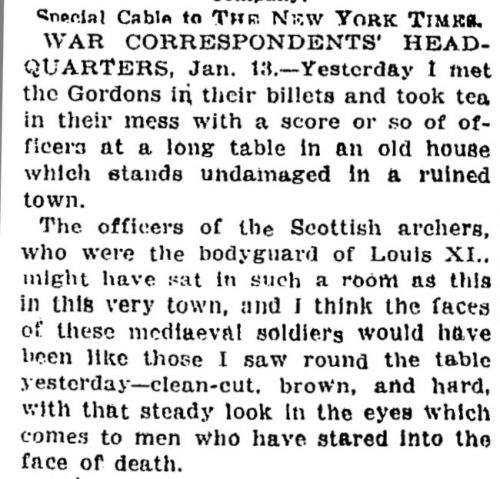
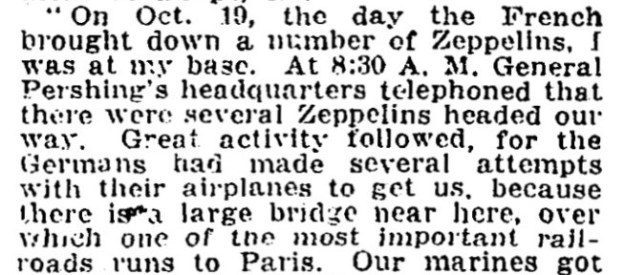
5. If you manage to talk with someone who’s actually involved in the war but all he does is spout generalities, throw in lots of atmospherics.

New York Times text, "Yesterday I met the Gordons in their billets and took tea..."

New York Times, January 14, 1918

6. Don’t worry about sending in war news. This will be provided by your colleagues, like a reporter covering the unveiling of a plaque at the Biltmore Hotel honoring its employees at the front, who will come across a letter from one of these employees containing actual war news.

New York Times text, January 1918.

New York Times, January 14, 1918

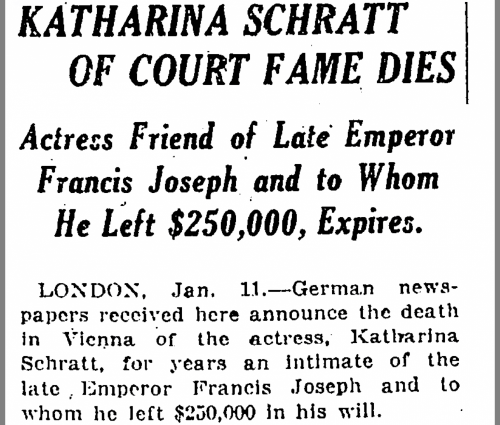
7. Human interest is also good! If the German press reports that the mistress of the former German emperor has died, write about that. Don’t worry about getting confirmation. The Times can just run another obituary in 1940, when she actually does die.

New York Times headline, Katharina Schmitt of Court Fame Dies.

New York Times, January 12, 1918

I know that reporters in Europe faced censorship and restrictions on their movements. And the Western Front was quiet in January 1918. Still, I have to believe it was possible to do better than this. I can see now why the public was so eager for soldiers’ personal accounts of life at the front, provided in books and public lectures. I hope that, as the war heats up and American lives are increasingly on the line, the Times will provide the public with better information.

Wednesday Miscellany: Women’s clothing, or lack thereof

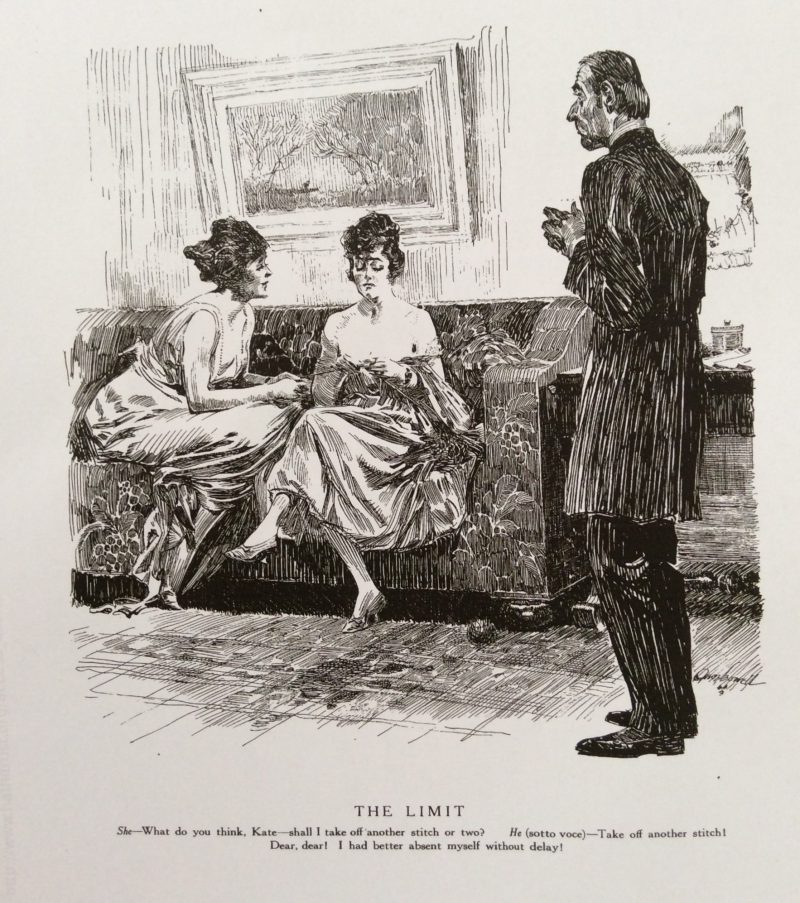
She: What do you think, Kate–shall I take off another stitch or two?
He (sotto voce)–Take off another stitch! Dear, dear! I had better absent myself without delay!

This is about as racy as 1918 gets.

Judge, January 12, 1918

Note to advertisers: if you want to get a half-naked woman into the New York Times, make her an Egyptian goddess.

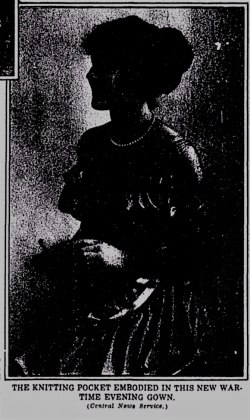
From the New York TImes rotogravure: the “new wartime evening gown” with a knitting pocket. Waltzing…sharp needles…what could go wrong?

New York Times, January 13, 1918 (All the photos in the rotogravure were this bad.)

Call me a philistine: bad modernism and bugle poems

When I started this blog, I imagined myself drifting through 1918 on a cloud of superiority, watching appreciatively as modernism flowered in the small journals and rolling my eyes at the sentimental tripe in the popular press. (When I promised not to engage in moral superiority, I didn’t say anything about aesthetic superiority.)

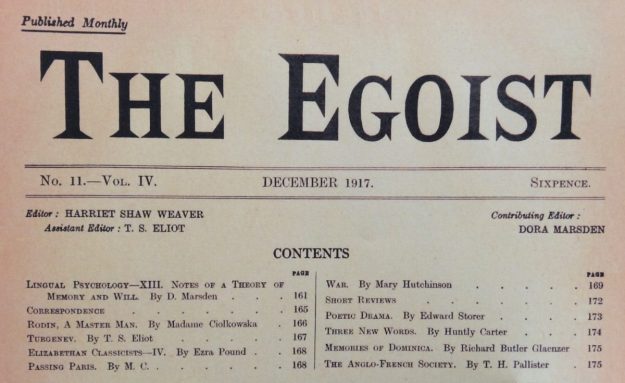
Table of contents, The Egoist, December 1917.

That’s not what has happened. When I eagerly picked up the December 1917 issue of The Egoist, the British journal where T.S. Eliot was assistant editor, the first thing I saw was an article called “XIII. Notes of a Theory of Memory and Will,” by D. Marsden. It began like this: “(1) If one were required to name the most basic characteristic of experience, choice would have to fall upon that of progressive economy of effort in respect of activities which are repeated.” That’s hard to argue with; I’m getting much faster at uploading photos on WordPress. But D. goes on like this for four pages, and I wasn’t sure what the point was. (I found out later that the point was that D(ora) Marsden was the editor of The Egoist, and, while she deserves credit for recognizing the genius of Eliot and Pound, she significantly overestimated the genius of D. Marsden.)

The Egoist gets better after that. T.S. Eliot discusses the role of a critic in a review of a book on Turgenev, and Ezra Pound writes in an article about the Elizabethans that in each great age “a few poets have written a few beautiful lines…and ten thousand people have copied them.” An editorial note informs readers that the first edition of A Portrait of the Artist as a Young Man (“which, it will be remembered, was printed in America owing to the refusal of British publishers and printers to handle it”) has sold out, but a British edition is on the way. So there are some fascinating historical nuggets, but if I had happened to put down Vanity Fair and pick this up in 1918, it wouldn’t have converted me instantly to modernism.

Cover banner, The Little Review.

Undeterred, I dove in just as eagerly to the January 1918 edition of The Little Review, an American literary journal. It opens with a seven-page prose poem by William Carlos Williams called “Impressions.” Here’s a typical passage:

What can it mean to you that a child wears pretty clothes and speaks three languages or that its mother goes to the best shops? It means: July has good need of his blazing sun. But if you pick one berry from the ash tree I’d not know it again for the same no matter how the rain washed.

After two or three pages of this, I said to myself, “This is nothing like the plum/icebox poem that everyone’s putting on Facebook! Was WCW drunk?” It turns out that he was flirting with poetic Cubism—a style of deliberate disjointedness in imitation of the Cubist painters. Well, it was disjointed all right. After the Williams poem, there was a long essay about the sexes by Ford Madox Hueffer (later known as Ford Madox Ford) that was deliciously gossipy but didn’t have much of a point.

Banner, St. Nicholas League, St. Nicholas Magazine, 1918.

Meanwhile, St. Nicholas magazine was having a contest where children wrote poems about bugles. Genevra Parker, age 13, got a silver medal. Here’s the first verse of her poem, which appeared in the January 1918 issue:

Blow, blow, blow—
To the murm’ring streamlets blow!
To the sparkling dew, and the roses, too,
And the echoes long and low;
To the clover-tops and the early bees;
Blow through the quiet lanes—
Sing to me of the silver sea
And the horseman on the plains.

Okay, Genevra isn’t breaking any new ground here, poetry-wise. But it’s a cool poem! And she was thirteen years old! And I can tell what it’s about: a bugle!

There’s some beautiful imagery in Williams’ poem, and I admire the spirit of experimentation behind his effort to bring Cubism from painting to verse. But, as a reading experience, I enjoyed “The Bugle-Call” a lot more.

Okay, you can call me a philistine now.

African-American voices of 1918

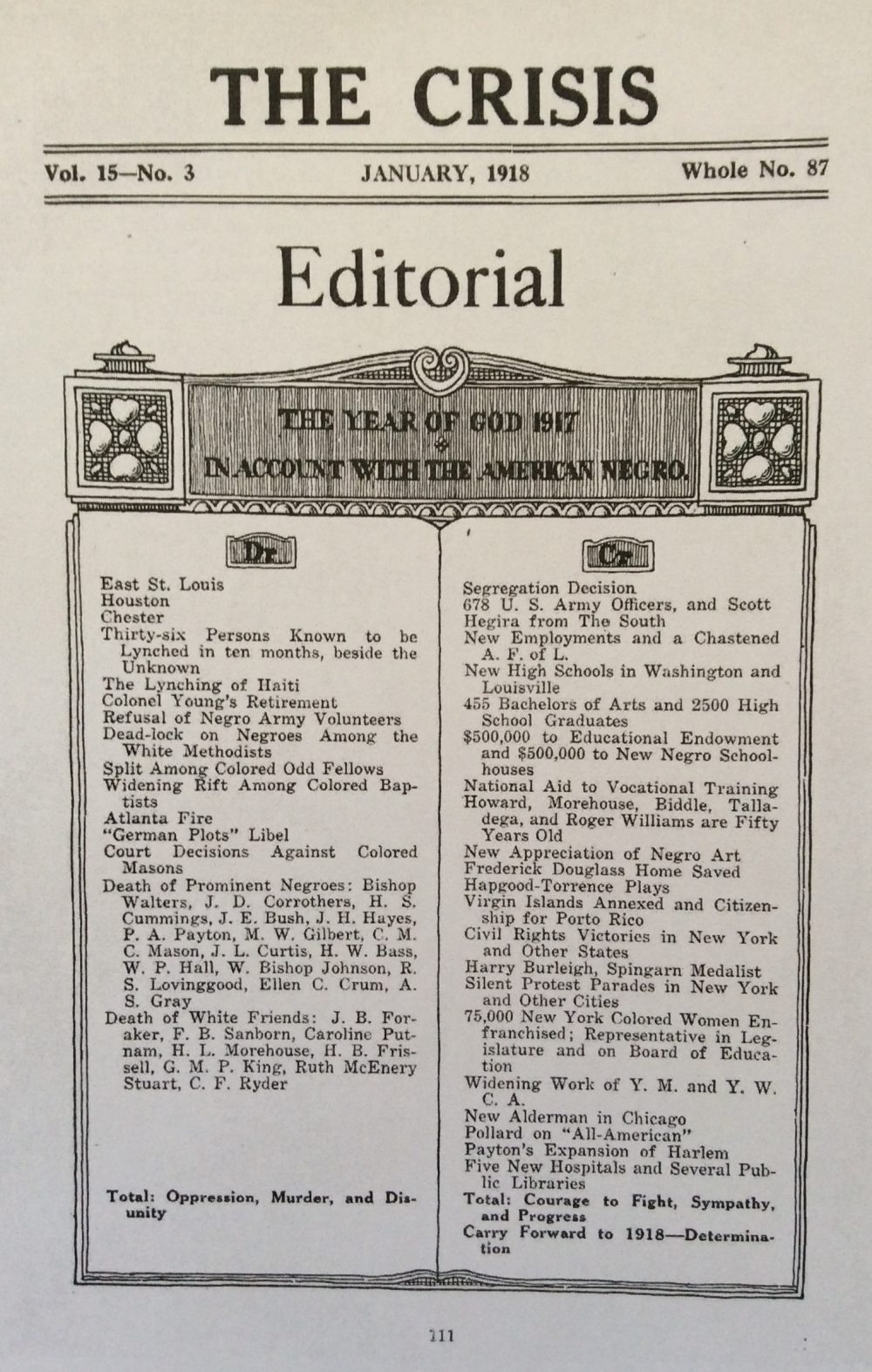
The Crisis editorial page, January 1918.

In 1918, African-Americans were almost invisible in the mainstream press. The New York Times, in a January 6 story called “Problems in Training Negro Soldiers,” groused that the “friends of the negro” were pressuring the War Department, which had drafted 83,600 black soldiers, to solve the “so-called race question in America.” The only other reference to African-Americans I’ve seen so far in the Times was the inclusion of an “unidentified Negro woman” on a list of New Yorkers—the rest were all named—who died of exposure during a cold snap.

I sought out African-American voices in honor of Martin Luther King Day, and found them in the January 1918 edition of The Crisis, the NAACP magazine, which was edited by W.E.B. Du Bois. It’s the best-written and most interesting magazine of the time that I’ve come across, and it feels the most contemporary.

An article by Lindsey Cooper on the 1917 East St. Louis race riots is the closest thing I’ve seen to modern long-form journalism. Framed as a report on the congressional investigation into the riots—which was conducted, of course, exclusively by white men—it provides an in-depth discussion of the social forces that sparked them. Across the Mississippi from St. Louis and home to many of the area’s African-Americans, East St. Louis, Illinois, was a cesspool of vice. The city subsided mainly by means of saloon licenses (376 saloons for a population of 75,000) because a separate municipality—the nation’s richest per capita—had been carved out for nearby factories.

When the white workers of St. Louis tried to unionize, factory owners thwarted their efforts by hiring black workers arriving from the South. This led to a cauldron of racial resentment that boiled over in an explosion of violence in May and July 1917. At least forty African-Americans were killed as police stood by ineptly or indifferently; some encouraged the violence. The National Guard was called, to little effect.  Cooper recounts the story of a man and his son who were dragged out of a car and killed as they passed through East St. Louis on the way home from a fishing expedition. A member of Congress, told of the incident during the hearing, commented, “Indians could have done no worse.”

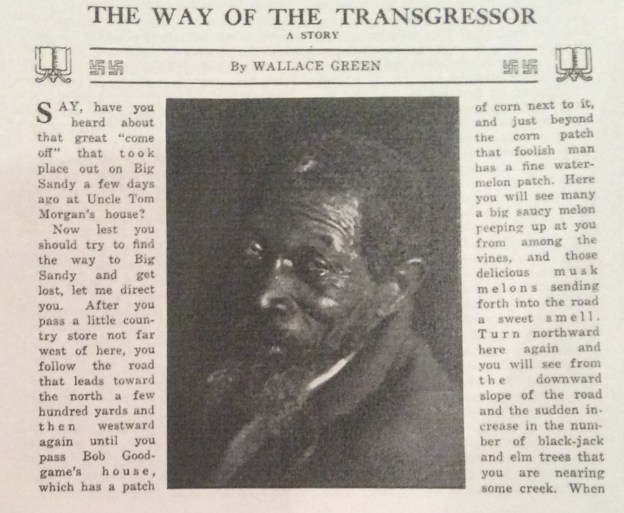
Headline and photograph illustration, The Way of the Transgressor, The Crisis, January 1918.

The Crisis also includes the best short story I’ve seen so far, “The Way of the Transgressor,” by Wallace Green. Green doesn’t try any fancy literary tricks, but the story is refreshingly lacking in the archness and overwriting of the day. It tells of a rural square dance that ends in a blaze of violence, but the best part is the depiction of the dance before the guns come out. I felt like I was there at Uncle Tom Morgan’s two-room log house, watching handsome Jack Sutton and tender-eyed Sealy Green walk down the center of the yard arm in arm “like two monarchs upon streets paved with gold, singing ‘You can’t turn the tea like me.’” Young men longed to swing in the beautiful arms of Pet Henderson, in “a red garment that fit her so well that she seemed to have been just taken out of the melting pot.”

And there’s more. A blazing indictment of the hypocrisy of racist white Christians. A letter from “A Voice from the Orient” calling Wilson out for racism. Another letter, apparently from a white Cuban-American soldier, telling of his experience under the inspiring leadership of the Afro-Cuban general Antonio Maceo in the Cuban Army of Liberation. And a refreshingly unsentimental “Mother’s New Year’s Resolution”: “I will live with my children, not merely for them; since such companionship is worth more than divergent ways, marked by needless sacrifices on the one side and a growing selfishness on the other…I will impart to my children the facts of life, that they may look with reverence upon their bodies.”

You can find The Crisis online, thanks to the Modernist Journals Project, at https://modjourn.org/journal/crisis/. It’s well worth a read, on Martin Luther King Day or any day.

Factory work by day, Yiddish drama by night: the Lower East Side life of Elizabeth Hasanovitz

Headline, One of Them, Elizabeth Hasanovitz, Atlantic, January 1918.

It’s only been two weeks, but I already hate 1918 rich people. They’re imperious, self-absorbed, and shallow. When a New Jersey judge makes an incognito coal delivery during a cold snap, the lady of the house threatens to have him fired if he doesn’t take it up to the second floor. (He does, and dumps it in the parlor.) Vanity Fair praises the unsurpassed valor of soldiers from “great schools like Exeter, St. Paul’s, and Groton.” Rich characters in short stories yammer endlessly about their personal dramas, and I say, “You know what you need? A job.” So it was refreshing to come across decidedly-not-rich Elizabeth Hasanovitz, whose serialized autobiography “One of Them” begins in the January 1918 Atlantic.

Born into a large and loving family in Russia, Elizabeth began teaching in her father’s Hebrew school at fourteen—illegally, since she lacked a teaching certificate. All she wanted in life was to go on teaching with her father, but it wasn’t to be. When she took the teachers’ exam, fifty-five of the sixty Yiddish candidates failed, including Elizabeth; all nine Russian candidates passed. Meanwhile, the family fell on hard times because of the police chief’s frequent demands for bribes. And there was the constant danger of anti-Jewish violence from drunken peasants.

One night, as the family sat down for the Sabbath meal, Elizabeth said, “I have been thinking and I have decided that—that—I—shall go—to America.” Her mother and sisters burst into tears, and her father rejected the idea out of hand. Elizabeth pleaded with her parents for days. She could send for the rest of the family, she said. “Think of the children going to free schools, growing up free citizens!” But her father wouldn’t budge. Finally, she resorted to a hunger strike. After three days, her father got her a passport.

Lower East Side street, ca. 1910

Lower East Side, ca. 1910 (New York Times photo archive, public domain photo)

Elizabeth ended up in Canada, where she got a factory job. The pay was decent, but she left because of the country’s “provincial mental atmosphere.” Chicago was no more to her liking, so she set out for New York. There, things went well at first. She was making ten dollars a week at a knitting mill and saving five for her brother’s ticket. She joined the Dramatic Club, which aimed to provide higher fare than the “trash” that most Yiddish theaters fed the public. All was well, except for the “common and vulgar” atmosphere in the factory. The other girls’ “frankness in manner and speech would make me blush, and I became an object of their teasing.”

But the good times didn’t last. Business slowed, and Elizabeth was laid off. Luckily, a fellow member of the Dramatic Club had a home textile enterprise, and he took Elizabeth on as a trainee. The atmosphere was congenial—the family members sang merry Russian songs as they worked—but Elizabeth was a hopeless seamstress, constantly sewing a front where a sleeve was supposed to be. Eventually she improved, but she was slow, and she earned only five or six dollars a week, barely enough to live on. Exhausted at night, she abandoned her dream of studying. When she was down to her last two dollars, she fell into despair.

Posed photo of striking shirtwaist factory workers, 1910.

Striking shirtwaist factory workers, 1910 (Library of Congress, public domain photo)

Elizabeth went to a flower shop and bought a funeral bouquet for $1.50. Back at her rooming house, she turned on the gas. To speed her death along, she soaked matches and drank the liquid. She woke up in the hospital, her friend Clara from the Dramatic Club at her side. Clara invited Elizabeth to live with her, and out of options, she agreed.

To be continued!

Elizabeth has her flaws. She’s a terrible snob, with her haughty dismissal of Canada and her airs and graces on the factory floor. She claims to have almost starved to death on the ocean journey because the other passengers grabbed all the food, but her real problem seems to have been with their disgusting table manners. And she’s quite the drama queen. The hunger strike! The funeral bouquet!

Still, she’s a compelling heroine, and she paints a vivid picture of immigrant life in the Lower East Side. I look forward to reading her further adventures. If you want to know more, you can find her entire autobiography online. Just don’t tell me what happens!

Our daughters’ daughters will adore us…

1918 opened with a bang in Congress. On January 10, two days after President Wilson announced the Fourteen Points at a joint sitting, the House of Representatives approved a constitutional amendment to give women the right to vote.

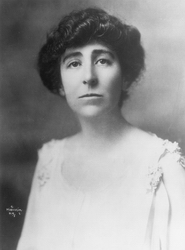
Jeannette Rankin.

Jeannette Rankin

Republican Representative Jeannette Rankin of Montana, the first woman member of Congress, opened the debate. “Is it not possible that the women of the country have something of value to give the nation at this time?” she asked. “It would be strange indeed if the women of this country through all these years had not developed an intelligence, a feeling, a spiritual force peculiar to themselves, which they held in readiness to give to the world.” Representative Walter Chandler, Republican of New York, reassured listeners that, despite what they might have heard, the suffragist movement was not in fact led by socialists and German sympathizers.

The public gallery was packed with women. The New York Times noted that “nearly every woman who journeyed to the House carried a knitting bag.” Most were confiscated, but a few women succeeded in knitting their way through the debate, as suffragist leaders looked on intently.

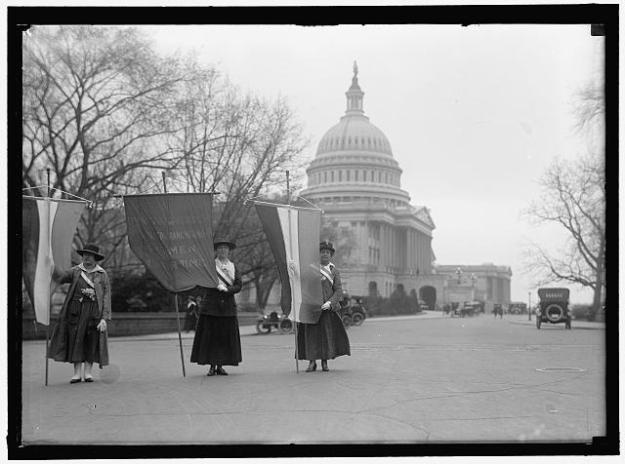
Suffragists picketing the Capitol, 1918.

Suffragists picketing Capitol, 1918 (www.loc.gov)

It didn’t look good at first. Democrat after Democrat voted against the amendment, the Times reported, seemingly dashing hopes that President Wilson’s endorsement the day before would turn the tide. “We are defeated,” suffragists in the gallery whispered. But the amendment’s supporters had mustered all of their strength. Republican leader James Mann came to the House from his sickbed in Baltimore; Thetus Sims of Tennessee, badly injured, staggered to his seat. When the final count of 274 to 136 was announced, exactly the two-thirds majority needed, “the people in the galleries arose en masse and cheered,” and “members on the floor joined in the jubilation.” A challenge to the vote count was unsuccessful. Outside the Capitol, a thousand women cheered “with all the enthusiasm of collegians after a football victory.”

While the Times reporter seems to have been swept up in the celebratory mood, the editorial page accepted the outcome with resigned huffiness. The issue, it said, was purely political. With the House almost evenly divided, and more and more states allowing women to vote, the Republicans had seen the political wisdom of taking up the suffragist cause. The Democratic Party, despite the “reasonable apprehensions” of its southern members, saw which way the wind was blowing. Wilson abandoned his long-held (and in the the Times’ opinion, correct) view that suffrage was a state, not a federal, issue. In wartime, the Times said, “woman suffrage is but a piffling and subminor matter.” Oh well. The amendment would find “harder sledding” in the Senate.

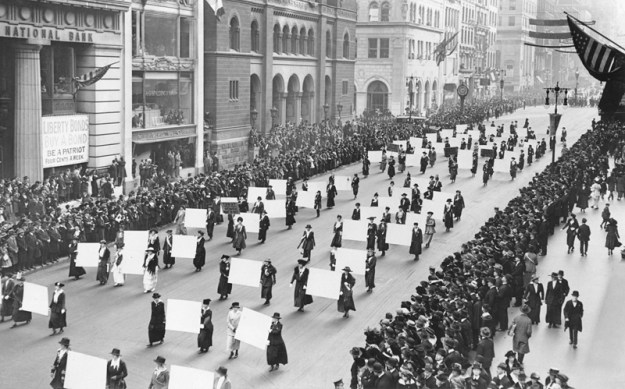
Suffragist Parade, Fifth Avenue, 1917.

Suffragist Parade, Fifth Avenue, 1917

Indeed it would. But, on the centennial of this crucial step forward, those of us who can fight sexual harassment because our great-great-grandmothers fought for the vote can, in the words of Mrs. Banks in Mary Poppins, sing in grateful chorus:

WELL DONE, WELL DONE, SISTER SUFFRAGETTE!

Wednesday Miscellany

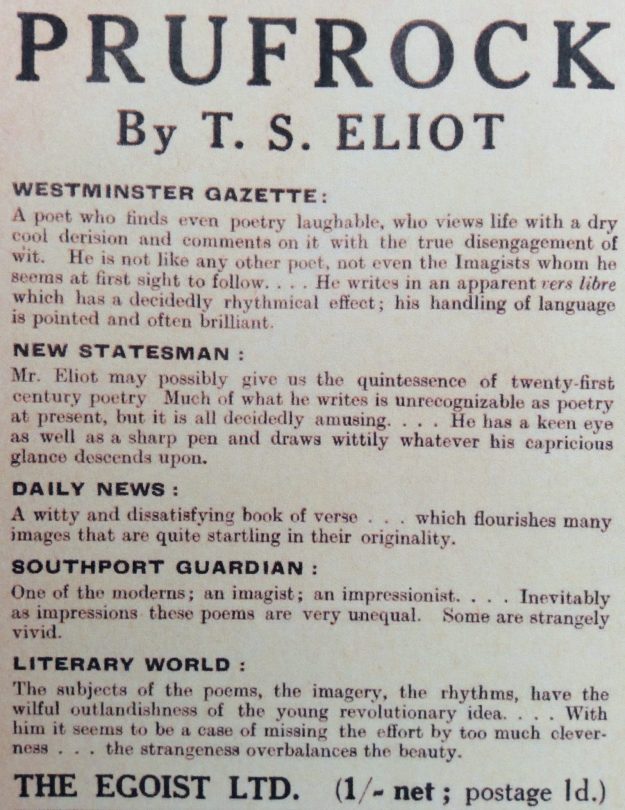
An ad in The Egoist, the British literary journal where T.S. Eliot was assistant editor. I love how proudly they quote the criticism. Dissatisfying! Very unequal! Missing the effort by too much cleverness!

Advertisement for Prufrock by T.S. Eliot.

The Egoist, January 1918

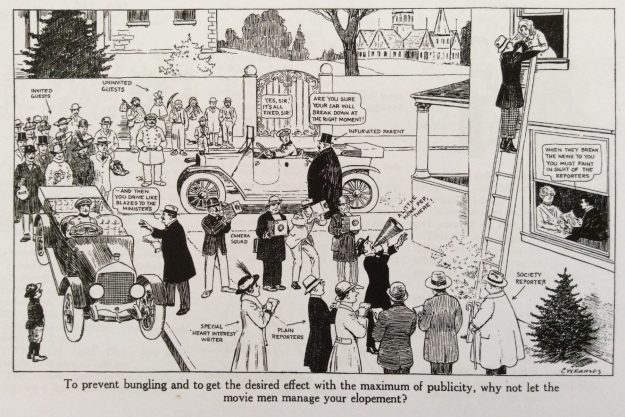
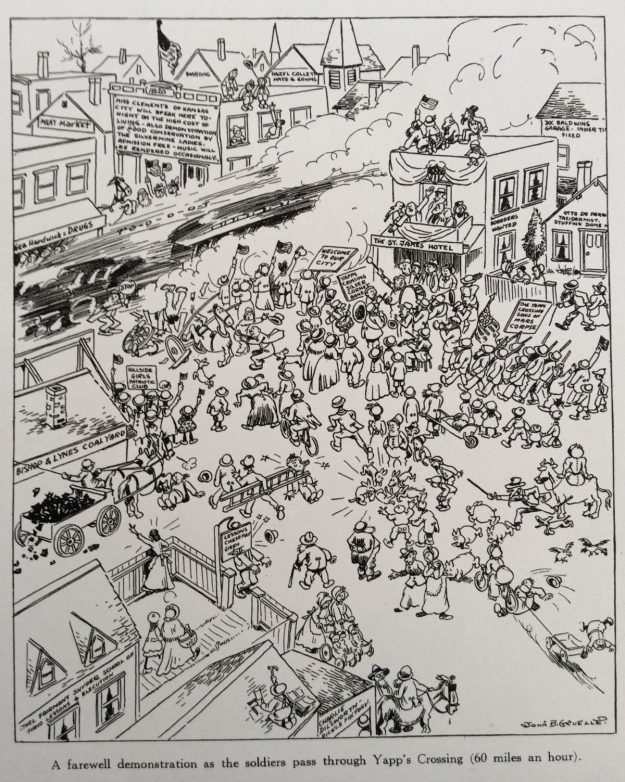
Judge was a humor magazine that managed almost never to be funny–more on that later–but they had some great illustrators. My favorites from the January 3, 1918, issue:

Judge cartoon, what if the movie men managed your elopement, January 3, 1918

Judge Cartoon, soldiers pass through Yapp's crossing, Johnny Gruelle, January 3, 1918.

Johnny Gruelle

The 14 Points: I flunk a pop quiz

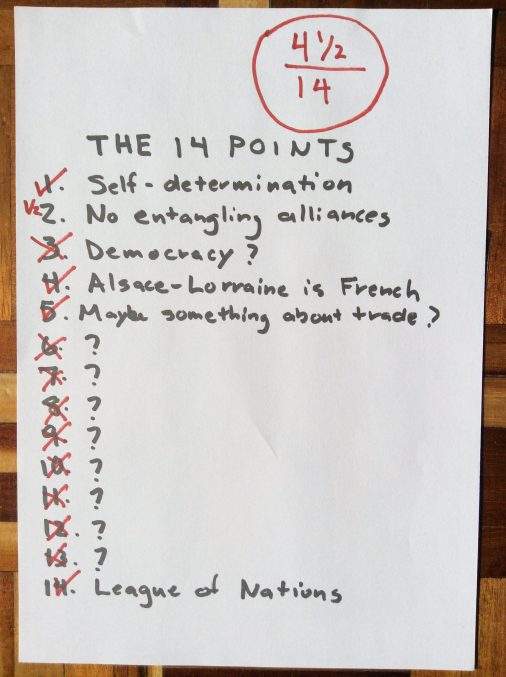
President Wilson’s speech to Congress on January 8, 1918, outlining the Fourteen Points—his statement of principles for peace—took Washington by surprise. There was barely enough time for the House and Senate to make arrangements for a joint session. I, on the other hand, knew it was coming, and for the first time My Year in 1918 felt like homework. I decided I might as well turn it into actual homework, and I gave myself a pop quiz: how many of the points could I remember? You can do this too! Just get a piece of paper, write down the numbers 1 to 14, and give it a go!

No? Okay, here they are:

  1. Open covenants of peace, openly arrived at.
  2. Absolute freedom of navigation upon the seas.
  3. The removal of economic barriers and establishment of equal trade conditions.
  4. Reduction of armaments.
  5. Free, open-minded, and impartial adjustment of colonial claims.
  6. The evacuation (by the Germans) of all Russian territory.
  7. The evacuation of Belgium.
  8. The restoration of French territory, including Alsace-Lorraine.
  9. A readjustment of Italy’s borders along the lines of nationality.
  10. Autonomy for the peoples of Austria-Hungary.
  11. The evacuation of Rumania, Serbia, and Montenegro.
  12. Sovereignty for the Turkish people and autonomy for other peoples under Turkish rule.
  13. An independent Polish state.
  14. A general association of nations.

Here’s what I managed to come up with:

Pop quiz on the 14 Points.

Not very impressive, especially since I was a government major. 32 percent! But I did get some key principles right. On second thought, flunking seems kind of harsh. I’ll bump my grade up to a D+.

If President Wilson hadn’t forced my hand, I would have waited a while to write about World War I. I’m starting to get the gist of what was going on—mostly, totally chaos in Russia—but it’s so complicated. When I was in school, World War I was treated like World War II: The Prequel. A slightly different line-up of combatants, a less morally clear-cut conflict. Afterwards, I read about the tremendous human cost of the war in books like Ernest Hemingway’s The Sun Also Rises and Vera Brittain’s Testament of Youth. But I never understood the war itself very well.

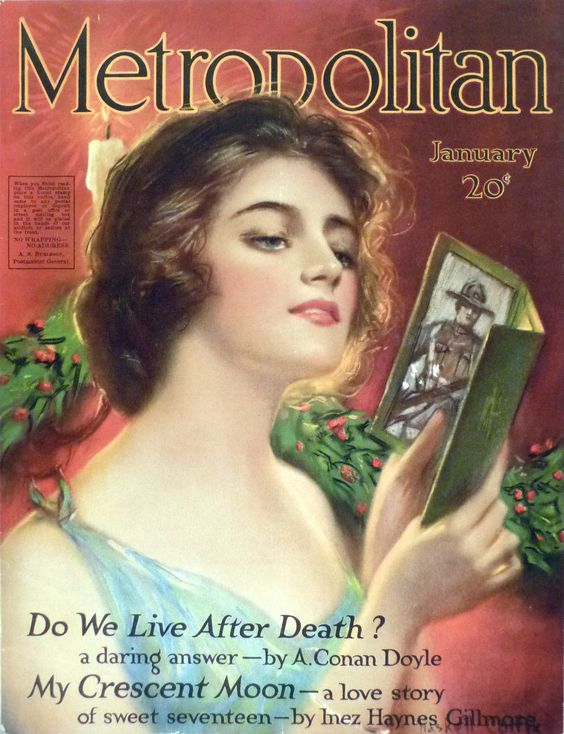
Here, then, are some early thoughts. On the one hand, the American press is completely consumed by the war. Children’s magazines explain the intricacies of U-boat fighting. Women’s magazines talk about doing your bit by cutting down on butter and sugar. (I’m not sure exactly how this helps.) There’s a war-related illustration on almost every magazine cover.

On the other hand, there’s a tremendous sense of confusion and ambivalence. What exactly are we fighting for, and why? There’s lots of carping in the press about the ineffectiveness of the Allied forces. A few days before Wilson’s address, British Prime Minister Lloyd George gave a speech to trade unionists that struck me more as an effort to maintain the loyalty of his people than as a rallying cry. In this context, Wilson’s speech seems as much a justification for the war as a path to peace.

It will be interesting to see how people in 1918 respond to the 14 points. In the meantime, I’d better brush up on my European geography. You never know when there’s going to be another quiz!

An early 20th-century Bridget Jones

As I’ve mentioned, I worried about what I would do for comfort reading during My Year in 1918. Sure, I love Edith Wharton, and I look forward to discovering some of her lesser-known works. But what if I’m not in the mood for finely wrought prose? What if my brain is fried and I just want to relax?

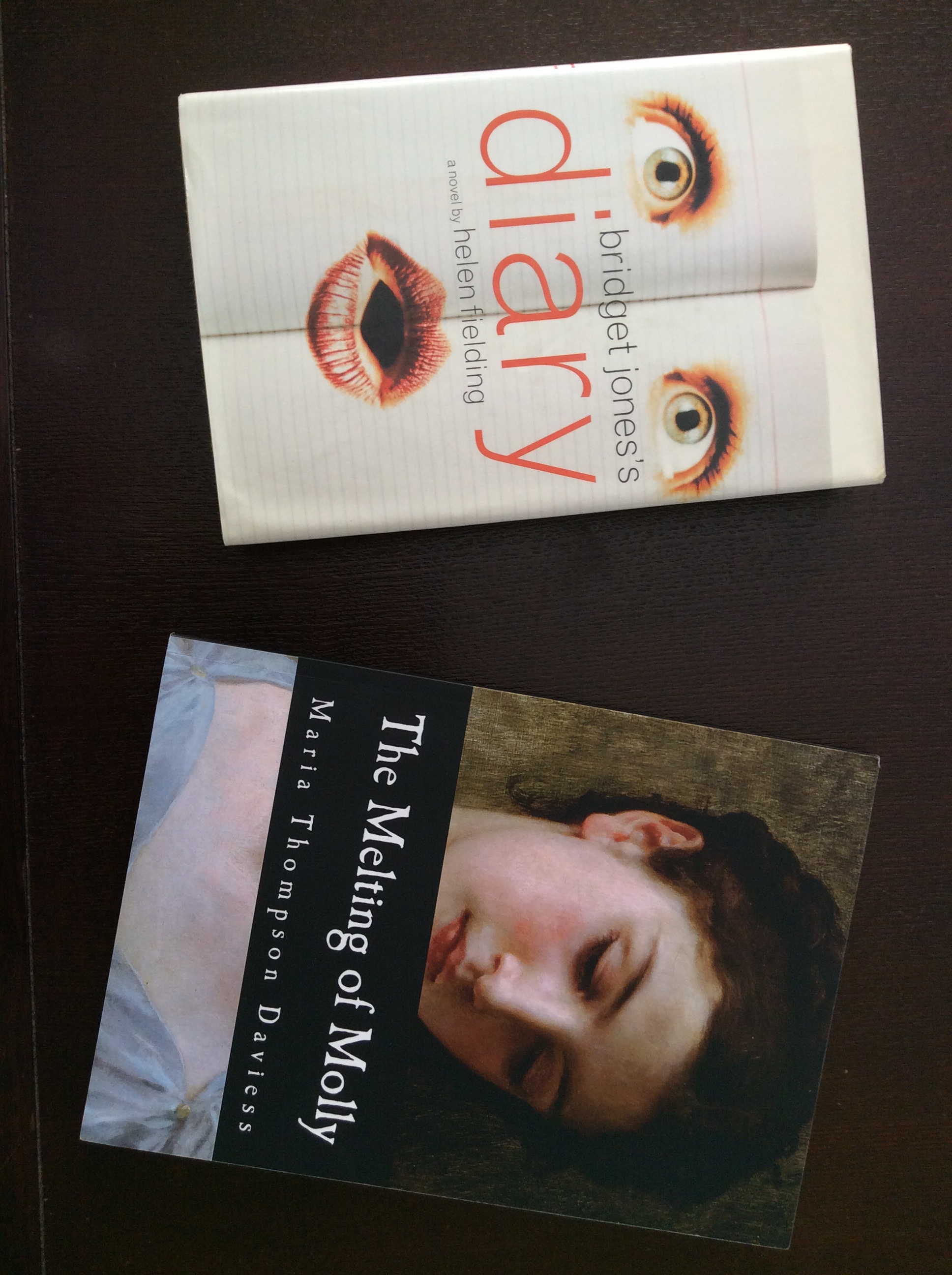
Photograph of Bridget Jones's Diary by Helen Fielding and The Melting of Molly by Maria Thompson Daviess.

Well, having just finished The Melting of Molly by Maria Thompson Daviess, the #4 fiction bestseller of 1912, I can put that worry to rest. Molly Carter is an early 20th-century Bridget Jones, a ditzy diarist obsessed with men and weight loss. Bridget starts every diary entry by noting her weight and calorie consumption, but Molly doesn’t have to count calories, since she’s on a crash diet that requires her to eat the same thing every day. Here’s her daily fare:

  • Breakfast: one slice of dry toast, one egg, fruit and a tablespoonful of baked cereal, small cup of coffee, no sugar, no cream.
  • Dinner: one small lean chop, slice of toast, spinach, green beans and lettuce salad.
  • Supper: slice of toast and an apple. (“Why the apple?” Molly mourns. “Why supper at all?”)

Molly’s a more successful dieter than Bridget—she drops over thirty pounds in three months or so, and somehow doesn’t end up with scurvy. But she’s just as confused about her love life. Where Bridget’s romantic tribulations are modeled on Pride and Prejudice, though, Molly’s story seems to be inspired by Emma.

Married off to a rich older man at eighteen after her true love abandons her to join the diplomatic corps, Molly is widowed at age twenty-four. The story begins a year later, with her old flame announcing that he’s coming to town as she prepares to shuck off her widow’s weeds. Hence the crash diet—he expects her to greet him in his favorite blue muslin frock with the twenty-three inch waist. Meanwhile, she’s the mother figure to the five-year-old son of the widowed doctor next door, who keeps a fatherly eye on her (and prescribes the crash diet). Other suitors materialize, including a pompous judge and Molly’s rakish cousin Tom, who showers her with not-so-brotherly kisses. If you don’t see where this is going from the beginning, well, you’re not paying much attention, and you definitely haven’t read Emma.

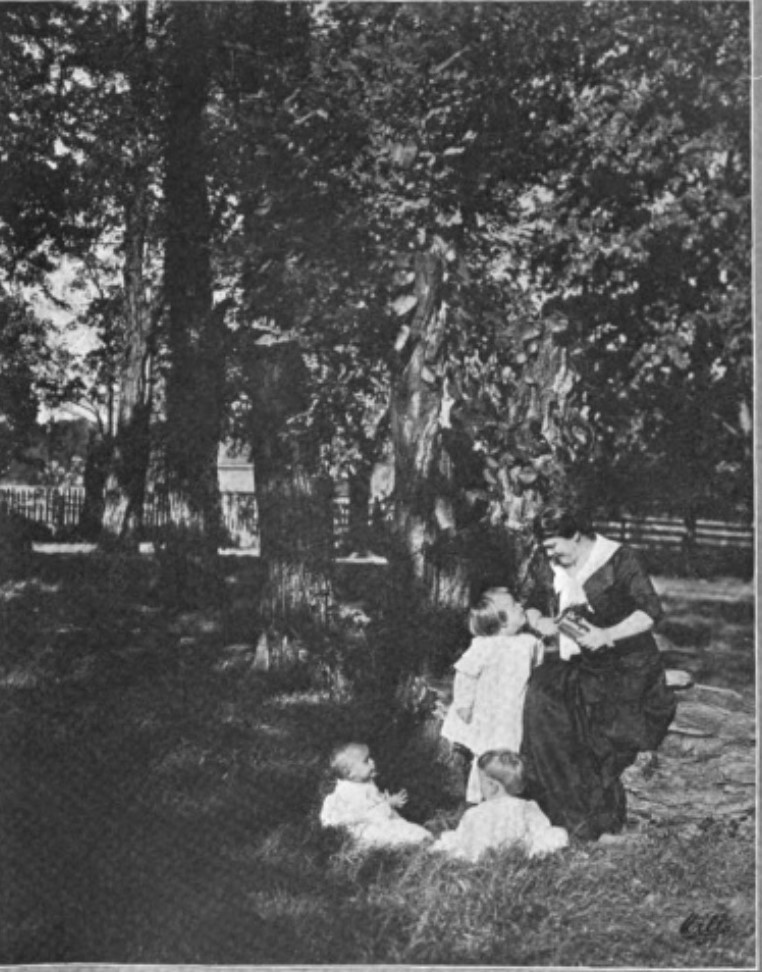
Maria Thompson Daviess outsider her home with children, Book News Monthly, January 1914..

Maria Thompson Daviess at home (Book News Monthly, January 1914)

The Melting of Molly is no forgotten literary classic. Molly’s feelings for the doctor veer abruptly between love and hate, often in a single sentence, for no apparent reason other than to keep the suspense going. The arrival of Molly’s former beau, which the whole book builds up to, ends up being a non-event. And Molly’s ruminations can be difficult to follow at times, unless that’s just 21st-century me. The Melting of Molly was one of fifteen novels Daviess wrote between 1909 and 1918, and this torrid pace may explain the less-than stellar writing.

Still, I’m glad those other fourteen books are out there. I’ll have plenty to keep myself entertained between Edith Wharton novels.

Good-bye to All That

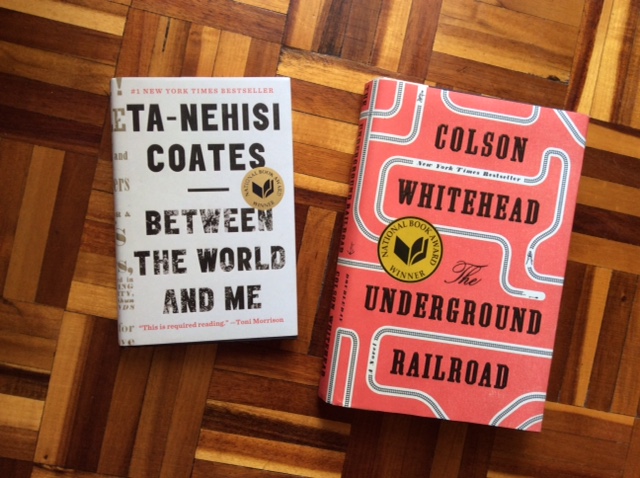
I fell into a reading rut in 2017. I would read a book I saw reviewed in the New York Times, or buy a new book by a favorite author. That was about it. It’s not that the books I read weren’t good. Some of them were even great. I expect that people a hundred years from now will still be reading The Underground Railroad and Between the World and Me. I only disliked one book—and I’m not going to say what it was.

Photograph of Between the World and Me by Ta-Nehisi Coates and The Underground Railroad by Colson Whitehead.

Future classics

I checked off eight of the twelve categories in Modern Mrs. Darcy’s Reading for Growth challenge, including ten books by #ownvoices or #diversebooks authors, five immigrant stories, and six books in translation (plus one in French). I didn’t particularly care about most of the other categories: a Newbery Award honoree, a book over 600 pages, or three books by the same author.

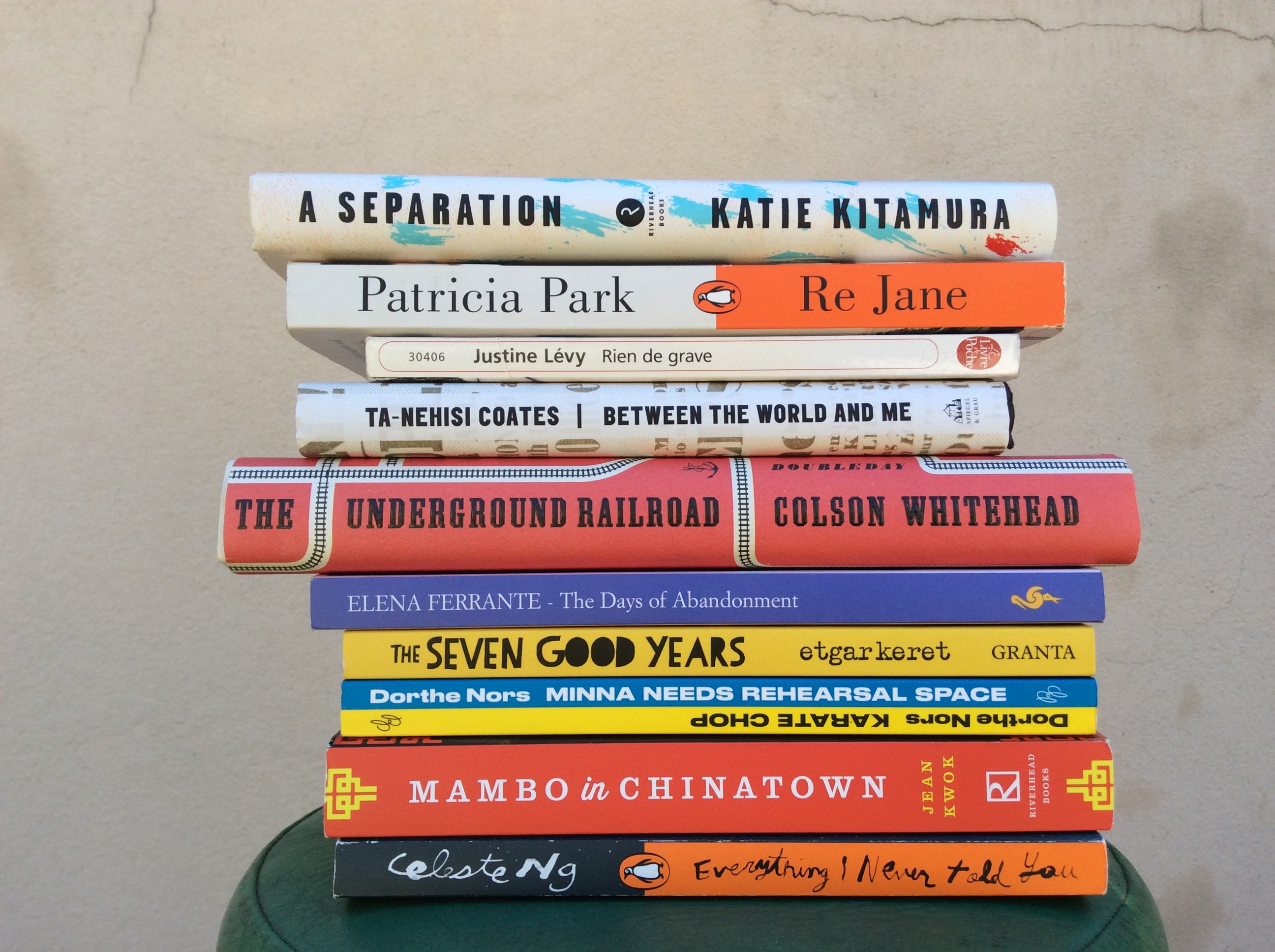
Pile of books with Katie Kitamura's A Separation on top.

Some of my reading challenge reads

But the other category I missed…there’s where the trouble lies. I didn’t read any books published before I was born. And it’s not like I narrowly missed this goal. The oldest book I read in 2017 was Justine Lévy’s Rien de Grave, which was published in 2004. That’s right, I managed to read forty books last year without reading anything published before the millennium. The books I read in 2017 were published, on average, in 2015.

I wasn’t always that kind of reader. In 1987, the books I read were published an average of 21 years before. Henry James’s Washington Square is on that list, along with books by Philip Roth and Edith Wharton. I discovered Laurie Colwin, still one of my favorite writers, and read five of her books. I read a book on Elizabethan thought published in the 1940s and a bunch of classic mysteries. There’s junk on the list, too; Judith Krantz features prominently. But, unlike my 2017 self, I was open to anything. (Well, except when it comes to diversity. All of the books I read in 1987 were by white authors except The Golden Gate by Vikram Seth, which features mostly white characters. I can blame this only partly on a less diverse publishing market.)

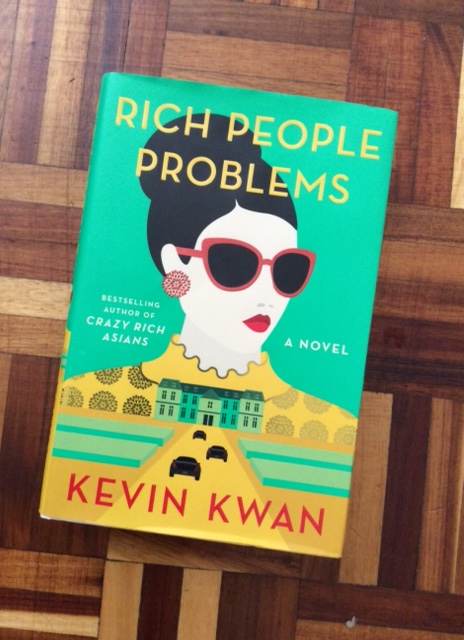
Well, My Year in 1918 will solve this problem. But it won’t be easy to give up contemporary books for a year. I enjoy a challenging read, but when I want to relax I default to my comfort zone, well-written novels by writers like Elinor Lipman, Meg Wolitzer, Curtis Sittenfeld, and Marisa de los Santos. Except for Lipman, they all have books coming out this year. I was having a great time reading Kevin Kwan’s Rich People Problems, but I was only halfway through on December 31, so I’ll have to wait until next January to find out who inherits Tyersall Park. I’ll have to wait for Dinner at the Center of the Earth by my wonderful NYU professor, Nathan Englander. I got Christmas presents that will have to wait for another Christmas to roll around. The current affairs books in my to-read pile won’t be so current next January.

Photograph of Rich People Problems by Kevin Kwan.

So good-bye, crazy rich Asians and befuddled New Yorkers, painfully innocent college students and hyper-observant Londoners! Farewell, innovative economists and eccentric Japanese tidiers! See you in 2019.