
Category Archives: My Life in 1918

Crop of photo of Virginia Woolf

Virginia Woolf, Jacob’s Room, and Literary Beefs

I realize that it’s unreasonable to sign up for the annual meeting of the International T.S. Eliot Society, followed immediately by the T.S. Eliot International Summer School, and complain that people talk about T.S. Eliot too much. I became a member of the T.S. Eliot community in a roundabout way, though, my lifelong but low-key interest in his poetry having being reinvigorated when I encountered his early poems and criticism in “real time” during my year of reading as if I were living in 1918. The society’s annual meetings were online during COVID, which seemed like a low-investment way to dip my toe into Eliot studies. Next thing I knew, I was attending the 2022 summer school in London, followed by in-person conferences in Cambridge, Massachusetts, and St. Louis, Missouri. In real life, I’m way more interested in Eliot than anyone else I know (as my loved ones occasionally gently remind me), but the Eliot community is, to put it mildly, not real life. Sometimes, a few days into a conference, I walk into a room, hear it buzzing with, “T.S. Eliot, T.S. Eliot, T.S. Eliot,” and think that there must be more to life.*

T.S. Eliot and Virginia Woolf (Lady Ottoline Morrell, 1924), National Portrait Gallery

I was excited, then, to see that among the the seminars on offer at this year’s summer school, which is taking place this week at Merton College, Oxford, was one on Eliot and Virginia Woolf. As an added bonus, it was taught by one of the most interesting and fun young Eliot scholars (a surprisingly competitive category). I’ve always had a vague interest in Woolf. I read To the Lighthouse for AP English in high school, read her first novel, The Voyage Out, as part of this project, read her essay “Mr. Bennett and Mrs. Brown” twice in recent years for reasons I can’t remember, and read her long feminist essay “A Room of One’s Own” somewhere along the way. (Recently I realized, aghast, that I have never actually read Mrs. Dalloway.) I wanted to read more of Woolf’s work, but I needed a kick in the pants, which I got with this seminar: the main texts were Eliot’s The Waste Land and Woolf’s Jacob’s Room, both published in 1922.
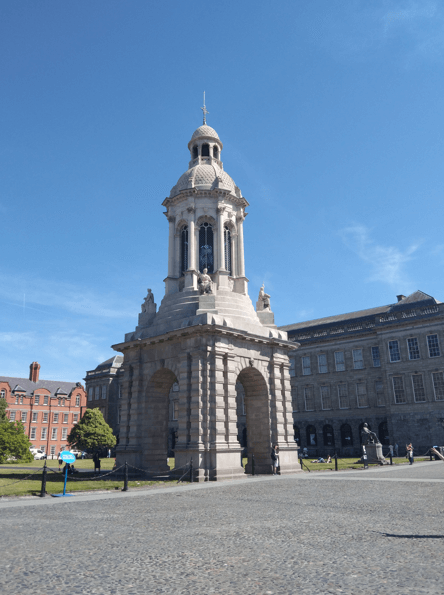
Trinity College, Dublin

Fate had other ideas, though. The morning after I arrived in Dublin, a few days early for the annual meeting at Trinity College, I woke up with a fever and tested positive for COVID. This entailed five days of isolation in my dorm room, followed by a period of mask-wearing and avoiding people, putting the kibosh on both the conference and summer school. I cancelled my travel to the UK and stayed on in Dublin **
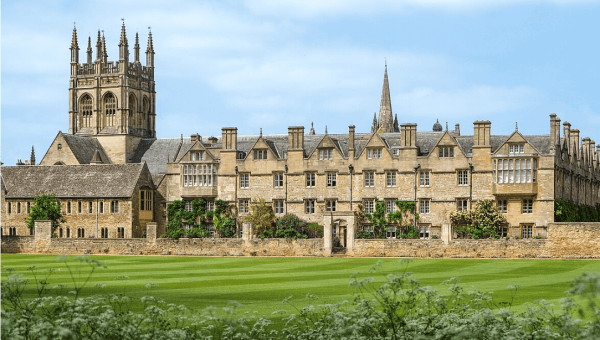
Merton College, Oxford, sigh (Jonas Magnus Lystad, Wikimedia Commons)

For the Woolf-Eliot seminar, we had been assigned a final project that could be anything. Since mine was this, and I didn’t exactly have an action-packed schedule in Dublin, I figured I’d go ahead and do it anyway.

I decided to skip Eliot for this project*** and focus on Jacob’s Room, Woolf’s third novel—specifically, on the reviews that it received following its publication in 1922 in the UK and 1923 in the United States.
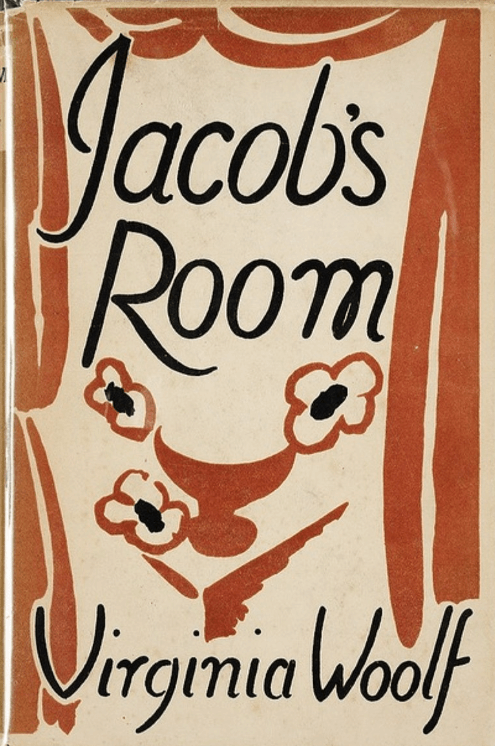
Vanessa Bell

Jacob’s Room is generally considered Woolf’s first fully experimental novel. It’s the story of Jacob, a young man from an upper-class but down-on-its-luck family who’s intellectual but not, from what I gather, all that smart. He basically thinks everything after Shakespeare is trash. Also, he’s rude to waiters. Everyone is fascinated by him, though, which led me to assume that he’s extremely good-looking. His fan base includes (naturally) his mom, a widow living in the seaside town of Scarborough; Clare, an upper-class woman who seems like appropriate wife material (her thoughts about him are along these lines: “Jacob! Jacob!”), Bonamy, a Cambridge classmate who’s in love with him (he also thinks, “Jacob! Jacob!” a lot), and several women who skirt the line between girlfriend and sex worker.

We mostly see Jacob through the eyes of these people and others. The reviews state that there’s little from Jacob’s point of view, but that’s not quite true: we see his thoughts, for example, on a sailing trip off Cornwall and on a solo tour of Italy and Greece where he experiences a (to this current solo traveler very relatable) mix of elation and existential angst.

Nothing much happens. Jacob finds a sheep’s jaw in Scarborough as a boy. He goes to Cambridge. He moves to London, works at a vaguely described office job, hangs out with his friends and in society, writes intellectual essays that don’t get published, and travels. In the last two pages, we learn obliquely that he has died in the war.

In between all this, there is a lot of description of whatever happens to be going on around Jacob—London traffic, the musings of random people, and the play of light on water. To give you a sense of it, I picked a random passage, which comes after Woolf informs us that little paper flowers in finger bowls are all the rage:

It must not be thought, though, that they ousted the flowers of nature. Roses, lilies, carnations in particular, looked over the rims of vases and surveyed the bright lives and swift dooms of their artificial relations. Mr Stuart Ormond made this very observation; and charming it was thought; and Kitty Kraster married him on the strength of it six months later. But real flowers can never be dispensed with. If they could, human life would be a different affair altogether. For flowers fade; chrysanthemums are the worst; perfect over night; yellow and jaded the next morning—not fit to be seen.

Trinity College, Dublin

This is a perfect example of what Woolf’s doing here. In the middle of all the flower description, she throws in what could be a whole novel itself about two people who we never hear about again. (And who, by the way, typify one of my pet peeves about people in novels—and, presumably, real life—from 100 years ago: their hasty and uninformed choices of marriage partners.)

But imagine 182 solid pages of this. That high a concentration of brilliance can get exhausting, and it’s possible, as you read, to simultaneously think “Virginia Woolf is a genius” and “if I have to read one more page, I’m going to die.”
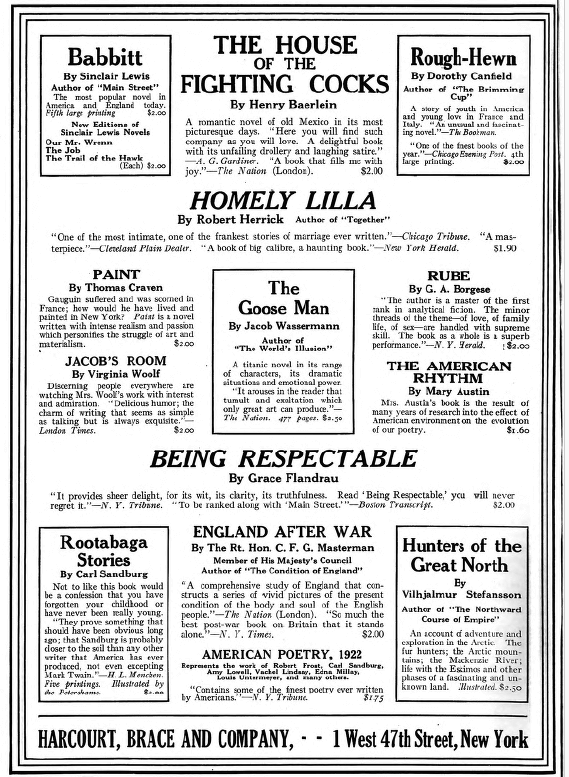
International Book Review, Literary Digest, February 1923

I was curious about what reviewers 100 years ago made of all this. Jacob’s Room was reviewed widely considering its small print run (1,200 copies from the Hogarth Press, which Woolf and her husband owned, followed by a second impression of about 2,000 copies, and, in the United States, 1,500 copies from Harcourt Brace). The 1923 edition of Book Review Digest includes excerpts from reviews of Jacob’s Room in a number of American publications, including The Boston Transcript, The New York World, The New York Times, The Springfield (Massachusetts) Review,**** Booklist, The Dial, Freeman, The Independent, and The International Book Review, a Literary Digest supplement. It also lists UK reviews, mostly from 1922, in The Spectator, The Saturday Review, The Times Literary Supplement, and The New Statesman.

I expected to sit on my born-into-a-world-where-modernism-already-existed perch and scoff at the reviews, which I assumed would be along the lines of the article in the first issue of Time magazine speculating that The Waste Land was a hoax. On the whole, though, they were quite positive, especially the ones in American publications.
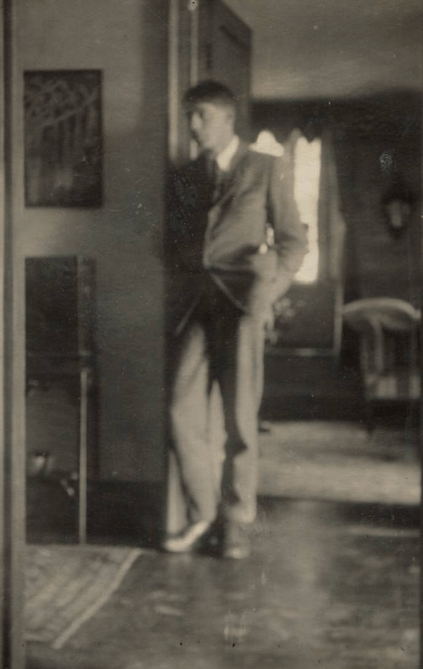
David Garnett (Lady Ottoline Morrell, 1920)

In the case of the first review I read, in the modernist journal The Dial, this was not much of a surprise, since the reviewer, David Garnett,***** was a fellow member of the Bloomsbury Group. “Virginia Woolf seems to be the most interesting of the younger writers now living as well as the best of them,” he writes about his friend. He compares Jacob’s Room favorably with James Joyce’s Ulysses, also published in 1922, saying that “it is the things from which mankind instinctively turns away that Mr Joyce delights to write about” while Woolf is “the kind of butterfly that stoops only at the flowers.” He does have one critique: “The book would be better if not quite so many pictures were called up; with all its beauty it is a little bit too much like fire, or like a very amusing person’s memory of life.”
New York Times, March 4, 1923

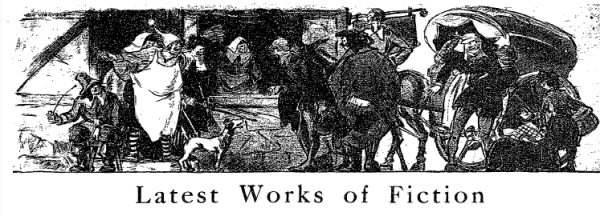
The New York Times included Jacob’s Room in a March 4, 1923, fiction roundup. The anonymous reviewer writes that, though the book is composed of mostly minor events, “it is the manner in which these things are revealed that makes the book of importance, at least as an example of what the younger rebels are doing in England.” The review says of the book’s style that “at first one is uneasily aware of Miss Woolf’s bizarre qualities as a writer of prose, but after one has progressed a way in the book this consciousness rather vanishes.” It wraps up by placing Woolf among a cohort of talented British women writers, none of whom, aside from May Sinclair, I have ever heard of,****** saying, “Her influence is one that modern England needs.”

Some more praise from across the Atlantic:

M.M. Colum in The Freeman: Woolf “shows herself to be possessed of one of the most entertaining minds among contemporary writers—witty, subtle, and ironic.”

H.W. Boynton in The Independent: Woolf’s “air of ironic detachment does not conceal a very warm concern in human affairs. Jacob’s Room, her new study of youth, is full of tenderness, though empty of the facile sentiment often confounded with tenderness.”

Mary Graham Bonner in the Literary Digest International Book Review: “A strangely beautiful book is Jacob’s Room, and the author, Virginia Woolf, has given us many a flash of genius here.”

This was an improvement over the reviews Jacob’s Room had received back home. Rebecca West wrote in the November 22, 1922, issue of the New Statesman that “Mrs. Woolf has once again provided us with a demonstration that she is at once a negligible novelist and a supremely important writer.” Gerald Gould wrote in the November 11, 1922, issue of the Saturday Review that “Mrs. Woolf has written something wholly interesting and partly beautiful. It is at once irritating and encouraging to reflect how much better she would do if her art were less self-conscious.”

Arnold Bennett, ca. 1920 (Pirie MacDonald)

Then there’s novelist Arnold Bennett, whose feud with Woolf had the rancor and longevity of a rap beef. First, in the essay “Modern Fiction,” which was published in the Times Literary Supplement on April 10, 1919, Woolf wrote about Bennett, H.G. Wells,******* and John Galsworthy that “it is because they are concerned not with the spirit but with the body that they have disappointed us, and left us with the feeling that the sooner English fiction turns its back upon them, as politely as may be, and marches, if only into the desert, the better for its soul.” Of the three writers, she writes, “Mr. Bennett is perhaps the worst culprit of the three.” She asks about his characters, “How do they live, and what do they live for?”
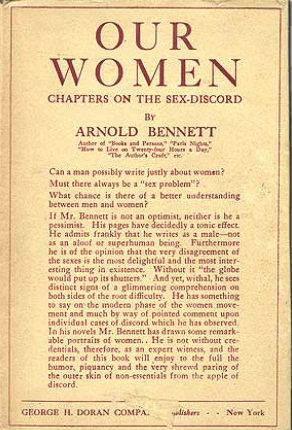
Then Bennett wrote a book called Our Women: Chapters on the Sex-Discord. The title alone is enough to tell you where this is going, but here’s a passage from the chapter on women writers:

The literature of the world can show at least fifty male poets greater than any woman poet. Indeed, the women poets who have reached even second rank are exceedingly few – perhaps not more than half a dozen. With the possible exception of Emily Bronte no woman novelist has yet produced a novel to equal the great novels of men. (One may be enthusiastic for Jane Austen without putting Pride and Prejudice in the same category with Anna Karenina or The Woodlanders.)********

Woolf, according to the introduction in the Oxford World’s Classics edition of Jacob’s Room, wrote “spirited letters to the New Statesman” in response to this while on a break from writing Jacob’s Room. Then she went a step further and put Bennett in the novel: “For example, there is Mr [John] Masefield, there is Mr Bennett. Stuff them into the flame of Marlow and burn them to cinders. Let not a shred remain. Don’t palter with the second rate. Detest your own age. Build a better one.”

Granted, Jacob, whose consciousness this is streaming through, is being a twit here, but if you’re Arnold Bennet you might not appreciate this fine point, given the whole “burn them to cinders” thing.

Bennett’s next step: An essay in the March 28, 1923, issue of Cassell’s Weekly called “Is the Novel Decaying? The Work of the Young,” in which he says,

I have seldom read a cleverer book than Virginia Woolf’s ‘Jacob’s Room,’ a novel which has made a great stir in a small world. It is packed and bursting with originality, and it is exquisitely written. But the characters do not vitally survive in the mind because the author has been obsessed by details of originality and cleverness.
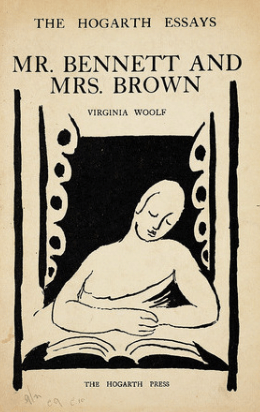
Cover of Mr. Bennett and Mrs. Brown, illustration of woman reading
Vanessa Bell

Woolf’s response to this was the aforementioned “Mr. Bennett and Mrs. Brown.” It was first published in the Nation and Atheneum, a British weekly, on December 1, 1923, then in expanded form under the title “Character and Fiction” in the July 1924 issue of The Criterion in response to a request for an article by (full circle!) editor T.S. Eliot, then as a stand-alone publication by the Hogarth Press.

I’m not going to try to do justice to “Mr. Bennett and Mrs. Brown” here. It’s one of the greatest literary essays of all time, a clarion call for modernism. It’s also one of the all-time great literary put-downs. If this is a rap beef, then Bennett is Drake, Woolf is Kendrick Lamar, and “Mr. Bennett and Mrs. Brown” is “Not Like Us.” Except that in a hundred years people will remember Drake, and, if people remember Arnold Bennett today, it’s probably because of “Mr. Bennett and Mrs. Brown.”

We could leave things here, with Woolf triumphant.

Except…

Except that Woolf, while a brilliant writer and a defining figure in feminism (with the even more famous essay “A Room of One’s Own” to come in 1929), was also a snob and a horrible racist.

Cover of Theory & Practice by Michelle de Kretser, photo of De Kretser as a young woman on red background

How should we think about this when we’re assessing Woolf’s work? Luckily, I don’t have to answer this question. Instead, I can point you to a wonderful novel about this very issue: Theory & Practice, by the Australian writer Michelle de Kretser. I bought it during a recent trip to Sydney, but it’s available worldwide and was reviewed in the New York Times in February. De Kretser’s heroine is a Sri Lanka-born graduate student in Melbourne in the 1980s, studying Woolf’s diaries as critical theory is taking over English departments at her university and elsewhere. (She’s referred to once late in the novel as Cindy, but I thought of her as “Michelle de Kretser,” which I don’t think is too unfair seeing as that’s a photo of De Kretser as a young woman on the cover of the Australian edition.) Then she comes across Woolf’s racist description of a key figure in Sri Lanka’s struggle against colonialism, but none of the theorists she’s surrounded by think this is important. The novel’s about loving Woolf, and about responding to the flaws of your literary heroes, but it’s also about being young, and going to parties in ramshackle group houses, and the stupid choices you make about love when you’re in your twenties. If that sounds like your thing (and I can’t think of anything that’s more my thing than all this), you should read it.

Jacob’s Room is brilliant, too, and, if I didn’t devour it the way I did Theory & Practice, I’m grateful to have been spurred to read it.

Now I need to get someone to make me read Mrs. Dalloway.

*Obviously, I AM very interested in T.S. Eliot or I wouldn’t do this to myself. But it’s like when I was a full-time Lao language student for ten months at the Foreign Service Institute. FSI is like a high school full of overaged students who are studying just one subject, with schedules along these lines: First period, Lao conversation. Second period, Lao grammar. Third period, Lao reading. Lunch. Fourth period, Lao grammar again. Fifth period, Lao reading again. On Wednesday afternoons they’d spring us for area studies, where we’d study Laos, along with Thailand and Burma. I loved it, but I’d often think, “Can’t we study something else for a change, like Japanese, or the parts of a cell?”

**Having, and recovering from, COVID in Dublin has been way more fun than you’d imagine. I Zoomed in to a seminar on Eliot and translation during the annual meeting, and it was awesome. After a few days of isolation I got the OK from a telehealth doctor to walk outside with a mask. There was a concert series going on that I could hear pretty clearly from my room. One night, the band started singing, “hip hip,” and I thought, oh, they’re covering that Weezer song, and I looked up the program and it ACTUALLY WAS Weezer.

***I haven’t been completely neglecting Eliot. I did my translation seminar paper on a 1992 translation of The Waste Land into Afrikaans.

****The inclusion of The Springfield Republican in the small selection of newspapers The Book Review Digest compiles review from is one of those 100-years-ago mysteries.

*****Garnett is the author of the 1922 novel Lady Into Fox, which I read for my 1920s bestseller book group, and which actually is about a lady who turns into a fox.
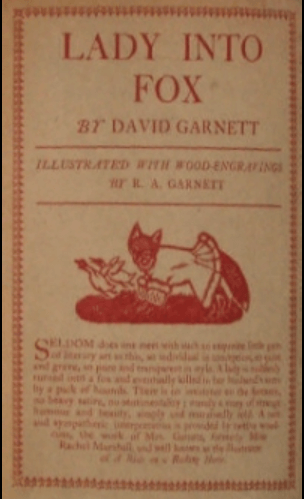
Cover, Lady into Fox by David Garnett. Woodcut of a fox.

******Here they are: Sheila Kaye-Smith, Mary Butts, Ethel Colburne Mayne, F. Tennyson Jesse (which sounds like the name on a fake Facebook friend request and turns out to be a pseudonym), and Elinor Mordaunt.

*******Further ramping up the interpersonal drama, West had a son with H.G. Wells. As I noted in my post on West’s novel The Return of the Soldier, they made some highly debatable child-rearing decisions, including telling him for years that they were his aunt and uncle.

********As fellow blogger Stuck in a Book wrote,  “Who on earth would pick The Woodlanders as their ammunition in favour of Thomas Hardy??”

The Top Posts of 1923

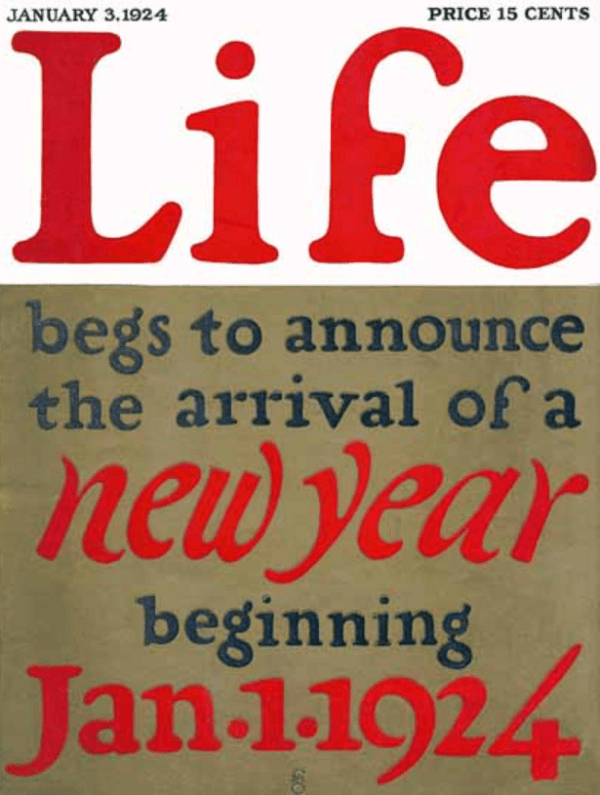
Happy 2024, everyone!

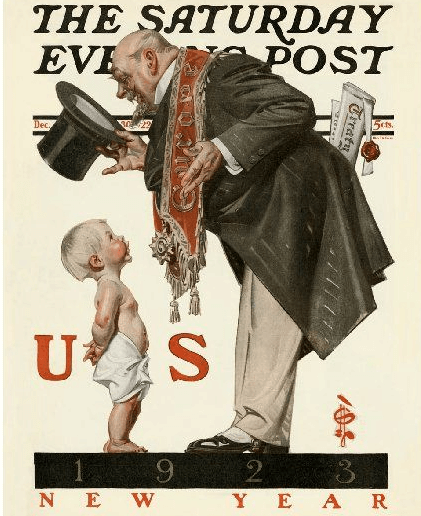
I don’t know if there’s some symbolism behind this year’s J.C. Leyendecker New Year’s baby that I’m missing, or if it’s just a baby knight riding a mechanical horse and using a feather as a lance. Any insights would be welcomed.

Elsewhere, Life waxes whimsical,

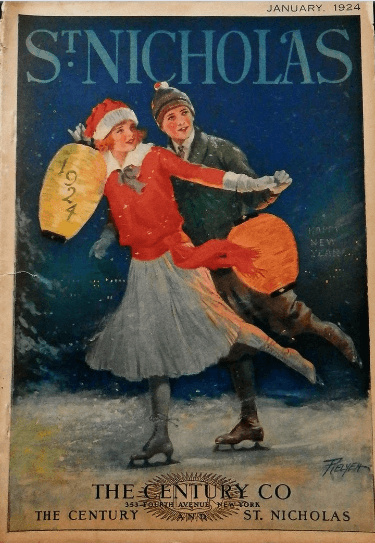
a skating duo rings in the new year at St. Nicholas,*

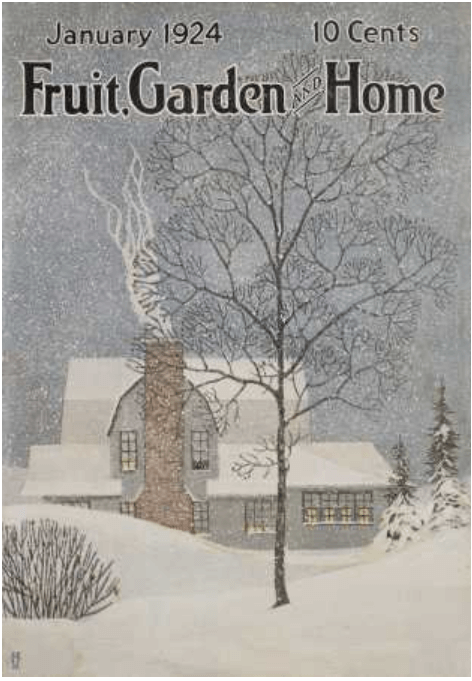
Fruit, Garden and Home (soon to be retitled, much more sensibly, Better Homes and Gardens) has a snowy scene,

and Motor magazine features the most scantily dressed Coles Phillips woman I’ve ever seen.

The Top Posts

As was the case last year, I didn’t have enough posts to fill out a top 10 list, but I did slightly better (8) than last year (7). Something must be going on with the Google algorithm, because 1) despite my lackadaisical posting schedule, my total views have shot up to unprecedented levels in recent months, and 2) almost all of the most popular posts, other than the home page (which makes up the vast majority of views), are from previous years. Pre-2023 posts don’t qualify for the Top 10, but I’ll mention the most popular ones after the countdown.

8. 1923 Magazine Covers Celebrate Thanksgiving.

For Thanksgiving, I always write about something I’m thankful for. In the past, I’ve chosen people I admire from 1918, illustrators of 1919, women illustrators of 1920, and, for 2021, the friends I’ve made along the way.** This year I chose the magazine covers themselves.

7. Children’s Books: Your 1923 Holiday Shopping Guide.

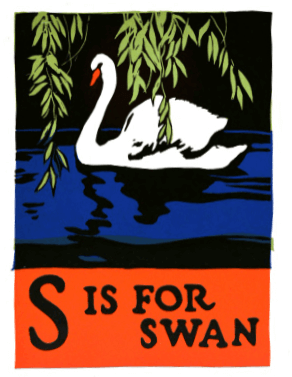
In researching my fifth annual children’s book shopping guide, I found a moral panic among magazine writers about children reading inappropriate books (Dare-Devil Dick! Seven Buckets of Blood!) and a couple of treasures: a beautifully illustrated alphabet book and an excellent poetry anthology.

6. A New Project!

In May, I announced that my friend Deborah Kalb and I were starting a podcast, Rereading Our Childhood, where, just like it sounds, we reread books we enjoyed as children. Six months in, we’ve published sixteen episodes, had a great time with our rereads, and, as I wrote this week in the top 10 countdown on the podcast blog, learned that producing a podcast is way harder than writing a blog. If you’re interested in following along, you can find us at rereadingourchildhood.buzzsprout.com.

5. Summer 1923 Magazine Covers, in All Their Glory.

Having left a cold, wet Cape Town winter, I reveled in the D.C. summer, and in the summer magazine covers of 1923.

4. The Top, Um, Seven Posts of 1922.

Last year’s countdown.

3. My Visit to 1920s–and 2020s–San Francisco.

I haplessly wandered around 2020s San Francisco in search of 1920s San Francisco.

2. The Top 10 Magazine Covers of Winter 1923.

I had a lot of fun doing this countdown of the best magazine covers of winter 1923, and discovering some not-so-artistic but still fascinating ones.***

1. Claude McKay’s Harlem Shadows, “If We Must Die,” and Congressional Confusion.

This post was by far the most popular new one of the year. I wrote about the critical reception to McKay’s poetry and about the confusion over whether “If We Must Die” was entered into the Congressional Record, and if so, by whom. This was the second year in a row, after last year’s post on Langston Hughes, Teenaged Poet, that a post about an African American poet rose to the top.

The Top Posts from Past Years

The most popular pre-1923 post of the year (and also the most popular post of the year, period) is The Surprisingly Ubiquitous Lesbians of 1918: A Pride Month Salute, in which I wrote about the lesbian relationships that were hiding in plain sight all over the place, apparently because people didn’t take women’s sexuality seriously. Perennial favorite My Quest to Earn a 1919 Girl Scout Badge is in second place, followed by Magazine Covers Ring in the 1920s and The Doctor and the Chorus Girl: A Heartbreaking Tale of Interracial Love.

The Journey Continues

On January 1, 2018, the day that I started this project and stopped reading anything from less than 100 years ago, I only expected it to last a year.**** (When I looked at my e-mail inbox this morning and found blog posts from Frank Hudson (talking about how Robert Frost is misunderstood) and witness2fashion (sharing some 1898 Delineator illustrations of women riding bicycles in very cumbersome clothing), I was reminded on the seventh New Year’s Day of this project of the wonderful community I’ve found along the way. I look forward to what 1924 will bring.*****

squiggle

*Speaking of which, I went ice skating in Cape Town a few days ago. If you’re a skater of average ability and want to feel like Michelle Kwan, go to a skating rink in South Africa.

**I skipped 2022, apparently.

***I still love the giant pencil.

****For any new readers who may be concerned about my sanity and my status as a well-informed citizen, the part of the project where I ONLY (with a few exceptions) read from 100 years ago did only last a year.

*****A housekeeping issue: For those of you who follow me on Twitter, I’ve stopped posting there. You can find me on BlueSky at @marygracemcgeehan.bsky.social.

My Visit to 1920s–and 2020s–San Francisco

The podcast on children’s books that I’ve been cohosting since May has been taking up all of my social media energy, but I’ve finally gotten sufficiently on top of it to return to the world of 100 years ago and revisit San Francisco, where I spent a few days in July.

Like everyone else, I’d heard the horror stories about what’s happened to the city, which I had last visited in 2004. Since my trip, I’ve seen some articles along the lines of “it’s not really as awful as they say,” or at least “it’s more complicated,” but at the time my expectations were along the lines of “urban hellscape.”*

So, as I strolled with my husband around neighborhoods like Nob Hill, North Beach, and Chinatown, I was pleasantly surprised to see a totally normal city. Not a utopia, but the same mix of commerce, bustle, and urban problems that I’m used to in Washington, D.C. If tourists were staying away in droves, no one had told the throngs of people at Fisherman’s Wharf or on the twisty-turny street.

After a week in Sacramento, with its downtown full of empty storefronts and sidewalks empty of people aside from the homeless, San Francisco seemed positively vibrant.**

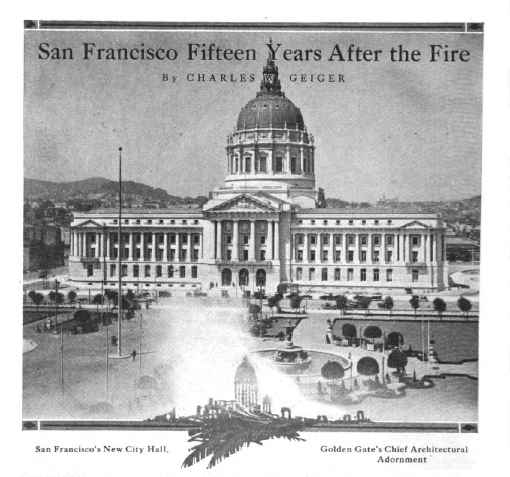
On the bus from Sacramento to San Francisco, I had prepared for my visit by doing some reading from 100-year-old magazines. In an article in the January 1922 issue of Illustrated World called “San Francisco Fifteen Years After the Fire,” Charles Geiger recounted the city’s impressive recovery following the 1906 earthquake and subsequent fires that destroyed much of the city. “When one gazes about and observes the new and beautiful city of San Francisco, which fifteen years ago was a barren desolate waste following the catastrophe which befell it,” Geiger wrote, “he is filled with admiration for the bravery and the daring of the people of this great western city who at a cost of half a million dollars have made a remarkable record of achievement.”

Illustrated World, January 1922

The most notable of these achievements, Geiger says, is the reconstruction of the Civic Center, which includes the City Hall, the city’s “chief architectural adornment,” the Exposition Auditorium, and the Public Library.

Illustrated World, January 1922

I couldn’t wait to check out this marvel of civic rebirth. My husband agreed to come along. I would have felt more comfortable with a Lonely Planet guidebook, with maps orienting you by neighborhood and text warning you of dangers. Bookstores in San Francisco turned out to be surprisingly few and far between, though. I did go to the legendary City Lights Bookstore in North Beach, but when I asked the young man at the checkout if they had guidebooks he looked at me like I’d asked for the Colleen Hoover fanfiction section. Guidebooks for where, he asked.

“San Francisco,” I confessed, unmasked as a tourist.***

“There might be some over there,” he said, pointing to a nearby shelf. And there were a few, but they were all along the lines of A Guide to San Francisco’s Ghosts. I didn’t want a visitation from the dead! I just wanted to go to City Hall!

So, on a Saturday morning, I put City Hall into Google Maps and got a route that went through Union Square and along Market Street. That sounded okay. Market Street was famous, right? Plus, I’d read on a blog post that one of the best bookstores in San Francisco was in the area.

Union Square was buzzing. Tourists and locals were enjoying the beautiful weather and pouring in and out of stores and restaurants. We continued along Market Street.

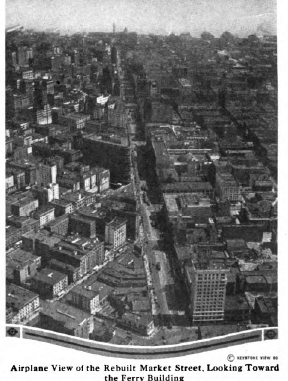
It didn’t take more than a block or two for us to see that something was very, very wrong. Since it was a weekend, I wouldn’t have expected a lot of foot traffic in this downtown area, but it didn’t seem like anyone came here, ever, other than the people standing around on the sidewalks, seemingly on drugs. We didn’t feel threatened, exactly. We just felt uneasy, like we had entered some postapocalyptic landscape. I don’t have any pictures. It wasn’t a place where you wanted to stand around messing with your phone, and, in any case, how do you photograph nothing? Suffice it to say that the wasteland of empty glass buildings didn’t at all resemble this photo of the area in Illustrated World.

Illustrated World, January 1922

Fortunately, it didn’t take long to get to the Civic Center area, which, while not exactly bustling, at least showed signs of life. Kids played at a playground in the square, and I wasn’t the only tourist snapping photos of City Hall.

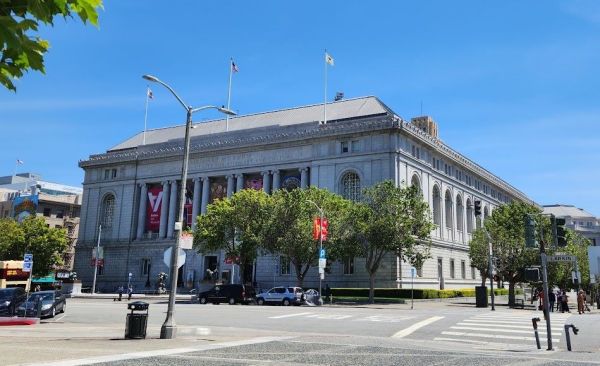
The buildings Geiger had marveled over resembled their 1922 selves, although the new public library he wrote about is now the Asian Art Museum.

The current library, which opened in 1996, is nearby, and we paid a visit. It was a pleasant space, though fairly empty on this sunny Saturday.

The bookstore, disappointingly, turned out to be a corner of the library where used books were for sale. No Lonely Planets here. I was ready to get out of Civic Center. Let’s go to Haigh-Ashbury, I said to my husband, and put the address of a highly recommended bookstore in that neighborhood into the Uber app.

When we got to the address, though, there was no bookstore to be found. I was starting to take this personally. Luckily, it turned out that the store—The Booksmith—had recently moved a block or so down Haight Street. I spent a happy hour browsing, and added The Booksmith to my list of favorites. And I finally got my Lonely Planet, which belatedly warned me that the Civic Center area is “best avoided without a mapped route to a specific destination.”

The rest of the trip was more reminiscent of 1960s than 1920s San Francisco. We chatted with tie-dye-dressed servers at a Haight-Ashbury creperie, who told us about the throngs the previous week, when the Dead had been in town, watched drummers drumming on Hippie Hill in Golden Gate Park,

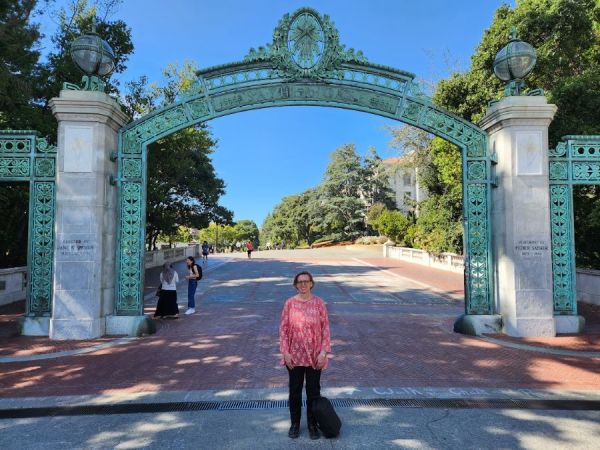
and visited Berkeley, a first for me.

I took in some sensational views, praise that we Cape Town residents do not dish out lightly.****

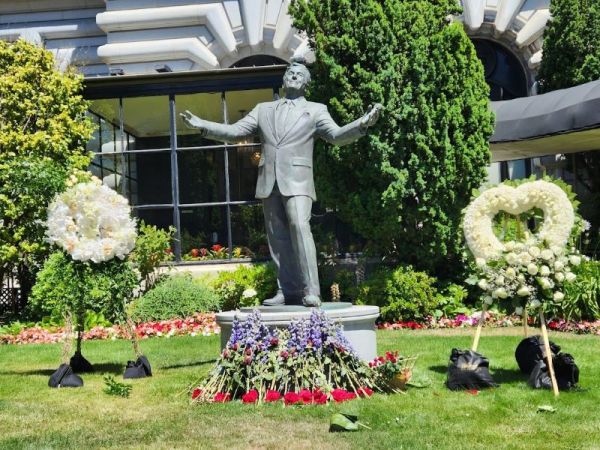
Outside the Fairmont Hotel on Nob Hill, there’s a statue of Tony Bennett, who first sang “I Left My Heart in San Francisco” there in 1961. He had died a few days before we arrived, and I stopped by twice to look at the floral tributes. Both times I saw a young hotel employee—maybe the same one, but I’m not sure—sadly paying his respects.

A few days after we left, I learned that, on August 2, 1923, a hundred years minus a week before our visit, Warren Harding had died at San Francisco’s Palace Hotel. The hotel, built in 1909 after the 1875 original burned in the fire, is still there. It’s on Market Street, in a less desolate area than where we walked. If I’d been more up on my history, I could have paid a visit.

Palace Hotel ballroom, 1920, promotional material (via Wikipedia Commons)

Oh, well. If I was going to memorialize someone, I’d pick Tony Bennett over Warren Harding any day.

As for San Francisco’s future, it would be tempting to loop back to Geiger’s glowing account of the city’s rebirth and say, “If they could rebuild then, they can rebuild now.” A closer look at the reconstruction, though, reveals that, while impressively rapid, it was marred by corruption, violence against alleged looters, and an attempt by city leaders to move residents of Chinatown, which had been destroyed by the fire, to mud flats on the outskirts of the city.

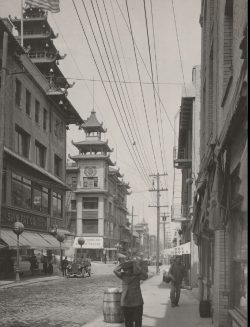
I did find one source of inspiration: the Chinese community, along with Chinese government representatives, successfully fought the relocation plan. Chinatown was rebuilt, with the new buildings featuring architectural flourishes like pagodas and dragons that still define the neighborhood today. It was a local businessman named Look Tin Eli who had the idea for the design of the new buildings, but some critics have called them a fantasy of China by western architects aimed at turning the neighborhood into a tourist attraction. Still, the community activism, business acumen, and resilience that led to Chinatown’s rebirth is a story I’m glad to have learned about.

Dupont Street, now Grant Avenue, San Francisco, ca. 1910 (Bancroft Library, University of California, Berkeley)
squiggle

*Heads up that these articles are from the New York Times and New Yorker, respectively. Both publications have a monthly quota of free articles for non-subscribers. I’m a Times subscriber, but it always irritates me when I unknowingly click on a link to a New Yorker article and belatedly realize that I’ve used up one of my six articles.

**Of course, Sacramento might have been more vibrant if the state legislature had been in session and/or temperatures hadn’t been hovering around 100. Also, a shout-out to the wonderful downtown bookstore Capital Books.

***Except who really cares? I’ve never understood why you’re supposed to be embarrassed about being a tourist, assuming you’re acting like a normal person and not an ugly-American stereotype, in which case you probably wouldn’t be embarrassed anyway. Is everyone just supposed to stay in the place they come from all the time to avoid this shameful label?

****If you’re new to this blog and thinking, “But you just said you live in Washington, D.C.,” I spend part of the year in each city.

squiggle

New on the podcast, Rereading Our Childhood:

Rereading The Owl Service by Alan Garner

Rereading The Great Brain by John D. Fitzgerald

Rereading A Wrinkle in Time by Madeleine L’Engle

Reading Little Witch and The Little Leftover Witch

Rereading Freaky Friday by Mary Rodgers

My Quest to Earn a 1920 Girl Scout Badge: Pathfinder, Part 1

It’s been almost three years since I set out to earn badges from the 1916 Girl Scout handbook, How Girls Can Help Their Country.* In the meantime, a 1920 edition has been published. Renamed Scouting for Girls, it’s full of new badges, as well as revamped old ones with new, generally more realistic requirements.

I’m on it! But I’m scaling back from my insanely ambitious effort last time, when I tackled all 36 badges over the course of just two posts. That was a bit much, what with all the knot tying and flower drawing and ironing and recorder playing. My poor husband! Plus, at that torrid pace I tended to give up on requirements I could have fulfilled if I’d been willing to devote more time to them, like memorizing the names of all the cabinet secretaries. I decided to take it slower this time, with one badge per post.

For my first badge, I chose Pathfinder, where you learn about your local area. I came fairly close to success last time, but I failed the requirement to know all the public buildings and public schools in my city. There’s a vastly improved set of requirements in the 1920 handbook, plus I’m in a different city—Cape Town, South Africa, then and Washington, D.C., now. (I rotate between the two.) I decided to focus my efforts, where possible, on the neighborhood of Mount Pleasant. It’s not my actual neighborhood, but it was developed in the early years of the 20th century so has a 1920s feel.**

Being a Pathfinder ended up being no simple task. At least, not in the overachiever way I decided to go about it, which included not just knowing about places in my community but photographing them and learning about their history. Where possible, I chose buildings that were at least a hundred years old. The project started to balloon out of control, so I decided to scale my ambition back further and devote this post to one particularly labor-intensive requirement. I’ll be back with additional pathfinding in a future post.

Here’s the requirement:

#4. Know the names and locations of the Post Office, Telegraph and Telephone Stations, Public Library, City or Town Hall, one hospital of good standing, one hotel or inn, three churches, one Protestant, one Catholic, one Synagogue, and the nearest railroad.***

As you see, a lot to unpack here.

Post Office

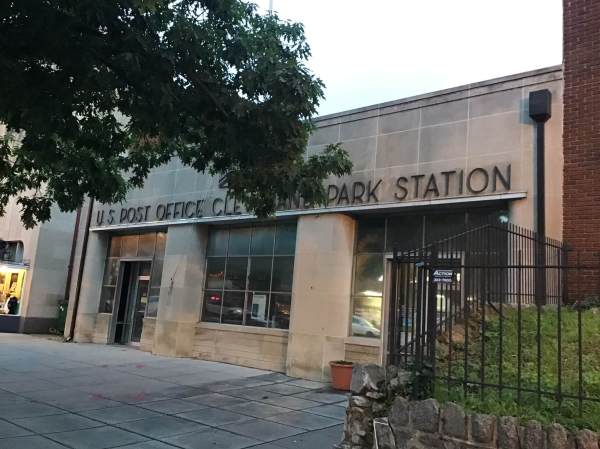
Cleveland Park Post Office

Mount Pleasant doesn’t have its own post office, so I photographed the one in nearby Cleveland Park. The 1941 building was designed by architect Carroll Meigs. When I looked him up, I found (after being sidetracked by the father-son civil engineering duo of Montgomery C. Meigs Sr. and Jr.****) a request to the D.C. government’s historic preservation office by the owners of a Meigs-designed Safeway in the Palisades neighborhood not to have the store designated as historically significant. As part of this effort, the owners dump all over Meigs and the store’s builder, calling its architecture “undistinguished” and saying that “despite the fact that both men had practices based in Washington, DC, neither are considered preeminent in their field.” The review board agreed, saying, “Even if its architect had been recognized as a creative master, this is not a master work or a manifestation of artistry.” The store, which was the oldest Safeway on the East Coast, closed in 2019.*****

Telegraph and Telephone Stations

With technological progress and the breakup of Ma Bell, telegraph and telephone stations have gone by the wayside. A search for nearby cell phone towers proved unexpectedly difficult—the sites I looked at were all difficult to navigate, insecure, or lacking in information. And the reward, a photo of a cell phone tower, didn’t particularly motivate me to persevere.

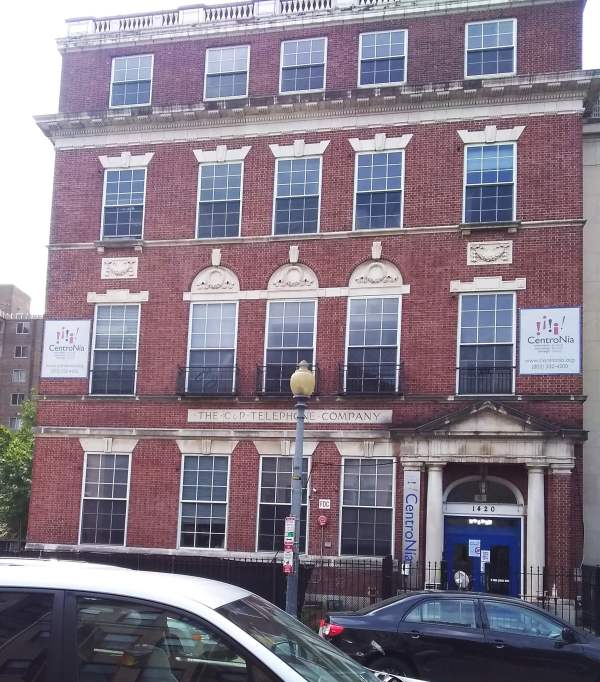
Former C&P Building

However, I did happen upon this old C&P Telephone building in Columbia Heights, a few blocks from Mount Pleasant, which is now a child care center. Apologies for the photo quality—there was a lot of glare on my phone, so I was blindly snapping away.

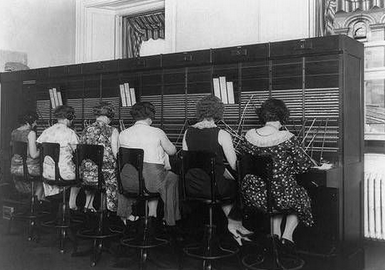
For extra credit, here’s a photo of women working at a C&P telephone exchange, from my post “Are You H.L. Mencken and George Jean Nathan’s Ideal Woman?”

Women at C&P Telephone Exchange, Washington, D.C., ca. 1920, Herbert French.
C&P Telephone Exchange, Washington, D.C., ca. 1920 (Herbert E. French)

Public Library

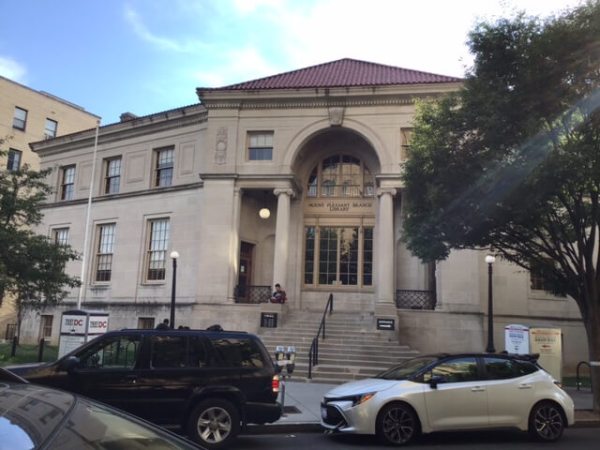
Mount Pleasant Library

The Mount Pleasant Public Library was built in 1925. It’s the third oldest D.C. library still in use and was the last to be built with funding from Andrew Carnegie.

This library, which was renovated and expanded in 2012, has been a constant in my life as I’ve moved in and out of Washington over the decades. I’ve checked out probably hundreds of books there and gone to a few yoga classes. During COVID, the library set up operations outdoors; you’d put a hold on a book, and when it arrived you’d give your name to a librarian sitting at a table outside the entrance and they’d go in and fetch it. That’s what I call service!

I’m nostalgic for the days when the wide set of steps in front actually led to the entrance—access is now through a flight of stairs on the side—but I’m lucky to be able to call this my local public library.******

City or Town Hall

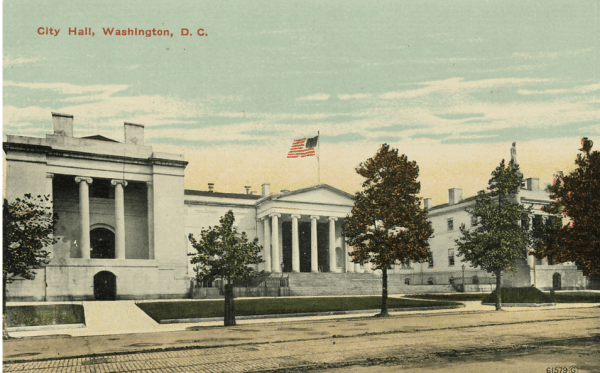
Postcard of District Building (now the John A. Wilson Building), 1914 (eBay)

My ambitious goal to photograph all the sites myself fell by the wayside with D.C.’s center of government, the John A. Wilson Building. It’s kind of far away, down past the White House. So you’ll have to make do with this vintage postcard.

I did learn a lot about the Wilson Building, though, starting with the fact of its existence. I realized when I saw this requirement that I had no idea where the seat of the D.C. government was—a shameful fact given that I have lived here on and off (mostly off) since 1983. This is partly due to D.C.’s neither-fish-nor-fowl administrative status, which makes City Hall less of an institution than it is in other cities. But still, shameful.******* Originally known simply as the District Building, the Wilson Building dates from 1908. It was renamed in 1994 after a former head of the city council.

Postcard of D.C. City Hall (now the D.C. Court of Appeals), early 1900s (streetsofwashington.com)

The original City Hall, built in 1822, now houses the District of Columbia Court of Appeals. I was familiar with this building, since it’s right in front of you when you get off the Metro at Judiciary Square on your way to the Mall.********

I will definitely keep an eye out for the Wilson Building next time I’m in the area.

Hospital of Good Standing

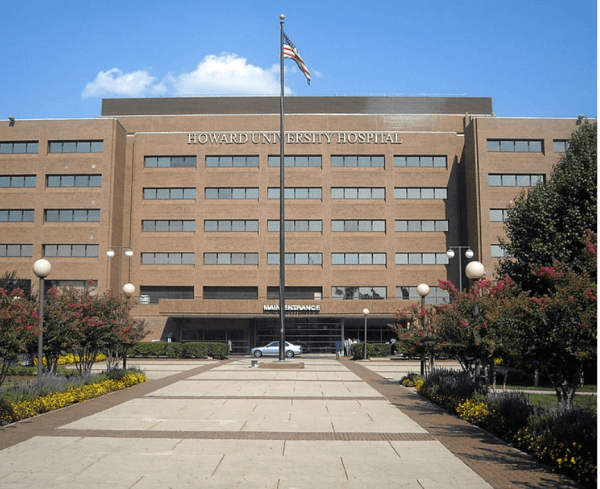
Howard University Hospital, 2008 (AgnosticPreachersKid)

My effort to locate an old-timey hospital in D.C. provide futile. Several of the city’s hospitals are over a hundred years old as institutions, but all of them have relocated to modern buildings.

The closest hospital to Mount Pleasant, according to ushospitalfinder.com, is Howard University Hospital. It’s currently housed in a nondescript modern facility, but it has an interesting history, originating as the Freedman’s Hospital and Asylum in 1862. Beginning in 1863, it was headed by Dr. Alexander Augusta, the country’s first black hospital administrator and professor of medicine. After the Civil War, it became Howard’s teaching hospital but remained a federal facility.

Alexander Augusta, date unknown (blackpast.org)

New quarters for the hospital, previously located on a military base, were built in 1909. The hospital was transferred to the control of Howard University in 1967, and the building remained in use as a hospital until 1975. It still stands, now housing the university’s communications school.

Howard University Hospital, 1910 (from the book An Era of Progress and Promise)

The current hospital, built in 1975, is on the former site of Washington’s Griffiths Stadium.********* It’s been beset with scandals and financial problems in recent years, making the “good standing” criterion in the badge requirement debatable. It’s under new management now, though, and was allocated $100 million for the construction of a new facility under the infrastructure law passed earlier this year, which I’ll take as a thumbs-up.
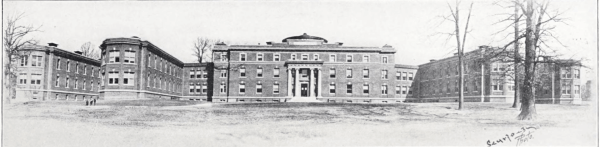
Hotel or Inn

The Line Hotel

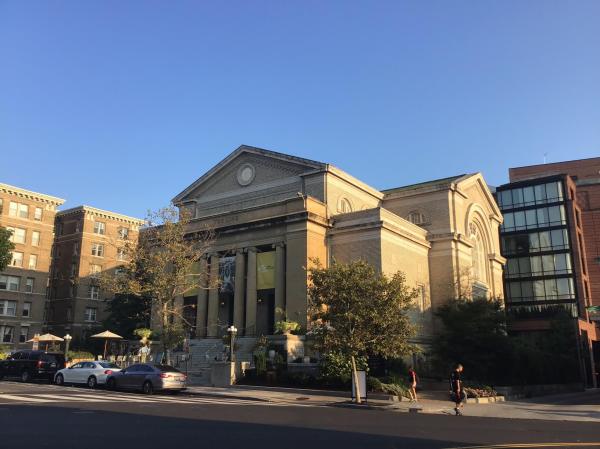
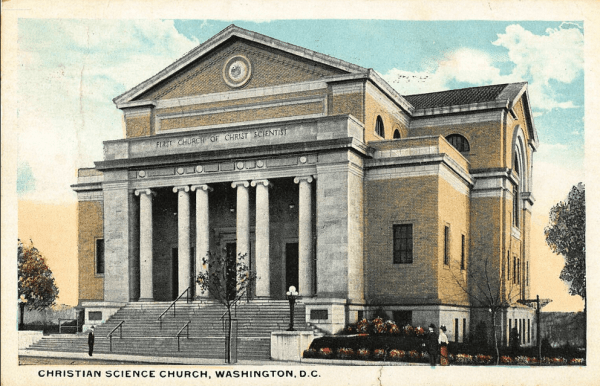
Finally, an easy one! The Line Hotel in the Adams Morgan neighborhood, just down the road from hotel-less Mount Pleasant, occupies a former Christian Science church that was built in 1912. The building sat empty for a quarter-century while the church retained a presence in the form of a reading room next door.

Postcard, Christian Science Church, 1921 (eBay)

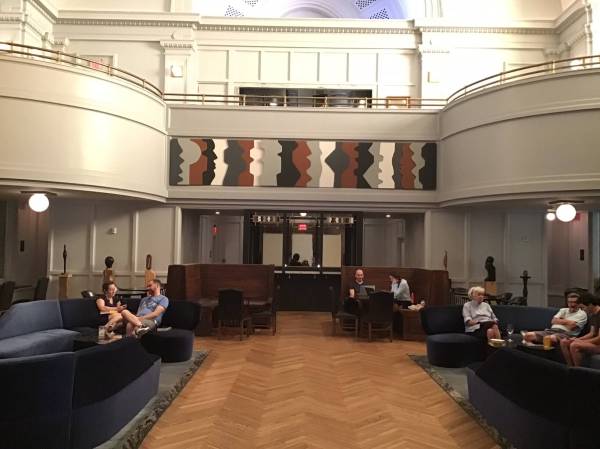
The Line opened in 2017 and quickly became a trendy hangout, with music pouring out of the building and guests and local residents relaxing on colorful cushions on the steps. It soon became embroiled in a dispute with the city government about a $46 million tax abatement related to the hiring of D.C. residents, which was eventually resolved in its favor. (Learning about your local community turns out to lead to all sorts of cans of worms). The hotel shut down for a while, along with the rest of the hospitality industry, because of COVID. A visit to the Line on a recent Sunday afternoon showed that it was, if not exactly hopping, pleasantly buzzing.

Lobby, The Line Hotel

The two impressively stocked bars were deserted, but I wouldn’t necessarily call a deserted bar at 6 p.m. on a Sunday a bad thing.

Bar, The Line Hotel

Three Churches, One Protestant, One Catholic, One Synagogue

National Baptist Memorial Church

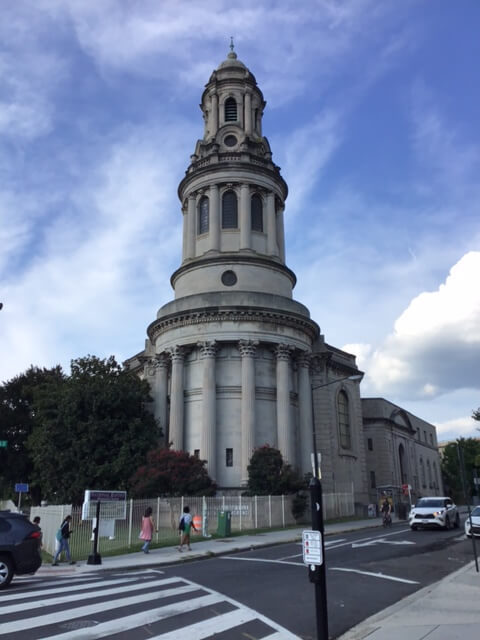
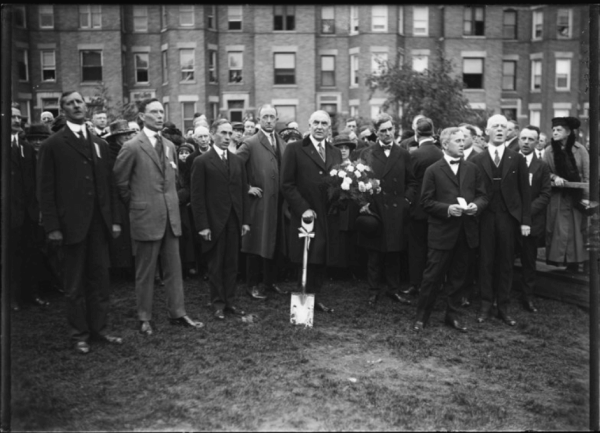
Mount Pleasant borders 16th Street NW, a boulevard that’s lined with houses of worship all the way up to the Maryland border, so I had an abundance of riches to choose from. To represent the Protestants, I selected the National Baptist Memorial Church, which is is exactly a hundred years old. Here’s  President Harding at the 1921 groundbreaking.

President Harding at National Memorial Baptist Church groundbreaking, 1921 (Library of Congress)

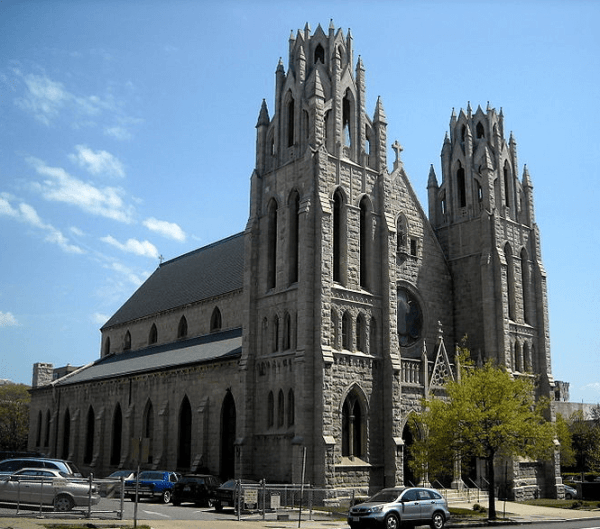
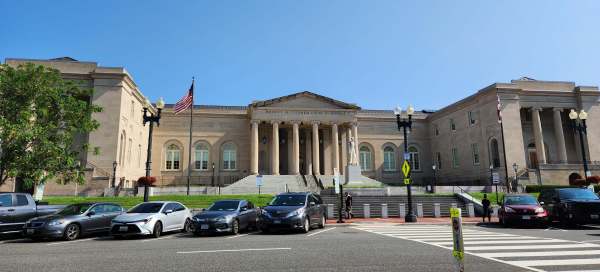
You can see the National Baptist Memorial Church on the left in the photo at the top of this post, along with All Souls Unitarian Church and the Unification Church’s National Family Church, which was built in 1933, with granite shipped from Utah, as the Washington, D.C., headquarters of the Mormon church.

St. Augustine Catholic Church, 2009 (AgnosticPreachersKid)

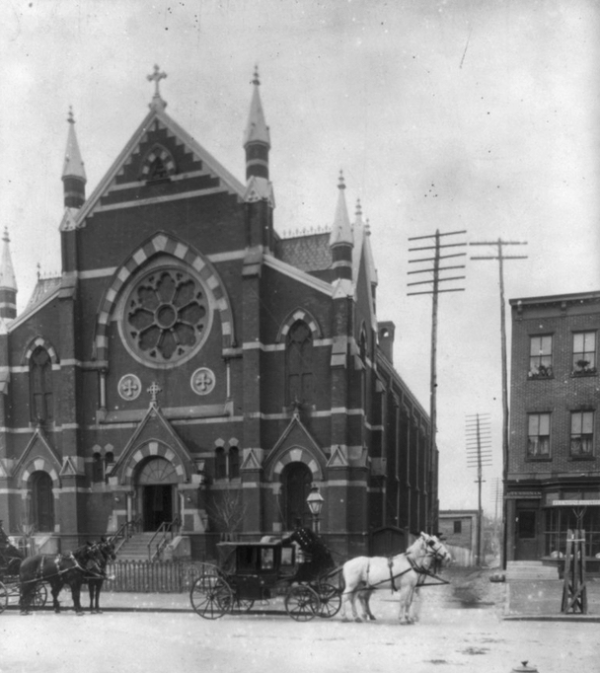
I had to go further afield to find a Catholic church and a synagogue. St. Augustine Catholic church has a storied history as the first African-American Catholic church in the District. It was founded in 1858, and its parish school was one of the first in the city to educate black children.

St. Augustine Church, ca. 1899 (Library of Congress)

St. Augustine subsequently merged with St. Paul’s, which had a dwindling congregation of white parishioners. The original church was torn down, and the longtime headquarters of the Washington Post was built on the site. The current church, built in 1897, is the old St. Paul’s.

Kesher Israel Synagogue

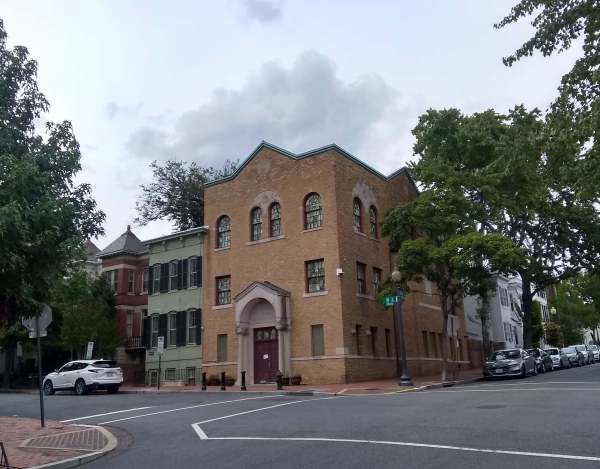
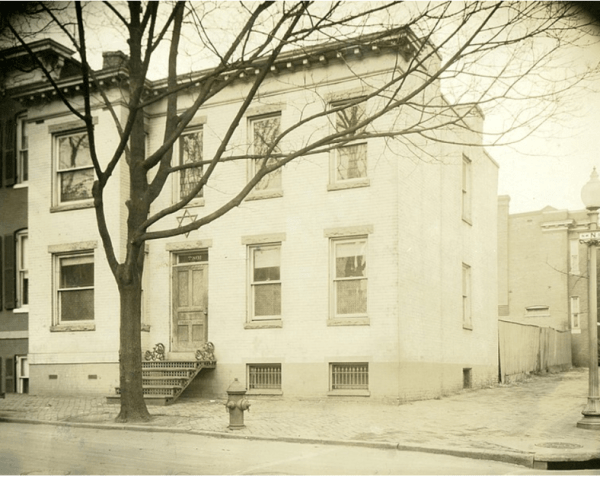
On a walk in Georgetown, I passed Kesher Israel, a Modern Orthodox synagogue that was founded in 1911. The congregation operated above a store on M Street at first, and in 1915 it moved into new quarters, pictured below. The current synagogue was built on the same site in 1931.

Kesher Israel Synagogue, 1915 (kesher.org)

Prominent members of Kesher Israel have included Herman Wouk, author of The Caine Mutiny, who called Kesher Israel “the best little shul in America,” and senator and vice presidential nominee Joe Lieberman, who occasionally walked the three miles from the synagogue to the Capitol for votes that took place on the Sabbath.

Nearest Railroad

Union Station, 2015 (VeggieGarden)

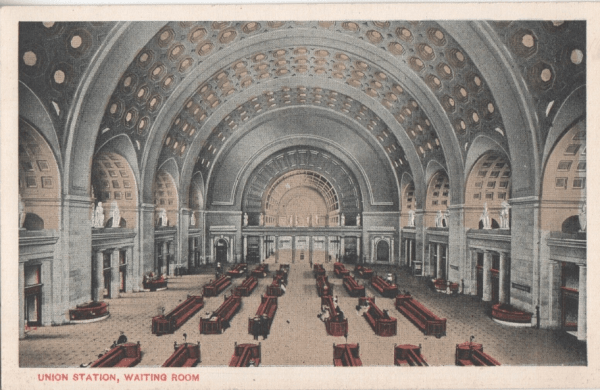
Union Station is Washington’s Amtrack station—the railroad’s second busiest, I recently learned (after New York’s Penn Station, presumably). Busiest in terms of riders, that is. In terms of hustle and bustle in the station itself, not so much. I took the Metro there on my way to the Library of Congress recently and was taken aback to see how deserted the station, once a bustling shopping center, is now.

Curious about how this had happened, I did some Googling and found a recent Washington Post article about the sad state of affairs, which has to do with a drop in ridership during COVID, an influx of homeless people when libraries and other public buildings closed, and the station’s complex ownership/leasing/subleasing setup. Planning for a $10 billion renovation project is underway, but that will take a decade. I hope that the station will return to at least a semblance of its former glory well before then, and that I will once again be able to browse happily in its shops.

In the meantime, here’s a photo of the station’s lobby, taken a few years after it opened in 1908.

Postcard of Union Station waiting room, ca. 1910 (eBay)

Whew! That was quite a requirement! It was well worth the effort, though. When I walk around my community now, I see it with new eyes and feel an increased sense of belonging.

Stay tuned for Part 2!

squiggle

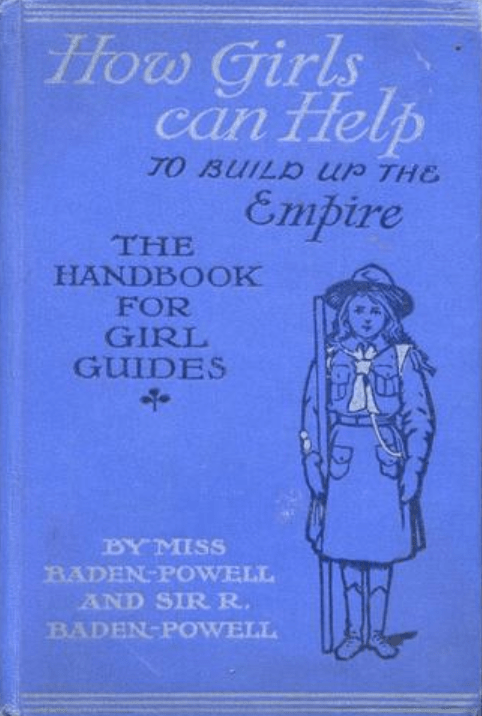
*How Girls Can Help Their Country was a spinoff of the British How Girls Can Help to Build Up the Empire.

**Mount Pleasant is one of Washington’s most diverse neighborhoods today, but, like many Washington neighborhoods, it has a troubling racial history. In the 1920s, almost all residents signed deeds prohibiting the sale of their homes to African Americans. You can learn more about the neighborhood’s history in this 2021 Washington Post article by a Mount Pleasant resident.

***I’m condensing this and other badge requirements, since there are separate instructions for city dwellers and residents of small towns or rural areas.

****Meigs Sr. served as the Union Quartermaster in the Civil War and supervised the construction of the U.S. Capitol. Meigs Jr. was, in addition to being a civil engineer, the father of boring children’s writer Cornelia Meigs.

*****Meigs has gotten enough grief, so I’ll refrain from commenting and let you be the judge:

Historic Preservation Review Board Application, 2018

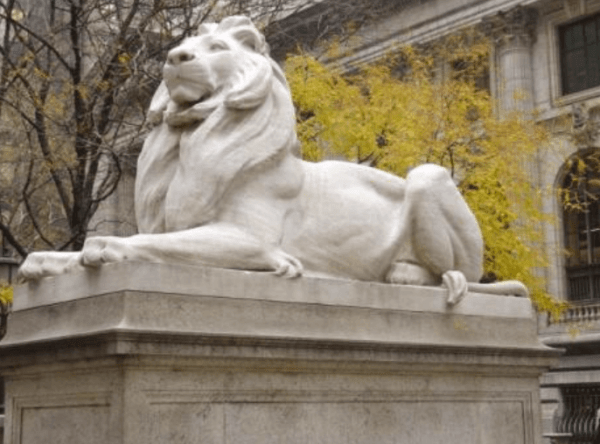
******When I was a kid, they used to play a song about the “local public library” on Captain Kangaroo and show photos of the lions at the library at 5th Avenue and 42nd Street in New York. I assumed that was the name of the building, and I asked my mom if she could take me there. She pointed out that we had just gone to the library. I said, “No—the Local Public Library!” Naturally, she had no idea what I was talking about. The sad thing is that we lived in New Jersey at the time and she could easily have taken me to visit the lions (to the extent that anything is easy when you’re the mother of four small children).

nypl.org

*******I polled two friends and both of them knew that the Wilson building is the home of the D.C. government.

********Update 7/22/2025: I took this photo of the D.C. Court of Appeals building on the way to the Metro from the nearby D.C. courthouse. I arrived in D.C. on Friday, my first time back since December, and, going through my huge stack of mail, found a summons for today. I was pretty sure I was ineligible since I spend most of the year out of town, but it was too late to sort that out so I had to show up. The woman at the desk told me to reschedule for an arbitrary day in the future and, in the meantime, provide proof that I don’t spend most of the year in D.C., after which I’ll be dismissed. She said that my presence on a jury could cause a mistrial, which seems kind of harsh given all this pathfinding.

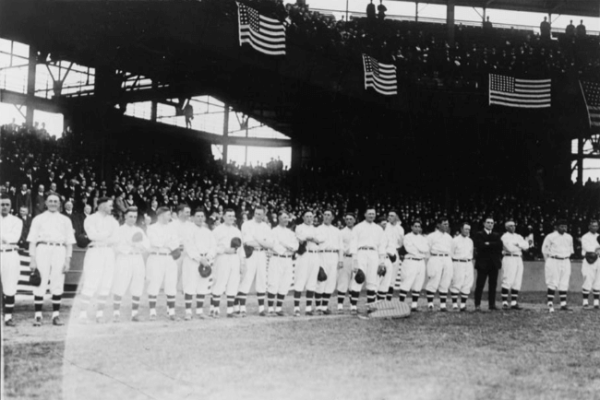
*********I had to stop myself from going down a whole other rabbit hole about Griffith Stadium, former home to the Washington Senators, the Redskins (now the Commanders, although I prefer the interim moniker Washington Football Team), and the Grays, the Negro League baseball team. You can learn more about this, and about the history of Howard University Hospital, on this fascinating page on Howard’s website.

Opening Day, Griffith Stadium, 1918 (Library of Congress)

Giving Thanks for the Friends I’ve Met Along the Way

On Thanksgiving every year, I’ve taken the opportunity to give thanks for some aspect of my adventures in the world of a hundred years ago. In 2018, I expressed gratitude for ten of the extraordinary people I’d come across during my year of reading as if I were living in 1918, like scholar/editor/activist W.E.B. Du Bois, food safety pioneer Harvey Wiley, and bra inventor Mary Phelps Jacob. The next year, I paid tribute to ten wonderful illustrators. The year after that, it was three women illustrators. (I had meant to cover more, but Neysa McMein proved to have such a fascinating life that I had to stop or the turkey wouldn’t have been done on time.)

As I was contemplating what to give thanks for this year, my thoughts turned to one of the best parts of this project—the twenty-first century people I’ve encountered along the way. I’ve given them shout-outs before, but now they’re front and center. Here they are, roughly in order of when I “met” them.

Pamela Toler and History in the Margins

One morning in February 2018, just five weeks into my project, I noticed a spike in my traffic. I soon discovered that Pamela Toler had recommended my blog, then titled My Year in 1918, on her own blog, History in the Margins. We’ve kept in touch through our blogs and Twitter since then.

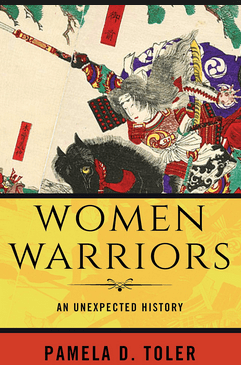
Cover of "Women Warriors" by Pamela D. Tonder.

Pamela has a job—“freelance writer specializing in history and the arts,” as she describes it—that I can imagine having in a parallel universe. She takes her readers down fascinating, little-known byways of history. Sometimes it’s a quick dive on a subject like the history of microphones, which end up being newer than she (or I) thought. Sometimes it’s a whole book, like Women Warriors, a fascinating history of women soldiers through the ages that combines the expertise of a Ph.D. historian (which she is) with the flair of the natural storyteller. Here’s a sample from the introduction: “As a nerdy tweenager I read everything I could find on Joan of Arc, from biographies designed to give young girls role models to George Bernard Shaw’s Saint Joan.* As a less obviously nerdy graduate student, I was fascinated by Lakshmi Bai, the Rani of Jhansi, who led her soldiers onto the battlefield to fight the British in the Indian mutiny of 1857.”

I’m thankful to have discovered Pamela the writer, and even more thankful to have gotten to know Pamela the online friend.

Connie Ruzich and the Forgotten Poets of the First World War

World War I Twitter led me to Robert Morris University professor Connie Ruzich and her blog, Behind Their Lines, which originated with a Fulbright project on World War I poets. She describes her blog as “a site for sharing lesser known poetry of the First World War, what I think of as lost voices and faded poems.”

Connie’s book, International Poetry of the First World War: An Anthology of Lost Voices, came out late last year. Even though it wasn’t priced for general readers, I was seriously tempted to use some of my COVID stimulus check to buy it. I left the U.S. for South Africa shortly after it was published, though, and didn’t get around to it. So I was thrilled to discover while writing this post that that a paperback edition is on the way.

Connie still posts occasionally on her blog—her most recent post combines a number of my interests, including Amy Lowell, Harvard, and T.S. Eliot/Ezra Pound snarkiness—and she links to older posts on Twitter on poets’ birthdays, National Beer Day, and other relevant occasions.

Connie, like Pamela, has become an online friend. When I drove across the country last October,** pre-vaccination, it gave me a pang as I passed through Chicago and Pittsburgh not to be able to stop by and see Pamela and Connie.

Frank Hudson and the Parlando Project

Early on in this project, when I was posting several times a week, I’d occasionally feel overwhelmed. Whenever this happened, I’d give myself a little lecture, saying, “Well, Frank Hudson posts as often as you do AND writes a song for every post AND sings it.”

Amazing guy, that Frank.

For the typical Parlando Project post (tag line: “where words and music meet”), Frank takes a poem that’s in the public domain, puts it to music, and shares his thoughts about the writer and the poem. He covers a much wider time period than I do, all the way back to classical Chinese poetry, but he often records poems from 1910s and 1920s, including a multi-year serial performance of The Waste Land to celebrate National Poetry Month.

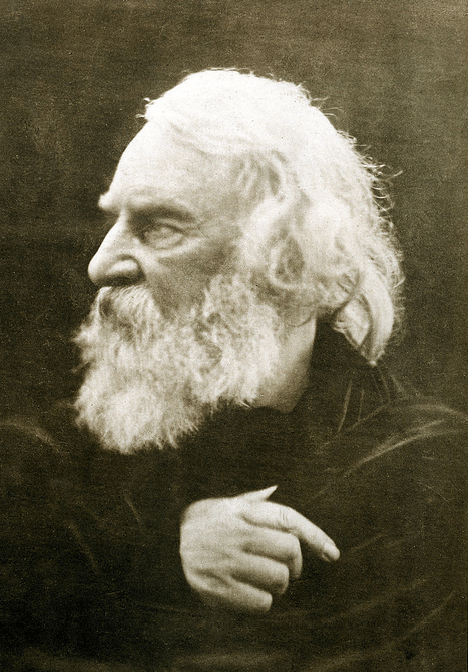
Henry Wadsworth Longfellow (Julia Margaret Cameron, 1868)

Maybe I’m biased because it was my idea (okay, there’s no maybe about it), but my favorite of Frank’s songs is his interpretation of the Henry Wadsworth Longfellow poem “Snow-Flakes,” featuring the wonderful line “This is the poem of the air.” In Frank’s rendition, recorded on Christmas 2018, “Snow-Flakes” and another Longfellow poem, “A Psalm of Life,” are being performed in a Beat Generation-era jazz club. If you’re in the mood for something seasonal but weary of the holiday standards, check it out!

Witness2Fashion and Century-Old Styles

Susan, the creative force behind the blog Witness2Fashion, is, like Frank, only a part-time resident of the world of a hundred years ago, but she stops by often. She’s a former theater costume designer who casts an expert eye on the fashions of the past while also tackling broader societal issues.

Delineator, January 1920

Witness2Fashion rang in the current decade, for example, with a visit to the January 1920 issue of Delineator magazine, showing us some Butterick patterns but then moving on to an article on sexual harassment called “It Won’t Do! A Warning for Business Women.”

Sometimes the posts take a more personal turn, like this one, featuring her detective work about the life of a TB patient named Ollie, a friend of her mother’s, whom she came to know through family photographs. My favorite Witness2Fashion post, with the irresistible title “Prudery in Advertising Used to Confuse Me,” is a mix of the personal and the historical.

Ladies’ Home Journal, June 1921

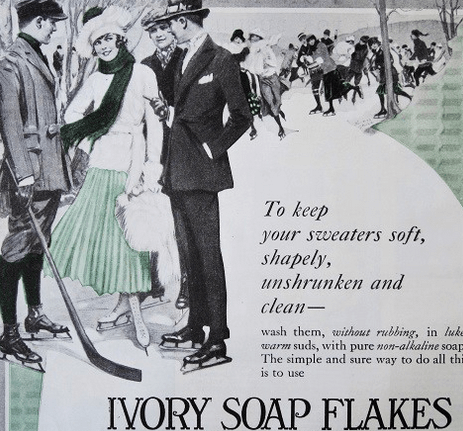
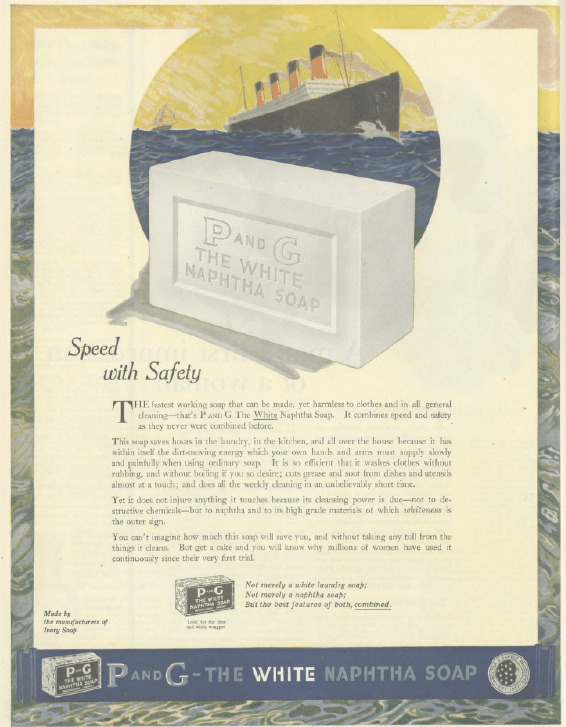
Susan and I check in with each other in the comments sections of our blogs every once in a while. When I wondered, a few months back, why hand-washing wasn’t one of the many uses listed for P and G White Naptha soap, she explained, “Naptha is a petroleum product, akin to mineral spirits (aka “Paint thinner,”) so you wouldn’t want to use it on your skin.” Mystery solved!

On a Witness2Fashion post about the evolution about corsets, I posted this comment: “I just came across a fascinating article in a 1922 issue of Printer’s Ink magazine, aimed at panicky corset sellers, assuring them that going corsetless is just a fad and reminding mothers to educate their daughters on the health benefits of corsets, including supporting internal organs and strengthening back muscles.” The actual Printer’s Ink article is unfortunately, as I have noted, lost in the mists of time.

It’s nice to have a kindred spirit!

Patty Stein and Rita Senger

Last year, I was wondering what happened to Rita Senger, a talented illustrator who disappeared from the covers of Vogue and Vanity Fair in 1919. A Google search led me to the blog of quilter Laurie Kennedy, who mentioned that Patty Stein, a fellow quilter, was Senger’s granddaughter. I e-mailed Laurie one night last November telling her of my interest in Rita Senger, and by morning I had heard from Patty.

Soon after that, I called Patty, who, while baking a cake, shared her memories of her grandmother, who traded her artistic career for marriage to a wealthy businessman. Rita came to life through Patty’s vivid stories, and hearing and writing about her was one of the high points of this project.

Old Books and New Friends

Last October, when I was out in Colorado, I spent two happy days virtually attending the annual meeting of the International T.S. Eliot Society. “Annual meeting” makes it sound like people introducing motions and voting, but it’s actually an academic conference. This was the year of the unveiling of the Emily Hale Archive at Princeton, which consists of over a thousand letters from Eliot to Hale, his long-distance companion of many years. The Eliot world was abuzz! But I digress.***

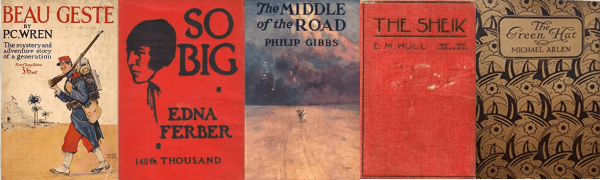
After the meeting, I followed some of the people I’d come across on Twitter. Just a few days later, one of them, Birkbeck/University of London lecturer Peter Fifield, tweeted that he was planning to start a 1920s best-seller discussion group. Needless to say, I was thrilled. In the year since, the group, which spans three continents, has read good books (The Home-Maker, So Big****) and not-so-good books (The Middle of the Road, The Green Hat) and problematic books (The Sheik, God’s Stepchildren), and we’ve had a great time talking about them all. (Sometimes, the worse the book, the better the discussion.) It’s become a group of friends that I look forward to seeing every month.

Happy Thanksgiving to All!

I haven’t met any of the people mentioned here (yet) in person*****, but my interactions with them, on Twitter, in blog comments, on the phone, and on Zoom, have greatly enriched my life—a silver lining to the virtual world we’re living in. So, to all of them, and to the rest of you who have shared my adventures in the world of a hundred years ago, happy Thanksgiving!******

squiggle

*This is me, except Eleanor of Aquitaine.

**Okay, sat in the passenger’s seat. My brother did all the driving.

***The T.S. Eliot gang almost got its own entry, but my interest in Eliot precedes this project, so they were disqualified.

****Going out on a limb here—this is next month’s selection so I’m only speaking for myself. But it’s Edna Ferber! And it’s wonderful!

*****UPDATE 7/20/2024: I eventually did meet up with some of the 1920s bestseller reading group members, when we participated in a roundtable at the 1922 conference of the British Association for Modernist Studies (BAMS) in Bristol (that’s me with the mask). I wrote about this and other literary adventures here.

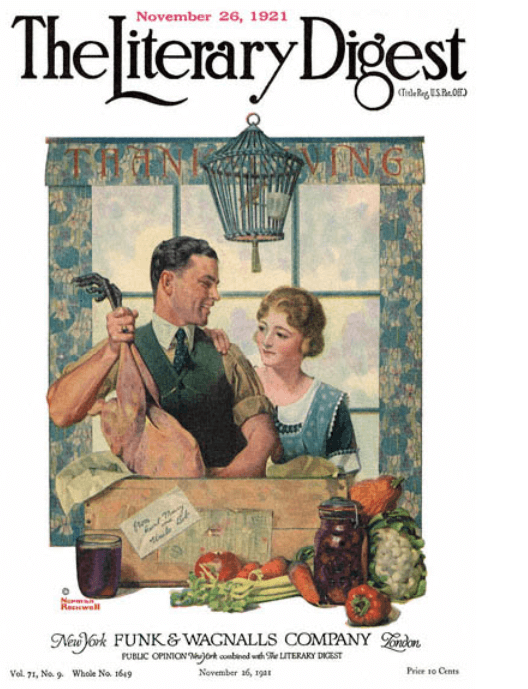
******I was going to round up this post with some charming Thanksgiving magazine covers, but this Norman Rockwell Literary Digest cover doesn’t look at all like a Rockwell,

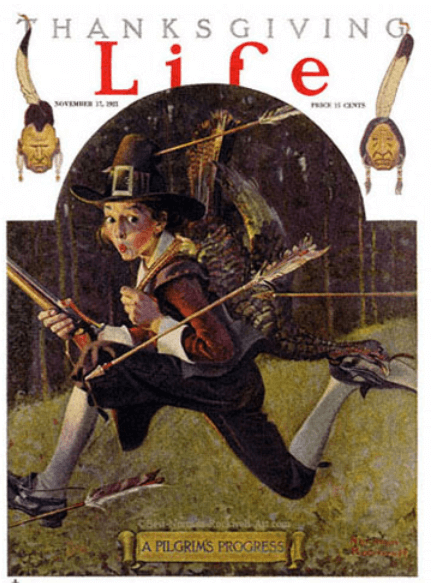
and this pilgrim/Indian warfare-themed Rockwell Life cover leaves me scratching my head,

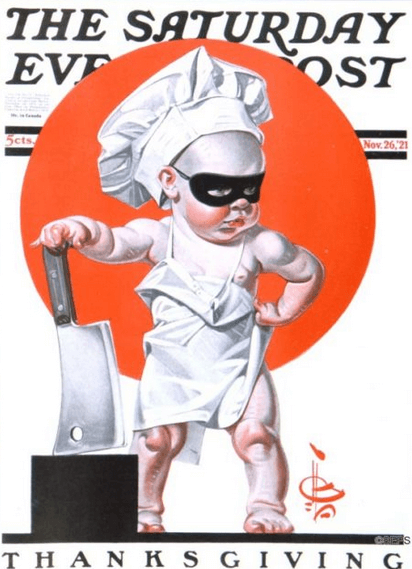
and what the hell, J.C. Leyendecker?

I think someone spiked the Thanksgiving cider over in New Rochelle.

Floor of Wanamaker's department store, 1920.

I Read a Random 1920 Book

In the three and a half years since I started this blog, I’ve read fifty-six books from a hundred years ago. Many of them, like The War-Whirl in Washington and Mary Marie, aren’t read much today.* But every one, no matter how obscure, was chosen by someone—me—with a contemporary sensibility. What if there were a way around this, I would occasionally wonder—a way to meet the world of a hundred years ago on its own terms, rather than through a 21st-century lens.

Last year, I thought of a way to do this: I’d read a random book. I picked up my copy of the 1920 Book Review Digest, flipped through it a few times, stopped, and, with my eyes closed, pointed to a place on the page.

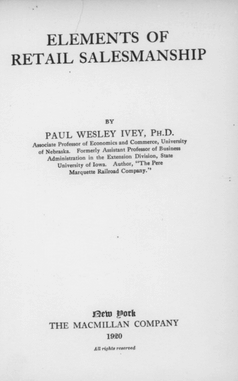
And got…Elements of Retail Salesmanship, by Paul Wesley Ivey, Ph.D.!**

Title page, Elements of Retail Salesmanship by Paul Wesley Ivey

 I couldn’t have been more thrilled. I could have ended up with anything—Hugh Temple Sheringham’s Trout Fishing Memoirs and Morals, for example, or Newell Dwight Hillis’s Rebuilding Europe in the Face of World-Wide Bolshevism. But no, I got a book about a topic I find fascinating, and that I had so far encountered only in Edna Ferber’s short stories about exhausted department store saleswomen.

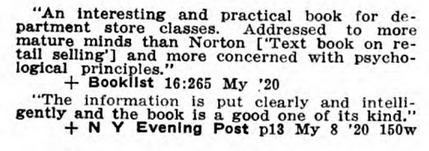
Plus, Elements of Retail Salesmanship got the equivalent of two thumbs up in Book Review Digest, which classifies each excerpted review as +, +-, or -. “The information is put clearly and intelligently and the book is a good one of its kind,” the New York Evening Post said.

Reviews of Elements of Retail Salesmanship in Book Review Digest, 1920.

Book Review Digest, 1920

Next step: acquiring a copy. These days, you can buy just about any out-of-copyright book online. Some companies put the text into Word documents and bind them, generally with a tiny font and/or horrible formatting. Some do OCR scans of book texts, with unintelligible results. Other companies just print out the scanned text from Google Books. This, I have learned from experience, is the best, even though you often end up with people’s underlining and marginal comments.***

That is, you can get almost anything unless it’s the first wave of COVID, which it was, plus something weird was going on in the printing industry. My favorite out-of-print publisher, Forgotten Books, finally admitted defeat and cancelled my order, so I tried again with my second-favorite, Scholar Select. Elements of Retail Salesmanship arrived in late August, just before my brother and I set off from D.C. by car for a month-long stay in Colorado.****

Book, Elements of Retail Salesmanship.

Ivey was thirty years old and just starting out his career as a professor at the University of Nebraska when Element of Retail Salesmanship was published. He sets out his ambition for the book on the first page. “If it serves to make the salesperson see the educational possibilities in her[1] work and the relation of better service to community welfare,” he says, “it will have served the purpose for which it was intended.” The “her” struck me as surprisingly woke for 1920, but Ivey explains in the footnote that “the feminine gender is used throughout this book because ninety-five percent of the customers and salespeople in department stores are women.”

Sometimes the idea of reading a hundred-year-old book is more exciting than the actual reading. And, to be honest, Elements of Retail Salesmanship dragged a bit at the start, while Professor Ivey walked us through the history of merchandising. There were some high points even here, though, like learning about how retail establishments used to employ “barkers” to lure people in from the street. Once the customer was inside, the retailer—who didn’t charge a fixed price, so every interaction was a bargaining session—was reluctant to let customers out until they bought something. I’m not sure how this was enforced, but it sounded alarming.

John Wanamaker, ca. 1890

John Wanamaker, ca. 1890 (Frances Benjamin Johnston, Library of Congress)

I was relieved, then, when John Wanamaker came along in the late 1800s, with his low-pressure sales tactics, fixed prices, and money-back guarantees. Like many visionaries, he was regarded as a lunatic at first, but eventually the mentality whereby, as Ivey puts it, “each merchant tried to climb to success over the dead body of his opponent” disappeared and the modern age of efficiency began.

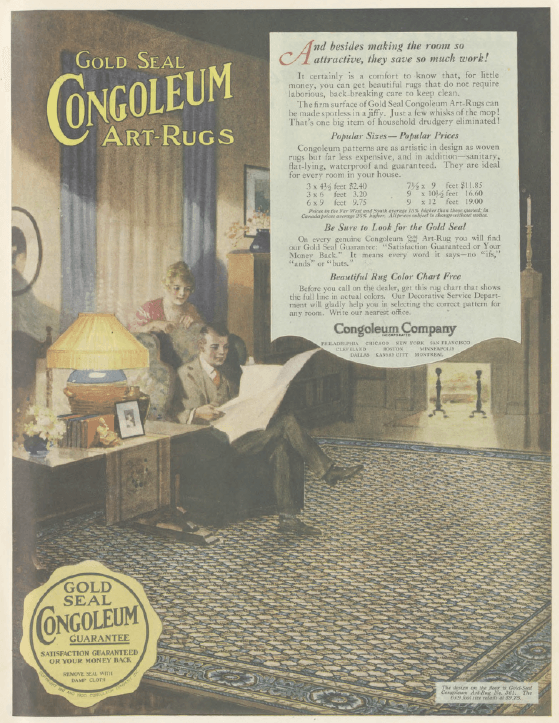
In the next chapter, Ivey moves on to “Knowing the Goods.” This is, in his philosophy, the salesperson’s most important obligation. Take congoleum, for example. Few people, he says, know that it is merely tar paper printed on both sides. I consider myself one of the world’s foremost experts on congoleum by virtue of having heard of it, but I did not know this interesting fact!

Congoleum linoleum rug ad, Ladies' Home Journal, January 1921.

Ladies’ Home Journal, January 1921

Or take corsets. Ivey tells us that

during the reign of Catherine de Medici of France, no woman in her court could find favor in her eyes whose waist measure exceeded thirteen inches; that in order to reduce the waist measure to this figure corsets were laced by serving men while in some cases the figure was placed in a steel cage or corset frame which held the victim’s body in a vise-like and perfectly rigid grip; that the death rate increased among the women due to this custom, and, finally, Henry IV of France stamped out the injurious fashion by an imperial order.

Engraving of an iron corset held by the Musée de Cluny, 1893

This is a fascinating bit of history (or, actually, mythology–it’s been debunked), but it leaves me wondering what exactly the salesperson is supposed to do with it. “Did you know these things can kill you?” doesn’t seem like much of a sales pitch, as opposed to, say, claiming that women need an artificial exoskeleton to keep their internal organs in place.*****
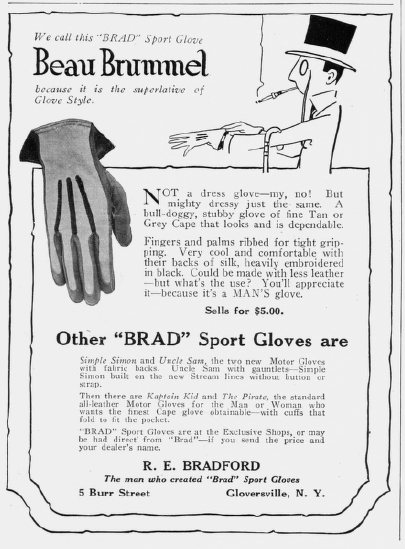
Overall, though, Professor Ivey makes a convincing case for knowing the goods. You wouldn’t want to be like the salesperson who, asked why one pair of gloves cost $2.00 and a similar-looking pair cost $2.50, thought intensely for a few seconds and then answered, “I guess it is because they are marked that way.” Another giveaway about lack of product knowledge: excessive use of terms such as “nifty,” “swell,” “classy,” “great,” and “fine.”******
Ad for gloves, Harper's Bazar, February 1918

Harper’s Bazar, February 1918

Professor Ivey has high hopes for retail merchandising as a profession, musing that

four to six years of continuous study after graduation from high school is the rule rather than the exception for those entering law and medicine and in some cases dentistry. If a similar period of time was spent in study and laboratory work by those entering retail selling they would become just as truly expert in their line and would command incomes proportionate to their effectiveness.

I mentally debated the microeconomics of this with Professor Ivey for a while, then forced myself to move on.

Luckily, there are ways to learn about the goods even without sitting in a classroom. For example, Ivey tells us, you can take home the informational material that manufacturers send with the merchandise and peruse it in your leisure hours. Or you can go to the library and read the encyclopedia entries on textiles, shoes, household furnishings, novelties, and other goods, which, he promises us, are “both entertaining and of an educational value.”

I decided to give this a test run. I found the 1911 edition of the Encyclopedia Britannica on HathiTrust, opened the 15th volume, which luckily had the entry for “Jewelry,” and picked a passage at random.

Excerpt from entry on Jewelry in 1911 Encyclopedia Britannica.

Encyclopedia Britannica, 1911 edition, vol. 15

I thought about Edna Ferber’s saleswomen, heading back to the boarding house, exhausted after being on their feet all day. My thoughts turned, too, to my younger self, tired out after a long day at the embassy in Phnom Penh, trying to read Elizabeth Becker’s When the War Was Over: Cambodia and the Khmer Rouge Revolution, and just not having it in me. And the ambassador let me sit in a chair! I had my doubts about whether the extracurricular encyclopedia reading ever actually happened.

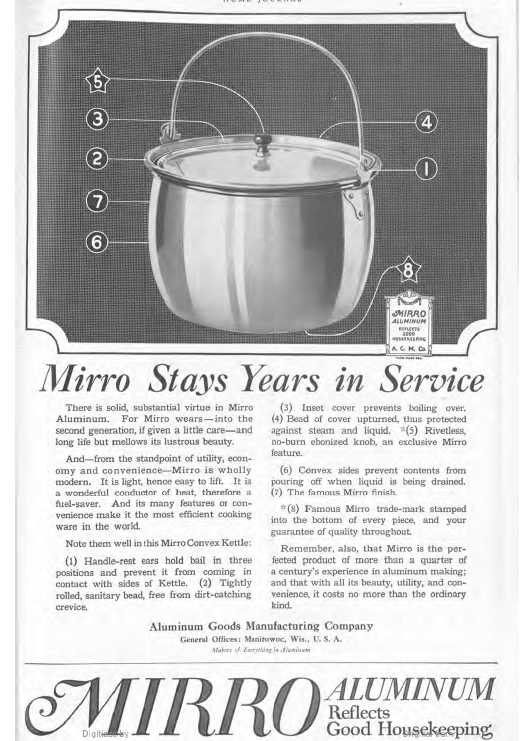
Luckily, Professor Ivey presents us with more enjoyable ways of improving our salesmanship. You can, for example, challenge yourself to engage as many of the customer’s senses as possible. You don’t just show her the aluminum kettle, you “ring” it. In the hands of a clever salesperson, he claims, silk can be made to “talk.’”

Picture of kettle in Mirro Kettle ad, Ladies' Home Journal, 1920.

Ladies’ Home Journal, February 1920

Then there’s the psychological angle. Ivey walks us through the different types of customer: the Impulsive or Nervous Customer, the Deliberate Customer, the Confident or Decisive Customer (“she walks into the store as a general would march into the camp of a defeated army”), the Silent or Indifferent Customer, and the Distrustful Customer. Selling to each type requires different tactics. One caveat, though, applies to all types: if a customer is considering an item of clothing, don’t say that you bought it yourself and are happy with it. Because who wants to dress like a salesclerk?

Salespeople, too, can be distinguished by personality. The ideal salesperson combines the traits of Enthusiasm, Honesty, Promptness (which turns out not to mean showing up for work on time but rather hopping to it when a customer needs help), and Cheerfulness.

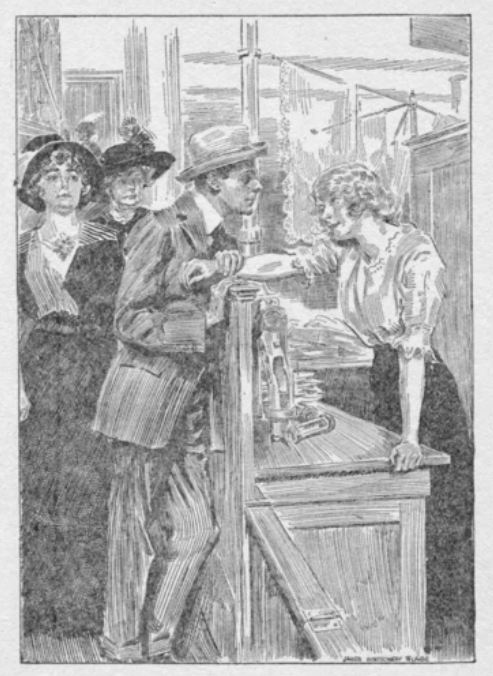
Man talking to woman at store counter, Roast Beef Medium by Edna Ferber

Illustration by James Montgomery Flagg from Roast Beef, Medium, by Edna Ferber (1913)

Too often, Professor Ivey tells us, salespeople ask questions like, “Is there anything today,” “Waited on?” “Do you wish anything?” “Can I show you something?” or merely “Something?” Syntax aside, these seemed to me like normal salesperson inquiries, but Professor Ivey says that they indicate suspicion that the customer is a “looker” as opposed to a serious shopper. Better: “Do you desire service?” or “Do you wish attention?”

Cheerfulness, Professor Ivey, tells us, is not merely a matter of smiling. There are smiles and there are smiles. There is “the pitying smile, when the customer signifies a desire to look at a cheaper article than the first shown her,” as well as the sarcastic, knowing, idiotic, and bored smiles, and, lastly, the “Heaven-help-me” smile, exchanged with a colleague when the customer finds difficulty in deciding between two silverware patterns. Oh, I know those smiles all too well!

Department store floor, Detroit, ca. 1910.

Department Store in Detroit, Michigan, ca. 1910 (Universal History Archive)

Enthusiasm, according to Professor Ivey, is not something that can be feigned. “All salespeople should have a feeling of admiration for the store in which they are working or else seek opportunities elsewhere,” he tells us. “Disloyalty can never be justified within an organization because sincerity would thereby be violated.”

And if you don’t wake up full of happiness? No problem. You just say to yourself, “This is a wonderful world. It’s great just to be alive,” or, “I feel fine, I feel happy.” Or you sing, or whistle.

With all due respect to Maria von Trapp, I’ve got some problems with this. I’m not expecting a marketing professor at the University of Nebraska in 1920 to be a Marxist, but seriously? “A feeling of admiration for the store in which they are working?” Have you ever HAD a job, Professor? (This is a rhetorical question–Ivey tells us that he has, in fact, worked in sales.) Also—where’s the chapter on what the salesperson can expect from her employer in exchange for all this expertise, psychological acumen, and sincere admiration?

Interior of Wanamaker's store, 1920.

Wanamaker Building, 1920 (Historical Society of Pennsylvania)

I went back to my post on “What’s Your 1918 Girl Job?” to see what the Ladies’ Home Journal had to say about opportunities for women in sales:

The average pay is low, hours long, and the work is not easy, but employment is steady for the competent worker. Hours have been shortened, however, and conditions improved by the activity of the Consumers’ League. Chances for advancement are good, however, for the ambitious girl in the employ of a good firm. (July 1918)

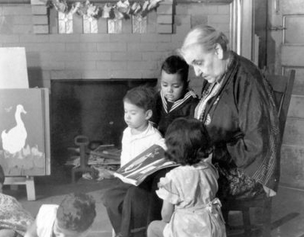
Jane Addams reading to children at Hull House.

Jane Addams at Hull House (Jane Addams Memorial Collection, University of Illinois at Chicago)

 The National Consumers’ League was an organization, founded by pioneering social worker Jane Addams and others, that advocated for better conditions for workers. Some of their causes seem odd today, such as their defense of an Oregon law that limited working hours for women, but not men, to ten hours a day (the case went to the Supreme Court and the law was upheld), but they were effective in combating poor working conditions, especially in sweatshops. We don’t hear a word from Professor Ivey about the National Consumers’ League. Or about trade unions, either.

Paul and Stella Ivey

Paul and Stella Ivey, date unknown (findagrave.com)

Politics aside, I had developed a fondness for the affable professor, and I set out to learn more about him. He was born in Bessemer, Michigan, in 1890, and attended Lawrence College in Appleton, Wisconsin. He earned a master’s degree from the University of Illinois, with a thesis titled “The Liquor Industry and Industrial Efficiency,” and went on to the University of Michigan for his doctorate. In 1915, a year after his arrival in Michigan, he married Stella Walker, a widow whose first husband, a dentist, had died of typhoid fever in 1912 at the age of 27. Ivey completed his dissertation, “The Pere Marquette Railroad,” in 1919, and started teaching at Nebraska that year. Here he is on the business administration department’s page in the university’s yearbook, bottom right, jokily captioned “Ivey-covered column.”

Photographs of Business Administration staff, University of Nebraska, 1920.

The Cornhusker, 1920 (yearbooks.unl.edu)

A new marriage, a professorship at a rapidly expanding university, and a book that was serialized in Publishers’ Weekly: all in all, a promising start. What was next? Mostly more of the same, as it turned out. Ivey left Nebraska for Northwestern University a few years later, and by 1932 he was teaching at the University of Southern California, where he would spend the rest of his career.

More books followed: Principles of Marketing in 1921, Salesmanship Applied in 1925, Getting Results in Selling in 1934, Successful Salesmanship in 1937, and Human Relations in Banking in 1941. His work was mentioned in the sermons of Lloyd Cassell Douglas, the minister and best-selling author of Magnificent Obsession and The Robe.

Professor Ivey died in Los Angeles in 1950, at the age of 60. Stella lived until 1967. They didn’t have any children, or at least any that I was able to track down. (UPDATE 2/19/2021: A relative of Stella’s says in the comments below that they had no children but were part of a large and close extended family on Stella’s side.) Professor Ivey’s work outlived him; the fourth addition of Successful Salesmanship, updated by a co-author, was published in 1961.

As chance would have it, Lincoln, Nebraska, was my brother’s and my first overnight stop on our drive back to D.C. from Colorado, so I had an opportunity for a Professor Ivey pilgrimage. Or more of a mini-pilgrimage, rather. I hadn’t done enough research yet to find the  building where he taught,

Drawing of business administration building, University of Nebraska, 1920

The Cornhusker, 1920 edition (yearbooks.unl.edu)

and a house built in 1925 now stands at the address of his Lincoln home (which I found online and subsequently lost). Besides, it was pouring, and we needed to get a move on. I did sense Professor Ivey’s presence, though, as I had breakfast in a coffee shop in the historic Haymarket district near the university.*******

Mary Grace McGeehan at coffee shop

I’ve decided to make reading a random book an annual tradition, so stay tuned! I can’t imagine, though, that my 1921 book could possibly be as much fun as Elements of Retail Salesmanship.

Problems from Elements of Retail Salesmanship.

Problems from Elements of Retail Salesmanship

squiggle

*Although “aren’t read much” doesn’t mean “aren’t read at all.” One effect of the proliferation of free public-domain e-books is that people come across century-old books at random and post reviews on Goodreads that say things like “the writing was kind of old-fashioned.”

**I set a few ground rules: no books over 400 pages, no books I was already aware of, and no books about history, because reading a 1920 book about, say, Elizabethan England seemed beside the point. In any case, Elements of Retail Salesmanship won fair and square on the first try.

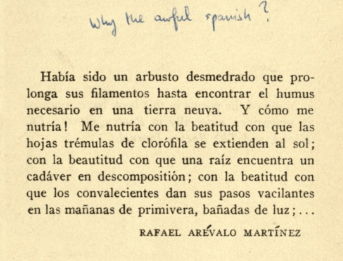
***This can actually be quite entertaining, as in this online copy of William Carlos Williams’ 1917 poetry collection Al Que Quiere!:

Al Que Quiere by William Carlos Williams, with handwritten note "Why the awful Spanish?"

HathiTrust

****This was, in case you’re wondering, a necessary trip and not an irresponsible pleasure jaunt.

*****When I was Googling around for a source for this, I found this comment from me from 2019 on witness2fashions’s website: “I just came across a fascinating article in a 1922 issue of Printer’s Ink magazine, aimed at panicky corset sellers, assuring them that going corsetless is just a fad and reminding mothers to educate their daughters on the health benefits of corsets, including supporting internal organs and strengthening back muscles.” The actual Printer’s Ink article is lost in the mists of time.

******This reminded me of the time I was trying on a dress in a Cape Town boutique and the salesperson said, “That’s a stunning dress!” I was mildly flattered, the way one is by even the most transparently insincere compliments, until I heard her say to a woman who was looking at a sweater, “That’s a stunning jersey!,” and then, to a woman standing in line to buy perfume, “That’s a stunning scent!”

*******One good thing about the Midwest (of many!) is the spaciousness, indoors as well as out. The coffee shop was huge, with tables at a safe distance from each other.

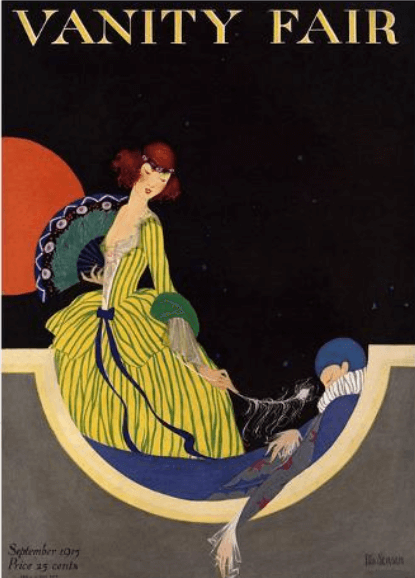
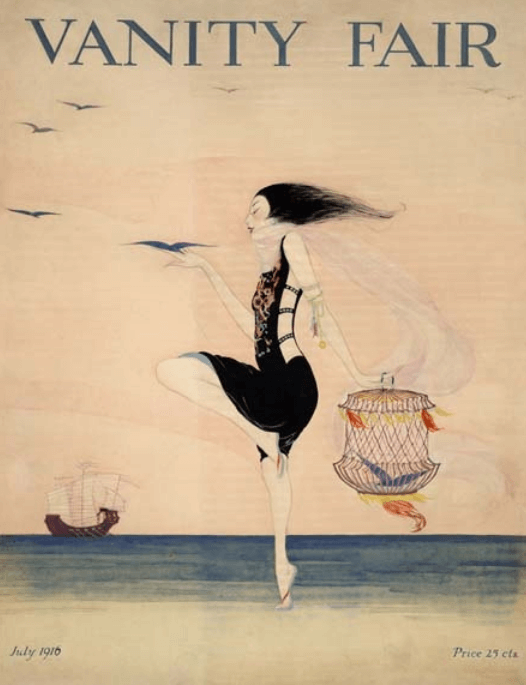
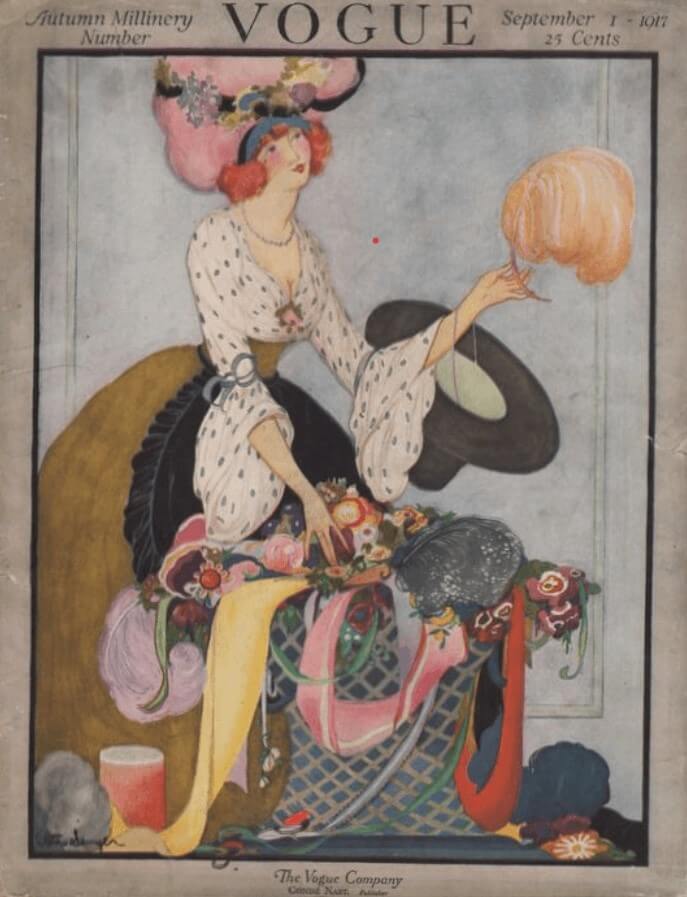
Rita Senger Vanity Fair covers

The Brief, Brilliant Career of Rita Senger

Remember Rita Senger, who illustrated the winning cover in the 1915/1920 Magazine Cover Smackdown? “Next time I write about illustrators I love, I’m going to write about Senger,” I promised.

Vanity Fair cover, September 1915, Rita Senger, woman with sleeping Pierrot.

September 1915

And I tried! As I prepared for my Thanksgiving post on 1920 women illustrators I’m thankful for, I scoured the internet for illustrations by, and information about, Senger.

And came up with…almost nothing. Just a handful of magazine covers, most of which I’d already seen, the last one this August 1919 Vanity Fair cover.

Vanity Fair cover, August 1919, Rita Senger, harlequin and woman on bridge.

August 1919

What happened? None of the usual suspects, like findagrave.com and Wikipedia, yielded anything. Then I came across a blog post by a quilter named Lori Kennedy saying that fellow quilter Patty Stein was Rita Senger’s granddaughter. The post included one of Senger’s Vogue covers and some photographs of her and her family.

Armed with the last name Stein, I found a listing for a Mrs. Rita Senger Stein of Highland Park, Illinois, among the life members of the Art Institute of Chicago in its 1925 annual report. That was it.

Cover, Bulletin of the Art Institute of Chicago, 1925.

If I wanted to find out more about Rita Senger, I realized, I was going to have to do something almost without precedent for this blog: contact an actual living person.*

So, one evening back in November,** I sent a message to Lori Kennedy asking if she could put me in touch with Patty Stein. By the time I woke up the next morning, there was an e-mail from Patty.

Patty turned out to be a delightful person, and we talked on the phone for almost an hour. She was making a cake as we talked, which I found extremely impressive, since I consider myself a decent baker but I can’t even focus if there’s music on in the background.

chocolate cake

Patty’s cake (Patty Stein)

This is Rita’s story, mostly as I heard it from Patty but incorporating some of my own research as well. Patty emphasized that she was only sharing the impressions of a granddaughter, which may not be entirely accurate. (The chronology of Senger’s magazine covers—and any possible inaccuracy in this respect—is mine.)

Rita Senger was born in New York City in 1893, the daughter of Adolph and Barbara (Ehrlich) Senger. (The name was sometimes spelled “Sanger.”) She was an art prodigy as a child, and she went to art school at the age of sixteen or seventeen.

Young Rita Senger at easel, ca. 1910s.

Rita Stein, ca. 1910s (courtesy of Patty Stein)

Rita’s father moved to Arizona after becoming ill with asthma, leaving Rita to care for her mother, three sisters, and two brothers (both of whom went on to become architects). Success as an illustrator came early. Her first Vogue cover appeared in June 1915,

Rita Senger cover, Vogue, June 15, 1916, woman walking dog.

June 15, 1915

and her first Vanity Fair cover—the one that won my magazine cover contest—followed three months later.

Senger illustrated one cover for each magazine in 1916,

Rita Senger cover, Vogue, June 15, 191, woman in hoop skirt.

June 15, 1916

Rita Senger Vanity Fair cover, July 1916, woman dancing on beach.

July 1916

two Vogue covers in 1917,***

Rita Senger Vogue cover, July 15, 1917, woman drinking tea under tree.

July 15, 1917

Rita Senger cover, Vogue, September 1, 1917, woman holding large feather.

September 1, 1917

one Vanity Fair cover in 1918,

Rita Senger Vanity Fair cover, April 1918, Pierrot holding unconscious woman.

April 1918

and the August 1919 Vanity Fair cover, the last in her career.

Patty is not sure how Rita met her husband, Joseph Stein. It was an unusual match for the time; he was Jewish and Rita, who came from a non-religious family, was not. Stein’s grandfather was one of the first Reform rabbis in Chicago, but he himself was not a practicing Jew. He was a wealthy businessman, the owner of Lucien Lelong, Inc., the U.S. affiliate of the Paris-based Société des Parfums Lucien Lelong. (The two companies were sold to Coty in 1953.)

These drawings of Lucien Lelong’s Paris office appear on a blog about the company’s history. The magazine and date are unidentified, but they look like ca. 1920s Vanity Fair to me.****

Illustrations of Lucien Lelong studio, Paris, possibly from Vanity Fair, 1920s?

Joseph had a keen artistic sense himself, and he paid a great deal of attention to the appearance of his products. Here is his patent for a Lucien Lelong perfume bottle:

Patent application for Lelong perfume bottle, Lelong.

United States Patent and Trademark Office

When Rita and Joseph married, she joined him in Chicago. The couple later settled in the suburb of Highland Park. Their son Tom, their only child, was born in 1920.

When I saw a picture of Rita with her extended family on Lori Kennedy’s website, I hoped that, having given up her career, she had gained a fulfilling life of a different sort. Life is rarely so simple, unfortunately. Like many parents of their time and class, she and her husband sent Tom to boarding school from an early age. Living outside of the hustle and bustle of the city, she felt isolated. “I believe she was a very frustrated artist and wife,” Patty said.

Rita did appreciate the benefits of wealth, though. In addition to their home in Highland Park, she and her husband owned, over the course of their marriage, an apartment on the Champs-Élysées and houses in Maine and in the Long Island town of Oyster Bay.

New Yor Times Headline, 6-Acre Estate Sold in Nassau County, 1-22-1942.

New York Times, January 22, 1942

Patty remembers Rita, whom her grandchildren called Tita after a mispronunciation by one of the children, as a tiny woman with a mink collar, pearls, and diamonds. She smoked at a time when that was the mark of a sophisticated woman. “They had an African-American cook who was always baking stuff—it was out of Gone With the Wind,” Patty told me. “I never remember her eating anything except pound cake and butter.”

Rita Senger and others at party.

Rita Senger Stein, center, at her son’s wedding reception, October 1943 (courtesy of Patty Stein)

After her marriage, Rita expressed her artistic side through patronage of the arts. In addition to her association with the Art Institute of Chicago, she was a collector, purchasing works by modern artists including the sculptors Kenneth Armitage and Henry Bertoia.

When their son Tom grew up, he wanted his own family to be very different from the one he was raised in. He married Pauline Blume, the daughter of Ernest Blume, a Marshall Field’s home goods buyer. Ernest and Joseph had had a nodding acquaintance before the couple met. The two men, who shared an appreciation for aesthetics, saw each other occasionally at lunch at Marshall Field’s.

Rita Senger Stein with her son and daughter-in-law, cutting cake, at their wedding.

Rita Senger Stein, far right, at her son’s wedding reception, October 1943 (courtesy of Patty Stein)

Tom and Pauline eventually settled in Colorado with their five children, whom Patty, the youngest, describes as “boisterous, smart, and mouthy.” Their sophisticated grandmother, who thought children should be seen and not heard, didn’t know what to make of them. She enjoyed them one at a time, and developed a special bond with her oldest grandson, but “five was way too many,” Patty said. One time, when Patty was little, she drew paper dolls and showed them proudly to her grandmother. Rita pointed out that the figures were out of proportion.*****

Art was an important part of the family’s daily life. “I did not grow up with a mom who had crocheted doilies on the sofa,” Patty said. When the family went to an exhibition of Bertoia’s work, Patty’s sister was told to stop touching the tree sculptures. “My grandmother lets me,” she said.

Harry Bertoia in sculpture studio.

Harry Bertoia with samples of his sculpture in the early 1960s (Harry Bertoia Foundation)

“She had so much influence on us five and our extended family,” Patty said of her grandmother. One of Rita’s nephews went on to be an artist and designer. Patty herself went on to a different kind of artistic career, as a ballet dancer.

When Rita was 85 years old, she and her husband moved to Denver so Tom and his family could care for them. One day, Rita sat Patty down and pulled out a portfolio from the 1920s, with drawings of nudes in copper and black. Until then, Patty hadn’t known that Rita had continued drawing after her career ended. “She was so gifted,” Patty said, “to see curves and shadows and lines where none of the rest of us could.”

Rita died on December 30, 1990, at the age of 97. For her descendants, her art collection, her furniture, and her own art work serve as tangible reminders of her artistic sensibility and her talent. For the rest of us, her art lives on online. The Library of Congress, which has the original of the July 1916 Vanity Fair cover in its collection, featured it in a 2002 exhibition titled “American Beauties: Drawings from the Golden Age of Illustration.”

Rita Senger Vanity Fair cover, July 1916, woman dancing on beach.

July 1916

The website for the exhibition states that “Rita Senger’s lithe beauty dancing on a shore (ca. 1916) embodied a freedom based on insistent individuality. Compared with their predecessors, [fellow illustrator Ethel] Plummer’s and Senger’s figures move freely in more public, open spaces.”

If Rita had enjoyed that same freedom in her own life, the world would be the richer for it. Still, I feel lucky to have discovered the work she did leave us, and, through Patty, to have learned this remarkable woman’s story. I can think of no better way to celebrate Women’s History Month than telling it here.

squiggle

*The “almost” being because in 2018 I called the Huntington Museum of Art in West Virginia and talked to a very nice woman who confirmed that the museum still owned the painting “Lead Kindly, Light,” by William Edouard Scott, which was featured on the cover of the April 1918 issue of The Crisis. Also, I e-mailed the Library of Congress in 2019 for a post that’s still on my to-do list. But contacting people whose job it is to answer your questions is very different from reaching out to a stranger and saying, “Tell me all about your grandma!”

Crisis cover, April 1918, black couple on wagon going north.

**I know, not exactly lightning speed. In my (feeble) defense, I left Washington, D.C., where I’d unexpectedly spent almost a year, for Cape Town shortly after my conversation with Patty, and after that I had some time-specific posts to do for the holidays, Black History Month, etc. Still!

***Or possibly three. Vogue’s website identifies this September 15, 1917, cover as being Senger’s,

Vogue cover, September 15, 1917, woman with purse.

but credits the September 1 cover, which is definitely hers, to Alice De Warenn Little, so it’s possibly that they flipped the attributions. Vogue published two issues a month at that point, and I’ve never come across two covers by the same artist during the same month.

****The life of Lelong, who was also a prominent couturier, makes for fascinating reading. During his marriage (possibly of convenience) to Princess Natalia Pavlovna Paley, she had a messy entanglement with the writer Jean Cocteau, who was gay. Another one of Lelong’s wives later married Collette’s widower.

Lucien Lelong in 1925

Lucien Lelong in 1925 (National Photo Company)

*****When Patty told me this, I laughed and told her about the time my brother and I, aged about eight and nine, were designing houses on graph paper. My father took a quick glance at our floor plans and told us the plumbing was misaligned—the second-floor bathroom needed to be directly above the first-floor bathroom so that the pipes would line up.

Crop of illustration from Bernice Bobs Her Hair, F. Scott Fitzgerald.

Bernice Bobs Her Hair–and I Bob Mine!

In 1920, 23-year-old F. Scott Fitzgerald was flying high. His first novel, This Side of Paradise, the story of a Princeton student who’s a lot like F. Scott Fitzgerald, was published in March. Reviews were glowing* and sales were strong.

Dust jacket, This Side of Paradise, first edition.

He married Zelda in April.**

F. Scott and Zelda Fitzgerald on their honeymoon, 1920.

F. Scott and Zelda Fitzgerald on their honeymoon, 1920 (Library of Congress)

The real money was in short stories, and his were starting to sell.*** “Bernice Bobs Her Hair” appeared in the May 1 edition of the Saturday Evening Post.

Saturday Evening Post cover, Norman Rockwell, May 1, 1920, man and woman at Ouija board.

Norman Rockwell

Meanwhile, back in 2020, my hair was getting long. Not this long,

Shampoo ad showing woman with long red hair, Ladies' Home Journal, April 1920.

Ladies’ Home Journal, April 1920

but long.

Mary Grace McGeehan with long hair, May 2020.

It could be months before the salons opened in D.C. Something had to be done.

Hey, I thought, how about a bob of my own to celebrate Bernice’s centennial? I had read the story in college and vaguely recalled it as the jolly tale of a popular young woman who gets her hair bobbed to the shock of all around her, but then all her friends decide she looks fantastic and they all go dance a celebratory Charleston.**** Or something along those lines.

Headline, Bernice Bobs Her Hair by F. Scott Fitzgerald, Saturday Evening Post, May 1, 1920.

The real story turned out to be nothing like that at all.***** Here’s what really happens.

Bernice, who hails from Eau Claire, Wisconsin, is visiting her aunt and cousin Marjorie, who live in an unnamed city that that could be Fitzgerald’s home town of Minneapolis-St. Paul. Bernice is attractive enough, but she’s a total buzz-kill. No one ever cuts in on her at dances. (She’s more popular in Eau Claire, but it hasn’t dawned on her that this might have something to do with her father being the richest man in town.) Warren, who’s miserably in love with Marjorie, has the misfortune of sitting with Bernice on the veranda at intermission at a country club dance. “He wondered idly whether she was a poor conversationalist because she got no attention or got no attention because she was a poor conversationalist,” Fitzgerald writes.

“She’s absolutely hopeless,” Marjorie complains to her mother one night. “I think it’s that crazy Indian blood in Bernice. Maybe she’s a reversion to type. Indian women all just sat round and never said anything.”

Marjorie’s mom calls her “idiotic,” more fondly than you should when your daughter’s being racist.

Bernice, you will not be surprised to hear (especially if you looked at the picture), has been standing behind the door the whole time. The next day at breakfast, she tells Marjorie that she heard everything. If that’s the way things are, she says, she might as well go back to Eau Claire. Marjorie is not as horrified by this concept as Bernice had expected, so she goes off and cries for a while.

Then she goes to confront Marjorie. She has barely gotten three words into her little lecture on kindness when Marjorie cuts her off, saying, in essence, “Cut the Little Women crap.” Bernice ponders this while Marjorie’s off at a matinee and when Marjorie returns she proposes a new plan: she’ll stay, and Marjorie will give her popularity lessons. Marjorie agrees—IF Bernice promises to do every single thing she tells her to. Deal, says Bernice.

Pillsbury ad, Saturday Evening Post, May 1, 1920.

Saturday Evening Post, May 1, 1920

The Eliza Dootlittle-ing of Bernice begins. There’s some eyebrow-tending and remedial dancing, but most of the focus is on repartee. A few days later, Bernice tries out her new line at a country club dance. “Do you think I ought to bob my hair, Mr. Charley Paulson?” she asks. “I want to be a society vampire, you see.” Mr. Charley Paulson has nothing useful to say on this subject, but Bernice announces that the bobbing is on. Servier Barber Shop. The whole gang’s invited.

Glidden ad, men on scaffolding, Satruday Evening Post, May 1, 1920.

Saturday Evening Post, May 1, 1920

Of course she’s not really going to have her hair bobbed. Short hair on women is considered immoral in respectable circles in 1920 (or 1919, if you allow for publication lead times). It’s just a line. But it works! The new Bernice and her inane babble are the toast of the town. As the weeks go by, she compiles an impressive list of admirers. Including—uh oh!—Warren. Remember him? Marjorie’s admirer who got stuck with Bernice on the veranda? Marjorie, who is not as indifferent to Warren as she lets on, is NOT amused.

At a bridge party, Marjorie confronts Bernice. “Splush!” she says. The hair bobbing business is just a line—admit it! Bernice is out of her league here, and next thing she knows the gang is at Servier Barber Shop. “My hair—bob it!” she says to the nearest barber.

Bernice at barber shop, Bernice Bobs Her Hair, F. Scott Fitzgerald.

And the barber does. Or, rather, he hacks it off. And…disaster! It turns out that Bernice’s lustrous brown locks were a major element of her attractiveness. Now, with her hair hanging in lank lifeless blocks, she looks, she thinks, “ridiculous, like a Greenwich Villager who had left her spectacles at home.” Warren and the other guys are instantly over her.

But Bernice has more spirit than we’ve given her credit for. That night, as Marjorie lies sleeping, her blond hair in braids, Bernice steals into her room and picks up a pair of shears. Snip snip, good-bye golden locks! As Marjorie sleeps on, Bernice heads out for the train station, braids in hand, and flings them into Warren’s front yard.

“Ha!” she giggled wildly. “Scalp the selfish thing!”
Then picking up her suitcase she set off at a half run down the moonlit street.

Hartford Fire Insurance ad, red wolf, May 1, 1920.

Saturday Evening Post, May 1, 1920.

All of this left me cheering for Bernice but second-guessing my choice of her as a tonsorial role model. The barber at Servier might not have been a bobbing expert, but at least he was a hair-cutting professional. Maybe I should leave well enough alone. Hardly anyone ever sees my hair these days, and when they do it’s tied up under a mask.

Mary Grace McGeehan outdoors in mask, May 2020.

But I have to look at my hair constantly, what with all the hand-washing while reciting 20-second snippets of The Love Song of J. Alfred Prufrock. I can’t take it anymore, I decide. Steeling my courage, I set a towel on the floor, wet my hair, and prop up my iPad to use  as a mirror.

Towel around my head, I tell myself it’s not too late. I can still back down. But Marjorie’s mocking voice says in my head, as it said in Bernice’s, “Give up and get down. You tried to buck me and I called your bluff.”

Mary Grace McGeehan, head in towel, May 2020.

Am I going to take that from a twit like Marjorie? No, I’m not! I lift the scissors****** to my head and start to snip.

Mary Grace McGeehan cutting hair, May 1920.

Halfway through, no turning back now. I smile bravely.

Mary Grace McGeehan halfway through haircut, May 1920.

Finished!

Mary Grace McGeehan haircut, May 2020.

I show myself the back, like a real hairdresser. A little crooked, but not too bad considering the awkward angle and lack of visibility.

Mary Grace McGeehan haircut from back, May 1920.

But the blow-dry is the true test. Which will it be? Limp, lifeless blocks, or chic new do?

Mary Grace McGeehan haircut horror, May 2020.

Just kidding. That’s Bernice. I love it!

Mary Grace McGeehan haircut thumbs-up, May 2020.

When the decade changed, a few friends asked me if I was excited to be moving into the 1920s. The answer was no, not really. Everyone knows about the Jazz Age and the Lost Generation. The 1910s felt more mine, somehow. But, as I read “Bernice Bobs Her Hair” in its original setting, with the illustrations and the ads and this photo stuck under the end of the story,

Photograph of house in country, Saturday Evening Post, May 1, 1920.

I felt like I was discovering Fitzgerald–not the canonic writer everyone reads in high school, not the man who knew so much disappointment and misery in his short life, but an ambitious and promising young man who brilliantly skewers the young people in his privileged social circle but rises above satire because he loves them too. I’m in at the beginning of something exciting and important, and I’m looking forward to seeing it unfold.

Stay safe, everyone, and don’t fear the scissors!

squiggle

*Here’s the opening of the New Republic review:

New Republic review, This Side of Paradise, F. Scott Fitzgerald, May 12, 1920.

The New Republic, May 12, 1920

**The timing was not a coincidence. The sale of This Side of Paradise sealed the deal on the engagement.

***Fitzgerald’s first published short story, “Babes in the Woods,” appeared in The Smart Set in September 1919. Summary: popular boy and popular girl meet at a party. Will they kiss? (UPDATE 12/20/2020: I realized while rereading This Side of Paradise  that “Babes in the Woods” is an excerpt from the novel. In the Smart Set version, Amory Blaine is still called Stephen Palms, Fitzgerald’s original name for him.)

Smart Set cover, September 1919, woman in hat.

****Yes, I know, the Charleston wasn’t actually a thing until 1923.

*****In my defense, college was quite a while ago.

******Presciently ordered way back in March.

Coles Phillips Luxite hosiery ad.

5 Old Posts That Might Come in Handy Around Now

Hi everyone, I hope you’re all where you want to be, with the people you want to be with. I’m in my studio apartment in D.C., feeling lucky that, unlike many people I know, I’m able to see friends and family (from a distance) and go for long walks.

Mary Grace McGeehan, March 2020

Me in my studio apartment

Here are some old posts that might come in handy if you’ve had enough Marie Kondo-ing and binge-watching and need something to occupy your mind. And, if you’re feeling competitive, there’s a prize!

1.  Are you a superior adult? Take this 1918 intelligence test and find out!

photograph of cameo, girl looking at hand surrounded by gemstones.

Tobias “ToMar” Maier

For this post, my most popular of 2018, I took a totally scientific intelligence test from the February 16, 1918, issue of Literary Digest that measures your intelligence by your ability to define 100 words. You, too, can find out whether you’re a superior adult!

2. Did College Shrink Your Breasts? A Quiz

Barnard College, 1918

In 1875, an awful guy named Dr. Henry Maudsley wrote an article called “Sex in Mind and Education” in a British journal. It was about how women are unfit to go to college with men, because menstruation. (And other things too, but that’s the main deal-breaker.) In 1918, the Education Review, an American journal edited by Columbia University’s horrible president Nicholas Butler,* for some reason saw fit to republish it. I took Maudsley’s arguments one by one and turned them into a quiz where you, too, can see if you’re unfit to go to college. (And like any highly scientific inquiry it needs a control group–that’s you, men!)

3. Can you beat me at this 1918 intelligence test? Probably!

American magazine headline, How High do You Stand on the Rating Scale? March 1919.

American magazine, March 1919

All smug over my 1918 performance, I set out to take a 1919 intelligence test. And, well, the title says it all. Would you fare better than me in the post-WWI workplace?** Find out here!

4. Are You A Stagnuck? A 1918 Year-End Quiz (With a Prize!)

False Armistice headline, New York Evening World, November 7, 1918.

New York Evening World, November 7, 1918 (Library of Congress)

In December 2018, as I wrapped up my year of reading as if I were living in 1918, I posted this quiz. The response was a resounding, “I give up! This is way too hard!” A year of immersion in 1918, it turned out, had left me severely delusional about normal people’s knowledge about the false armistice, the staffing of the Wilson administration, modernist literary criticism, and the like. But you have way more time on your hands now, so here’s your chance to give it another shot! The prize for the highest number of correct answers received by April 15, 2020 (or the first person to get them all right if more than one person does, which judging from previous experience is highly unlikely), is a book of your choice that was written in 1920 or before and is priced at $25 or below on Amazon or through your local independent bookseller. Answers are all on the blog, and there’s a hint right here on this page!***

5. Ten 1919 Illustrators I’m Thankful For

Coles Phillips January 1916 Good Housekeeping cover illustration, woman and easel.

Coles Phillips

Maybe by now you’re thinking, “Really? She thinks what I need right now is to take a test? She doesn’t get me at all.” If that’s the case, you can relax your mind and feast your eyes on these wonderful illustrations from some of my favorite illustrators of 1919. I’ve been obsessed with Coles Phillips since I wrote this. The image at the top is from a 1917 ad of his from the Overland automobile company.

Stay safe and healthy, everyone!

squiggle

*Last May, when I was watching Jeopardy, Alex Trebek said, “The 1931 Nobel Peace Prize was shared by 2 Americans…” and I yelled from the kitchen, “Nicholas Butler!” He continued, “…Nicholas Butler and this Hull House cofounder.” “Jane Addams!” I yelled, as the contestants all sat there like dummies.

**Leaving aside that if you’re a man you definitely would.

***Submit your answers through the Contact page. If you win and you live outside the United States, I can’t promise to be able to send you your prize, but I’ll do the best I can.

The Top 10 Posts of 1919…and a new name for a new decade

Happy New Year, everyone!

The beginning of a new decade is a good time for a fresh start. A time to review your diet, and your exercise routine, and your blog title. When I launched My Year in 1918 on January 1, 2018, I expected it to be a one-year journey to the world of a hundred years ago. Which it was, in the sense that I spent that year reading ONLY as if I were living 100 years ago. Since this is not something one can do indefinitely, I reentered the 21st century at the beginning of 2019. I found I didn’t want to leave the 1910s behind, though, so I continued reading and writing about the world of 1919.

Vanity Fair cover, January 1920, cartoon of people driving cars.

Which, since I didn’t listen to my friend Emily, who warned me about this exact scenario, left me with an outdated blog name. I didn’t worry about this too much in 2019, seeing the year as an extended victory lap. But, as the 1920/2020s approached, I was growing tired of having to give long-winded explanations about why my blog was called My Year in 1918.

So I’m excited to announce this blog’s new, non-expiring, name: My Life 100 Years Ago.*

The Crisis cover, January 1920, woman wearing turban.

Now on to the most popular posts of the year.

The Top 10 wasn’t as competitive a category in 2019 as it was in 2018, when, posting with monomaniacal zeal, I ended up with 94 contenders. Last year I only published 21 posts. Still, thanks to the magic of Google search engine optimization—the more you’ve written the more important Google thinks you are, so you end up being, say, the go-to person on glamorous spy ring leader Despina Storch—I ended up with a slightly higher number of views in 2019 than in 2018.**

Here are the top 10 posts, starting with #7 because there is, weirdly, a four-way tie in that position.

#7 (tie). Ten 1919 Illustrators I’m Thankful For

Coles Phillips Vogue cover, woman with hat,

I had a great time learning about the lives and art of these illustrators. My favorite discovery was Coles Phillips, who pioneered the Fadeaway Girl technique.***

#7 (tie). Can you beat me at this 1919 intelligence test? Probably!

Number chart for intelligence test, American Magazine, 1919.

Last year, I took a vocabulary-based intelligence test from 1918 and did pretty well. This year, I took a series of intelligence tests from 1919 and, well, the title says it all.

#7 (tie). My Perfect 1919 Summer Morning

I woke up one day in D.C. to find it was a miraculously beautiful August morning, then spent the whole day inside writing this blog post. It was worth it, though. For one thing, I now know way more than I used to about 1919 deodorant.

#7 (tie). Nobel Prize Laureate Selma Lagerlöf: A Swedish storyteller whose own story couldn’t be told

Posed photograph of Selma Lagerlof leaning against Sophie Elkan.

While spending a month in Sweden, I looked into the life of the first woman Nobel Prize laureate in literature and found lots of romantic intrigue.

#6. Princeton interlude: Orange and black is the new black

Princeton students in beer suits, ca. 1926.

In which I go to my Princeton grad school reunion and take on a burning question: What’s with those goofy jackets?

#5. And the best novel of 1918 is…

Good news—clickbait works! So I won’t tell you what it is here either. Hint: it’s based on the real-life woman pictured with her family in this photograph.

#4. My Quest to Earn a 1919 Girl Scout Badge, Part 2

I have had a huge amount of fun doing this blog. The intelligence tests! The quizzes on What’s Your 1918 Girl Job? and Did College Shrink Your Breasts?! The search for 1918 love! But setting out to earn badges from the 1916 Girl Scout handbook was the most fun of all. In this second round, I polished silver and translated Proust and played the recorder and…well, read for yourself!

#3. Children’s Books: Your 1919 Holiday Shopping Guide

Man shooting duck, illustration by Boyd Smith, Mother Goose Nursery Rhymes.

This was another of my favorite projects of the year, and readers must have agreed—this post shot up to #3 in only twelve days. One surprise was the amount of violence in children’s books of 100 years ago. The illustration here is from a NURSERY RHYME.

#2. April 1919 Ladies’ Home Journal Ads: A Riot of Color for Spring

1919 Uneeda Biscuit ad with slogan Peace and Plenty, illustration of cornucopia.

The popularity of this post taught me this lesson: “People don’t care what you write, just put up a bunch of cool pictures and they’ll be happy.”

#1. My Quest to Earn a 1919 Girl Scout Badge

The humongous success of this post—it had three time as many views as the next most popular post of the year—shows that readers had as much fun as I did with the Girl Scout badge quest. Luckily, there are more badges to be earned this year, with a new edition of the Girl Scout handbook out in 1920. And if you missed the second installment, it’s just a click away at #4!

Honorable Mentions:

Downtown Provo

Exploring Provo–and Mormon History: Sometimes initial popularity hurts a post in the stats, because if you read the post at the top of the blog without clicking on it then it’s credited to the home page. This is what happened with this post, which tied the record for daily views when first published but ended up as #18 of 21 for the year.

Celebrating 100 Posts: 2017 Me Interviews 2019 Me about My Year in 1918: There’s no particular reason to give this post an honorable mention except that I like it, it wasn’t far out of tied-for-tenth place, and it’s a good introduction to the blog if you’re just discovering it now.

Dishonorable Mention

More beautiful images from 1918: I always hope that the least-viewed post of the year doesn’t turn out to be a labor of love that I spent days and days on. Luckily (and perhaps not coincidentally), this hasn’t been the case so far. 2019’s worst performer, with 10 views**** (which is at least better than last year’s two), is one of three posts of images that I published in the first weeks of 2019, when I was shell-shocked after emerging from 1918. So I guess the “people only want to look at pictures” rule isn’t infallible.

Best-Performing Post from 2018

In search of a good mother poem: Posts originally published in 2018 didn’t qualify for Top 10 honors. Which is bad luck for this one, which only came in 17th last year but was this year’s second most viewed overall. I hope that all these visitors weren’t seeking inspirational Mother’s Day verse, since they would have been disappointed. That is, I think “Dedication for a Plot of Ground,” William Carlos Williams’ tribute to his fierce grandmother, is inspiring, but I can’t imagine it on a needlepoint sampler.

All the best for the new year! I’m looking forward to sharing the Roaring Twenties with you.

squiggle

*UPDATE 1/2/2020: This blog’s URL is now officially mylife100yearsago.com. Myyearin1918.com redirects to this site, so everything should happen seamlessly from your end regardless of how you access it, except maybe RSS feeds. (Drop me a line if it doesn’t.) Everyone on the internet made this process sound incredibly scary–“you’ll want to brush up on your FTP skills,” etc.–but it ended up taking five minutes on WordPress.

**Another thing about search engine optimization: Google severely punishes broken links, which my blog suddenly has lots of. The Modernist Journals Project recently revamped its site, breaking my many links to magazines such as The Smart Set, The Crisis, and The Little Review. I’m fixing them one by one. If you encounter a broken link to something you need (or just want) to see, send me a message on the Contact page and I’ll send you the link. (To the person who clicked eight times last week trying in vain to get to the issue of The Smart Set with H.L. Mencken’s review of My Ántonia in it, here it is.)

***Phillips seems to have been the inspiration for Grace Lin’s children’s book A Big Bed for Little Snow, which was just reviewed in the New York Times, with a fadeaway illustration from the book of a mother and child. In the book, Lin writes, “Little Snow listened to Mommy’s footsteps fade away,” which I suspect is a shout-out. (UPDATE 1/18/020: I sent a message to Grace Lin’s website to ask about this and got a response saying that Lin discusses the connection in this video. It’s well worth watching if you’ve got five minutes, and not just because of the Phillips connection.)

****But, remember, more people read it on the home page.

squiggle

New on the Book List:

I have been very lazy about updates. I’ve recently added mini-reviews for the latest (and last) entries for 2019:

The Girl from the Marsh Croft, by Selma Lagerlöf (1908; translated 1910)
Understood Betsy, by Dorothy Canfield Fisher (1916)
Pictures of the Floating World, by Amy Lowell (1919)