
Welcome to the sixth annual children’s books holiday shopping guide! I’ve just arrived in Cape Town from Washington, D.C., as I do at this time every year.* This year, determined to avoid a repetition of last year’s kind of pathetic effort, I got an earlier start. The problem was, I couldn’t stop myself from reading just one more 1924 roundup, or looking up just one more book, so here I am on Christmas Eve afternoon in full Bird by Bird mode.

This year, as always, pioneering children’s librarian Annie Carroll Moore** is my principal guide. And, as always, she’s kind of annoying. In her article in the May 1924 issue of The Bookman, she’s supposedly having a conversation with a young writer who’s published two children’s books and isn’t sure whether he should continue. Her reply, supposedly, is the whole rest of the article, with quotation marks and everything. If this were a real conversation, he’d be extremely sorry that he asked. Skip the framing device, Annie! Just tell us about the books! Luckily, in her October article, she writes more or less like a normal person.
The October issue of The Bookman also has an article by Louise Hunting Seaman about giving books to children, with lots of cool examples of how to do it without looking like you’re giving them a homework assignment. You could, for example, give them a real Italian puppet*** holding a copy of Pinocchio or give them Padraic Colum’s The Island of the Mighty, a tale of Celtic Britain, and take them to the Hall of Armor at the Metropolitan Museum (although, as noted below, I’m not so gung-ho on The Island of the Mighty.)
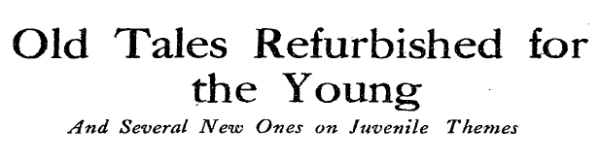
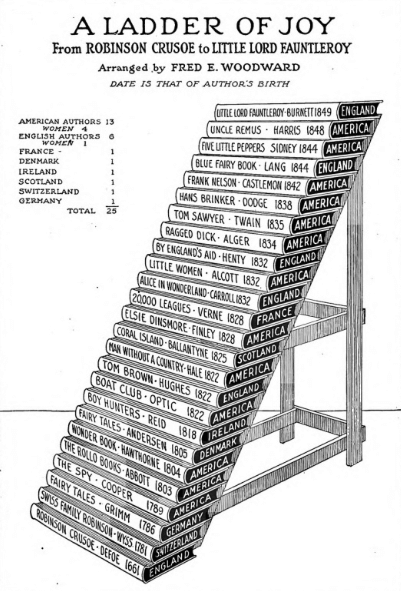
The New York Times weighs in on the children’s books of the season in the December 7 issue,**** the Library Journal give us a comprehensive list “designed merely for the convenience of children’s librarians in checking the fall and winter output” (not realizing that it might come in handy for bloggers a hundred years in the future too), and St. Nicholas’s November issue has a list of books for children that turn out to all be really old, but that’s OK with me because it’s accompanied by this cool graphic by one of my favorite 100-year-ago people, infographics pioneer Fred Woodward.
So plenty to work with, even with Publisher’s Weekly’s excellent roundup sadly having bitten the dust in 1922 and HathiTrust, my main source of 100-year-old books and magazines, infuriatingly having blocked access to a lot of books outside the U.S. for copyright reasons.*****
Fairy Tales, Nursery Rhymes, and Folk Tales
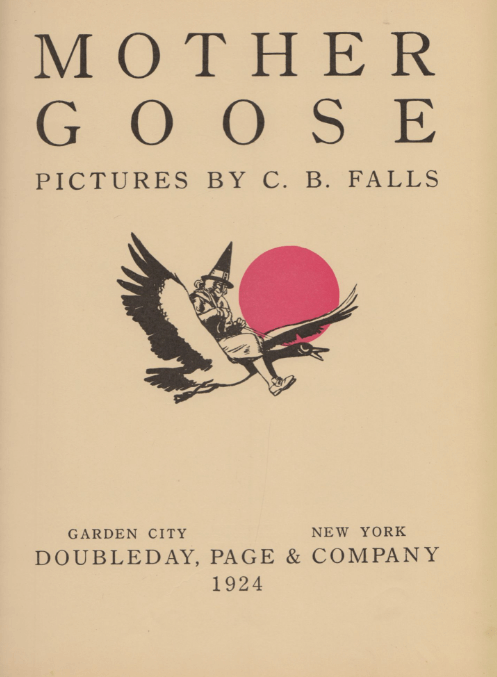
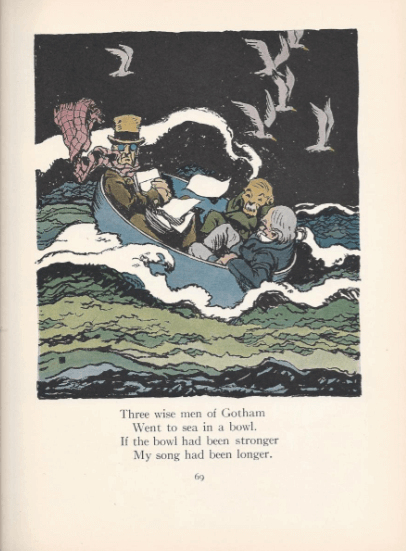
I was a fan of C.B. Falls’ 1923 offering The A B C Book, but I’m meh on his Mother Goose, as is Moore, who says, ““It is a book of distinguished appearance, but something highly important to little children is missing from its pictures—the quality that, differentiating Mother Goose characters from all others, makes them live again in a new way of their own.” The three men in the illustration of “Three Wise Men of Gotham” are, she points out, “easily recognizable as Wilson, Lloyd George, and Clemenceau.” I wasn’t familiar with this particular nursery rhyme, which turns out to be pretty horrifying.******
For Young Children
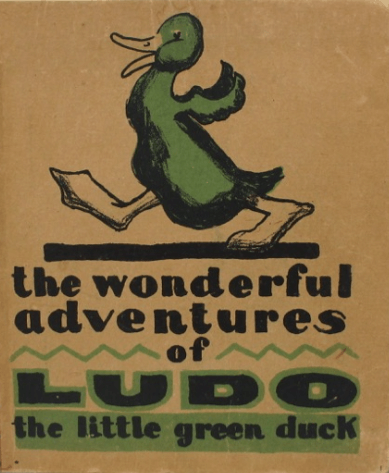
Moore praised Jack Roberts’ The Wonderful Adventures of Ludo the Little Green Duck, saying, “It’s gay, it’s fresh, and it’s different,” and adding, “It captured my imagination at a psychological moment, for the dummy came into my office on the last day of the Democratic Convention in Madison Square Garden.” I’m not sure what that means, but, hey, we’re all at a psychological moment, right? This was one of the books that was blocked by HathiTrust, but Ludo’s adventures take him around the world, and “around the world” plus “1924” generally equals “racist.” The online images I was able to find seemed to bear this out. (That’s Ludo in the Bookman headline with some of his new friends.)
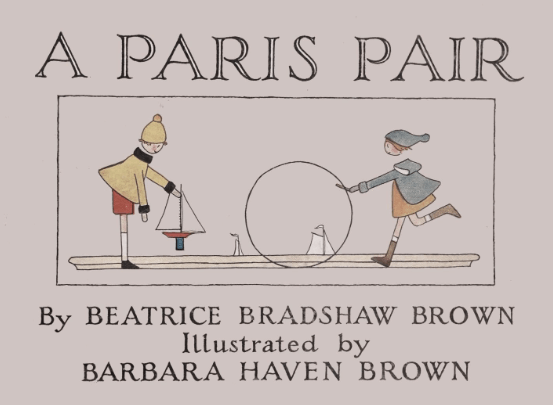
A Paris Pair: Their Day’s Doings by Beatrice Bradshaw Brown is, according to Moore, a “delightful, inexpensive book” that features “a clever verse in English for each hour in the day of two French children.” I did in fact find it pretty delightful, although going to the Louvre EVERY day sounds pretty exhausting. Here’s lunchtime:
LUNCHEON never comes too soon,
For we are nearly starved at noon!
Spinach and an omelette,
Salad, too, and better yet
Delicious jam with creamy cheese—
A dish that’s very sure to please!
Becoming gratitude they feel,
And thank le bon Dieu for their meal
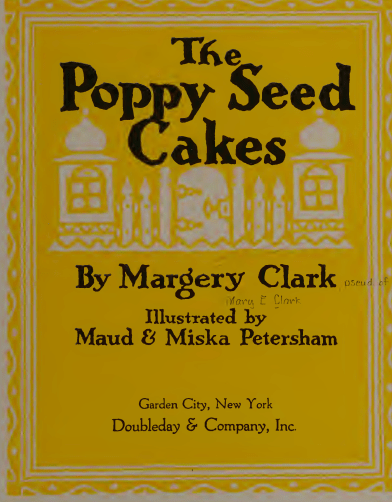
Moore calls The Poppy Seed Cakes by Margery Clark, illustrated by Maude and Miska Petersham, “certain to appeal to little children,” although I (admittedly not any kind of child) found the stories silly and some of the illustrations, like this one,
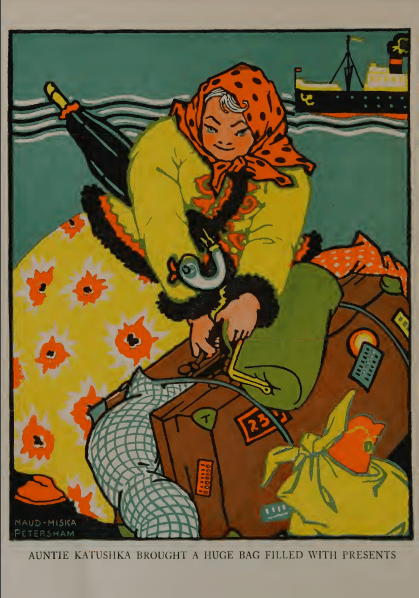
kind of sinister.
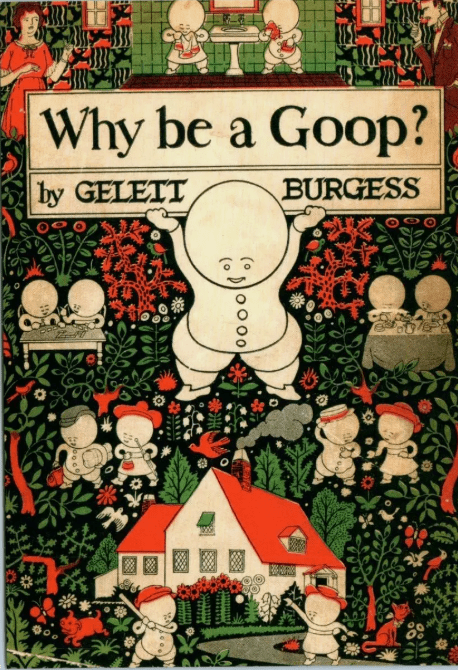
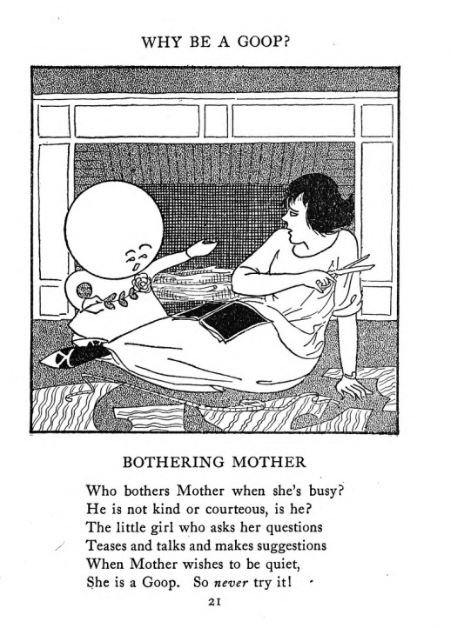
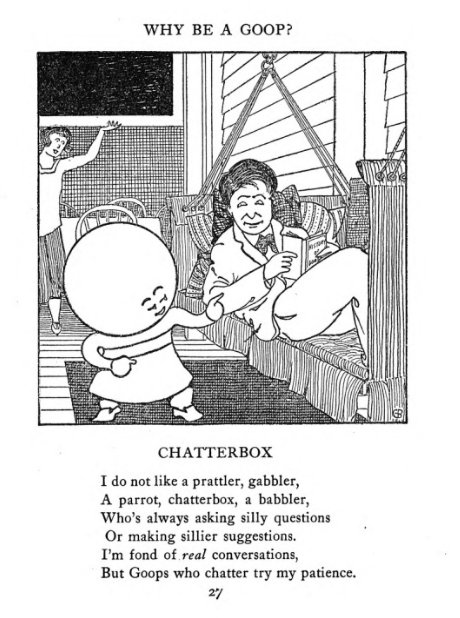
Why Be a Goop? is a late installment in Gelett Burgess’s series that started in 1900 with Goops and How to Be Them, which was a favorite of mine when I was little, although the Goops’ round heads freaked me out. In that book, the Goops did things like lick their fingers and lick their knives and generally lead “disgusting lives.” In this one, though, they seem to spend most of their time trying to get the attention of their negligent parents.
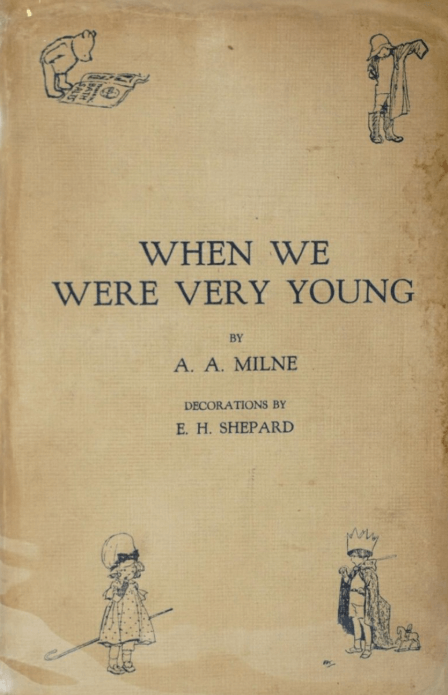
When We Were Very Young, A.A. Milne’s classic book of verses featuring Christopher Robin, surprisingly didn’t make it onto any of the lists, maybe because of its November publication date. I loved this book as a child. We had a record of the poems, too, and I can still recite some of them, like this one,*******
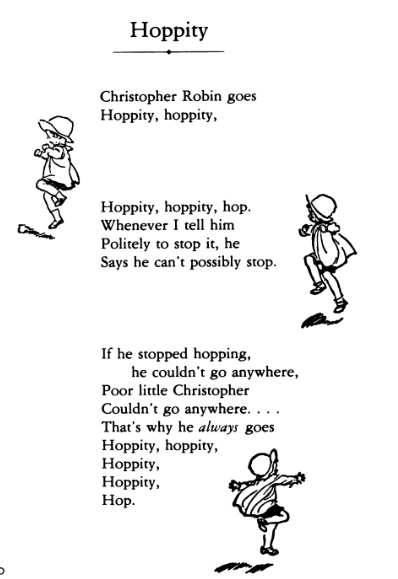
by heart.
For Middle-Grade Readers
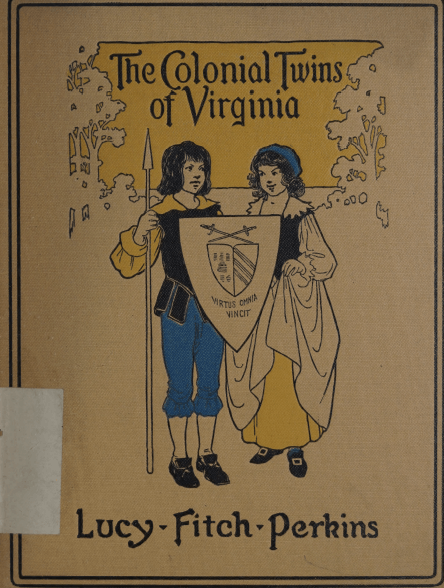
Its title alone would have DQ’d The Colonial Twins of Virginia, the latest installment in Lucy Fitch Perkins’s twins series, even if I hadn’t done a word search for “slave,” which yielded, among other things, one of the twins saying to the other, “One has to love people, and there aren’t any other people here to love except the slaves, and of course they don’t count.”
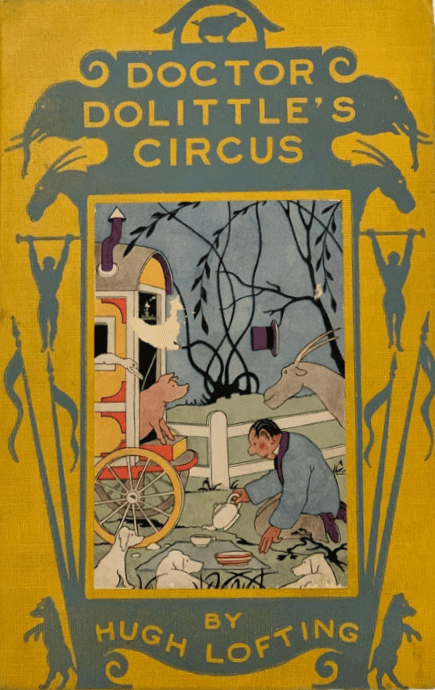
I didn’t have high hopes, but Dr. Dolittle’s Circus by Hugh Lofting appears to be one of the less offensive books` in the series (I wrote about previous installments here and here). Dr. D. comes to the aid of abused animals in a circus, including returning a seal to the sea.
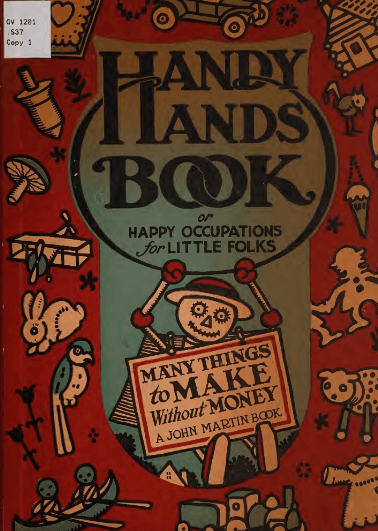
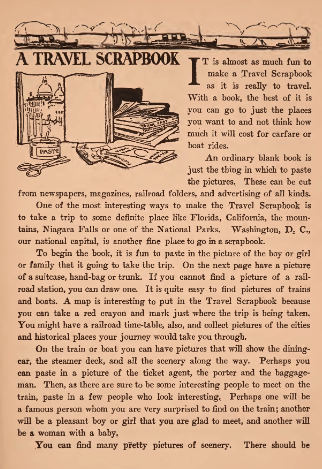
I loved activity books as a kid and am always on the lookout for a good hundred-year-old one. I’m not a fan of John Martin’s annual miscellany, so his Handy Hands Book was a pleasant surprise. I don’t buy Martin’s argument that “it is almost as much fun to make a Travel Scrapbook as it is really to travel” (unless maybe you’re stuck at DFW on Christmas Eve), but making a scrapbook of an imaginary journey does seem like fun.
For Older Children
Novels for high-school-aged children from a hundred years ago tend to be unbearably tedious, and this year’s were no exception.
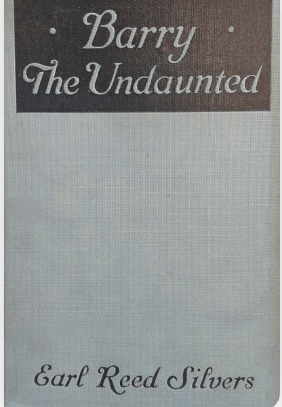
Moore describes Earl Silvers’ Barry the Undaunted as “a story of high school boys and girls with an element of civic interest,” and it’s about as thrill-packed as that makes it sound. I gave up early on, in the middle of a prolonged discussion between Barry (who is a girl) and her fellow campers about what rules their swim team should have.
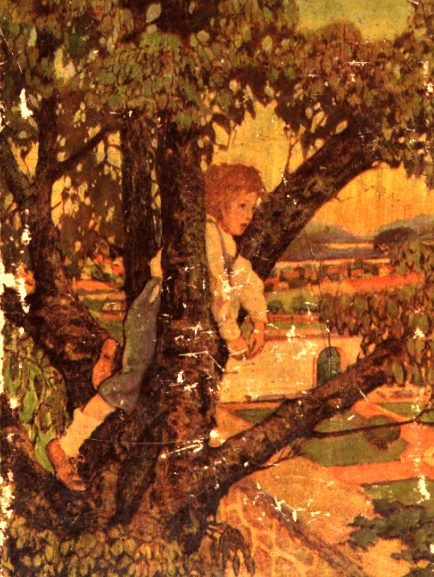
Moore quotes the introduction to Cornelia Meigs’ The New Moon as saying, “It might seem a tedious journey to walk at a sheep’s pace across the whole state of Pennsylvania.” Indeed it might, I say as someone who found a journey across half of the state of Pennsylvania in the passenger seat of a Prius pretty tedious. The journeyer is a boy who makes his way from Ireland to the American frontier. From a quick flip-through it struck me as more interesting than Meigs’ previous novels, but that’s not saying much.
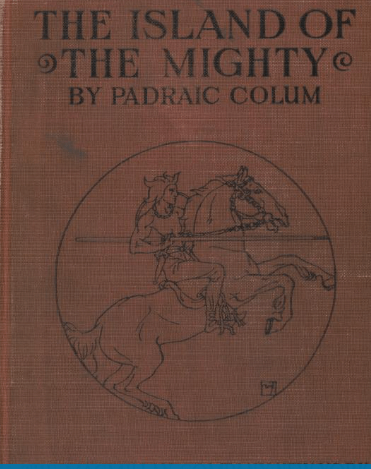
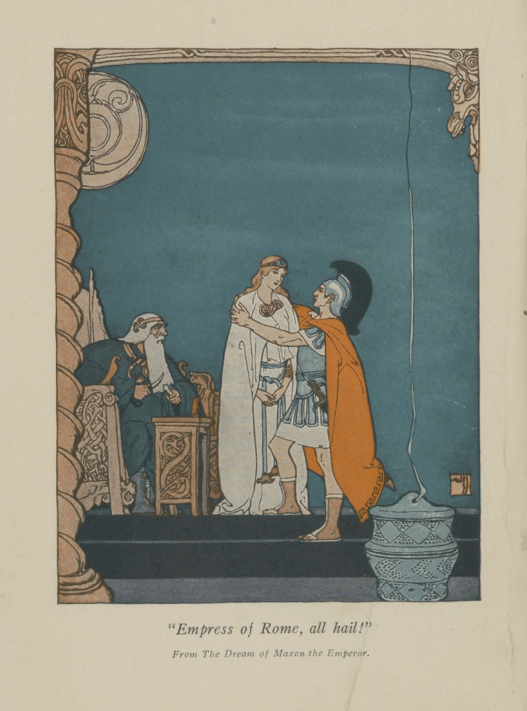
The first word of The Island of the Mighty, the book that Louise Hunting Seaman suggests that you accompany with a visit to the Hall of Armor at the Met, is “thus.” As “distinguished” as Moore finds it, I didn’t make it much further. Wilfred Jones’s illustrations are pretty cool, though.
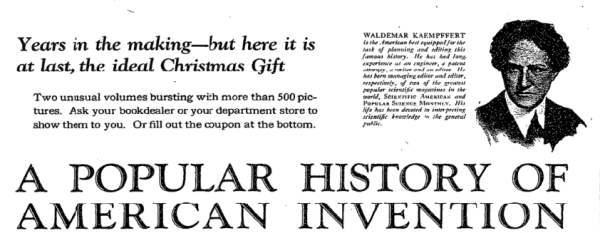
You will, this New York Times ad claims of Waldemar Kaempffert’s A Popular History of American Invention, “read these exciting volumes as you would a novel…You watch Goodyear in rags vulcanizing rubber over the kitchen stove; Davenport tearing up his wife’s one silk dress to insulate a motor.”
Oh no! I raced to find the horrifying scene:
“Tearfully but bravely the young wife handed to her boyish inventive husband, ‘Tom,’ the silk dress in which she had been married only eight years before. He needed it in his work as an inventor. It had been carefully folded away in lavender by the beautiful bride when, in 1827, Thomas Davenport, the active but studious village blacksmith of Brandon, Vt., had so far forgotten his profound interest in the ‘galvanic magnet’ of Joseph Henry as to fall in love and ‘settle down.’”
This is, I have to say, a lot more exciting than Cornelia Meigs.
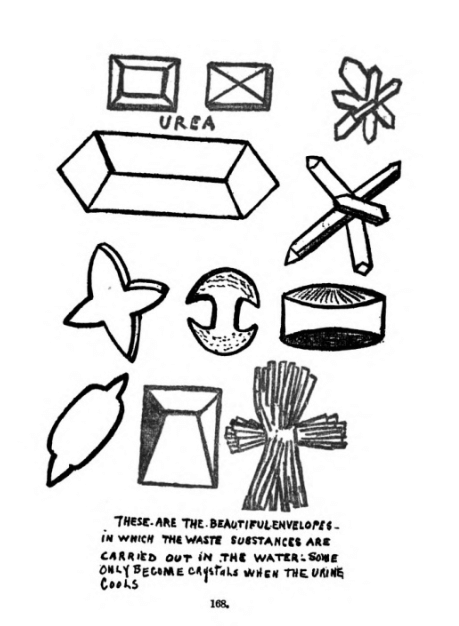
Moore calls Dr. W.T. Grenfell’s Yourself and Your Body “a unique and valuable book embodying Dr. Grenfell’s talks to his own children, with original and amusing drawings.” Grenfell, unsurprisingly, doesn’t cover ALL of your body, although there’s a chapter called “Waste,” which ends with, “Here ends this difficult chapter.” Here’s a cute drawing of urea:
Young Adults
Or the older children might just want to skip right up to reading adult books, like Agatha Christie, a favorite of my own mid- to late teens.
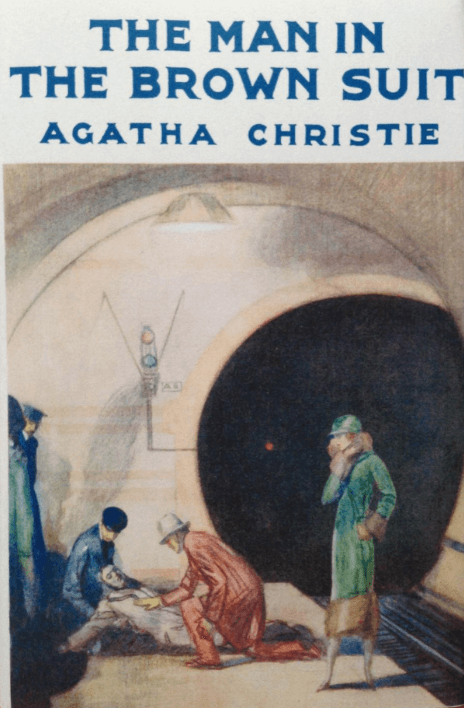
Some critics were disappointed that her latest novel, The Man in the Brown Suit, was a stand-alone thriller that didn’t figure Hercule Poirot, but it turns out to be partly set in Cape Town, which I’m pretty excited about.
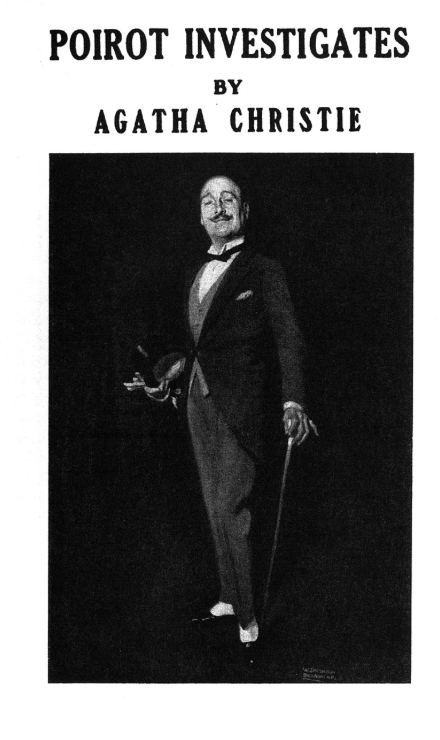
Plus, luckily for Poirot fans, there’s also her first short story collection, Poirot Investigates.
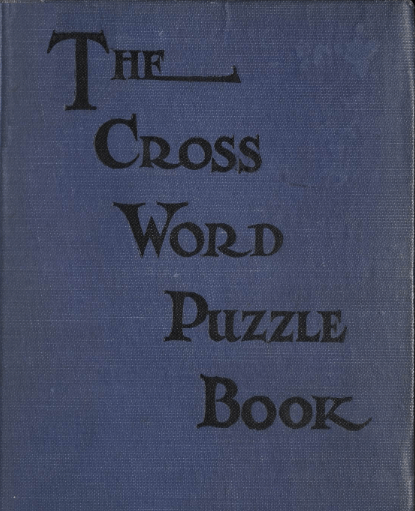
Number one on my 1924 wish list, and on the list of books I’m mad at HathiTrust for blocking in South Africa, is The Cross Word Puzzle Book, the first book of crossword puzzles ever and also Simon and Schuster’s first book ever. It launched a craze I have quite a bit of expertise on, since it featured prominently in my seventh-grade history paper “Fads of the 1920s.” (You can also get it at Project Gutenberg, but it’s not in the original format so you can’t print it out and do the puzzles yourself.) (UPDATE 12/24/2024: The Library of Congress has a PDF, but you can’t download it.)
Christmas Eve has given way to Christmas day and now Christmas night,********* and I’d love to curl up with a good cross word. Oh, well. Good thing I have Agatha Christie to keep me entertained.
Happy holidays, everyone!
*Although not, as people often assume, because I want to avoid the northern hemisphere winter. While people here are celebrating the holidays by having barbecues (braais in local parlance) or going to the beach, I’m dreaming of hot chocolate and long nights.
**Who, I see, has changed the name she writes under from Annie to Anne. I knew this was coming—Wikipedia says that she “officially changed her name to Anne in her fifties, to avoid confusion with Annie E. Moore, another woman who was also publishing material about juvenile libraries at that time.” In my opinion, ACM, who basically invented children’s libraries and children’s book reviewing, should have been the one to keep the i.
***I was going to say something snooty about Pinocchio being a marionette, not a puppet, but I looked into it and marionette is a subcategory of puppet.
****As always, there are a lot of reissued classics, which qualify for inclusion if they have new illustrations.
*****In the past, HathiTrust allowed worldwide access after 95 years, which is when copyright expires in the U.S., for most publications except U.K. periodicals.
******The Times, which is more of a fan than Moore, points out that Falls’s collection includes about three hundred verses “and must be comprehensive of all of them that are now extant.” There’s something to be said for selectivity.
*******Admittedly not a particularly complex piece of verse.
********The fake-sounding Martin turns out to have been a real person, although his actual name was Morgan van Roorbach Shepard, which would have been hard to squeeze onto the cover of all those books.
*********Don’t worry, I haven’t been doing this the WHOLE time.
 My Life 100 Years Ago