August in Washington, D.C., wound down in a very un-D.C. fashion, with moderate temperatures and low humidity, a far cry from the weather in late July when I went to the DC Open finals.* The women’s final, played in the afternoon after a long rain delay, felt like a battle to see which player could draw more of the humid air into her lungs. (Conditions were better for the men, who played at sunset after another long rain delay.)
DC Open winner Leylah Fernandez and finalist Anna Kalinskaya
I started my Labor Day weekend early by joining two friends for a swim at the Hearst Pool near the National Cathedral. This was my first visit to this pool, which opened in 2021, and only my second swim of the summer. As I swam leisurely laps and lazed on a lounge chair chatting with my friends, I regretted that I hadn’t spent more time at the pool.
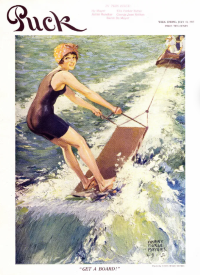
I decided to cut myself some slack, though, given that my summer started out as a Cape Town winter and along the way featured COVID in Dublin, a week visiting family in Colorado, and Hurricane Erin, which didn’t come as far north as DC but brought cloudy skies and cool weather. I’d celebrate the last days of summer, I decided, by taking a look at swimmers on the magazine covers of 1925.
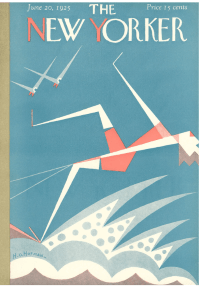
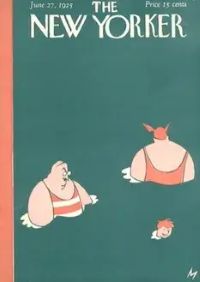
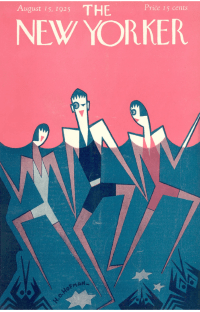
The New Yorker, in its first summer, went all-in on celebrating the joys of the surf.
H.O. Hofman, June 20, 1925Julian de Minskey, June 27, 1925H.O. Hofman, August 15, 1925
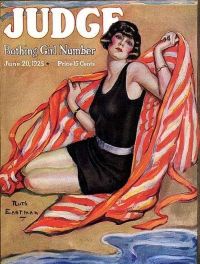
Judge was on board too.
Ruth EastmanGuy Hoff, August 1, 1925
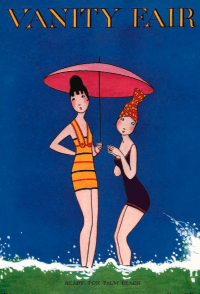
Vanity Fair was not to be outdone by Judge in the red wrap department.
Miguel Covarrubias, July 1925
Kids joined in the fun at the Saturday Evening Post.
Elberg McGran Jackson, July 24, 1925Charles McLellan, August 1, 1925
It struck me that, while the men and boys are still covered up on top, the women’s suits aren’t all that different from what you’d see at the beach or the pool these days. When I was growing up, all girls’ and women’s suits had higher-cut legs (if you wanted to be modest, you had to get one with a little skirt, which was kind of pointless because it would float up when you got into the water), but now you see all different kinds of suits, including ones like these.
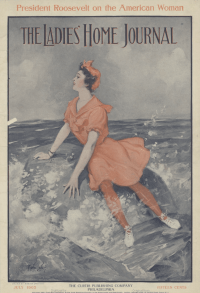
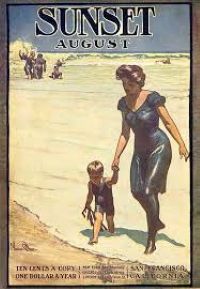
Women had to fight for the type of suits that you see on the 1925 covers. Twenty years before, bathing suits looked like this:
Martin Justice, July 1905Lafayette Maynard Dixon, August 1905
Stockings were on their way out by the mid-1910s,
Anne Harriet Fish, November 1915Harry Morse Meyers, July 18, 2015
but bare-legged swimming was still barred in some places. The outcry following the arrest of Olympic gold medalist Ethelda Bleibtrey for swimming “nude” (i.e. without stockings) at Manhattan Beach in Los Angeles in 1919 helped put an end to the leg-baring bans.
Ethelda Bleibtrey at Olympic Games, Antwerp, 1920.
By 1925, Life was poking fun at the similarity between men’s and women’s suits. (They would diverge again when men started bathing topless in the 1930s.)
Garrett Price, August 27, 1925
With Labor Day behind us and pools closed, swimming is a wistful memory.
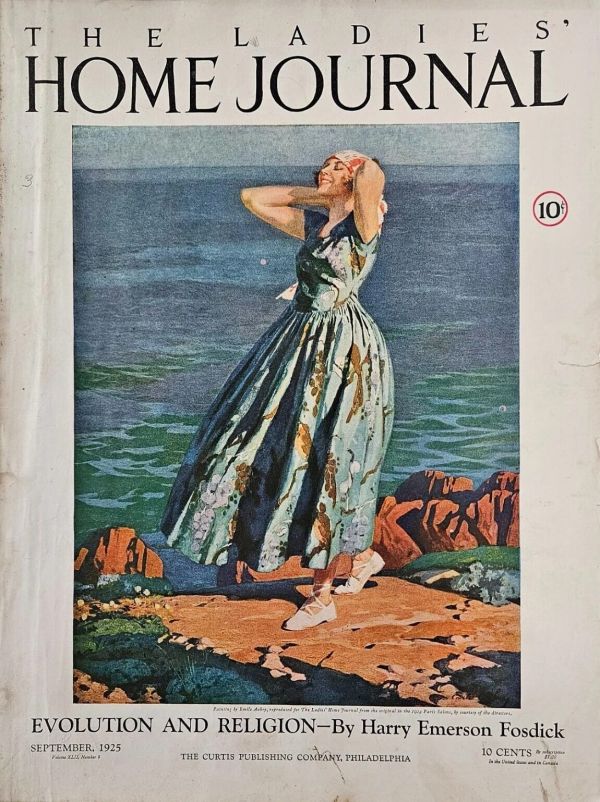
Emile Aubry, September 1925
As this woman reminds us, though, you don’t have to go in the water to enjoy the warm weather while it lasts.
*The tournament is officially called the [Corporate Sponsor 1] [Corporate Sponsor 2] DC Open, but I don’t have either the mental energy to remember all that or the desire to advertise these companies every time I mention it.
I recently went on on a trip from Cape Town to Washington, D.C., Seattle, North Cascades National Park, Seattle again, Denver, D.C. again, and then back home to Cape Town, all in three weeks. It was wonderful, but it was too much: too many airports, too many suitcases, too many weird bathroom setups. (Well, two, but that was two too many.) I kept saying to myself, “I’ll be so happy to just be able to hang out at home,” forgetting to take Cape Town winters into consideration and add, “provided that it doesn’t rain nonstop so that staying at home is the only option.”
I went out walking every day when the rain let up, hoping to make it home before the skies opened again. On one of these walks I looked up and saw a double rainbow, which lifted my spirits tremendously. Cape Town is unfortunately not a place where it’s wise to to take out your phone and start snapping away while walking along a busy road, so I don’t have a photo of it. But I assume you’re familiar with the concept.
I haven’t done a magazine illustration post in a while,* so I decided to pay tribute to that moment, and to summer from a Cape Town winter, with a rainbow of summer 1924 magazine covers.
First up in vivid red is Spanish illustrator Eduardo Garcia Benito’sJune Vanity Fair cover.**
Eduardo Garcia Benito, June 1924
Imposing a constraint, like “it has to be orange,” makes you expand your horizons. I wasn’t familiar with The Designer, although it must have had a large circulation if it was serializing Sinclair Lewis’s Arrowsmith.*** I wasn’t familiar with the cover artist, American illustrator Charles Allan Winter, either.
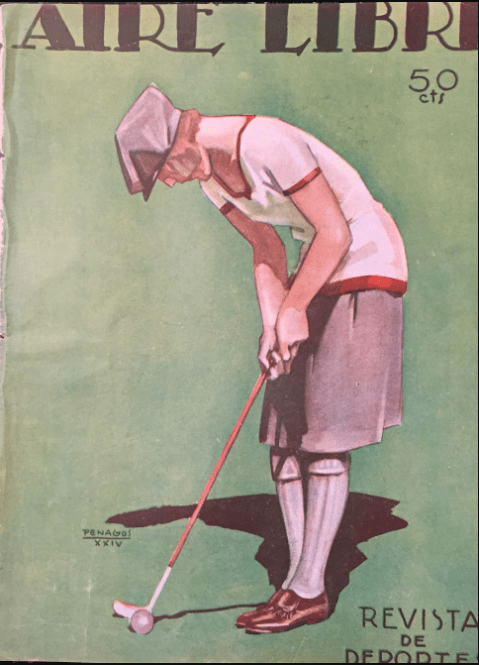
You can’t expand your horizons much further than to a short-lived Spanish sports magazine for which the only online reference I could find is a Catalan-language Wikipedia page that has been flagged for possible deletion. The illustrator, Spanish artist Rafael de Penagos, is new to me. He received a gold medal at the 1925 International Exhibition of Modern Decorative and Industrial Arts in Paris, from which Art Deco got its name (surprisingly, not until the 1960s).
Rafael de Panagos, July 1, 1924
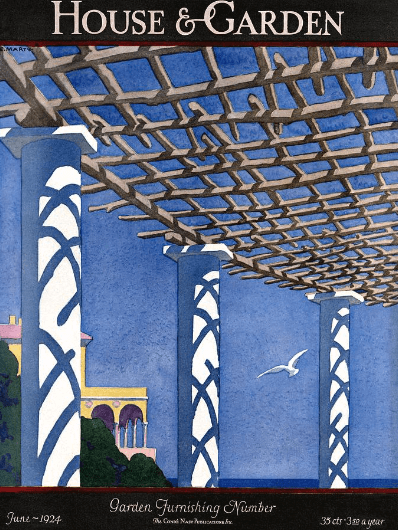
In vibrant blue, a House & Garden cover by French artist André Édouard Marty. Marty, not to be confused with leading French Communist Party member André Marty, was another leading figure in the Art Deco movement.
André Édouard Marty, June 1924
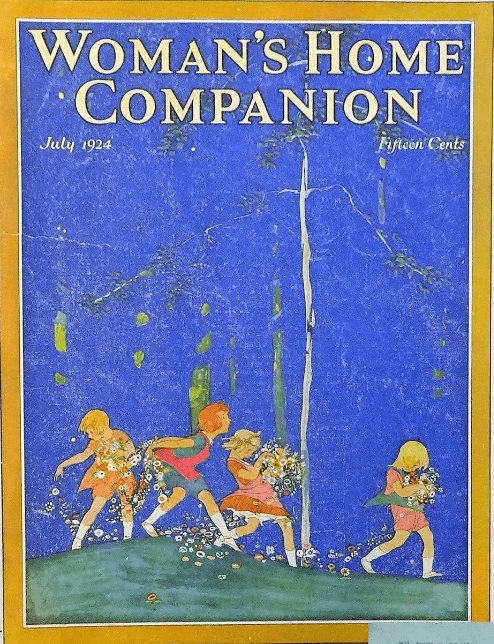
I’m not of the school of thought that indigo is a color of the rainbow, since squeezing it in between blue and purple throws off the symmetry, but I couldn’t resist these flower-strewing children, drawn by an artist I couldn’t identify.**** This issue of Woman’s Home Companion includes an essay on parenthood by F. Scott Fitzgerald, the last installment of Dorothy Canfield Fisher’s The Home-Maker, an ahead-of-its-time novel about a stay-at-home dad,***** and an illustrated story by N.C. Wyeth. Not bad for fifteen cents.
July 1924
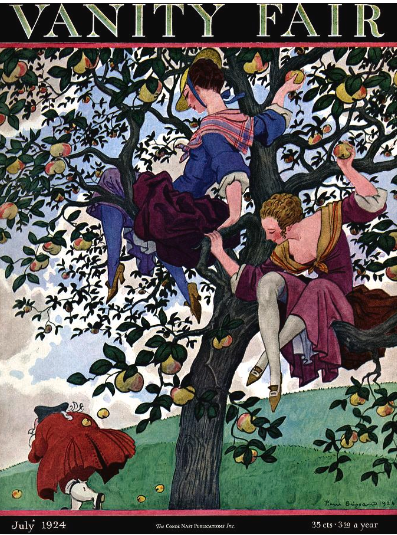
Here’s the purplest cover I could find, from Vogue regular Pierre Brissaud.******
Pierre Brissaud, July 1924
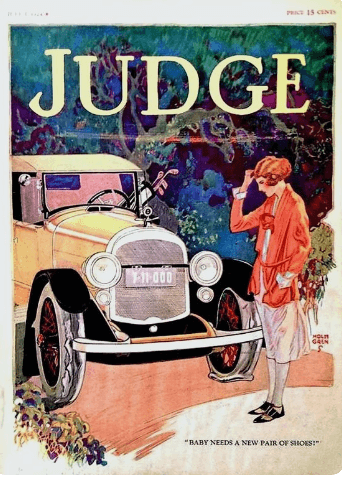
To wrap things up, here’s a cover by John Holmgren, yet another new-to-me artist, who managed to fit every color of the rainbow onto this Judge cover.
John Holmgren, July 5, 1924
But wait! This is just a SINGLE rainbow.
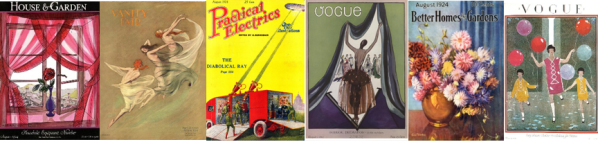
July slipped into August as I was working on this post, which gave me another month’s worth of magazine covers to work with. Now August is slipping away as well, and I’m back in Washington. At this rate, the leaves will be falling off the trees by the time I post this if I write about each one, so here they all are:
House and Garden: Joseph B. Platt. Vanity Fair: Warren Davis (back to his old tricks). Vogue (green): George Wolfe Plank. Vogue (purple): Harriet Meserole. Other artists unknown.
Enjoy the end of summer (or, if you’re in Cape Town, FINALLY the end of winter), everyone!
*Or any other post, for that matter.
**There’s a truly bonkers essay by D.H. Lawrence in this issue called “On Being a Man.” It starts out with a racist account of sitting on a train with an African American man and segues into a discussion of why marriage is literally hell.
***Lewis won, and rejected, the 1926 Pulitzer for Arrowsmith. In a written statement, he objected to the criteria for which the prize was awarded: “for the American novel published during the year which shall best present the wholesome atmosphere of American life, and the highest standard of American manners and manhood.” I’m with Lewis on this, although some said that he was just miffed that he hadn’t won the award for Main Street, published in 1921.
****ChatGPT claimed that the cover artist was Charles Dana Gibson, which I didn’t buy. I asked for a source for this information, and it said, oh, sorry, it’s actually Frances Tipton Hunter. This sounded more plausible but I still wasn’t convinced, so I asked again for the source, at which point ChatGPT threw up its hands and admitted that it was just making stuff up.
Happy Thanksgiving, everyone! Or, to be more precise, happy day after Thanksgiving. As I was cooking yesterday, I was mildly stressing out about whether I would have time to post this on the actual day. Then it occurred to me that it was highly unlikely that anyone would stop in the middle of cooking, eating, watching football, or whatever and say to their loved ones, “I have to check to see if there are any late-breaking blog posts.”
J.C. Leyendecker is best known for his New Year’s babies, but his Thanksgiving covers were also a regular feature at the Saturday Evening Post. This one is titled “Trading for a Turkey.” Thanksgiving is a more fraught holiday than New Year’s, though, and, even though the story about the Dutch buying the island of Manhattan from the Indians for $24 worth of beads turns out not to be true, this reminder of it still made me uncomfortable.
J.C. Leyendecker, December 1, 1923
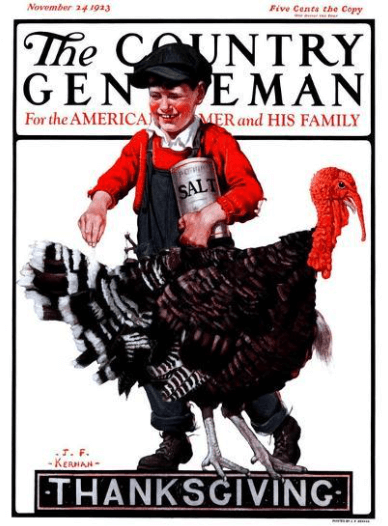
Speaking of the New Year’s babies, this J.F. Kernan Country Gentleman cover recalls Leyendecker’s 1922 cover, also featuring a bird’s tail being salted.
J.F. Kernan, November 14, 1923J.C. Leyendecker, December 31, 1921
For those of you who haven’t been following along, salting a bird’s tail is supposed to render it temporarily incapable of flying. So the New Year’s baby is trying to make sure the dove of peace doesn’t fly away. The Country Gentleman boy is presumably, more prosaically, trying to get the bird to stay still so he can eat it for Thanksgiving dinner. Or maybe he’s just pre-salting it.
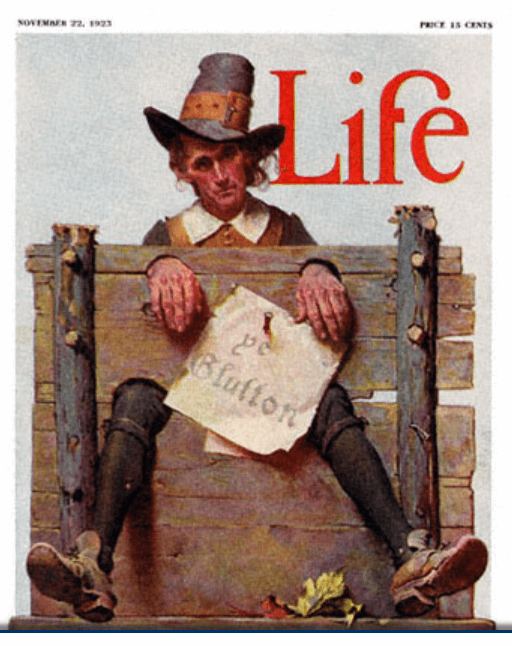
With Leyendecker doing the honors at the Saturday Evening Post, Norman Rockwell was over at Life depicting a svelte Pilgrim in the stocks for gluttony.
Rival humor magazine Life took a more risqué approach to the holiday with an Enoch Bolles cover titled “Turkey with Very Little Dressing.”*
Enoch Bolles, November 24, 1923
That was all I could find as far as actual Thanksgiving covers go, but this Fruit, Garden and Home cover has a nice autumn feel.**
And last but not least, happy 50th anniversary to St. Nicholas magazine! “Is there any doubt that in the thoughts of thousands and thousands, old and young, who have read and to-day are reading its pages, ST. NICHOLAS will be numbered among the blessings for which they are grateful on Thanksgiving day?” the magazine asks, not stopping to wait for an answer.***
As for me, I’ll take a moment to give thanks for the wonderful magazines of 1923–yes, including you, St. Nicholas!
*When I was working on the post on summer 1923 magazine covers, I went down a research rabbit hole about Enoch Bolles (whose Judge cover I didn’t end up using) and learned that we were once neighbors of sorts—he was a long-term patient at a psychiatric hospital a few miles away from where my family lived in New Jersey in the 1960s.
**Again for those of you who haven’t been following along, this excellent title was changed to Better Homes and Gardens in 1924.
***Speaking of rabbit holes, I tried to figure out the vintage of the magazine (presumably from her own childhood) that the woman is reading, and therefore whether she is Mom or Grandma, but I couldn’t find any covers that resembled this one.
The children’s books holiday shopping guide was going to be my farewell to 1920, but I’m back in Cape Town after an unexpectedly long sojourn in DC, and while all my friends there are longing for summer weather and the beach I’m pining for snow.*
And where better to find snow (in Cape Town, anyway) than on the cover of a December 1920 magazine?
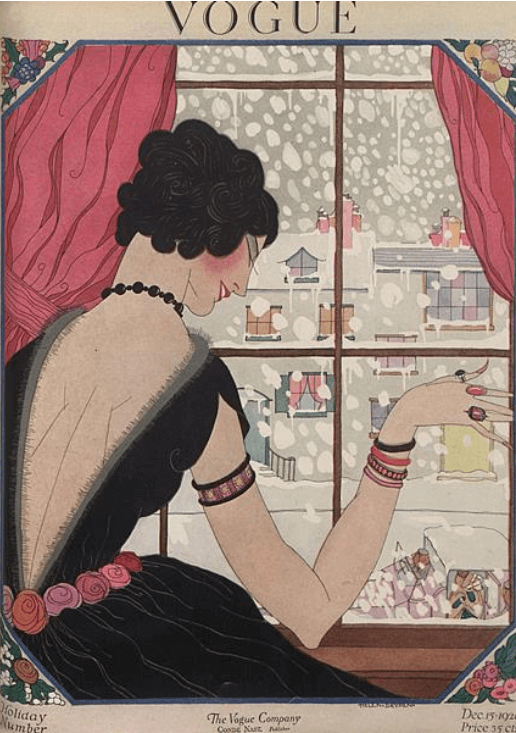
The award for snowiest magazine cover goes to Helen Dryden at Vogue,
December 15, 1920
followed by Motor,
Scribner’s,
and The Farmer’s Wife, which consistently punches above its weight cover-wise.
Leroy Jansen
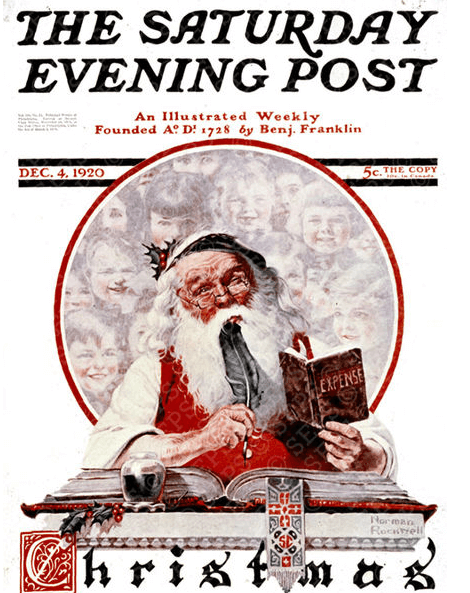
Santa makes an appearance on the Saturday Evening Post’s Norman Rockwell cover,
December 4, 1920
on the Ladies’ Home Journal,
and, naturally, on St. Nicholas.
One of Santa’s helpers is hard at work on the Saturday Evening Post.
J.C. Leyendecker, December 25, 1920
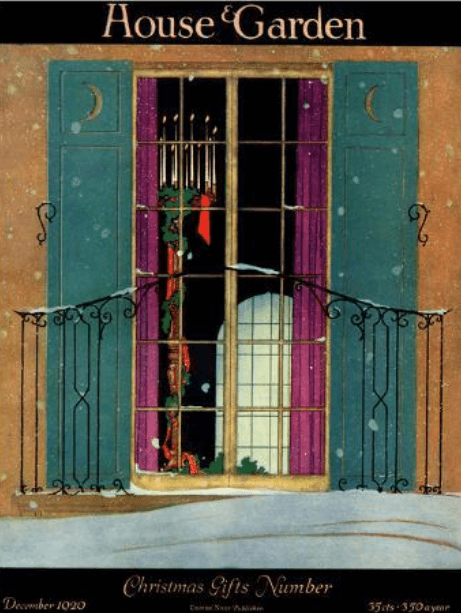
There’s holiday greenery at Modern Priscilla
Blanche K. Brink
and Century
and House & Garden.
Henry Richardson
They’re wrapping presents at Woman’s Home Companion
and hoping for presents at Literary Digest.
Norman Rockwell
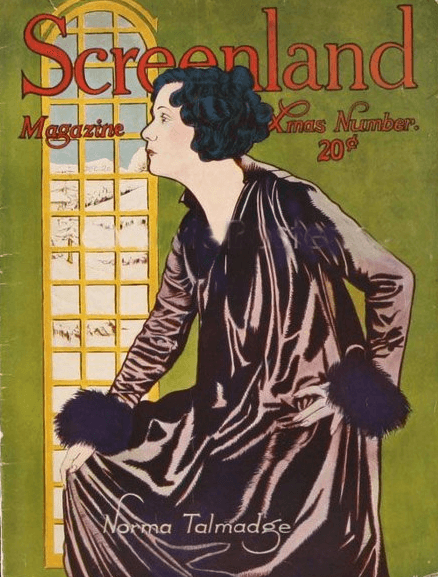
Screenland
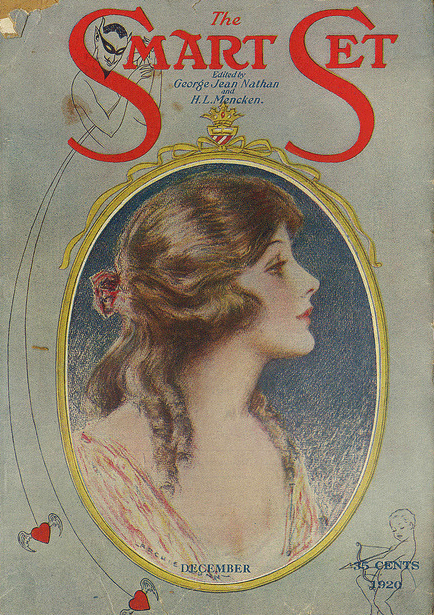
and The Smart Set
pay halfhearted tribute to the holidays with red-and-green color schemes.
Children on Norman Rockwell’s Life cover ask, “Is he coming?”,
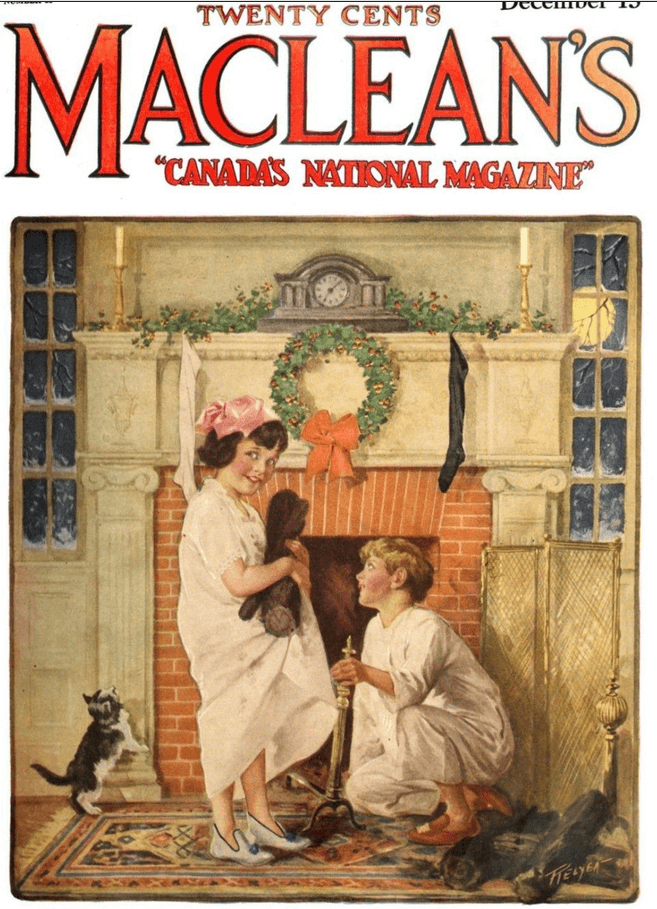
along with the children on Maclean’s up in Canada
and millions of children around the world tonight, and a hundred years ago tonight.
Happy holidays to all!
*Not that they actually have snow in DC at the moment, or pretty much ever at Christmas, but it did snow a week after I left. Which quickly turned into slush and then into ice, as my friends, who have little patience for my foul-weather nostalgia, were quick to remind me.































 My Life 100 Years Ago