Tag Archives: 1918

A pioneering 1918 infographic, worth a thousand words

Words! So. Many. Words. Mine, and the 1918 people’s. I need a break.

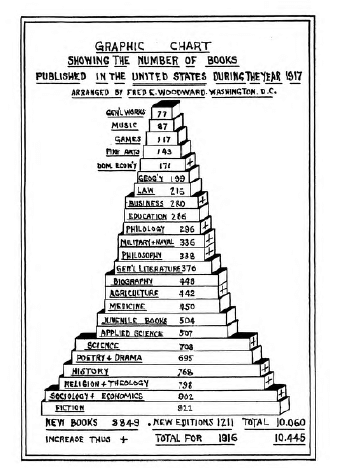
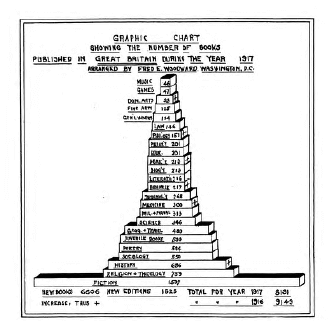
The April 1918 issue of The Bookman has just the thing: a graphic about book publication in the United States and Great Britain. And a picture is worth a thousand words, which is the length that my typical post has swollen to these days.

Here are the stats for books published in the U.S. in 1917:

And in Great Britain:

In the accompanying article, Fred E. Woodward, who drew the graphic, points out that

a single glance at the two charts reveals a notable difference between the two figures, the one representing the books of the United States being an almost symmetrical pyramid endued with the appearance of stability and a certain element of vigor and strength, while the one representing Great Britain exhibits an enormous overplus of works of fiction as compared to the remaining classes.

Interesting. Not so interestingly, Woodward goes on to explain the charts at length, which kind of defeats the purpose of a chart. But I can forgive him a lot because, as far as I can tell, he is basically inventing information graphics here. (I did some research and found some earlier examples, going back to a depiction by J.J. Sylvester of chemical bonds and their mathematic properties in Nature magazine in 1878.* So let’s just say Woodward was inventing fun infographics.**)

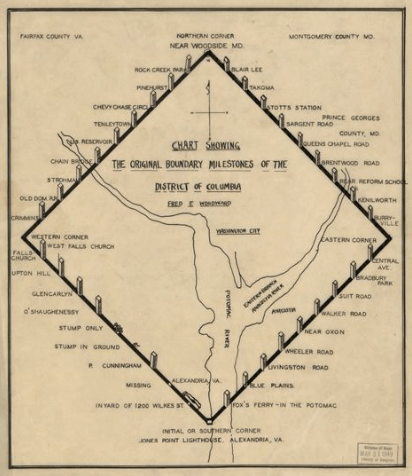
Chart showing the original boundary milestones of the District of Columbia, Fred E. Woodward, 1906 (Library of Congress)

Fred Woodward really, really liked drawing infographics about books. He did a way more complicated one in the April 1917 issue of The Bookman, and, also in 1917, wrote a graphic pamphlet on book sales for the U.S. Bureau of Education. Woodward also wrote a 1907 book called A Ramble Along the Boundary Stones of the District of Columbia with a Camera. I’m going to D.C. soon and, believe me, I’m going to be rambling along those boundary stones.

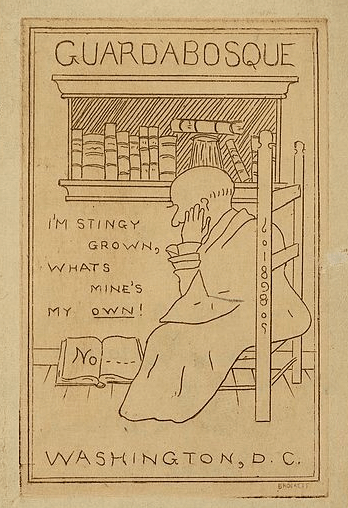
Bookplate of Fred E. Woodward, Washington, D.C., 1898 (Library of Congress)

The Library of Congress has this 1898 bookplate of Woodward’s (drawn by someone else, though) in its collection.  “Guardabosque” is a play on his name—it means forest ranger in Spanish, which is apparently the original meaning of Woodward. According to the LOC, there’s an inscription on the back saying that Woodward was the head of the books department at Woodward & Lothrop in Washington. A little more sleuthing revealed that he was the younger brother of the founder of the iconic, and now sadly out of business, department store.*** He’s apparently no relation, though, to graphic artist Fred Woodward, formerly the art director of Rolling Stone and now at GQ.

I was going to hold forth about how few books were published 100 years ago compared to now, but, you know, words. So here’s an infographic:

(Source, 1917: The Bookman magazine, April 1918. Source, 2015: International Publishers Association Annual Report, 2016.)

I realize that this is an apples-and-oranges situation in terms of comparisons. And that I’m no Fred Woodward (either one) infographics-wise.

Still, you get the picture.

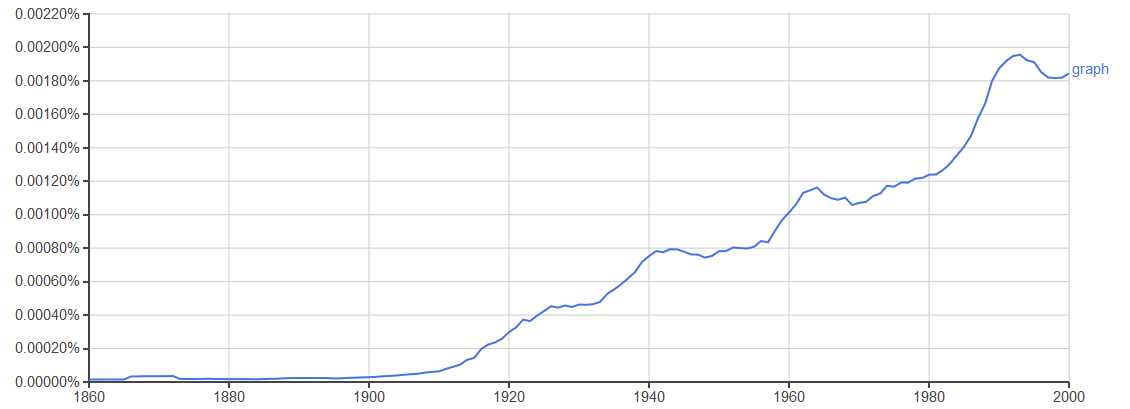
*Sylvester, as it turns out, coined the word “graph” in another 1878 Nature article. This is even more amazing than there having been no such word as “surreal” in 1918. If you don’t believe that “graph” is so new, which I didn’t, here’s the Google N-Gram:

**I realize that Woodward probably wasn’t doing this all by himself. Please be in touch if you know of other examples!

***I have wonderful memories of going Christmas shopping in the children’s castle at Woodies (as we D.C. cognoscenti call it) in the 1970s.

Thursday Miscellany: Lady soldiers (ha ha!), a Vogue retread, a fed-up doctor, and an Erté duel

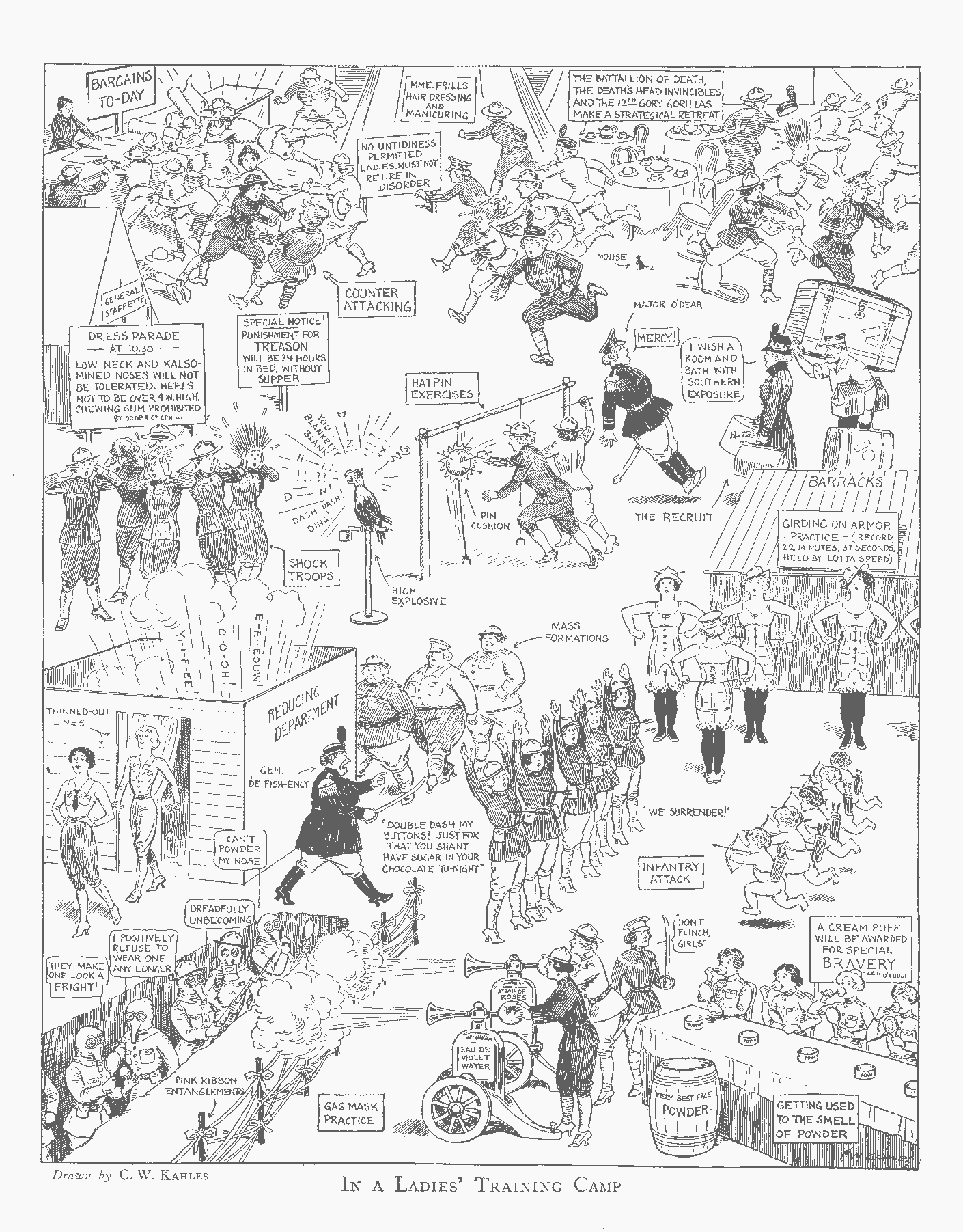
Ha ha, lady soldiers! I was going to ask C.W. Kahles if he’d ever heard of Russia’s all-woman Battalion of Death, but there they are in the upper right corner, running away from a mouse.

Judge magazine, April 20, 1918

This April 1918 Vogue cover, the only repeat in the magazine’s history, first ran in November 1911. It’s worth a second look.

Nutritionist/FDA founder/Poison Squad leader Dr. Harvey Wiley is back, with some sensible child-rearing advice. He often seems like a time traveler from a future era, full of “I can’t believe I’m stuck in this stupid century” exasperation.

Dr. Wiley’s Question Box, Good Housekeeping, April 1918

One of the most pleasant surprises about 1918 is the bright and modern decor. I want to live in this bungalow.

The Delineator, April 1918

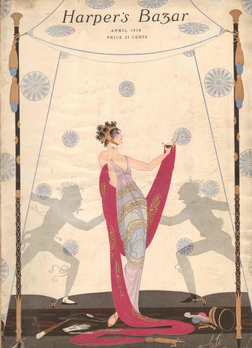
There’s often something vaguely sinister lurking under the surface of Erté’s gorgeous magazine covers. This one, titled “The Duel,” is more unsettling than most.

Insurgent Youth: The literary generation gap in 1918

“There is a vendetta between the generations.”

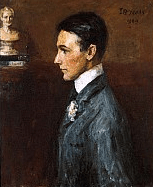
John Butler Yeats portrait of Van Wyck Brooks, 1909.

Portrait of Van Wyck Brooks by John Butler Yeats, 1909

So said critic Van Wyck Brooks in The Dial on April 11, 1918. (UPDATE 12/22/2020: Reading this again, I see that the actual quote is “There is a vendetta between the two generations.”) Randolph Bourne, a colleague of Brooks’ at the magazine, addressed the same theme in his March 28 essay “Traps for the Unwary,” asking

What place is there to be for the younger American writers who have broken the “genteel” tradition?…Read Mr. Brownell on standards and see with what a bewildered contempt one of the most vigorous and gentlemanly survivals from the genteel tradition regards the efforts of the would-be literary artists of today.*

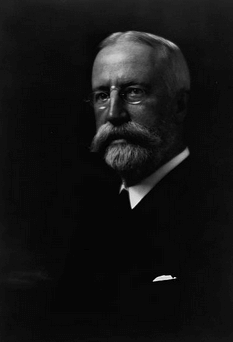
William Crary Brownell, date unknown (Library of Congress)

So I read Mr. Brownell on standards. (William Crary Brownell, that is. 1918 writers have an irritating habit of referring to people on first introduction as Mr. or Mrs. or Miss Last Name.) He was, it seems, a founding figure in American literary criticism, having sought to raise the country’s level of criticism as Matthew Arnold had in Britain. H.L. Mencken called Brownell “The Aristotle of Amherst”—not one of his better sallies, IMHO.

Brownell’s thesis in a nutshell: standards are important, but the younger generation doesn’t have them. He singles out “a recent clever novel—by a lady—that has evoked a very general chorus of cordial appreciation.” After quoting from a passage about a guy clipping his toenails, without providing the name of the book or author (another annoying 1918 habit), he says that

the picture is manifestly less a gem of genre than a defiance of decorum…One must draw the line somewhere and it is decorous to draw it on the hither side of the purlieus of pornography.

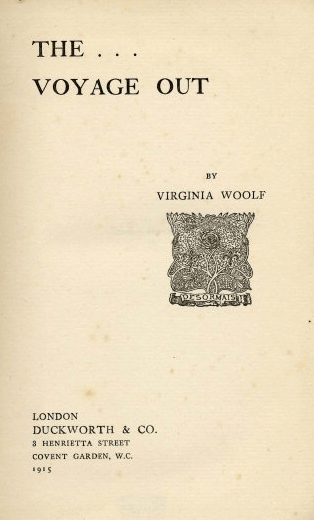
The lady writer, it turns out, is Virginia Woolf, and the book is her first novel, The Voyage Out.

First edition of Virginia Woolf’s The Voyage Out, Duckworth & Co., London, 1915

Brownell’s pretty boring, to be honest. Columbia professor Brander Matthews is a more entertaining old fogey. In his essay “The Tocsin of Revolt”,** in the March 1918 issue of The Art World, he says that

when a man finds himself at last slowly climbing the slopes that lead to the lonely peak of three-score-and-ten he is likely to discover that his views and his aspirations are not in accord with those held by men still living leisurely in the foothills of youth…If he is wise, he warns himself against the danger of becoming a mere praiser of past times; and if he is very wise he makes every effort to understand and to appreciate the present and not to dread the future.

Brander Matthews, date unknown

The young and old have clashed since time immemorial, Matthews says—and the survival of art depends on these very battles. This is all very sensible, and I wondered what Matthews was doing in such a reactionary magazine.

But!

But at the present moment, and perhaps more especially in our own country, there are signs of danger.

Uh-oh! Like what?

In this new century we have been called upon to admire painting by men who have never learned how to paint, dancing by women who have never learned how to dance, verse by persons of both sexes who have never acquired the elements of versification.

Matthews ends on a hopeful note. Ultimately, he believes, the younger generation

will tire of facile eccentricity and of lazy freakishness, of unprofitable sensationalism and undisciplined individualism. They will again seek the aid of tradition and they will toil to master the secrets of technic.***.

Bourne, a Columbia graduate himself, says of Matthews in a March 14 review of his autobiography that he was “incorrigibly anecdotal, genial, and curious.” He marvels, though, at his portrait of Columbia, then being torn apart by a free-speech controversy, as a paradise of harmoniousness. Ultimately, he delivers a damning verdict:

If there was ever a man of letters whose mind moved submerged far below the significant literary currents of the time, that is the man revealed in this book.

Columbia University library, 1917 (librarypostcards.blogspot.com)

Of Brownell, Bourne says in “Traps for the Unwary” that

one can admire the intellectual acuteness and sound moral sense…and yet feel how quaintly irrelevant for our purposes is an idea of the good, the true, and the beautiful.

Bourne agrees with Brownell and Matthews that standards are important, and that young people are turning out a lot of junk. The problem, he says, is that the older critics lump all young people together. What’s needed is a new criticism, focused on the younger generation, that

shall be both severe and encouraging. It will be obtained when the artist himself has turned critic and set to work to discover and interpret in others the motives and values and efforts he feels in himself.

In the natural order of things, Bourne could have been a standard-bearer for this new criticism after Brownell and Matthews passed on. But the two elders would survive for another decade, while Bourne had only months to live. Having battled disability and chronic illness throughout his life, he succumbed to influenza on December 22, 1918.****

If Bourne didn’t have the chance to build this new criticism, though, others did—first and foremost T.S. Eliot, who, across the Atlantic, was perfecting his craft as both a poet and a critic.

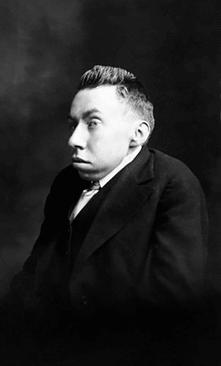
Randolph Bourne, date unknown

*The young generation was, I should note, fairly long in the tooth. Brooks was 32 and Bourne was 31. Other members of this literary youthquake included Ezra Pound (32), Margaret Anderson (31), T.S. Eliot (29), and John Reed (30). Meanwhile, much of the actual younger generation—21-year-old F. Scott Fitzgerald and 18-year-old Ernest Hemingway, for example—was off fighting in France. (UPDATE 11/17/1918: Actually, neither of them was fighting in France. Fitzgerald a lieutenant in the army but the war ended before he was sent overseas. Hemingway was an ambulance driver in Italy.)

**I think he means toxin. Matthews was an advocate of simplified spelling, so that may be the issue, although I never thought of “toxin” as particularly complicated. (UPDATE 12/16/1918: I came across “tocsin” in the New York Times and it turns out to mean a warning bell. Some dictionaries now consider it archaic.)

***Or technique, as we old-fashioned spellers call it.

****You can learn more about this brilliant thinker, and also about Walter Lippman, Alice Paul, John Reed, and Max Eastman, in Young Radicals, a wonderful book by Jeremy McCarter, co-author of Hamilton: The Revolution.

Thursday Miscellany: an eight-year-old writer, a Vanity Fair harlequin, and toasted cigarettes

(I’m changing my schedule from M-W-F to Tu-Th-Sat, so Wednesday Miscellany is now Thursday Miscellany.)

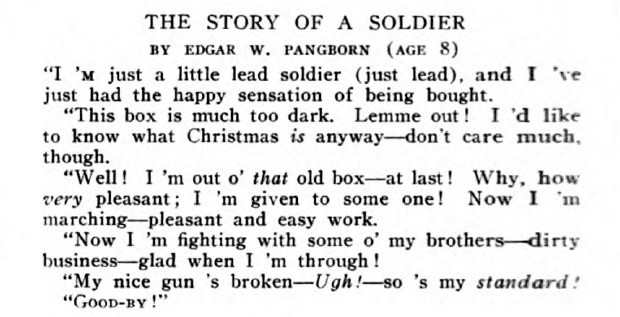
This story was a submission to a contest in St. Nicholas magazine. Even if you don’t read it as an allegory of a doomed WWI soldier–and it’s hard not to–it seems way too good to have been written by an eight-year-old. I Googled Edgar Pangborn,  and it turns out that he went on to become a science fiction writer who was one of the founders of the “humanist” school and served as an inspiration to Ursula Le Guin.*

St. Nicholas magazine, April 1918

Oh, how sweet! My boyfriend killed someone!

Ladies’ Home Journal, April 1918

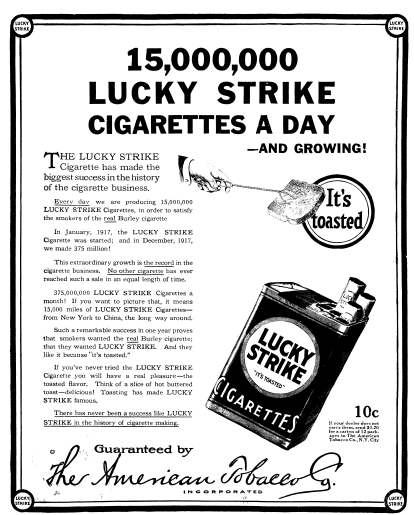
In case you thought, like I did, that Don Draper made up “It’s toasted” in 1960.

Judge magazine, March 2, 1918

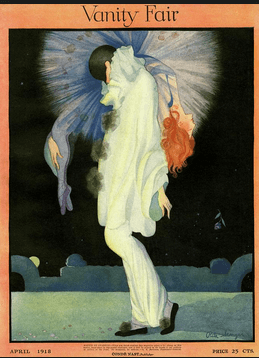
And finally, a harlequin and a ballerina on Rita Senger’s April 1918 Vanity Fair cover.

*He’s going to be hard to top as the youngest person I run across in My Year in 1918 who will go on to later fame.

My 1918 Bedside Bookshelf

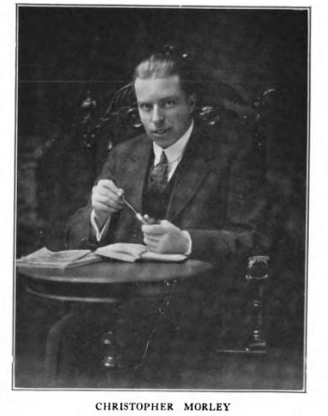
Christopher Morley was one of those famous-in-their-time people no one has heard of today.* In 1918, the hardworking twenty-seven-year-old had just published Parnassus on Wheels, his first novel, and a book of light verse called Songs for a Little House,** and he had a book of essays coming out. He was also the literary editor of Ladies’ Home Journal.

The Bookman, February 1918

In a piece in the February 1918 issue of The Bookman (originally published in the New York Sun), Morley stirred up quite a kerfuffle. The issue: what books you should choose for your guest room. “Let us assume that many of your guests are of the male sex and have the habit of reading in bed,” he writes. “You keep a reading lamp by the bed, of course, and a bookshelf. What thirty volumes would you choose to fill that shelf?”

Of course, Morley doesn’t really want to know what books YOU’D choose. He wants to tell you what books HE’D choose. As advertised, they’re pretty manly. Robert Louis Stevenson, Arthur Conan Doyle, Joseph Conrad, Rudyard Kipling. Plus some manly-sounding books I never heard of, like The Adventures of Captain Kettle and Casuals of the Sea. You can read the rest of the list here. Morley writes that

I find that for such strollers, wastrels and errant persons as frequent my house, this is a fairly well-selected guest-room library. I wonder if your readers will concur.

They didn’t. Harold Crawford Stearns sent in a list, published in March, that only had one duplicate with Morley’s, the Bible. It was equally manly, though. In April, D.M.T. Willis argued that Morley had chosen not bedtime books but “books that one wants to read when wide awake on a cold afternoon before the fire, or in a hammock under trees in warm weather.”

Bedtime reading, he says,

seems to me like the intense desire to eat candy one experiences immediately after church service, a sort of reactive indulgence, a kind of “now-I-can-do-as-I-please-for-the-rest-of-the-night” feeling.

My sentiments exactly!

Willis includes little blurbs with his list, like, “The Rubaiyat. Because every man and most women sometime at night want to feel as happy-go-lucky and sentimental as Omar,” and “The Bible, because some one might read it and become a poet.” His list is as lacking as Morley’s in women authors, but he’s such a charming blurber that I would totally stay at his house.

As for the contribution from Edward O’Brien, the editor of the Best American Short Stories series, all I can say is, really, Edward? The Canterbury Tales? At bedtime? I checked out another one of his choices, Religio Poetae, by Coventry Patmore. Here’s how the title essay starts:

No one, probably, has ever found his life permanently affected by any truth of which he has been unable to obtain a real apprehension, which, as I have elsewhere shown, is quite a different thing from real comprehension.

Zzzzzz.

The Bookman, to its credit, is snarky about Morley’s gender policy, saying in April that

Mr. Morley’s guest-room is apparently adapted solely to the needs of his male friends—or is it that his women visitors are of the kind that do not read?***

Finally, some women, identifying themselves as “Two Old Maids,” weigh in, and at last we have a handful of women authors: Jane Addams, Edna Ferber, and Lady Montagu.

Of course, I’m just like Christopher Morley: the real reason I’m writing about this is to give you MY 1918 guest room bookshelf list.

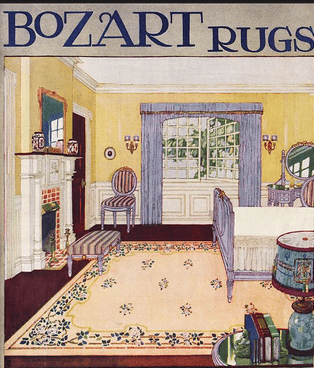
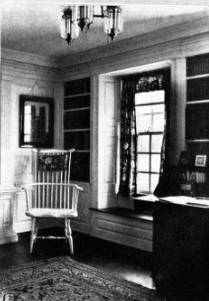
First I need a 1918 guest bedroom, though. Luckily I found one that’s perfect:

Screenshot (251)-2

Ladies’ Home Journal, May 1918

Okay, now for my list. It includes a mix of  books I’ve read for this project, other 1918-era books I’ve been wanting to read, and a few earlier classics. In the spirit of D.M.T. Willis, I’ve included blurbs explaining why I picked each one.

  1. Bab: A Sub-Deb by Mary Roberts Rinehart. Because this story about a rebellious, hapless teenager is hilarious, and short enough that you’ll be able to read the whole thing during your visit.
  2. Emma by Jane Austen. Because somehow it seems more 1918-ish than the rest of Austen.
  3. Mrs. Spring Fragrance by Sui Sin Far. Because I just finished this fantastic collection of short stories about the Chinese community in Seattle and San Francisco, and I can’t wait to tell you about it.
  4. The Age of Innocence by Edith Wharton. Because being a houseguest with a well-stocked bookshelf at hand is such an Edith Wharton thing to do.
  5. The Magic City by E. Nesbit. Because every guest room bookshelf needs some magic, and I missed this one during my E. Nesbit years.
  6. Tendencies in Modern American Poetry by Amy Lowell. Because I want to take a deeper look into what was happening in poetry in 1918, and who better to explain it than Lowell?
  7. The Tree of Heaven by May Sinclair. Because it was one of the big books of 1918, but when I ordered a print-on-demand version they sent me a book with Sinclair’s name on the cover but a 1907 Robert Chambers book with the same title inside.
  8. Pointed Roofs by Dorothy Richardson. Because May Sinclair said in The Egoist that she’s a great modernist but I’d never heard of her.
  9. Villette by Charlotte Brontë. Because I’ve been wanting to read it and it seems more bedtimey than Jane Eyre.
  10. Renascence, and Other Poems by Edna St. Vincent Millay. Because Louis Untermeyer panned it in The Dial and I’m in the mood to pick a fight.
  11. Marion: The Story of an Artist’s Model by Winnifred Eaton. Because the story of a half-white, half-Chinese artist’s model sounds intriguing, plus she’s Sui Sin Far’s sister.
  12. Anne of Green Gables by L.M. Montgomery. Because, shamefully, I’ve never read it.
  13. Daddy-Long-Legs by Jean Webster. Because this breezy epistolary novel, which I wrote about here, is the perfect bedtime read.
  14. Personality Plus by Edna Ferber. Because the Two Old Maids sound like they know what they’re talking about.
  15. O Pioneers! by Willa Cather. Because it’s one of the best books I’ve ever read. Just don’t read the ending right before you turn off the light, like I did.
  16. The Last Ditch by Violet Hunt. Because her wonderful poem in Poetry magazine about her breakup with Ford Madox Hueffer (Ford) made me want to read more of her work.
  17. The Story of an African Farm by Olive Schreiner. Because I really need to read this South African classic.
  18. Behind the Scenes, or, Thirty Years a Slave and Four Years in the White House, by Elizabeth Keckley. Because Keckley’s amazing journey sounds well worth reading about.
  19. The Circular Staircase by Mary Roberts Rinehart. Because this was Rinehart’s first best-seller, and if her mysteries are as good as Bab: A Sub-Deb I can’t wait to get started.
  20. Understood Betsy by Dorothy Canfield Fisher. Because I read this when I was very young and I’d love to see if I remember anything.
  21. The God by H.D. Because I need to start actually reading the Imagist poets instead of just reading about their love lives.
  22. Married Love by Marie Carmichael Stopes. Because, who knows, this British sex manual might come in handy for my houseguests.
  23. Parnassus on Wheels by Christopher Morley. Because Jeff O’Neal raved about it, but mostly because I love the idea of Morley sitting on the bookshelf with all these women.

Of course, what I’ve really done is put together a list of books I want YOU to have when I stay in YOUR guest room. I’ll be traveling a lot over the next few months, so get ready!

(And there’s still room on the bookshelf–I haven’t reached Morley’s 30 volumes yet–so I’d welcome your suggestions.)

The House Beautiful, September 1917

*Except for Jeff O’Neal of Book Riot, who talked about Morley’s novel Parnassus on Wheels on last year’s holiday book recommendation podcast.

**It’s just like it sounds. He writes so goopily about his wife that I assumed, based on previous 1918 experience, that she would run off with a female Imagist poet in short order. But no, they were still married when he died in 1957.

*** This can’t possibly mean what it sounds like. If it did, she wouldn’t be sleeping in the guest room, would she?

A 1918 play about a single mother, too far ahead of its time

Reading the March 1918 issue of The Bookman a couple of weeks ago, I came across a brief review of The Madonna of the Future, which had recently opened on Broadway. As critic Clayton Hamilton tells us,

the heroine of this play is a very rich young woman, unencumbered with relatives, who desires to become a mother but does not desire to be saddled with a husband. In consequence of her convictions, she picks out an apparently eugenic mate and becomes, in due time, the mother of a nameless child.

My reaction: What? This is the least 1918 thing I’ve ever heard of!   

“Madonna of the Future” star Emily Stevens, New York Times, January 27, 1918

The Dramatic Mirror thought so too. “The most pitiful creature of the brothel would scorn such an idea,” the magazine huffed. It was not alone, apparently—New York Chief Magistrate William McAdoo* received a number of complaints. He wrote to the theater’s lawyers telling them that, if the issue arose in court, he would have to declare the play obscene. McAdoo said that

the character of the heroine repeatedly and tiresomely states over and over again that the doctrines advanced by her are unconventional and, in the sense usually accepted by ordinary people, immoral. She says that her highest ideal of maternity is that of the cow, which might suggest that the proper place for this play would be a stable instead of the stage, committing the dialogue to learned veterinarians.

I haven’t been able to find a script of the play, but here’s what I’ve managed to piece together. Iris Fotheringham, a wealthy young woman from Tarrington, New York, hates men, but has what the Dramatic Mirror calls “one redeeming virtue—the dream of all good women—the desire of motherhood.” She decides that her secretary, Rex Letherick, would be a suitable father,** and whisks him off to Europe. After the baby is born, she blithely resumes her New York life. Rex is desperately in love with Iris, and, as the Dramatic Mirror puts it, “still willing to be her husband.” Iris gets wind that there’s another woman in the picture, gets jealous, and marries Rex.

Alan Dale and his daughter Marjorie, 1900 (Library of Congress)

What makes this story even more interesting is that the play’s author, Alan Dale, was America’s most famous theater critic. The British-born Dale (real name Alfred Cohen) had been writing acerbic reviews for the Hearst newspapers since the 1880s. He had made a lot of enemies along the way. “The theatrical world is finding considerable amusement in the situation created by the police complaint,” the Dramatic Mirror gloated, speculating that the cause of the play’s troubles was a morality campaign by the city’s Tammany Hall mayor. For good measure, the magazine threw in some cracks about the play’s bad reviews.

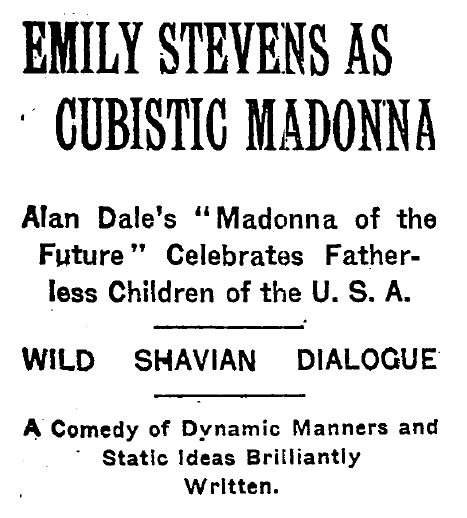
New York Times, January 29, 1918

This was unfair, as far as I can tell. The un-bylined New York Times reviewer called the play “a brilliantly written comedy of ideas,” although he complained that the ending was a copout. He noted similarities to George Bernard Shaw, but said that Shaw, “having real ideas of his own, also has the courage of them.”  Astonishingly, the reviewer got away with saying that the de-stigmatization of single motherhood was important to contemplate,

for women in these coming manless times will be much occupied with the thought that life would be less empty if only there were children. And the world will have need of new citizens.

George Jean Nathan, date unknown

George Jean Nathan, who co-edited Smart Set with H.L. Mencken and is now regarded as the greatest theater critic of his time, really, really hated Dale’s reviews. He complained in Smart Set’s April 1918 issue that Dale displayed

the sort of humour…that proceeds from the comparison of something or other with a Limburger cheese or from some such observation as “‘Way Down Yeast’ ought to get a rise out of everybody.” The sort of humor, in short, whose stock company has been made up largely of bad puns, the spelling of girl as “gell,” the surrounding of every fourth word with quotation marks, such bits as “legs—er, oh I beg your pahdon—I should say ‘limbs’,” a frequent allusion to prunes and to pinochle, and an employment of such terms as “scrumptious” and “bong-tong.”

But Nathan goes on to praise The Madonna of the Future, saying that

its theme is viewed through the glasses of a man possessed of a certain pleasant measure of cultural background and expounded in well thought out and effective vein; its net impression is of a piece of writing designed by a civilized gentleman for a civilized audience.

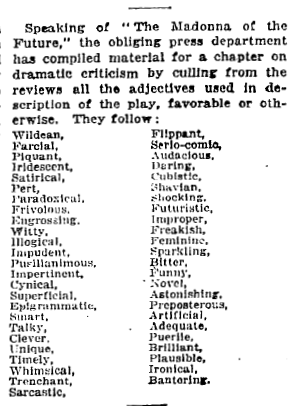
The New York Times ran this list of adjectives that had been used to describe the play, ranging from puerile to shocking to brilliant:

New York Times, March 10, 1918

After the theater received the letter, the script was revised, there was some back and forth with McAdoo, the play closed on Broadway after less than two months, and the censored version, retitled The Woman of the Future, moved to New York’s “subway circuit.”

In spite of its short run, The Madonna of the Future caused quite a stir. Today’s Iris Fotheringhams may, in part, have Alan Dale to thank for getting people used to the idea that having a baby without a husband isn’t all that big a deal.

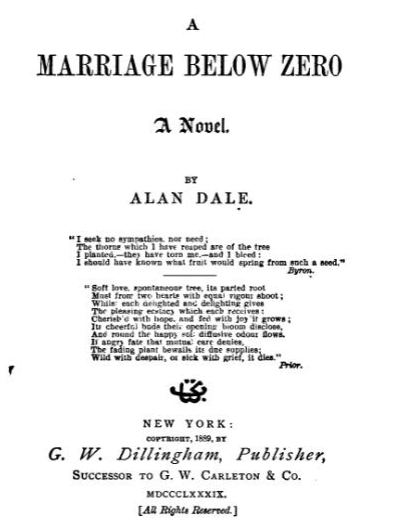
Alan Dale lives on in another way as well: his 1889 novel A Marriage Below Zero has been described as the first English-language novel to depict a romantic relationship between two men.

All in all, not a bad legacy for someone who said “scrumptious” and “bong-tong.”

G.W. Dillingham, 1889

*This William McAdoo, a former congressman and New York police commissioner, was born in Ireland and was apparently no relation to Secretary of the Treasury/Railroad Administrator/Woodrow Wilson son-in-law William Gibbs McAdoo.

**Well, he has a great porn star name anyway.

Wednesday miscellany: Naked microscope bookplate people, stylish women, and cherry blossoms

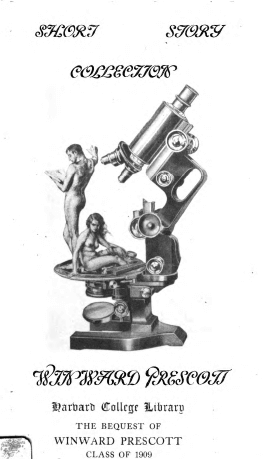
Imagine my surprise when I opened a copy of Hugh de Sélincourt’s 1918 book Nine Tales, digitized from Harvard’s Widener Library, and found these naked people on a microscope. I was all the more surprised because I went to Harvard* in the 1980s and Widener was so conservative that their cataloging system had a separate “X” category for dirty books, which you had to order from the librarian instead of getting them in the stacks. I had to check out Henry Miller’s Tropic of Cancer for a class one time and I felt like a pervert.

So what’s the story? I searched for the bookplate on Google Images and, proving that you can find anything on the internet, was directed to a website for The McCrone Group, a microscopy company, that includes a page about bookplates with pictures of microscopes, written by John Gustav Delly. I learned that Winward Prescott, Harvard ’09, was a serious bookplate collector; his donation now makes up the largest part of the extensive collection at Harvard’s Houghton Library. If you check out the McCrone Group page–which I highly recommend–the bookplate is image 72.

She’s living her best life.

Judge magazine, April 6, 1918

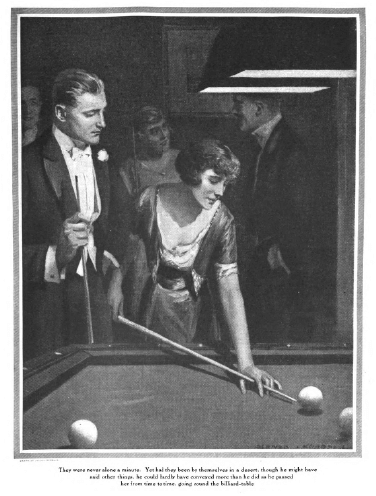
Okay, not courageous at a Russian woman soldier level, but wearing a dress this low-cut to play billiards takes guts.

Illustration from “Camille,” Cosmopolitan, April 1918

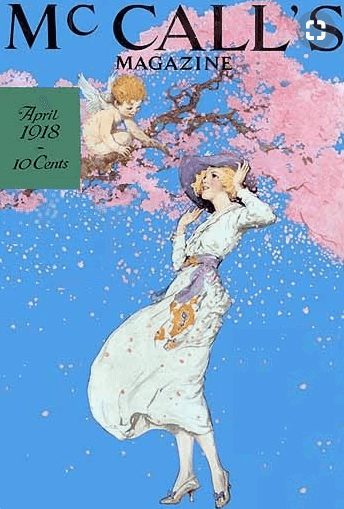
And, just in time for the D.C. cherry blossoms, a McCall’s cover by Willy Pogany.

*And, no, people don’t mention this at any possible opportunity. It’s relevant!

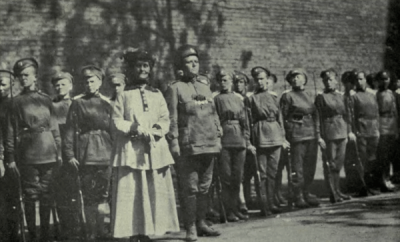
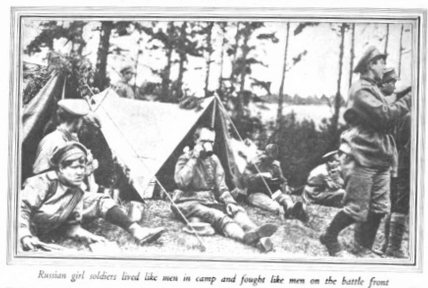
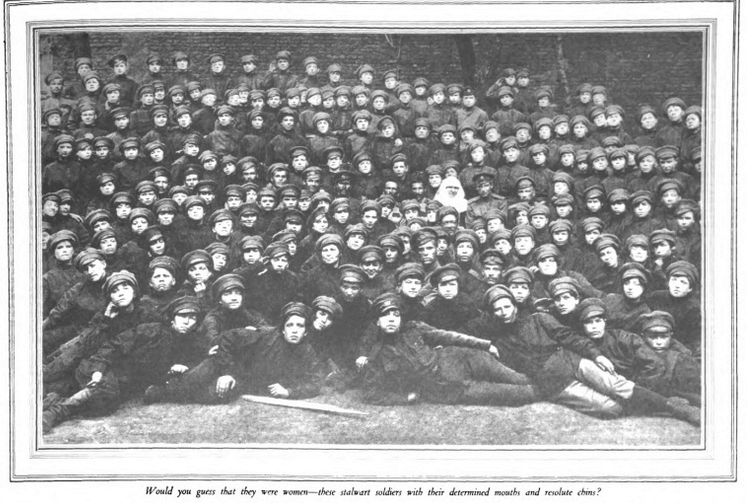
The giggling battalion: Russian women soldiers through the eyes of an American war correspondent

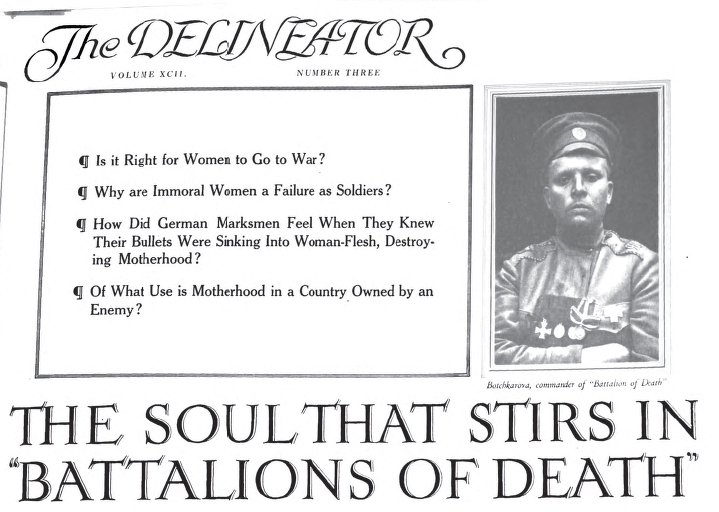
Reporting about Russia’s battalions of women soldiers in the March 1918 issue of The Delineator, war correspondent William G. Shepherd asks everyone the same question.

What about motherhood?

I thought of how it must feel to be a soldier and know that your bullets were sinking into woman-flesh, destroying motherhood; and of how, in spite of all this, you must shoot to kill these women soldiers lest they kill you.

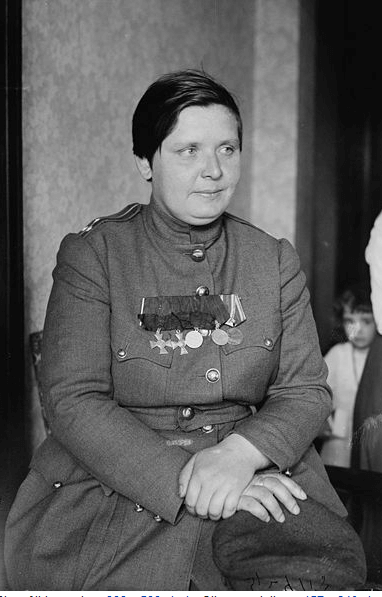
He gets an interview with Maria Bochkareva, the commander of the First Women’s Battalion. Amid the chaos of the Russian Revolution, her soldiers have deserted her, and she’s hospitalized in Petrograd (now St. Petersburg). He asks her why she went into the war. Weren’t the men fighting well enough to suit her?

“Yes, indeed,” she exclaimed…“But I can’t see why there should be any difference between men and women in this war and so I enlisted and went to the front.”

“But women have got something that men haven’t,” Shepherd mansplains. “They have potential motherhood, and if you kill that, you kill the whole race.”

Maria Bochkareva and her soldiers with British suffragist leader Emmeline Pankhurst, 1917

Bochkareva, who at age twenty-eight has left two abusive husbands and fought in two wars, has a less sentimental take on the matter. “What is the use of motherhood in a country which is owned by an enemy?”

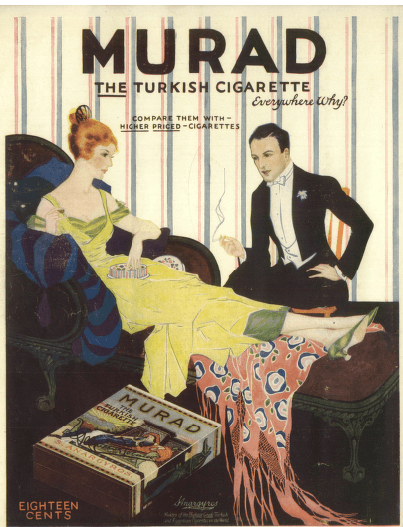
To Bochkareva, Shepherd marvels, the “girl” soldiers

are mere sets of brains that go to war. They are mere pairs of legs that can march, pairs of arms that can carry rifles, and most of all they include index fingers that can pull triggers, and good right eyes that can see marks.

Imagine!

Another issue weighing almost as heavily on Shepherd’s mind is the girl soldiers’ sex lives. He meets a deserter from Bochkareva’s battalion and asks her why she left.

“I left because there were too many bad girls in our company,” explained this seventeen-year-old miss in riding breeches who sat in a chair on the sidewalk before my hotel with her knees crossed.

“But I didn’t think morals had anything to do with fighting,” said my interpreter, who happened to be a celebrated Russian writer.

“Nothing to do with fighting!” exclaimed the girl. “Why, do you know you can never trust a bad girl in the firing-line?…I’ll fight for Russia, but not for that crowd.”

A light goes on in Shepherd’s head.

This was the first idea we got of the fact that in the girl legions of Russia, good girls make good soldiers and bad girls make poor ones.

The seventeen-year-old soldier goes on,

“Love hasn’t got any place in war, and when it comes to the other thing, it not only ruins girl soldiers, but the men soldiers, too.”

“But don’t the girls ever talk of their sweethearts at the front?” asked my interpreter.

“The girls who are in earnest don’t,” she said. “As soon as a girl begins to get sentimental or to talk about some man she likes, we just remind her that within a few days, if she is a good soldier of Russia, she may be dead.”

The Delineator, March 1918

Another thing about the girl soldiers: they’re so girly! In the barracks of another newly formed women’s battalion (made up, its leaders assure Shepherd, entirely of good girls),

Some of them were reading, some were knitting, and several of them were romping girlishly. One was trying to stick another with a hatpin and another was chasing a girl with a glass of water with which she threatened to deluge the fugitive. It was just such a romp as one might have expected in the hallways of an exclusive girls’ boarding school. Only the clipped heads and the trousers seemed out of place.

Earlier, he watched Bochkareva’s equally girly soldiers decamping for the front.

Men soldiers do not giggle when they climb into cars, but I must admit that these girl soldiers did. They helped each other remove their packs from their backs; they threw their short, stubby rifles into the cars and then boosted each other in as best they could. There was giggling a-plenty and even little shrieks of mirth; when a girl fell, there was a shout of laughter.

For all his condescension, Shepherd ends up respecting the soldiers of the “Battalion of Death,” as Bochkareva’s soldiers were known. They fought courageously against the Germans, dodging bullets as they took ammunition to the front lines. For military security reasons, he can’t provide the names of the heroes, but

I can say that it was Bochkareva’s band that captured a hundred Germans and forced them to throw down their rifles and throw up their hands and exclaim, “Ach Gott! The Russian women!”

The Delineator, March 1918

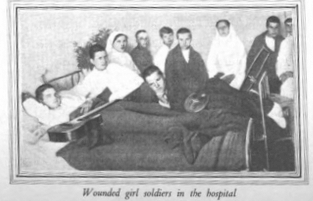
Shepherd visits some wounded veterans of the battle in the hospital and spots a German helmet. His interpreter asks the owner where she got it.

“I took it from a German soldier who tried to shoot me after he was wounded,” she said. “I was trying to help him, when suddenly he raised himself to his elbow and fired at me with his revolver.”

“What did you do?” we asked her.

“I shot him,” she said simply. “What else could I do?”

The Czar’s government, Shepherd tells us, authorized the women’s battalions in order to shame war-weary men into joining the army. But the situation was changing fast. On March 3, 1918, just as Shepherd’s story was hitting the newsstands, Russia made peace with Germany.

Maria Bochkareva (date unknown)

Bochkareva ended up on the wrong side of history. Branded an “enemy of the working class,” she was executed by the Soviet secret police in May 1920, at the age of thirty. The execution was against Lenin’s orders, and her killers were later put to death themselves.

As Bochkareva’s troops headed to the front, a Jewish seamstress stood sentinel on the train. At each stop, the soldiers faced insults and leers from men on the platform. At one station, a group of male soldiers tried to peer inside, saying, “We have come to see the girls.” The sentinel

made no outcry. She simply raised her rifle toward them and said:

“There are no girls here; only soldiers of Russia.”

(UPDATE: You can see Maria Bochkareva at a July 4 ceremony in Washington, D.C. in the last few seconds of this video, which I included in my post on the July 4 loyalty parade in New York.)

Despina Storch: The sad fate of a woman of intrigue

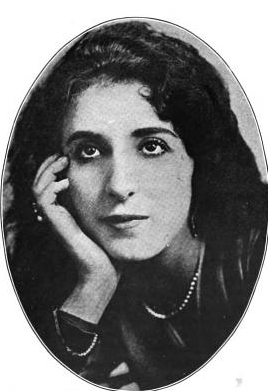
Remember Despina Storch, the beautiful Turkish woman who was arrested by the Secret Service as the suspected head of a German spy ring and sent to Ellis Island to be deported? (UPDATE 1/2/2019: For readers looking for information on Storch who were directed here by Google, I suggest that you start with my earlier post, which you can find here.)

Despina Storch, 1917 (Underwood & Underwood, N.V.)

She never made it to France. She died on Ellis Island on March 30, 1918, at the age of 23. The cause was pneumonia.

Or was it? Some suspected suicide, especially since two of her three accused co-conspirators, Elizabeth Nix and “Baron”* Robert de Clairmont, had also fallen seriously ill.

An immigration inspector denied the rumors, saying of Mme. Storch, “She made a brave fight for her life and every effort was made to save her. She was physically unable to overcome the ravages of pneumonia. I wish to state positively that she did not commit suicide.”

The suicide theory would have been plausible, though, since Mata Hari’s October 1917 execution by a French firing squad must have been on the group’s mind.

Mata Hari, 1906

Despina Storch’s funeral took place on April 1. Her companion and co-accused, the Count de Beville, was allowed to leave Ellis Island to attend, accompanied by his parents and a Secret Service agent. According to a report in the New York Sun, Beville “bore a plaque of roses and some lilies which he tenderly placed in the folded arms of the dead woman.” He knelt by the casket, praying, for two hours.

He murmured over and over again, and some say the words were “Forgive me,” and others, “Cherie, Cherie, and like French words of endearment.

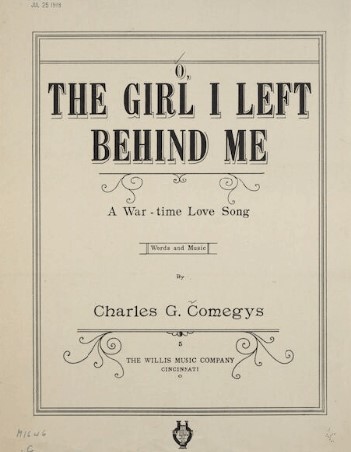
Willis Music Company, 1918 (Library of Congress)

Outside, a “morbidly inquisitive crowd” milled around the hearse. When the coffin was borne out of the funeral parlor,

the chatter of the crowd hushed, and all that stirred the quiet was the music of “The Girl I Left Behind Me,” which echoed into the street, as the subway band, on an army recruiting bus, rolled through Fifth avenue, close by.

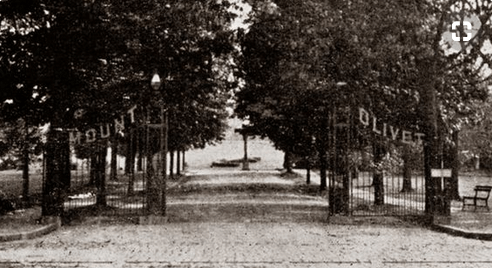
Mount Olivet Cemetery, date unknown

The Count and his parents accompanied the hearse to Mount Olivet Cemetery in Queens, where Mme. Storch’s “exquisitely carved white coffin” was placed in a vault. Beville “wept silently and cast a last look at the vault as he was led back to the car.”

Thus ended the brief life of the woman the Sun called “the most romantic spy suspect America has yet known.”

Despina Storch in Spain, adapted from an illustration in the Washington Times, June 16, 1918

*The New York Times was dubious about his claim to this title.

The best and worst of March 1918: Magazines, essays, cover art, and humor

When I was in the Foreign Service, living in Cambodia or Honduras or wherever, people used to ask, “But don’t you miss home?” I never knew what to say. The honest answer was, “I miss some things, sometimes, but it’s way more interesting here. Don’t you get bored living in the same place all the time?” That seemed kind of rude, though.

A quarter of the way through, that’s how I feel about my life in 1918. I’ll see, for example, that Meg Wolitzer, Curtis Sittenfeld, and Rebecca Harrington all have books coming out, and for a second I’ll wish that I could read them, but then I’ll pick up Mrs. Spring Fragrance or the latest issue of The Dial, and the feeling goes away. I can read those books next year. In the meantime, it’s way more interesting here.

Now for the best and worst of March 1918:

Best Magazine: The Little Review
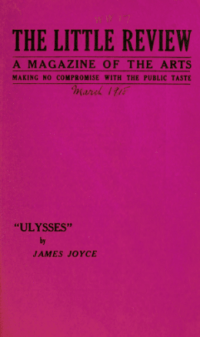
Ulysses, as I wrote earlier this month, made its first appearance in the Little Review in March 1918. The issue also includes Ezra Pound writing on Marianne Moore, fiction by Wyndham Lewis, and an essay by Ford Madox Hueffer (a.k.a. Ford) that contains the sentence “The Englishman’s mind is of course made up entirely of quotations.” But the rest of the issue could have been blank (which wouldn’t have been unprecedented—the first thirteen pages of the September 1916 issue were blank, an expression of editor Margaret Anderson’s frustration over the lack of quality submissions) and it still would have been the best magazine of the month, if not the year.

Worst Magazine: The Art World
The Art World, as I noted last week, had nothing good to say about impressionism or anything that came after. To put that into perspective, the first major exhibition of impressionist art was in 1874. So an art magazine taking this stance in 1918 is like Rolling Stone saying in 2018 that this rock-and-roll music is just a lot of noise.
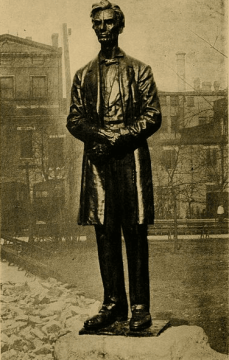
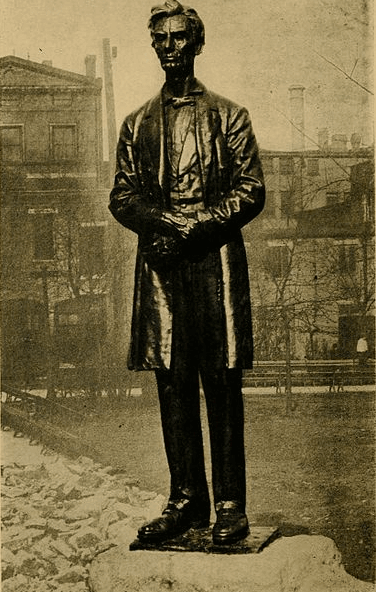
Statue of Lincoln, George Grey Barnard, Lytle Park, Cincinnati (1917)

In its March 1918 issue, the last before it merged into another magazine, The Art World criticized George Grey Barnard’s statue of Lincoln in Cincinnati, saying that Barnard

does not show the majestic Lincoln at the bar of history being judged and admired, but a slave Lincoln at the block, being sold and pitied…let us hope that Mr. Barnard will now deign to accept the advice we gave him in June 1917 and make a new Lincoln—virile, heroic, and majestic.

The magazine approvingly quotes portraitist Cecilia Beaux saying of the 1913 Armory Show in New York, the first large exhibition of modern art in the United States, that

“It was like a sudden windstorm that raises no little dust, noise, and confusion for the moment; when the wind dies down you discover that much that was of no real value has blown away, leaving a clearer, wholesome atmosphere.”

The Art World branches out to the written word in this issue, calling a modernist poem “speech worthy of a yapping maniac.”

Best humorous essay: “Making the Nursery Safe for Democracy,” by Harold Kellock, The Bookman

 

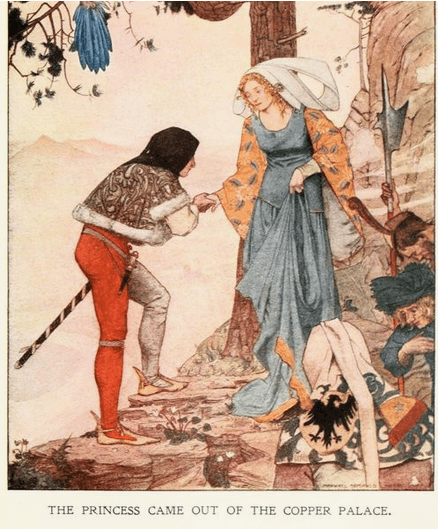
Essays about family life in 1918 are generally steeped in sarcasm (if they’re by men) or sentimentality (if they’re by women). It’s hard to find a family that seems real. Then I came across Harold Kellock’s essay about his four-year-old son being bombarded with royalist propaganda through his nursery reading. Every night, Kellock is forced to read his son a story about some heroic king. “In a world wherein we are pouring out our blood and treasure that democracy may live safely,” he complains, “our children scarcely out of the cradle are being made into staunch little monarchists.” He takes a stab at democratizing the stories, but it doesn’t work, and he resigns himself to nursery royalism.

“Then,” I read, “the king took Gretel to his palace and celebrated the marriage in great state. And she told the king all her story, and he sent for the fairy and punished her.” Think of having the power of punishment over fairies! The King und Gott! But my son swallows it complacently. He does not question the divine right of kings.
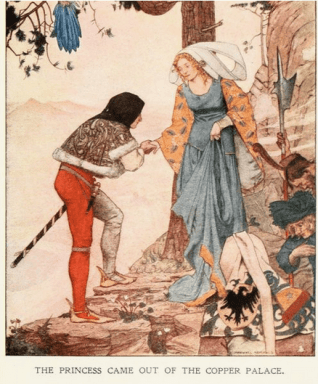
Faery Tales from Hans Christian Andersen, Maxwell Armfield, 1910

Kellock reassures himself that, when the time comes, he can turn his child into a democrat by showing him photographs “of some vacuous king, discreetly bearded to hide his recessional features,” or “a typical princess, whose hat and features alike seem so unfortunately chosen, opening a Red Cross bazaar.”

But not for a while, he says.

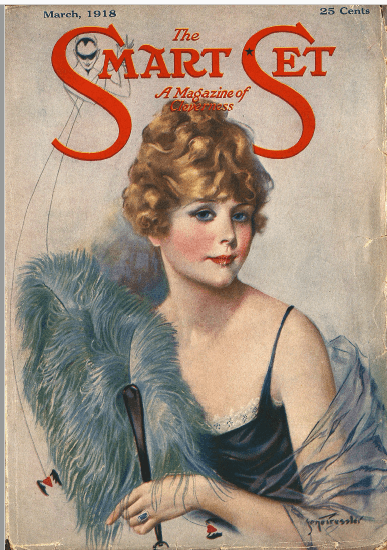
Worst humorous essay: “I Must Have Been A Little Too Rough,” by George B. Jenkins, Jr., Smart Set
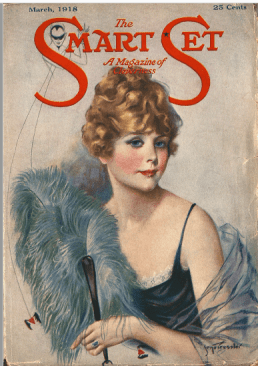
I hope this is the worst thing I read all year. There must be an anti-gender violence message hidden somewhere, but…well, read it for yourself.

I must have been a little too rough.

“Women,” her father had told me, “are tired of the courteous treatment of the average man. They are bored by the vapid compliments, the silly lies, the stupid chatter of pale youths with gardenias in their lapels. If you want to be a success with women, be rude! Be violent! Overpower them, assert your physical superiority! If necessary, beat them!” He became quite excited. “Pound them! Assault them! Half-murder them!”

I listened to him respectfully, though I did not care for him at all. Yet I believed him, for he is notoriously successful in his affaires.

I decided to test his theories. Striding into the next room, I grasped his daughter about the waist.

“I love you!” I roared, squeezing her until her face was purple.

“You belong to me!” I shouted, dragging her around the room by her hair, and overturning several chairs in our progress.

“Damn you!” I shrieked, striking her on the shoulder, where the blow left a blue welt, “I will fight the world for you.”

She began to whimper.

“Shut up!” I ordered, in my rudest manner, and slung her across the room.

But I must have been a little too rough, for she fell out the window.

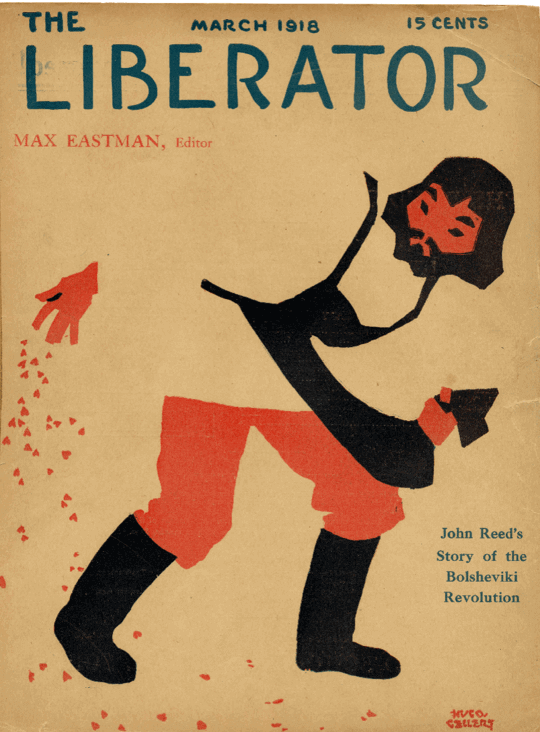
Best magazine cover: The Liberator
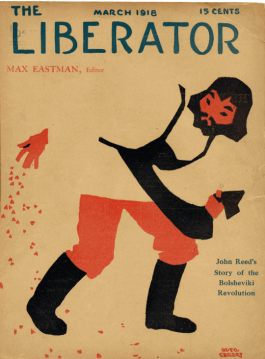
The first issue of The Liberator was published in March 1918. Its predecessor, The Masses, had closed down in 1917 after being declared treasonous by the government for its anti-war stance. The debut issue included reporting from Russia by John Reed, whose Ten Days that Shook the World was published the next year (and who died in Russia in 1920 at the age of 32). I’ll write more about The Liberator later. For now, here’s its inaugural cover, by Hungarian-American artist Hugo Gellert.

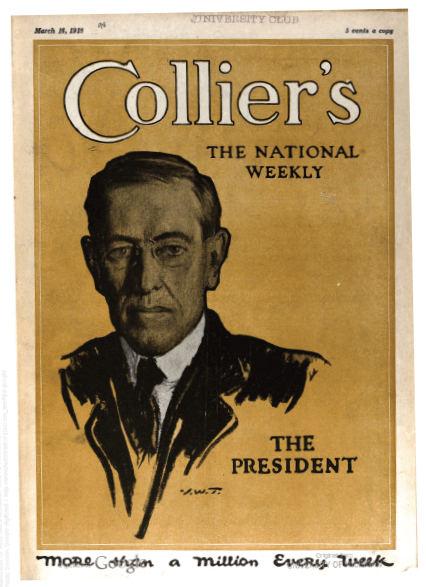
Worst magazine cover: Collier’s
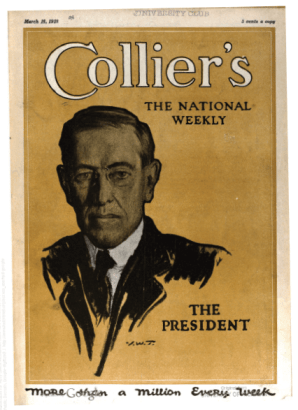
I’m imagining the meeting where this cover was conceived.

Art director: How about…the President?
Editor: What would he be doing?
Art director: Nothing, just a picture of his face, in black and white. With a caption that says [stretches his hand into the air dramatically], “The President.”
Editor: I like it!

Best humor:
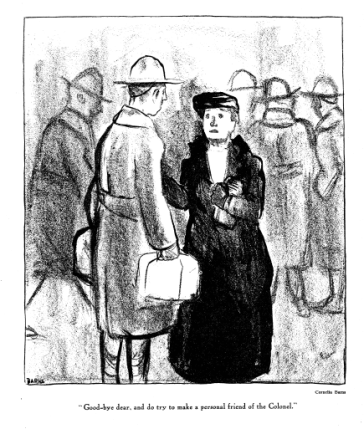

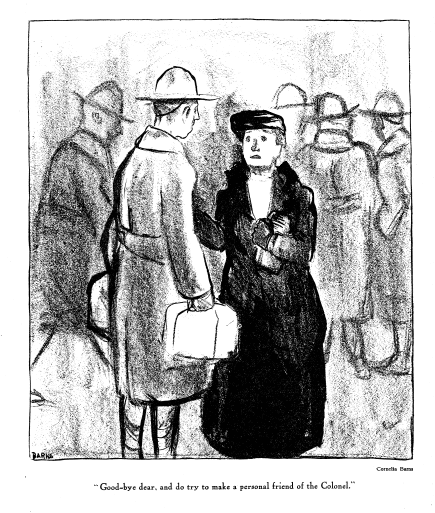
As I’ve noted before, there are no good jokes in 1918 magazines. But I liked this Cornelia Barns Liberator cartoon, featuring the world’s most coldhearted mother seeing her son off to war.

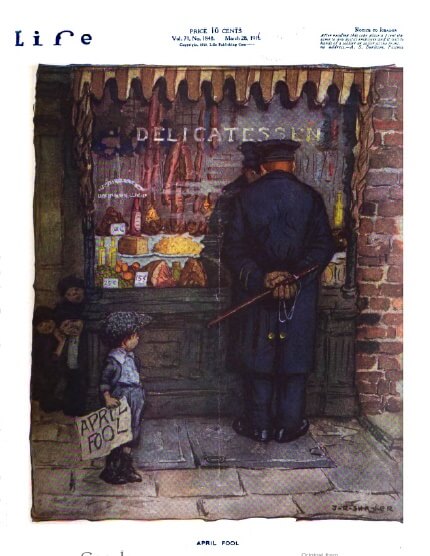
Worst humor:
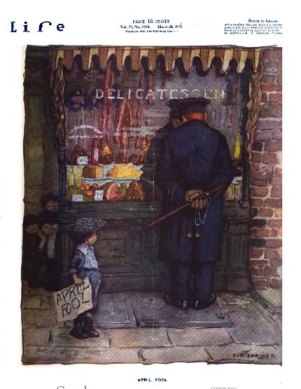
First dog: How is brother collie over there? Is he in your set?
Second: Oh, yes; we visit the same garbage pails.

(Life magazine, March 28, 1918)

And, in honor of Women’s History Month, the most inspiring women:

I came across so many! Novelists Edith Wharton, Willa Cather, and Mary Roberts Rinehart; artist Elizabeth Gardner; dancer Irene Castle; Little Review editor Margaret Anderson; suffragist Anna Kelton Wiley; prosecutor Annette Abbott Adams; rebellious housewife Julia Clark Hallam; and the anonymous woman who wrote about how divorce saved her sanity.
But every month is Women’s History month at My Year in 1918, and there are lots more inspiring women to come. (Sneak preview: a pioneering British sexologist and a witty Chinese-American writer.) On to April!