Category Archives: Nonfiction

Children’s Books: Your 1924 Holiday Shopping Guide

Welcome to the sixth annual children’s books holiday shopping guide! I’ve just arrived in Cape Town from Washington, D.C., as I do at this time every year.* This year, determined to avoid a repetition of last year’s kind of pathetic effort, I got an earlier start. The problem was, I couldn’t stop myself from reading just one more 1924 roundup, or looking up just one more book, so here I am on Christmas Eve afternoon in full Bird by Bird mode.

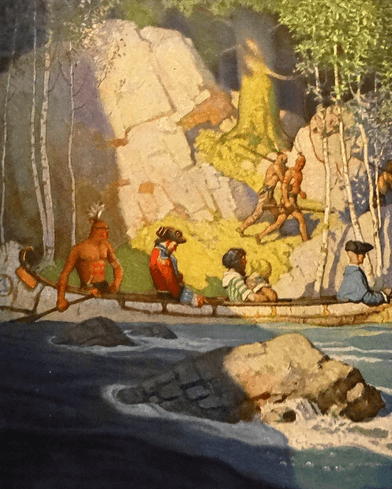
The Bookman, October 1924

This year, as always, pioneering children’s librarian Annie Carroll Moore** is my principal guide. And, as always, she’s kind of annoying. In her article in the May 1924 issue of The Bookman, she’s supposedly having a conversation with a young writer who’s published two children’s books and isn’t sure whether he should continue. Her reply, supposedly, is the whole rest of the article, with quotation marks and everything. If this were a real conversation, he’d be extremely sorry that he asked. Skip the framing device, Annie! Just tell us about the books! Luckily, in her October article, she writes more or less like a normal person.

The October issue of The Bookman also has an article by Louise Hunting Seaman about giving books to children, with lots of cool examples of how to do it without looking like you’re giving them a homework assignment. You could, for example, give them a real Italian puppet*** holding a copy of Pinocchio or give them Padraic Colum’s The Island of the Mighty, a tale of Celtic Britain, and take them to the Hall of Armor at the Metropolitan Museum (although, as noted below, I’m not so gung-ho on The Island of the Mighty.)
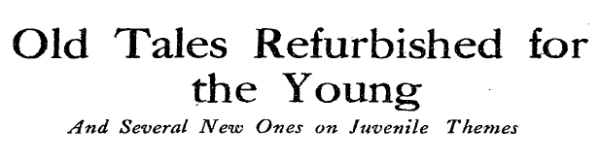
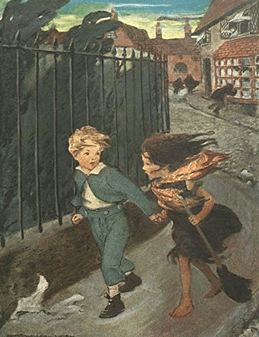
New York Times, December 7, 1924

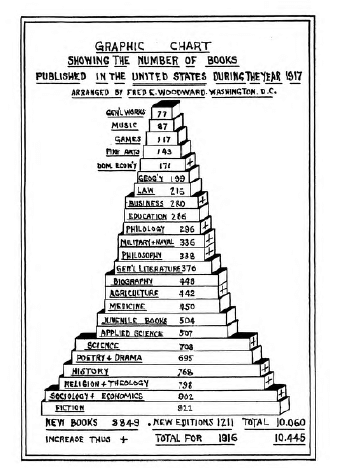
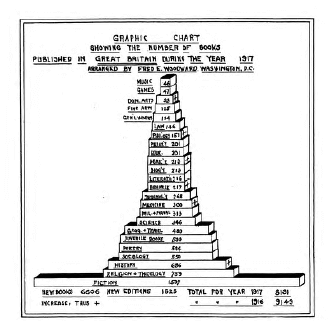
The New York Times weighs in on the children’s books of the season in the December 7 issue,**** the Library Journal give us a comprehensive list “designed merely for the convenience of children’s librarians in checking the fall and winter output” (not realizing that it might come in handy for bloggers a hundred years in the future too), and St. Nicholas’s November issue has a list of books for children that turn out to all be really old, but that’s OK with me because it’s accompanied by this cool graphic by one of my favorite 100-year-ago people, infographics pioneer Fred Woodward.
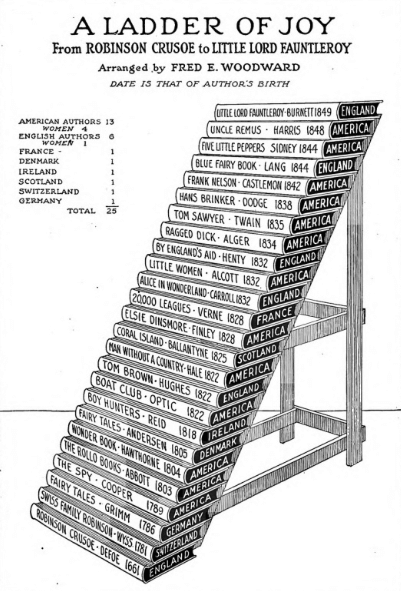
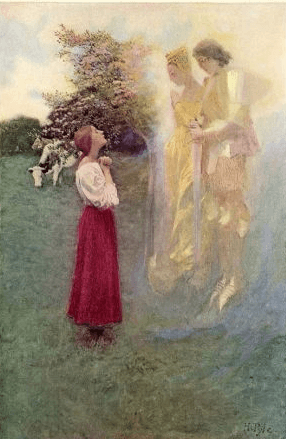
Fred Woodward, St. Nicholas, November 1924

So plenty to work with, even with Publisher’s Weekly’s excellent roundup sadly having bitten the dust in 1922 and HathiTrust, my main source of 100-year-old books and magazines, infuriatingly having blocked access to a lot of books outside the U.S. for copyright reasons.*****

Fairy Tales, Nursery Rhymes, and Folk Tales
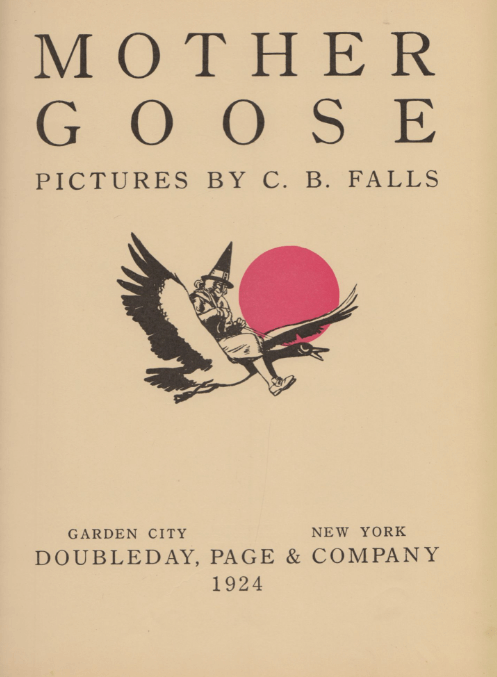
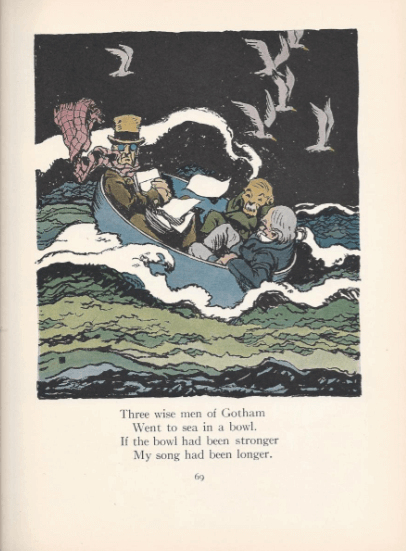
I was a fan of C.B. Falls’ 1923 offering The A B C Book, but I’m meh on his Mother Goose, as is Moore, who says, ““It is a book of distinguished appearance, but something highly important to little children is missing from its pictures—the quality that, differentiating Mother Goose characters from all others, makes them live again in a new way of their own.” The three men in the illustration of “Three Wise Men of Gotham” are, she points out, “easily recognizable as Wilson, Lloyd George, and Clemenceau.” I wasn’t familiar with this particular nursery rhyme, which turns out to be pretty horrifying.******
For Young Children
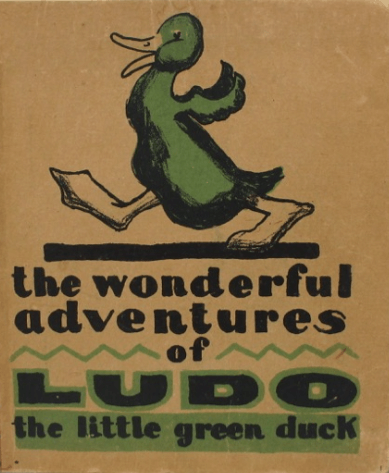
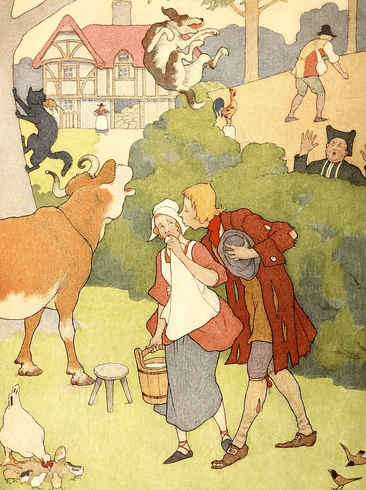
Moore praised Jack Roberts’ The Wonderful Adventures of Ludo the Little Green Duck, saying, “It’s gay, it’s fresh, and it’s different,” and adding, “It captured my imagination at a psychological moment, for the dummy came into my office on the last day of the Democratic Convention in Madison Square Garden.” I’m not sure what that means, but, hey, we’re all at a psychological moment, right? This was one of the books that was blocked by HathiTrust, but Ludo’s adventures take him around the world, and “around the world” plus “1924” generally equals “racist.” The online images I was able to find seemed to bear this out. (That’s Ludo in the Bookman headline with some of his new friends.)
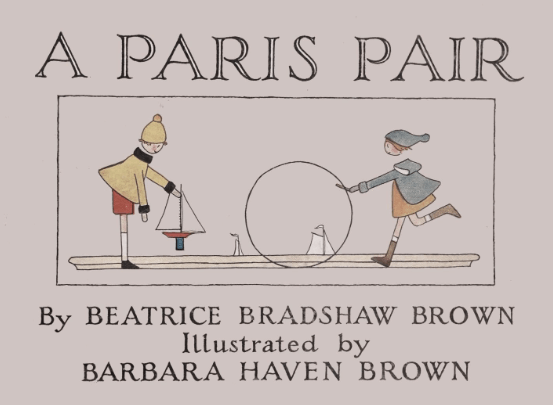
A Paris Pair: Their Day’s Doings by Beatrice Bradshaw Brown is, according to Moore, a “delightful, inexpensive book” that features “a clever verse in English for each hour in the day of two French children.” I did in fact find it pretty delightful, although going to the Louvre EVERY day sounds pretty exhausting. Here’s lunchtime:

LUNCHEON never comes too soon,
For we are nearly starved at noon!
Spinach and an omelette,
Salad, too, and better yet
Delicious jam with creamy cheese—
A dish that’s very sure to please!
Becoming gratitude they feel,
And thank le bon Dieu for their meal
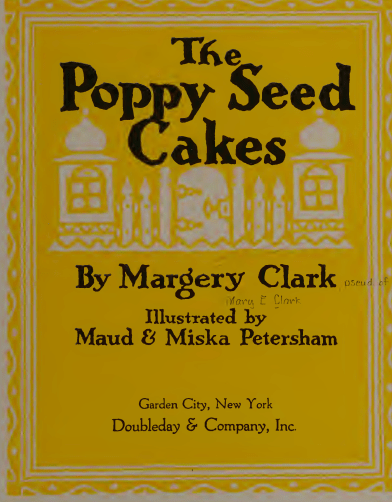
Moore calls The Poppy Seed Cakes by Margery Clark, illustrated by Maude and Miska Petersham, “certain to appeal to little children,” although I (admittedly not any kind of child) found the stories silly and some of the illustrations, like this one,
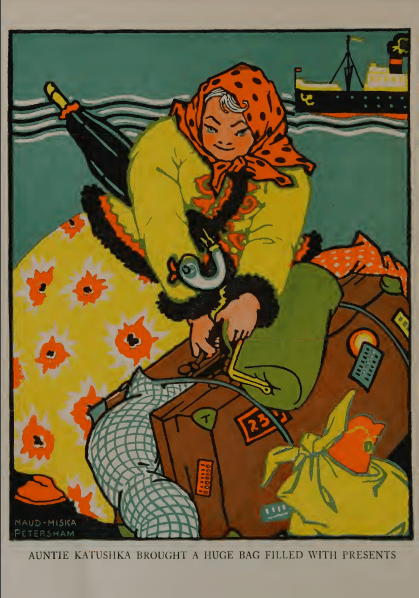
kind of sinister.
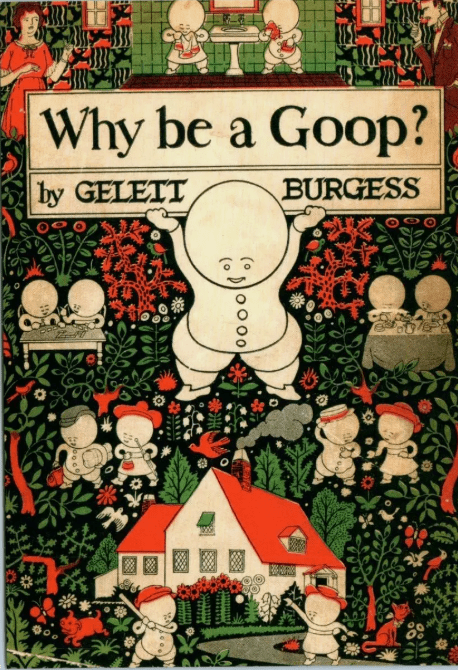
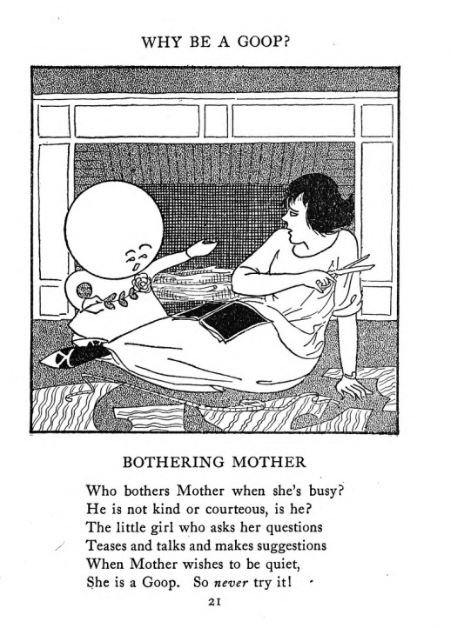
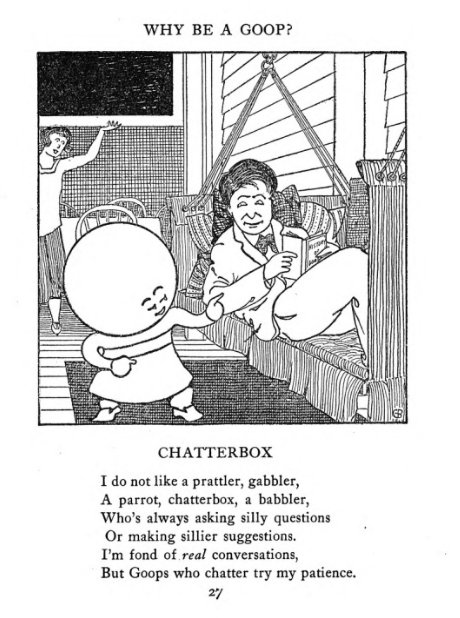
Why Be a Goop? is a late installment in Gelett Burgess’s series that started in 1900 with Goops and How to Be Them, which was a favorite of mine when I was little, although the Goops’ round heads freaked me out. In that book, the Goops did things like lick their fingers and lick their knives and generally lead “disgusting lives.” In this one, though, they seem to spend most of their time trying to get the attention of their negligent parents.
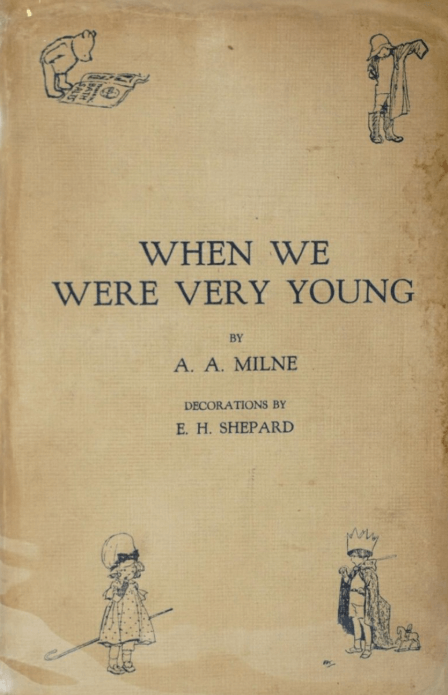
When We Were Very Young, A.A. Milne’s classic book of verses featuring Christopher Robin, surprisingly didn’t make it onto any of the lists, maybe because of its November publication date. I loved this book as a child. We had a record of the poems, too, and I can still recite some of them, like this one,*******
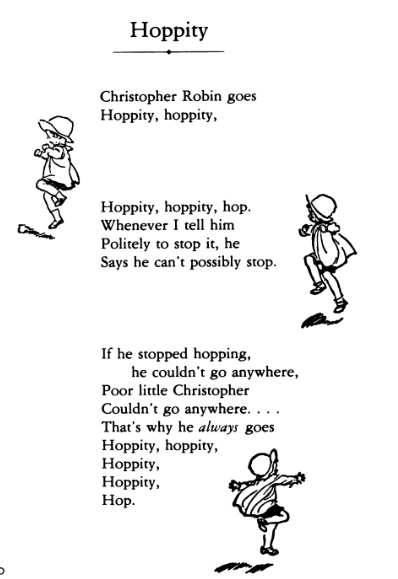
by heart.

For Middle-Grade Readers
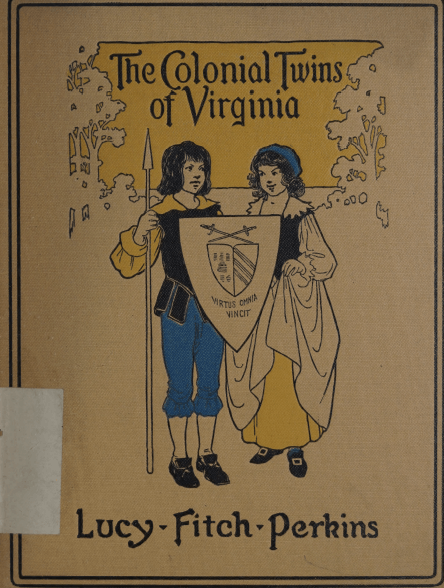
Its title alone would have DQ’d The Colonial Twins of Virginia, the latest installment in Lucy Fitch Perkins’s twins series, even if I hadn’t done a word search for “slave,” which yielded, among other things, one of the twins saying to the other, “One has to love people, and there aren’t any other people here to love except the slaves, and of course they don’t count.”
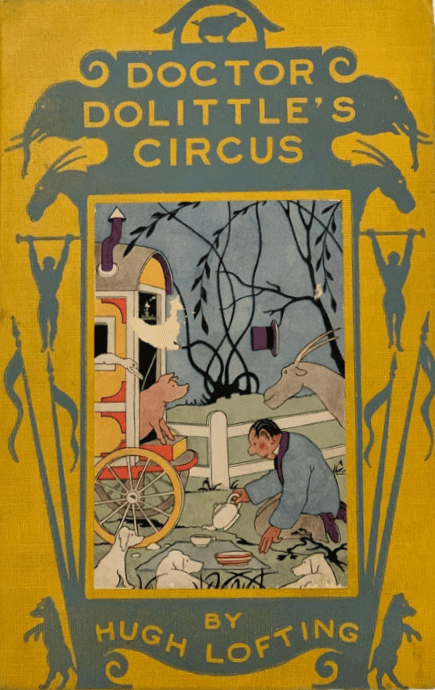
I didn’t have high hopes, but Dr. Dolittle’s Circus by Hugh Lofting appears to be one of the less offensive books` in the series (I wrote about previous installments here and here). Dr. D. comes to the aid of abused animals in a circus, including returning a seal to the sea.
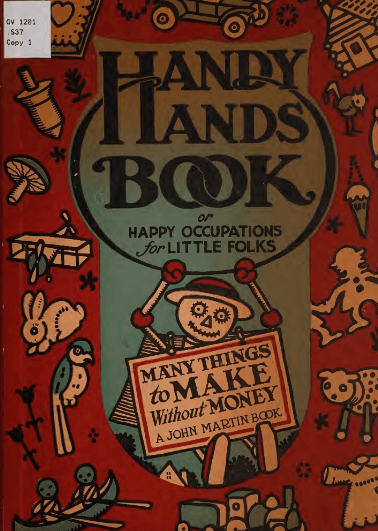
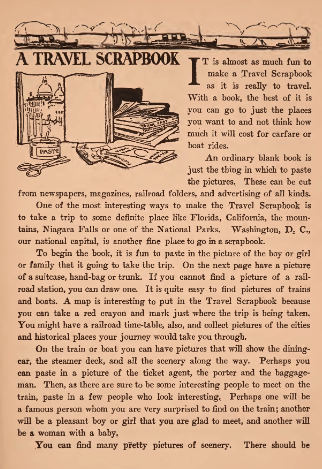
I loved activity books as a kid and am always on the lookout for a good hundred-year-old one. I’m not a fan of John Martin’s annual miscellany, so his Handy Hands Book was a pleasant surprise. I don’t buy Martin’s argument that “it is almost as much fun to make a Travel Scrapbook as it is really to travel” (unless maybe you’re stuck at DFW on Christmas Eve), but making a scrapbook of an imaginary journey does seem like fun.
For Older Children

Novels for high-school-aged children from a hundred years ago tend to be unbearably tedious, and this year’s were no exception.
Moore describes Earl Silvers’ Barry the Undaunted as “a story of high school boys and girls with an element of civic interest,” and it’s about as thrill-packed as that makes it sound. I gave up early on, in the middle of a prolonged discussion between Barry (who is a girl) and her fellow campers about what rules their swim team should have.
The New Moon

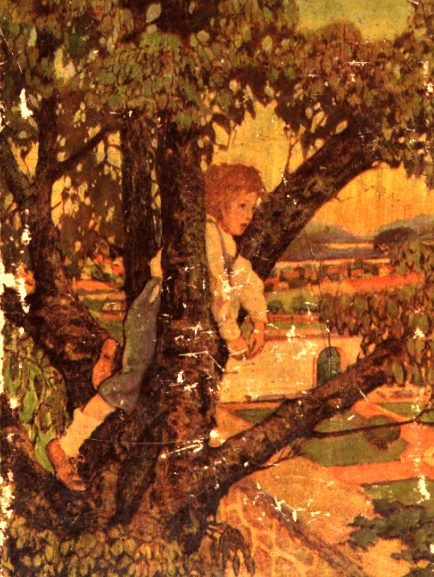
Moore quotes the introduction to Cornelia Meigs’ The New Moon as saying, “It might seem a tedious journey to walk at a sheep’s pace across the whole state of Pennsylvania.” Indeed it might, I say as someone who found a journey across half of the state of Pennsylvania in the passenger seat of a Prius pretty tedious. The journeyer is a boy who makes his way from Ireland to the American frontier. From a quick flip-through it struck me as more interesting than Meigs’ previous novels, but that’s not saying much.
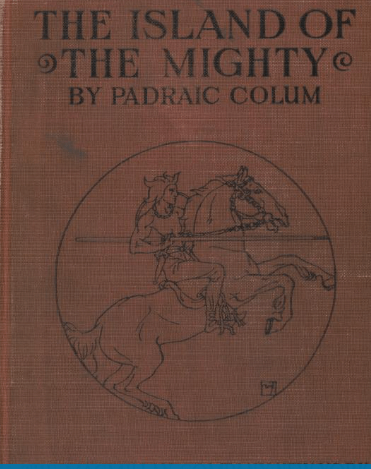
The first word of The Island of the Mighty, the book that Louise Hunting Seaman suggests that you accompany with a visit to the Hall of Armor at the Met, is “thus.” As “distinguished” as Moore finds it, I didn’t make it much further. Wilfred Jones’s illustrations are pretty cool, though.
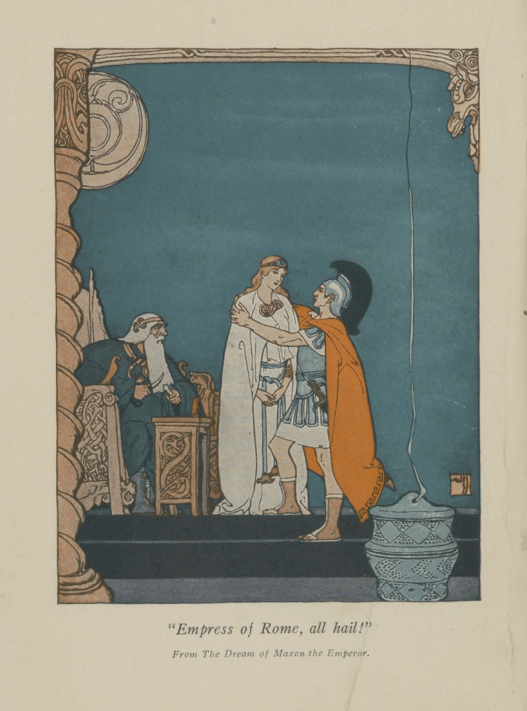

Wilfred Jones, The Island of the Mighty

You will, this New York Times ad claims of Waldemar Kaempffert’s A Popular History of American Invention, “read these exciting volumes as you would a novel…You watch Goodyear in rags vulcanizing rubber over the kitchen stove; Davenport tearing up his wife’s one silk dress to insulate a motor.”
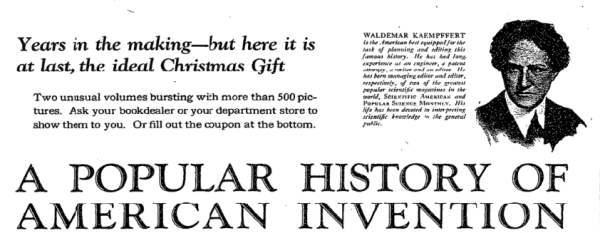
Oh no! I raced to find the horrifying scene:

“Tearfully but bravely the young wife handed to her boyish inventive husband, ‘Tom,’ the silk dress in which she had been married only eight years before. He needed it in his work as an inventor. It had been carefully folded away in lavender by the beautiful bride when, in 1827, Thomas Davenport, the active but studious village blacksmith of Brandon, Vt., had so far forgotten his profound interest in the ‘galvanic magnet’ of Joseph Henry as to fall in love and ‘settle down.’”

This is, I have to say, a lot more exciting than Cornelia Meigs.
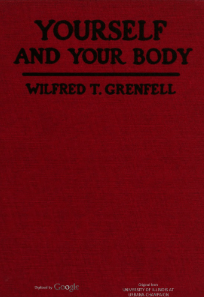
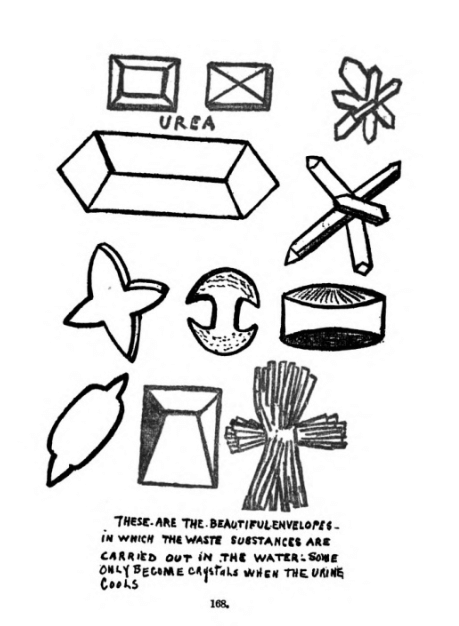
Moore calls Dr. W.T. Grenfell’s Yourself and Your Body “a unique and valuable book embodying Dr. Grenfell’s talks to his own children, with original and amusing drawings.” Grenfell, unsurprisingly, doesn’t cover ALL of your body, although there’s a chapter called “Waste,” which ends with, “Here ends this difficult chapter.” Here’s a cute drawing of urea:
Young Adults

Or the older children might just want to skip right up to reading adult books, like Agatha Christie, a favorite of my own mid- to late teens.
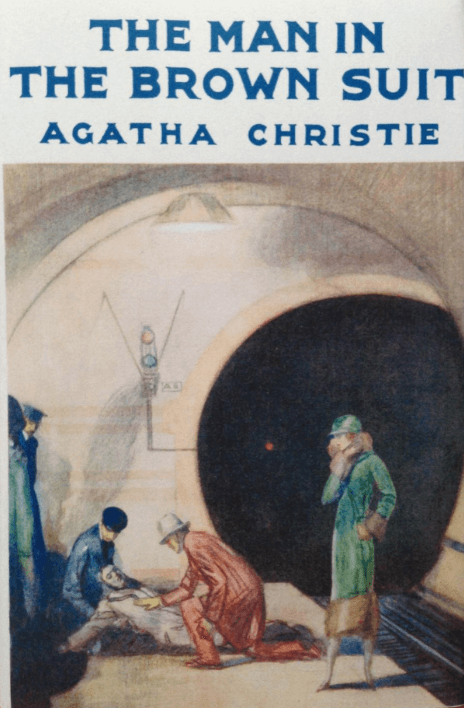
Some critics were disappointed that her latest novel, The Man in the Brown Suit, was a stand-alone thriller that didn’t figure Hercule Poirot, but it turns out to be partly set in Cape Town, which I’m pretty excited about.
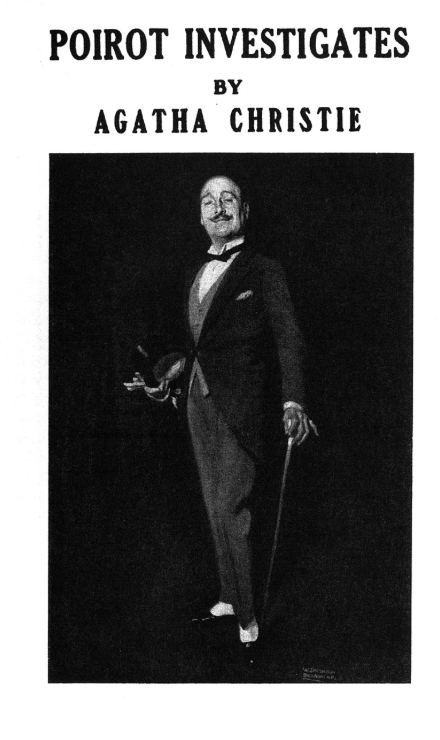
Plus, luckily for Poirot fans, there’s also her first short story collection, Poirot Investigates.
Number one on my 1924 wish list, and on the list of books I’m mad at HathiTrust for blocking in South Africa, is The Cross Word Puzzle Book, the first book of crossword puzzles ever and also Simon and Schuster’s first book ever. It launched a craze I have quite a bit of expertise on, since it featured prominently in my seventh-grade history paper “Fads of the 1920s.” (You can also get it at Project Gutenberg, but it’s not in the original format so you can’t print it out and do the puzzles yourself.) (UPDATE 12/24/2024: The Library of Congress has a PDF, but you can’t download it.)

Christmas Eve has given way to Christmas day and now Christmas night,********* and I’d love to curl up with a good cross word. Oh, well. Good thing I have Agatha Christie to keep me entertained.
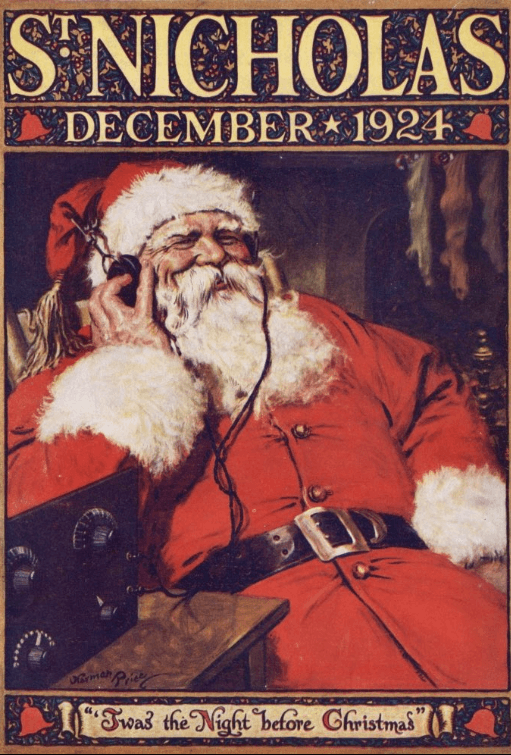
Happy holidays, everyone!

squiggle

*Although not, as people often assume, because I want to avoid the northern hemisphere winter. While people here are celebrating the holidays by having barbecues (braais in local parlance) or going to the beach, I’m dreaming of hot chocolate and long nights.

**Who, I see, has changed the name she writes under from Annie to Anne. I knew this was coming—Wikipedia says that she “officially changed her name to Anne in her fifties, to avoid confusion with Annie E. Moore, another woman who was also publishing material about juvenile libraries at that time.” In my opinion, ACM, who basically invented children’s libraries and children’s book reviewing, should have been the one to keep the i.

***I was going to say something snooty about Pinocchio being a marionette, not a puppet, but I looked into it and marionette is a subcategory of puppet.

****As always, there are a lot of reissued classics, which qualify for inclusion if they have new illustrations.

*****In the past, HathiTrust allowed worldwide access after 95 years, which is when copyright expires in the U.S., for most publications except U.K. periodicals.

******The Times, which is more of a fan than Moore, points out that Falls’s collection includes about three hundred verses “and must be comprehensive of all of them that are now extant.” There’s something to be said for selectivity.

*******Admittedly not a particularly complex piece of verse.

********The fake-sounding Martin turns out to have been a real person, although his actual name was Morgan van Roorbach Shepard, which would have been hard to squeeze onto the cover of all those books.

*********Don’t worry, I haven’t been doing this the WHOLE time.

Children’s Books: Your 1923 Holiday Shopping Guide

Welcome to the fifth annual children’s books holiday shopping guide! It’s been a hectic holiday season, including a trip from Washington, D.C., to Cape Town less than a week ago (I split my time between the two cities), so this is a pared-down edition.

My research this year started out with a big disappointment: it turns out that the 1922 edition of Publisher’s Weekly’s annual Christmas Bookshelf issue, which had been one of the highlights of my My Life 100 Years Ago year, was the last. Why, Publisher’s Weekly? Why?

Luckily, there’s still a lot of coverage, including holiday roundups in the New York Times, one on children’s books and another buone on books for the general reader with lots of books older children might enjoy. And, as always, pioneering children’s librarian Annie Carroll Moore weighs in in The Bookman, this time with not just one but two articles on holiday books, in the October and December issues.

New York Times, December 23, 1923

In non-book news, the Times also provides some helpful advice on keeping your children healthy over the holidays, including, “Don’t overdress them with their new sweaters or furs, just because it is Christmas.”

For Young Readers

From The A B C Book by Charles B. Falls

A piece of all-around good news: there are more pictures, and in particular more color pictures, in books for young children than there were just a few years ago. There’s even a book with color illustrations on every page, the first I’ve seen: Charles B. Falls’ The A B C Book, a book of woodcuts with an animal for each letter. (If you’re wondering what he did about X, it’s for xifius, which turns out to be Greek for swordfish.) It’s a favorite of Moore’s, and of mine.

From The Six Who Were Left in a Shoe by Padraic Colum

The New York Times recommends Padraic Colum’s The Six Who Were Left in a Shoe, and, although I found the story kind of silly, their praise for the endpapers is justified.

For Middle-Grade Readers and Older Children

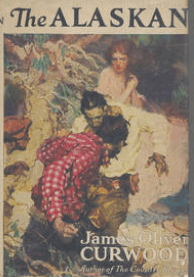
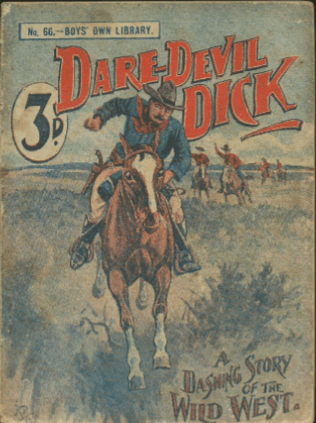
There was a bit of a moral panic going on regarding children’s reading in 1923, including in an article in the October 1 issue of The Library Journal by librarian Wilhelmina Harper. Harper’s bottom line: children are reading too much sensational adult literature, like Daredevil Dick and Seven Buckets of Blood (neither of which, sadly, I was unable to find),* and should be directed to high-quality children’s literature instead. I wondered whether Harper was being excessively prim and proper until I found The Alaskan: A Novel of the North, a 1923 novel by James Oliver Curwood, whose books, Harper tells us with concern, fifth- and sixth-grade boys have been asking for. Flipping through it, I found the following sentence: “He hurried back, seized a loaded gun, and sprang to the window, knowing that he must continue to deal death until he was killed.” Maybe Harper has a point.

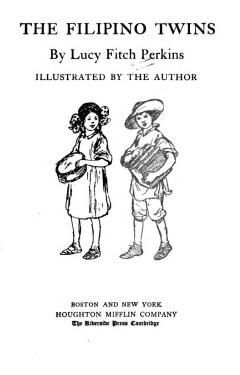
So what does Harper think children should be reading? Books published before 1923, mostly, which doesn’t do me much good. She speaks highly of Lucy Fitch Perkins’ series about twins from around the world, but I had a bad feeling about the 1923 installment, The Filipino Twins, When I skimmed through the first few chapters, though, I found it surprisingly lacking in racism. Unfortunately, the same thing can’t be said for the 1931 installment, which is about a pair of African American twins. So I’ll pass on Perkins.

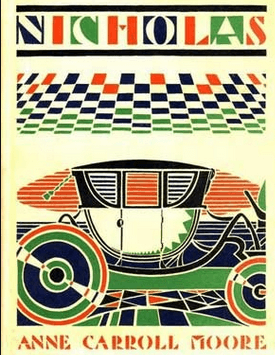
Nicholas: A Manhattan Christmas Story, by Anne Carroll Moore

I would have been more impressed by Annie Carroll Moore’s positive write-up about Nicholas, A Manhattan Christmas Story in the October 1923 Bookman roundup if the book hadn’t been written by…Moore herself.** Then, in the December issue, she waxes lyrical about writing Nicholas. According to my research for my post about Moore, it is not exactly a forgotten classic. Luckily for present-day me, though, it wasn’t actually published until 1924, so I can wait until next year. Cool Art Deco cover, though.

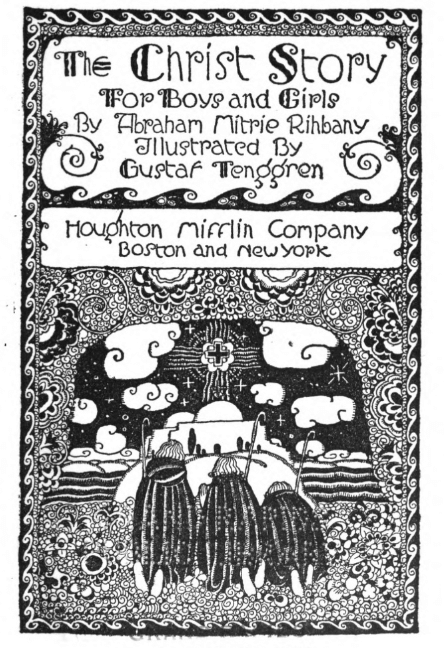
The Christ Story for Boys and Girls, featured in the New York Times roundup (which not very inclusively refers to Jesus as “our Savior”), is described as attempt by Abraham Mitrie Ribhany, a Lebanese Christian who moved to the United States as a young man, to draw on his own childhood experiences with Palestinian traditions to give children an idea of what Jesus’ life was like. I was intrigued by the premise, but I’m leery of a book that refers to Jesus repeatedly as Syrian*** without ever mentioning that he was Jewish.

From A Child’s Story of American Literature

The Times raves about A Child’s Story of American Literature by Algernon Tassin and Arthur Bartlett Maurer, although the reviewer calls the title “deplorable,” since it’s for older readers who would turn up their noses at the word “child.” Also, they think Tassin and Maurer have assigned insufficient importance to the works of Sidney Lanier. I’m okay with that, but, skipping through the book, I found a number of things to give me pause. For example, this passage:

You are a child of culture. Is it not your affair to make sure that, a hundred years hence, the story of which you are the first chapter will not have the same regrettable thing to record?

My hundred-years-hence ears perked up. It turns out that the regrettable thing is how, just as America has not made enough of an effort to Americanize her aliens, there has been insufficient appreciation of the United States of America’s own literature. I took issue with the first part, since, whatever you think of Americanization as a concept, my own experience of the world of 100 years ago is that people never shut up about. I do agree about the low self-esteem regarding American literature, though. Be that as it may, I’m not adding this book to my gift list.

A number of poetry anthologies for young people are on offer. I summarily disqualified The Boy’s Book of Verse, edited by Mary Gould Davis, which is the follow-up to her 1922 volume titled, you guessed it, The Girl’s Book of Verse. Moore and the Times both recommend This Singing World: Modern Poems for Young People, edited by Louis Untermeyer. “Hardly any boy or girl in the teens, or even for a few years earlier, but will find much in the volume to enjoy,” the Times raves.****

I wouldn’t bet money on that, but it is a nice selection, featuring poets including William Butler Yeats, Carl Sandburg, H.D., and, um, Louis Untermeyer and his wife, Jean Starr Untermeyer. This one’s going on my list. And the great thing about getting a poetry book as a present is that you don’t have to pretend to have read the whole thing.

Happy holidays, everyone, and happy reading!

squiggle

*UPDATE 12/27/2023: An enterprising reader found a listing for Dare-Devil Dick on Abe Books.

**The only reason that Moore even kind of gets away with this is that she only mentions the illustrator in the text of the article, with her name listed as the author in the list of books at the end.

***The Christ Story for Boys and Girls is based on Ribhany’s influential 1916 adult book The Syrian Christ.

****It took me a while to get my head around that syntax.

Floor of Wanamaker's department store, 1920.

I Read a Random 1920 Book

In the three and a half years since I started this blog, I’ve read fifty-six books from a hundred years ago. Many of them, like The War-Whirl in Washington and Mary Marie, aren’t read much today.* But every one, no matter how obscure, was chosen by someone—me—with a contemporary sensibility. What if there were a way around this, I would occasionally wonder—a way to meet the world of a hundred years ago on its own terms, rather than through a 21st-century lens.

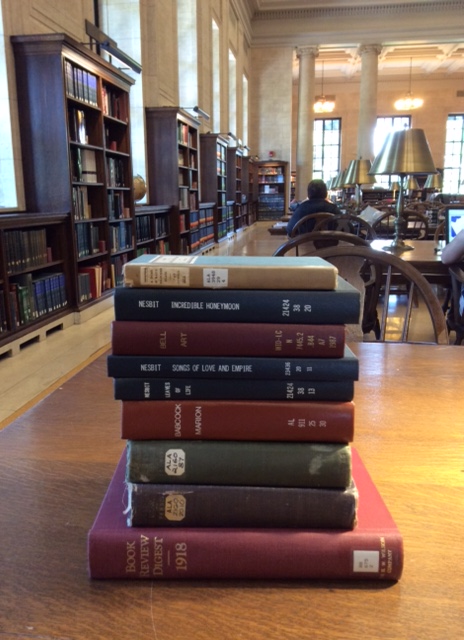
Last year, I thought of a way to do this: I’d read a random book. I picked up my copy of the 1920 Book Review Digest, flipped through it a few times, stopped, and, with my eyes closed, pointed to a place on the page.

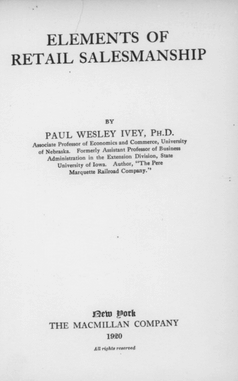
And got…Elements of Retail Salesmanship, by Paul Wesley Ivey, Ph.D.!**

Title page, Elements of Retail Salesmanship by Paul Wesley Ivey

 I couldn’t have been more thrilled. I could have ended up with anything—Hugh Temple Sheringham’s Trout Fishing Memoirs and Morals, for example, or Newell Dwight Hillis’s Rebuilding Europe in the Face of World-Wide Bolshevism. But no, I got a book about a topic I find fascinating, and that I had so far encountered only in Edna Ferber’s short stories about exhausted department store saleswomen.

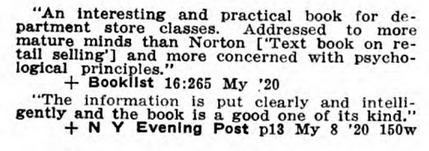
Plus, Elements of Retail Salesmanship got the equivalent of two thumbs up in Book Review Digest, which classifies each excerpted review as +, +-, or -. “The information is put clearly and intelligently and the book is a good one of its kind,” the New York Evening Post said.

Reviews of Elements of Retail Salesmanship in Book Review Digest, 1920.

Book Review Digest, 1920

Next step: acquiring a copy. These days, you can buy just about any out-of-copyright book online. Some companies put the text into Word documents and bind them, generally with a tiny font and/or horrible formatting. Some do OCR scans of book texts, with unintelligible results. Other companies just print out the scanned text from Google Books. This, I have learned from experience, is the best, even though you often end up with people’s underlining and marginal comments.***

That is, you can get almost anything unless it’s the first wave of COVID, which it was, plus something weird was going on in the printing industry. My favorite out-of-print publisher, Forgotten Books, finally admitted defeat and cancelled my order, so I tried again with my second-favorite, Scholar Select. Elements of Retail Salesmanship arrived in late August, just before my brother and I set off from D.C. by car for a month-long stay in Colorado.****

Book, Elements of Retail Salesmanship.

Ivey was thirty years old and just starting out his career as a professor at the University of Nebraska when Element of Retail Salesmanship was published. He sets out his ambition for the book on the first page. “If it serves to make the salesperson see the educational possibilities in her[1] work and the relation of better service to community welfare,” he says, “it will have served the purpose for which it was intended.” The “her” struck me as surprisingly woke for 1920, but Ivey explains in the footnote that “the feminine gender is used throughout this book because ninety-five percent of the customers and salespeople in department stores are women.”

Sometimes the idea of reading a hundred-year-old book is more exciting than the actual reading. And, to be honest, Elements of Retail Salesmanship dragged a bit at the start, while Professor Ivey walked us through the history of merchandising. There were some high points even here, though, like learning about how retail establishments used to employ “barkers” to lure people in from the street. Once the customer was inside, the retailer—who didn’t charge a fixed price, so every interaction was a bargaining session—was reluctant to let customers out until they bought something. I’m not sure how this was enforced, but it sounded alarming.

John Wanamaker, ca. 1890

John Wanamaker, ca. 1890 (Frances Benjamin Johnston, Library of Congress)

I was relieved, then, when John Wanamaker came along in the late 1800s, with his low-pressure sales tactics, fixed prices, and money-back guarantees. Like many visionaries, he was regarded as a lunatic at first, but eventually the mentality whereby, as Ivey puts it, “each merchant tried to climb to success over the dead body of his opponent” disappeared and the modern age of efficiency began.

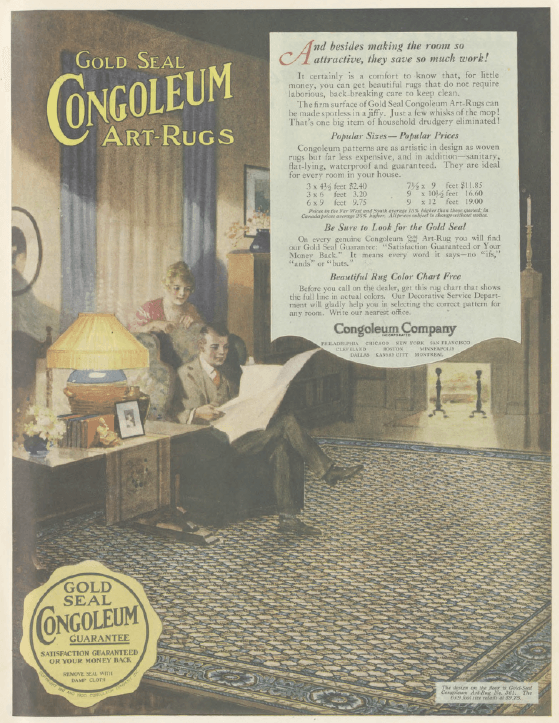
In the next chapter, Ivey moves on to “Knowing the Goods.” This is, in his philosophy, the salesperson’s most important obligation. Take congoleum, for example. Few people, he says, know that it is merely tar paper printed on both sides. I consider myself one of the world’s foremost experts on congoleum by virtue of having heard of it, but I did not know this interesting fact!

Congoleum linoleum rug ad, Ladies' Home Journal, January 1921.

Ladies’ Home Journal, January 1921

Or take corsets. Ivey tells us that

during the reign of Catherine de Medici of France, no woman in her court could find favor in her eyes whose waist measure exceeded thirteen inches; that in order to reduce the waist measure to this figure corsets were laced by serving men while in some cases the figure was placed in a steel cage or corset frame which held the victim’s body in a vise-like and perfectly rigid grip; that the death rate increased among the women due to this custom, and, finally, Henry IV of France stamped out the injurious fashion by an imperial order.

Engraving of an iron corset held by the Musée de Cluny, 1893

This is a fascinating bit of history (or, actually, mythology–it’s been debunked), but it leaves me wondering what exactly the salesperson is supposed to do with it. “Did you know these things can kill you?” doesn’t seem like much of a sales pitch, as opposed to, say, claiming that women need an artificial exoskeleton to keep their internal organs in place.*****

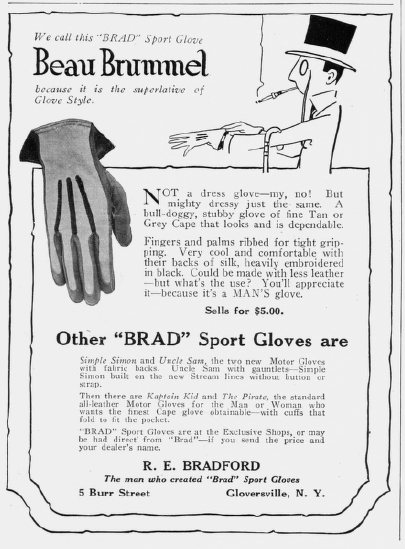
Overall, though, Professor Ivey makes a convincing case for knowing the goods. You wouldn’t want to be like the salesperson who, asked why one pair of gloves cost $2.00 and a similar-looking pair cost $2.50, thought intensely for a few seconds and then answered, “I guess it is because they are marked that way.” Another giveaway about lack of product knowledge: excessive use of terms such as “nifty,” “swell,” “classy,” “great,” and “fine.”******

Ad for gloves, Harper's Bazar, February 1918

Harper’s Bazar, February 1918

Professor Ivey has high hopes for retail merchandising as a profession, musing that

four to six years of continuous study after graduation from high school is the rule rather than the exception for those entering law and medicine and in some cases dentistry. If a similar period of time was spent in study and laboratory work by those entering retail selling they would become just as truly expert in their line and would command incomes proportionate to their effectiveness.

I mentally debated the microeconomics of this with Professor Ivey for a while, then forced myself to move on.

Luckily, there are ways to learn about the goods even without sitting in a classroom. For example, Ivey tells us, you can take home the informational material that manufacturers send with the merchandise and peruse it in your leisure hours. Or you can go to the library and read the encyclopedia entries on textiles, shoes, household furnishings, novelties, and other goods, which, he promises us, are “both entertaining and of an educational value.”

I decided to give this a test run. I found the 1911 edition of the Encyclopedia Britannica on HathiTrust, opened the 15th volume, which luckily had the entry for “Jewelry,” and picked a passage at random.

Excerpt from entry on Jewelry in 1911 Encyclopedia Britannica.

Encyclopedia Britannica, 1911 edition, vol. 15

I thought about Edna Ferber’s saleswomen, heading back to the boarding house, exhausted after being on their feet all day. My thoughts turned, too, to my younger self, tired out after a long day at the embassy in Phnom Penh, trying to read Elizabeth Becker’s When the War Was Over: Cambodia and the Khmer Rouge Revolution, and just not having it in me. And the ambassador let me sit in a chair! I had my doubts about whether the extracurricular encyclopedia reading ever actually happened.

Luckily, Professor Ivey presents us with more enjoyable ways of improving our salesmanship. You can, for example, challenge yourself to engage as many of the customer’s senses as possible. You don’t just show her the aluminum kettle, you “ring” it. In the hands of a clever salesperson, he claims, silk can be made to “talk.’”

Picture of kettle in Mirro Kettle ad, Ladies' Home Journal, 1920.

Ladies’ Home Journal, February 1920

Then there’s the psychological angle. Ivey walks us through the different types of customer: the Impulsive or Nervous Customer, the Deliberate Customer, the Confident or Decisive Customer (“she walks into the store as a general would march into the camp of a defeated army”), the Silent or Indifferent Customer, and the Distrustful Customer. Selling to each type requires different tactics. One caveat, though, applies to all types: if a customer is considering an item of clothing, don’t say that you bought it yourself and are happy with it. Because who wants to dress like a salesclerk?

Salespeople, too, can be distinguished by personality. The ideal salesperson combines the traits of Enthusiasm, Honesty, Promptness (which turns out not to mean showing up for work on time but rather hopping to it when a customer needs help), and Cheerfulness.

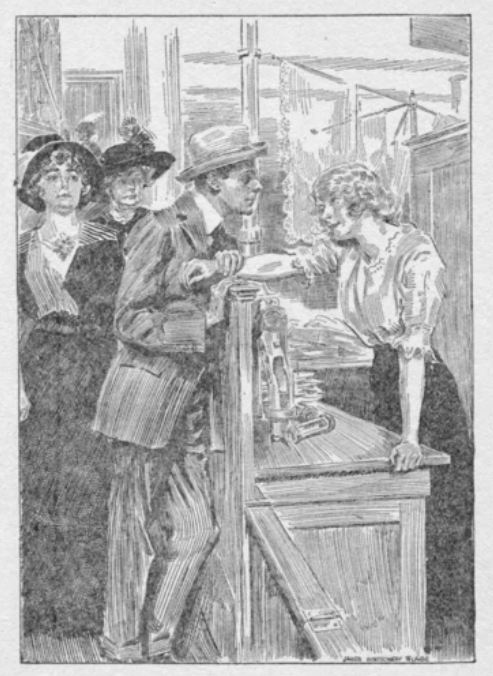
Man talking to woman at store counter, Roast Beef Medium by Edna Ferber

Illustration by James Montgomery Flagg from Roast Beef, Medium, by Edna Ferber (1913)

Too often, Professor Ivey tells us, salespeople ask questions like, “Is there anything today,” “Waited on?” “Do you wish anything?” “Can I show you something?” or merely “Something?” Syntax aside, these seemed to me like normal salesperson inquiries, but Professor Ivey says that they indicate suspicion that the customer is a “looker” as opposed to a serious shopper. Better: “Do you desire service?” or “Do you wish attention?”

Cheerfulness, Professor Ivey, tells us, is not merely a matter of smiling. There are smiles and there are smiles. There is “the pitying smile, when the customer signifies a desire to look at a cheaper article than the first shown her,” as well as the sarcastic, knowing, idiotic, and bored smiles, and, lastly, the “Heaven-help-me” smile, exchanged with a colleague when the customer finds difficulty in deciding between two silverware patterns. Oh, I know those smiles all too well!

Department store floor, Detroit, ca. 1910.

Department Store in Detroit, Michigan, ca. 1910 (Universal History Archive)

Enthusiasm, according to Professor Ivey, is not something that can be feigned. “All salespeople should have a feeling of admiration for the store in which they are working or else seek opportunities elsewhere,” he tells us. “Disloyalty can never be justified within an organization because sincerity would thereby be violated.”

And if you don’t wake up full of happiness? No problem. You just say to yourself, “This is a wonderful world. It’s great just to be alive,” or, “I feel fine, I feel happy.” Or you sing, or whistle.

With all due respect to Maria von Trapp, I’ve got some problems with this. I’m not expecting a marketing professor at the University of Nebraska in 1920 to be a Marxist, but seriously? “A feeling of admiration for the store in which they are working?” Have you ever HAD a job, Professor? (This is a rhetorical question–Ivey tells us that he has, in fact, worked in sales.) Also—where’s the chapter on what the salesperson can expect from her employer in exchange for all this expertise, psychological acumen, and sincere admiration?

Interior of Wanamaker's store, 1920.

Wanamaker Building, 1920 (Historical Society of Pennsylvania)

I went back to my post on “What’s Your 1918 Girl Job?” to see what the Ladies’ Home Journal had to say about opportunities for women in sales:

The average pay is low, hours long, and the work is not easy, but employment is steady for the competent worker. Hours have been shortened, however, and conditions improved by the activity of the Consumers’ League. Chances for advancement are good, however, for the ambitious girl in the employ of a good firm. (July 1918)

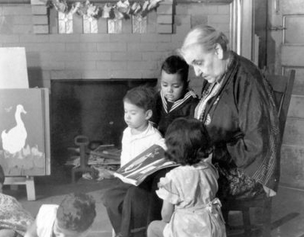
Jane Addams reading to children at Hull House.

Jane Addams at Hull House (Jane Addams Memorial Collection, University of Illinois at Chicago)

 The National Consumers’ League was an organization, founded by pioneering social worker Jane Addams and others, that advocated for better conditions for workers. Some of their causes seem odd today, such as their defense of an Oregon law that limited working hours for women, but not men, to ten hours a day (the case went to the Supreme Court and the law was upheld), but they were effective in combating poor working conditions, especially in sweatshops. We don’t hear a word from Professor Ivey about the National Consumers’ League. Or about trade unions, either.

Paul and Stella Ivey

Paul and Stella Ivey, date unknown (findagrave.com)

Politics aside, I had developed a fondness for the affable professor, and I set out to learn more about him. He was born in Bessemer, Michigan, in 1890, and attended Lawrence College in Appleton, Wisconsin. He earned a master’s degree from the University of Illinois, with a thesis titled “The Liquor Industry and Industrial Efficiency,” and went on to the University of Michigan for his doctorate. In 1915, a year after his arrival in Michigan, he married Stella Walker, a widow whose first husband, a dentist, had died of typhoid fever in 1912 at the age of 27. Ivey completed his dissertation, “The Pere Marquette Railroad,” in 1919, and started teaching at Nebraska that year. Here he is on the business administration department’s page in the university’s yearbook, bottom right, jokily captioned “Ivey-covered column.”

Photographs of Business Administration staff, University of Nebraska, 1920.

The Cornhusker, 1920 (yearbooks.unl.edu)

A new marriage, a professorship at a rapidly expanding university, and a book that was serialized in Publishers’ Weekly: all in all, a promising start. What was next? Mostly more of the same, as it turned out. Ivey left Nebraska for Northwestern University a few years later, and by 1932 he was teaching at the University of Southern California, where he would spend the rest of his career.

More books followed: Principles of Marketing in 1921, Salesmanship Applied in 1925, Getting Results in Selling in 1934, Successful Salesmanship in 1937, and Human Relations in Banking in 1941. His work was mentioned in the sermons of Lloyd Cassell Douglas, the minister and best-selling author of Magnificent Obsession and The Robe.

Professor Ivey died in Los Angeles in 1950, at the age of 60. Stella lived until 1967. They didn’t have any children, or at least any that I was able to track down. (UPDATE 2/19/2021: A relative of Stella’s says in the comments below that they had no children but were part of a large and close extended family on Stella’s side.) Professor Ivey’s work outlived him; the fourth addition of Successful Salesmanship, updated by a co-author, was published in 1961.

As chance would have it, Lincoln, Nebraska, was my brother’s and my first overnight stop on our drive back to D.C. from Colorado, so I had an opportunity for a Professor Ivey pilgrimage. Or more of a mini-pilgrimage, rather. I hadn’t done enough research yet to find the  building where he taught,

Drawing of business administration building, University of Nebraska, 1920

The Cornhusker, 1920 edition (yearbooks.unl.edu)

and a house built in 1925 now stands at the address of his Lincoln home (which I found online and subsequently lost). Besides, it was pouring, and we needed to get a move on. I did sense Professor Ivey’s presence, though, as I had breakfast in a coffee shop in the historic Haymarket district near the university.*******

Mary Grace McGeehan at coffee shop

I’ve decided to make reading a random book an annual tradition, so stay tuned! I can’t imagine, though, that my 1921 book could possibly be as much fun as Elements of Retail Salesmanship.

Problems from Elements of Retail Salesmanship.

Problems from Elements of Retail Salesmanship

squiggle

*Although “aren’t read much” doesn’t mean “aren’t read at all.” One effect of the proliferation of free public-domain e-books is that people come across century-old books at random and post reviews on Goodreads that say things like “the writing was kind of old-fashioned.”

**I set a few ground rules: no books over 400 pages, no books I was already aware of, and no books about history, because reading a 1920 book about, say, Elizabethan England seemed beside the point. In any case, Elements of Retail Salesmanship won fair and square on the first try.

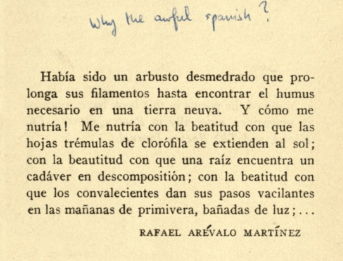
***This can actually be quite entertaining, as in this online copy of William Carlos Williams’ 1917 poetry collection Al Que Quiere!:

Al Que Quiere by William Carlos Williams, with handwritten note "Why the awful Spanish?"

HathiTrust

****This was, in case you’re wondering, a necessary trip and not an irresponsible pleasure jaunt.

*****When I was Googling around for a source for this, I found this comment from me from 2019 on witness2fashions’s website: “I just came across a fascinating article in a 1922 issue of Printer’s Ink magazine, aimed at panicky corset sellers, assuring them that going corsetless is just a fad and reminding mothers to educate their daughters on the health benefits of corsets, including supporting internal organs and strengthening back muscles.” The actual Printer’s Ink article is lost in the mists of time.
******This reminded me of the time I was trying on a dress in a Cape Town boutique and the salesperson said, “That’s a stunning dress!” I was mildly flattered, the way one is by even the most transparently insincere compliments, until I heard her say to a woman who was looking at a sweater, “That’s a stunning jersey!,” and then, to a woman standing in line to buy perfume, “That’s a stunning scent!”

*******One good thing about the Midwest (of many!) is the spaciousness, indoors as well as out. The coffee shop was huge, with tables at a safe distance from each other.

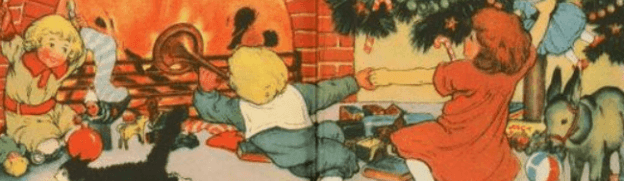
Crop from Helen Nyce, Visit to St. Nicholas, children and Christmas tree

Children’s Books: Your 1920 Holiday Shopping Guide

It’s that time of year again! The holiday roundup of children’s books is one of my favorite My Life 100 Years Ago traditions, if you can call something you’ve only done once before a tradition. (The year before last, I did a just plain holiday shopping guide.)

Illustration from children's books article, Publishers Weekly, November 6, 1920.

Publishers Weekly, November 6, 1920

Once again, I had a lot of help. Pioneering children’s librarian Annie Carroll Moore is on hand with a guide to fall books in the November 1920 issue of The Bookman,* and Margaret Ashmun has an article on Christmas books for the young and old in the December issue. Publisher’s Weekly has an expansive holiday roundup, and Literary Digest weighs in with fifty gift suggestions for children. The New York Times has an engagingly written writeup by Hildegarde Hawthorne, granddaughter of Nathaniel. (There’s also a Times article with the seemingly promising title of “Christmas in Bookland,” in which Coningsby Dawson blathers on for two pages about the wonders of motherhood and manages to only mention one book, An Outline of History by H.G. Wells.)

For the Very Young

I had an easier time finding books for very young children than I did last year, mostly thanks to Hawthorne. As far as I can tell, though, books with illustrations on every page were still unheard of.

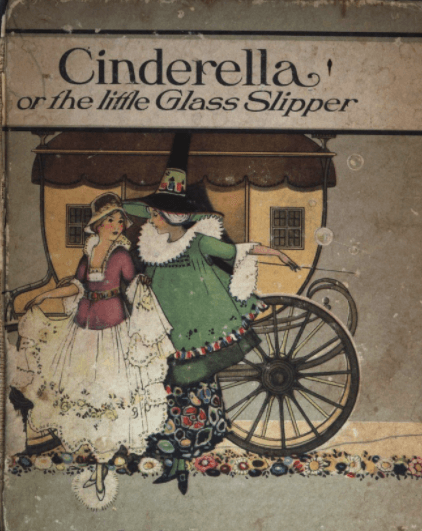
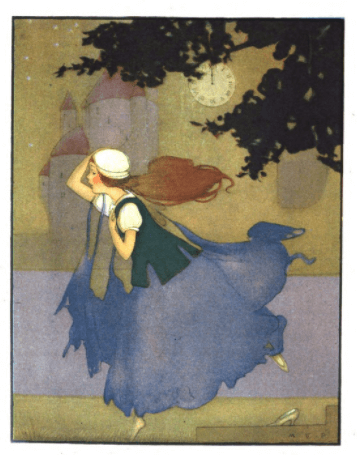
Cover of Cinderella, illustrated by Margaret Evans Price, Cinderella with coach.

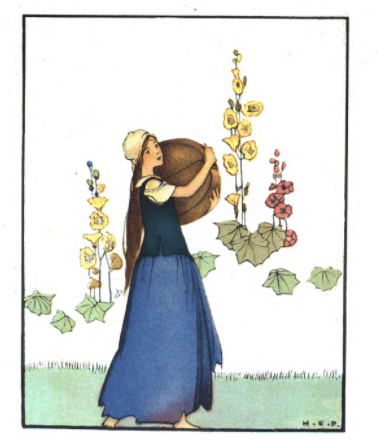
Cinderella, or The Little Glass Slipper, illustrated by future Fisher-Price co-founder Margaret Evans Price, has just seven illustrations in the 40-page text, plus some more at the beginning and end. Still, they’re charming,

Margaret Evans Price illustration from Cinderella, Cinderella doing chores.

Margaret Evans Price illustration from Cinderella, Cinderella running away from ball.

and Cinderella is going on my list.

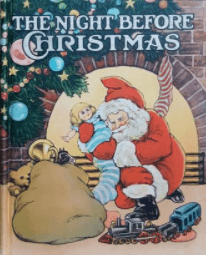
Cover of The Night Before Christmas, illustrated by Nyce, 1920, Santa with toys.

The Night Before Christmas presents Clement C. Moore’s classic 1823 poem (actual title: “A Visit from St. Nicholas”) with illustrations by Helene Nyce.

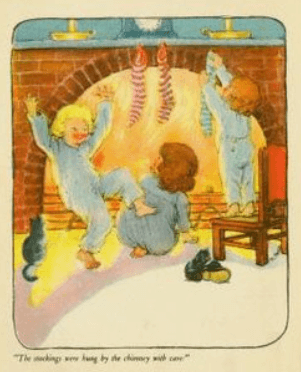
Nyce illustration, The Night Before Christmas, 1920, children dancing in front of fire.

That’s a crop from one of Nyce’s illustrations at the top of the post.

Fantasy and Fairy Tales

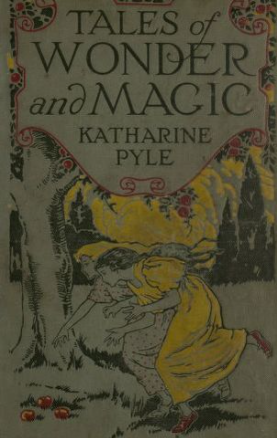
Cover, Tales of Wonder and Magic, Katharine Pyle, 1920.

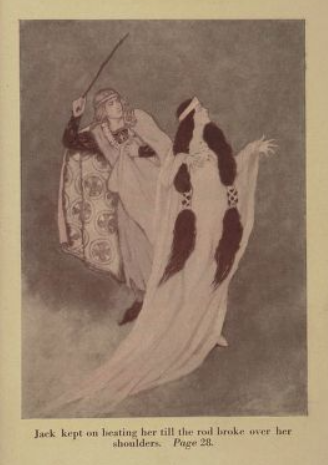
Tales of Wonder and Magic, a collection of fairy tales from around the world written and illustrated by Katharine Pyle, also turned out not to have many illustrations, which disappointed me at first, until I came across this one,

Tales of Wonder and Magic, Katharine Pyle, 1920, prince beating princess.

which made me wish it had fewer.

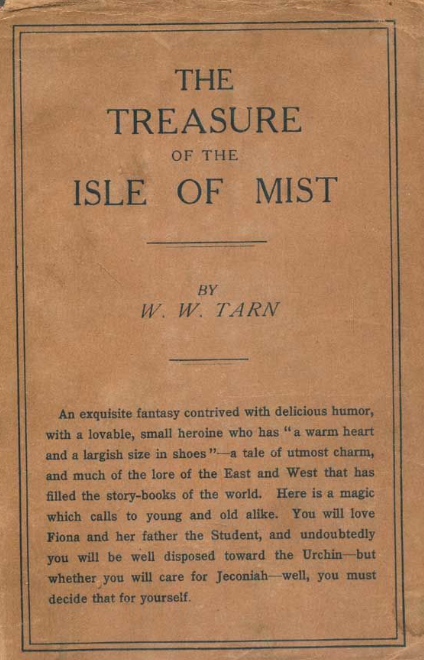
Cover, Treasure of the Isle of Mist, W.W. Tarn.

Hathitrust

Annie Carroll Moore calls The Treasure of the Isle of Mist, by the Scottish writer W.W. Tarn, “an exquisite fantasy of youth and autumn.” If your kid is transfixed by sentences like this, by all means add it to your holiday list:

Up through the calm water, to meet the eye of the gazer, came the green clearness of stone, and blinks of unveined sand showing white between the brown tangled blades of the great oar-weed; and you might see a school of little cuddies, heads all one way, playing hide and seek in the sea forest, and caring no whit for the clumsy armored crab beneath them, who crawled sideways, a laborious patch of color in the shimmering transparency. 

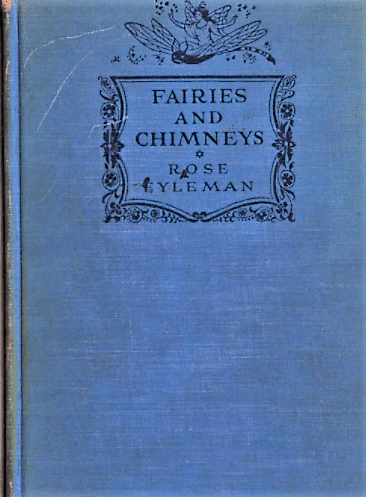
Cover, Fairies and Chimneys, by Rose Fyleman.

Rose Fyleman’s poetry collection Fairies and Chimneys is, in Moore’s opinion, “just the book to take up after leaving Fiona and The Student” (of The Treasure of the Isle of Mist). Since she presumably doesn’t mean after flinging the book aside in disgust, I had low hopes.

I was charmed by the poems, though. They’re told in the voice of a little girl who’s a staunch believer in fairies, who keep popping up in the midst of everyday life—on a bus on Oxford Street, for example.

Here’s one of my favorites, called “Wishes”:

I wish I liked rice pudding,
I wish I were a twin,
I wish some day a real live fairy
Would just come walking in.

I wish when I’m at table
My feet would touch the floor,
I wish our pipes would burst next winter,
Just like they did next door.

I wish that I could whistle
Real proper grown-up tunes,
I wish they’d let me sweep the chimneys
On rainy afternoons.

I’ve got such heaps of wishes,
I’ve only said a few;
I wish that I could wake some morning
And find they’d all come true!

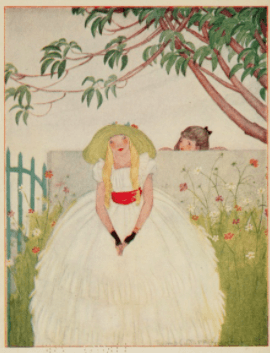
My wish: that Fairies and Chimneys had more illustrations. There’s only one, this frontispiece,

Frontispiece, Fairies and Chimneys by Rose Fylman, two girls separated by fence.

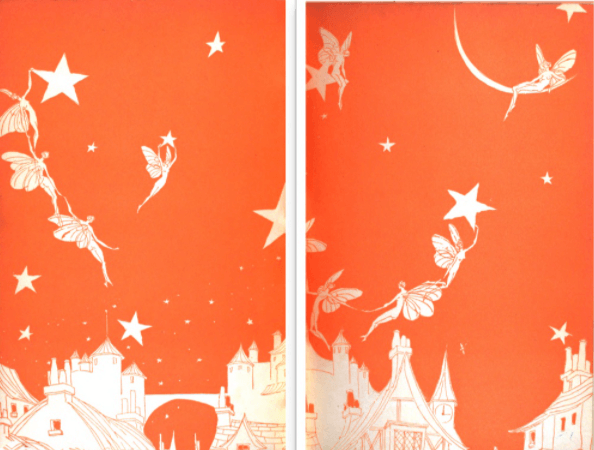
plus this artwork on the inside cover.**

Lining pages, Fairies and Chimneys.

Still, pictures or not, this is going on my list.

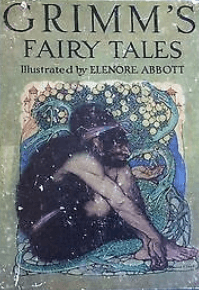
Cover, Grimm's Fairy Tales, Abbott, 1920.

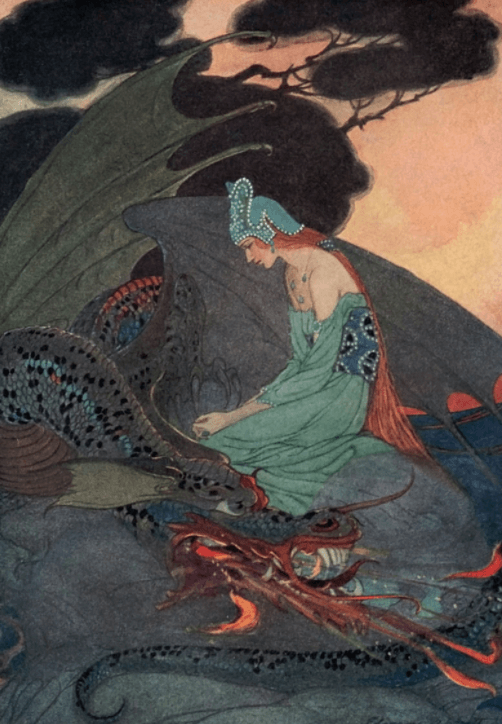
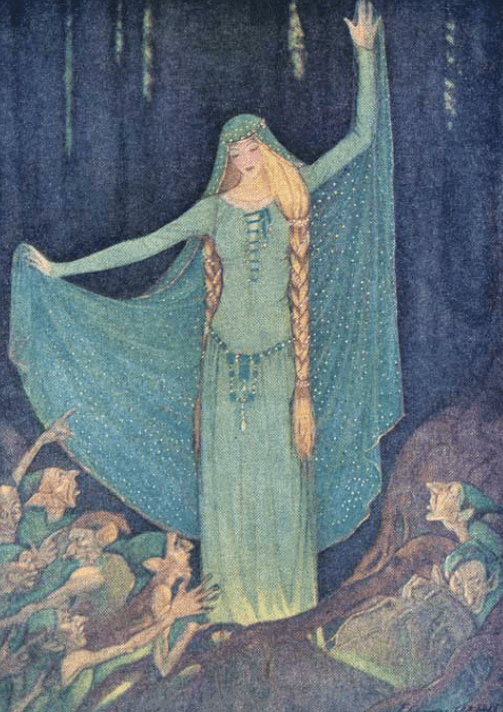
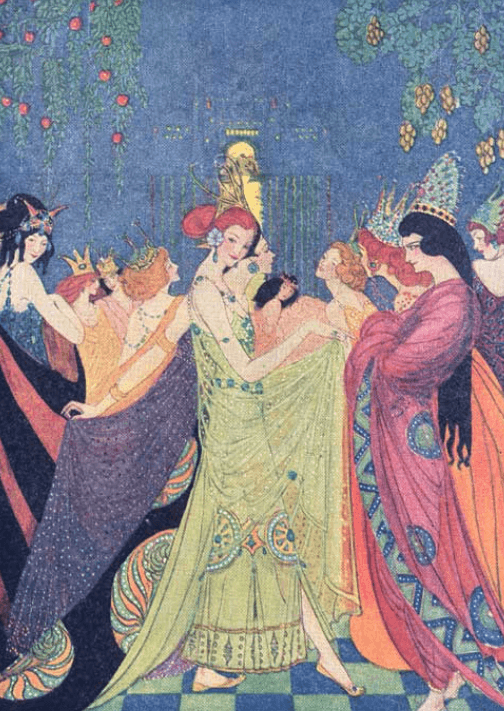
On to Grimm’s Fairy Tales, illustrated “delightfully this time,” according to Ashmun, by Elenore Abbott. I checked it out and found actual delightfulness—and no violent illustrations!***

Illustration by Elenore Abbot from Grimm's Fairy Tales

Illustration from Grimm's Fairy Tales by Elenore Abbott, woman in veil with long braids.

Illustration from Grimm's Fairy Tales by Elenore Abbott, women at party.

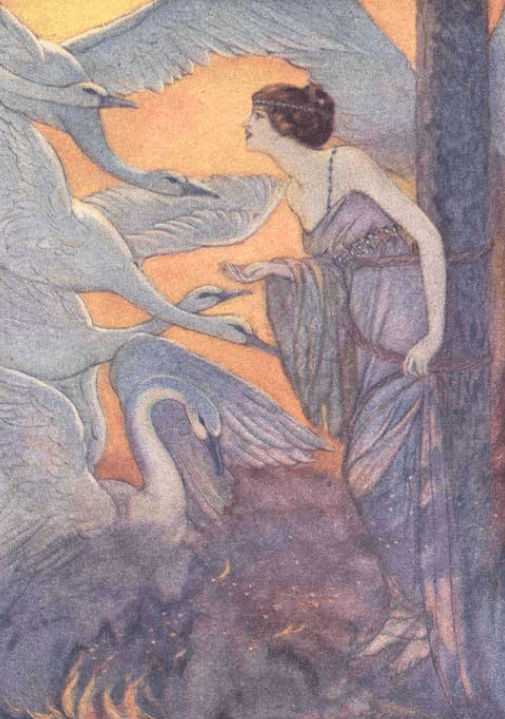
Illustration by Elenore Abbott, Grimm's Fairy Tales, 1920, woman with swans.

On the list. I’m on a roll!

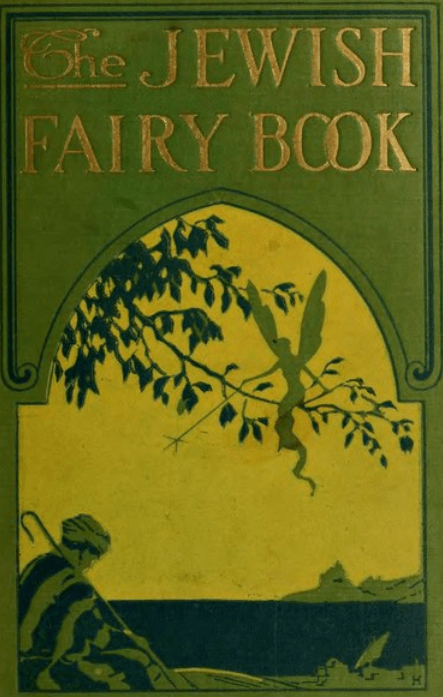
The Jewish Fairy book, 1920, cover.

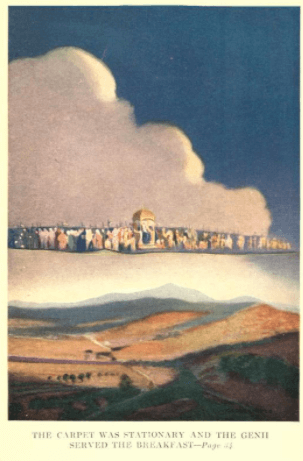
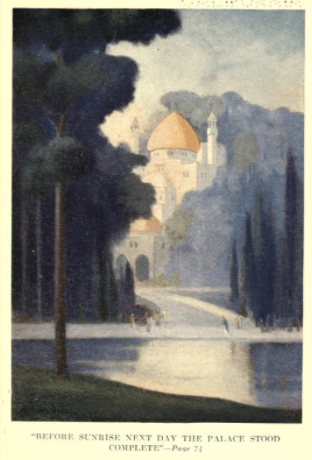
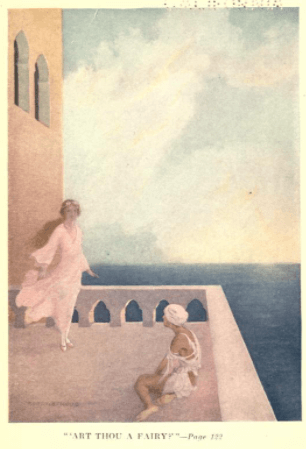
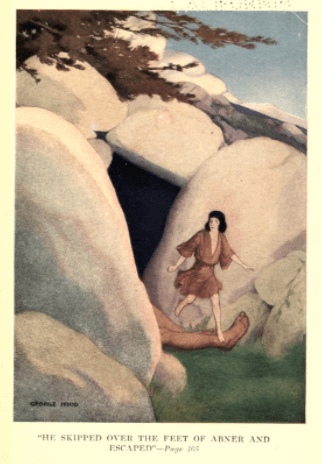
I had just about given up on including any kind of diversity in this roundup when I came upon The Jewish Fairy Book in Hawthorne’s Times article. This collection of traditional Jewish stories by Gerald Friedlander, with illustrations by George W. Hood,

Illustration from The Jewish Fairy Book, flying carpet.

Illustration from The Jewish Fairy Book, palace.

Illustration from The Jewish Fairy Book, girl and fairy on terrace.

Illustration from The Jewish Fairy Book, man walking out of cave.

would make a perfect (if belated) Hanukkah gift.

For Middle-Grade and Older Readers

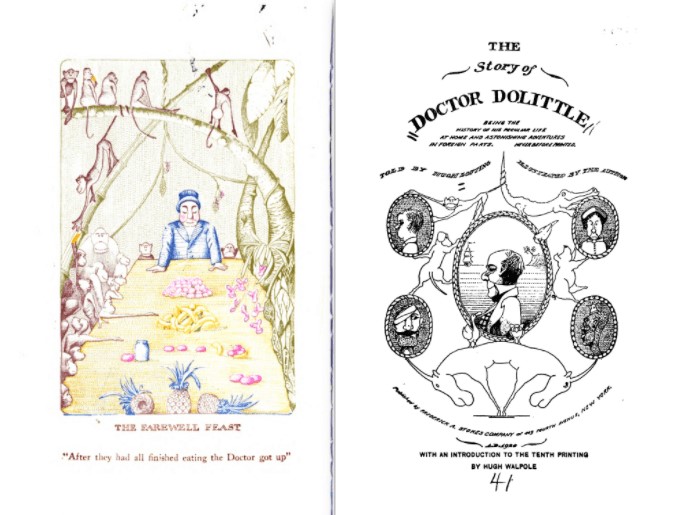
Dr. Dolittle title page and frontispiece, 1920.

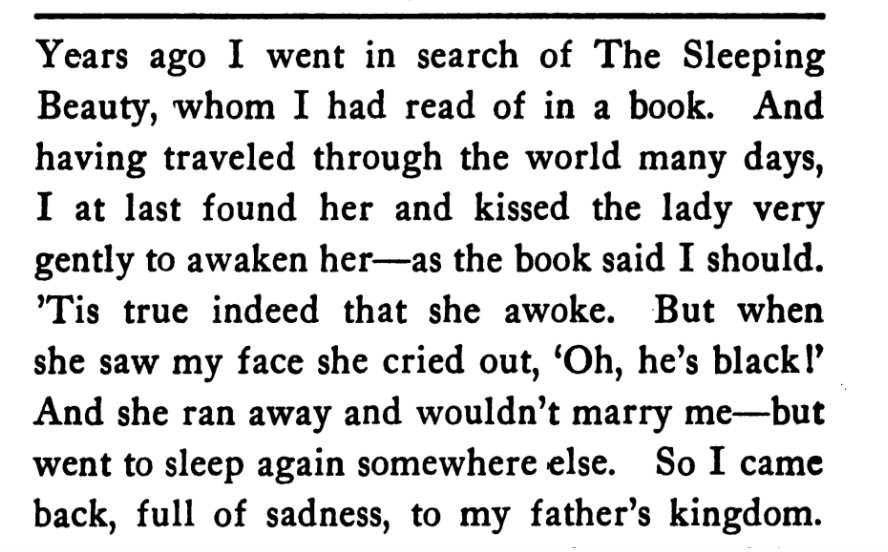
Annie Carroll Moore calls Hugh Lofting’s The Story of Dr. Dolittle “the most delightful nonsense story of the year,” and it’s the one undisputed children’s classic of 1920. I was going to buy a copy and (re)read it myself, but I bought one of the sequels by mistake and had to return it. This is just as well, because it turns out that modern editions have all the racism taken out, and I would potentially have ended up recommending a book where a Black prince tells this tale of woe:

Excerpt from The Story of Dr. Dolittle, racist passage.

The prince asks Dr. Dolittle to turn his skin white. Dr. D. works his magic, and lo and behold

all the animals cried out in surprise. For the Prince’s face had turned as white as snow, and his eyes, which had been mud-colored, were a manly gray!

Thanks to the blog Leaves & Pages for setting me straight.

L'Alsace Heureuse cover, Hansi, 1919.

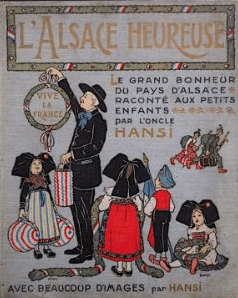
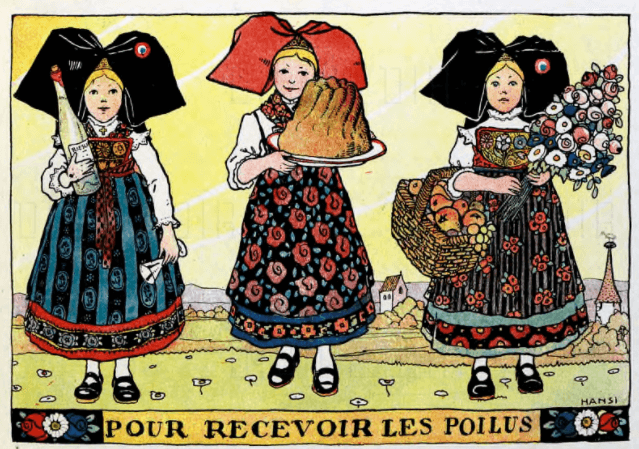
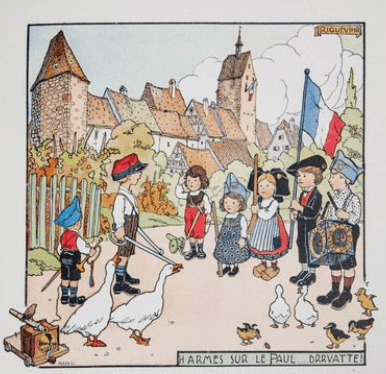
Moore has high praise as well for L’Alsace Heureuse, by Hansi (real name Jean-Jacques Waltz), a French writer of Alsatian descent. “What a happy Alsace is pictured here,” she says. “No book yet written about the war will give children the interest of the pleasure of these pictures.” The pictures I found online were indeed charming,

L'Alsace Heureuse, Hansi, 1919, three Alsace women.

but given that “happy” isn’t usually the first word that early 20th century Alsace brings to mind, I had my doubts. I couldn’t find a complete copy of L’Alsace Heureuse, but the grim pictures I came across in Hansi’s 1916 children’s book L’Histoire d’Alsace leave me inclined to approach this one with caution. Plus, I see no evidence that L’Alsace Heureuse was translated into English at the time.
The Story of Our Country title page and frontispiece.

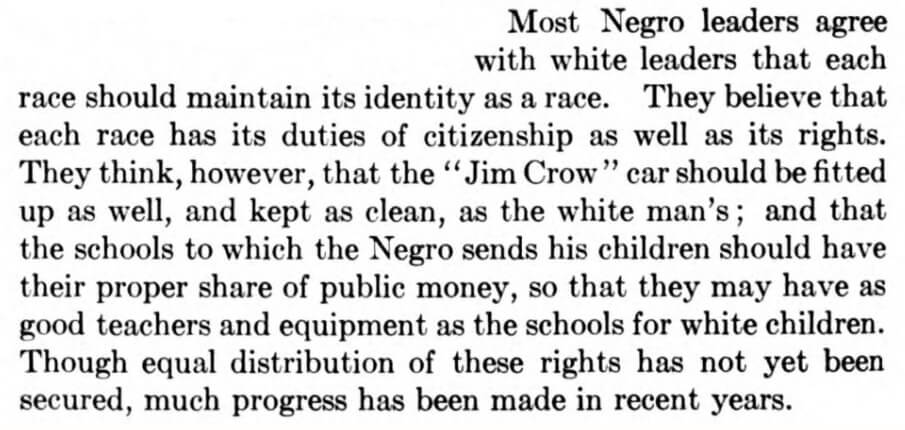
“E. Boyd Smith has written and illustrated ‘The Story of Our Country,’” is the totality of what Moore has to say about this book. I pulled it up on Hathitrust, typed “Negro” in the search bar, and found this:

Text from The Story of Our Country by E. Boyd Smith claiming Negro leaders favor segregation.

Next!

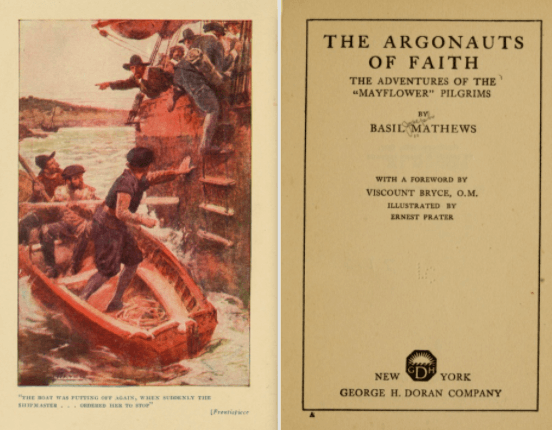
Title page and Frontispiece, Argonauts of Faith by Basil Matthews.

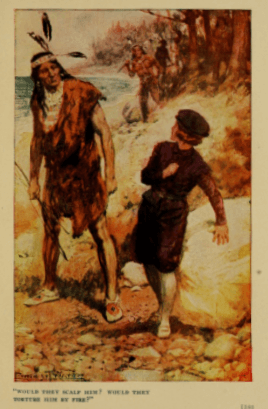
The 300th anniversary of the founding of Plymouth colony was celebrated a lot more enthusiastically than this year’s 400th, and there was no shortage of books about the Pilgrims. Moore’s favorite is The Argonauts of Faith, by Basil Matthews. Flipping through the illustrations, I found this one. “Would they scalp him? Would they torture him by fire?” the caption asks.

Argonauts of Faith illustration, white boy cowering from Indian.

They didn’t—they treated him kindly and he dined out on stories of his time with the Indians for the rest of his days—but I decided to give the Argonauts a pass anyway.

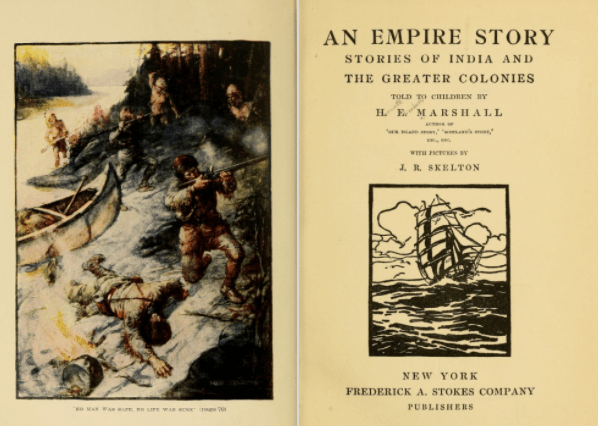
Sometimes, as with this reissue of H.E. Marshall’s An Empire Story, you don’t even need to go beyond the title page.

An Empire Story title page and frontispiece.

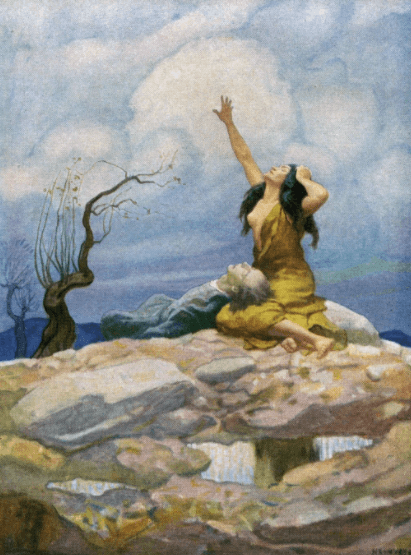
Illustrator N.C. Wyeth (father of Andrew) had a busy year,**** with new editions of Charles Kingsley’s Westward Ho!,

N.C. Wyeth illustration from Westward Ho!, bare-chested woman with dead man on her lap.

Daniel Dafoe’s Robinson Crusoe,

N.C. Wyeth illustration from Robinson Crusoe, Crusoe shooting murtherers.

and Henry Wadsworth Longfellow’s The Courtship of Miles Standish.

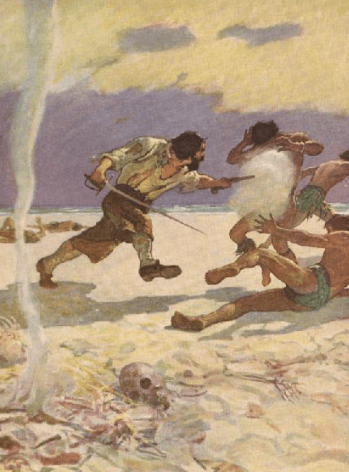
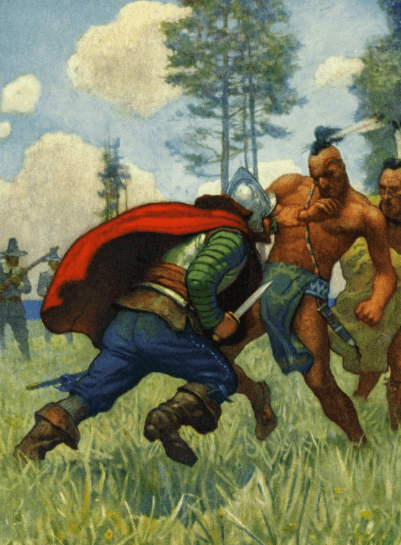
N.C. Wyeth illustration from The Courtship of Miles Standish, man stabbing Indian.

No, no, and no. (And in case you think I’m being a prude, it’s not the woman’s bare chest I object to, it’s the—I checked the text—dead guy on her lap.)

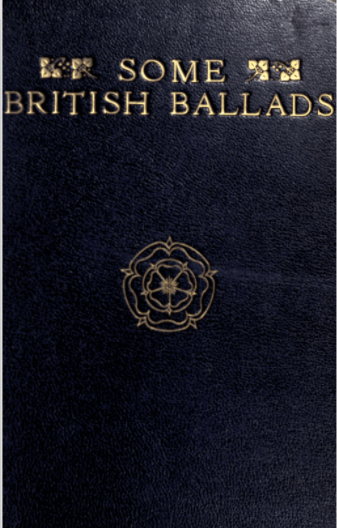
Cover of Some British Ballads.

Of Some British Ballads, a volume of Child ballads with pictures by Arthur Rackham, Ashmun says, “The fortunate recipient will find herself saying over and over, ‘Binnorie, oh, Binnorie!’”

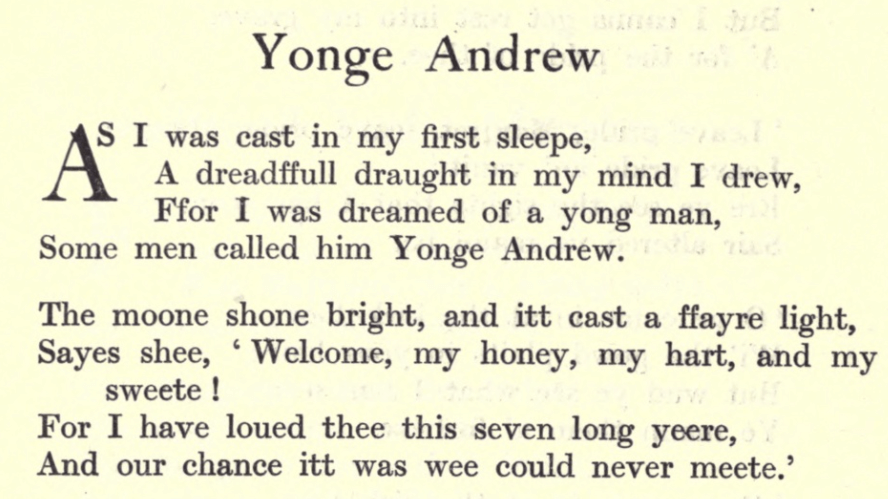
If you say so, Margaret. MY prediction is that the recipient will take a quick look at the text, see that it’s in old-timey English,

Text from Yonge Andrew, Some British Ballads.

come upon this illustration from “Yonge Andrew,”

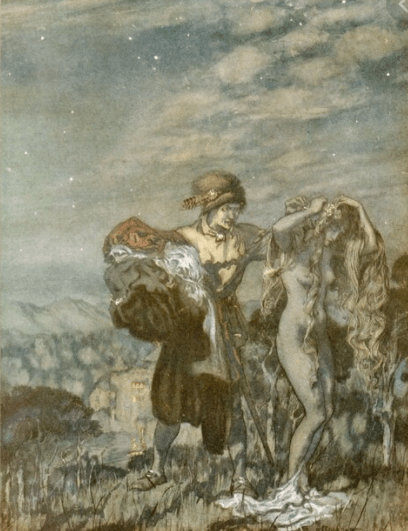
Arthur Rackham illustration of Yonge Andrew, from Some British Ballads, man with naked woman.

and stick the book into the back of his closet for further perusing.*****

Cover, Ancient Man, by Hendrik Willem Van Loon, pyramids on yellow background.

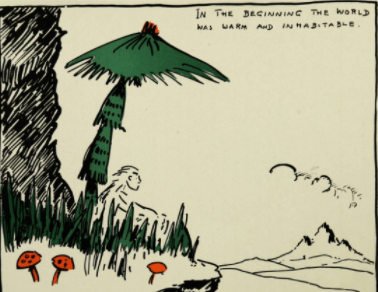
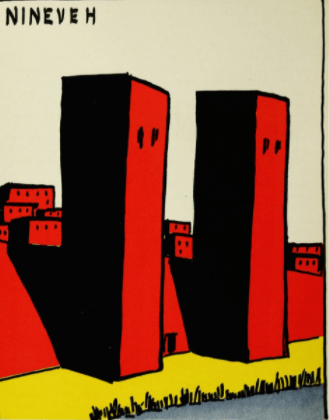
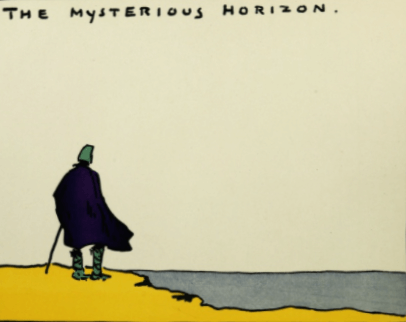
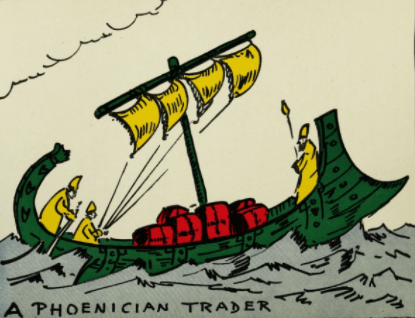
Every once in a while, I come across something from a hundred years ago that gives me a shock of recognition, seeming to come from a much later time. That’s how I felt when I saw the illustrations from Ancient Man by Dutch-American writer Hendrik Willem Van Loon.****** “Broad smears of color that tell a clear story none the less,” is how Hawthorne puts it, unknowingly summarizing the future of children’s illustration.
Ancient Man, by Hendrik Willem Van Loon, man under tree.

Ancient Man by Hendrik Willem Van Loon, 1920, pyramids on yellow background.

Ancient Man by Hendrik Willem van Loon, 1920, red towers of Nineveh.

Ancient Man by Hendrik Willem Van Loon, man looking at horizon.

Ancient Man by Hendrik Willem Van Loon, 1920, Phoenician ship.

Ca. 1920 history is fraught with peril, though, so I downloaded the text onto my Kindle. I’m about halfway through. Some of it, like a description of African people’s woolly hair and thick lips and references to prehistoric man “and his wife,” doesn’t pass the modern sensibility test. Biblical stories are presented as literal history, and non-Western civilizations like China and Asia are completely disregarded. With these caveats, though, I’d recommend it, especially if you (like me) are hazy on who exactly the Phoenecians were.

For Young Adults

Older teens are always hard to shop for, and this year is no exception.

Story of Opal cover, 1920.

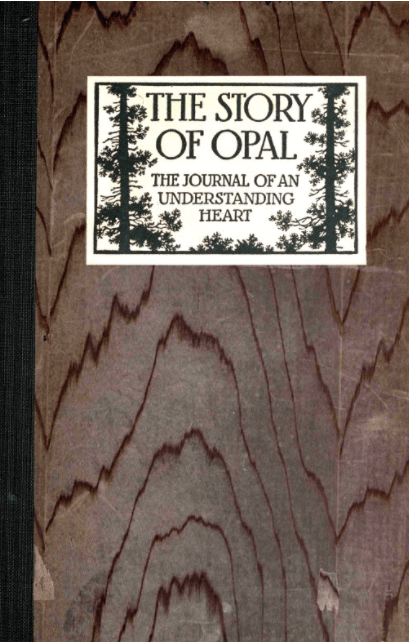
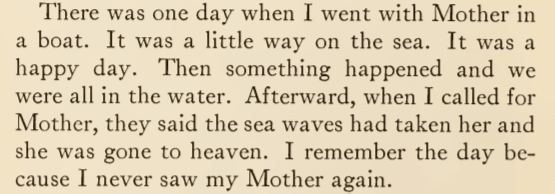
Moore, who has a habit of throwing adult books into the children’s roundup mix, has good things to say about The Story of Opal, a memoir by Opal Whiteley that was originally serialized in The Atlantic. Opal’s mom drowns on page 2 while she and Opal are boating.

Text from The Story of Opal, by Opal Whiteley

Her father dies in the next paragraph. He’s not at the logging camp with Opal and her mom at the time, which stands to reason seeing as he’s Henry, Prince of Orleans, or so Whiteley claimed (although she doesn’t mention him by name in this book as far as I can tell). I’m having just a TINY bit of trouble buying this.

Cover, The Good Cheer Book.

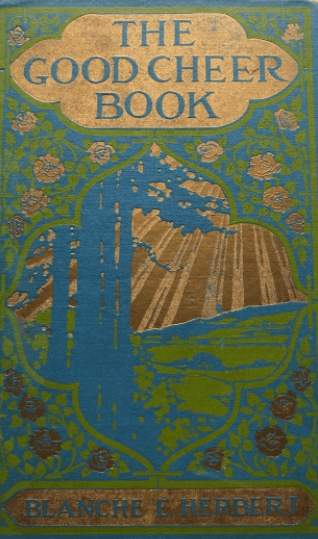
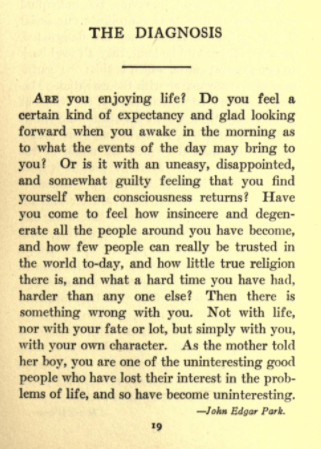
Ashmun says that The Good Cheer Book, compiled by Blanche E. Herbert, “will no doubt be a popular gift at Christmas.” Like everyone else, I could use some good cheer these days, so I opened it eagerly. Do you feel down in the dumps, John Edgar Park asks us in the opening essay. Well, yes, John, sometimes!

Here’s his advice:

Text of The Diagnosis, from The Good Cheer Book.

If the print’s too small for you, here’s a summary: “It’s all your fault! Suck it up!”

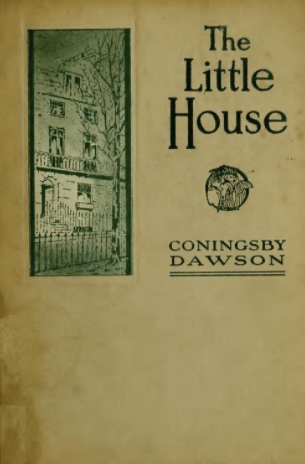
Cover of The Little House by Coningsby Dawson, 1920.

The Little House, Ashmun promises us, has “a real Christmas flavor.” It’s by, uh-oh, Coningsby Dawson, he of the bookless New York Times essay, and it’s told from the point of view of the house. “To have been responsible for the happy ending is pretty nearly as clever as to have made the story up out of one’s own head or, as we houses say, out of one’s own walls,” the house says.

That was this last straw. I decided to cast the critics aside and do my own search for a gift for the older teen.

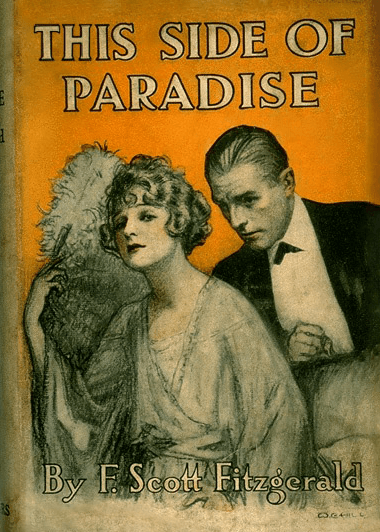
Dust jacket, This Side of Paradise, first edition.

I’m reading F. Scott Fitzgerald’s This Side of Paradise at the moment, for the third or fourth time. Each time I get something different out of it. When I was starting grad school at Princeton, what I loved was Fitzgerald’s swoony take on the place. “I think of Princeton as being lazy and good-looking and aristocratic—you know, like a spring day,” says semi-autobiographical hero Amory Blaine.
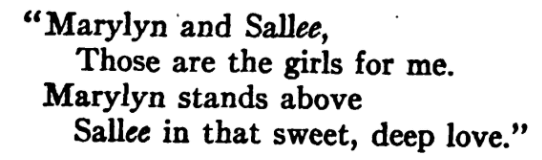
This time what I love is Fitzgerald’s unsparing take on the self-invention of his protagonist, who progresses from one stage of cringe-inducing idiocy to another over the course of his young life, from this early-teen love poem

Poem from This Side of Paradise, 1920.

to his first-day-of-college posturing (“he tried conscientiously to look both pleasantly blasé and casually critical, which was as near as he could analyze the prevalent facial expression”), to, if memory serves (I’m only up to the Princeton part), a fatuous romance and a freak-out about sex.******* It’s easy to for older people to lampoon the pretensions of the young, but not so easy when you’re in your early twenties yourself, as Fitzgerald was.  

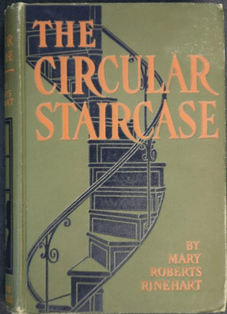
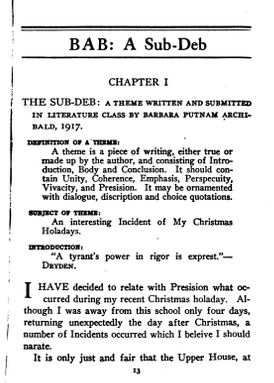
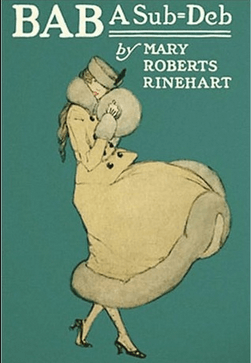
In a previous post, I quoted critic John Walcott, who said in a 1917 Bookman essay that young people turn away from books that skewer their peers, like Mary Roberts Rinehart’s Bab: A Sub-Deb and Booth Tarkington’s Seventeen.  They take themselves with deadly seriousness, Walcott says, and don’t relish being spoofed. But, as I’ve written before, Fitzgerald, for all the fun he pokes at his characters, doesn’t just send them up; he loves them too. That’s what I appreciate most about him now, and that’s why I don’t think our young friend will turn him aside.

For Children of All Ages

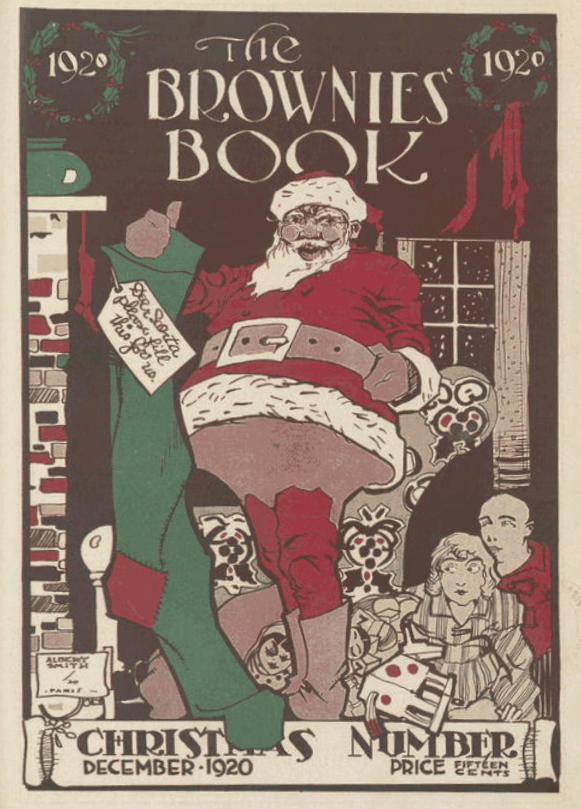
The Brownies' Book, December 1920, black Santa on roof.

Library of Congress

What if your children aren’t white? Or what if they are, and you want to show them that the real world is more diverse than the one portrayed in the children’s books of 1920? Bookwise, there’s almost nothing out there, other than Hazel, which I wrote about last year. But there’s one wonderful gift you can give them: The Brownies’ Book, a magazine by the publishers of The Crisis for African-American children, or rather, as they put it, “designed for all children, but especially for ours.” This is, sadly, your last chance; December 1921 marked the end of the magazine’s two-year run. (UPDATE 3/1/2021: I wrote about The Brownies’ Book here.)

The 1920 Children’s Holiday Book List********

Cinderella, illustrated by Margaret Evans Price

Cover of Cinderella, illustrated by Margaret Evans Price, Cinderella with coach.

Fairies and Chimneys, by Rose Fyleman

Cover, Fairies and Chimneys, by Rose Fyleman.

Grimm’s Fairy Tales, illustrated by Elenore Abbott

Cover, Grimm's Fairy Tales, Abbott, 1920.

The Jewish Fairy Book, by Gerald Friedlander, illustrated by George W. Hood

The Jewish Fairy book, 1920, cover.

Ancient Man, by Willem van Loon

Cover, Ancient Man, by Hendrik Willem Van Loon, pyramids on yellow background.

This Side of Paradise, by F. Scott Fitzgerald

Dust jacket, This Side of Paradise, first edition.

The Brownies’ Book

The Brownies' Book, December 1920, black Santa on roof.

Happy holidays, everyone, and happy reading!

squiggle

*I’m also reading, and loving, Roads to Childhood, a 1920 collection of Moore’s columns.

**These pages are, I learned in the New York Times roundup, called lining pages. Elaborate lining pages were, apparently, all the rage in 1920.

Lining pages, The Story of Our Country.

The Story of Our Country

Argonauts of Faith lining pages.

Argonauts of Faith

Lining papers from Westward Ho!, illustrated by N.C. Wyeth.

Westward Ho!

***Granted, I got 125 hits when I searched for “killed.” But you can’t have Grimm without the grim.

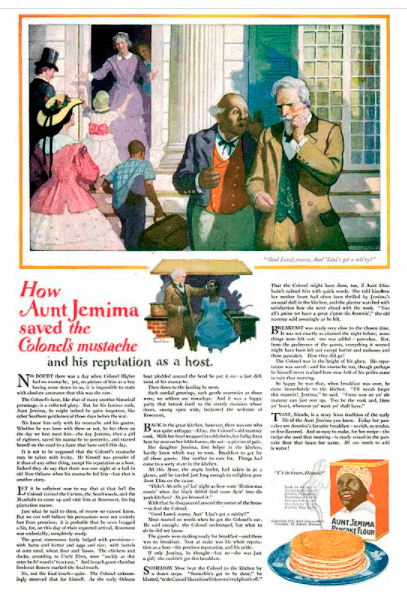
****He was also busy illustrating the advertising campaign about pancake-making enslaved person Aunt Jemima.

Aunt Jemima saves colonel's moustache, October 1920.

Ladies’ Home Journal, October 1920

*****Just as well that the young reader is likely to give “Yonge Andrew” a pass. It’s about a guy who seduces a young woman, tricks her into giving him her father’s gold and all her clothes, and sends her back to her father, who, seeing that she’s naked, locks her outside, where she dies. Or something along those lines—my old-timey English is a tad rusty.

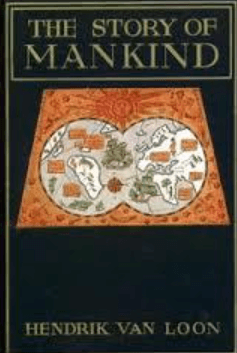
******Van Loon would go on to win the first Newbery Award for his 1921 book The Story of Mankind, which incorporates much of Ancient Man.

Cover, The Story of Mankind, Van Loon, 1921.

*******“Did they actually do it?” my young self wondered. But my young self wondered that about a lot of people, including Madame Bovary, so is not necessarily the best guide in these matters. (UPDATE 3/1/2021: Having now reread the book, I have no idea what this was all about.)

********With the caveat that any book given to an ACTUAL CHILD should be given a more thorough read than I’ve given these.

squiggle

New on the (non-holiday) Book List:

Ten Days That Shook the World, by John Reed

Children’s Books: Your 1919 Holiday Shopping Guide

Happy holidays, everyone! This year’s Holiday Shopping Guide is devoted to books, because who doesn’t love a book? Well, lots of people, but, when I looked for gift ideas in the December 1919 issue of Vanity Fair, this monogrammed humidor ($30.00)

Humidor, Vanity Fair, December 1919.

and this kit bag ($118.50)    

Kit bag, Vanity Fair, December 1919.

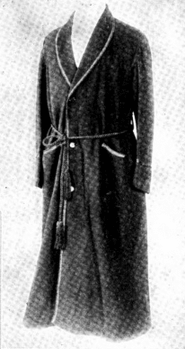
and this vicuna bath robe ($70.75),

Vicuna bathrobe, Vanity Fair, December 1919.

to say nothing of this solid platinum opera watch with gold hands and numerals ($800.00, plus $96.00 for the chain),

Platinum watch and chain, Vanity Fair, December 1919.

all cost more than the average weekly wage  of $25.61. I’m feeling more egalitarian than that this season, so books it is.

My original plan was to review books for all ages, but the children’s books ended up taking up a whole post. I have the books for grown-ups all picked out and will try to write about them as well, but I’ve learned not to commit myself to future posts because they hardly ever happen. (UPDATE 12/13/2020: This one didn’t either.) 

Banner, Bookman, From the Child's Holiday Books of 1919, November 1919.

I had a lot of help with this gift guide. New York chief children’s librarian Annie Carroll Moore, whom I wrote about earlier this year, has a holiday book roundup in the November issue of The Bookman. Boston chief children’s librarian Alice Jordan* has recommendations in House Beautiful, and Elementary School Journal and Literary Digest chime in as well. Library Journal, taking its sweet time about it, published the results of a vote among children’s librarians on the best children’s books of 1919 in its December 1920 issue.

Books With Color Illustrations

Children’s picture books as we think of them today, with a color illustration on every page, didn’t exist in 1919. Even books for very young children consisted mostly of text, with occasional line illustrations and a few color plates. If my own experience of reading to children is any guide, small children of a hundred years ago would push the pages impatiently to get to the pictures, leaving the adult reader to come up with a highly abridged version of the story on the fly. So the pictures are the key.

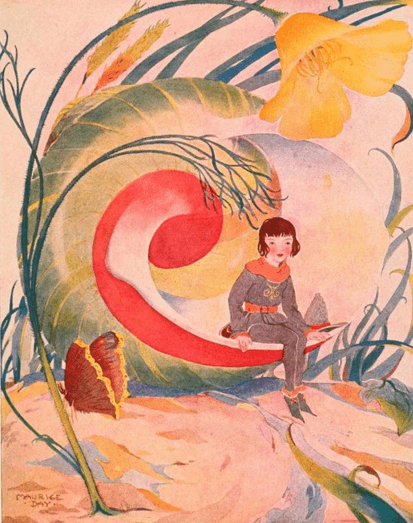
Cover, The Firelight Fairy Book, Henry Beston, illustrated by Maurice Day, 1919.

Moore was so entranced by The Firelight Fairy Book by Henry Beston, with illustrations by Maurice Day, that she went to Boston to meet Beston. He turned out to be a World War I veteran who started writing one of the tales, “The City Under the Sea,” IN A SUBMARINE IN ACTIVE PURSUIT OF GERMAN SUBMARINES, which is a great story, if not exemplary military tradecraft.

Maurice Day illustration, boy and girl with dragon, The Firelight Fairy Book.

Maurice Day, The Firelight Fairy Book

Illustration by Maurice Day, boy and old man, The Firelight Fairy Book.

Maurice Day, The Firelight Fairy Book

Moore wasn’t as big a fan of Day’s illustrations in a new edition of Horace E. Scudder’s Fables and Folk Stories—“his animals might be stronger”—but I was quite taken with this one:

Fables and Folk Stories, illustration by Maurice Day.

Maurice Day, Fables and Folk Stories

Some other illustrated books Moore discusses with varying levels of enthusiasm:

Czechoslovak Fairy Tales by Parker Fillmore, with illustrations by Jan Matulka,

Illustration by Jan Matulka for Czechoslovak Fairy Tales

The Last of the Mohicans by James Fenimore Cooper, with new illustrations by N.C. Wyeth,

Illustration by N.C. Wyeth, The Last of the Mohicans

At the Back of the North Wind by George MacDonald, with new illustrations by Jessie Willcox Smith,**

Illustration by Jessie Willcox Smith from At the Back of the North Wind.

a new edition of The Water Babies by Charles Kingsley, also illustrated by Jessie Willcox Smith,

Illustration by Jessie Willcox Smith from The Water Babies.

Saint Joan of Arc by Mark Twain, with new illustrations by Harold Pyle,

Illustration by Harold Pyle, Saint Joan of Arc by Mark Twain.

and Mother Goose Nursery Rhymes, with illustrations by Boyd Smith.

Illustration by Boyd Smith, Mother Goose Nursery Rhymes.

Caveat emptor on this last one. As I was perusing Smith’s illustrations, finding them quite charming, I came across this one,

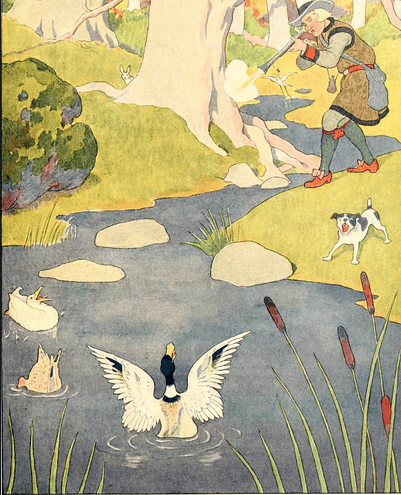
Man shooting duck, illustration by Boyd Smith, Mother Goose Nursery Rhymes.

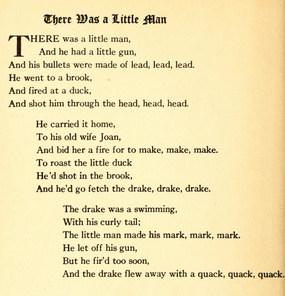
which turns out to illustrate this poem,

There Was a Little Man from Mother Goose Nursery Rhymes, text.

which I don’t recall my mother ever reciting as she lulled me to sleep.

Cover, The Burgess Bird Book.

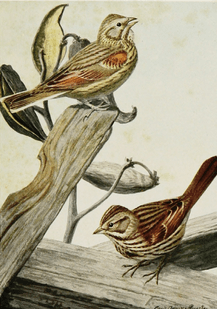
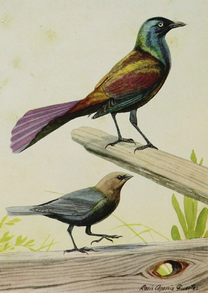
I imagined Thornton Burgess’s The Burgess Bird Book for Children as a reference for budding Audubons. It turned out to be full of twee tales, such as one in which Jenny Wren meets up with Peter Rabbit, who was Beatrix Potter’s intellectual property, right? The pictures by the Dutch-Puerto Rican artist Louis Agassiz Fuertes*** are wonderful, though.

Illustration by Louis Agassiz Fuertes from The Burgess Bird Book for Children.

Illustration by Louis Agassiz Fuertes from The Burgess Bird Book for Children.

Alice Jordan had good things to say about A Chinese Wonder Book by Norman Hinsdale Pitman, illustrated by Li Chu-T’ ang. I was intrigued, especially because Jordan said that Li was Chinese. I loved the illustrations,

Illustration by Li Chu-T' ang, A Chinese Wonder Book.

Illustration by Li Chu-T' ang, A Chinese Wonder Book.

Illustration by Li Chu-T' ang, A Chinese Wonder Book.

but I wondered whether Pitman was one of those people who make up stories and claim they’re foreign folk tales. He turned out, though, to be an American professor who spent many years teaching in China and won several awards from the Chinese government, so presumably he knew what he was talking about.

This is as multicultural as children’s books get in 1919, so I was inclined to declare it my #1 recommendation in this category. To make sure I wasn’t leading you astray, I read one of the tales, “Lu-San, Daughter of Heaven.”

Illustration by Li Chu-T' ang, A Chinese Wonder Book.

What young person wouldn’t relate to the story of a girl whose parents don’t appreciate her (that’s putting it mildly—they’re always trying to sell Lu-San into slavery or kill her) but end up having to kiss her feet and watch as she ascends to heaven on a golden throne? I liked the girl-power theme (Lu-San’s brothers are treated like kings) and the realistic way her parents respond after Lu-San is transformed into a radiant princess and their dingy houseboat into a majestic ship:

At first they did not know how to live as Lu-san had directed. The father sometimes lost his temper and the mother spoke spiteful words; but as they grew in wisdom and courage they soon began to see that only love must rule.

So it’s official: A Chinese Wonder Book is my #1 recommendation.

For Middle-Grade Readers

There is a lot of blurring between these categories; many of the books mentioned above are appropriate for middle-grade readers as well. Here are some selections specifically for this age group.

Or not. Sometimes Moore just makes me scratch my head.

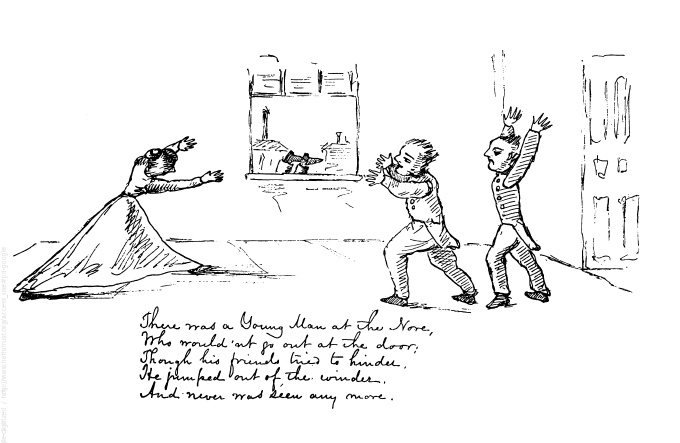
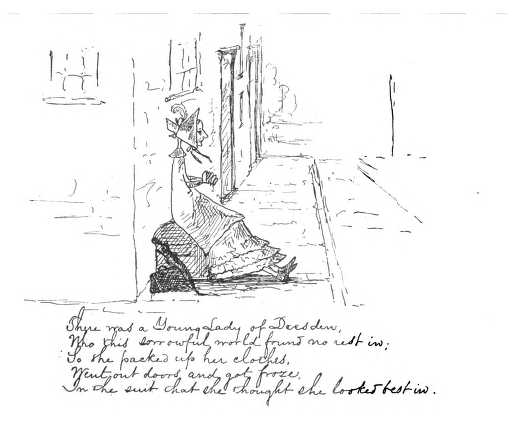
For example, what is Susan Hale’s Nonsense Book doing in a children’s book roundup? That the handwritten limericks are illegible is the best thing that can be said about them.**** Would you read this tale of death by jumping out a window

Illustrated limerick from Nonsense Book by Susan Hale.

or this one of suicide by exposure

Illustrated limerick from Nonsense Tales by Susan Hale.

to your favorite nephew?

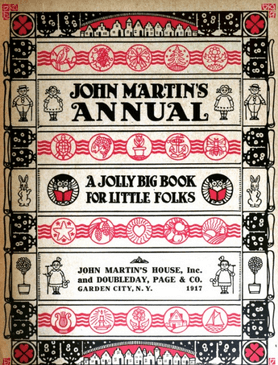
Cover, John Martin's Annual, 1917.

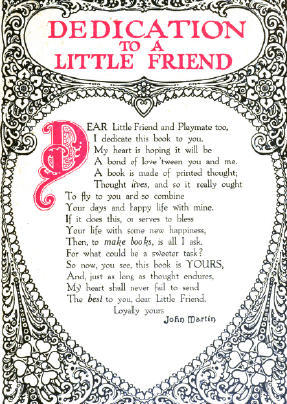
Moore pans John Martin’s Big Book for Little Folks, No. 3. I couldn’t find it, but I did find the 1917 volume. It starts out with this poem,

Dedication to a Little Friend from John Martin's Annual, 1917.

which reminds me of the fairy tales that simpering old ladies inflict on the kids in the Edward Eager books (now THERE are some great books for middle-grade readers).

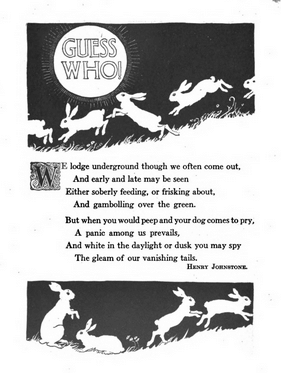
Next up is the world’s least challenging riddle.

Riddle from John Martin Annual, 1917. Answer is rabbits and there are pictures of rabbits.

So I’m on board with Carroll even before she quotes from Martin’s story about Thoreau:

He was so kind! and he was a busy man too. He built his own house. He had a garden. He made lead pencils. He wrote books. Most likely we never did know a busy man who was more kind than he was to everybody—animals and all—children and all. No wonder he became a very famous man.

As we will see below, kindness to animals and fame do not always go hand in hand.

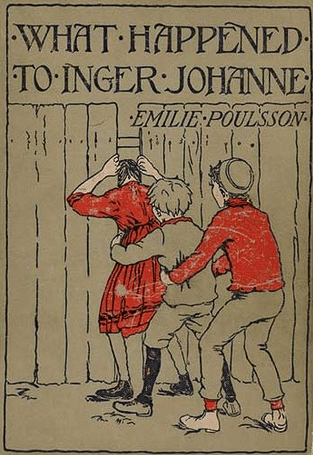
Cover of What Happened to Inger Johanne by Dikken Zwilgmeyer.

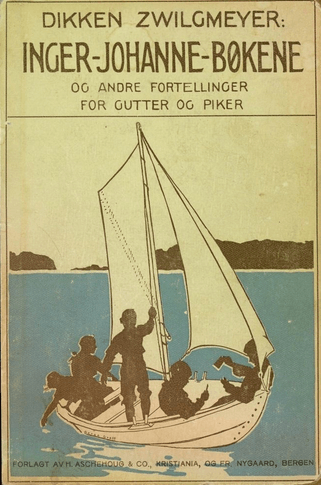
Moore describes What Happened to Inger Johanne, a translation of an 1890 book by the Norwegian writer Dikken Zwilgmeyer (UPDATE 12/22/2019: who turns out to be a woman, real name Barbara Hendrikke Wind Daae Zwilgmeyer),  

Cover of Inger Johanne Bokene by Dikken Zwilgmeyer.

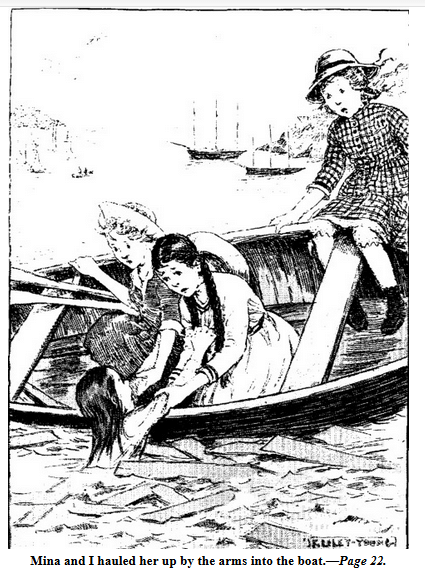
as “alive from beginning to end.” It’s a miracle that Inger herself is alive from beginning to end. In the illustrations by Florence Liley Young, she and her friends fall out of a boat,

Illustration by Florence Liley Young from What Happened to Inger Johanne.

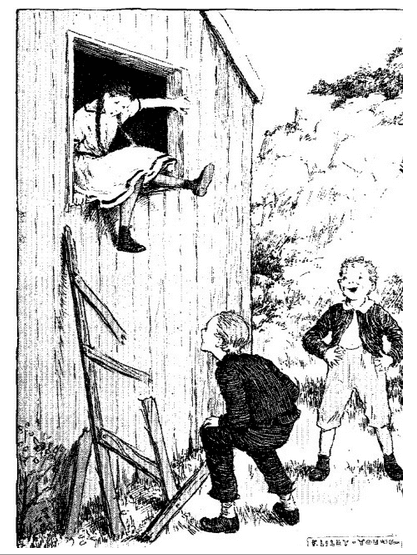
get stuck in a barn window when the ladder breaks,

Illustration by Florence Liley Young from What Happened to Inger Johanne.

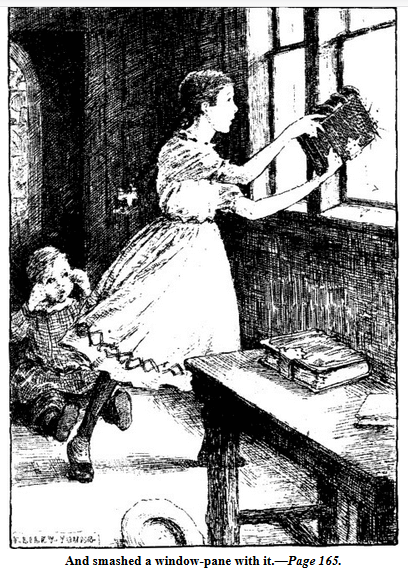
smash a window with a book,

Illustration by Florence Liley Young from What Happened to Inger Johanne.

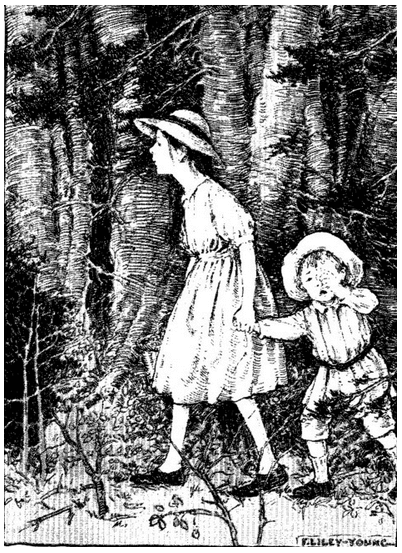
and get lost in the woods.

Illustration by Florence Liley Young from What Happened to Inger Johanne.

The chapter on Christmas mumming is less harrowing. My favorite part is where the children speak P-speech, which turns out to be a Norwegian version of Pig Latin. It goes (in the English translation) like this: “Can-pan you-pou talk-palk it-pit?”

A “child of ten”—who I assume is our old friend Edouard from last year’s holiday roundup—says that Inger sounds more like Tom Sawyer than anyone else. I trust Edouard’s judgment, and a girl Tom Sawyer is just the thing. So What Happened to Inger Johanne is my #1 recommendation for middle-school readers.*****

For Older Children

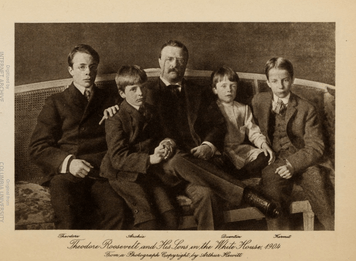
Theodore Roosevelt and sons, from Theodore Roosevelt's Letters to his Children, 1919.

Frontispiece, Theodore Roosevelt’s Letters to His Children

 The children’s book of the season is Theodore Roosevelt’s Letters to his Children. It’s the only unanimous choice on the librarians’ list, and it did sound promising: whatever you think of Roosevelt, he had (according to my childhood reading, anyway) some of the most fun presidential children in history. I was merrily scrolling to get to a letter about Christmas in the White House when I was stopped in my tracks by the words “kill” and “stabbed.” They turned out to be from a 1901 letter to Roosevelt’s twelve-year-old son Theodore III, titled “A Cougar and Lynx Hunt.”  

Theodore Roosevelt with hunting party, Colorado, 1905.

Theodore Roosevelt hunting in Colorado, 1905 (Denver Library Digital Collections)

Theodore (père) is out hunting with his friend Phil in Colorado when their dogs run up a tree after a cougar. Theodore has a clear shot at it, but Phil is taking a picture. The cougar jumps out of the tree, the dogs chase it and get into a big fight, and the cougar

bit or clawed four of them, and for fear that he might kill them I ran in and stabbed him behind the shoulder, thrusting the knife you loaned me right into his heart. I have always wanted to kill a cougar as I did this one, with dogs and the knife.

Banner, Reviews of New Books, Some of the Seasons Best Juvenile Books

After that, I just wasn’t feeling the Christmas in the White House spirit. I decided to move on to Literary Digest and “Some of the Seasons [sic] Best Juvenile Books.”

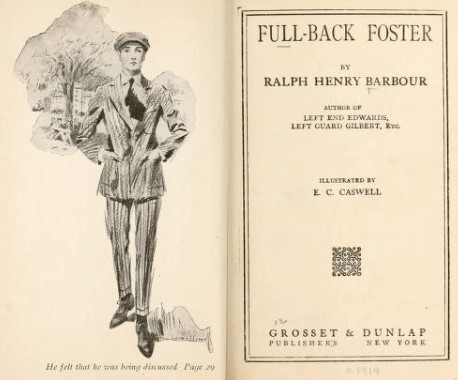
Title page and frontispiece of Full-Back Foster by Ralph Henry Barbour.

Full-Back Foster by Ralph Henry Barbour: “Describes how a ‘sissy’ is turned into a most serviceable full-back.”

Pass!

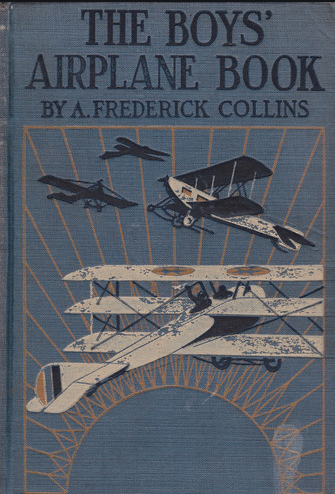
Cover, The Boys' Airplane Book, A. Frederick Collins.

The Boys’ Airplane Book by A. Frederick Collins. “It…behooves all ambitious boys to know the mechanism of the airplane, and to be able to construct one which not only will fly but will carry a human passenger….One feels that it would be impossible to go astray under such guidance.”

One would just as soon not test this theory. Pass!

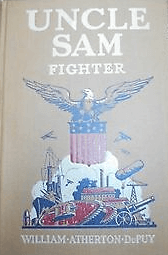
Cover, Uncle Sam: Fighter, William Atherton DuPuy.

Uncle Sam: Fighter by William Atherton DuPuy. “Describes graphically how we prepared our draft army in the recent war, and how we mobilized our energies efficiently for the most expeditious service to ourselves and our allies. Navy purchases, railroad administration, the minimizing of waste…”

Yawn! And all lies—the U.S. war mobilization was totally inept. Pass!

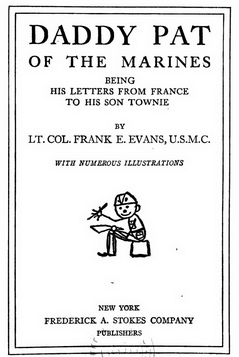
Title Page, Daddy Pat of the Marines, Lt. Col. Frank E. Evans.

Daddy Pat of the Marines by Lieut. Col Frank E. Evans (U.S.M.C.) “Even the six-year-olds must have their war books.”

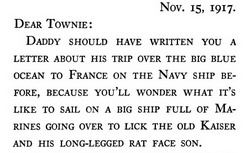
Begins thus:

Text from Daddy Pat of the Marines referring to "the old Kaiser and his long-legged rat face son."

 Pass!

Illustration, Rosemary Greenaway.

Rosemary Greenaway by Joslyn Gray. “The sentimental spirit which pervades this story will be liked by a certain type of girl reader.”

Pass!

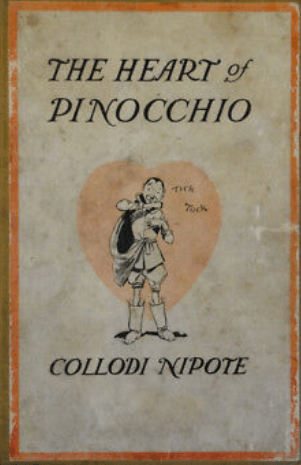
Cover, The Heart of Pinocchio, Collodi Nipote.

The Heart of Pinocchio by Collodi Nipote. The author of the original Pinocchio “is dead, but fortunately another member of the Lorenzini family has skillfully introduced Pinocchio into a story of war.”

Pass!

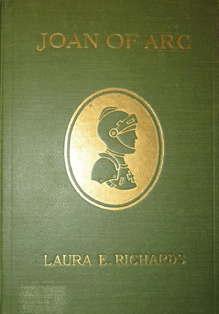
Cover, Joan of Arc, Laura E. Richards.

Joan of Arc by Laura E. Richards. “She has entered more thoroughly into the historical aspects of her heroine than most writers for girls and boys; her sources are carefully noted throughout.”

I’ll stick with Mark Twain. Pass!

These are the best juvenile books? I’d hate to see the worst.

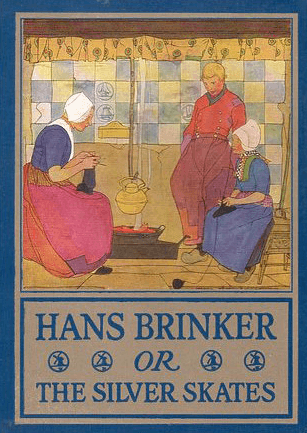
Cover of Hans Brinker or the Silver Skates, illustrated by Maginel Wright Enright.

Then I checked out a new edition of Mary Mapes Dodge’s 1865 children’s classic Hans Brinker, or, The Silver Skates, described by Elementary School Journal as a “beautiful gift ed.”

I had thought of Hans Brinker as a middle-grade book. The story turns out to be more harrowing than I imagined, though, with an amnesiac father and a doctor with a dead wife and a missing son. There’s also a scene in which someone draws a knife across a robber’s throat and threatens to kill him. Weary of violence by now, I almost disqualified it. But it has ice skating! And wooden shoes! And the Festival of Saint Nicholas, during which Dutch children become “half wild with joy and expectation”! And tulips! (A footnote about tulip mania quotes from Extraordinary Popular Delusions and the Madness of Crowds.****** You can’t accuse Dodge of talking down to children.)

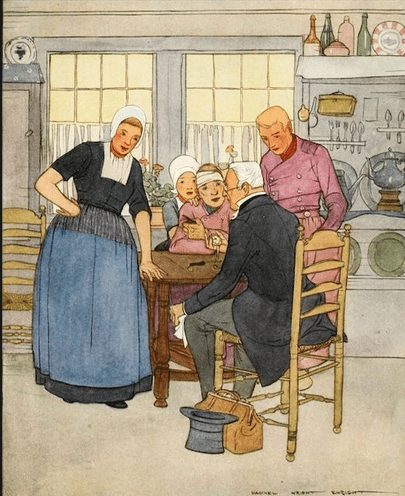
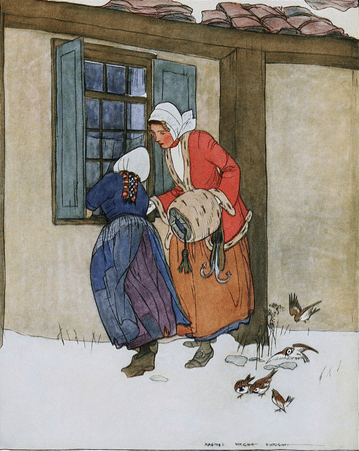
Not to mention the wonderful new illustrations by Maginel Wright Enright, who turns out to be the sister of Frank Lloyd Wright and the mother of children’s writer Elizabeth Enright, author of Gone-Away Lake and The Four-Story Mistake.

Maginel Wright Enright illustration, Hans Brinker, people skating on canal.

Maginel Wright Enright illustration, Hans Brinker, people around table.

Maginel Wright Enright illustration, Hans Brinker, people standing next to house.

So, finally, a book to recommend to older readers!

Not all children are alike, though. What to give to the kind of child (often a boy) who would open a book, even one as amazing as Hans Brinker, with a wan thank you and a sigh?

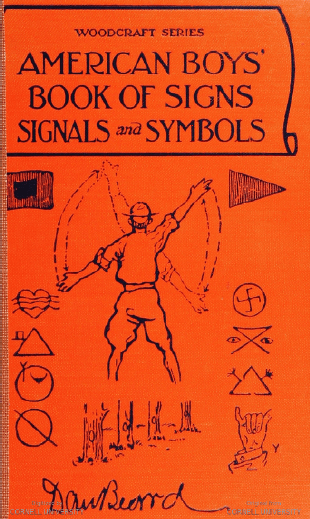
Cover, American Boys' Book of Signs, Signals and Symbols, by Daniel Beard.

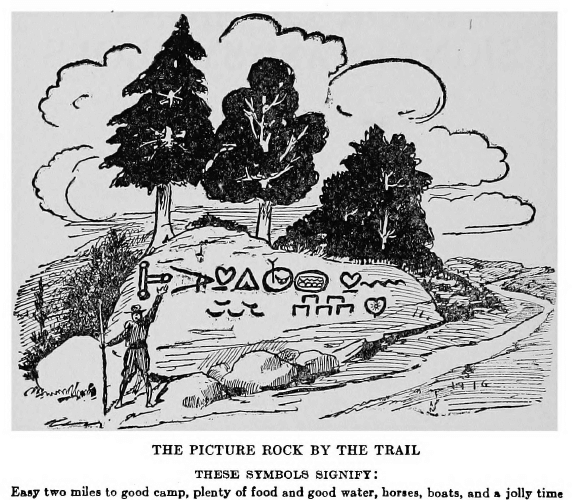
Well, you (and he) are in luck! There’s American Boys’ Book of Signs, Signals and Symbols, by Daniel Carter “Uncle Dan” Beard, a founding figure in American Boy Scouting.******* According to Elementary School Reader, it

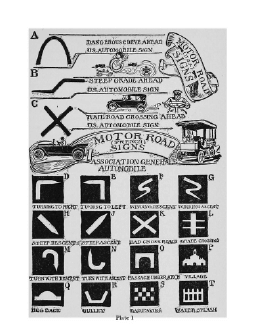
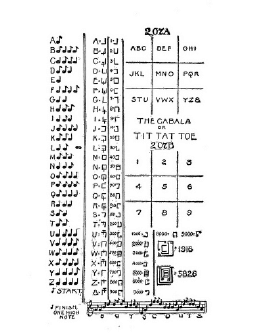
explains simply all kinds of signs including danger signs, trail signs, signs of the elements, secret writing, gesture signals, deaf and dumb alphabet, signal codes, railway signals, hobo and Indian signs, and Boy Scout signs and signals.

This book is guaranteed to have your child running outside as soon as the presents are opened to set trail signs and communicate with his friends in steamer toot talk.

Signs from American Boys' Book of Signs, Signals, and Symbols.

Automobile signs from American Boys' Book of Signs, Signals, and Symbols.

Illustration from American Boys' Book of Signs, Signals, and Symbols.

(Be forewarned that the book includes swastika-like symbols and hobo signs to note the presence of “white, yellow, red, and black men,” along with some discussion of American Indians that, while intended to be respectful, wouldn’t pass muster today.)

So that’s it—a gift for every kid on our list.

Oh, wait! What about that dreamy teenaged girl who’s longing for a good book to curl up with while her siblings are outside drawing hobo signs?

Henri Matisse, Young Woman in the Garden, 1919.

Henri Matisse, Young Woman in the Garden, 1919

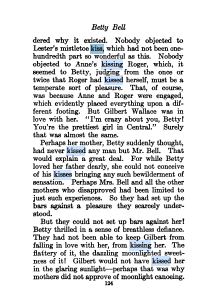
Betty Bell by Fannie Kilbourne sounded promising at first. Moore describes it as “a very readable, thoroughly sophisticated, and well written analysis of a cross-section of Betty Bell at sixteen.” She warns, however, that “we do not recommend the book for children’s reading. In the libraries its title would immediately attract girls from ten to twelve whose mothers would object to it.”

Naturally I immediately downloaded it and started skimming to find the objectionable parts. The book is indeed an exceptionally accurate description of what goes on in an adolescent girl’s brain, but I was soon reminded that inside an adolescent girl’s brain is not a place anyone except the owner of that particular brain would want to spend much time.
Page from Betty Bell by Frances Kilbourne, with "kiss" highlighted eight times.

Our dreamy young woman would think Betty was an idiot.********

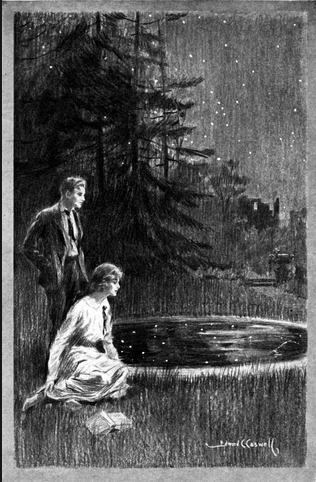
Frontispiece of The Pool of Stars, illustration by Edward C. Caswell.

Frontispiece of The Pool of Stars, Edward C. Caswell

There was a lot of buzz around The Pool of Stars by Cornelia Meigs, which Moore calls “a very well-written story.” I remembered Meigs from those lists of Newbery Award winners they were always inflicting on us in elementary school,********* so I spent an hour reading it on my Kindle.

Betsey, our heroine, is agonizing as the book begins about whether to go to college next year or go to Bermuda with her rich aunt, which would (for reasons that are not explained) permanently put the kibosh on college. Studying is so EXHAUSTING, Betsey keeps thinking. All those geometrical shapes and Barbary pirates! I’d rather go to the beach!

I’m starting to suspect that Betsey is not a true intellectual.

She does decide to go to college, though, and spends the rest of the book pondering the mystery of why a young woman living nearby always looks so sad. I. DO. NOT. CARE., I kept saying, before finally giving up.

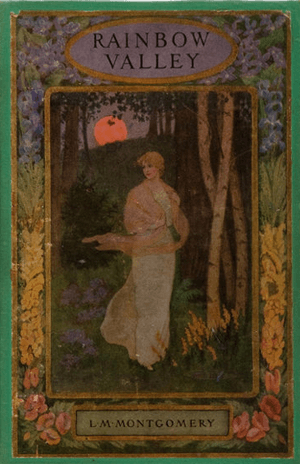
Cover of Rainbow Valley, Anne of Green Gables No. 7, L.M. Montgomery.

There’s also Rainbow Valley, the fifth volume in L.M. Montgomery’s Anne of Green Gables series. (Now it’s considered the seventh, but two volumes covering earlier parts of Anne’s life were published in the 1930s.) It didn’t appear on any of the best-of-1919 lists, maybe because it was published late in the year, but, hey, it’s Anne of Green Gables, right?

Except that Anne has, in the two years since Anne’s House of Dreams was published, somehow been transformed from a newlywed (and, by the end of the book, mother of two) to a mother of six who spends all her time thinking about the problems of the town’s new minister.**********

Note to children’s authors: happy newlyweds are one thing, but mothers of six are (to young girls) just squalid.

So what to give to our dreamy girl? In desperation I turned to H.L. Mencken, even though I knew perfectly well that books for girls are not his thing.

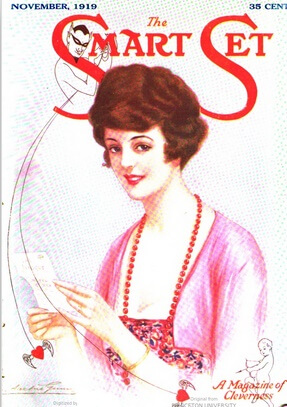
And there, miraculously, it was, in a November 1919 Smart Set article called “Novels for Indian Summer.”

Cover of Smart Set, November 1919.

The best of them, and by long odds, is “The Moon and Sixpence” by W. Somerset Maugham,

Mencken begins.

It has good design; it moves and breathes; it has a fine manner; it is packed with artful and effective phrases. But better than all this, it is a book which tackles head-on one of the hardest problems that the practical novelist ever has to deal with, and which solves it in a way that is both sure-handed and brilliant. This is the problem of putting a man of genius into a story in such fashion that he will seem real—in such fashion that the miracle of him will not blow up the plausibility of him.

The Moon and Sixpence is the story of Charles Strickland, a middle-aged British stockbroker who abandons his family and goes to Paris and then to Tahiti to pursue his dream of becoming a great artist. He succeeds (the story is based loosely on the life of Paul Gaugin), but at a tremendous cost to those around him, and, ultimately, himself.

Sacred Spring, Paul Gauguin, 1894.

Sacred Spring, Paul Gauguin, 1894.

Really? you may be thinking. Your top recommendation for a dreamy teenaged girl is about an egocentric middle-aged stockbroker? Based on the life of a painter who was so reprehensible, even by the standards of 19th-century painters, that the New York Times ran an article last month headlined, “Is It Time Gaugin Got Cancelled?”

All I can tell you is this: I was that dreamy girl, and I loved The Moon and Sixpence.

Happy holiday reading, everyone!

squiggle

*I pictured Moore and Jordan as bitter enemies, but Moore turns out to have described Jordan as the best librarian-reviewer, which is especially gracious considering that Moore invented the profession.

**Moore mentions, apropos of nothing, that Smith also designed the color poster for Children’s Book Week in 1919, which, as I’ve mentioned, is the first time Children’s Book week was celebrated.

Children's Book Week Poster, 1919, Jessie Willcox Smith, children with bookshelf.

***Fuertes (who was only named after, not related to, famed but racist naturalist Louis Agassiz) was one of the most prolific bird illustrators of his time. Two bird species were named after him, including the Fuertes’s parrot, which is now critically endangered.
Illustration of Fuertes parrot from American Museum Journal, 1918.

American Museum Journal, 1918

****Hale’s brother Edward Everett Hale of “The Man Without A Country” fame clearly got all the literary talent in the family.

*****Note to Norwegian readers (okay, reader): Is this book still famous? And is P-speech an actual thing?

******Extraordinary Popular Delusions and the Madness of Crowds was written by Charles Mackay, the father of our old friend Marie Corelli.

*******Beard was the founder of the Sons of Daniel Boone, which merged into the Boy Scouts in 1910.

Ernest Thompson Seton, Robert Baden-Powell, and Dan Beard, date unknown.

Ernest Thompson Seton, Robert Baden-Powell, and Dan Beard, date unknown

********Much in the way I couldn’t stand the supposedly universally beloved but, to me, vapid heroine of Judy Blume’s Are You There, God? It’s Me, Margaret.

*********Meigs won for her 1933 book Invincible Louisa, a biography of Louisa May Alcott.

**********Could this have been related to problems in Montgomery’s own marriage to a depressed minister, who, she complained in her diary in 1924, would stare blankly into space for hours with a “horrible imbecile expression on his face”?

Banner with pictures of Helen Bogan, Helen Dryden, Josephine Turpin Washington, Mary Roberts Rinehart, and Susan Glaspell.

Celebrating Women’s History Month: Five inspiring women of 1919

Every month is Women’s History Month at My Year in 1918. I’m celebrating the official one, though, by taking a closer look at some women I’ve come across in my reading but hadn’t gotten to know very well until now. For each of them, I’ll share something she left behind.

The Poet: Louise Bogan

Louise Bogan, ca. 1920 (Curt Anderson)

Louise Bogan had an illustrious career. She was named to the post now known as the Poet Laureate of the United States in the 1940s and was the New Yorker’s poetry critic for over three decades. When she died in 1970, the New York Times called her “one of the most distinguished lyric poets in the English language.”

Bogan’s life was not an easy one. She was born in Maine in 1897, the daughter of a mill superintendent and a mentally unstable woman whose inappropriate sexual behavior contributed to the severe depression Bogan suffered from throughout her life. Her family moved to Boston in 1909 and Bogan attended the famed Girls’ Latin School. After a year at Boston University, she turned down a scholarship to Radcliffe and instead married a soldier. By the time she was 23, she had given birth to a daughter and separated from her husband, who died of pneumonia in 1920. Bogan lived in Vienna for a few years, leaving her daughter behind with her parents (!), and then moved to New York, where she spent the rest of her life.

In 1919, 22-year-old Bogan had already begun to make a name for herself. I first came across her work in the December 1917 issue of the experimental poetry magazine Others. In “The Young Wife,” she describes what it was like to be a woman in an age when premarital sex was forbidden for women and condoned for men.*

Here’s an excerpt from “The Young Wife.” You can read the rest here. Bogan didn’t include it in her 1923 collection Body of This Death, and it’s not widely known today, but it’s become one of my favorite poems.

Others, December 1917

The Artist: Helen Dryden

American Club Woman Magazine, October 1914

1919 was a golden age of illustration, and Helen Dryden’s cheerful, colorful Vogue covers were one reason why. Born into an affluent Baltimore family in 1882, Dryden grew up in Philadelphia and began her career as an artist there. She moved to Greenwich Village in 1909 and soon signed a contract with Condé Nast, where she worked for the next thirteen years. In later life (as I learned in a comment on this blog by fashion blogger witness2fashion) she designed Studebaker car interiors. At one point she was reported to be the highest-paid woman artist in the United States. By 1956, though, she was living in a welfare hotel. I’m not sure what happened in between, and there doesn’t seem to be a biography of Dryden. I hope someone will write one.

In the meantime, here are some Dryden Vogue covers from 1919.

Vogue, January 15, 1919

Vogue, February 15, 1919

Vogue, March 15, 1919

(UPDATE 11/29/2019: Oops! I realized when I did my post on illustrators I’m thankful for that the January 15 cover is by Georges Lepape. To make it up to you (and her), here’s a cover Dryden did for House & Garden. I featured it on my blog banner without realizing it was hers.)

The Educator: Josephine Turpin Washington

The Afro-American Press and Its Editors, 1891

I first came across Josephine Turpin Washington when I read her short piece “A Mother’s New Year’s Resolution” in the January 1918 issue of The Crisis. Washington was born in Virginia in 1861, the granddaughter of a Louisiana man named Edwin Durock Turpin and a woman named Mary whom he bought as a slave and, according to a family memoir, fell in love with and married. Washington grew up in Richmond and attended Howard University, working as a clerk for Frederick Douglas during the summers. She taught math at Howard for a few years and then married a doctor and moved to Alabama, where she taught at several African-American universities and wrote on a wide range of issues of concern to the black community. It turns out that we’ll have a chance to learn more about Turpin—a collection of her essays, edited by Rita B. Dandridge, was published last month.

Here’s the beginning of “A Mother’s New Year’s Resolution.”** You can find the rest of the article here. My favorite lines:

I will live with my children not merely for them; since such companionship is worth more than divergent ways, marked by needless sacrifices on the one side and a growing selfishness on the other.

The Crisis, January 1918

The Writer: Mary Roberts Rinehart

Mary Roberts Rinehart, 1914 (Theodore Christopher Marceau)

Mary Roberts Rinehart is often called the American Agatha Christie, although she started writing mysteries more than a decade before Christie did. Rinehart was born outside Pittsburgh in 1876, the daughter of an unsuccessful entrepreneur who committed suicide when she was 19. She attended nursing college, married a doctor, and turned her writing hobby into a profession after she and her husband lost $12,000 in the 1903 stock market crash.*** In 1908, she published her first mystery novel, The Circular Staircase, which sold 1.25 million copies. Reinhart was amazingly prolific, turning out several books a year in a variety of genres—mainstream fiction, travel books, and short stories as well as mysteries. She also wrote several plays, including the 1920 Broadway hit The Bat.

First edition, 1908

Oddly, Rinehart was almost murdered herself. In 1947, while she was staying at her summer house in Bar Harbor, Maine, a chef who had worked for her for 25 years shot at her and then tried to slash her with a pair of knives. Apparently he was angry that Rinehart had hired a butler.**** Other servants subdued him, and he killed himself in jail the next day. Later that year, the house burned down in a huge fire that destroyed 250 Bar Harbor homes. Also in 1947—a horrific year for Rinehart, it seems—she revealed in a Ladies’ Home Journal article that she had had a radical mastectomy and urged women to have breast examinations.

I haven’t read any of Rinehart’s mysteries yet, but I did read, and love, her 1917 comic novel Bab: A Sub-Deb. Here’s the first page. You can read the rest here.

The Playwright: Susan Glaspell

Susan Glaspell, date unknown

Susan Glaspell first won fame as a short story writer and novelist, but she’s best known today as a playwright and as the co-founder, with her husband, of the Provincetown Players, an avant-garde theater group.

Glaspell was born on a farm in Iowa and moved with her family to Davenport when she was a teenager. After graduating from Drake College, she worked in Davenport for a few years as a journalist and then turned to writing fiction full-time. She quickly found success as a short story writer***** and published a bestselling novel called The Glory of the Conquered in 1909. After her second novel appeared in 1911, the New York Times said she was “high among the ranks of American storytellers.”

Glaspell fell in love with a married writer named George Cram Cook, married him in 1913 after his divorce came through, and moved to Greenwich Village. In 1916, she and Cook founded the Provincetown Players in Cape Cod, working alongside friends, including leftist journalist John Reed, to produce a series of innovative one-act plays. Always looking for material, Glaspell asked an acquaintance one day whether he had written any plays. He said he hadn’t, but a friend of his had. The friend was Eugene O’Neill, and the theater produced his first one-act play, Bound East for Cardiff, in July 1916. The group continued its work at the Provincetown Playhouse in Greenwich Village.

George Cram Cook and Susan Glaspell, New York Tribune, July 15, 1917

Glaspell’s success continued after her husband’s death in 1924. She was awarded the Pulitzer Prize in 1931 for her play Alison’s House. Her best-known work today, though, is the 1916 one-act play Trifles, which was inspired by a murder trial she covered as a journalist. As it opens, a surly farmer has been killed and his wife has been taken in for questioning. The county attorney and the sheriff are interviewing a neighboring farmer in the dead man’s house. The sheriff’s wife and the neighboring farmer’s wife have tagged along. The women make occasional comments about the murder suspect’s preserves and her quilting, and the men snicker. While the men are upstairs investigating, the women discover a dead parakeet, apparently killed by the husband. The investigators haven’t been able to find a motive, and this seems to be it. To protect the abused wife, the women hide the incriminating evidence.

Here’s the first page of Trifles. You can read the play here. (It’s really short!)

Trifles, 1916 edition

It was great to learn more about these inspiring women. But women’s history, like men’s history, isn’t just a pageant of hero(in)es. In my next post I’ll tell you about some 1919 women I’m not such a big fan of.

*Before this project, I had the impression that premarital sex for men was frowned upon in principle but tolerated. In fact, it was more or less encouraged, the theory being that men were physically incapable of abstaining from sex and were better off sleeping with prostitutes or loose women than marrying before they were ready to support a family.

**The Crisis often used swastikas in its graphic design—this was, of course, before the emergence of the Nazi party.

***As an MFA graduate, I’m envious of all those 1919-era women who turned to writing short stories to make money.

****Speaking of butlers, we have Rinehart to thank for the phrase “the butler did it,” which originated with her 1930 novel The Door. She didn’t use those exact words, but—SPOILER ALERT—the butler did do it.

*****Like I said.

Celebrating 100 Posts: 2017 Me Interviews 2019 Me about My Year in 1918

Happy 100 posts to My Year in 1918!* In the blog world, this milestone is traditionally celebrated by indulging in some navel-gazing. So I thought it would be a good time to finally sit down for an interview with 2017 Mary Grace, who had some questions for her post-2018 self. 2017 Mary Grace expected that this interview would take place around New Year’s, but 2019 Mary Grace kept dragging her feet. Once she finally sat down with 2017 Mary Grace, though, she was quite chatty.

Photograph of Mary Grace McGeehan, 2017.

2017 Mary Grace

Photograph of Mary Grace McGeehan, 2018.

2019 Mary Grace (well, November 2018, but I haven’t changed much)

Here goes:

Tell me about your favorites among the writers you discovered, the books you read, and your other reading.

Photograph of young Edna Ferber.

Edna Ferber, date unknown

I read some great books by famous writers, like O Pioneers! and My Ántonia by Willa Cather and The Voyage Out by Virginia Woolf. But, as much as I loved these books, I had more fun discovering books that are forgotten today. One that I’ve recommended over and over is Edna Ferber’s 1912 short story collection Buttered Side Down. Ferber is best known today for the theater and film adaptations of her books, like Showboat and Giant. I wish her book themselves were more widely read. She’s funny and entertaining and empathetic toward her mostly working-class characters.

Cover of The Crisis magazine, January 1918, drawing of African-American woman with daisies in front of her face.

Among magazines, the biggest revelation was The Crisis, the NAACP magazine edited by W.E.B. Du Bois. It was the only national publication for African-Americans, who were non-existent in the mainstream press except as racist stereotypes. Du Bois was unsparing in covering lynching, discrimination, and other racial injustices, but the magazine also included poems and short stories and news items about achievements by African-Americans, such as 20-year-old college football star/singer Paul Robeson. And cute babies!

Photograph of T.S. Eliot by Lady Ottoline Morrell, 1923.

T.S. Eliot, 1923 (Lady Ottoline Morrell)

Another highlight was reading T.S. Eliot’s monthly literary criticism in The Egoist, the small British magazine where he served as literary editor. I’d never thought of Eliot as funny, but he wrote some hilarious takedowns of well-known writers (often under a pen name). My favorite, on G.K. Chesterton: “Mr. Chesterton’s brain swarms with ideas; I see no evidence that it thinks.”

What were your least favorites?

Photograph of young H.L. Mencken.

H.L. Mencken, date unknown

 Hands down, my least favorite book was In Defense of Women by H.L. Mencken. It’s 218 pages of essentialist garbage: men are dreamy romantics and women are hard-headed pragmatists, too sensible to care about ridiculous pastimes like politics or to bother with the picayune details of the typical male job. That’s why more women aren’t lawyers, he says. Oh, that’s why. Mencken does take aim against some Victorian shibboleths, like the myth that women don’t enjoy sex. On the whole, though, it was infuriating, and I was glad to learn that the 1918 edition sold fewer than 900 copies. (A significantly revised edition published in 1922 did much better.)

The New York Times was surprisingly awful. Domestic news coverage was all right, but, aside from a few war reporters, the best known of whom (Phillip Gibbs) wrote primarily for British papers, there was virtually zero foreign news coverage, and much of it—especially about Russia—was highly inaccurate. The czar and his family were repeatedly reported killed when they were still alive and reported alive when they were dead. And there were some shockingly right-wing editorials, like the one saying that German accusations of American racism were unfounded because Americans are very patient with their black servants.

My go-to hate read was The Art World. The magazine detested all art from Impressionism on, which, as I’ve mentioned, was as reactionary for its time as saying today that rock and roll is just a bunch of noise. This caption to an illustration of a Cézanne painting was typical.

Photograph of Cezanne landscape in Art World magazine, January 1918, with caption reading in part, to a normal mind significant of childish incompetence.

The Art World, January 1918

I kind of missed The Art World’s crazy rants when, in mid-1918, it merged into a décor magazine.

Were there any forgotten books or writers that readers of today might enjoy?

Cover illustration of Bab: A Sub-Deb by Mary Roberts Rinehart, first edition, 1917.

I’ve mentioned Ferber as an unjustly neglected writer. I also read a number of books that were a huge amount of fun without reaching that level of literary merit. One was Bab: A Sub-Deb, by Mary Roberts Rinehart. It’s a comic novel, told in the first person, about the hapless 17-year-old daughter of an upper-crust New York family. She’s always getting into scrapes, like when she buys a frame with the photograph of a young man in it and claims that it’s her boyfriend to shock her family, but then the man in the photograph shows up, full of endearments! Rinehart is better known today as a mystery writer, but Bab: A Sub-Deb was a huge popular and critical hit when it was published in 1917.

Cover of Hermione and Her Little Group of Serious Thinkers by Don Marquis, first edition, 1916.

Another very funny book, also about a young upper-class New York woman, was Hermione and Her Little Group of Serious Thinkers, a collection of newspaper pieces by Don Marquis, best known today as the creator of the cockroach-and-cat duo Archy and Mehitabel. Hermione and her little group “take up” every fad and fashionable cause—suffrage, clairvoyance, Indian philosophy, modernist poetry, etc.—and drop them just as quickly. Here’s a typical rumination of Hermione’s:

This war is going to have a tremendous influence on Art—vitalize it, you know, and make it real, and all that sort of thing. In fact, it’s doing it already. We took up the war last night—our Little Group of Advanced Thinkers, you know—in quite a serious way and considered it thoroughly in all its aspects and we decided that it would put more soul into Art.

 And into life, you know.

What was your most surprising discovery?

Cover of Dear Enemy by Jean Webster, first edition, 1915.

 I knew about the prevalence of eugenic thought—the belief in the purification of society through selective breeding—but I thought of it as a right-wing philosophy. So I was shocked to learn that it was embraced by progressives, including a lot of people I otherwise admire, like Daddy-Long-Legs author Jean Webster, a socialist. In Dear Enemy, the (deservedly) less well-known sequel to Daddy-Long-Legs, Sallie McBride (Daddy-Long-Legs heroine Judy’s best friend from college, who is now running the orphan asylum where Judy grew up) writes to the asylum’s doctor as follows:

You know, I’m tempted to ask you to prescribe arsenic for Loretta’s cold. I’ve diagnosed her case: she’s a Kallikak. Is it right to let her grow up and found a line of 378 feeble-minded people for society to care for? Oh dear! I do hate to poison the child, but what can I do?

On a lighter note, I always thought of 1918 as a time when the modernists  (the good guys) were facing off against the Victorians (the villains). There is truth to this, but a lot of modernist art and writing was just plain stupid. The 1917 collection Others: An Anthology of the New Verse, edited by Alfred Kreymborg, included verse by T.S. Eliot, William Carlos Williams, Wallace Stevens, and Carl Sandburg, but there was also this poem by Walter Conrad Arensberg:**

Text of poem Ing by Walter Conrad Arensberg, from The Others, An Anthology of the New Verse, 1917.

From The Others: An Anthology of the New Verse (1917)

Ahead of its time? Definitely. In a good way? I don’t think so.

What was the most difficult part of the project? What did you miss the most?

 I thought it would be hard to set aside the light but well-written contemporary fiction that I turn to for comfort reads—writers like Elinor Lipman, Stephen McCauley, and Meg Wolitzer—but I found so much fun 1918 reading that this wasn’t much of an issue. What I did miss was the journalistic entertainment that we take for granted—advice columns, quizzes, humor pieces, crossword puzzles and the like. With a few exceptions, like Dorothy Parker’s writing for Vanity Fair and Harvey Wiley’s Good Housekeeping column Dr. Wiley’s Question-Box, that type of thing just didn’t exist. (Three was humor, but for the most part it wasn’t funny.)

Header for Dr. Wiley's Question-Box, Good Housekeeping magazine, 1918, with instructions for submitting questions.

What was the most fun part?

 I loved writing the Best and Worst posts. It was fun to discover excellent writing, ads, and magazine cover art. Finding the worsts was even more fun. I’ll take the opportunity here to show this Life magazine cover, which I missed at the time but now belatedly crown the Worst Magazine Cover of 1918.

Life magazine cover, July 4, 1918, boy pointing toy gun at dachshund wearing German helmet, shadow of soldier with sword.

Life, July 4, 1918

What did you learn about the world of 1918? What did 1918 teach you about the world we live in today?

 One of my biggest takeaways was how central the role of social class was in 1918. We talk now—and rightly so—about the dangers of rising inequality, but back then social class (along with gender, race and ethnicity) determined every aspect of your life, from what you wore to who you married. In one story I read—I can’t remember what it was—an upper-class man is walking in the city and he gets depressed because, after an hour, he hasn’t seen another gentleman. It struck me as extraordinary that he could identify people’s social class with a single glance.

Drawing of the De Pinna family, owners of the De Pinna department store, wearing Easter finery, Harper's Bazar, April 1918.

Harper’s Bazar, April 1918

Someone asked me what would surprise a 1918 person who was transported to 2018 the most. I said they’d be astonished by how casually dressed most people are, and how similarly men and women dress. There are good and bad things about this—I sigh over 1918 clothes—but clothing as a marker of social class doesn’t exist in the same way anymore (leaving aside work uniforms like suits and ties).

Over the course of the project, I became much more appreciative of the world we live in today. Despite its many problems, it’s a vastly better place than the world of a hundred years ago. Of course, we’re the beneficiaries of hard-won victories by previous generations of activists on civil rights, women’s rights, and expanded educational opportunities. We need to fight just as hard as they did to ensure that we leave behind a better world than the one we inherited. Here, my views aren’t quite so rosy, particularly when it comes to climate change.

What did you learn about being a blogger?

Copy of My Year in 1918 blog header with five 1918 magazine covers.

A while back, I read a post by a successful blogger about increasing viewer traffic. The key, he said, is to write about the same things that everyone else is writing about because that’s what people want to read. Don’t think you can write about a niche topic and find your audience, he said—it’s not going to happen.

I’m glad I didn’t see this post when was starting out, because it would have discouraged me. And he’s wrong—I did find my audience. It might be small by his standards, and, sure, it can be frustrating to happen upon a blog post that says something like “I was kind of tired but I had some coffee and now I feel better” and see that it has 117 likes. But I can’t think of any other area of life with so few barriers to getting your voice heard and becoming part of a community. I’m not a historian, or an expert on 1918, but I had something to say, and people listened. That’s a wonderful thing.
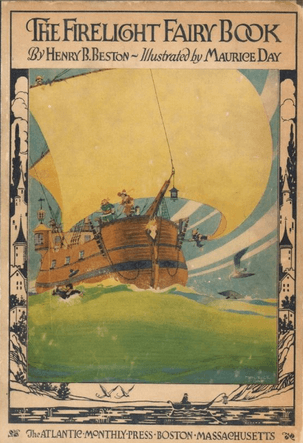
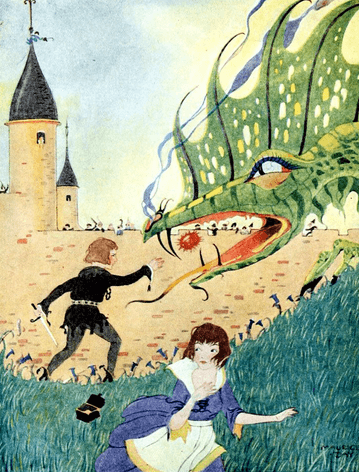
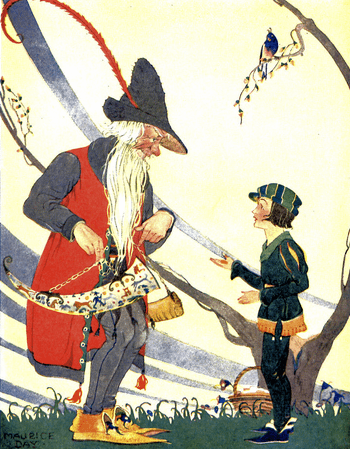
How has your year in 1918 affected your reading life?

 As I’ve mentioned, I had a rocky transition at the beginning of 2019, similar to the reverse culture shock I used to experience when I got back to the United States from a diplomatic posting. It took me several weeks to go back to reading contemporary books and news. Now that I have, I’ve become fussier about what I read. Everything I read in 2018 had a larger purpose as part of the project, and I try to bring a similar sense of purpose into my reading now. I read less day-to-day news and more explanatory journalism. I read less journalism in general, for that matter, and more poetry. And I’m more tenacious about sticking with challenging reading, like this 800-page French book that I started four years ago and am finally close to finishing.

Cover illustration of La Valse Lente des Tortues by Katherin Pancol.

OK, it’s not Balzac

That said, I’m only human. The day I got back from my recent trip to Ethiopia, having taken six plane flights in eight days, I read five articles (here’s one) about how the cast of Crazy Rich Asians owned the red carpet at the Oscars.

Who was your most admired figure from 1918? Your least admired?

Portrait photograph of W.E.B. Du Bois, 1918.

W.E.B. Du Bois, 1918

Photograph of Jane Addams reading to children at Hull House.

Jane Addams reads to children at Hull House. (Jane Addams Memorial Collection, University of Illinois at Chicago)

For Thanksgiving, I wrote a post on 10 1918 People I’m Thankful For. Of these ten, I’d say that Jane Addams and W.E.B. Du Bois are my most admired.

New York times editorial headline reading Vardaman Falls.

New York Times, August 22, 1918

There were lots of villains. One of the worst is Senator James Vardaman of Mississippi. He was known as “the Great White Chief” and lived up to this moniker with comments like “the only effect of Negro education is to spoil a good field hand and make an insolent cook.” He was defeated in the Democratic primary when seeking a second term in 1918. Not for being a racist, though—it was because he had voted against the U.S. entry into World War I. The New York Times had this to say after his defeat: “Was he the victim of his own singularity, grown megalomaniacal, or did he simply overestimate the hillbilliness of his state?”***

What did you learn about marginalized voices from 1918?

Street scene, Lower East Side, New York, ca. 1910.

Lower East Side, ca. 1910 (New York Times photo archive)

I learned that the word “marginalized” barely does justice to how African-American writers and members of other racial and religious minorities were treated in literature. “Erased” would be a better word. Jewish immigrant writers were starting to appear, though, and I read two fascinating memoirs by Lower East Side textile workers—One of Them by Elizabeth Hasanovitz (whom I wrote about here and here) and An American in the Making by Marcus Eli Ravage. Along with Edna Ferber’s short stories, Ravage’s memoir is the forgotten book I most enthusiastically recommend to readers today.

Is there anything you wish you had done that you didn’t have a chance to?

 So many things!!! I didn’t listen to much 1918 music or watch 1918 movies except one short one. I totally fell down on the job when it came to 1918 cooking, partly because wartime food restrictions made for awful-sounding recipes. And I didn’t spend a day wearing a corset, as I planned to.

 How does 1918 writing compare to today’s writing? What was better? What was worse?

Cover of The Best Short Stories of 1918, edited by Edward J. O'Brien.

Short stories were big business in 1918, but, aside from Edna Ferber’s, they were terrible. I bought The Best Short Stories of 1918 but didn’t make it through a single one. A critic at the time complained that everyone was trying to be O. Henry, and he was right.

On the other hand, it was a golden age of poetry. Poets like T.S. Eliot and William Carlos Williams and Marianne Moore and Louise Bogan were just starting their careers. (Yeats was more established.) Of course, there was a lot of terrible poetry too. Sadly, I haven’t been able to find the worst poem I read, toward the beginning of the year. It was about little baby Judas’s mommy wondering why he was so tormented.

Cover of The Little Review, March 1918, with text reading Ulysses by James Joyce.

As far as fiction goes, Ulysses appeared in print for the first time, serialized in The Little Review, and My Ántonia was published. In non-fiction, Eminent Victorians and The Education of Henry Adams transformed how biography and memoir are written. All in all, I doubt 2018 will leave as great a mark in literary history.

What were some of the underlying, unquestioned assumptions that you found? How does that shed light on the underlying assumptions that we might hold today?

People = men was a big one. It wasn’t just the generic use of “men” to mean human beings. Writers defaulted to the assumption that their readers were men and that, basically, anyone who did anything of any importance would be a man. This was hard-wired into the language.

It’s not possible to know which of our current unquestioned assumptions will seem as antiquated in a hundred years (if it were, they wouldn’t be unquestioned), but I’m constantly thinking about what they might be. There was a New York Times essay on this topic early this year that I found fascinating.

Did you cheat? How, and how often?

I went into the project with some unrealistic plans that went by the wayside almost immediately. The original idea was that I wouldn’t read anything contemporary at all, other than the minimum required to be a good citizen (information about candidates in the midterm elections, for instance).

Portrait photograph of novelist Marie Corelli, 1909.

Marie Corelli, 1909

Then, on January 3, I read an article in the New York Times about the British writer Marie Corelli being arrested for hoarding sugar. I had never heard of Corelli, and I realized that I wouldn’t be able to write about her without doing some research. I looked her up on Wikipedia and discovered that she was one of the best-selling writers of her day, that she was the illegitimate daughter of the author of Extraordinary Popular Delusions and the Madness of Crowds, which I had heard of, and that she was probably a lesbian. Fortuitously, she had written a totally bonkers article about eugenics in the January 1918 issue of  Good Housekeeping, so I wrote about that too. The small amount of background reading I did made the story a much richer one, and it ended up as one of my top 10 posts of the year.

From then on, my rule was that I’d treat research the way Catholics treat lustful thoughts—they’re inevitable, but don’t dwell on them. I’d go to (usually) Wikipedia, get the information I needed, and get out quickly.

Once the guidelines were set, I was pretty good about sticking to them. I got news alerts on my iPad, so I knew what was in the headlines. If a news event was important enough that I felt I needed to know about it (like the Trump-Putin summit, the Kavanaugh hearings, and the midterm election results) I’d read an article about it—just one. No editorials, op-eds, or features. I did make some exceptions: I read blogs because it was only fair since I wanted people to read my blog; I read a few articles written by classmates from my MFA program, like this one; and I exchanged fiction writing with a few friends. That’s about it. 99% of my reading was from 1918.

Did you come across any interesting (contemporary) people over the course of the project?

Cover of Women Warriors by Pamela D. Tonder.

Yes, I did. I’ve mentioned some of them before: history writer Pamela Toler, whose new book Women Warriors: An Unexpected History is waiting for me in Washington, D.C.; Connie Ruzich, who writes about World War I poets on her blog Behind Their Lines; Ph.D. student Leah Budke, who is researching modernist anthologies; the unnamed person behind the blog Whatever It Is, I’m Against It, who writes every day about what was in the New York Times a hundred years ago; Frank Hudson of The Parlando Project, who writes about poets, many of them from the 1918 era, and puts their words to song; and Sheryl Lazarus of the blog A Hundred Years Ago, who is cooking her way through the 1910s (putting me to shame). More recent discoveries include two wonderful fashion blogs, Femme Fashion Forward, Danielle Morrin’s blog about fashion from 1880 to 1930, and Witness2Fashion, reflections on everyday fashion through the ages. Getting to (virtually) know these people was one of the best parts of the year.

What’s next? Where will you take the project from here?

When I started, I envisioned this as strictly a one-year project. But, although I’m no longer reading only as if I were living in 1918, that period is like a second home to me now and I plan to go back often. So I’ll keep going with my blog, although I won’t post as frequently. At some point I’ll need to figure out what to do about its now out-of-date title!**** (Update 1/11/2020: This blog used to be called My Year in 1918.)

Do you have any advice for anyone considering a project like this?

Do it! I had high hopes for the project, but it was even more rewarding than I expected.

Portrait of Annie Sadilek Pavelka, the real-life My Antonia, and her family.

Annie Sadilek Pavelka and her family, date unknown. (A photo file that was really, really hard to reduce.)

But don’t let it take over your life. Once in a while, particularly during the first half of the year when I kept to a strict three posts a week schedule, I would be working late at night to get a post up, stressing out over picture file size reductions (something I spent way more time on than I could have imagined), and I’d have to remind myself that, hey, it’s just a blog.

Anything else you want to add?

Cover of From the Mixed-Up Files of Mrs. Basil E. Frankweiler by E.L. Konigsberg.

In E.L. Konigsberg’s 1967 children’s classic From the Mixed-Up Files of Mrs. Basil E. Frankweilerone of my favorite books of all time—Claudia Kinkaid, who has run away to the Metropolitan Museum of Art, says that she wants to “come back different.” When I decided to spend a year in 1918, I wanted to come back different, too. But, like Claudia, I didn’t know exactly what this meant.

After my year in 1918, I know that period in a way that no one else in the world does. Not that I know more about it than anyone else–for example, many people were, unlike me, aware that they didn’t have helicopters back then. But no one else, I am sure, has experienced the year in real time as I did. And I have come back different, in ways that I’m still figuring out. It was a remarkable journey, and one I’ll always be glad I made.

Thanks for joining me.

Thanks for having me!

*If you want to get technical, this is actually my 101st post. I spent much of February traveling in Ethiopia and Zanzibar, which was a great way to celebrate Black History Month but not a very good way to write about it. When I got back to Cape Town I had to rush to get out my post on the first book about an African-American child while it was still February. That was my 100th post.

**Don’t feel too sorry for Arensberg. He was very rich and later became a prominent collector of modern art.

***There is a building at the University of Mississippi named after Vardaman. Wikipedia says it was renamed, but as far as I can tell this is in the works but hasn’t happened yet.

****As I was preparing for this blog in 2017, I asked my friend Emily, she of the DietBet, for advice. As a veteran of several location-related blog name changes (her husband is in the Foreign Service), she warned me against choosing a title that would go out of date. But did I listen? No. You were right, Emily! Her blog is now (and forever) named The Next Dinner Party.

New review on the Book List:

February 27: The Education of Henry Adams by Henry Adams (1918) (audiobook).

The Comic Side of WWI: Percy Crosby and the Rookie from the 13th Squad

With the centenary of the armistice approaching, I’ve been feeling like I should be writing about the war more and not just going on about dieting and Dorothy Parker. But how? I’m not an expert on the Battles of the Meuse-Argonne and wouldn’t do a very good job of pretending to be one. Then it occurred to me that I could tell the stories of individual soldiers, as I did once before, months ago, when I wrote about aviator and Mutiny on the Bounty co-author Jimmy Hall.

So here’s the story of Percy Lee Crosby. Well, he mostly tells his own story, through his wonderful cartoons.

Percy Crosby, date unknown

Crosby grew up in Queens, the son of Irish immigrants. His father ran an art supply store, and his talent was evident from an early age. He dropped out of high school as a sophomore and got a series of jobs as a writer and illustrator for magazines and newspapers, including the Socialist Daily Call, which sparked a lifelong commitment to leftist causes. He eventually started writing a syndicated comic strip, The Clancy Kids. While in training in France in 1917, Crosby, then a 25-year-old lieutenant, began writing That Rookie from the 13th Squad as a daily syndicated panel. A collection of these cartoons was published in February 1918.

When we meet the Rookie, a private in training at a U.S. military base, he hasn’t yet gotten the hang of military discipline,

and he’s the bane of his commanding officers’ existence.

Despite his haplessness and youthful appearance, he has a beautiful girlfriend,

although he has a bit of a wandering eye

and enjoys a good burlesque show.

He’s not the bravest of souls, but he resists the temptation of a deferment.

Training can be terrifying

and he wishes the war would just be over and done with.

But he pulls his socks up,

dreams big dreams,

and rises in the ranks.

Crosby was struck in the eye by shrapnel on the Argon and awarded a Purple Heart. He returned to action, survived the war, and published another Rookie collection in 1919. In 1923, he began writing Skippy, a strip about the adventures of a nine-year-old boy that made him rich and famous. There were Skippy dolls and toys and an Oscar-winning Skippy movie. (And the peanut butter, which sparked a long trademark dispute.) Skippy was a major influence on Peanuts creator Charles Schulz.

Life Magazine cover featuring Skippy, August 2, 1923

In the 1932 Olympics, Crosby won a silver medal in, I kid you not, watercolors and drawing. This, along with architecture, literature, painting, and sculpture, was an Olympic events from 1928 to 1936. I couldn’t find a picture of his entry, “Jackknife,” but here are some spectators checking out the action in the painting event.

Crosby started buying two-page ads in major newspapers espousing left-wing positions and taking on targets like the FBI, the IRS, and Al Capone. The New Republic dubbed him the “Mad Patriot.” He socialized with the stars of the New York artistic and literary scene, including Jerome Kern, Ring Lardner, John Barrymore, and Heywood Broun. Like many of them, he was a heavy drinker.

Crosby and his first wife divorced, and he stopped drinking for a few years when he remarried. He fell off the wagon, though, and after a violent episode in 1939 his wife filed for divorce and got a restraining order against him. He never saw her or their four children, aged five to nine at the time, again. He married again, but his drinking continued and his behavior became increasingly erratic. In 1948, following a suicide attempt after the death of his mother, he was committed to a mental hospital. Despite his efforts to be freed–he claimed that his long confinement was related to his left-wing views–he remained institutionalized until his death in 1964.

In 1918, though, these bad times were far in the future. So let’s end with the Rookie, on watch at the front now, thinking a soldier’s thoughts.


An academic interlude: Harvard’s Widener Library

I live in Cape Town, which has a lot of advantages, like this

and this,

but presents certain challenges My Year in 1918-wise. Online resources like Google Books’ Hathitrust and the Modernist Journals Project are a godsend for online researchers–I get all my magazines there–and most of the books I read are available on Kindle, but there’s no substitute for holding an actual, physical book in your hand.*

So when I went to my Harvard reunion last month, I stayed on and spent a couple of days in Widener Library, which (together with the university’s other, smaller libraries) is home to the world’s third-largest collection of books. My ideal vacation destination!

Widener is a great place to channel 1918. The library, which was dedicated on commencement day in 1915,

Dedication of the Harry Elkins Widener Memorial Library, Harvard University, 24 June 1915 (Harvard Graduates’ Magazine, Vol. 24)

was donated to the university by Eleanor Elkins Widener in memory of her son, Harry Elkins Widener of the class of 1907, who died on the Titanic. Harry was, despite his youth, an accomplished book collector**, and there’s a room in the library dedicated to his memory.***

That room is roped off, but I did get to browse the stacks (which is just as fun and creepy as it was when I was an undergrad), grab a pile of 1918-era books, and peruse them in this less luxurious but still very cool reading room.

Conclusions: E. Nesbit was kind of boring when she wasn’t writing for children. Winnifred Eaton’s Marion: The Story of an Artist’s Model seems like it’s worth reading (good thing, since it’s on my 1918 bedside bookshelf). So does Clive Bell’s Art.

I also did some literary detective work, continuing my pursuit of the script of Alan Dale’s 1918 play The Madonna of the Future, which, as I wrote in April, shocked audiences with its depiction of a wealthy woman who becomes a single mother by choice. There was no trace of it in the National Union Catalogue, although there were lots of other works by Dale, whose real name was Alfred J. Cohen.

With the help of a research librarian, I did find an article in Puck magazine in which Dale, who was a prominent (but, according to Smart Set’s George Jean Nathan, very, very bad) drama critic, interviewed his play’s star, Emily Stevens. Bottom line: Stevens thinks Dale is kind of a moron.

If anyone has advice on where else I might turn to find the elusive script, please let me know. The Library of Congress pointed me in the direction of a copyright records archive, but no luck there either. I’m starting to think it might not exist.

Just when I was winding up my visit to Widener, thinking that it had been fun but a bit lacking in serendipity, I came upon, in this copy of Edna Ferber’s Buttered Side Down,*****

a real-life copy of a Winward Prescott naked microscope bookplate!

Which, in case the excitement of this is eluding you (although a naked microscope bookplate should be exciting enough in its own right), I discovered a while back in an online scan of a Harvard library book and wrote about here.

Two afternoons well spent! Next stop, when I’m back in D.C. in July: The Library of Congress.

*Yes, I know there are some great South African books from that era, and I will get to them.

**An area of accomplishment that is, of course, available only to very rich people.

***There’s a myth at Harvard that, in memory of her drowned son, Eleanor Elkins Widener demanded that the university require that all students pass a swimming test in order to graduate. During the reunion, several classmates reminisced about dutifully going to the athletic center to take the test–which does (or did) in fact exist, but is not a graduation requirement and has nothing to do with Widener. Luckily, some upperclassmen clued me in before I got all wet for nothing.

****Although not as many as I wanted, since, unlike during my student days, much of Harvard’s collection is now stored offsite, including–who would have thought it!–a high percentage of obscure books from 100 years ago.

*****which I subsequently raved about

A pioneering 1918 infographic, worth a thousand words

Words! So. Many. Words. Mine, and the 1918 people’s. I need a break.

The April 1918 issue of The Bookman has just the thing: a graphic about book publication in the United States and Great Britain. And a picture is worth a thousand words, which is the length that my typical post has swollen to these days.

Here are the stats for books published in the U.S. in 1917:

And in Great Britain:

In the accompanying article, Fred E. Woodward, who drew the graphic, points out that

a single glance at the two charts reveals a notable difference between the two figures, the one representing the books of the United States being an almost symmetrical pyramid endued with the appearance of stability and a certain element of vigor and strength, while the one representing Great Britain exhibits an enormous overplus of works of fiction as compared to the remaining classes.

Interesting. Not so interestingly, Woodward goes on to explain the charts at length, which kind of defeats the purpose of a chart. But I can forgive him a lot because, as far as I can tell, he is basically inventing information graphics here. (I did some research and found some earlier examples, going back to a depiction by J.J. Sylvester of chemical bonds and their mathematic properties in Nature magazine in 1878.* So let’s just say Woodward was inventing fun infographics.**)

Chart showing the original boundary milestones of the District of Columbia, Fred E. Woodward, 1906 (Library of Congress)

Fred Woodward really, really liked drawing infographics about books. He did a way more complicated one in the April 1917 issue of The Bookman, and, also in 1917, wrote a graphic pamphlet on book sales for the U.S. Bureau of Education. Woodward also wrote a 1907 book called A Ramble Along the Boundary Stones of the District of Columbia with a Camera. I’m going to D.C. soon and, believe me, I’m going to be rambling along those boundary stones.

Bookplate of Fred E. Woodward, Washington, D.C., 1898 (Library of Congress)

The Library of Congress has this 1898 bookplate of Woodward’s (drawn by someone else, though) in its collection.  “Guardabosque” is a play on his name—it means forest ranger in Spanish, which is apparently the original meaning of Woodward. According to the LOC, there’s an inscription on the back saying that Woodward was the head of the books department at Woodward & Lothrop in Washington. A little more sleuthing revealed that he was the younger brother of the founder of the iconic, and now sadly out of business, department store.*** He’s apparently no relation, though, to graphic artist Fred Woodward, formerly the art director of Rolling Stone and now at GQ.

I was going to hold forth about how few books were published 100 years ago compared to now, but, you know, words. So here’s an infographic:

(Source, 1917: The Bookman magazine, April 1918. Source, 2015: International Publishers Association Annual Report, 2016.)

I realize that this is an apples-and-oranges situation in terms of comparisons. And that I’m no Fred Woodward (either one) infographics-wise.

Still, you get the picture.

*Sylvester, as it turns out, coined the word “graph” in another 1878 Nature article. This is even more amazing than there having been no such word as “surreal” in 1918. If you don’t believe that “graph” is so new, which I didn’t, here’s the Google N-Gram:

**I realize that Woodward probably wasn’t doing this all by himself. Please be in touch if you know of other examples!

***I have wonderful memories of going Christmas shopping in the children’s castle at Woodies (as we D.C. cognoscenti call it) in the 1970s.