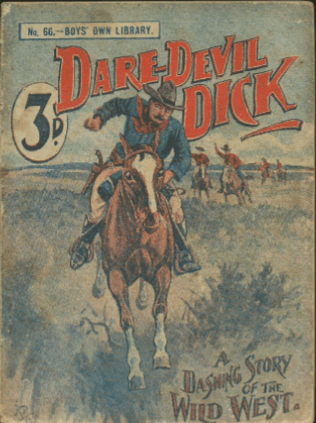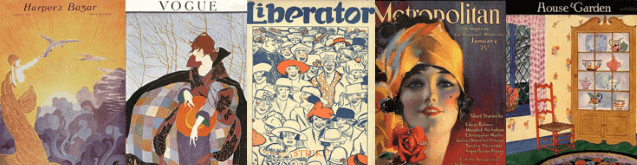
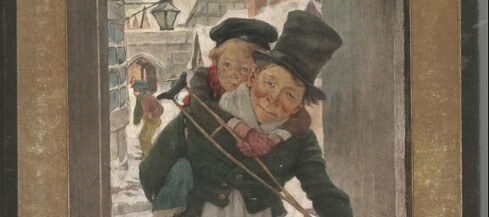
August in Washington, D.C., wound down in a very un-D.C. fashion, with moderate temperatures and low humidity, a far cry from the weather in late July when I went to the DC Open finals.* The women’s final, played in the afternoon after a long rain delay, felt like a battle to see which player could draw more of the humid air into her lungs. (Conditions were better for the men, who played at sunset after another long rain delay.)
DC Open winner Leylah Fernandez and finalist Anna Kalinskaya
I started my Labor Day weekend early by joining two friends for a swim at the Hearst Pool near the National Cathedral. This was my first visit to this pool, which opened in 2021, and only my second swim of the summer. As I swam leisurely laps and lazed on a lounge chair chatting with my friends, I regretted that I hadn’t spent more time at the pool.
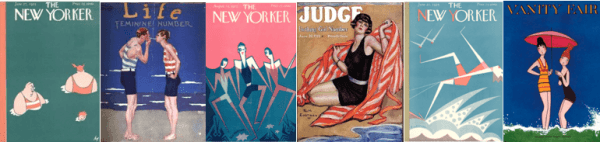
I decided to cut myself some slack, though, given that my summer started out as a Cape Town winter and along the way featured COVID in Dublin, a week visiting family in Colorado, and Hurricane Erin, which didn’t come as far north as DC but brought cloudy skies and cool weather. I’d celebrate the last days of summer, I decided, by taking a look at swimmers on the magazine covers of 1925.
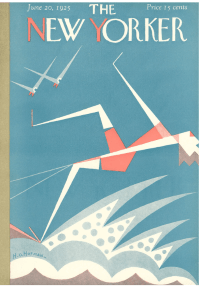
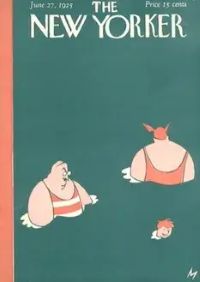
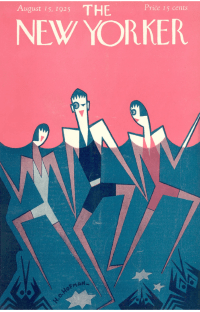
The New Yorker, in its first summer, went all-in on celebrating the joys of the surf.
H.O. Hofman, June 20, 1925Julian de Minskey, June 27, 1925H.O. Hofman, August 15, 1925
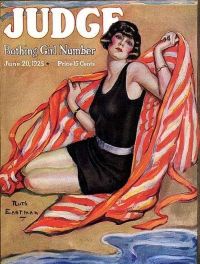
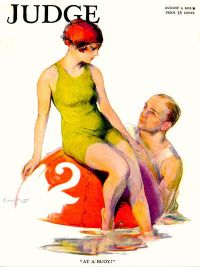
Judge was on board too.
Ruth EastmanGuy Hoff, August 1, 1925
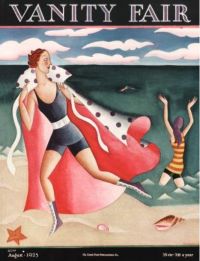
Vanity Fair was not to be outdone by Judge in the red wrap department.
Miguel Covarrubias, July 1925
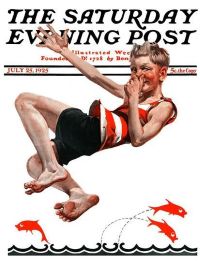
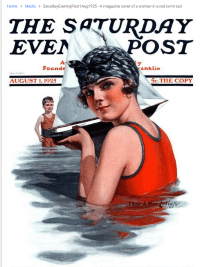
Kids joined in the fun at the Saturday Evening Post.
Elberg McGran Jackson, July 24, 1925Charles McLellan, August 1, 1925
It struck me that, while the men and boys are still covered up on top, the women’s suits aren’t all that different from what you’d see at the beach or the pool these days. When I was growing up, all girls’ and women’s suits had higher-cut legs (if you wanted to be modest, you had to get one with a little skirt, which was kind of pointless because it would float up when you got into the water), but now you see all different kinds of suits, including ones like these.
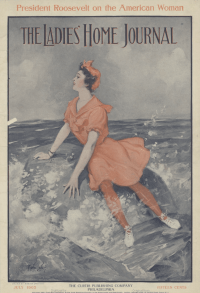
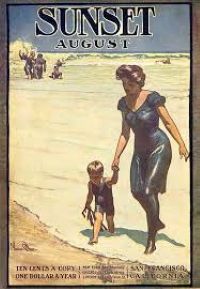
Women had to fight for the type of suits that you see on the 1925 covers. Twenty years before, bathing suits looked like this:
Martin Justice, July 1905Lafayette Maynard Dixon, August 1905
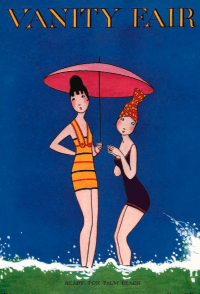
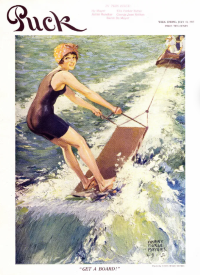
Stockings were on their way out by the mid-1910s,
Anne Harriet Fish, November 1915Harry Morse Meyers, July 18, 2015
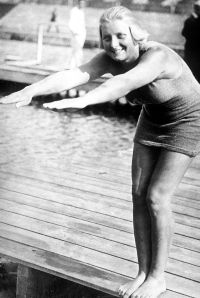
but bare-legged swimming was still barred in some places. The outcry following the arrest of Olympic gold medalist Ethelda Bleibtrey for swimming “nude” (i.e. without stockings) at Manhattan Beach in Los Angeles in 1919 helped put an end to the leg-baring bans.
Ethelda Bleibtrey at Olympic Games, Antwerp, 1920.
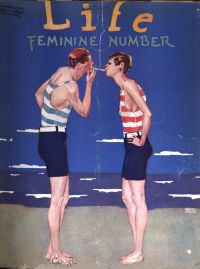
By 1925, Life was poking fun at the similarity between men’s and women’s suits. (They would diverge again when men started bathing topless in the 1930s.)
Garrett Price, August 27, 1925
With Labor Day behind us and pools closed, swimming is a wistful memory.
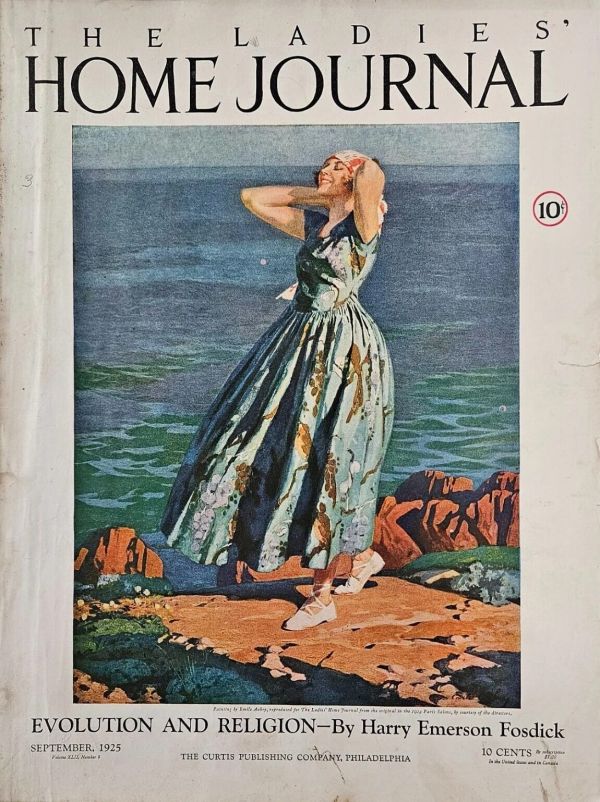
Emile Aubry, September 1925
As this woman reminds us, though, you don’t have to go in the water to enjoy the warm weather while it lasts.
*The tournament is officially called the [Corporate Sponsor 1] [Corporate Sponsor 2] DC Open, but I don’t have either the mental energy to remember all that or the desire to advertise these companies every time I mention it.
I realize that it’s unreasonable to sign up for the annual meeting of the International T.S. Eliot Society, followed immediately by the T.S. Eliot International Summer School, and complain that people talk about T.S. Eliot too much. I became a member of the T.S. Eliot community in a roundabout way, though, my lifelong but low-key interest in his poetry having being reinvigorated when I encountered his early poems and criticism in “real time” during my year of reading as if I were living in 1918. The society’s annual meetings were online during COVID, which seemed like a low-investment way to dip my toe into Eliot studies. Next thing I knew, I was attending the 2022 summer school in London, followed by in-person conferences in Cambridge, Massachusetts, and St. Louis, Missouri. In real life, I’m way more interested in Eliot than anyone else I know (as my loved ones occasionally gently remind me), but the Eliot community is, to put it mildly, not real life. Sometimes, a few days into a conference, I walk into a room, hear it buzzing with, “T.S. Eliot, T.S. Eliot, T.S. Eliot,” and think that there must be more to life.*
T.S. Eliot and Virginia Woolf (Lady Ottoline Morrell, 1924), National Portrait Gallery
I was excited, then, to see that among the the seminars on offer at this year’s summer school, which is taking place this week at Merton College, Oxford, was one on Eliot and Virginia Woolf. As an added bonus, it was taught by one of the most interesting and fun young Eliot scholars (a surprisingly competitive category). I’ve always had a vague interest in Woolf. I read To the Lighthouse for AP English in high school, read her first novel, The Voyage Out, as part of this project, read her essay “Mr. Bennett and Mrs. Brown” twice in recent years for reasons I can’t remember, and read her long feminist essay “A Room of One’s Own” somewhere along the way. (Recently I realized, aghast, that I have never actually read Mrs. Dalloway.)I wanted to read more of Woolf’s work, but I needed a kick in the pants, which I got with this seminar: the main texts were Eliot’s The Waste Landand Woolf’s Jacob’s Room, both published in 1922.
Trinity College, Dublin
Fate had other ideas, though. The morning after I arrived in Dublin, a few days early for the annual meeting at Trinity College, I woke up with a fever and tested positive for COVID. This entailed five days of isolation in my dorm room, followed by a period of mask-wearing and avoiding people, putting the kibosh on both the conference and summer school. I cancelled my travel to the UK and stayed on in Dublin **
For the Woolf-Eliot seminar, we had been assigned a final project that could be anything. Since mine was this, and I didn’t exactly have an action-packed schedule in Dublin, I figured I’d go ahead and do it anyway.
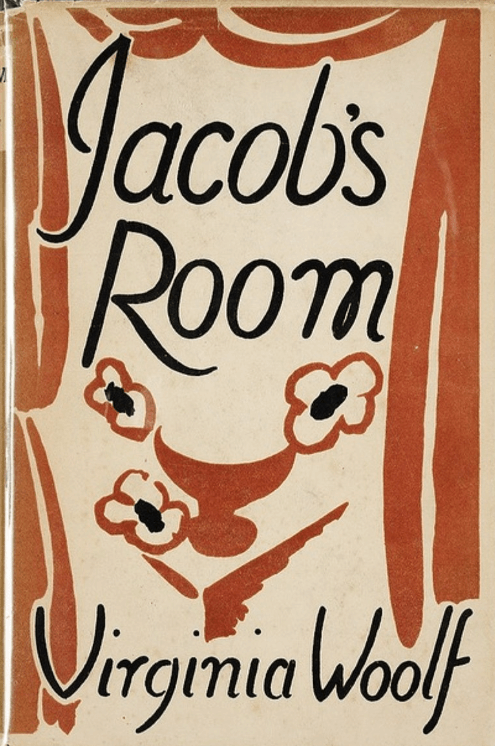
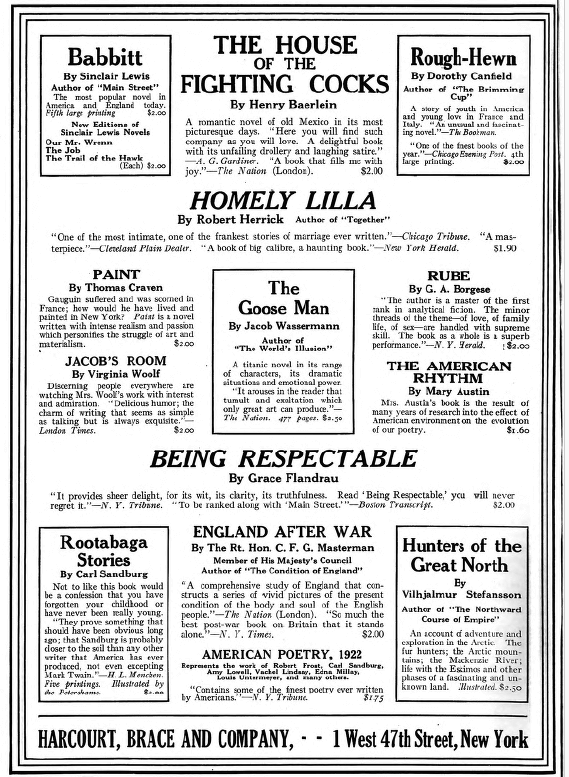
I decided to skip Eliot for this project*** and focus on Jacob’s Room, Woolf’s third novel—specifically, on the reviews that it received following its publication in 1922 in the UK and 1923 in the United States.
Vanessa Bell
Jacob’s Room is generally considered Woolf’s first fully experimental novel. It’s the story of Jacob, a young man from an upper-class but down-on-its-luck family who’s intellectual but not, from what I gather, all that smart. He basically thinks everything after Shakespeare is trash. Also, he’s rude to waiters. Everyone is fascinated by him, though, which led me to assume that he’s extremely good-looking. His fan base includes (naturally) his mom, a widow living in the seaside town of Scarborough; Clare, an upper-class woman who seems like appropriate wife material (her thoughts about him are along these lines: “Jacob! Jacob!”), Bonamy, a Cambridge classmate who’s in love with him (he also thinks, “Jacob! Jacob!” a lot), and several women who skirt the line between girlfriend and sex worker.
We mostly see Jacob through the eyes of these people and others. The reviews state that there’s little from Jacob’s point of view, but that’s not quite true: we see his thoughts, for example, on a sailing trip off Cornwall and on a solo tour of Italy and Greece where he experiences a (to this current solo traveler very relatable) mix of elation and existential angst.
Nothing much happens. Jacob finds a sheep’s jaw in Scarborough as a boy. He goes to Cambridge. He moves to London, works at a vaguely described office job, hangs out with his friends and in society, writes intellectual essays that don’t get published, and travels. In the last two pages, we learn obliquely that he has died in the war.
In between all this, there is a lot of description of whatever happens to be going on around Jacob—London traffic, the musings of random people, and the play of light on water. To give you a sense of it, I picked a random passage, which comes after Woolf informs us that little paper flowers in finger bowls are all the rage:
It must not be thought, though, that they ousted the flowers of nature. Roses, lilies, carnations in particular, looked over the rims of vases and surveyed the bright lives and swift dooms of their artificial relations. Mr Stuart Ormond made this very observation; and charming it was thought; and Kitty Kraster married him on the strength of it six months later. But real flowers can never be dispensed with. If they could, human life would be a different affair altogether. For flowers fade; chrysanthemums are the worst; perfect over night; yellow and jaded the next morning—not fit to be seen.
Trinity College, Dublin
This is a perfect example of what Woolf’s doing here. In the middle of all the flower description, she throws in what could be a whole novel itself about two people who we never hear about again. (And who, by the way, typify one of my pet peeves about people in novels—and, presumably, real life—from 100 years ago: their hasty and uninformed choices of marriage partners.)
But imagine 182 solid pages of this. That high a concentration of brilliance can get exhausting, and it’s possible, as you read, to simultaneously think “Virginia Woolf is a genius” and “if I have to read one more page, I’m going to die.”
International Book Review, Literary Digest, February 1923
I was curious about what reviewers 100 years ago made of all this. Jacob’s Room was reviewed widely considering its small print run (1,200 copies from the Hogarth Press, which Woolf and her husband owned, followed by a second impression of about 2,000 copies, and, in the United States, 1,500 copies from Harcourt Brace). The 1923 edition of Book Review Digest includes excerpts from reviews of Jacob’s Room in a number of American publications, including TheBoston Transcript, TheNew York World, TheNew York Times, TheSpringfield (Massachusetts) Review,**** Booklist, The Dial, Freeman, The Independent, and TheInternational Book Review, a Literary Digest supplement. It also lists UK reviews, mostly from 1922, in The Spectator, TheSaturday Review, TheTimes Literary Supplement, and The New Statesman.
I expected to sit on my born-into-a-world-where-modernism-already-existed perch and scoff at the reviews, which I assumed would be along the lines of the article in the first issue of Time magazine speculating that The Waste Land was a hoax. On the whole, though, they were quite positive, especially the ones in American publications.
David Garnett (Lady Ottoline Morrell, 1920)
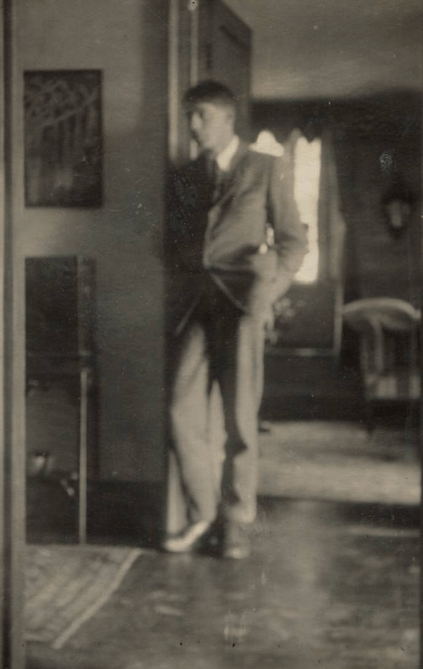
In the case of the first review I read, in the modernist journal The Dial, this was not much of a surprise, since the reviewer, David Garnett,***** was a fellow member of the Bloomsbury Group. “Virginia Woolf seems to be the most interesting of the younger writers now living as well as the best of them,” he writes about his friend. He compares Jacob’s Room favorably with James Joyce’s Ulysses, also published in 1922, saying that “it is the things from which mankind instinctively turns away that Mr Joyce delights to write about” while Woolf is “the kind of butterfly that stoops only at the flowers.” He does have one critique: “The book would be better if not quite so many pictures were called up; with all its beauty it is a little bit too much like fire, or like a very amusing person’s memory of life.”
New York Times, March 4, 1923
The New York Times included Jacob’s Room in a March 4, 1923, fiction roundup. The anonymous reviewer writes that, though the book is composed of mostly minor events, “it is the manner in which these things are revealed that makes the book of importance, at least as an example of what the younger rebels are doing in England.” The review says of the book’s style that “at first one is uneasily aware of Miss Woolf’s bizarre qualities as a writer of prose, but after one has progressed a way in the book this consciousness rather vanishes.” It wraps up by placing Woolf among a cohort of talented British women writers, none of whom, aside from May Sinclair, I have ever heard of,****** saying, “Her influence is one that modern England needs.”
Some more praise from across the Atlantic:
M.M. Colum in The Freeman: Woolf “shows herself to be possessed of one of the most entertaining minds among contemporary writers—witty, subtle, and ironic.”
H.W. Boynton in The Independent: Woolf’s “air of ironic detachment does not conceal a very warm concern in human affairs. Jacob’s Room, her new study of youth, is full of tenderness, though empty of the facile sentiment often confounded with tenderness.”
This was an improvement over the reviews Jacob’s Room had received back home. Rebecca West wrote in the November 22, 1922, issue of the New Statesman that “Mrs. Woolf has once again provided us with a demonstration that she is at once a negligible novelist and a supremely important writer.” Gerald Gould wrote in the November 11, 1922, issue of the Saturday Review that “Mrs. Woolf has written something wholly interesting and partly beautiful. It is at once irritating and encouraging to reflect how much better she would do if her art were less self-conscious.”
Arnold Bennett, ca. 1920 (Pirie MacDonald)
Then there’s novelist Arnold Bennett, whose feud with Woolf had the rancor and longevity of a rap beef. First, in the essay “ModernFiction,” which was published in the Times Literary Supplement on April 10, 1919, Woolf wrote about Bennett, H.G. Wells,******* and John Galsworthy that “it is because they are concerned not with the spirit but with the body that they have disappointed us, and left us with the feeling that the sooner English fiction turns its back upon them, as politely as may be, and marches, if only into the desert, the better for its soul.” Of the three writers, she writes, “Mr. Bennett is perhaps the worst culprit of the three.” She asks about his characters, “How do they live, and what do they live for?”
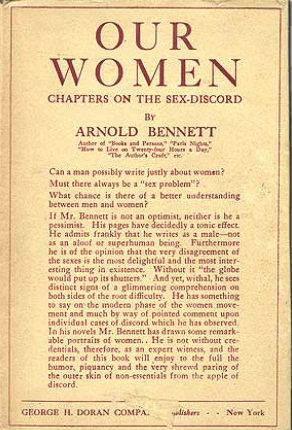
Then Bennett wrote a book called Our Women: Chapters on the Sex-Discord. The title alone is enough to tell you where this is going, but here’s a passage from the chapter on women writers:
The literature of the world can show at least fifty male poets greater than any woman poet. Indeed, the women poets who have reached even second rank are exceedingly few – perhaps not more than half a dozen. With the possible exception of Emily Bronte no woman novelist has yet produced a novel to equal the great novels of men. (One may be enthusiastic for Jane Austen without putting Pride and Prejudice in the same category with Anna Karenina or The Woodlanders.)********
Woolf, according to the introduction in the Oxford World’s Classics edition of Jacob’s Room, wrote “spirited letters to the New Statesman” in response to this while on a break from writing Jacob’s Room. Then she went a step further and put Bennett in the novel: “For example, there is Mr [John] Masefield, there is Mr Bennett. Stuff them into the flame of Marlow and burn them to cinders. Let not a shred remain. Don’t palter with the second rate. Detest your own age. Build a better one.”
Granted, Jacob, whose consciousness this is streaming through, is being a twit here, but if you’re Arnold Bennet you might not appreciate this fine point, given the whole “burn them to cinders” thing.
Bennett’s next step: An essay in the March 28, 1923, issue of Cassell’s Weekly called “Is the Novel Decaying? The Work of the Young,” in which he says,
I have seldom read a cleverer book than Virginia Woolf’s ‘Jacob’s Room,’ a novel which has made a great stir in a small world. It is packed and bursting with originality, and it is exquisitely written. But the characters do not vitally survive in the mind because the author has been obsessed by details of originality and cleverness.
Vanessa Bell
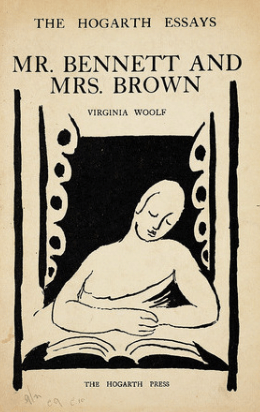
Woolf’s response to this was the aforementioned “Mr. Bennett and Mrs. Brown.” It was first published in the Nation and Atheneum, a British weekly, on December 1, 1923, then in expanded form under the title “Character and Fiction” in the July 1924 issue of The Criterion in response to a request for an article by (full circle!) editor T.S. Eliot, then as a stand-alone publication by the Hogarth Press.
I’m not going to try to do justice to “Mr. Bennett and Mrs. Brown” here. It’s one of the greatest literary essays of all time, a clarion call for modernism. It’s also one of the all-time great literary put-downs. If this is a rap beef, then Bennett is Drake, Woolf is Kendrick Lamar, and “Mr. Bennett and Mrs. Brown” is “Not Like Us.” Except that in a hundred years people will remember Drake, and, if people remember Arnold Bennett today, it’s probably because of “Mr. Bennett and Mrs. Brown.”
We could leave things here, with Woolf triumphant.
Except…
Except that Woolf, while a brilliant writer and a defining figure in feminism (with the even more famous essay “A Room of One’s Own” to come in 1929), was also a snob and a horrible racist.
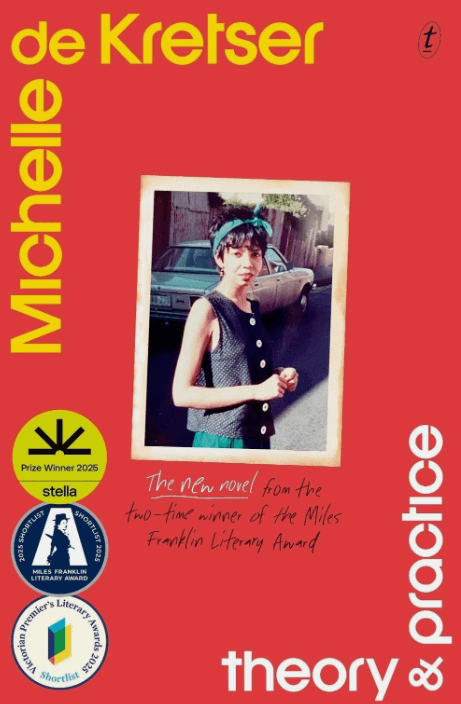
How should we think about this when we’re assessing Woolf’s work? Luckily, I don’t have to answer this question. Instead, I can point you to a wonderful novel about this very issue: Theory & Practice, by the Australian writer Michelle de Kretser. I bought it during a recent trip to Sydney, but it’s available worldwide and was reviewed in the New York Times in February. De Kretser’s heroine is a Sri Lanka-born graduate student in Melbourne in the 1980s, studying Woolf’s diaries as critical theory is taking over English departments at her university and elsewhere. (She’s referred to once late in the novel as Cindy, but I thought of her as “Michelle de Kretser,” which I don’t think is too unfair seeing as that’s a photo of De Kretser as a young woman on the cover of the Australian edition.) Then she comes across Woolf’s racist description of a key figure in Sri Lanka’s struggle against colonialism, but none of the theorists she’s surrounded by think this is important. The novel’s about loving Woolf, and about responding to the flaws of your literary heroes, but it’s also about being young, and going to parties in ramshackle group houses, and the stupid choices you make about love when you’re in your twenties. If that sounds like your thing (and I can’t think of anything that’s more my thing than all this), you should read it.
Jacob’s Room is brilliant, too, and, if I didn’t devour it the way I did Theory & Practice, I’m grateful to have been spurred to read it.
Now I need to get someone to make me read Mrs. Dalloway.
*Obviously, I AM very interested in T.S. Eliot or I wouldn’t do this to myself. But it’s like when I was a full-time Lao language student for ten months at the Foreign Service Institute. FSI is like a high school full of overaged students who are studying just one subject, with schedules along these lines: First period, Lao conversation. Second period, Lao grammar. Third period, Lao reading. Lunch. Fourth period, Lao grammar again. Fifth period, Lao reading again. On Wednesday afternoons they’d spring us for area studies, where we’d study Laos, along with Thailand and Burma. I loved it, but I’d often think, “Can’t we study something else for a change, like Japanese, or the parts of a cell?”
**Having, and recovering from, COVID in Dublin has been way more fun than you’d imagine. I Zoomed in to a seminar on Eliot and translation during the annual meeting, and it was awesome. After a few days of isolation I got the OK from a telehealth doctor to walk outside with a mask. There was a concert series going on that I could hear pretty clearly from my room. One night, the band started singing, “hip hip,” and I thought, oh, they’re covering that Weezer song, and I looked up the program and it ACTUALLY WAS Weezer.
***I haven’t been completely neglecting Eliot. I did my translation seminar paper on a 1992 translation of The Waste Land into Afrikaans.
****The inclusion of The Springfield Republican in the small selection of newspapers The Book Review Digest compiles review from is one of those 100-years-ago mysteries.
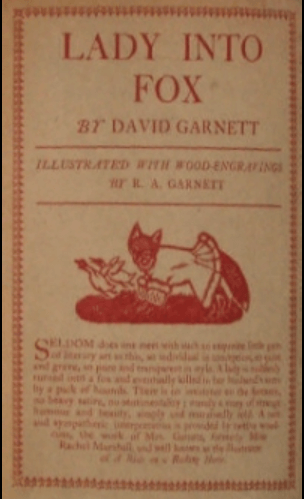
*****Garnett is the author of the 1922 novel Lady Into Fox, which I read for my 1920s bestseller book group, and which actually is about a lady who turns into a fox.
******Here they are: Sheila Kaye-Smith, Mary Butts, Ethel Colburne Mayne, F. Tennyson Jesse (which sounds like the name on a fake Facebook friend request and turns out to be a pseudonym), and Elinor Mordaunt.
*******Further ramping up the interpersonal drama, West had a son with H.G. Wells. As I noted in my post on West’s novel The Return of the Soldier, they made some highly debatable child-rearing decisions, including telling him for years that they were his aunt and uncle.
This year, a lot of Americans will be celebrating Independence Day in a minor key. I’m one of them. I’m spending our country’s anniversary in COVID isolation at Trinity College, Dublin, a set of circumstances not conducive to riotous celebration even at the best of times. I felt like I should mark the day somehow, though, so I’m sharing some magazine covers from July 1925 that show some of the many ways our country’s unquenchable spirit can be celebrated:
spending the day at Coney Island,
Ilonka Karasz, July 4, 1925
lighting a festive lantern,
Conrad Dickel, July 1925
breathing in the sea air,
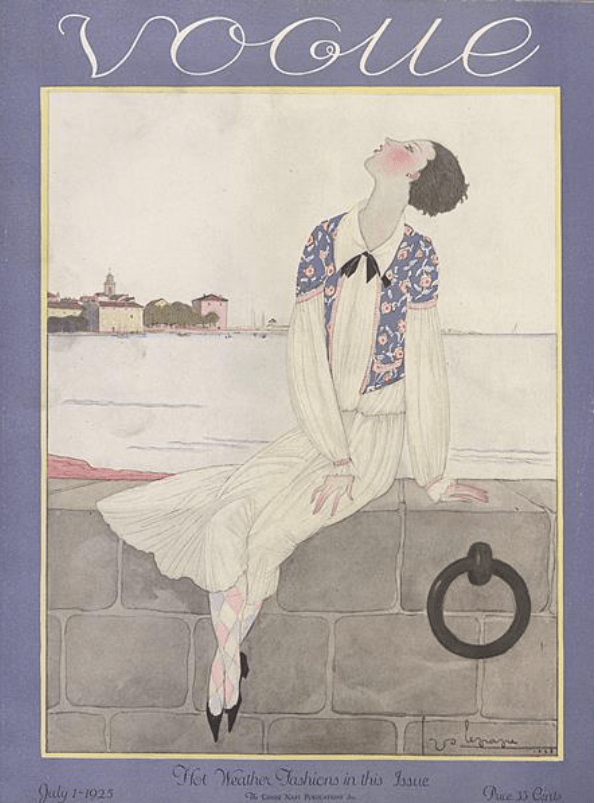
Georges Lepape, July 1, 1925
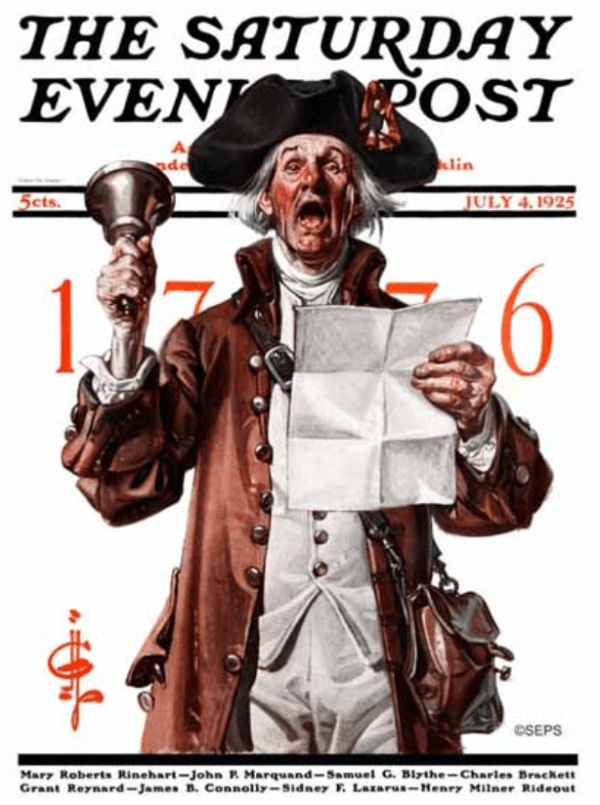
ringing the bell of freedom,
J.C. Leyendecker, July 4, 1925
and celebrating the diversity that always has been, and always will be, our country’s greatest strength.
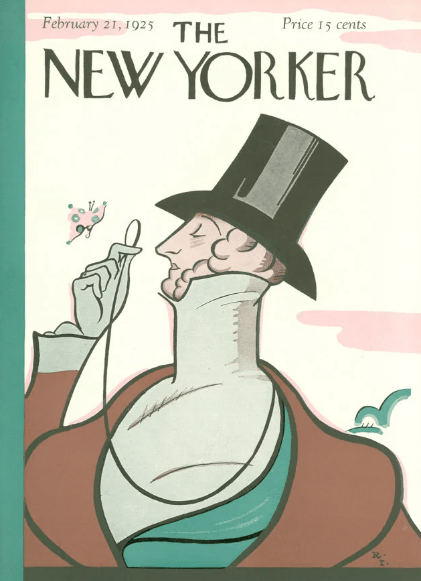
I grew up with the New Yorker. My family had a subscription. We had a huge cartoon collection that I browsed through constantly. My high school English teacher explained the proper way to read the magazine: front to back, skipping the cartoons and ads, then back to front, reading them. I read books like James Thurber’s memoir The Years With Ross (Harold Ross was the magazine’s founding editor) and Brandon Gill’s Here at the New Yorker. I knew from all this reading that the magazine’s early issues were considered unfunny and sophomoric. So I approached the first issue, dated February 22, 1925, with low expectations.
Which were mostly, but not entirely, met.
Here are some bests and worsts from the 36-page issue. Actually, worsts and bests, because with the way everything else is going these days I’m in the mood to end on an upbeat note.
Worst Archetype
An editor’s note in the debut issue says that the New Yorker “is not edited for the old lady in Dubuque.” This now-famous bon mot also appeared in the magazine’s prospectus and, according to an article about the magazine in the March 2, 1925, issue of Time, “on cards which they tacked up about town.”*
Time claimed to have asked an old lady from Dubuque for her views on the New Yorker’s first issue. The old lady, who was actually Time (and, later, New Yorker) writer Niven Busch, replied, “I, and my associates here, have never subscribed to the view that bad taste is any the less offensive because it is metropolitan taste…there is no provincialism so blatant as that of the metropolitan who lacks urbanity.”
Mary Hayford (Encyclopedia Dubuque)
In 1964, Dubuque, playing the long game, sent an actual old lady,** Mary Hayford, to New York to counter the hayseed image. “We have three fine colleges and everyone is studying for their master’s and Ph.D., so we’re very culturally minded,” she told the New York Times. Hayford appeared on the Tonight Show and went on to travel around the country as an ambassador for Dubuque. In her 1989 obituary, the New York Times said that Hayford “helped turn a New York snub into a symbol of pride.”
Best Archetype
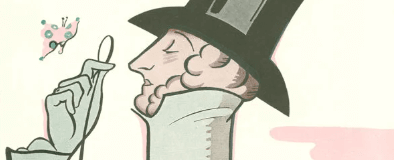
Rea Irvin
Eustace Tilley,*** Rea Irvin’s cover fop, appears on the magazine’s anniversary covers to this day, sometimes in his original guise, sometimes with a twist. The hundredth-anniversary edition came in six different versions.
Worst Front of the Book Item
I’m not going to dignify it by reproducing it here, but there’s an item in the “Of All Things” department that manages, in just six lines, to be racist toward both American Indians and Jewish people. The rest of the section mostly consists of jokes about drama critic George Jean Nathan’s love life.****
Best Front of the Book Item
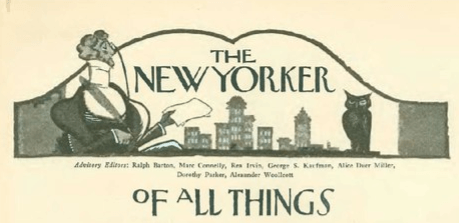
I’m obsessed with 1920s crossword puzzle books,***** so I was interested to read that, according to an anonymous writer in the Talk of the Town section, they’re falling out of fashion in the trendy New York circles where they first became popular. Simon & Schuster, isn’t worried, though; they’re publishing a new volume of puzzles by celebrities. The Talk of the Town writer says that he has a puzzle in the book, which, he tells us blushingly, “’they” say is one of the best. Through some literary detective work, I ID’d the writer/puzzle constructor as advisory editor Marc Connelly.******
Worst Description
A profile on Giulio Gatti-Cassaza, manager of the Metropolitan Opera, describes his nose as follows: “It is a fine, memorable feature, this Gatti- Cassaza nose. It is the sharpest, most assertive part of his wise, sensitive, melancholy face.” If this description leaves you feeling insufficiently well informed about G G-C’s nose, the profile includes two more sentences about it.
To this day, the New Yorker retains what a writer for the magazine described in 2012 as “a literary commitment to tiny details, combined with a comedic eye for social types.” Whether you think this is a good or bad thing depends on how much you want to know about people’s noses.
Best Description
A brief item in a section called “The Hour Glass” describes New York State Senate minority leader (and future New York mayor) James J. Walker thus: “His face is thin; his features sharp, and his cheeks have the perennially youngish tint of the juvenile who bounds onstage as the chief chorine shrills: ‘Oh, girls, here comes the Prince now.’” I feel like I’ve read a similar description somewhere before, but it’s more entertaining than reading about noses.
Worst Gossip
“In Our Midst” is a column of innocuous gossip that seems intended to let us know who is cool enough to be featured in the New Yorker.******* It’s all pretty boring, so I’ll arbitrarily choose this: “Jerome (‘Jerry’) D. Kern was in town one day buying some second-hand books.”
Best Gossip
Also from “In Our Midst”: “Those are pretty clever and interesting stories about married life that Mrs. Vi Shore is writing for Liberty. Yr. corres. wonders if Mr. Shore reads them.”
Hey, New Yorker, I’ve got an idea! Maybe, instead of boring gossip, you could publish interesting short stories! In the meantime, I’m going to track down Mrs. Vi Shore’s.
Worst Criticism
The Books section includes a rave review of God’s Stepchildren by Sarah G. Millin, “a powerful story, the story, simple, direct, unfailingly real and not for a sentence dull, of what comes of white-and-black mating in South Africa. It is, of course, tragic.” I have actually read this book, for my 1920s bestseller discussion group. Meanwhile, E.M. Forster’s A Passage to India, which I have, more unremarkably, also read, is given this squib at the end of the section: “A foaming-up of India race hate, pictured with searching skill.”
If it were up to me, I’d highlight the book that comes out against, not for, race hate.
Best Criticism
The art columnist, bylined “Froid” and actually Murdock Penderton, has this to say about an exhibition of British paintings: “If you are a person who quit trading with the corner grocer because you believed him a German spy, you will enjoy this exhibit.…A placard with sufficient fairness warns you that this exhibit is held in the interest of further cementing the bonds of the English speaking races….If you care for anything later than Ingres, stay at home and let the cement of the English speaking races crumble away.”
Worst Going On
I want to attend almost all of the goings on on “THE NEW YORKER’S conscientious calendar of events worth while.” I do not, however want to go to “Dinner to Gen. Summerall, Hotel Plaza. Tuesday, Feb. 17, given by a citizens’ committee, Gen. John F. O’Ryan, chairman.” I’m sure the Gen. is a nice guy and all, but I was a diplomat for 28 years and I never, ever want to go to another dinner with speeches.
Best Going On
“Lady, Be Good—Liberty Theatre. A nice little musical comedy, with the enviably active Astaires and the most delightful score in the city.”
Adele Astaire, Fred’s sister and dance partner, called the story line “tacky” and “weak,” but who cares? The Astaires! A Gershwin score! Sigh. I had to satisfy myself with a 1966 broadcast of Fred Astaire singing the show’s two big hits (“Fascinating Rhythm” along with the title track) and shuffling around a little.
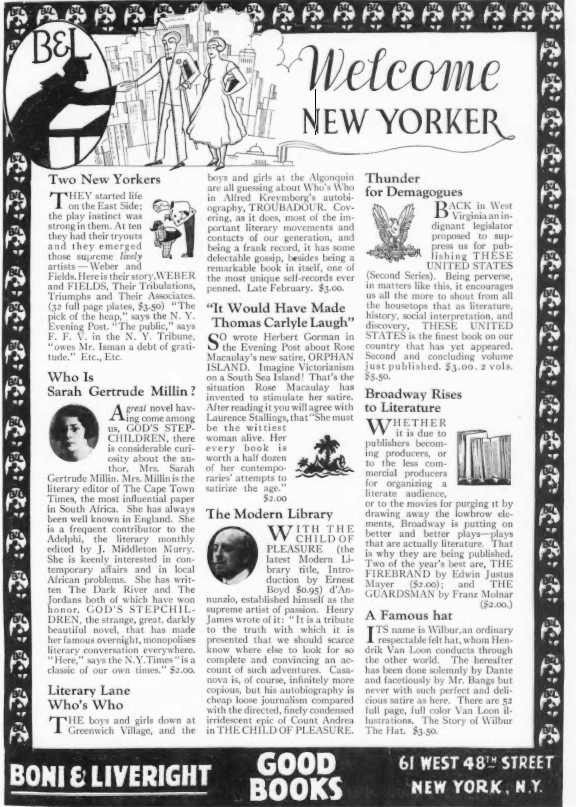
Worst Ad
“What’s wrong with this friendly welcome?” you might be asking. But there’s Sarah G. Millin again, who has written, the ad says, a “strange, great, darkly beautiful novel.” I’ll give them strange.********
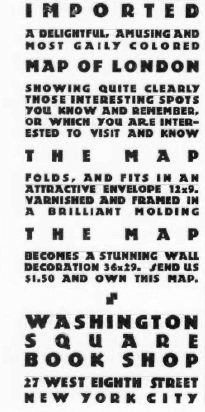
Best Ad
If the map is as stylish as this ad, I’ll pay $1.50 for it.
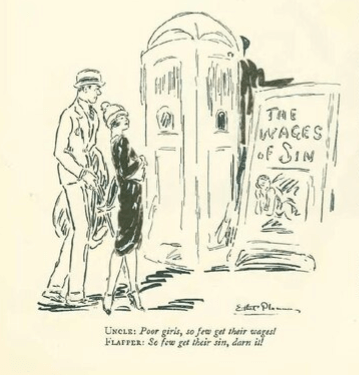
Worst Cartoon
There were only six cartoons, and they were all okay, so I’ll yield the floor to Time magazine, which complained that the magazine contained “one extremely funny original joke, tagged, unfortunately, with a poor illustration.” Given the absence of other contenders for extremely funny original joke, it has to be this one, by Ethel Plummer, who only submitted a few more cartoons to the magazine.
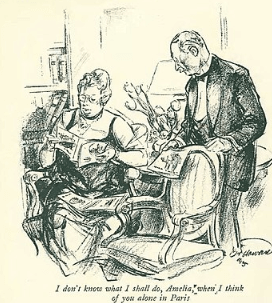
Best Cartoon
Oscar Howard
I wouldn’t say this had me in stitches, but it’s a quintessential New Yorker cartoon, the type you might expect from Helen Hokinson in the 1940s.********* Like Plummer, though, cartoonist Oscar Howard only made a few appearance in the magazine.
All in All…
Harold Ross and Jane Grant, his wife and collaborator, ca. 1920-1925 (New York Public Library)
The critics were right: the magazine is sophomoric and trying too hard. It’s difficult to tell whether it’s celebrating or skewering its subjects. And it’s horribly racist. Looking at the first issue, though, you can see flashes of what’s to come. It’s there in the typeface (designed by Irvin), in the drawings, and in the sections, many of which have survived. (There’s even one of those pieces of filler with a newspaper headline and a snarky comment. Not a funny comment, but it’s a start.)
Ross was frank about the New Yorker’s flaws, writing in the first issue that the magazine “recognizes certain shortcomings and realizes that it is impossible for a magazine fully to establish its character in one number.”
It will take a while, but the bones of a great magazine are there.
*Time itself had debuted two years earlier, on March 3, 1923. I read the first issue but didn’t get around to doing a post. The highlight for me, as an amateur T.S. Eliot scholar, was an article reporting speculation that The Waste Land was a hoax.
**That is, if you think 60 is old, which I, with skin in this game, don’t.
***According to a piece on Tilley in the New Yorker’s 80th anniversary issue in 2005, his name came from a series of humorous pieces by staff writer Corey Ford during the magazine’s first year.
****Not that I’m in a position to criticize this choice of material, having written an entire blog post making fun of George Jean Nathan and H.L. Mencken’s love lives.
*****As I noted in my post on children’s books of 1924, publisher Simon & Schuster called them “cross word puzzles.” The New Yorker, in its first issue, calls them cross-word puzzles. On the other hand, they write “teen-ager” to this day, so they’re not exactly my go-to source on hyphenation.
******Connelly, like several of the magazine’s other advising editors, was a member of the Algonquin Round Table. The other advisory board members on the masthead were Ralph Barton, Rea Irvin, George S. Kaufman, Alice Duer Miller, Dorothy Parker, and Alexander Woollcott. (In 1925, “celebrity” meant someone who was notable, not hugely famous.)
******* Other people whose mundane activities the New Yorker deems worthy of mention include writer Don Marquis, Bookman editor John Farrar, humor writer Donald Ogden Stewart, actress Norma Talmadge, and bunch of people I’m not enough of a sophisticate to have heard of. To be fair, the definition of “gossip” at the time was more along the lines of “bits of news” than “delicious scandal.”
New York Times, December 21, 1913
********Millin is, the ad says, the literary editor of the Cape Town Times. Except that’s not the newspaper’s name—it is, and was, the Cape Times. I realize that this is an extremely niche complaint.
*********Hokinson made her debut in the magazine’s July 4, 1925, edition.
Belated happy New Year, everyone, and welcome to the (can it be?) eighth year of My Life 100 Years Ago.*
J.C. Leyendecker, January 3, 1925
This year’s J.C. Leyendecker New Year’s baby apparently just registered his new car and immediately has to repair it, which I gather is par for the course for ca. 1925 vehicles.
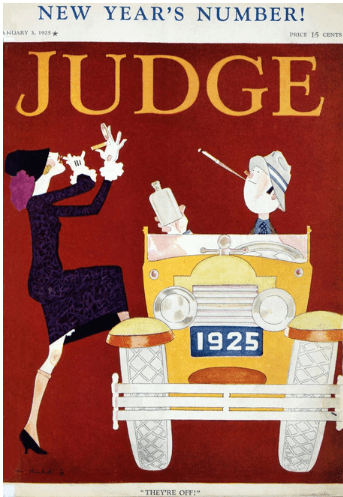
John Held Jr., January 5, 1925
Cars can be fun, though, as you can see from the most Roaring Twenties magazine cover ever. You can cavort and smoke and…well, let’s just say don’t base your driving behavior on hundred-year-old magazine covers.
Cars were also celebrated on the covers of Vogue**
Georges Lepape, January 1, 1925
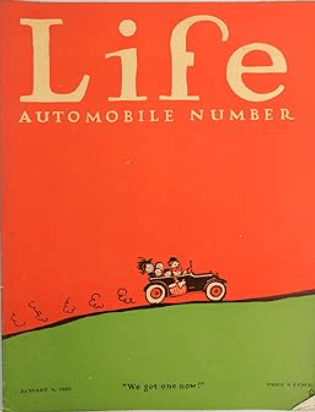
and Life (“We got one now,” the family exults in the caption),
F.G. Cooper, January 8, 1925
while, over at Motor, ironically, cars are a mere afterthought.
Coles Phillips, January 1925
On to the top posts of 1924!
Which is not a very competitive category because my productivity this year was less than stellar, with a mere three posts. Here they are:
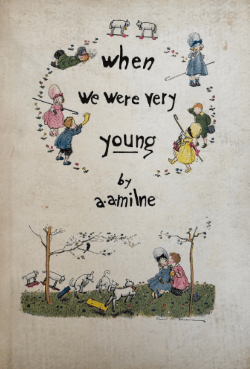
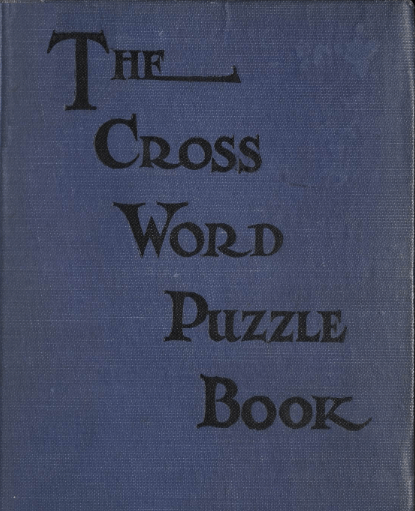
Highlights of 1924 include When We Were Very Young, A.A. Milne’s first collection of Christopher Robin poems; a fun book of poems about a day in the life of two Parisian kids; and, for older kids, two Agatha Christies and The Cross Word Puzzle Book, the first-ever crossword collection, which, infuriatingly, I can’t download from South Africa.
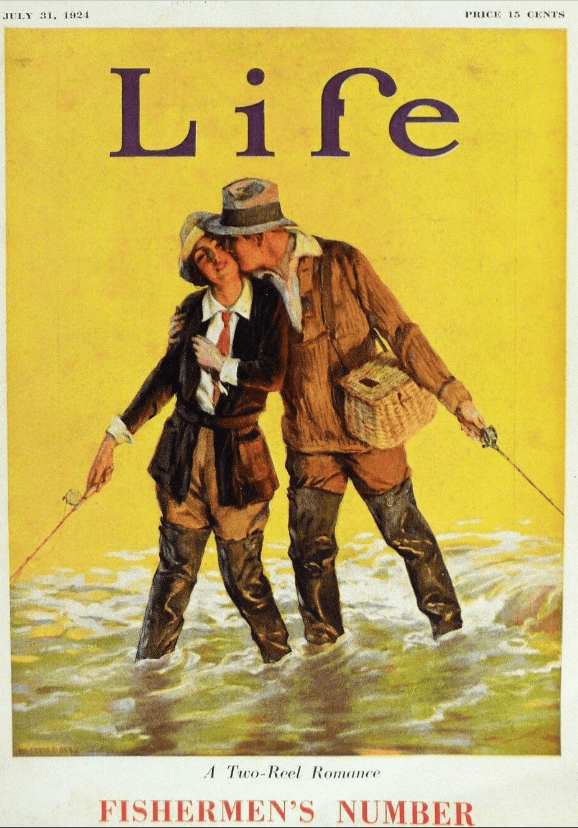
Longing for sun in rainy, wintery Cape Town, I took refuge in a rainbow of summer 1924 magazine covers. (Now, in sunny, summery Cape Town, I’m wistfully scrolling Facebook for my DC friends’ photos of the recent snowstorm.)
In spite of my slack production, this blog had by far its most views ever in 2024, proving, depending on your world view, either that 1) sticking to something, however intermittently, pays off, or 2) life is unfair.*** The most popular posts this year overall were from past years. (The #1 new post was only #15 overall.) To make this a real Top 10, here are seven of them.
Parker’s “Any Porch,” her first published poem, is one of my favorite a hundred years ago things ever. It’s been a while—I’ll have to catch up with her in 1925.
For this Thanksgiving post, I was going to write about ten women I was thankful for, but Neysa McMein (who was Dorothy Parker’s best friend) ended up being so fascinating that I never would have gotten dinner on the table if I hadn’t cut back.
Langston Hughes wrote one of his greatest poems, “The Negro Speaks of Rivers,” as a teenager—and also wrote about fairies and Mexican children’s games.
This is part one in my two-part quest to earn a Girl Scout badge from 100 years ago. Sadly, Part 2, where I actually succeeded in earning a couple, is less popular.
In last year’s most popular new post, I wrote about McKay’s poem “If We Must Die” and the confusion over whether it was entered into the Congressional Record, and if so, by whom.
It took a while for the twenties to start roaring, but halfway through the decade flappers are everywhere, Art Deco has come into its own, and the Jazz Age is well underway. I’m looking forward to what 1925 will bring.
*If you want to get technical, for the first two years it was My Life in 1918.
**The first few websites I saw attributed this cover to Sonia Delaunay, which surprised me since as far as I knew she was an artist, not an illustrator. The cover’s definitely by Lepape—you can see his signature in the top left hand corner—but according to this website it’s a portrayal of Delaunay’s “simultaneous” technique.
***Or, I guess, 3) search engine algorithms are weird.
Welcome to the sixth annual children’s books holiday shopping guide! I’ve just arrived in Cape Town from Washington, D.C., as I do at this time every year.* This year, determined to avoid a repetition of last year’s kind of pathetic effort, I got an earlier start. The problem was, I couldn’t stop myself from reading just one more 1924 roundup, or looking up just one more book, so here I am on Christmas Eve afternoon in full Bird by Bird mode.
The Bookman, October 1924
This year, as always, pioneering children’s librarian Annie Carroll Moore** is my principal guide. And, as always, she’s kind of annoying. In her article in the May 1924 issue of The Bookman, she’s supposedly having a conversation with a young writer who’s published two children’s books and isn’t sure whether he should continue. Her reply, supposedly, is the whole rest of the article, with quotation marks and everything. If this were a real conversation, he’d be extremely sorry that he asked. Skip the framing device, Annie! Just tell us about the books! Luckily, in her October article, she writes more or less like a normal person.
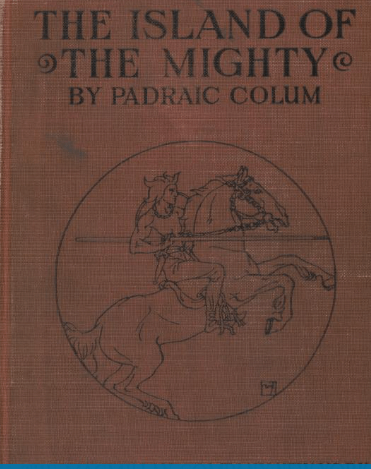
The October issue of The Bookman also has an article by Louise Hunting Seaman about giving books to children, with lots of cool examples of how to do it without looking like you’re giving them a homework assignment. You could, for example, give them a real Italian puppet*** holding a copy of Pinocchio or give them Padraic Colum’s The Island of the Mighty, a tale of Celtic Britain, and take them to the Hall of Armor at the Metropolitan Museum (although, as noted below, I’m not so gung-ho on The Island of the Mighty.)
New York Times, December 7, 1924
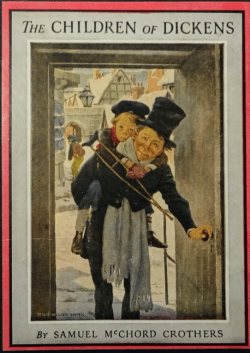
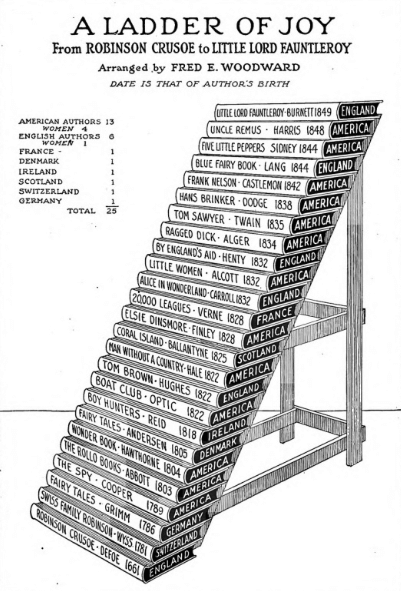
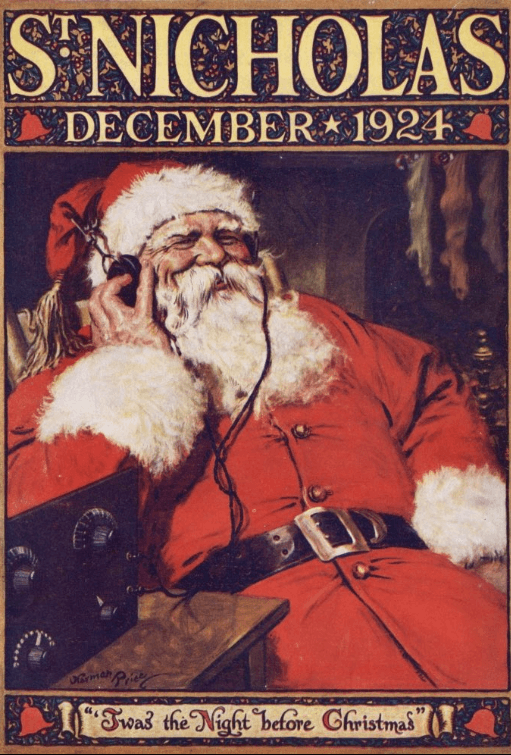
The New York Times weighs in on the children’s books of the season in the December 7 issue,**** the Library Journal give us a comprehensive list “designed merely for the convenience of children’s librarians in checking the fall and winter output” (not realizing that it might come in handy for bloggers a hundred years in the future too), and St. Nicholas’s November issue has a list of books for children that turn out to all be really old, but that’s OK with me because it’s accompanied by this cool graphic by one of my favorite 100-year-ago people, infographics pioneer Fred Woodward.
Fred Woodward, St. Nicholas, November 1924
So plenty to work with, even with Publisher’s Weekly’s excellent roundup sadly having bitten the dust in 1922 and HathiTrust, my main source of 100-year-old books and magazines, infuriatingly having blocked access to a lot of books outside the U.S. for copyright reasons.*****
Fairy Tales, Nursery Rhymes, and Folk Tales
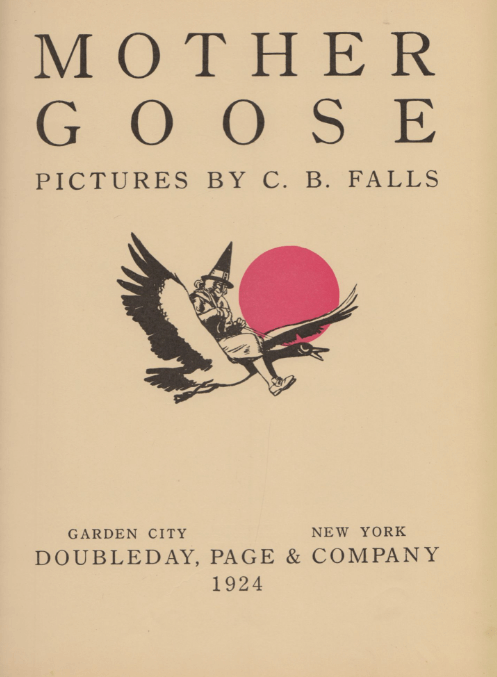
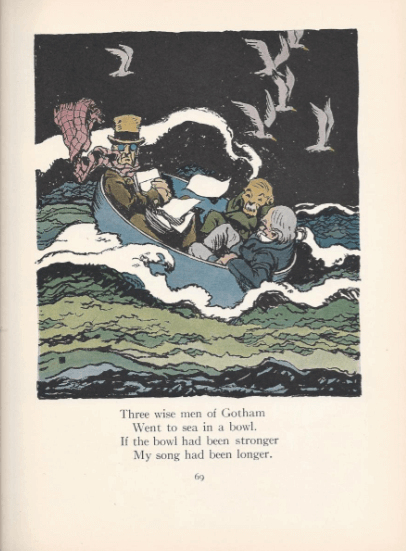
I was a fan of C.B. Falls’ 1923 offering The A B C Book, but I’m meh on his Mother Goose, as is Moore, who says, ““It is a book of distinguished appearance, but something highly important to little children is missing from its pictures—the quality that, differentiating Mother Goose characters from all others, makes them live again in a new way of their own.” The three men in the illustration of “Three Wise Men of Gotham” are, she points out, “easily recognizable as Wilson, Lloyd George, and Clemenceau.” I wasn’t familiar with this particular nursery rhyme, which turns out to be pretty horrifying.******
For Young Children
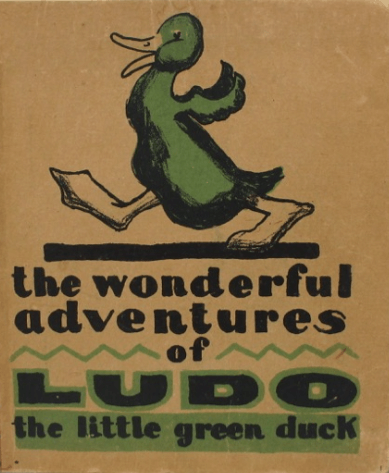
Moore praised Jack Roberts’ The Wonderful Adventures of Ludo the Little Green Duck, saying, “It’s gay, it’s fresh, and it’s different,” and adding, “It captured my imagination at a psychological moment, for the dummy came into my office on the last day of the Democratic Convention in Madison Square Garden.” I’m not sure what that means, but, hey, we’re all at a psychological moment, right? This was one of the books that was blocked by HathiTrust, but Ludo’s adventures take him around the world, and “around the world” plus “1924” generally equals “racist.” The online images I was able to find seemed to bear this out. (That’s Ludo in the Bookman headline with some of his new friends.)
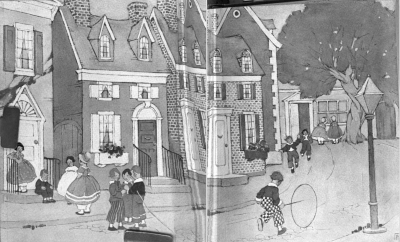
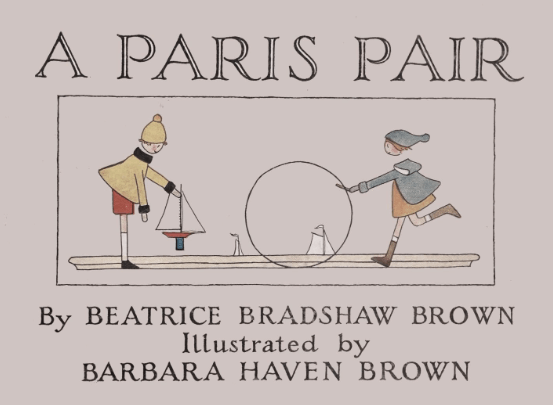
A Paris Pair: Their Day’s Doingsby Beatrice Bradshaw Brown is, according to Moore, a “delightful, inexpensive book” that features “a clever verse in English for each hour in the day of two French children.” I did in fact find it pretty delightful, although going to the Louvre EVERY day sounds pretty exhausting. Here’s lunchtime:
LUNCHEON never comes too soon, For we are nearly starved at noon! Spinach and an omelette, Salad, too, and better yet Delicious jam with creamy cheese— A dish that’s very sure to please! Becoming gratitude they feel, And thank le bon Dieu for their meal
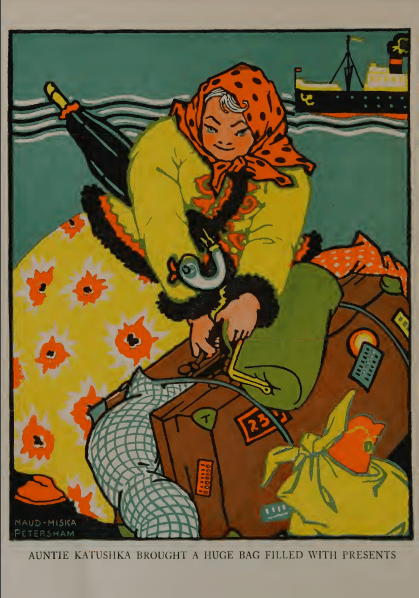
Moore calls The Poppy Seed Cakesby Margery Clark, illustrated by Maude and Miska Petersham, “certain to appeal to little children,” although I (admittedly not any kind of child) found the stories silly and some of the illustrations, like this one,
kind of sinister.
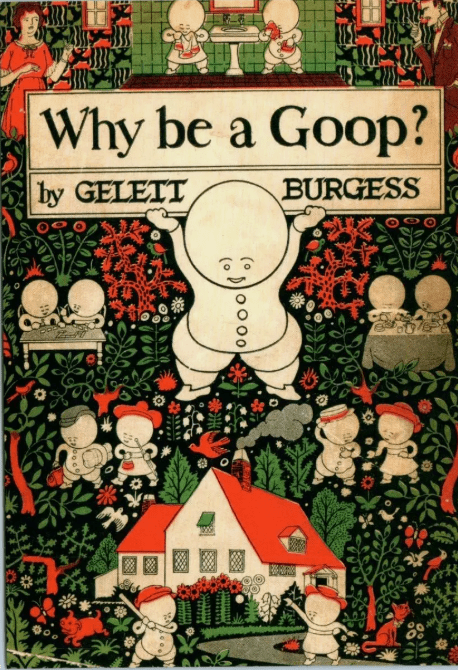
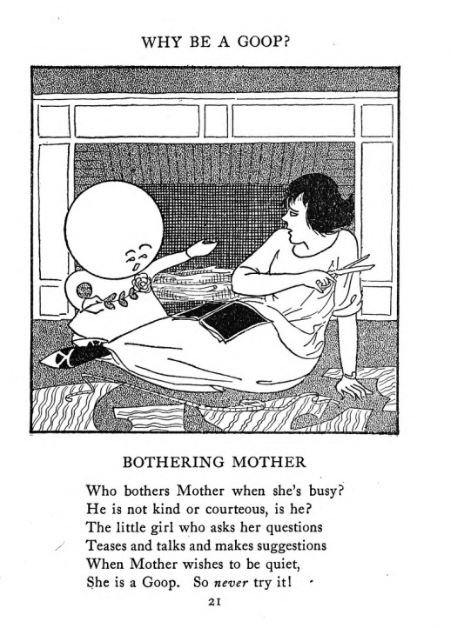
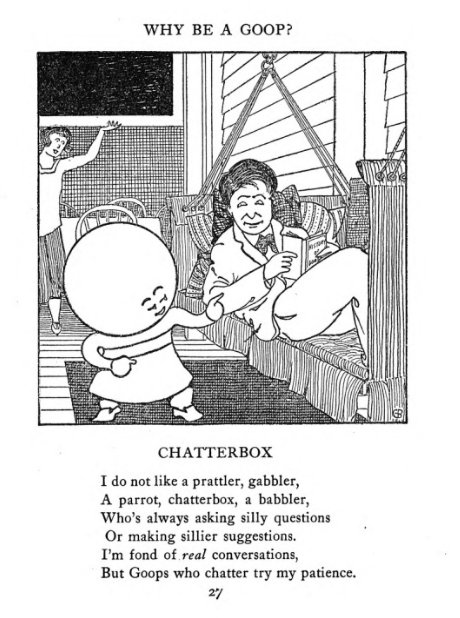
Why Be a Goop? is a late installment in Gelett Burgess’s series that started in 1900 with Goops and How to Be Them, which was a favorite of mine when I was little, although the Goops’ round heads freaked me out. In that book, the Goops did things like lick their fingers and lick their knives and generally lead “disgusting lives.” In this one, though, they seem to spend most of their time trying to get the attention of their negligent parents.
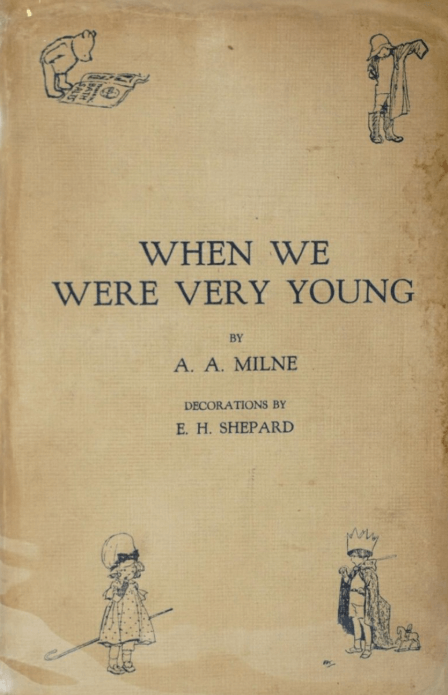
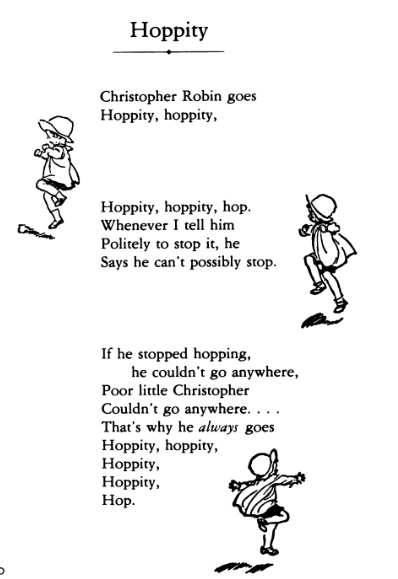
When We Were Very Young, A.A. Milne’s classic book of verses featuring Christopher Robin, surprisingly didn’t make it onto any of the lists, maybe because of its November publication date. I loved this book as a child. We had a record of the poems, too, and I can still recite some of them, like this one,*******
by heart.
For Middle-Grade Readers
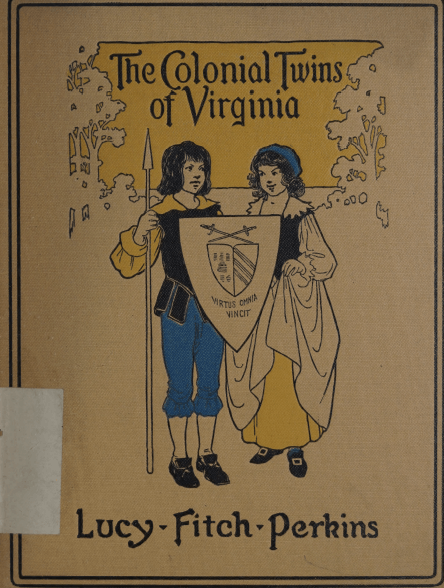
Its title alone would have DQ’d The Colonial Twins of Virginia, the latest installment in Lucy Fitch Perkins’s twins series, even if I hadn’t done a word search for “slave,” which yielded, among other things, one of the twins saying to the other, “One has to love people, and there aren’t any other people here to love except the slaves, and of course they don’t count.”
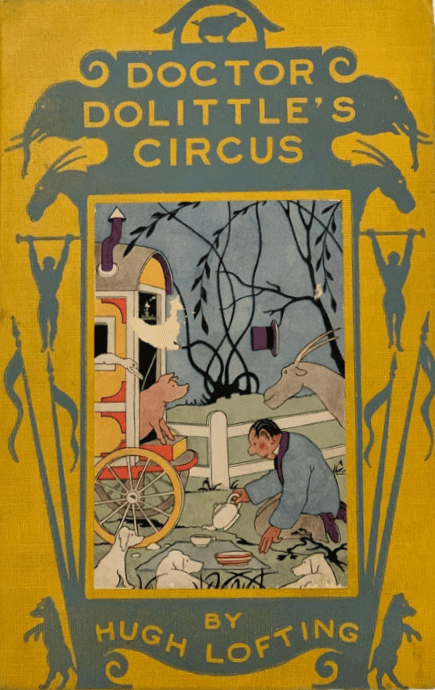
I didn’t have high hopes, but Dr. Dolittle’s Circusby Hugh Lofting appears to be one of the less offensive books` in the series (I wrote about previous installments here and here). Dr. D. comes to the aid of abused animals in a circus, including returning a seal to the sea.
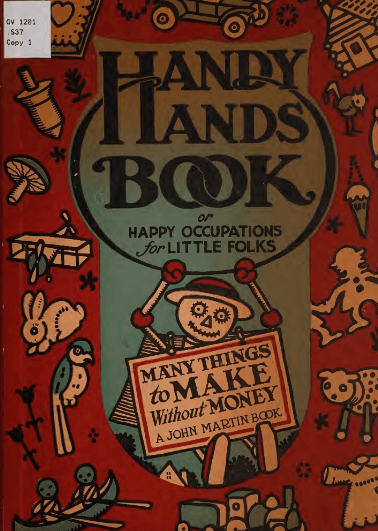
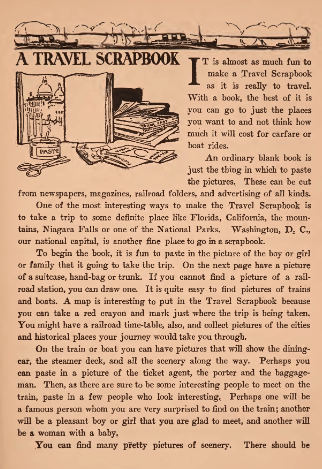
I loved activity books as a kid and am always on the lookout for a good hundred-year-old one. I’m not a fan of John Martin’s annual miscellany, so his Handy Hands Bookwas a pleasant surprise. I don’t buy Martin’s argument that “it is almost as much fun to make a Travel Scrapbook as it is really to travel” (unless maybe you’re stuck at DFW on Christmas Eve), but making a scrapbook of an imaginary journey does seem like fun.
For Older Children
Novels for high-school-aged children from a hundred years ago tend to be unbearably tedious, and this year’s were no exception.
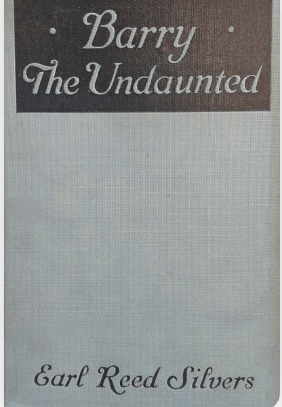
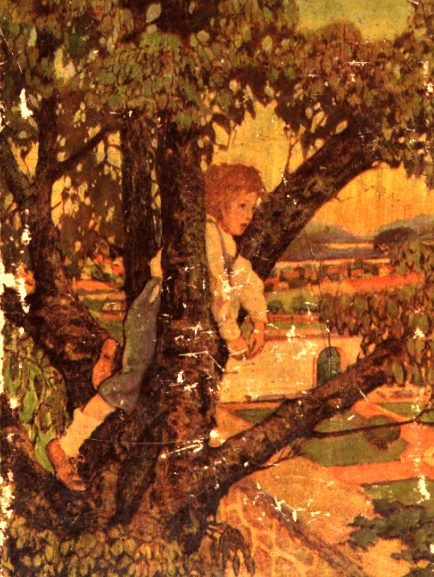
Moore describes Earl Silvers’ Barry the Undauntedas “a story of high school boys and girls with an element of civic interest,” and it’s about as thrill-packed as that makes it sound. I gave up early on, in the middle of a prolonged discussion between Barry (who is a girl) and her fellow campers about what rules their swim team should have.
The New Moon
Moore quotes the introduction to Cornelia Meigs’ The New Moonas saying, “It might seem a tedious journey to walk at a sheep’s pace across the whole state of Pennsylvania.” Indeed it might, I say as someone who found a journey across half of the state of Pennsylvania in the passenger seat of a Prius pretty tedious. The journeyer is a boy who makes his way from Ireland to the American frontier. From a quick flip-through it struck me as more interesting than Meigs’ previous novels, but that’s not saying much.
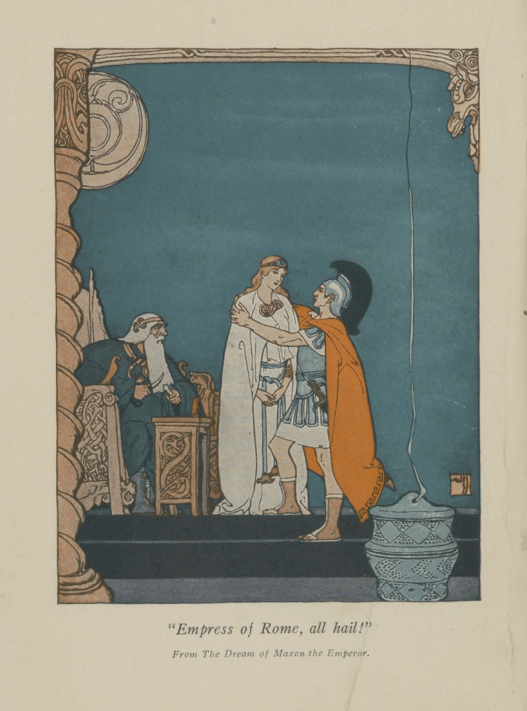
The first word of The Island of the Mighty, the book that Louise Hunting Seaman suggests that you accompany with a visit to the Hall of Armor at the Met, is “thus.” As “distinguished” as Moore finds it, I didn’t make it much further. Wilfred Jones’s illustrations are pretty cool, though.
Wilfred Jones, The Island of the Mighty
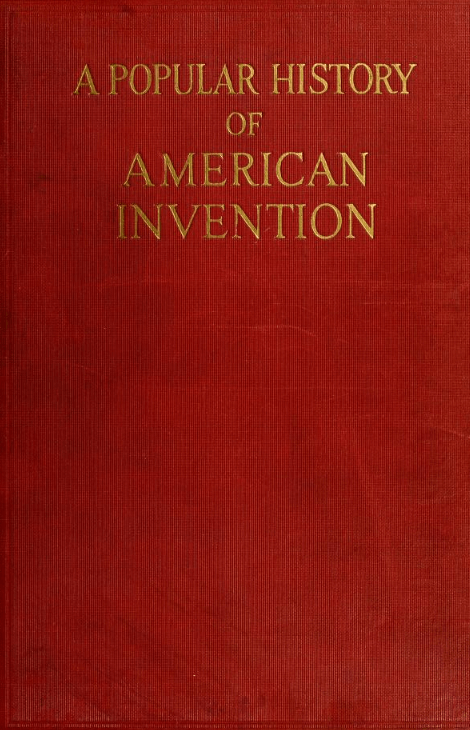
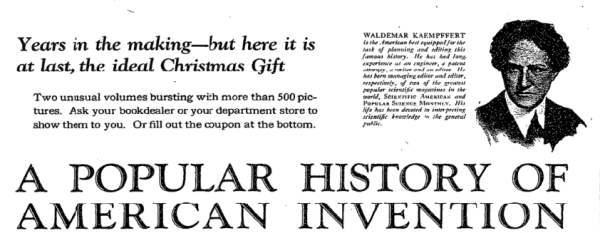
You will, this New York Times ad claims of Waldemar Kaempffert’s A Popular History of American Invention, “read these exciting volumes as you would a novel…You watch Goodyear in rags vulcanizing rubber over the kitchen stove; Davenport tearing up his wife’s one silk dress to insulate a motor.”
Oh no! I raced to find the horrifying scene:
“Tearfully but bravely the young wife handed to her boyish inventive husband, ‘Tom,’ the silk dress in which she had been married only eight years before. He needed it in his work as an inventor. It had been carefully folded away in lavender by the beautiful bride when, in 1827, Thomas Davenport, the active but studious village blacksmith of Brandon, Vt., had so far forgotten his profound interest in the ‘galvanic magnet’ of Joseph Henry as to fall in love and ‘settle down.’”
This is, I have to say, a lot more exciting than Cornelia Meigs.
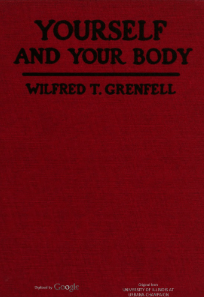
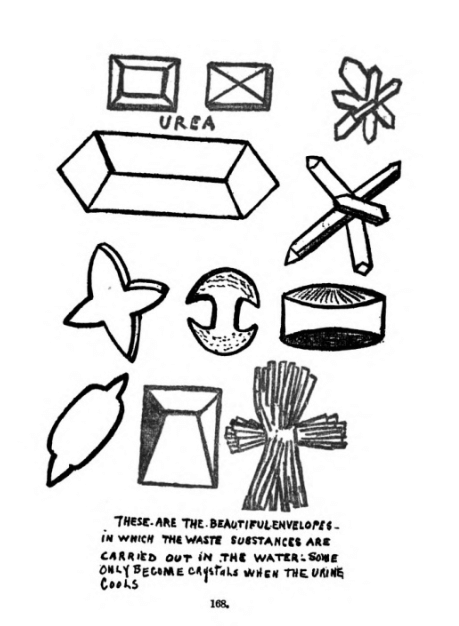
Moore calls Dr. W.T. Grenfell’s Yourself and Your Body“a unique and valuable book embodying Dr. Grenfell’s talks to his own children, with original and amusing drawings.” Grenfell, unsurprisingly, doesn’t cover ALL of your body, although there’s a chapter called “Waste,” which ends with, “Here ends this difficult chapter.” Here’s a cute drawing of urea:
Young Adults
Or the older children might just want to skip right up to reading adult books, like Agatha Christie, a favorite of my own mid- to late teens.
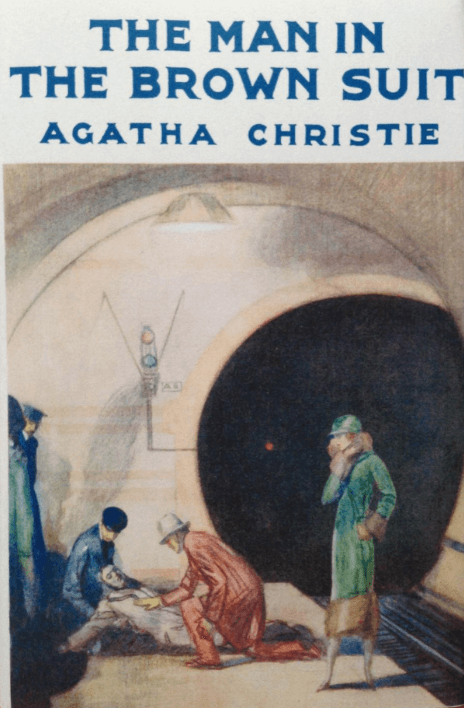
Some critics were disappointed that her latest novel, The Man in the Brown Suit, was a stand-alone thriller that didn’t figure Hercule Poirot, but it turns out to be partly set in Cape Town, which I’m pretty excited about.
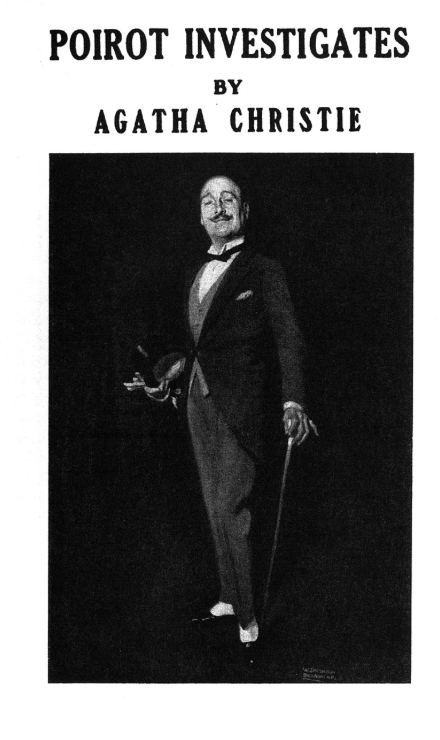
Plus, luckily for Poirot fans, there’s also her first short story collection, Poirot Investigates.
Number one on my 1924 wish list, and on the list of books I’m mad at HathiTrust for blocking in South Africa, is The Cross Word Puzzle Book, the first book of crossword puzzles ever and also Simon and Schuster’s first book ever. It launched a craze I have quite a bit of expertise on, since it featured prominently in my seventh-grade history paper “Fads of the 1920s.” (You can also get it at Project Gutenberg, but it’s not in the original format so you can’t print it out and do the puzzles yourself.) (UPDATE 12/24/2024: The Library of Congress has a PDF, but you can’t download it.)
Christmas Eve has given way to Christmas day and now Christmas night,********* and I’d love to curl up with a good cross word. Oh, well. Good thing I have Agatha Christie to keep me entertained.
Happy holidays, everyone!
*Although not, as people often assume, because I want to avoid the northern hemisphere winter. While people here are celebrating the holidays by having barbecues (braais in local parlance) or going to the beach, I’m dreaming of hot chocolate and long nights.
**Who, I see, has changed the name she writes under from Annie to Anne. I knew this was coming—Wikipedia says that she “officially changed her name to Anne in her fifties, to avoid confusion with Annie E. Moore, another woman who was also publishing material about juvenile libraries at that time.” In my opinion, ACM, who basically invented children’s libraries and children’s book reviewing, should have been the one to keep the i.
***I was going to say something snooty about Pinocchio being a marionette, not a puppet, but I looked into it and marionette is a subcategory of puppet.
****As always, there are a lot of reissued classics, which qualify for inclusion if they have new illustrations.
*****In the past, HathiTrust allowed worldwide access after 95 years, which is when copyright expires in the U.S., for most publications except U.K. periodicals.
******The Times, which is more of a fan than Moore, points out that Falls’s collection includes about three hundred verses “and must be comprehensive of all of them that are now extant.” There’s something to be said for selectivity.
*******Admittedly not a particularly complex piece of verse.
********The fake-sounding Martin turns out to have been a real person, although his actual name was Morgan van Roorbach Shepard, which would have been hard to squeeze onto the cover of all those books.
*********Don’t worry, I haven’t been doing this the WHOLE time.
I recently went on on a trip from Cape Town to Washington, D.C., Seattle, North Cascades National Park, Seattle again, Denver, D.C. again, and then back home to Cape Town, all in three weeks. It was wonderful, but it was too much: too many airports, too many suitcases, too many weird bathroom setups. (Well, two, but that was two too many.) I kept saying to myself, “I’ll be so happy to just be able to hang out at home,” forgetting to take Cape Town winters into consideration and add, “provided that it doesn’t rain nonstop so that staying at home is the only option.”
I went out walking every day when the rain let up, hoping to make it home before the skies opened again. On one of these walks I looked up and saw a double rainbow, which lifted my spirits tremendously. Cape Town is unfortunately not a place where it’s wise to to take out your phone and start snapping away while walking along a busy road, so I don’t have a photo of it. But I assume you’re familiar with the concept.
I haven’t done a magazine illustration post in a while,* so I decided to pay tribute to that moment, and to summer from a Cape Town winter, with a rainbow of summer 1924 magazine covers.
First up in vivid red is Spanish illustrator Eduardo Garcia Benito’sJune Vanity Fair cover.**
Eduardo Garcia Benito, June 1924
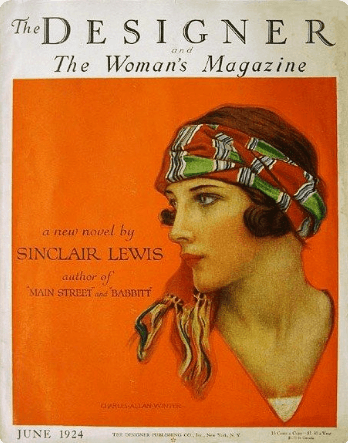
Imposing a constraint, like “it has to be orange,” makes you expand your horizons. I wasn’t familiar with The Designer, although it must have had a large circulation if it was serializing Sinclair Lewis’s Arrowsmith.*** I wasn’t familiar with the cover artist, American illustrator Charles Allan Winter, either.
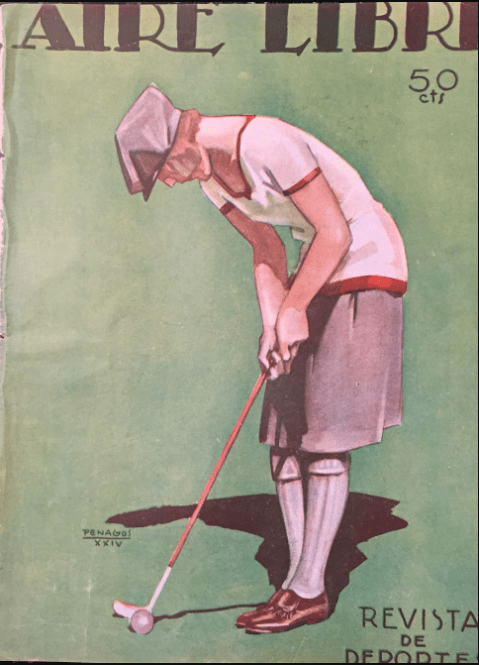
You can’t expand your horizons much further than to a short-lived Spanish sports magazine for which the only online reference I could find is a Catalan-language Wikipedia page that has been flagged for possible deletion. The illustrator, Spanish artist Rafael de Penagos, is new to me. He received a gold medal at the 1925 International Exhibition of Modern Decorative and Industrial Arts in Paris, from which Art Deco got its name (surprisingly, not until the 1960s).
Rafael de Panagos, July 1, 1924
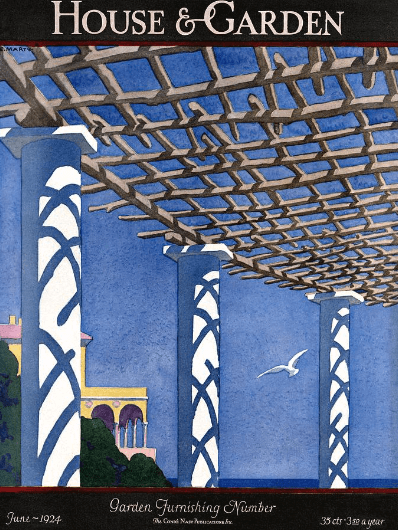
In vibrant blue, a House & Garden cover by French artist André Édouard Marty. Marty, not to be confused with leading French Communist Party member André Marty, was another leading figure in the Art Deco movement.
André Édouard Marty, June 1924
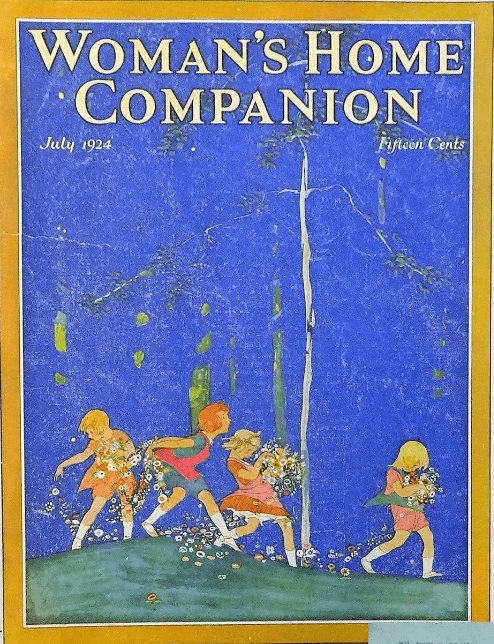
I’m not of the school of thought that indigo is a color of the rainbow, since squeezing it in between blue and purple throws off the symmetry, but I couldn’t resist these flower-strewing children, drawn by an artist I couldn’t identify.**** This issue of Woman’s Home Companion includes an essay on parenthood by F. Scott Fitzgerald, the last installment of Dorothy Canfield Fisher’s The Home-Maker, an ahead-of-its-time novel about a stay-at-home dad,***** and an illustrated story by N.C. Wyeth. Not bad for fifteen cents.
July 1924
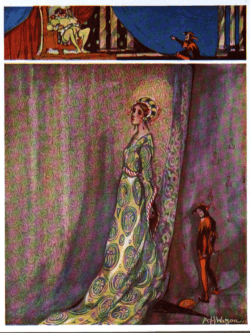
Here’s the purplest cover I could find, from Vogue regular Pierre Brissaud.******
Pierre Brissaud, July 1924
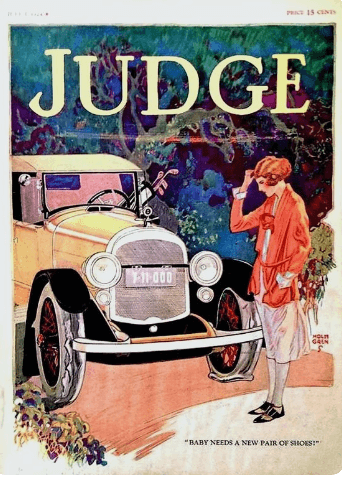
To wrap things up, here’s a cover by John Holmgren, yet another new-to-me artist, who managed to fit every color of the rainbow onto this Judge cover.
John Holmgren, July 5, 1924
But wait! This is just a SINGLE rainbow.
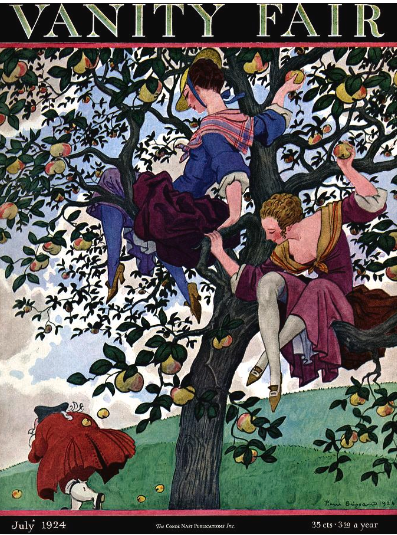
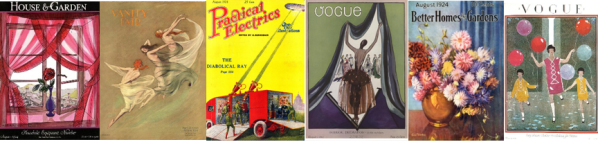
July slipped into August as I was working on this post, which gave me another month’s worth of magazine covers to work with. Now August is slipping away as well, and I’m back in Washington. At this rate, the leaves will be falling off the trees by the time I post this if I write about each one, so here they all are:
House and Garden: Joseph B. Platt. Vanity Fair: Warren Davis (back to his old tricks). Vogue (green): George Wolfe Plank. Vogue (purple): Harriet Meserole. Other artists unknown.
Enjoy the end of summer (or, if you’re in Cape Town, FINALLY the end of winter), everyone!
*Or any other post, for that matter.
**There’s a truly bonkers essay by D.H. Lawrence in this issue called “On Being a Man.” It starts out with a racist account of sitting on a train with an African American man and segues into a discussion of why marriage is literally hell.
***Lewis won, and rejected, the 1926 Pulitzer for Arrowsmith. In a written statement, he objected to the criteria for which the prize was awarded: “for the American novel published during the year which shall best present the wholesome atmosphere of American life, and the highest standard of American manners and manhood.” I’m with Lewis on this, although some said that he was just miffed that he hadn’t won the award for Main Street, published in 1921.
****ChatGPT claimed that the cover artist was Charles Dana Gibson, which I didn’t buy. I asked for a source for this information, and it said, oh, sorry, it’s actually Frances Tipton Hunter. This sounded more plausible but I still wasn’t convinced, so I asked again for the source, at which point ChatGPT threw up its hands and admitted that it was just making stuff up.
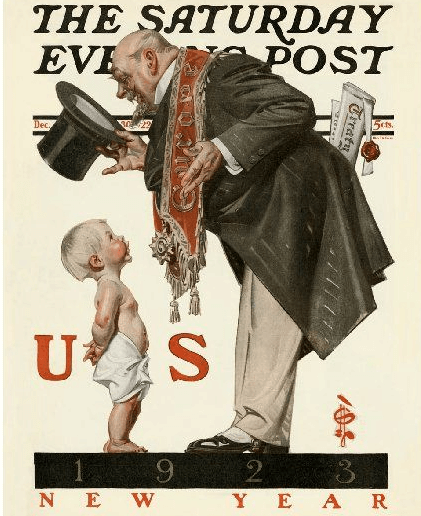
I don’t know if there’s some symbolism behind this year’s J.C. Leyendecker New Year’s baby that I’m missing, or if it’s just a baby knight riding a mechanical horse and using a feather as a lance. Any insights would be welcomed.
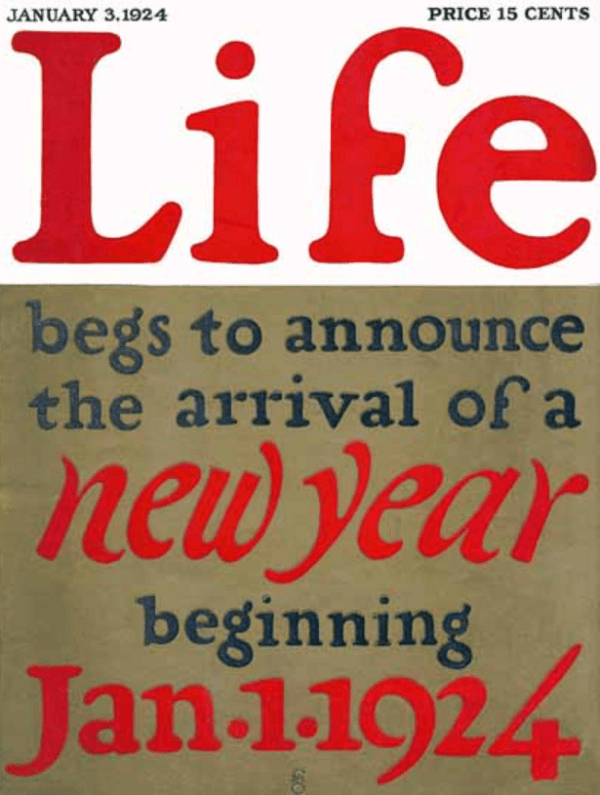
Elsewhere, Life waxes whimsical,
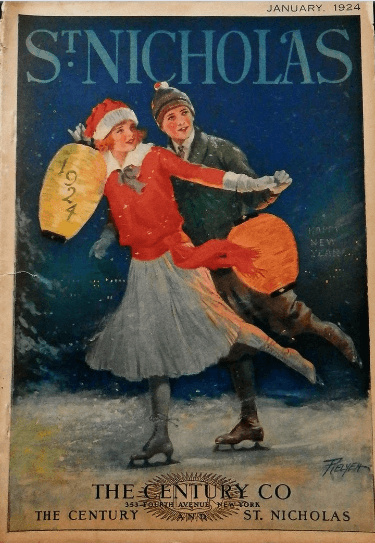
a skating duo rings in the new year at St. Nicholas,*
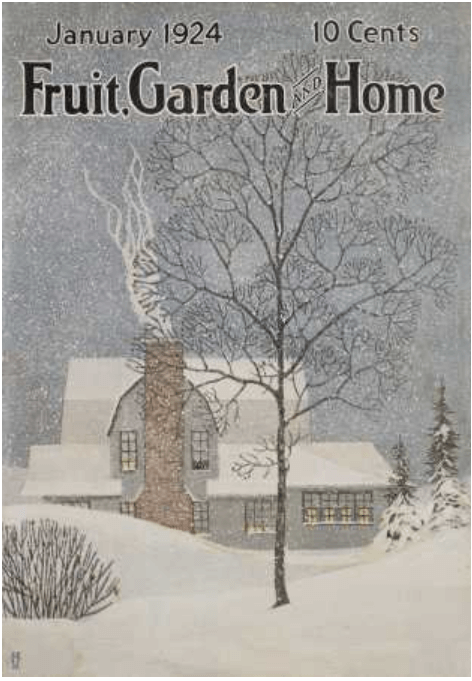
Fruit, Garden and Home (soon to be retitled, much more sensibly, Better Homes and Gardens) has a snowy scene,
and Motor magazine features the most scantily dressed Coles Phillips woman I’ve ever seen.
The Top Posts
As was the case last year, I didn’t have enough posts to fill out a top 10 list, but I did slightly better (8) than last year (7). Something must be going on with the Google algorithm, because 1) despite my lackadaisical posting schedule, my total views have shot up to unprecedented levels in recent months, and 2) almost all of the most popular posts, other than the home page (which makes up the vast majority of views), are from previous years. Pre-2023 posts don’t qualify for the Top 10, but I’ll mention the most popular ones after the countdown.
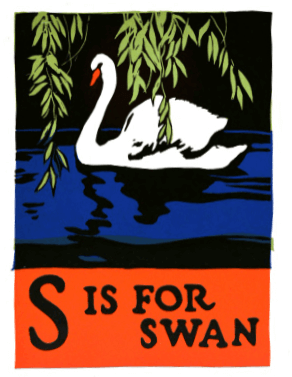
In researching my fifth annual children’s book shopping guide, I found a moral panic among magazine writers about children reading inappropriate books (Dare-Devil Dick! Seven Buckets of Blood!) and a couple of treasures: a beautifully illustrated alphabet book and an excellent poetry anthology.
In May, I announced that my friend Deborah Kalb and I were starting a podcast, Rereading Our Childhood, where, just like it sounds, we reread books we enjoyed as children. Six months in, we’ve published sixteen episodes, had a great time with our rereads, and, as I wrote this week in the top 10 countdown on the podcast blog, learned that producing a podcast is way harder than writing a blog. If you’re interested in following along, you can find us at rereadingourchildhood.buzzsprout.com.
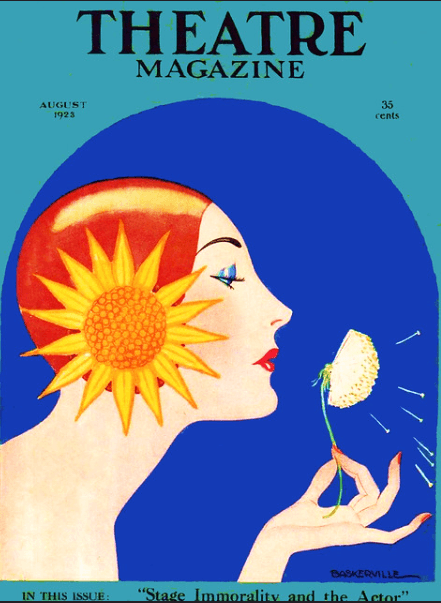
I had a lot of fun doing this countdown of the best magazine covers of winter 1923, and discovering some not-so-artistic but still fascinating ones.***
This post was by far the most popular new one of the year. I wrote about the critical reception to McKay’s poetry and about the confusion over whether “If We Must Die” was entered into the Congressional Record, and if so, by whom. This was the second year in a row, after last year’s post on Langston Hughes, Teenaged Poet, that a post about an African American poet rose to the top.
On January 1, 2018, the day that I started this project and stopped reading anything from less than 100 years ago, I only expected it to last a year.**** (When I looked at my e-mail inbox this morning and found blog posts from Frank Hudson (talking about how Robert Frost is misunderstood) and witness2fashion (sharing some 1898 Delineator illustrations of women riding bicycles in very cumbersome clothing), I was reminded on the seventh New Year’s Day of this project of the wonderful community I’ve found along the way. I look forward to what 1924 will bring.*****
*Speaking of which, I went ice skating in Cape Town a few days ago. If you’re a skater of average ability and want to feel like Michelle Kwan, go to a skating rink in South Africa.
**I skipped 2022, apparently.
***I still love the giant pencil.
****For any new readers who may be concerned about my sanity and my status as a well-informed citizen, the part of the project where I ONLY (with a few exceptions) read from 100 years ago did only last a year.
*****A housekeeping issue: For those of you who follow me on Twitter, I’ve stopped posting there. You can find me on BlueSky at @marygracemcgeehan.bsky.social.
Welcome to the fifth annual children’s books holiday shopping guide! It’s been a hectic holiday season, including a trip from Washington, D.C., to Cape Town less than a week ago (I split my time between the two cities), so this is a pared-down edition.
My research this year started out with a big disappointment: it turns out that the 1922 edition of Publisher’s Weekly’s annual Christmas Bookshelf issue, which had been one of the highlights of my My Life 100 Years Ago year, was the last. Why, Publisher’s Weekly? Why?
In non-book news, the Times also provides some helpful advice on keeping your children healthy over the holidays, including, “Don’t overdress them with their new sweaters or furs, just because it is Christmas.”
For Young Readers
From The A B C Book by Charles B. Falls
A piece of all-around good news: there are more pictures, and in particular more color pictures, in books for young children than there were just a few years ago. There’s even a book with color illustrations on every page, the first I’ve seen: Charles B. Falls’ The A B C Book, a book of woodcuts with an animal for each letter. (If you’re wondering what he did about X, it’s for xifius, which turns out to be Greek for swordfish.) It’s a favorite of Moore’s, and of mine.
From The Six Who Were Left in a Shoe by Padraic Colum
The New York Times recommends Padraic Colum’s The Six Who Were Left in a Shoe, and, although I found the story kind of silly, their praise for the endpapers is justified.
For Middle-Grade Readers and Older Children
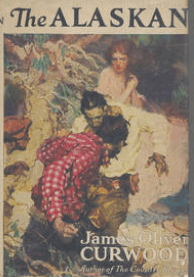
There was a bit of a moral panic going on regarding children’s reading in 1923, including in an article in the October 1 issue of The Library Journal by librarian Wilhelmina Harper. Harper’s bottom line: children are reading too much sensational adult literature, like Daredevil Dick and Seven Buckets of Blood (neither of which, sadly, I was unable to find),* and should be directed to high-quality children’s literature instead. I wondered whether Harper was being excessively prim and proper until I found The Alaskan: A Novel of the North, a 1923 novel by James Oliver Curwood, whose books, Harper tells us with concern, fifth- and sixth-grade boys have been asking for. Flipping through it, I found the following sentence: “He hurried back, seized a loaded gun, and sprang to the window, knowing that he must continue to deal death until he was killed.” Maybe Harper has a point.
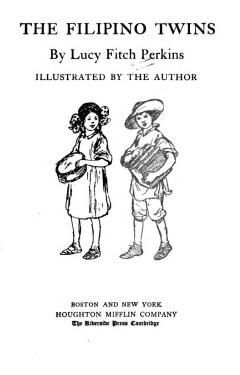
So what does Harper think children should be reading? Books published before 1923, mostly, which doesn’t do me much good. She speaks highly of Lucy Fitch Perkins’ series about twins from around the world, but I had a bad feeling about the 1923 installment, The Filipino Twins,When I skimmed through the first few chapters, though, I found it surprisingly lacking in racism. Unfortunately, the same thing can’t be said for the 1931 installment, which is about a pair of African American twins. So I’ll pass on Perkins.
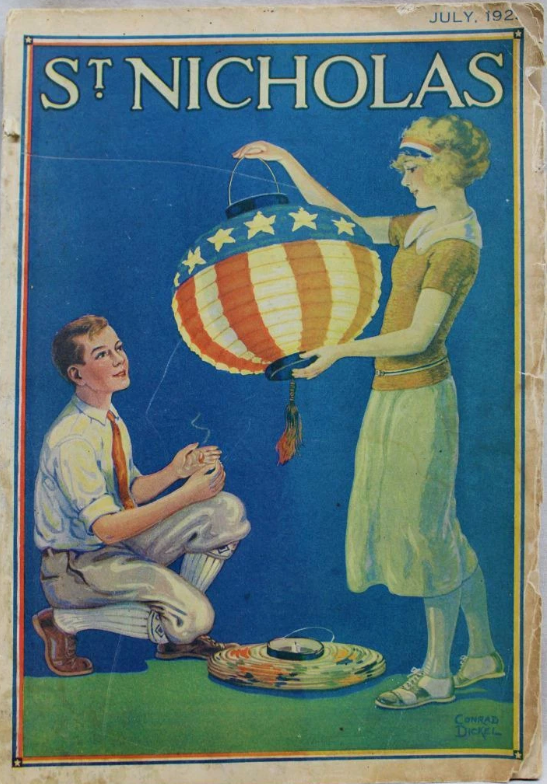
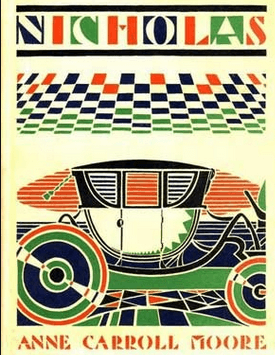
I would have been more impressed by Annie Carroll Moore’s positive write-up about Nicholas, A Manhattan Christmas Storyin the October 1923 Bookman roundup if the book hadn’t been written by…Moore herself.** Then, in the December issue, she waxes lyrical about writing Nicholas. According to my research for my post about Moore, it is not exactly a forgotten classic. Luckily for present-day me, though, it wasn’t actually published until 1924, so I can wait until next year. Cool Art Deco cover, though.
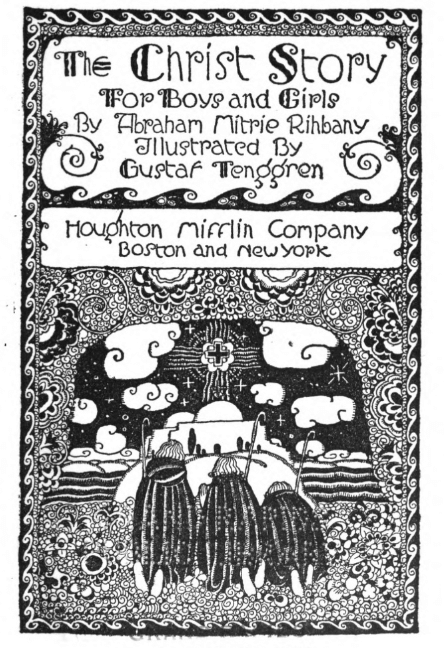
The Christ Story for Boys and Girls, featured in the New York Times roundup (which not very inclusively refers to Jesus as “our Savior”), is described as attempt by Abraham Mitrie Ribhany, a Lebanese Christian who moved to the United States as a young man, to draw on his own childhood experiences with Palestinian traditions to give children an idea of what Jesus’ life was like. I was intrigued by the premise, but I’m leery of a book that refers to Jesus repeatedly as Syrian*** without ever mentioning that he was Jewish.
From A Child’s Story of American Literature
The Times raves about A Child’s Story of American Literatureby Algernon Tassin and Arthur Bartlett Maurer, although the reviewer calls the title “deplorable,” since it’s for older readers who would turn up their noses at the word “child.” Also, they think Tassin and Maurer have assigned insufficient importance to the works of Sidney Lanier. I’m okay with that, but, skipping through the book, I found a number of things to give me pause. For example, this passage:
You are a child of culture. Is it not your affair to make sure that, a hundred years hence, the story of which you are the first chapter will not have the same regrettable thing to record?
My hundred-years-hence ears perked up. It turns out that the regrettable thing is how, just as America has not made enough of an effort to Americanize her aliens, there has been insufficient appreciation of the United States of America’s own literature. I took issue with the first part, since, whatever you think of Americanization as a concept, my own experience of the world of 100 years ago is that people never shut up about. I do agree about the low self-esteem regarding American literature, though. Be that as it may, I’m not adding this book to my gift list.
A number of poetry anthologies for young people are on offer. I summarily disqualified The Boy’s Book of Verse, edited by Mary Gould Davis, which is the follow-up to her 1922 volume titled, you guessed it, The Girl’s Book of Verse. Moore and the Times both recommend This Singing World: Modern Poems for Young People, edited by Louis Untermeyer. “Hardly any boy or girl in the teens, or even for a few years earlier, but will find much in the volume to enjoy,” the Times raves.****
I wouldn’t bet money on that, but it is a nice selection, featuring poets including William Butler Yeats, Carl Sandburg, H.D., and, um, Louis Untermeyer and his wife, Jean Starr Untermeyer. This one’s going on my list. And the great thing about getting a poetry book as a present is that you don’t have to pretend to have read the whole thing.
**The only reason that Moore even kind of gets away with this is that she only mentions the illustrator in the text of the article, with her name listed as the author in the list of books at the end.
***The Christ Story for Boys and Girls is based on Ribhany’s influential 1916 adult book The Syrian Christ.
****It took me a while to get my head around that syntax.
Happy Thanksgiving, everyone! Or, to be more precise, happy day after Thanksgiving. As I was cooking yesterday, I was mildly stressing out about whether I would have time to post this on the actual day. Then it occurred to me that it was highly unlikely that anyone would stop in the middle of cooking, eating, watching football, or whatever and say to their loved ones, “I have to check to see if there are any late-breaking blog posts.”
J.C. Leyendecker is best known for his New Year’s babies, but his Thanksgiving covers were also a regular feature at the Saturday Evening Post. This one is titled “Trading for a Turkey.” Thanksgiving is a more fraught holiday than New Year’s, though, and, even though the story about the Dutch buying the island of Manhattan from the Indians for $24 worth of beads turns out not to be true, this reminder of it still made me uncomfortable.
J.C. Leyendecker, December 1, 1923
Speaking of the New Year’s babies, this J.F. Kernan Country Gentleman cover recalls Leyendecker’s 1922 cover, also featuring a bird’s tail being salted.
J.F. Kernan, November 14, 1923J.C. Leyendecker, December 31, 1921
For those of you who haven’t been following along, salting a bird’s tail is supposed to render it temporarily incapable of flying. So the New Year’s baby is trying to make sure the dove of peace doesn’t fly away. The Country Gentleman boy is presumably, more prosaically, trying to get the bird to stay still so he can eat it for Thanksgiving dinner. Or maybe he’s just pre-salting it.
With Leyendecker doing the honors at the Saturday Evening Post, Norman Rockwell was over at Life depicting a svelte Pilgrim in the stocks for gluttony.
Rival humor magazine Life took a more risqué approach to the holiday with an Enoch Bolles cover titled “Turkey with Very Little Dressing.”*
Enoch Bolles, November 24, 1923
That was all I could find as far as actual Thanksgiving covers go, but this Fruit, Garden and Home cover has a nice autumn feel.**
And last but not least, happy 50th anniversary to St. Nicholas magazine! “Is there any doubt that in the thoughts of thousands and thousands, old and young, who have read and to-day are reading its pages, ST. NICHOLAS will be numbered among the blessings for which they are grateful on Thanksgiving day?” the magazine asks, not stopping to wait for an answer.***
As for me, I’ll take a moment to give thanks for the wonderful magazines of 1923–yes, including you, St. Nicholas!
*When I was working on the post on summer 1923 magazine covers, I went down a research rabbit hole about Enoch Bolles (whose Judge cover I didn’t end up using) and learned that we were once neighbors of sorts—he was a long-term patient at a psychiatric hospital a few miles away from where my family lived in New Jersey in the 1960s.
**Again for those of you who haven’t been following along, this excellent title was changed to Better Homes and Gardens in 1924.
***Speaking of rabbit holes, I tried to figure out the vintage of the magazine (presumably from her own childhood) that the woman is reading, and therefore whether she is Mom or Grandma, but I couldn’t find any covers that resembled this one.