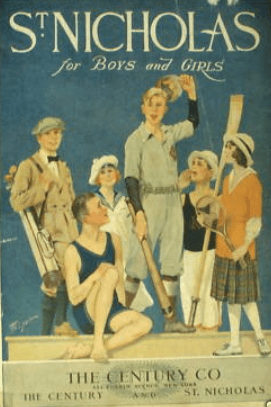
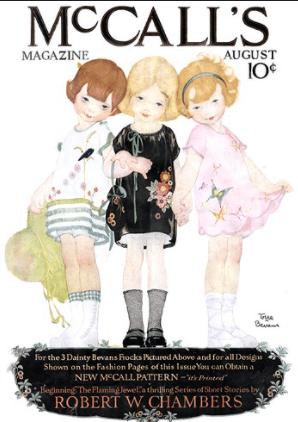
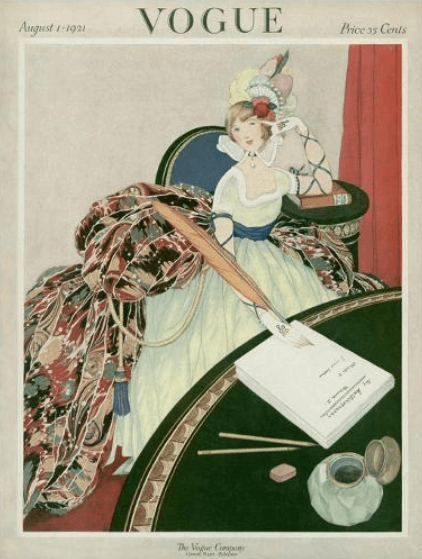
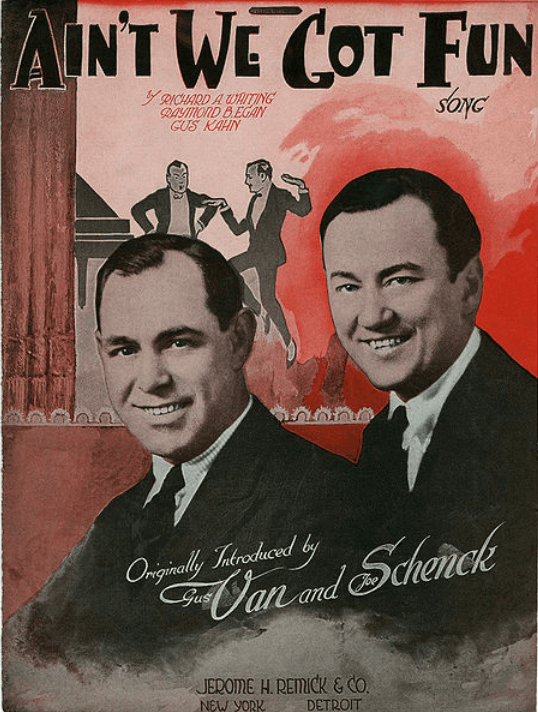
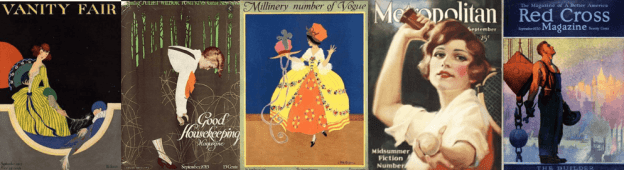
Tag Archives: Vanity Fair

One last summer swim in 1925

August in Washington, D.C., wound down in a very un-D.C. fashion, with moderate temperatures and low humidity, a far cry from the weather in late July when I went to the DC Open finals.* The women’s final, played in the afternoon after a long rain delay, felt like a battle to see which player could draw more of the humid air into her lungs. (Conditions were better for the men, who played at sunset after another long rain delay.)

DC Open winner Leylah Fernandez and finalist Anna Kalinskaya

I started my Labor Day weekend early by joining two friends for a swim at the Hearst Pool near the National Cathedral. This was my first visit to this pool, which opened in 2021, and only my second swim of the summer. As I swam leisurely laps and lazed on a lounge chair chatting with my friends, I regretted that I hadn’t spent more time at the pool.

I decided to cut myself some slack, though, given that my summer started out as a Cape Town winter and along the way featured COVID in Dublin, a week visiting family in Colorado, and Hurricane Erin, which didn’t come as far north as DC but brought cloudy skies and cool weather. I’d celebrate the last days of summer, I decided, by taking a look at swimmers on the magazine covers of 1925.

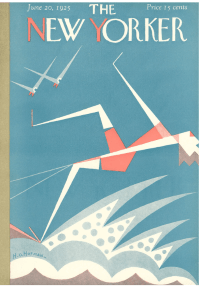
The New Yorker, in its first summer, went all-in on celebrating the joys of the surf.

H.O. Hofman, June 20, 1925
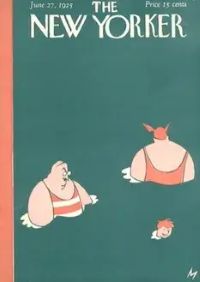
New Yorker cover, June 27, 1925, Julian de Miskey, family swimming
Julian de Minskey, June 27, 1925
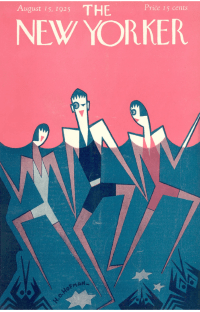
New Yorker cover, August 15, 1925, three people swimming.
H.O. Hofman, August 15, 1925

Judge was on board too.

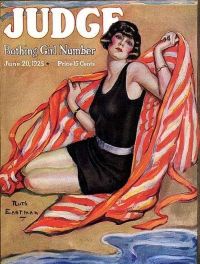
Judge magazine cover, June 20, 1925, woman in bathing suit holding striped towel.
Ruth Eastman
Judge magazine cover, August 1, 1925, woman on buoy with man
Guy Hoff, August 1, 1925

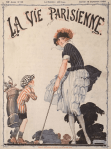
Vanity Fair was not to be outdone by Judge in the red wrap department.

Vanity Fair, July 1925, Miguel Covarrubias, woman in red cape at beach.
Miguel Covarrubias, July 1925

Kids joined in the fun at the Saturday Evening Post.

Saturday Evening Post cover, boy jumping into water, Elberg McGran Jackson, July 24, 1925.
Elberg McGran Jackson, July 24, 1925
Saturday Evening Post cover, Charles McLellan, August 1, 1925, woman with boat with boy in background.
Charles McLellan, August 1, 1925

It struck me that, while the men and boys are still covered up on top, the women’s suits aren’t all that different from what you’d see at the beach or the pool these days. When I was growing up, all girls’ and women’s suits had higher-cut legs (if you wanted to be modest, you had to get one with a little skirt, which was kind of pointless because it would float up when you got into the water), but now you see all different kinds of suits, including ones like these.

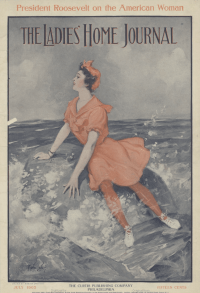
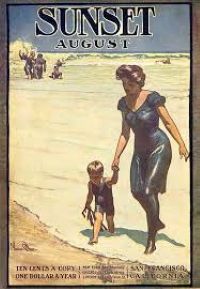
Women had to fight for the type of suits that you see on the 1925 covers. Twenty years before, bathing suits looked like this:

Martin Justice, July 1905
Lafayette Maynard Dixon, August 1905

Stockings were on their way out by the mid-1910s,

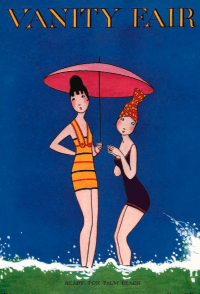
Vanity Fair cover, November 1915, Anne Harriet Fish, two women at beach holding parasol, "Ready for Palm Beach Issue."
Anne Harriet Fish, November 1915
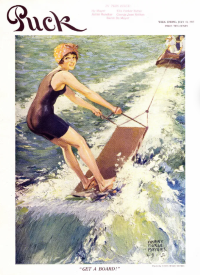
Puck cover, Harry Morse Meyers, July 18, 1915, woman in bathing suit on board being towed by boat.
Harry Morse Meyers, July 18, 2015

but bare-legged swimming was still barred in some places. The outcry following the arrest of Olympic gold medalist Ethelda Bleibtrey for swimming “nude” (i.e. without stockings) at Manhattan Beach in Los Angeles in 1919 helped put an end to the leg-baring bans.

Ethelda Bleibtrey at Olympic games, Antwerp, 1920.
Ethelda Bleibtrey at Olympic Games, Antwerp, 1920.

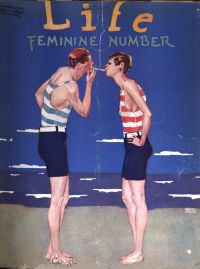
By 1925, Life was poking fun at the similarity between men’s and women’s suits. (They would diverge again when men started bathing topless in the 1930s.)

Garrett Price, August 27, 1925

With Labor Day behind us and pools closed, swimming is a wistful memory.

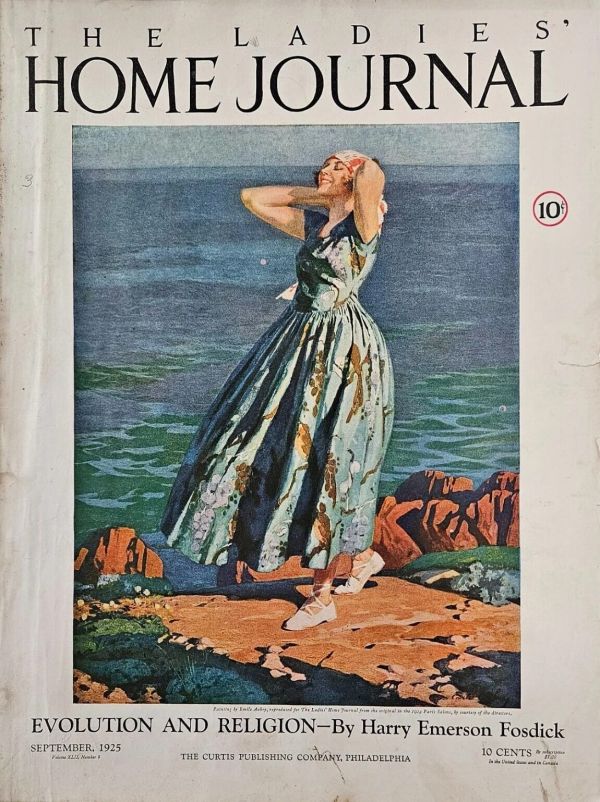
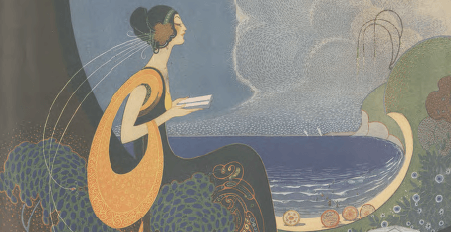
Emile Aubry, September 1925

As this woman reminds us, though, you don’t have to go in the water to enjoy the warm weather while it lasts.

*The tournament is officially called the [Corporate Sponsor 1] [Corporate Sponsor 2] DC Open, but I don’t have either the mental energy to remember all that or the desire to advertise these companies every time I mention it.

**I really, really want her dress.

A Double Rainbow of 1924 Magazine Covers

I recently went on on a trip from Cape Town to Washington, D.C., Seattle, North Cascades National Park, Seattle again, Denver, D.C. again, and then back home to Cape Town, all in three weeks. It was wonderful, but it was too much: too many airports, too many suitcases, too many weird bathroom setups. (Well, two, but that was two too many.) I kept saying to myself, “I’ll be so happy to just be able to hang out at home,” forgetting to take Cape Town winters into consideration and add, “provided that it doesn’t rain nonstop so that staying at home is the only option.”

I went out walking every day when the rain let up, hoping to make it home before the skies opened again. On one of these walks I looked up and saw a double rainbow, which lifted my spirits tremendously. Cape Town is unfortunately not a place where it’s wise to to take out your phone and start snapping away while walking along a busy road, so I don’t have a photo of it. But I assume you’re familiar with the concept.

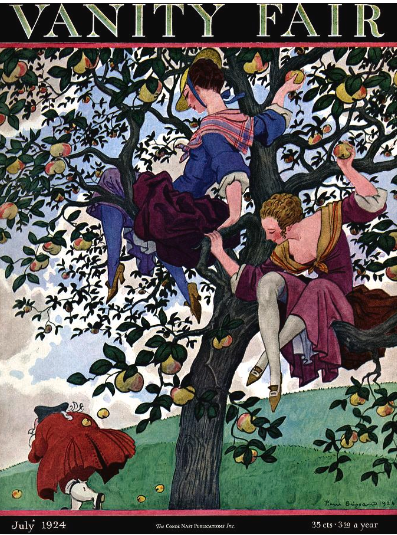
I haven’t done a magazine illustration post in a while,* so I decided to pay tribute to that moment, and to summer from a Cape Town winter, with a rainbow of summer 1924 magazine covers.

First up in vivid red is Spanish illustrator Eduardo Garcia Benito’s June Vanity Fair cover.**

Eduardo Garcia Benito, June 1924

Imposing a constraint, like “it has to be orange,” makes you expand your horizons. I wasn’t familiar with The Designer, although it must have had a large circulation if it was serializing Sinclair Lewis’s Arrowsmith.*** I wasn’t familiar with the cover artist, American illustrator Charles Allan Winter, either.

Charles Allan Winter, June 1924

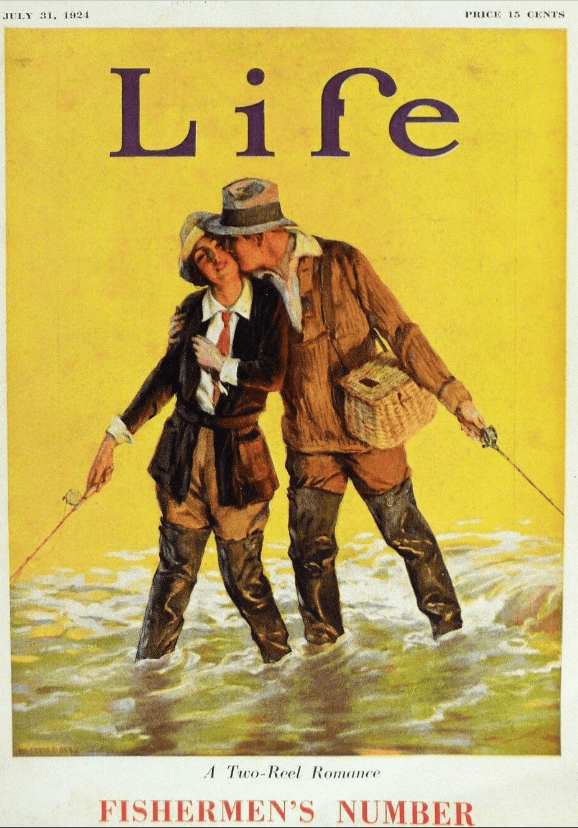
It’s nice to see Life cover artist Warren Davis drawing something other than his usual half-naked women frolicking around.

Warren Davis, July 31, 1924

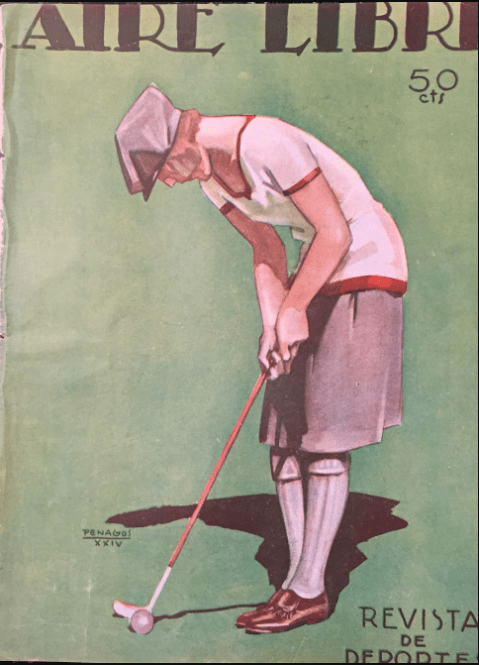
You can’t expand your horizons much further than to a short-lived Spanish sports magazine for which the only online reference I could find is a Catalan-language Wikipedia page that has been flagged for possible deletion. The illustrator, Spanish artist Rafael de Penagos, is new to me. He received a gold medal at the 1925 International Exhibition of Modern Decorative and Industrial Arts in Paris, from which Art Deco got its name (surprisingly, not until the 1960s).

Rafael de Panagos, July 1, 1924

In vibrant blue, a House & Garden cover by French artist André Édouard Marty. Marty, not to be confused with leading French Communist Party member André Marty, was another leading figure in the Art Deco movement.

André Édouard Marty, June 1924

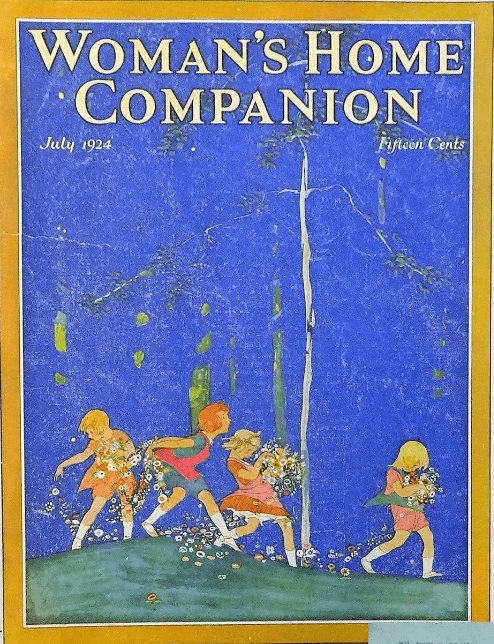
I’m not of the school of thought that indigo is a color of the rainbow, since squeezing it in between blue and purple throws off the symmetry, but I couldn’t resist these flower-strewing children, drawn by an artist I couldn’t identify.**** This issue of Woman’s Home Companion includes an essay on parenthood by F. Scott Fitzgerald, the last installment of Dorothy Canfield Fisher’s The Home-Maker, an ahead-of-its-time novel about a stay-at-home dad,***** and an illustrated story by N.C. Wyeth. Not bad for fifteen cents.

July 1924

Here’s the purplest cover I could find, from Vogue regular Pierre Brissaud.******

Pierre Brissaud, July 1924

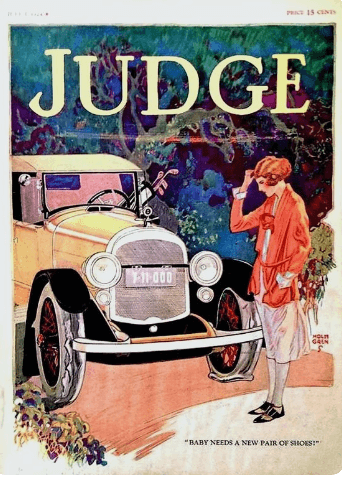
To wrap things up, here’s a cover by John Holmgren, yet another new-to-me artist, who managed to fit every color of the rainbow onto this Judge cover.

John Holmgren, July 5, 1924

But wait! This is just a SINGLE rainbow.

July slipped into August as I was working on this post, which gave me another month’s worth of magazine covers to work with. Now August is slipping away as well, and I’m back in Washington. At this rate, the leaves will be falling off the trees by the time I post this if I write about each one, so here they all are:

House and Garden: Joseph B. Platt. Vanity Fair: Warren Davis (back to his old tricks). Vogue (green): George Wolfe Plank. Vogue (purple): Harriet Meserole. Other artists unknown.

Enjoy the end of summer (or, if you’re in Cape Town, FINALLY the end of winter), everyone!

squiggle

*Or any other post, for that matter.

**There’s a truly bonkers essay by D.H. Lawrence in this issue called “On Being a Man.” It starts out with a racist account of sitting on a train with an African American man and segues into a discussion of why marriage is literally hell.

***Lewis won, and rejected, the 1926 Pulitzer for Arrowsmith. In a written statement, he objected to the criteria for which the prize was awarded: “for the American novel published during the year which shall best present the wholesome atmosphere of American life, and the highest standard of American manners and manhood.” I’m with Lewis on this, although some said that he was just miffed that he hadn’t won the award for Main Street, published in 1921.

****ChatGPT claimed that the cover artist was Charles Dana Gibson, which I didn’t buy. I asked for a source for this information, and it said, oh, sorry, it’s actually Frances Tipton Hunter. This sounded more plausible but I still wasn’t convinced, so I asked again for the source, at which point ChatGPT threw up its hands and admitted that it was just making stuff up.

*****I spoke about this book at a roundtable on 1920s best-sellers at a conference on Modernism in the UK in 2022.

******As I was finishing up this post I came across this beautiful, and arguably purpler, Vogue cover by George Wolfe Plank.

George Wolfe Plank, June 15, 2024
squiggle

New on Rereading Our Childhood, the podcast I cohost (or not so new but newer than my last blog post):

Our Favorite Children’s Books from 50 Years Ago

Rereading Danny Dunn and the Anti-Gravity Paint by Jay Williams and Raymond Abrishkin

Rereading The Egypt Game by Zilpha Keatley Snyder

Rereading The Phantom Tollbooth by Norton Juster

Rereading Stuart Little by E.B. White

Rereading February’s Road by John Verney

Reading Anne of Green Gables by L.M. Montgomery

Rereading The Book of Three by Lloyd Alexander

Rereading Misty of Chingoteague by Marguerite Henry

Rereading The Mysterious Disappearance of Leon (I Mean Noel) by Ellen Raskin

Rereading Ramona the Pest by Beverly Cleary

Rereading Black Hearts in Battersea by Joan Aiken

The Top 10 Magazine Covers of Winter 1923

It’s been a while since I’ve done a magazine cover post, and last time I was kind of snarky, so I decided to set out in search of the top 10 magazine covers of January and February 1923.

Except that it was really hot outside (I’m in Cape Town), and I wasn’t feeling all that energetic, so I thought maybe ChatGPT could find them for me.

In other words, do your own blog post, I’m too busy writing term papers!

Feeling slightly chastened, I set out on my search.

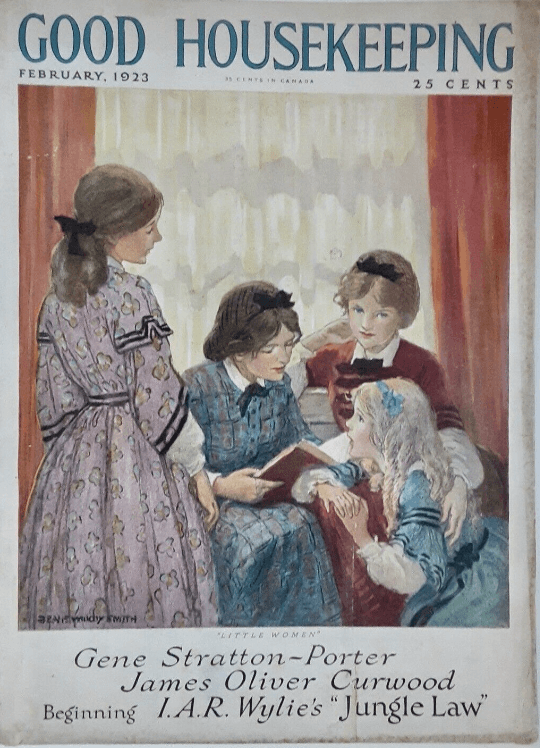
I started out with a round of disqualifications, beginning with covers that reused illustrations that had originally appeared elsewhere. This led me down a rabbit hole of trying to figure out whether the Jessie Willcox Smith illustration from Little Women that appears on the cover of the February 1923 issue of Good Housekeeping is from the edition of the book that she illustrated. I tentatively decided that it isn’t.

Jessie WIllcox Smith

I had an even harder time figuring out the provenance of Smith’s January 1923 cover featuring Hans Brinker. Irritated, I summarily disqualified Smith. I was looking for edgier covers in any case.

Jessie Willcox Smith

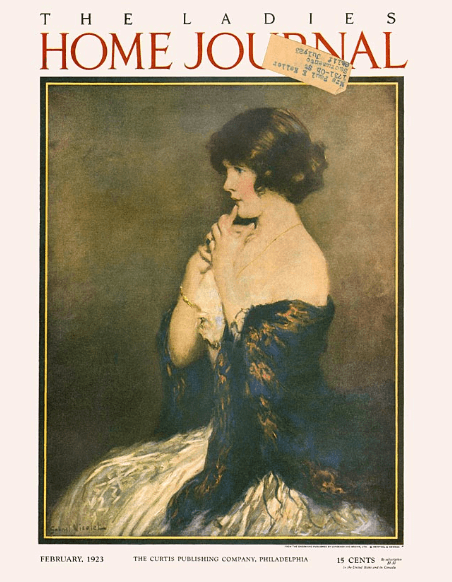
Next to go was the February Ladies’ Home Journal cover, which turned out to be a painting by French artist Gabriel Émile Edouard Nicolet, who died in 1921.

Gabriel Émile Edouard Nicolet

Then I eliminated covers that gave me the creeps, regardless of their artistic merit.

Frank Walts
A. M. Hopfmuller.

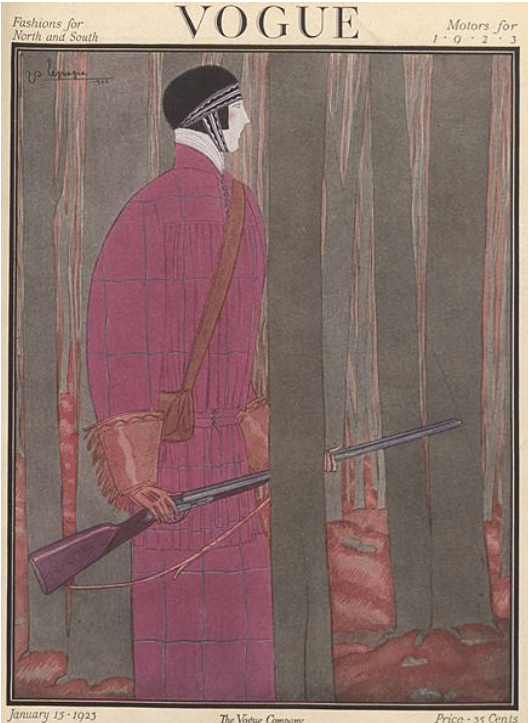
Ditto, covers with guns,

Georges Lepape

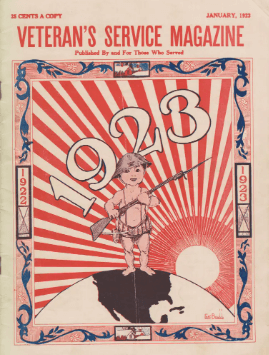
especially covers with babies with guns.

Next up are the covers that captured my interest for reasons other than the quality of the art, like this one from Fruit, Garden and Home, which, fascinatingly, turns out to be the original name of Better Homes and Gardens, from its founding in 1922 until August 1924, when sanity prevailed and the magazine was renamed.

And this one from Popular Mechanics, illustrating an article called “Down Popocatepetl on a Straw Mat.” As someone who rode up Popocatepetl (a volcano outside Mexico City) in a car and struggled to walk up a tiny bit of it, I have a great deal of admiration for anyone who accomplished this.*

And this intriguing cover illustrating the article “Stopped by a Pencil” in Personal Efficiency magazine. What the heck is going on here? A metaphor for bureaucracy? An actual giant pencil on the rampage? Sadly, Personal Efficiency is not available online, so I’ll never know.

And now for the Top 10! Ranking them was a challenge, not for the usual “it was so hard to decide, everyone deserved to win” reason but because of the lack of standouts. Most of the covers struck me as deserving to be ranked #5. Here’s what I came up with, after a lot of hemming and hawing.

10. Popular Science, January 1923, artist unknown

I toyed with the idea of relegating this cover to the same category as the giant pencil, but it’s just too cool. I mean, it’s a monster new airship that will carry passengers across the continent! Called the San Francisco Express! Okay, it might be a dubious bit of futurology at a time when transatlantic airplane flights had already taken place,** but still…cool!

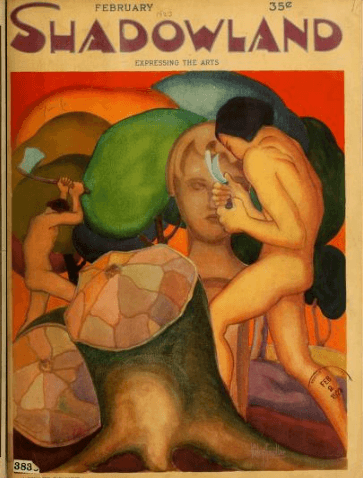
9. Shadowland, February 1923, A. M. Hopfmuller.

A. M. Hopfmuller

I can never figure out what exactly is going on in A.M. Hopfmuller’s Shadowland covers, but I’ll miss them when the magazine ceases publication in November 1923.

8. Vanity Fair, February 1923, Anne Harriet Fish

Anne Harriet Fish

I’m a fan of Fish’s Vanity Fair covers, and this one might have ranked more highly if I could figure what exactly was going on. A woman is looking through store receipts??? and is crying??? or holding another receipt up to her face??? while her husband smokes nonchalantly??? Or something??? Plus, what’s the deal with that chair?

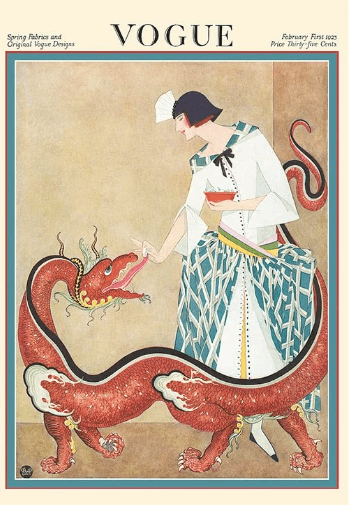
7. Vogue, George Wolfe Plank, February 1, 1923

George Wolfe Plank

This cover, of a woman feeding a sugar cube to a dragon, is done with Plank’s usual artistry, but it just didn’t particularly grab me the way some of his other covers did.***

6. Saturday Evening Post, Coles Phillips, February 17, 1923

Coles Phillips

My love for Coles Phillips knows no bounds, and I’m always happy to see him pop up, but the Saturday Evening Post’s limited color palate doesn’t play to his strengths.

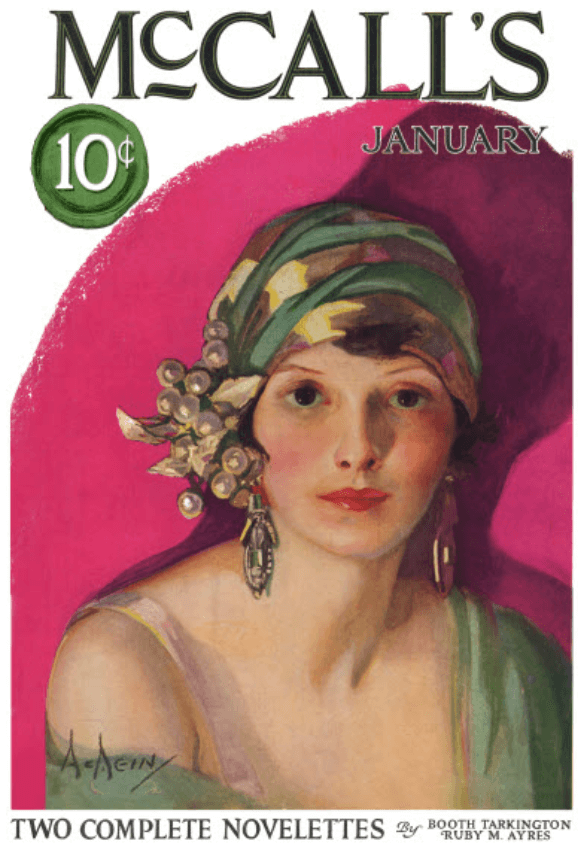
5. McCall’s, January 1923, Neysa McMein

Neysa McMeen

I’m normally more of a fan of Neysa McMein as a fascinating 1920s figure (salon hostess, suffragist, Dorothy Parker’s best friend, etc.) than as an artist, but there’s something that haunts me about this woman. “Who are you?” I keep asking myself. “And what’s wrong?”

4. The Crisis, February 1923, Louis Portlock

Louis Portlock

I’m not familiar with Louis Portlock and I couldn’t find out anything about him except for one other cover for The Crisis, from 1922. I like the simplicity of this illustration.

3. Harper’s Bazar, January 1923, Erté.

Erté

Erté’s never not brilliant, but, as with Plank, I wouldn’t say he was at his best here.****

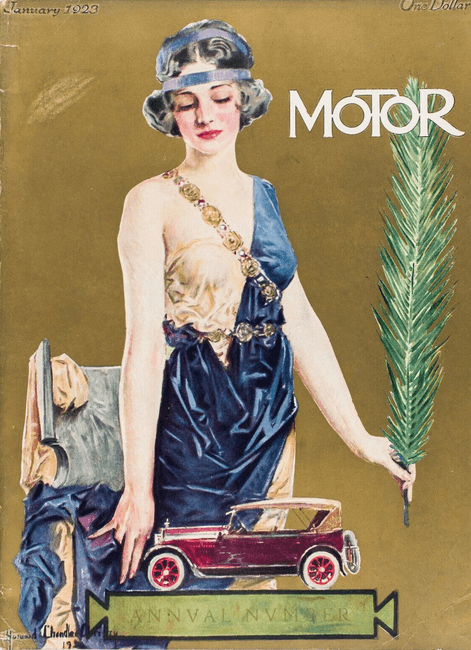
2. Motor, January 1923, Howard Chandler Christy

Howard Chandler Christy

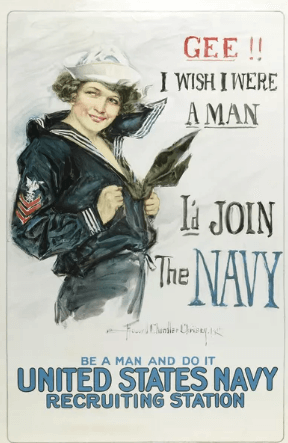
I was struck by this Motor cover, although I can’t figure out what’s going on in the lower left corner, where the woman’s dress seems to turn into a wall, or something. I didn’t think I was familiar with Christy, but it turns out that he was the artist behind some of the most famous World War I recruiting posters, like this one:

Howard Chandler Christy

1. The Liberator, January 1923, Frank Walts

Frank Walts

I almost disqualified this Liberator cover because I featured it with other New Year’s covers in last month’s top posts of 1922 post, but that just seemed unfair, especially given the lack of top-quality covers.***** It wasn’t a shoo-in for #1, but I like the simple artistry.

Even though I wasn’t wowed by this batch of covers, I had fun seeing what some of my favorite artists were up to, discovering a few new ones, and pondering the mystery of the giant pencil. In retrospect, I’m glad ChatGPT wasn’t up to the task.

squiggle

*Although I have more admiration for the Mexican guy steering with the stick than for the the guy holding on for dear life in the back, who I assume is the writer of the article.

**If, like me until recently, you thought Charles Lindbergh was the first person to fly across the Atlantic, he was just the first person to do it SOLO. British aviators John Alcock and Arthur Brown made the first transatlantic flight in 1919.

***Like this one

George Wolfe Plank, Vogue, June 15, 1921

and this one,

George Wolfe Plank, August 1, 1918

for example.

****As opposed to here

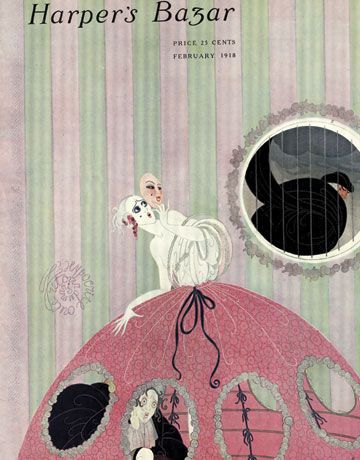
Erté Harper's Bazar cover, February 1918, masked woman looking out window at man.
Erté, February 1918

and here.

Erté, May 1918

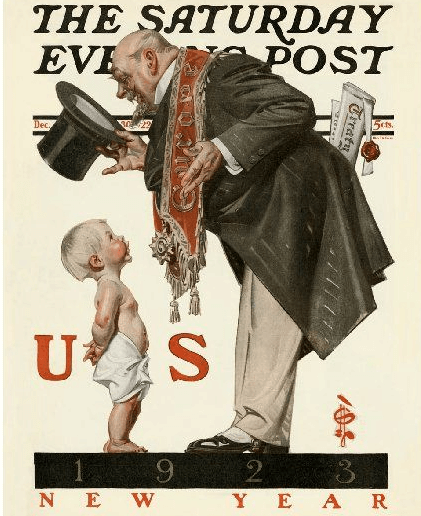
*****J.C. Leyendecker’s Saturday Evening Post cover was disqualified, though, because it came out on December 30. Besides, it was confusing.

J.C. Leyendecker, December 30, 1922

In search of an extraordinary spring 1922 magazine cover

I haven’t done a post on magazine covers since last August. I tried early this year, but the covers I found were uninspiring. Has the Golden Age of Illustration come to an end, I wondered.*

I decided to give it another shot, and I spent a long time looking at covers from March and April 1922. They weren’t bad. Most of them were quite good, in fact. But nothing seemed new or fresh or different.

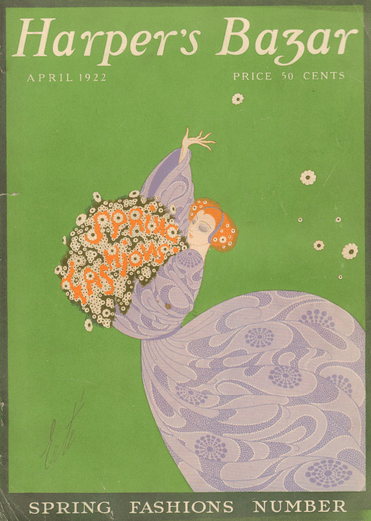
I expect Erté’s Harper’s Bazar covers to be attractive and haunting, but the March one is haunting without being attractive and the April one is attractive without being haunting.**

Erte Harper's Bazar March 1922 cover, couple kissing in silhouette.
Erté, March 1922
Erte Harpers' Bazar April 1922 cover, woman strewing flowers.
Erté, April 1922

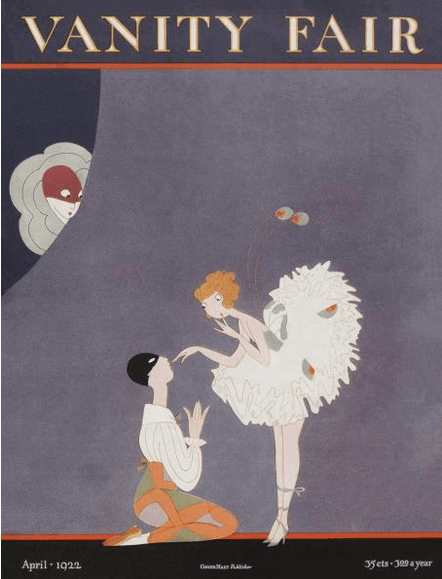
This A. H. Fish Vanity Fair cover was solid but not memorable.

A.H. Fish April 1922 Vanity Fair cover, ballerina with pierrot.
A.H. Fish, April 1922

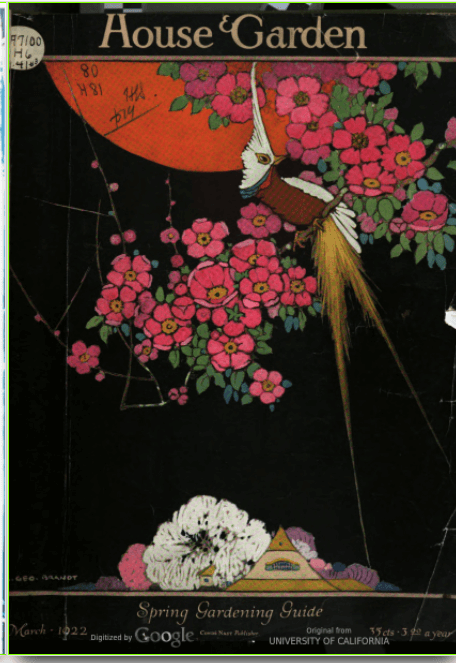
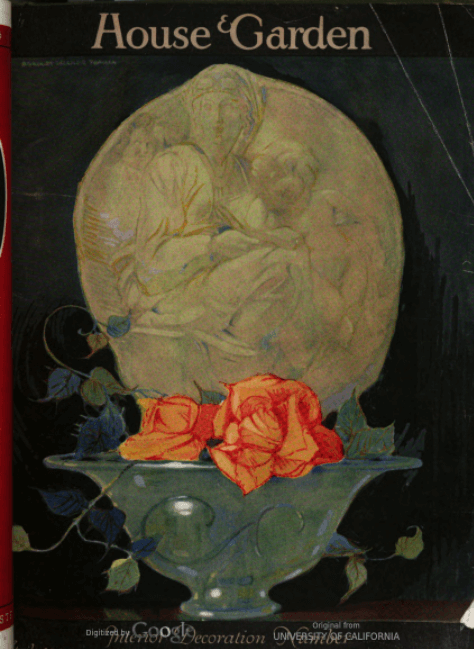
Are these either houses or gardens? I think not, House & Garden!

George Brandt House & Garden March 1922 cover, floral display.
H. George Brandt, March 1922
B.W. Tomlin House & Garden April 1922 cover, flowers in front of bas relief.
Bradley Walker Tomlin, April 1922

Okay, maybe I was just in a bad mood. I’ll stop carping now and just tell you what I found.

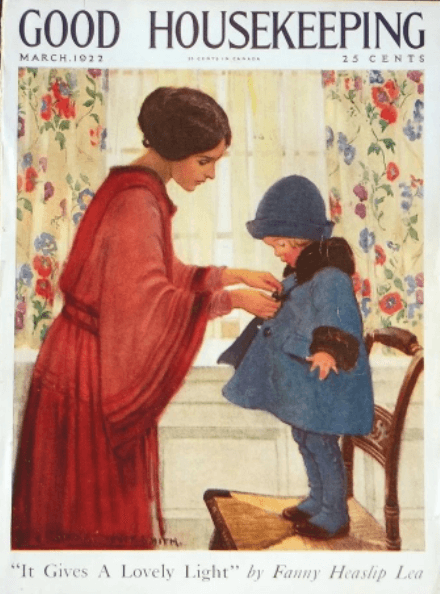
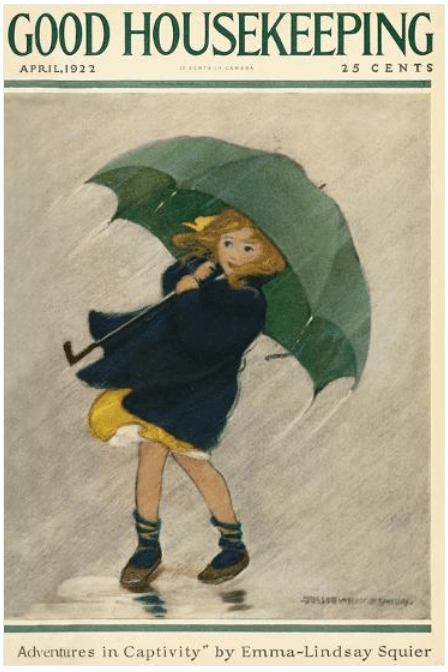
Regular Good Housekeeping cover illustrator Jessie Willcox Smith was her usual competent, family-friendly self.

Jessie Willcox Smith March 1922 Good Housekeeping cover, mother putting coat on child.
Jessie Willcox Smith, March 1922
Jessie Willcox Smith Good Housekeeping April 1922 cover, girl with green umbrella in rain.
Jessie Willcox Smith, April 1922

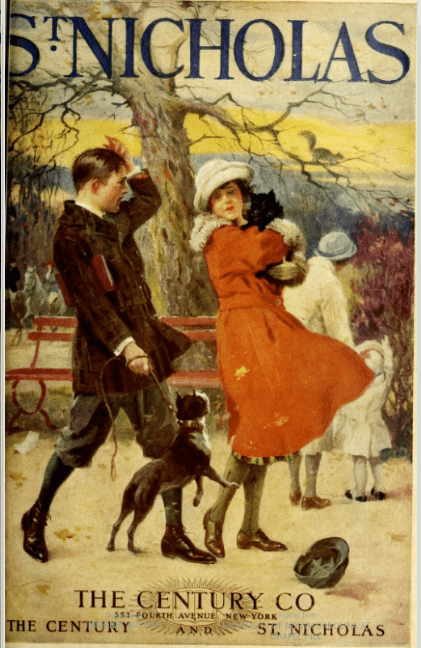
The kids were up to their usual wholesome fun at St. Nicholas.

St. Nicholas March 1922 cover, boy and girl with dogs.
March 1922
St. Nicholas April 1922 cover, boy and girl feeding birds.
April 1922

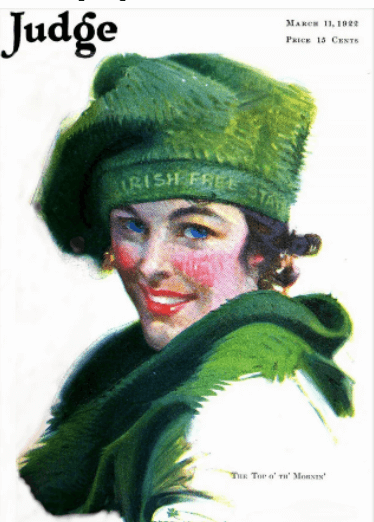
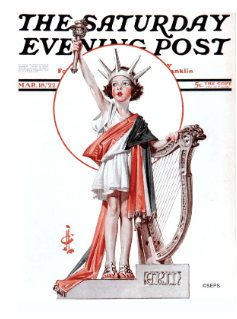
With Ireland newly independent, St. Patrick’s Day celebrations were especially festive.

Judge March 11, 1922 cover, woman in green beret with Irish Free State slogan.
March 11, 1922
J.C. Leyendecker March 15, 1922 Saturday Evening Post cover, girl dressed as Statue of Liberty with harp, Ireland independence.
J.C. Leyendecker, March 18, 1922

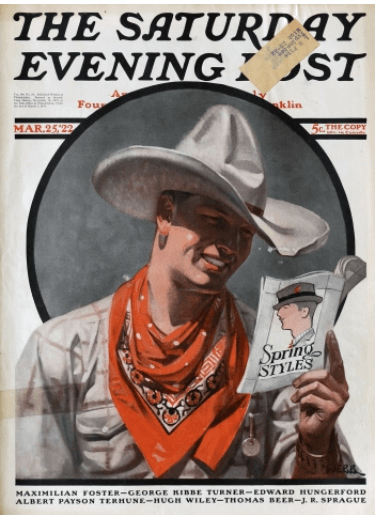
There was a newcomer, Tom Webb, at the Saturday Evening Post,

Tom Webb March 25, 1922 Saturday Evening Post cover, cowboy looking at Spring Styles ad.
Tom Webb, March 25, 1922

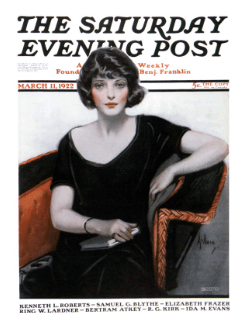
along with old Post hand Neysa McMein,

Neysa McMein March 11, 1922 Saturday Evening Post cover, woman in black dress sitting in chair.
Neysa McMein, March 11, 1922

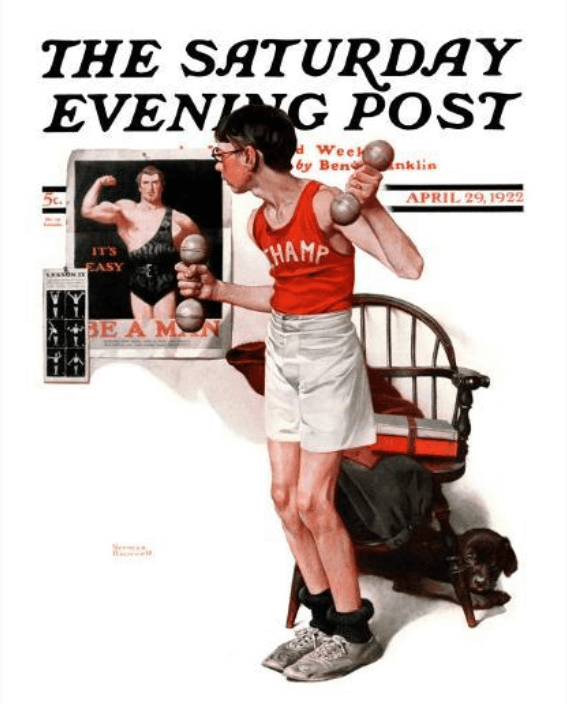
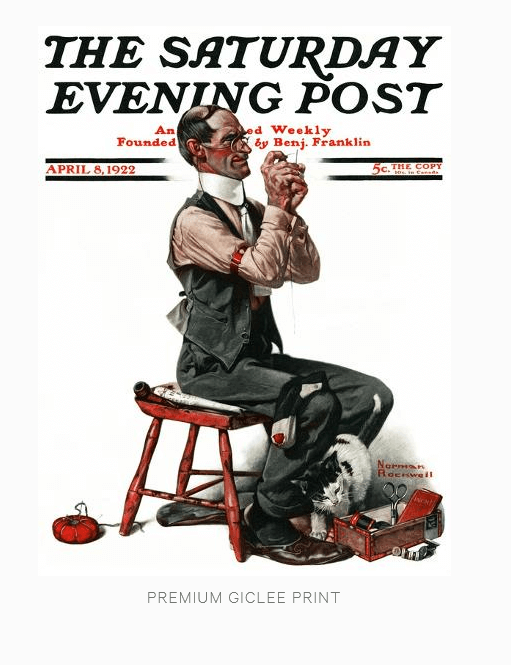
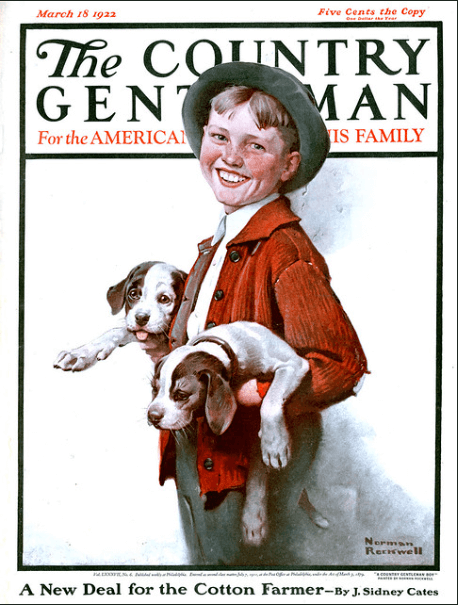
as well as Norman Rockwell, already a SEP veteran at 28.

Norman Rockwell April 29, 1922 Saturday Evening Post cover, skinny boy lifting weights with poster of muscleman.
Norman Rockwell, April 29, 1922
Norman Rockwell April 8, 1922 Saturday Evening Post cover, man threading needle.
Norman Rockwell, April 8, 1922

The insanely prolific Rockwell was all over the place in March and April, at The Literary Digest

Norman Rockwell Literary Digest cover, March 25, 1922, man with girl reading book.
Norman Rockwell, March 25, 1922

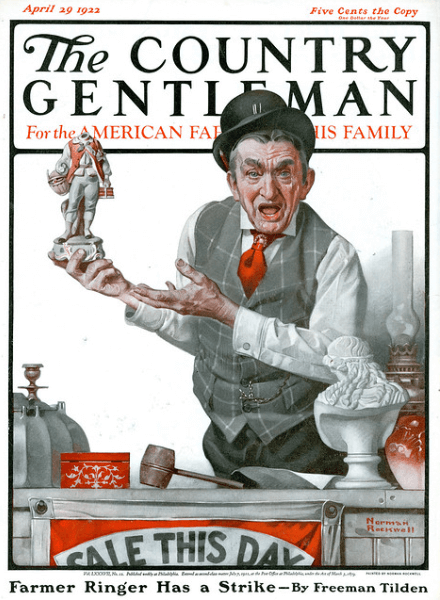
and The Country Gentleman

Norman Rockwell Country Gentleman cover, April 29, 1922, auctioneer holding headless figure.
Norman Rockwell, April 29, 1922
Norman Rockwell Country Gentleman cover, March 18, 1922, smiling boy holding two dogs.
Norman Rockwell, March 18, 1922

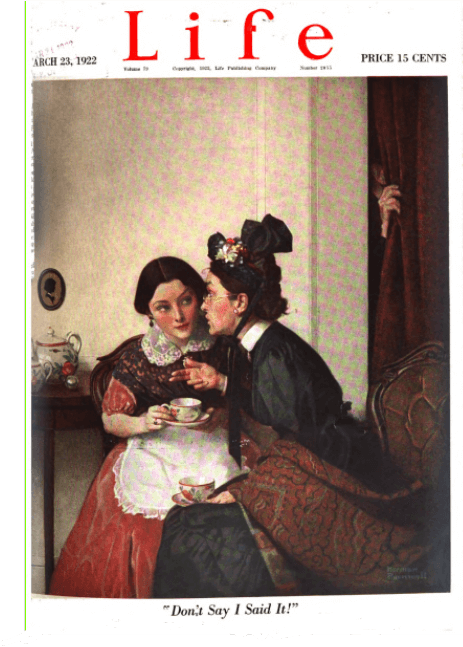
and Life.

Norman Rockwell, March 23, 1922

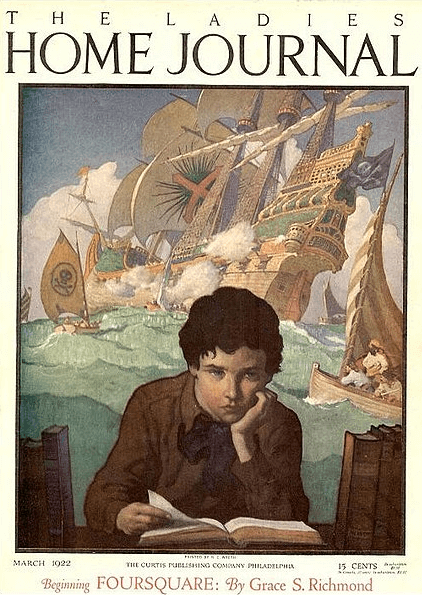
For the Ladies’ Home Journal, N.C. Wyeth (father of Andrew) painted a boy dreaming of stolen loot.

N.C. Wyeth Ladies' Home Journal March 1922 cover, boy reading book with picture of daydream of pirates.
N.C. Wyeth, March 1922

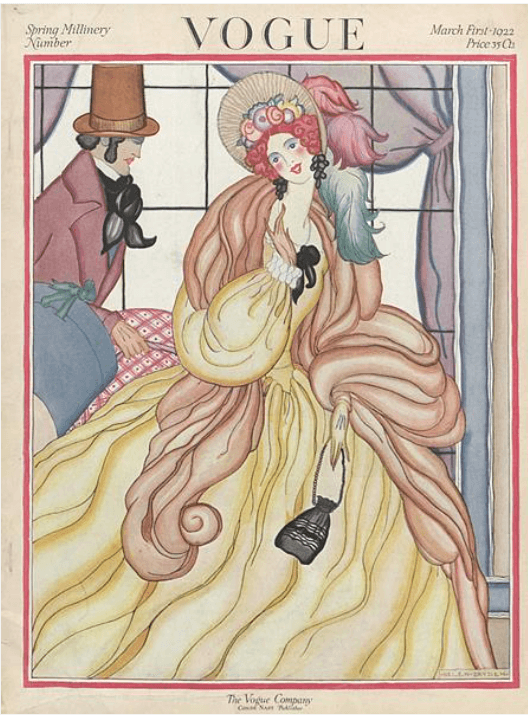
Over at Vogue, a Helen Dryden cover featured an old-timey couple,

Helen Dryden Vogue cover, March 1, 1922, woman in long dress and flowery hat with whiskered man in top hat.
Helen Dryden, March 1, 1922

and there were two new-to-me Vogue cover artists, Pierre Brissaud and Henry R. Sutter.***

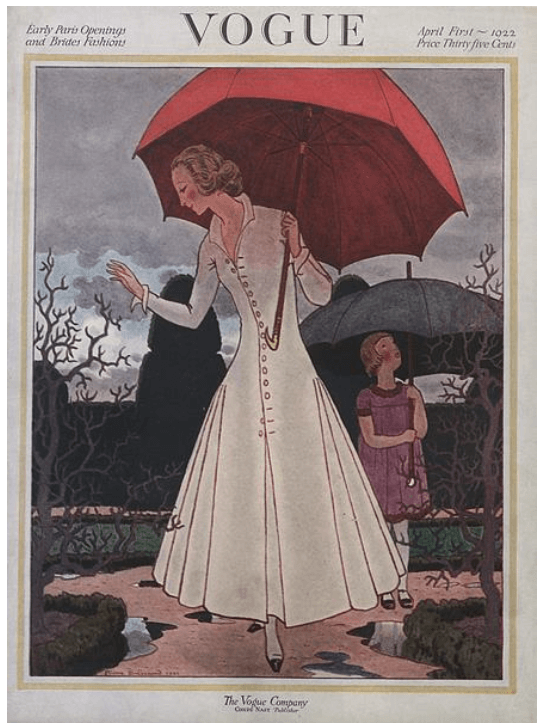
Pierre Brissaud Vogue cover, April 1, 1922, woman and girl under umbrellas.
Pierre Brissaud, April 1, 1922
Henry R. Sutter Vogue cover, April 15, 1922, woman in cape looking down at valley.
Henry R. Sutter, April 15, 1922

So, this is all very nice, and if I hadn’t been looking at hundred-year-old magazine covers for over four years I might be impressed. It’s just that there wasn’t anything that hadn’t been done before.

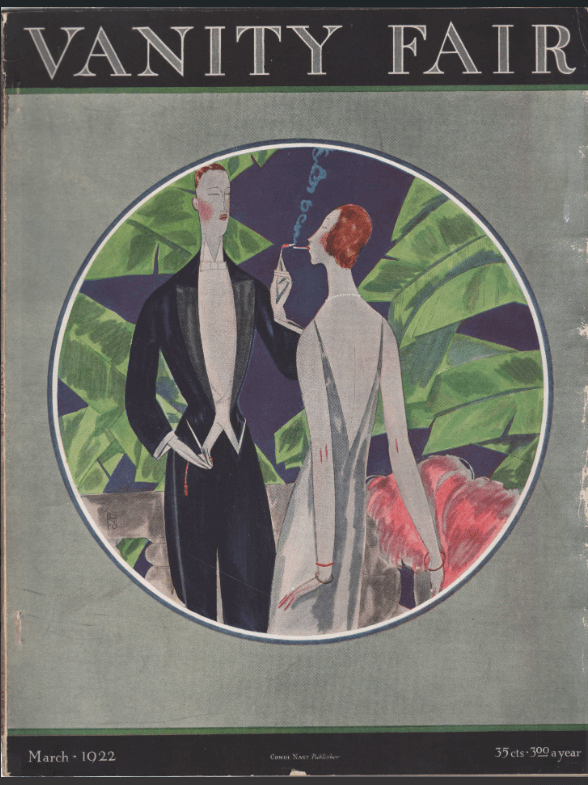
And then I came across this Vanity Fair cover from March 1922, by newcomer Eduardo Garcia Benito, who had arrived in New York from Spain the year before.**** I hadn’t seen anything yet like the sleek, clear lines and bold colors of this cover, which would come to typify Art Deco illustration.*****

Eduardo Gracia Benito Vanity Fair cover, March 1922, man lighting cigarette for woman in front of foliage, Art Deco style.
Eduardo Garcia Benito, March 1922

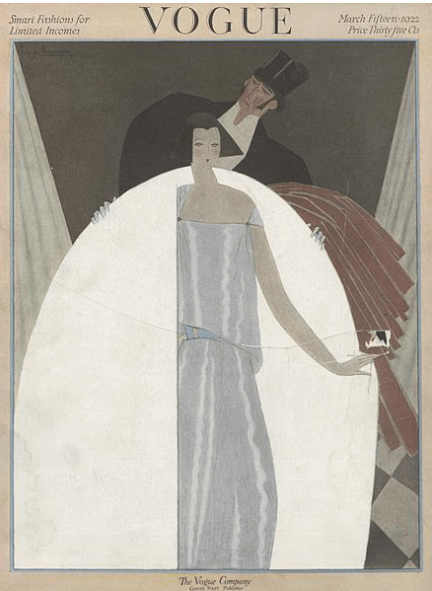
And then I took a second look at the other March Vogue cover, by Georges Lepape, which, maybe because of the muted colors, I hadn’t paid particular attention to.

Georges Lepape Vogue cover, March 15, 1922, man putting fur coat on woman, Art Deco style.
Georges Lepape, March 15, 1922

Same minimalist design. Same clear lines. Same boyish silhouette on the woman.

Two years into the decade, the twenties have begun!

squiggle

*I had already expressed concern about this in my 1915/1920 Magazine Cover Smackdown post.

**Here is an examples of an attractive and haunting Erté cover:

Erté Harper's Bazar cover, February 1918, masked woman looking out window at man.
Erté, February 1918

***UPDATE 5/1/2022: I looked into this some more and these both seem to be Vogue debuts. Brissaud went on to be a regular Vogue cover artist. Sutter only did six covers that I could find (i.e. that appear on art.com, which I think has all of them), all in 1922 and 1923. I haven’t been able to find much information about him other than that he lived in Provincetown, Massachusetts.

****This wasn’t Benito’s Condé Nast debut, though. This November 15, 1921, Vogue cover was his first (as far as I can tell) of many for the magazine.

Eduardo Garcia Benito, November 15, 1921

*****I could do without the “Women can smoke too!” message, though.

Summer 1921 Magazine Covers, Viewed Longingly from Wintery Cape Town

Objectively speaking, winter in Cape Town is not all that bad. The temperature rarely dips below the high 40s, and a cold day is one when it doesn’t make it into the 60s. Subjectively speaking, though, winter in Cape Town is miserable. It rains a lot, and houses don’t have central heating, so we sit around freezing and grumbling.*

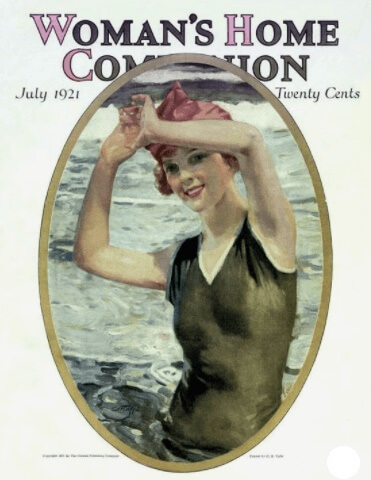
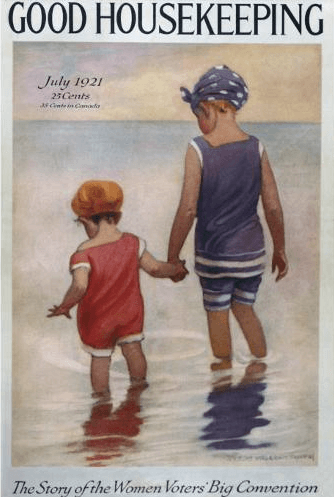
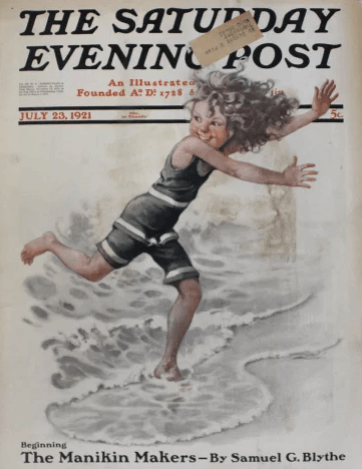
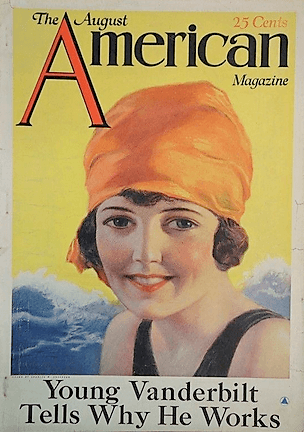
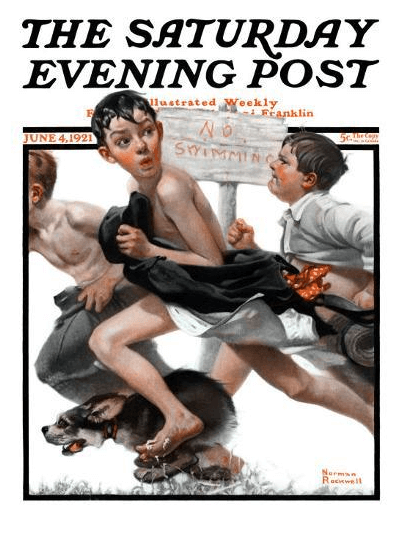
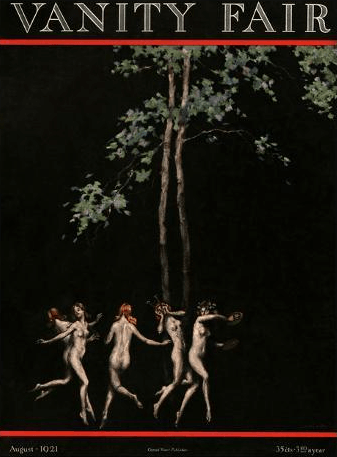
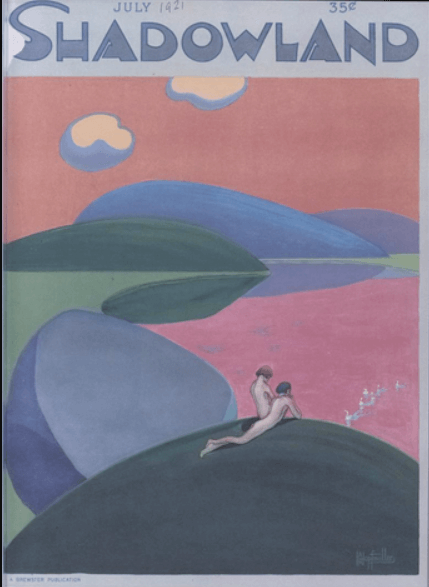
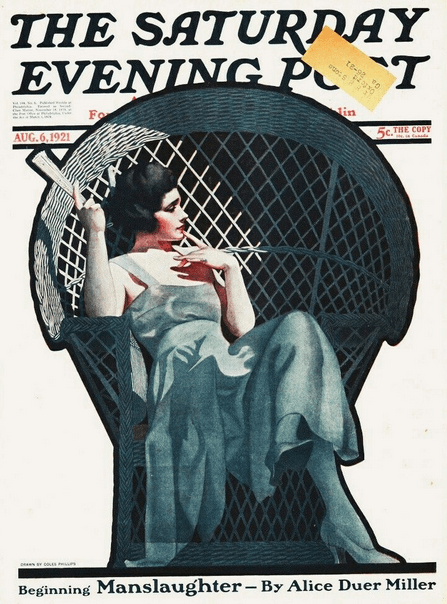
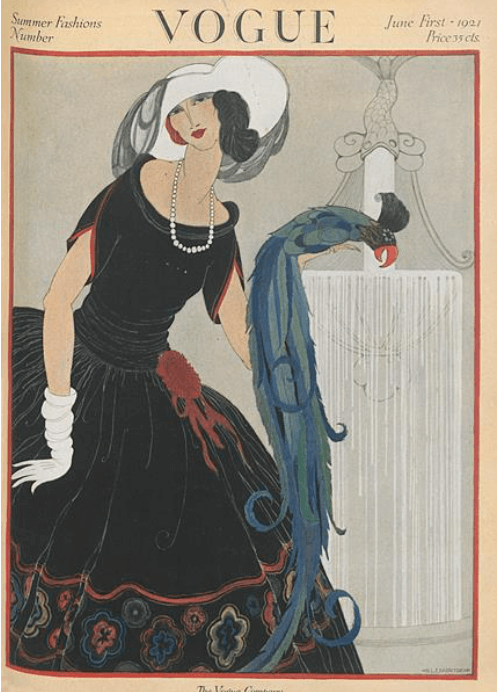
What I needed to improve my mood, I decided, was some summer fun from the covers of 1921 magazines. I could pretend I was somewhere hot, hanging around at the beach**

Jessie Willcox Smith
Sarah Stillwell-Weber
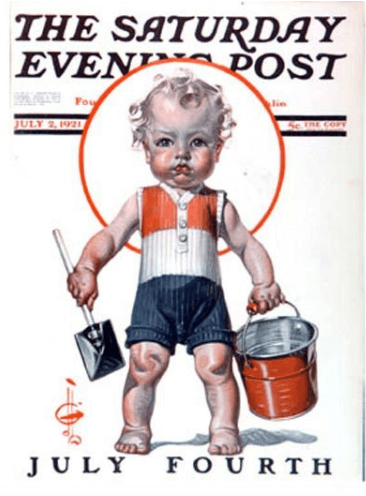
J.C. Leyendecker Saturday Evening Post cover, July 2, 1921, toddler with bucket.
J.C. Leyendecker

or the pool

Anne Harriet Fish

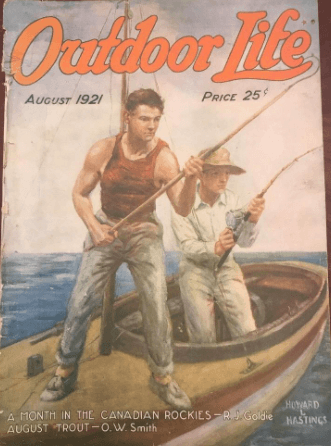
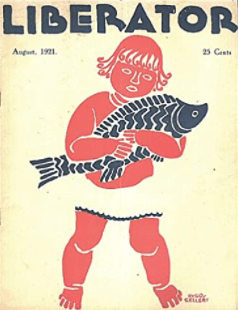
or fishing

Helen Dryden
Howard L. Hastings
Hugo Gellert

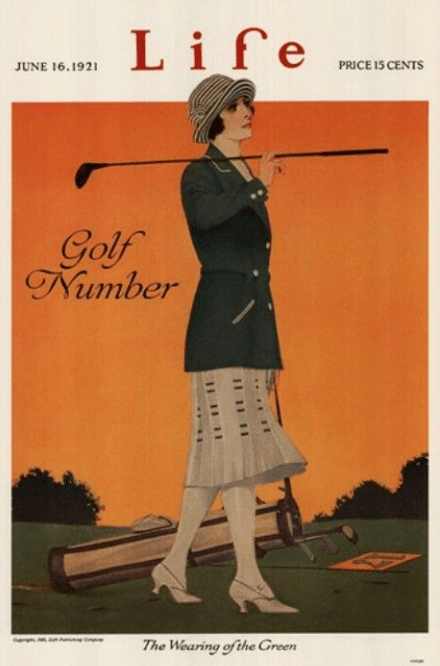
or playing golf

or camping

Howard L. Hastings

or basking in the moonlight

Erté

Erté

or canoodling

A.M. Hopfmuller

or cavorting about in the altogether,

Norman Rockwell
Warren Davis
A.M. Hopfmuller

or just hanging around,

Coles Phillips
Helen Dryden

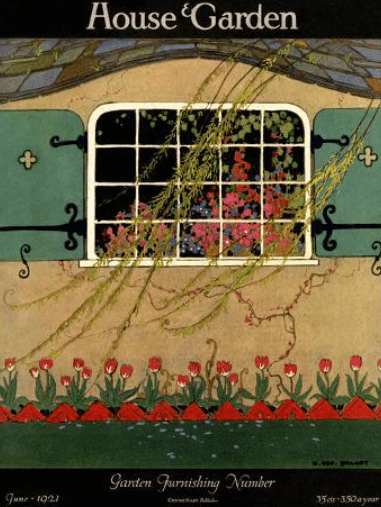
maybe at the summer house.

Margaret Harper August 1921 House & Garden cover, country house aerial view.
Margaret Harper
Henry George Brandt June 1021 House & Garden cover, window of cottage with flowers.
Henry George Brandt

(Okay, these are not all ACTUAL wishes. I’m not much of a fisherman, for example.)

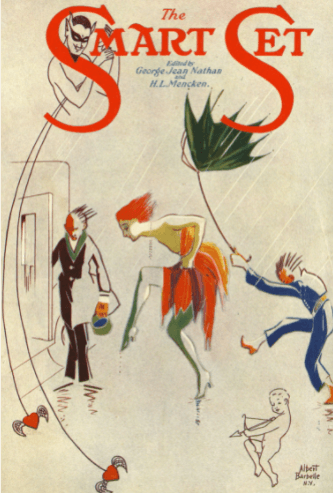
Lo and behold, I did actually make it to the northern hemisphere in time for the last few weeks of the summer. It turns out, though, that my image of Washington in August was a teeny bit romanticized. Life has been more like this

George Wolfe Plank

and this

Albert Barbelle

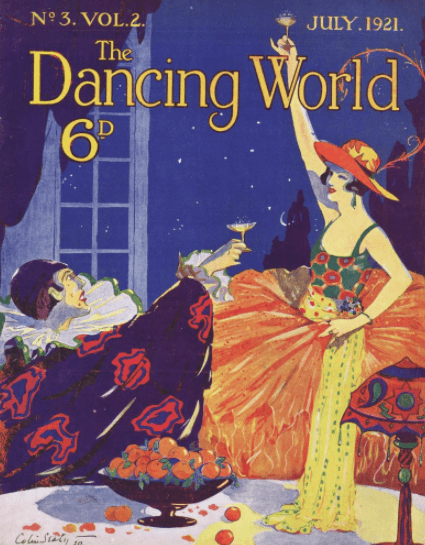
than this.

Colin Sealy

But I’ve had a great time hanging out with my friends,

and even though I haven’t spent much (okay, any) time working on my manuscript

George Wolfe Plank

I swear that’s going to happen before the fall sets in.

But fall is weeks away, so let’s not think about it right now. After all, in the words of the #1 hit song of late summer 1921, “In the meantime, in between time…”

squiggle

*Of course, I always keep in mind how fortunate I am compared to most people in Cape Town.

**If we were rerunning the Best Magazine Cover of a Woman Swimming with a Red Scarf on Her Head competition, we’d have some good contenders here.

squiggle

New On The Book List:

The Mysterious Affair at Styles, by Agatha Christie

Rita Senger Vanity Fair covers

The Brief, Brilliant Career of Rita Senger

Remember Rita Senger, who illustrated the winning cover in the 1915/1920 Magazine Cover Smackdown? “Next time I write about illustrators I love, I’m going to write about Senger,” I promised.

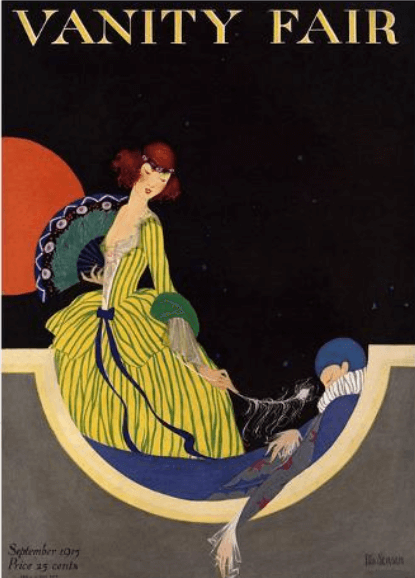
Vanity Fair cover, September 1915, Rita Senger, woman with sleeping Pierrot.

September 1915

And I tried! As I prepared for my Thanksgiving post on 1920 women illustrators I’m thankful for, I scoured the internet for illustrations by, and information about, Senger.

And came up with…almost nothing. Just a handful of magazine covers, most of which I’d already seen, the last one this August 1919 Vanity Fair cover.

Vanity Fair cover, August 1919, Rita Senger, harlequin and woman on bridge.

August 1919

What happened? None of the usual suspects, like findagrave.com and Wikipedia, yielded anything. Then I came across a blog post by a quilter named Lori Kennedy saying that fellow quilter Patty Stein was Rita Senger’s granddaughter. The post included one of Senger’s Vogue covers and some photographs of her and her family.

Armed with the last name Stein, I found a listing for a Mrs. Rita Senger Stein of Highland Park, Illinois, among the life members of the Art Institute of Chicago in its 1925 annual report. That was it.

Cover, Bulletin of the Art Institute of Chicago, 1925.

If I wanted to find out more about Rita Senger, I realized, I was going to have to do something almost without precedent for this blog: contact an actual living person.*

So, one evening back in November,** I sent a message to Lori Kennedy asking if she could put me in touch with Patty Stein. By the time I woke up the next morning, there was an e-mail from Patty.

Patty turned out to be a delightful person, and we talked on the phone for almost an hour. She was making a cake as we talked, which I found extremely impressive, since I consider myself a decent baker but I can’t even focus if there’s music on in the background.

chocolate cake

Patty’s cake (Patty Stein)

This is Rita’s story, mostly as I heard it from Patty but incorporating some of my own research as well. Patty emphasized that she was only sharing the impressions of a granddaughter, which may not be entirely accurate. (The chronology of Senger’s magazine covers—and any possible inaccuracy in this respect—is mine.)

Rita Senger was born in New York City in 1893, the daughter of Adolph and Barbara (Ehrlich) Senger. (The name was sometimes spelled “Sanger.”) She was an art prodigy as a child, and she went to art school at the age of sixteen or seventeen.

Young Rita Senger at easel, ca. 1910s.

Rita Stein, ca. 1910s (courtesy of Patty Stein)

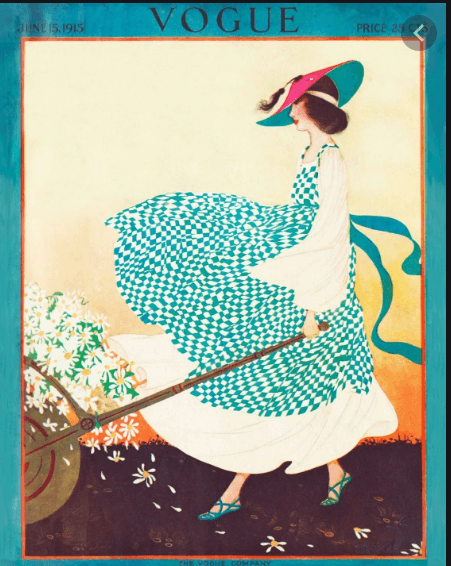
Rita’s father moved to Arizona after becoming ill with asthma, leaving Rita to care for her mother, three sisters, and two brothers (both of whom went on to become architects). Success as an illustrator came early. Her first Vogue cover appeared in June 1915,

Rita Senger cover, Vogue, June 15, 1916, woman walking dog.

June 15, 1915

and her first Vanity Fair cover—the one that won my magazine cover contest—followed three months later.

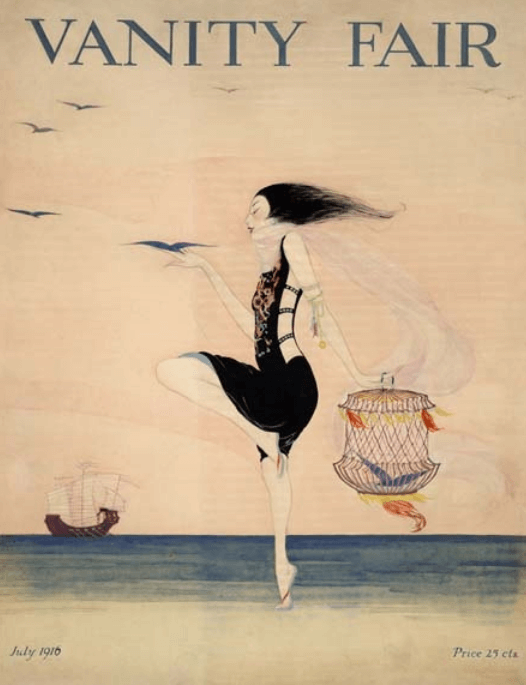
Senger illustrated one cover for each magazine in 1916,

Rita Senger cover, Vogue, June 15, 191, woman in hoop skirt.

June 15, 1916

Rita Senger Vanity Fair cover, July 1916, woman dancing on beach.

July 1916

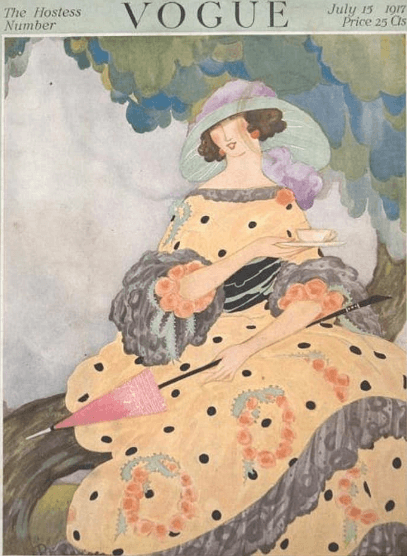
two Vogue covers in 1917,***

Rita Senger Vogue cover, July 15, 1917, woman drinking tea under tree.

July 15, 1917

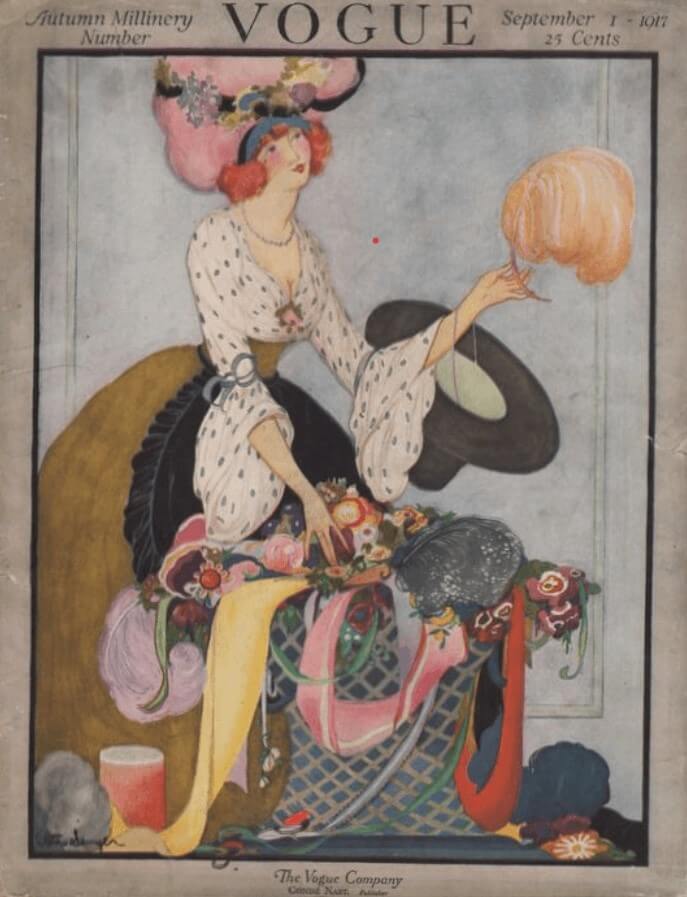
Rita Senger cover, Vogue, September 1, 1917, woman holding large feather.

September 1, 1917

one Vanity Fair cover in 1918,

Rita Senger Vanity Fair cover, April 1918, Pierrot holding unconscious woman.

April 1918

and the August 1919 Vanity Fair cover, the last in her career.

Patty is not sure how Rita met her husband, Joseph Stein. It was an unusual match for the time; he was Jewish and Rita, who came from a non-religious family, was not. Stein’s grandfather was one of the first Reform rabbis in Chicago, but he himself was not a practicing Jew. He was a wealthy businessman, the owner of Lucien Lelong, Inc., the U.S. affiliate of the Paris-based Société des Parfums Lucien Lelong. (The two companies were sold to Coty in 1953.)

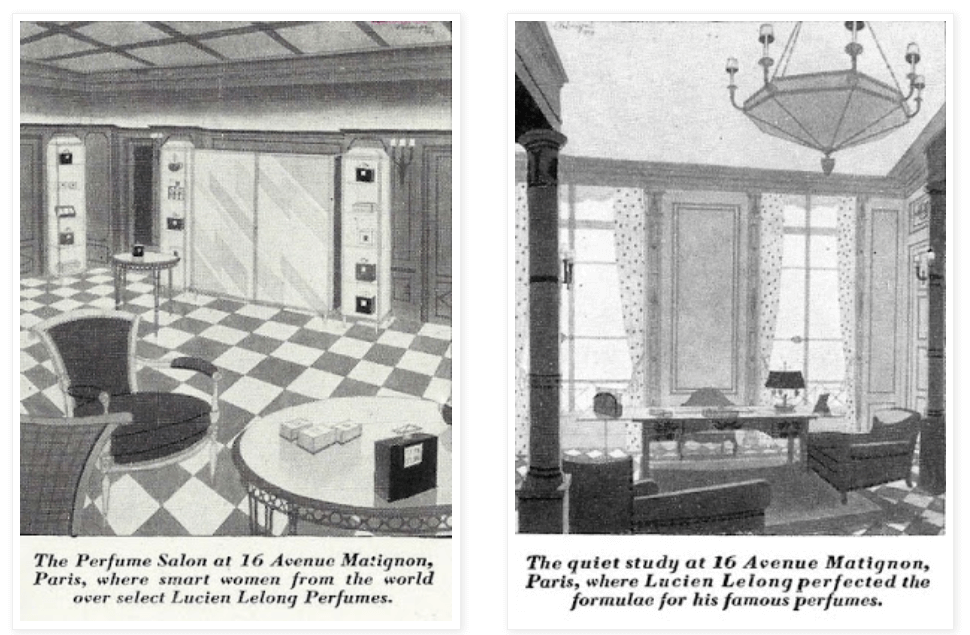
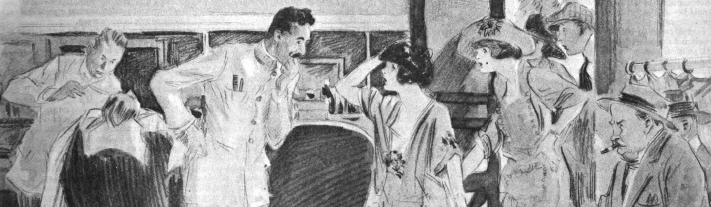
These drawings of Lucien Lelong’s Paris office appear on a blog about the company’s history. The magazine and date are unidentified, but they look like ca. 1920s Vanity Fair to me.****

Illustrations of Lucien Lelong studio, Paris, possibly from Vanity Fair, 1920s?

Joseph had a keen artistic sense himself, and he paid a great deal of attention to the appearance of his products. Here is his patent for a Lucien Lelong perfume bottle:

Patent application for Lelong perfume bottle, Lelong.

United States Patent and Trademark Office

When Rita and Joseph married, she joined him in Chicago. The couple later settled in the suburb of Highland Park. Their son Tom, their only child, was born in 1920.

When I saw a picture of Rita with her extended family on Lori Kennedy’s website, I hoped that, having given up her career, she had gained a fulfilling life of a different sort. Life is rarely so simple, unfortunately. Like many parents of their time and class, she and her husband sent Tom to boarding school from an early age. Living outside of the hustle and bustle of the city, she felt isolated. “I believe she was a very frustrated artist and wife,” Patty said.

Rita did appreciate the benefits of wealth, though. In addition to their home in Highland Park, she and her husband owned, over the course of their marriage, an apartment on the Champs-Élysées and houses in Maine and in the Long Island town of Oyster Bay.

New Yor Times Headline, 6-Acre Estate Sold in Nassau County, 1-22-1942.

New York Times, January 22, 1942

Patty remembers Rita, whom her grandchildren called Tita after a mispronunciation by one of the children, as a tiny woman with a mink collar, pearls, and diamonds. She smoked at a time when that was the mark of a sophisticated woman. “They had an African-American cook who was always baking stuff—it was out of Gone With the Wind,” Patty told me. “I never remember her eating anything except pound cake and butter.”

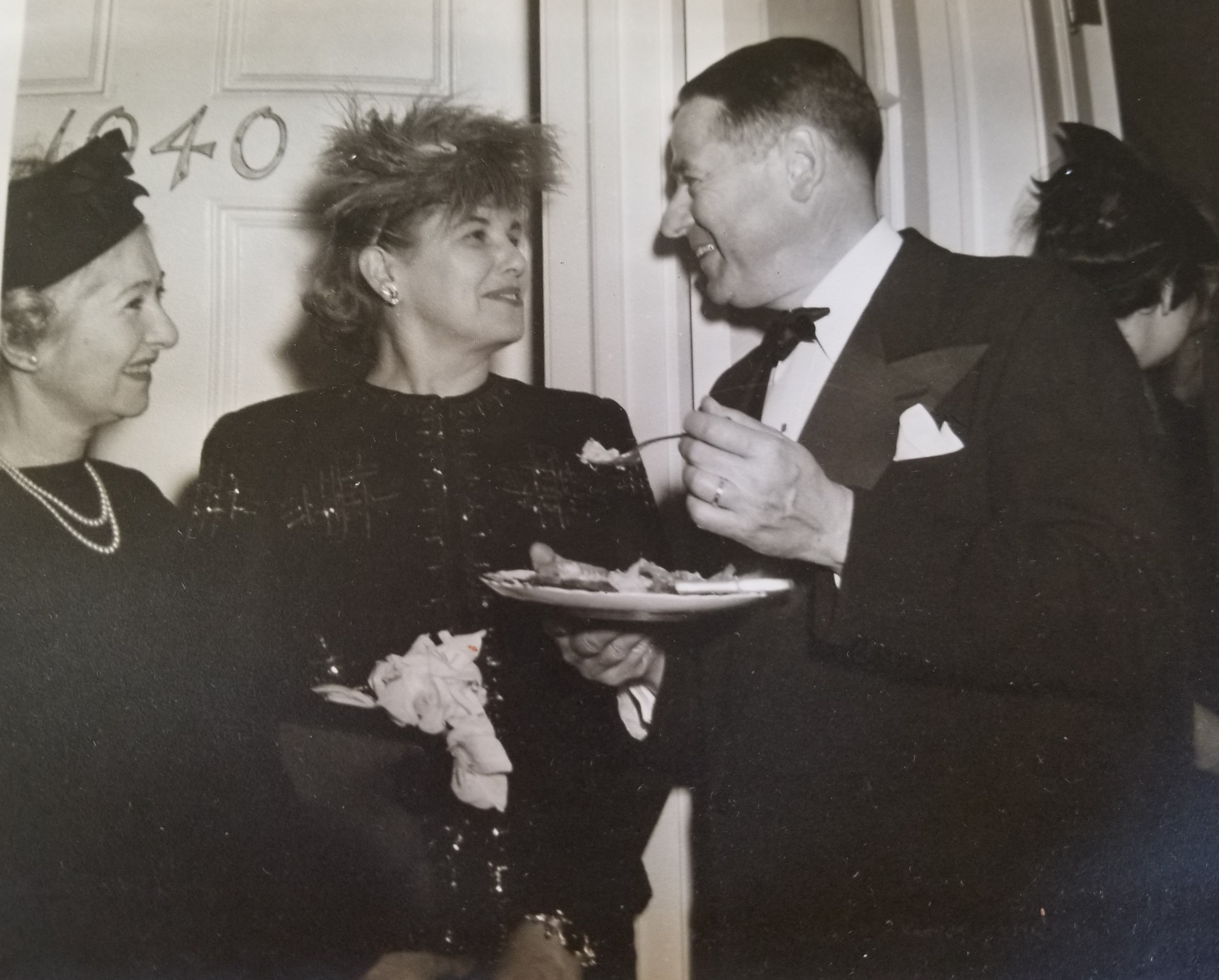
Rita Senger and others at party.

Rita Senger Stein, center, at her son’s wedding reception, October 1943 (courtesy of Patty Stein)

After her marriage, Rita expressed her artistic side through patronage of the arts. In addition to her association with the Art Institute of Chicago, she was a collector, purchasing works by modern artists including the sculptors Kenneth Armitage and Henry Bertoia.

When their son Tom grew up, he wanted his own family to be very different from the one he was raised in. He married Pauline Blume, the daughter of Ernest Blume, a Marshall Field’s home goods buyer. Ernest and Joseph had had a nodding acquaintance before the couple met. The two men, who shared an appreciation for aesthetics, saw each other occasionally at lunch at Marshall Field’s.

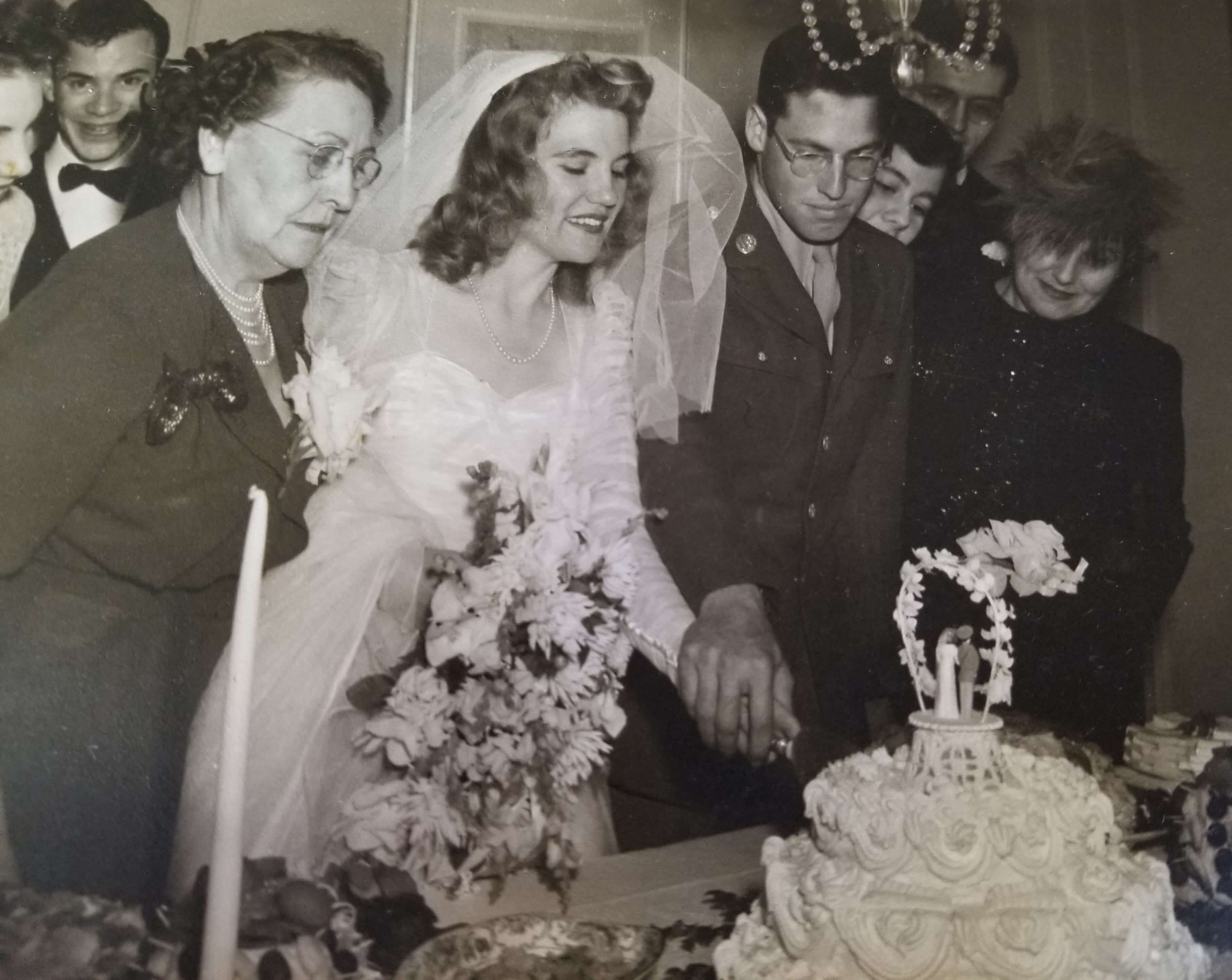
Rita Senger Stein with her son and daughter-in-law, cutting cake, at their wedding.

Rita Senger Stein, far right, at her son’s wedding reception, October 1943 (courtesy of Patty Stein)

Tom and Pauline eventually settled in Colorado with their five children, whom Patty, the youngest, describes as “boisterous, smart, and mouthy.” Their sophisticated grandmother, who thought children should be seen and not heard, didn’t know what to make of them. She enjoyed them one at a time, and developed a special bond with her oldest grandson, but “five was way too many,” Patty said. One time, when Patty was little, she drew paper dolls and showed them proudly to her grandmother. Rita pointed out that the figures were out of proportion.*****

Art was an important part of the family’s daily life. “I did not grow up with a mom who had crocheted doilies on the sofa,” Patty said. When the family went to an exhibition of Bertoia’s work, Patty’s sister was told to stop touching the tree sculptures. “My grandmother lets me,” she said.

Harry Bertoia in sculpture studio.

Harry Bertoia with samples of his sculpture in the early 1960s (Harry Bertoia Foundation)

“She had so much influence on us five and our extended family,” Patty said of her grandmother. One of Rita’s nephews went on to be an artist and designer. Patty herself went on to a different kind of artistic career, as a ballet dancer.

When Rita was 85 years old, she and her husband moved to Denver so Tom and his family could care for them. One day, Rita sat Patty down and pulled out a portfolio from the 1920s, with drawings of nudes in copper and black. Until then, Patty hadn’t known that Rita had continued drawing after her career ended. “She was so gifted,” Patty said, “to see curves and shadows and lines where none of the rest of us could.”

Rita died on December 30, 1990, at the age of 97. For her descendants, her art collection, her furniture, and her own art work serve as tangible reminders of her artistic sensibility and her talent. For the rest of us, her art lives on online. The Library of Congress, which has the original of the July 1916 Vanity Fair cover in its collection, featured it in a 2002 exhibition titled “American Beauties: Drawings from the Golden Age of Illustration.”

Rita Senger Vanity Fair cover, July 1916, woman dancing on beach.

July 1916

The website for the exhibition states that “Rita Senger’s lithe beauty dancing on a shore (ca. 1916) embodied a freedom based on insistent individuality. Compared with their predecessors, [fellow illustrator Ethel] Plummer’s and Senger’s figures move freely in more public, open spaces.”

If Rita had enjoyed that same freedom in her own life, the world would be the richer for it. Still, I feel lucky to have discovered the work she did leave us, and, through Patty, to have learned this remarkable woman’s story. I can think of no better way to celebrate Women’s History Month than telling it here.

squiggle

*The “almost” being because in 2018 I called the Huntington Museum of Art in West Virginia and talked to a very nice woman who confirmed that the museum still owned the painting “Lead Kindly, Light,” by William Edouard Scott, which was featured on the cover of the April 1918 issue of The Crisis. Also, I e-mailed the Library of Congress in 2019 for a post that’s still on my to-do list. But contacting people whose job it is to answer your questions is very different from reaching out to a stranger and saying, “Tell me all about your grandma!”

Crisis cover, April 1918, black couple on wagon going north.

**I know, not exactly lightning speed. In my (feeble) defense, I left Washington, D.C., where I’d unexpectedly spent almost a year, for Cape Town shortly after my conversation with Patty, and after that I had some time-specific posts to do for the holidays, Black History Month, etc. Still!

***Or possibly three. Vogue’s website identifies this September 15, 1917, cover as being Senger’s,

Vogue cover, September 15, 1917, woman with purse.

but credits the September 1 cover, which is definitely hers, to Alice De Warenn Little, so it’s possibly that they flipped the attributions. Vogue published two issues a month at that point, and I’ve never come across two covers by the same artist during the same month.

****The life of Lelong, who was also a prominent couturier, makes for fascinating reading. During his marriage (possibly of convenience) to Princess Natalia Pavlovna Paley, she had a messy entanglement with the writer Jean Cocteau, who was gay. Another one of Lelong’s wives later married Collette’s widower.

Lucien Lelong in 1925

Lucien Lelong in 1925 (National Photo Company)

*****When Patty told me this, I laughed and told her about the time my brother and I, aged about eight and nine, were designing houses on graph paper. My father took a quick glance at our floor plans and told us the plumbing was misaligned—the second-floor bathroom needed to be directly above the first-floor bathroom so that the pipes would line up.

Crop of Good Housekeeping cover, January 1921.

The Top 10 Posts of 1920

Happy new year, everyone! I’m sure you’re as glad to say good-bye to 2020 as I am.

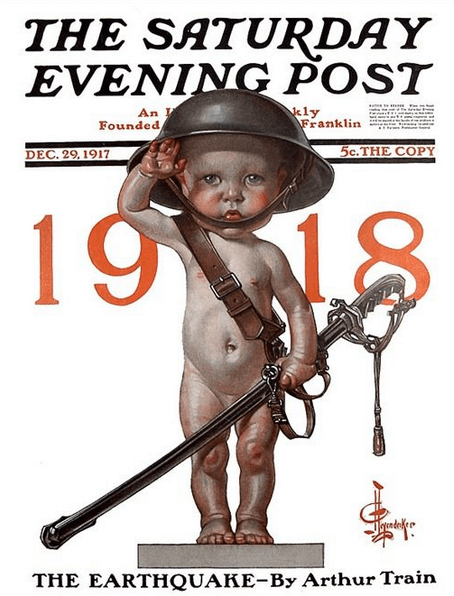
It is, incredibly, my fourth New Year’s here at My Life 100 Years Ago. That’s four Saturday Evening Post covers by J.C. Leyendecker. In 1918 we had a baby soldier,

J.C. Leyendecker New Year's cover 1918, baby soldier.

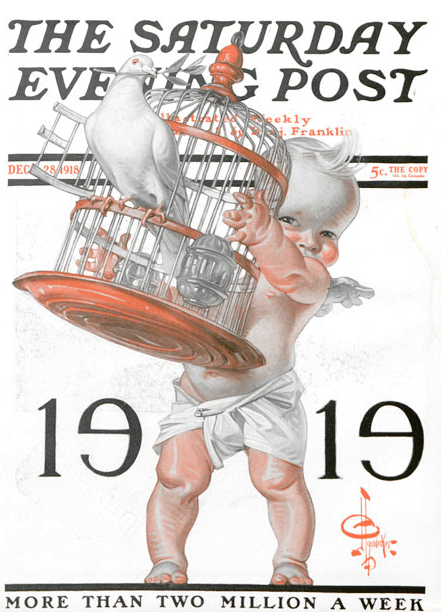
in 1919 a baby celebrating peace,

J.C. Leyendecker New Years 1919 cover, baby letting doves out of cage.

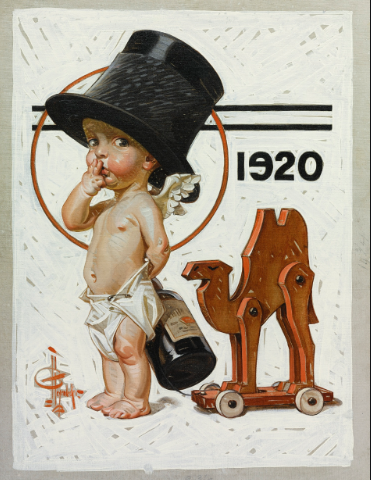
and in 1920 a shushing baby,

J.C. Leyendecker January 2020 Saturday Evening Post cover, baby with camel toy.

which didn’t make much sense until I realized that it was a censored version of this original:

J.C. Leyendecker painting of baby with whiskey bottle and camel toy.

sotheby.com

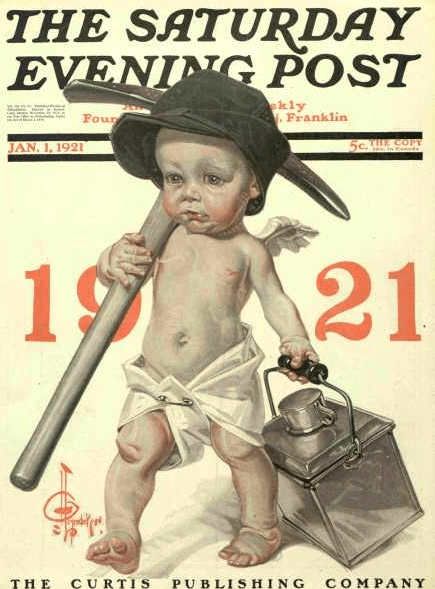
This year we have a baby coal miner.

J.C. Leyendecker 1921 New Year's cover, baby coal miner.

This puzzled me, because the violent conflicts in the mining industry seem more up The Liberator’s or The Crisis’s* alley than the business-friendly Post’s. The magazine’s website explains that “the 1921 cherub anticipates an end to the bitter coal miners’ strike in Alabama.” If Leyendecker were still at it (his streak ran from 1907 to 1943), this year’s baby would be getting a vaccine.

Meanwhile, Good Housekeeping and Sunset have New Year’s babies of their own, going for cute and creepy respectively.

Good Housekeeping Jessie Willcox Smith cover, January 1921, child on moon.

Jessie Willcox Smith

Robert Kearfott Sunset cover, New Years 1921, baby.

Robert Kearfott

The Top 10 Posts

I only published 15 posts total this year, and the top ten were the first ten. This struck me at as strange and a little alarming at first, but when I looked more closely at the numbers it made sense. Four out of the top five were from March, April, and May—i.e. peak COVID lockdown time, when everyone was desperate for entertainment.

#10. The Top 10 Posts of 1919…and a new name for a new decade

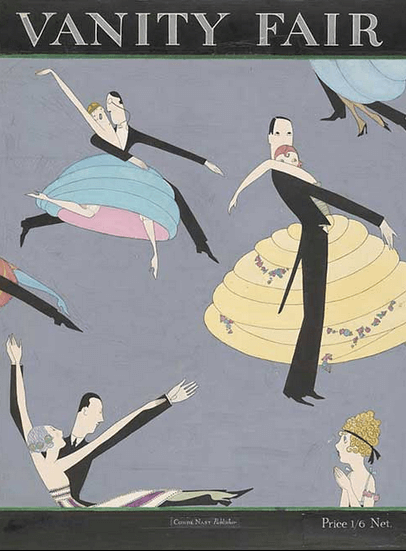
Vanity Fair cover, January 1920, cartoon of people driving cars.

John Held Jr.

This is kind of meta.

#9. 5 Old Posts That Might Come in Handy Around Now

Coles Phillips Luxite hosiery ad.

Coles Phillips

I thought you all might want some diversions during those grim first weeks, so I compiled some quizzes I’d published over the years. Except, oops, I forgot What’s Your 1918 Girl Job?

#8. Are You H.L. Mencken and George Jean Nathan’s Ideal Woman? A Quiz

H.L. Mencken and George Jean Nathan

Smart Set co-editors H.L. Mencken and George Jean Nathan may have been the greatest critics of their era, but their attitude toward woman left a lot to be desired. I had a wonderful time writing this post on July 4 and managed to finish it just in time to watch the fireworks from the roof of my building. This is probably my favorite post ever as far as the pictures go.

#7. Magazine Covers Ring in the 1920s

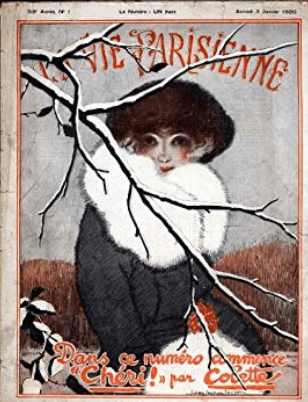
La Vie Parisienne cover, January 1920, woman in fur behind snowy branch.

“Forget the words, I just want pictures!” readers often tell me, although somewhat more politely than that. This year, I listened.

#6. You Be the Judge: The 1915/1920 Magazine Cover Smackdown

Vanity Fair cover, September 1915, Rita Senger, woman with sleeping Pierrot.

Rita Senger

It was fun comparing magazine covers from 1915 and 1920, and I enjoyed hearing about your favorites. Rita Senger’s winning 1915 Vanity Fair cover took me in a fascinating direction that you’ll be hearing about soon. (UPDATE 4/6/2021: You can read more about Rita Senger here.)

#5. The doctor and the chorus girl: A heartbreaking tale of interracial love

Eugene Nelson and Helen Lee Worthing, 1929.

This Valentine’s Day post started out with idle curiosity—what happened to four aspiring actresses after they won a movie magazine contest? It turned into a bit of an obsession as I delved into the lives of popular Follies girl Helen Lee Worthing and her husband Eugene Nelson, a prominent African-American physician. Of all the posts I’ve done, I may be proudest of this one, and I’m glad it found so many readers.

#4. 1920 magazine covers bring late winter cheer

Anne Harriet Fish Vanity Fair cover, March 1920, couples dancing.

Anne Harriet Fish

I celebrated my return to the northern hemisphere with some wintry cover art, not suspecting that another winter would be on the way by the time I returned to South Africa.

#3. My Dream 1920 Summer Vacation

If we couldn’t go on vacation this year, at least we could dream of beaches…and white shoes…and gramophones.

#2. Bernice Bobs Her Hair…and I Bob Mine!

Crop of illustration from Bernice Bobs Her Hair, F. Scott Fitzgerald.

With the salons closed, I got into the F. Scott Fitzgerald spirit and gave myself a homemade bob.

#1. Magazine Ads Take Baby Steps Into the 1920s

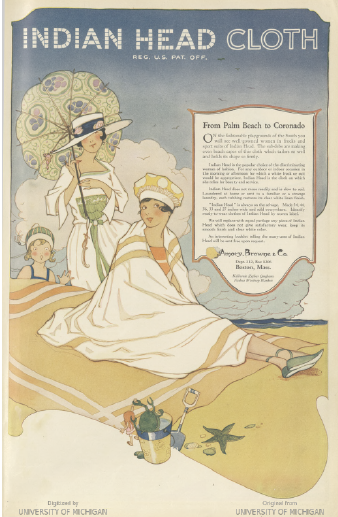
Indian Head Cloths ad, women at beach, Ladies' Home Journal, April 1920.

Okay, I get the hint! I’ll do another ad roundup soon.

Honorable Mention

Vintage photo, young male couple.

 A Pioneering Gay Novel of 1919. Not that being #11 out of 15 is such a spectacular achievement, but I can’t resist giving this post a plug. Finding a novel about a loving gay couple who just wanted to live like normal people was my biggest surprise of the year.

Dishonorable Mention

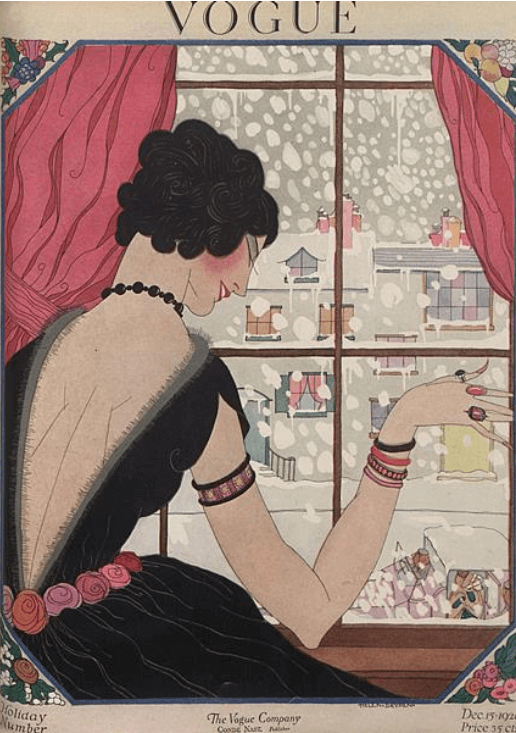
Helen Dryden Vogue cover, December 1920, woman looking out at snow.

Helen Dryden

December 1920 Magazine Covers Bring Holiday Cheer. As I mentioned, the last five posts were the least popular, and the last post of all is on trend with the fewest views. Also: I see I’m in a bit of a blog title rut.**

Best-Performing Post from a Past Year

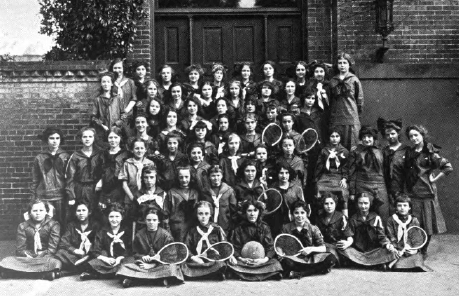
Girl Scout troop, 1916.

How Girls Can Help Their Country

My Quest to Earn a 1919 Girl Scout Badge. This was my most fun post ever, and it lives on, with more than twice as many views in 2020 as the #1 post published during the year. In the meantime, a new edition of the Girl Scout handbook has been published—I should get on it.

Best Readership News

You know how when you’re just starting out in your profession you work like crazy, and then when you get more senior you can just coast? Yeah, me neither, but blogging works like that. In 2018, when I was reading full-time as if I were living in 1918, I published 94 posts. In 2019, I had 21. This year, 15. But here’s what happened to the numbers.

Blog stats, 2018-2020.

There are technical and highly boring reasons for this having to do with the impact of longevity on how search engines assess websites, but whatever! I’ll take it!

Happy 2021! May it be better than your 2020.

squiggle

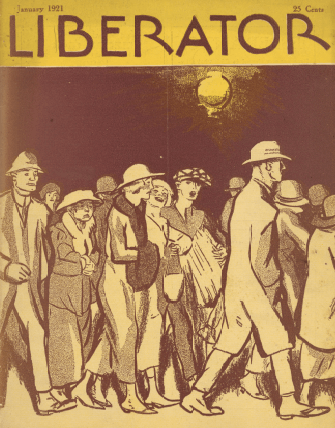
*The January 1921 Liberator and Crisis covers:

Liberator January 1921 cover, Cornelia Barnes, people walking down street.

Cornelia Barnes

Crisis cover January 1921, statue of man with Sphinx.

**Although not as bad of a rut as the time back in 2019 when four out of five posts in a row started with “Celebrating.”

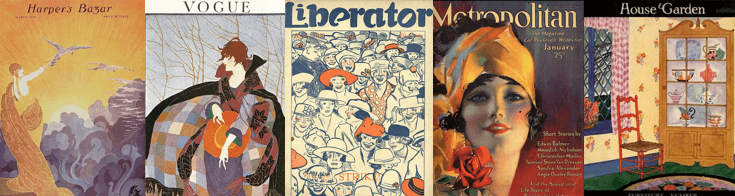
Banner of 1915 and 1920 magazine covers

1915/1920 Magazine Cover Smackdown: And the Winners Are…

The people have spoken! And the people, it turns out, like athletic, adventurous women and hate scantily clad women.

Let’s back up a minute. In case you haven’t been following along, in my last blog post I asked the people to vote on whether 14 magazines (and two mismatched pairs) had better covers in 1915 or 1920. This was in the context of me being a 1920 crank going on about how things were better in the 1910s. But enough with the explanation…you can check it out yourself.

On to the winners:

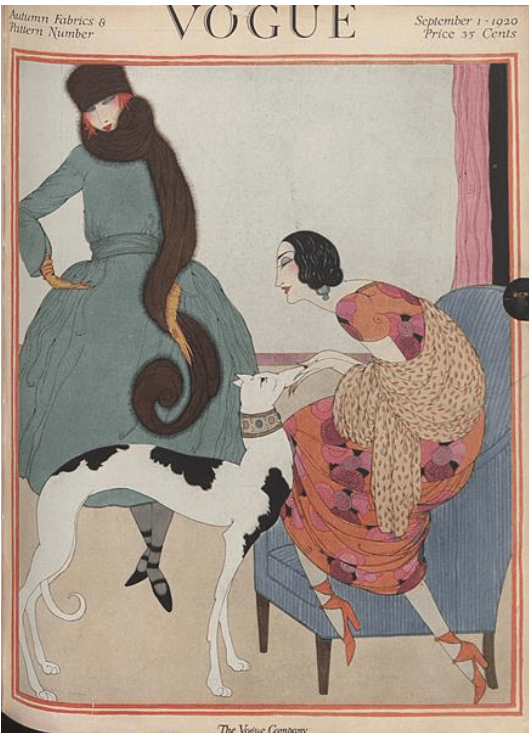
1. Vogue

Helen Dryden, September 15, 1915
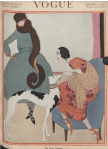
Helen Dryden, September 1, 1920

This is the first of several matchups where an artist faces off against him/herself. Dryden is a favorite of mine, previously featured in my posts on Ten 1919 Illustrators I’m Thankful For and Five Inspiring Women of 1919. The winner, which also got my vote, is Dryden’s colorful 1915 cover, which bested her uncharacteristically subdued 1920 cover with 58% of the vote.

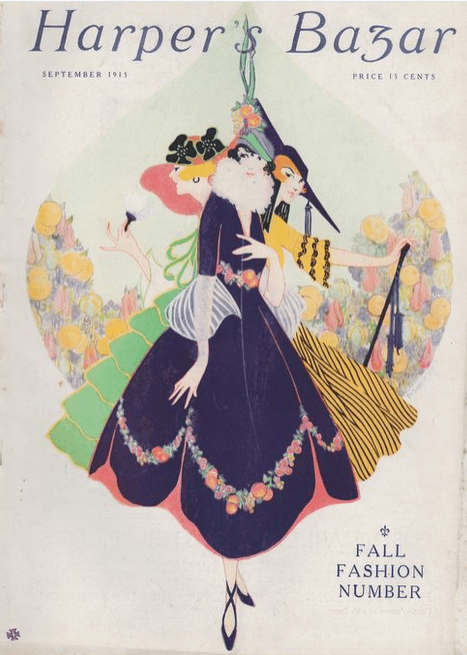
2.  Harper’s Bazar

Erte Harper's Bazar cover, September 1915, three women

Erté, September 1915

Erté Harper's Bazar cover, September 1920

Erté, September 1920

Another self-matchup, Erté vs. Erté.* This was inevitable, because Erté, who was one of the Ten 1918 People I’m Thankful For, was Harper’s Bazar’s regular cover artist from 1915 to 1936. I’m thankful that I have a decade and a half of his illustrations to look forward to, but his October 1920 cover wasn’t one of my favorites. Readers agreed, with the 1915 cover winning 59% of the vote.

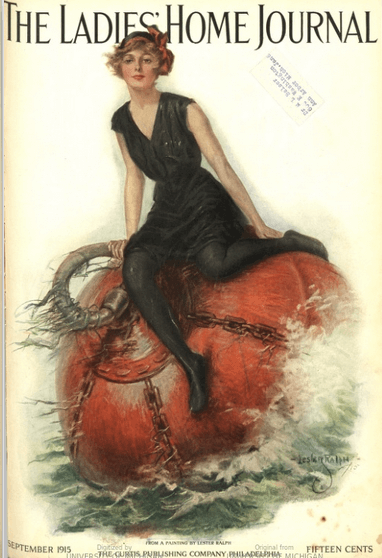
3. Ladies’ Home Journal

Ladies' Home Journal cover, September 1915, Lester Ralph, woman sitting on naval mine.

Lester Ralph, September 1915

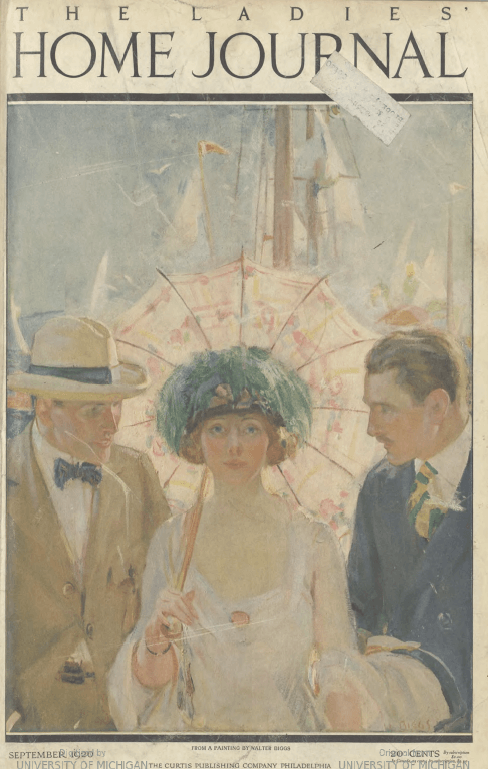
Walter Biggs, September 1920

This boring vs. weird matchup featured Leslie Ralph’s woman sitting on what looks like a German naval mine vs. Walter Biggs’ popular parasol-carrying woman. I was of two minds here but ended up going for the 1920 cover because at least no one was about to blow up. Readers are made of sterner stuff than I am, though, and the 1915 cover won 71% of the vote.

4. Vanity Fair
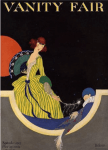
Vanity Fair cover, September 1915, Rita Senger, woman with sleeping Pierrot.

Rita Senger, September 1915

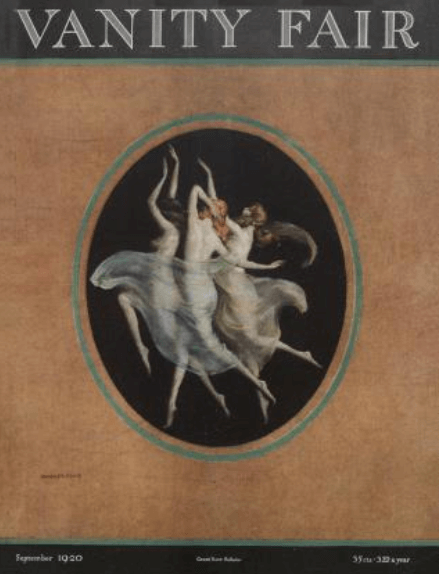
Warren David Vanity Fair cover, September 1920, naked women dancing.

Warren Davis, September 1920

Rita Senger’s 1915 Vanity Fair cover is my favorite of the bunch, winning my enthusiastic vote against Warren Davis’ frolicking naked women. I admired the first Warren Davis cover I saw, way back toward the beginning of this blog, but I soured on him when I learned that drawing naked women was the only thing he ever did. Readers shared my taste, giving Senger a lopsided 91% victory.

5. The Crisis

The Crisis, September 1920, photo of bust by C. Matey.

Sculpture by C. Matey, September 1915

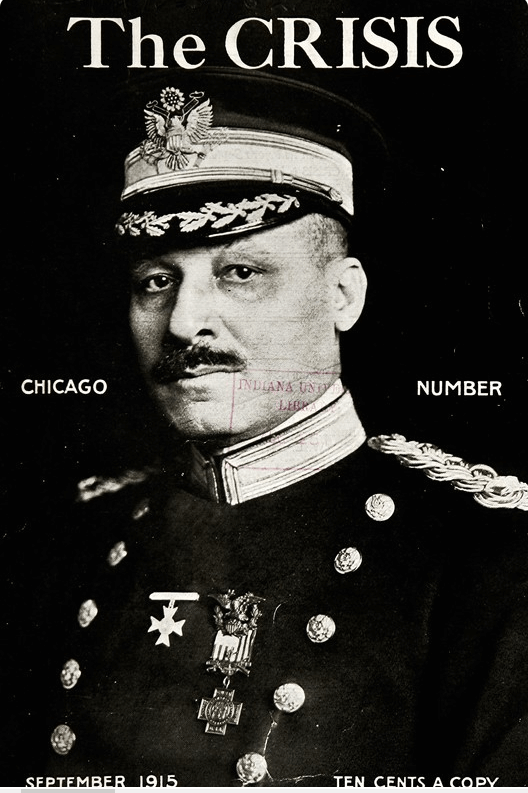
The Crisis, September 1915, The Colonel of the 8th Regiment.

Unknown artist, September 1920

I was disappointed that both of these covers featured photographs, as opposed to, say, a Frank Walts drawing or a William Edouard Scott painting. I voted, with mixed feelings, for the 1920 cover featuring a sculpture by the mysterious (or, at least, not easily Googleable) C. Matey, which led the polls with 57% of the vote.

6. St. Nicholas

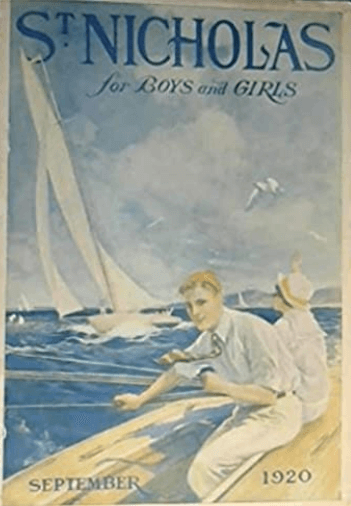
St. Nicholas cover, September 1915, Charles Livingston Bull, children sailing.

Charles Livingston Bull, September 1920

St. Nicholas magazine cover, September 1915, Norman Price, motorcycle stunts.

Norman Price, September 1915

If I could jump into one of these covers, Mary Poppins-style, I’d definitely opt for sailing over watching dangerous motorcycle escapades (both of which apparently require a necktie). But as a cover I went for the eye-popping red and the action of the 1915 cover. I was in a minority here; 55% chose sailing.

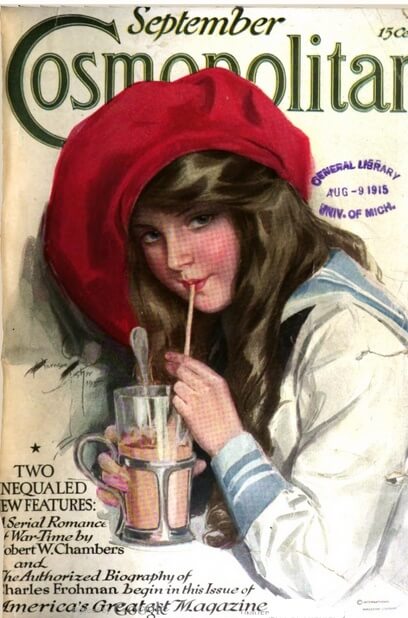
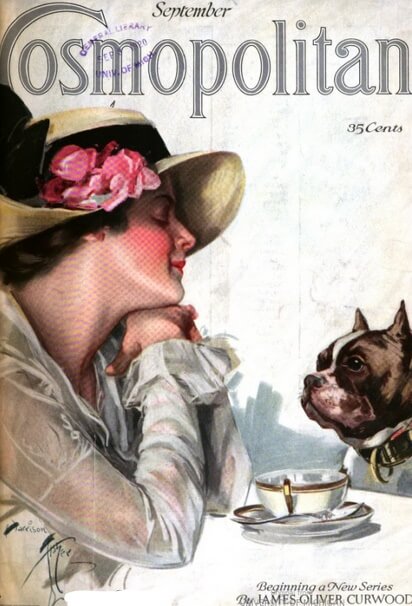
7. Cosmopolitan

Cosmpolitan cover, September 1915

Harrison Fisher, September 1915

Cosmopolitan cover, September 1920, Harrison Fisher, woman drinking tea with dog.

Harrison Fisher, September 1920

A Harrison Fisher vs. Harrison Fisher faceoff, with similar young-woman-drinking-something themes. The one with the dog (title: “You Beauty!”) struck me as a bit unsanitary, so (putting aside my resentment over just happening upon it after spending an hour searching for images of women drinking through straws for my Are You H.L. Mencken and George Jean Nathan’s Ideal Woman? quiz) I went with the 1915 cover. 62% of readers agreed.

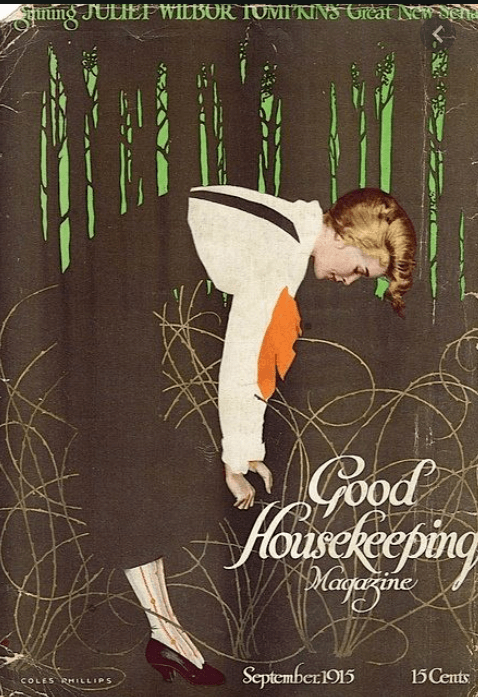
8. Good Housekeeping

Good Housekeeping cover, September 1920, Coles Phillips fadeaway girl.

Coles Phillips, September 1915

Good Housekeeping cover, Jesse Wilcox Smith, September 1920, little girls hugging in doorway.

Jessie Willcox Smith, September 1920

As I’ve repeatedly mentioned, I adore Coles Phillips, who was Good Housekeeping’s sole cover illustrator for a two-year stretch in the 1910s.** If I had known about him two years ago, My Sad Search for 1918 Love might have ended differently. I don’t adore Jessie Willcox Smith, who was at the vanguard of the cutesification of magazine art (although I do adore her illustration from At the Back of the North Wind featured in the 1919 children’s books holiday shopping guide and her Good Housekeeping New Year’s 1918 cover). 83% of voters agreed with me.***

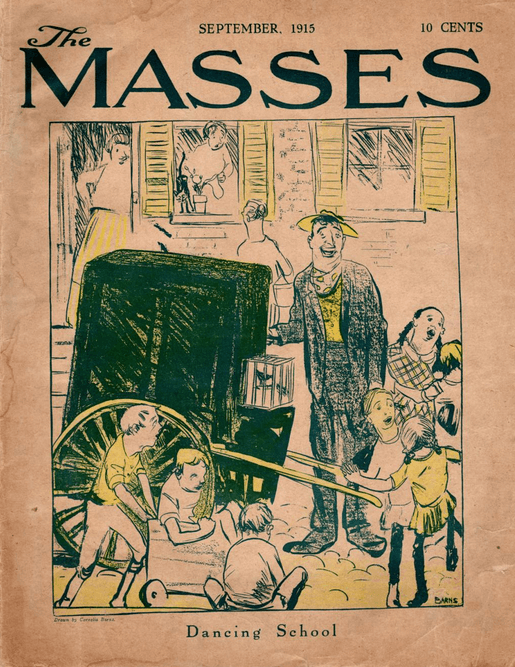
9. The Masses/The Liberator

The Masses cover, September 1920, Cornelia Barnes, children dancing near organ grinder.

Cornelia Barnes, September 1915

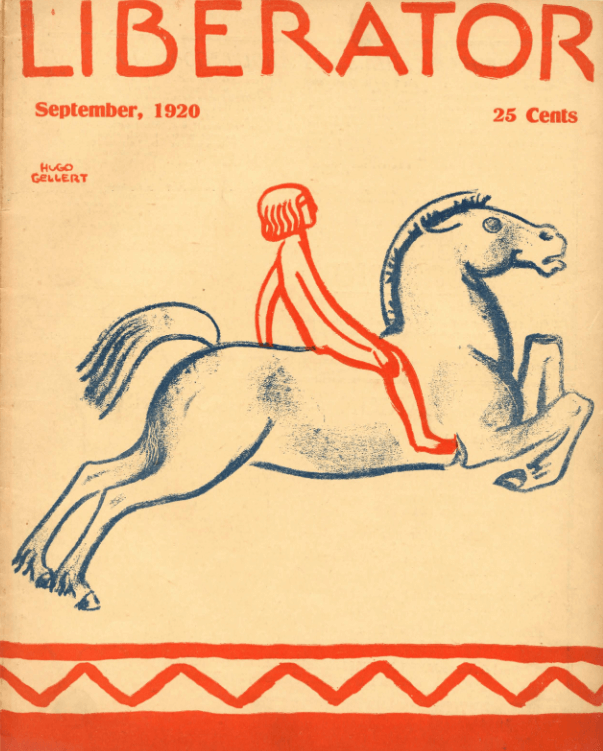
The Liberator, September 1920, Hugo Gellert, boy on flying horse.

Hugo Gellert, September 1920

As I noted in my previous post, The Liberator arose in the ashes of The Masses, which closed after staff members were charged with conspiring to obstruct conscription. I’m a fan of Cornelia Barns, who drew a proto-New Yorker cartoon I loved, and an even bigger fan of Hugo Gellert and his wonderful covers for The Liberator (including its inaugural issue). This isn’t my favorite Gellert, though, and I ended up voting for Barnes. 57% of voters agreed.

10. The Smart Set

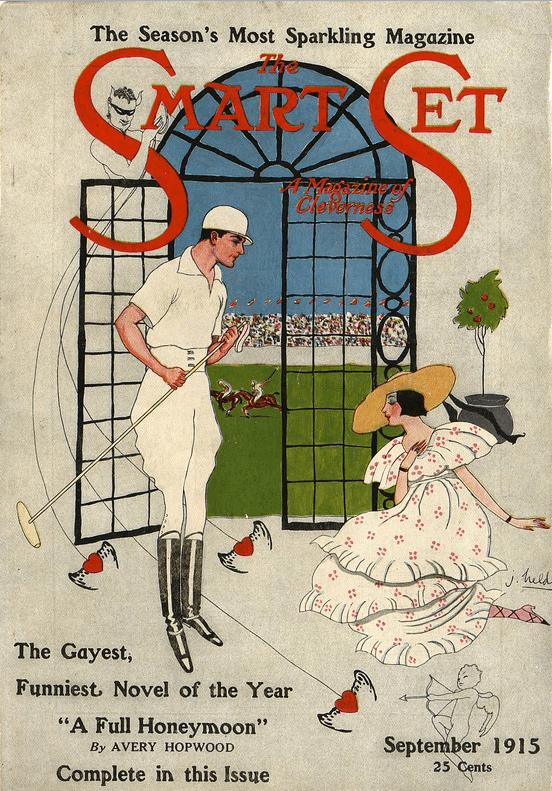
Smart Set cover, September 1915, John Held Jr., man in polo clothes with woman.

John Held Jr., September 1915

Smart Set cover, September 1920, Archie Gunn, man and woman on boat.

Archie Gunn, September 1920

The Smart Set is one of the few magazines where what’s inside is consistently better than what’s on the cover. I did like John Held Jr.’s cheery 1915 polo cover; less so the people in the boat who you just know are racist. A lopsided 86% of readers agreed.

11. Photoplay

Photoplay cover, September 1915, Mary Pickford.

Unknown illustrator, September 1915

Photoplay cover, September 1920, Rolf Armstrong, Constance Talmadge.

Rolf Armstrong, September 1920

Movie star vs. movie star. I could have gone for either one of these, and in choosing the 1920 cover I was perhaps slightly biased by my fondness for Rolf Armstrong, although this isn’t one of my favorites.**** I was in the minority here, with 55% of readers choosing the 1915 cover by an unknown illustrator. (I originally credited the 1915 illustration to Anita Stewart, who, an alert reader pointed out, is actually the subject. Kicking myself!)

12. La Vie Parisienne
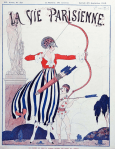
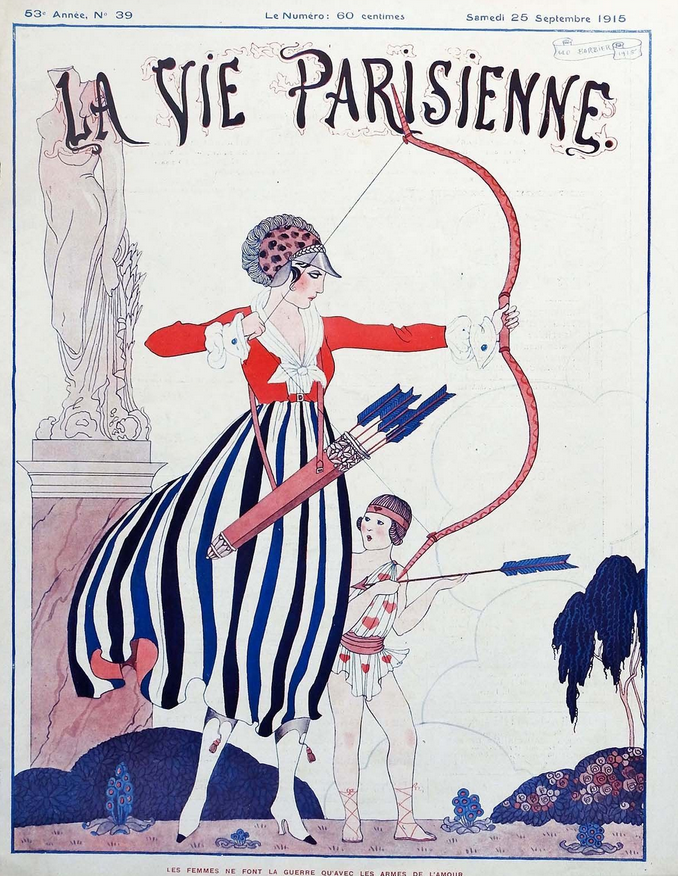
La Vie Parisienne cover, September 25, 1915, woman shooting arrow.

Unknown artist, September 25, 1915

La Vie Parisienne, September 18, 1920, woman playing golf with caddy.

Unknown artist, September 18, 1920

I lucked out in having two La Vie Parisienne covers that are suitable for a family blog. I prefer the clear lines of the 1915 archer, and so did a whopping 90% of readers.

13. Life

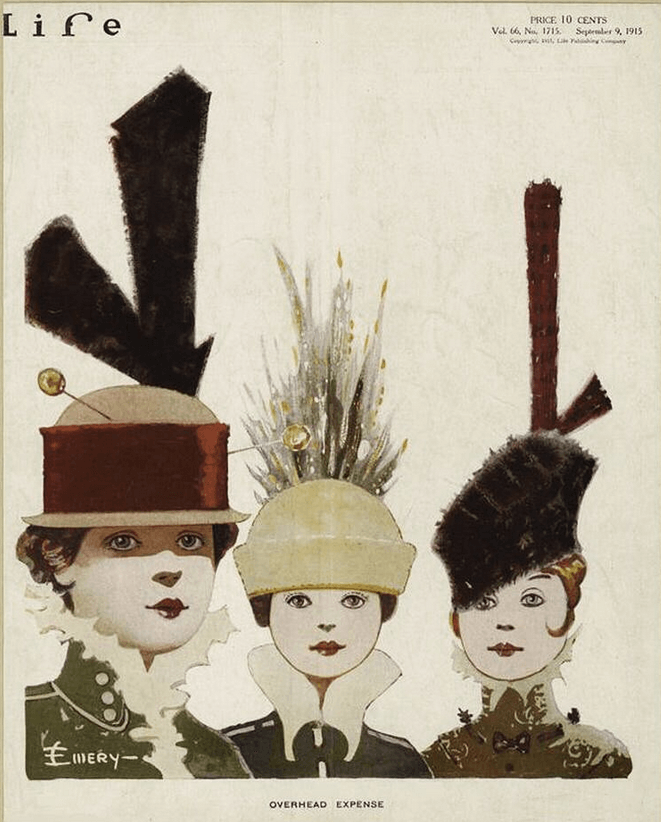
Life cover, September 8, 1915

Emery, September 8, 1915

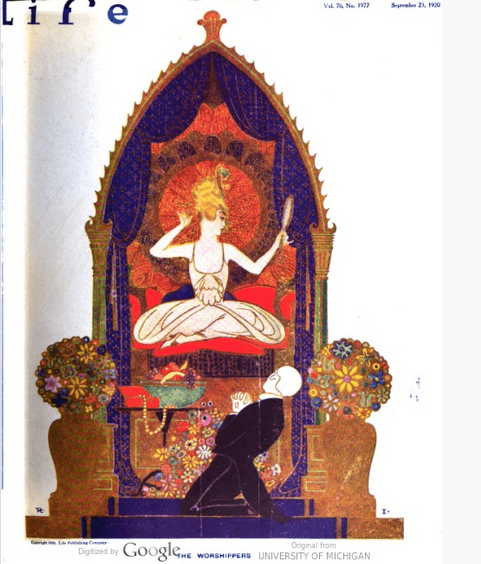
Life cover, Rea Irvin, September 23, 1920, woman on throne.

Rea Irvin, September 23, 1920

I’m a big fan of future New Yorker illustrator Rea Irvin, but not so much of his 1920 Life cover (although it bears closer scrutiny since the picture seems to be embroidered). I have no idea who Emery is, but his or her whimsical take on hat fashions is a lot of fun. 76% of readers agreed.

14. Saturday Evening Post

Saturday Evening Post cover, Charles Livingston Bull, September 18, 1915, owl in front of sun.

Charles Livingston Bull, September 18, 1915

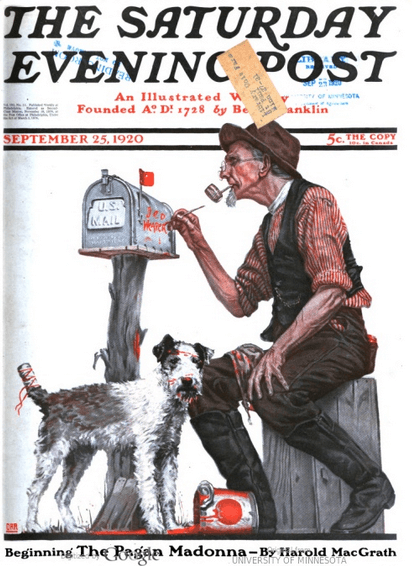
Saturday Evening post cover, September 25, 1920, Alfred E. Orr, man painting name on mailbox.

Alfred E. Orr, September 25, 1920

I had second thoughts about some of my choices, none more than this one. I voted for Alfred E. Orr’s man painting a mailbox when clearly the correct choice is Charles Livingston Bull’s owl. A consequential choice, since there was a dead heat here.

15. Metropolitan

Metropolitan cover, September 1920, Edna Crompton, woman serving at tennis.

Edna Crompton, September 1920

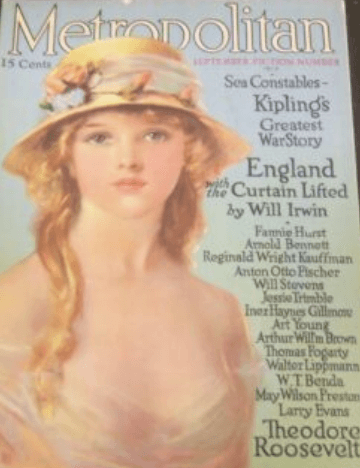
Metropolitan cover, September 1915, young woman in straw hat.

Unknown artist, September 1915

Despite my 1910s leanings, I’m not blind to the ways that the 1920s are better, including more women being portrayed as being physically active as opposed to standing around with their clothes falling off. 90% of readers agreed.

16. The Best of the Rest

Red Cross cover, September 1920, Gerrit Beneker, worker in front of skyline.

Gerrit Beneker, September 1920

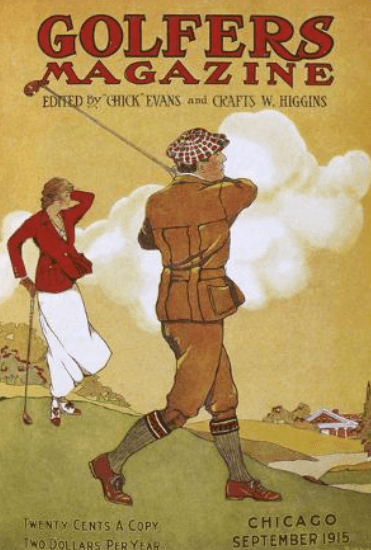
Golfers magazine, September 1920, man swinging golf club while woman watches.

Unknown artist, September 1915

For the last matchup, I paired up two covers that didn’t have a counterpart in the other year but that I couldn’t bear to leave out. My favorite, and that of 75% of readers, was Gerrit Beneker’s 1920 builder on the cover of Red Cross (the magazine’s second to last issue).

And the winning cover is…

Vanity Fair cover, September 1915, Rita Senger, woman with sleeping Pierrot.

Rita Senger, September 1915

I’m new at this polling business, and if I had it to do again (which I no doubt will, given how much fun it was this time) I would allow everyone to vote for their favorite cover of all. As it is, I’ll have to go with the cover that had the highest vote percentage. This isn’t really fair because it may just reflect the weakness of the competition, but so be it.

All caveats aside, I’m delighted to announce that the winner is Rita Senger’s wonderful Vanity Fair cover, which, as noted, is also my favorite. It edged out the 1915 La Vie Parisienne cover by a few tenths of a percentage point. Next time I write about illustrators I love, I’m going to write about Senger.

And the winning year is…

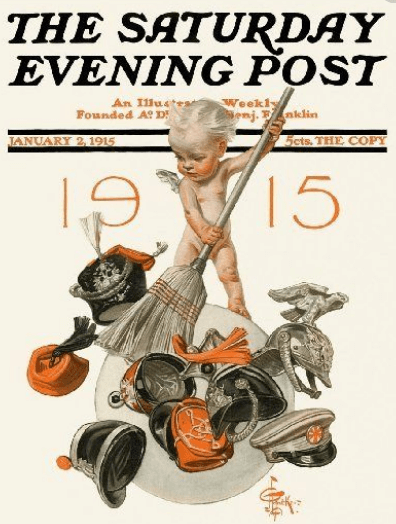
Saturday Evening Post January 9, 1915 cover, J.C. Leyendecker, New Year's baby brushing away military hats.

J.C Leyendecker

1915 was the overwhelming winner, beating out 1920 in twelve of the matchups, with three victories for 1920 and one tie. Interestingly, given that it was my grousing about the decline of magazine illustration that spurred the contest, I voted for 1920 six times, twice as often as the average reader.

So it’s been officially, objectively proven: the 1910s rule!

And the winning reader is…

Thomas Jefferson and the Return of the Magic Hat, by Deborah Kalb

…Allison Silberberg, who has received a free copy of Deborah Kalb’s wonderful middle-grade novel George Washington and the Return of the Magic Hat. Allison’s favorite cover is the Red Cross “The Builder” cover, which makes a lot of sense given the former Alexandria, Virginia, mayor’s commitment to building communities. You can find Allison on Facebook here and on Twitter here.

And the winning new (to me) blogging technology is…

Readership during the week the Magazine Cover Smackdown was published shattered previous records, even when taking into account some iffy botlike behavior on the day before publication. So clearly readers like polls! Judging from the low number of votes as a percentage of views, though, readers are not as fond of voting in polls as they are of reading them.

That’s fine! It’s just a blog poll! It’s not like the future of America is at stake!

Which is not something that can be said for the other election that’s going on right now. So, as we celebrate the hundredth anniversary of women’s suffrage,***** make sure to

League of Women Voters poster, 1920, women looking at Capitol.

League of Women Voters poster, 1920

squiggle

*Estimated amount of time that I have spent over the course of this blog putting the accent mark in Erté’s name (or, rather, pseudonym): two hours.

**For more Fadeaway Girls, check out my Pinterest board.

***Not that I’m judging you 17 percenters. In fairness to Smith, this is a beautifully illustrated cover—I love the green doors and the shadows.

****That’s Armstrong’s Metropolitan cover on the blog banner, unless you’re reading this in the future when I have updated the banner, in which case here’s the old one, featuring 1919 covers. It was a thing of beauty (future me says), and I miss it so much!

*****Of course, it would take decades more of struggle before African-American men and women’s right to vote was fully honored throughout the country.
Rodin, Young Woman Reading an Illustrated Journal, ca. 1880

You Be the Judge: The 1915/1920 Magazine Cover Smackdown

An occupational hazard of reading as if you were living a hundred years ago is that you start turning into a curmudgeon. “Things were so much better in the 1910s,” you (okay: I) grumble on a regular basis, apropos of 1920. Not everything, of course—the 1910s had the war and the Spanish influenza, for starters, and with starters like that there’s no point racking your brain for additional examples. But some things definitely got worse.

The font at The Smart Set, for example. What were H.L. Mencken and George Jean Nathan thinking?

Headline "Novels, Chiefly Bad," H.L. Mencken, Smart Set, August 1919

Smart Set, August 1919

Headline, "Books More or Less Amusing," H.L. Mencken, Smart Set, August 1920

Smart Set, August 1920

Dorothy Parker was fired from Vanity Fair in January 1920, so good-bye to her theater reviews

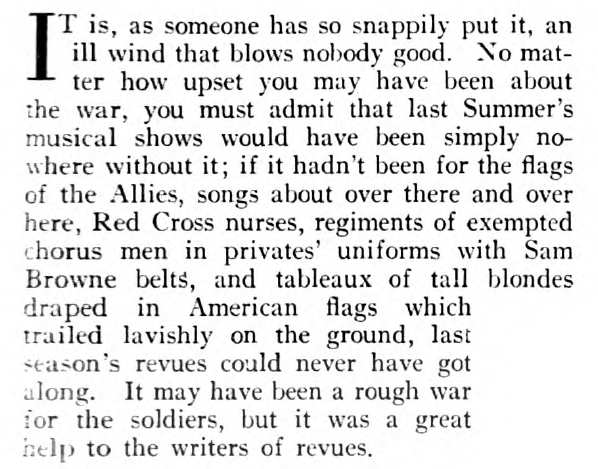
Excerpt from Dorothy Parker theater review, Vanity Fair, August 1919

“The First Shows of Summer,” Vanity Fair, August 1919

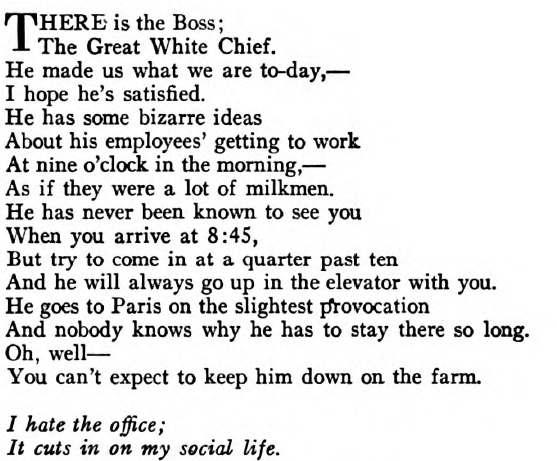
and hate poems.

From "Our Office: A Hate Poem," Dorothy Parker, Vanity Fair

“Our Office: A Hate Poem,” Vanity Fair, May 1919

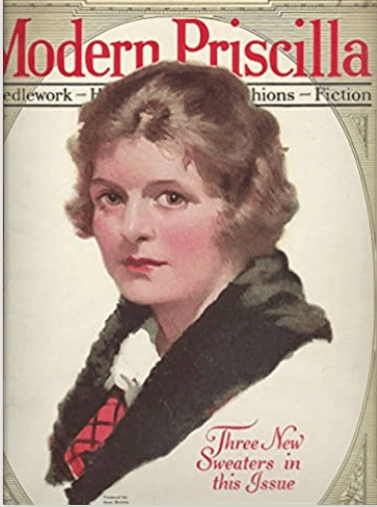
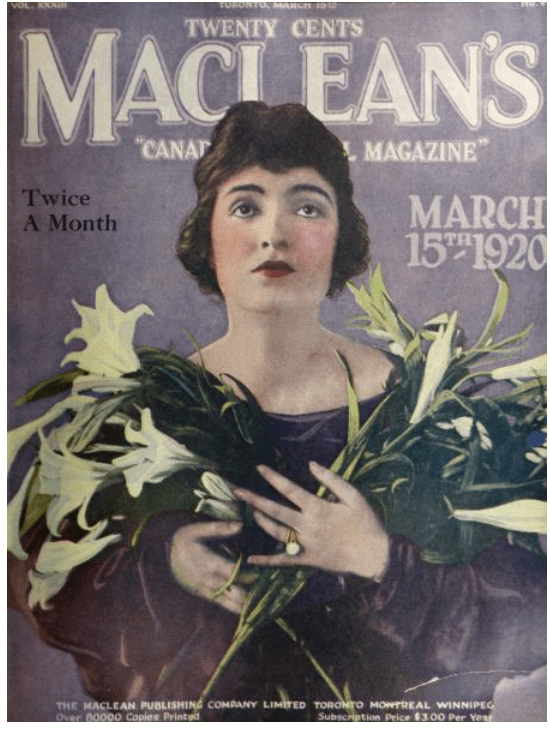
And then there are the magazine covers. Every time I’ve thought about doing a magazine cover post in the last few months, I’ve found some dispiriting examples,

Modern Priscilla cover, woman wearing scarf

Good Housekeeping cover, April 1920, girl wearing bonnet

Maclean's magazine, March 15, 1920, womn carrying calla lilies

thought wistfully about the good old days,*

Crisis cover, April 1918, Willian Edouard Scott, black couple on wagon.

William Edouard Scott

Vogue Helen Dryden cover, February 15, 1918, woman looking in mirror.

Helen Dryden

Erté Harper's Bazar cover, May 1918

Erté

and given up.

I wondered sometimes whether I was being fair. Maybe, like so many people, I was longing for a golden age that only existed in my mind. But how to measure such a thing?

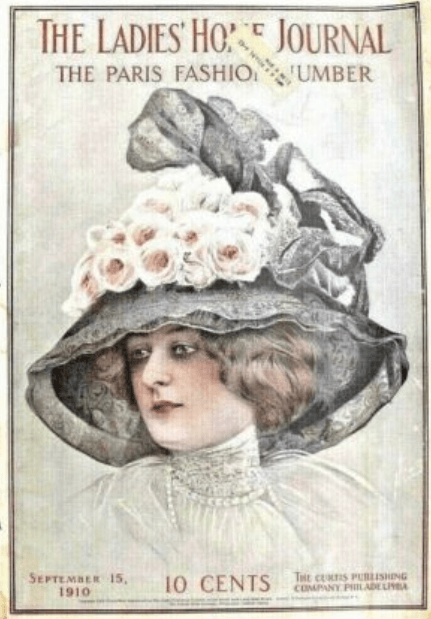
And then inspiration struck. The magazines could duke it out, mano a mano, 1920 vs. the 1910s. I chose 1915 as the opponent, a nice round number but not so far back that it’s super-old-timey like this 1910 Ladies’ Home Journal cover:

Ladies' Home Journal, September 15, 1910, woman in big hat.

As I assembled the covers, it dawned on me that maybe I still wasn’t being fair. What was to stop me from picking all the 1915 covers to prove a point? I pondered this for a while, and then the answer came to me: the people!

Normally, I’m very limited as to what I can do on this blog because I’m a wordpress.com member, meaning that WordPress hosts my blog as well as being the platform for designing it, as opposed to the far cooler wordpress.org members, whose blogs are hosted by other companies so they can get all sorts of plug-ins that don’t run on wordpress.com.** But one thing that wordpress.com lets you do now is run polls. And what’s more fun than a poll?***

So I leave it to you, the people, to decide, for each of the 16 magazines below, whether its September 1915 cover (top) or its September 1920 cover (bottom) is better. (In several cases, as it turns out, artists are competing against themselves.) The polls will stay open for a week, and the winners will be announced in early October. If the covers I’m rooting for don’t win, I promise to accept your verdict graciously. Because that’s what democracy is all about!

And, in case you find your energy flagging, there’s a prize at the end.

1. Vogue

Helen Dryden, September 15, 1915

Helen Dryden, September 1, 1920


2. Harper’s Bazar

Erte Harper's Bazar cover, September 1915, three women

Erté

Erté Harper's Bazar cover, September 1920

Erté


3. Ladies’ Home Journal

Lester Ralph

Walter Biggs


4. Vanity Fair

Vanity Fair cover, September 1915, Rita Senger, woman with sleeping Pierrot.

Rita Senger

Warren David Vanity Fair cover, September 1920, naked women dancing.

Warren Davis


5. The Crisis

The Crisis, September 1915, The Colonel of the 8th Regiment.

The Crisis, September 1920, photo of bust by C. Matey.

Sculpture by C. Matey


6. St. Nicholas

St. Nicholas cover, Norman Price, September 1915, motorcycle jump.

Norman Price

St. Nicholas cover, September 1915, Charles Livingston Bull, children sailing.

Charles Livingston Bull


7. Cosmopolitan

Cosmpolitan cover, September 1915, Harrison Fisher, young woman sipping milkshake in red hat.

Harrison Fisher

Cosmopolitan cover, September 1920, Harrison Fisher, woman having tea with dog.

Harrison Fisher


8. Good Housekeeping

Good Housekeeping cover, September 1920, Coles Phillips fadeaway girl.

Coles Phillips

Good Housekeeping cover, Jesse Wilcox Smith, September 1920, little girls hugging in doorway.

Jessie Willcox Smith


9. The Masses/The Liberator****

The Masses cover, September 1920, Cornelia Barnes, children dancing near organ grinder.

Cornelia Barnes

The Liberator, September 1920, Hugo Gellert, boy on flying horse.

Hugo Gellert


10. The Smart Set

Smart Set cover, September 1915, John Held Jr., man in polo clothes with woman.

John Held Jr.

Smart Set cover, September 1920, man talking to woman on boat.

Archie Gunn*****


11. Photoplay

Photoplay cover, September 1915, Mary Pickford, Anita Stewart cover design.

Photoplay cover, September 1920, Rolf Armstrong, Constance Talmadge.

Rolf Armstrong


12. La Vie Parisienne

La Vie Parisienne cover, September 25, 1915, woman shooting arrow.

La Vie Parisienne, September 18, 1920, woman playing golf with caddy.


13. Life

Life cover, September 8, 1915, Emery, women with long-feathered hats.

Emery

Life cover, September 23, 1920, Rea Irvin, woman on throne.

Rea Irvin


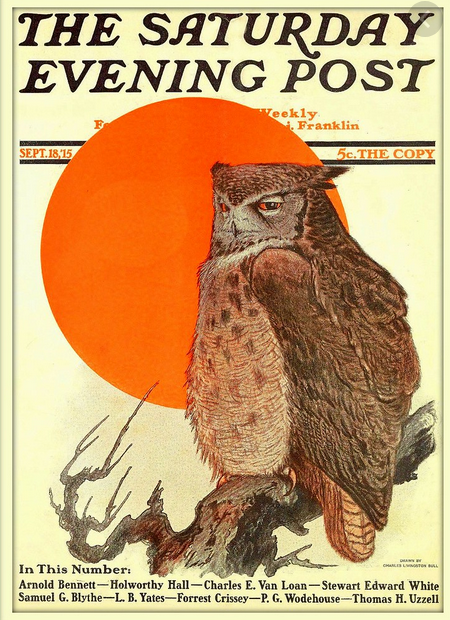
14. Saturday Evening Post

Saturday Evening Post cover, September 18, 1915, Charles Livingston Bull, owl in front of orange sun.

Charles Livingston Bull

Saturday Evening post cover, September 25, 1920, Alfred E. Orr, man painting name on mailbox.

Alfred E. Orr


15. Metropolitan

Metropolitan cover, September 1915, young woman in straw hat.

Metropolitan cover, September 1920, Edna Crompton, woman serving at tennis.

Edna Crompton


16. The Best of the Rest

There were two covers that didn’t have a counterpart in the other year but that were too good to leave out, so I’ll let them face off.

Golfers magazine, September 1920, man swinging golf club while woman watches.

Red Cross cover, September 1920, Gerrit Beneker, worker in front of skyline.

Gerrit Beneker


That’s it, the hard work of voting is over. Now for the prize!

Thomas Jefferson and the Return of the Magic Hat, by Deborah Kalb

My friend and fellow blogger Deborah Kalb’s book Thomas Jefferson and the Return of the Magic Hat is being published this week. It’s the third in a series of books about the adventures of a group of fifth-grade friends who travel back in time and meet America’s founding presidents. The first three readers who let me know which magazine cover was their favorite will receive a free copy. You can post a comment below or drop me a line through the Contact page.******

I’ve read the book and highly recommend it—it’s a lot of fun but at the same time it engages seriously with the issue of slavery. As the U.S. prepares to choose its next president, the timing couldn’t be better. So hurry up and vote!

squiggle

*I know, apples and oranges. But I’m describing a mental state, so bear with me.

**Like PUTTING PHOTOS SIDE BY SIDE, FOR EXAMPLE, WORDPRESS!

***Besides a quiz, I mean.

****The Masses, a socialist monthly, ceased publication in 1917 after editor Max Eastman and several staff members were charged with conspiring to obstruct conscription. Eastman and his sister Chrystal Eastman founded The Liberator in 1918.

*****Which I am very proud to tell you I deciphered from this:

Illegibile signature, Smart Set cover, September 1920.

******For readers living outside the United States, I’ll do my best to get a copy to you, but I can’t make any promises.

1920 magazine covers bring late winter cheer

When I picked up my mail after arriving in D.C. from Cape Town a couple of weeks ago, I found to my surprise that I have been a New Yorker subscriber since September. My first reaction: “Oh, look, a giant pile of guilt!” Then I saw the brightly colored covers, and I wanted to gather them all in a slippery embrace, like fellow survivors from a lost world. Few things from 100 years ago bring me as much joy as magazine covers, and few things (well, few non-news-related things) are as dispiriting as a 2020 magazine rack.

I had a post on February 1920 covers almost ready before I left Cape Town, but what with all the electricity cuts I didn’t manage to post it. So I’m covering both February and March here.

The February magazines feature lots of women engaging in wholesome outdoor activities like skiing,

Country Life magazine cover, February 1920, woman skiing.

Edwin Wilson

snowshoeing,

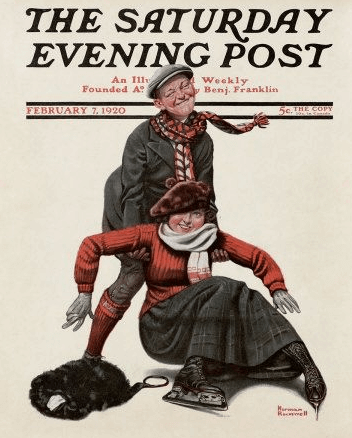
and pathetic ice skating.

Norman Rockwell cover, Saturday Evening Post, February 7, 1920

Norman Rockwell

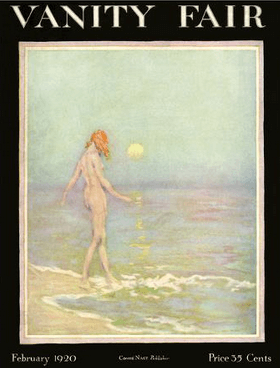
And also engaging in unwholesome outdoor activities like this:

Warren Davis March 1920 Vanity Fair cover, naked woman walking into the ocean.

Warren Davis

The artist for this surprisingly risqué cover is Warren Davis. He also drew this February 1918 Vanity Fair cover,

which I took note of back in February 2018. That one was also daring, but it struck me as having that Greek mythology vibe that lets you get away with anything. It turns out, though, that young women cavorting around outdoors naked, or at most with a diaphanous scarf, comprise pretty much Warren Davis’ entire oeuvre.*

Some favorite artists are back: Frank Walts at The Crisis,

Frank Walts The Crisis cover, February 1920, drawing of African-American boy.
Frank Walts

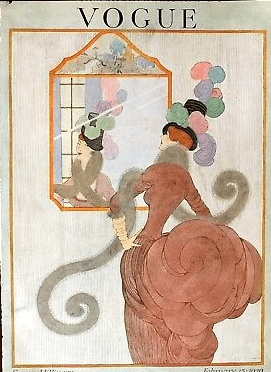
Helen Dryden at Vogue,

Helen Dryden Vogue cover, February 15, 1920, woman looking in mirror.
Helen Dryden

A.M. Hopfmuller at Shadowland,

A.M. Hopfmuller February 1920 Shadowland cover, abstract landscape.

A.M. Hopfmuller

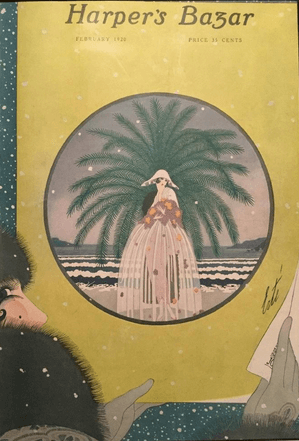
and, as always, Erté at Harper’s Bazar.

Erté February 1920 Harper's Bazar cover, woman in gown on beach.

Erté

There’s a Valentine’s theme at Red Cross

Red Cross magazine cover, February 1920, dog carrying Valentines.

(Google/HathiTrust)

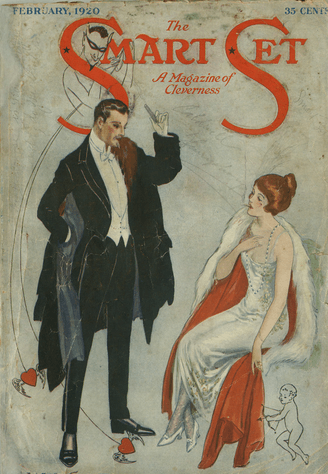
and at Smart Set, which I’m pleased to see breaking out of its face-of-young-attractive-woman rut.

There are people in traditional dress at Sunset

Sunset magazine cover, February 1920, woman in traditional Spanish-Mexican dress.

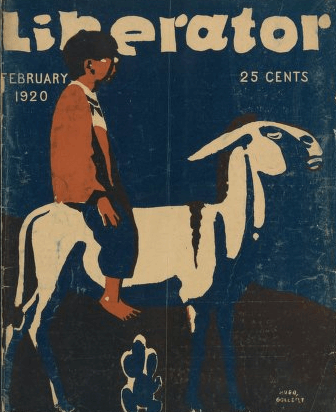
and Liberator

Hugo Gellert

and World Outlook.

I loved these covers from House & Garden

Charles Livingston Bull House & Garden cover, February 1920.

Charles Livingston Bull

and Popular Mechanics

February 1920 Popular Mechanics cover, vehicles transporting houses and stores.

and Elite Styles.

February 1920 Elite Styles cover, woman in gown in room.

As I prepared for my trip, I was all psyched up to leave the southern hemisphere summer for some outdoor winter fun. Of course, what I actually ended up doing was lugging groceries home in the rain. So good riddance to February…

…and onward to blustery March!

St. Nicholas cover, March 1920, young man and women in wind.

(Google/HathiTrust)

Woman's World cover, February 1920, children struggling with kite.

They’re getting in some late-season ice skating at Red Cross**

Norman Rockwell Red Cross cover, couple skating.

Norman Rockwell

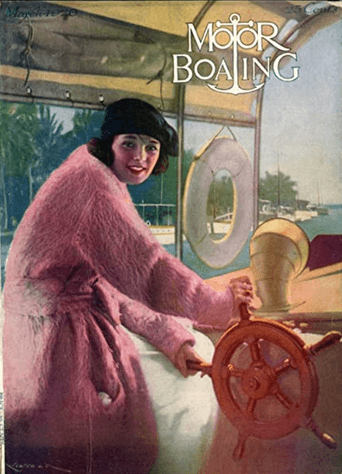
and some early-season boating at Motor Boating.

Motor Boating cover, March 1920, woman in pink coat steering wheel of boat.

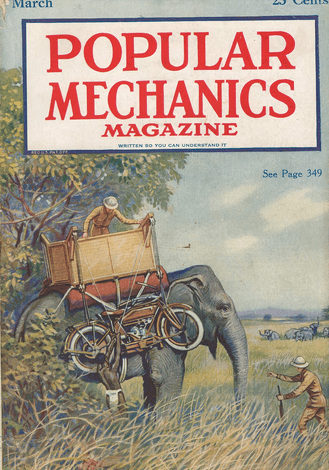
Am I reading this wrong or is this elephant being used as an accessory to kill other elephants?*** And don’t get me started on the African man in the loincloth.

Popular Mechanics cover, March 1920, elephant hunt.

Everybody’s is late to the Valentine’s Day party.

Everybody's magazine cover, March 1920, soldier with cupid in helmet.

Vogue has a cover by regular George Wolfe Plank

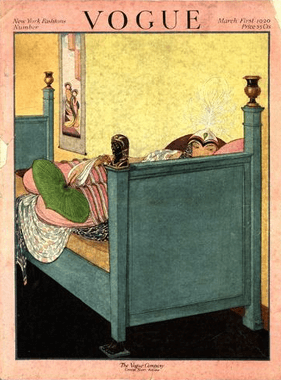
George Wolfe Plank Vogue cover, March 1, 1920, flapper on bed.

George Wolfe Plank

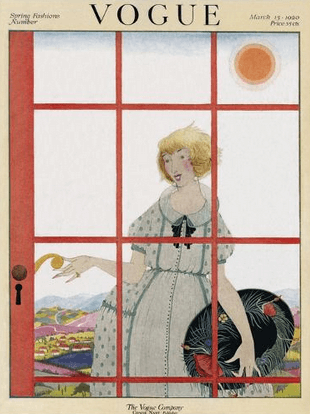
and one by 26-year-old newcomer Harriet Meserole, who would go on to be a Vogue stalwart.****

Vogue cover, March 15, 1920.

Harriet Meserole

Bright spring colors abound at Harper’s Bazar

Erte Harper's Bazar cover, March 1920, Erte.

Erté

and The Delineator

Delineator cover, March 1920, woman in cape.

and The Green Book

Green Book cover, March 1920.

and House & Garden

Harry Richardson House & Garden cover, March 1920, house with path and flowers.

Harry Richardson

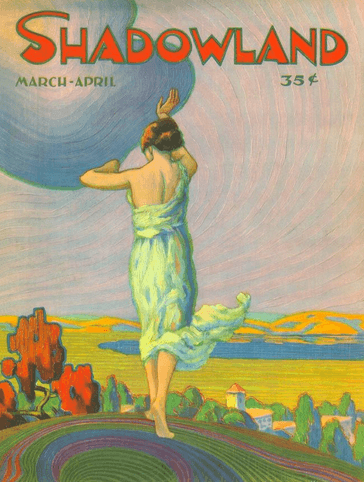
and Shadowland

A.M. Hopfmuller Shadowland cover, March 1920.

A.M. Hopfmuller

and Vanity Fair, which features a cover by Anne Harriet Fish, an artist whom I wasn’t familiar with but who will now join Gordon Conway and John Held Jr. in the ranks of VF artists whose work I can’t tell apart.

Anne Harriet Fish Vanity Fair cover, March 1920, couples dancing.

Anne Harriet Fish

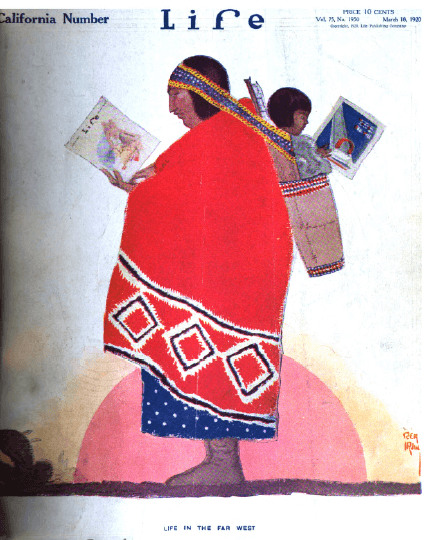
Future New Yorker cartoonist Rea Irvin was the artist for this striking, though problematic to modern sensibilities, Life cover.

Rea Irvin Life magazine cover, March 1920.

Rea Irvin

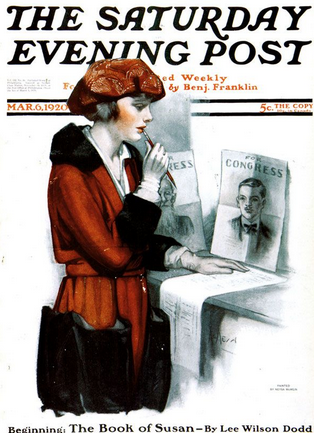
This woman on the cover of the Saturday Evening Post seems to be about to ditzily cast her first vote for the supposedly more handsome candidate, which I would take offense at, except, um, Warren Harding.*****

Neysa McMein Saturday Evening Post cover, March 6, 1920.

Neysa McMein

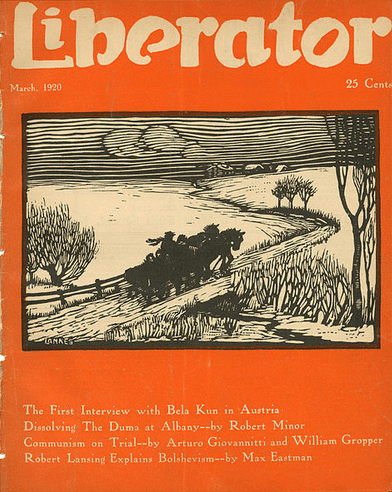
The woodcut on the cover of Liberator is by J.J. Lankes, who was a friend of, and illustrator for, Robert Frost and Sherwood Anderson.

J.J. Lankes Liberator cover, March 1920, woodcut of horse and cart.

J.J. Lankes

This Photoplay cover isn’t particularly notable except that “If Christ Went to the Movies” is the best cover headline ever.******

Rolf Armstrong Photoplay cover, March 1920, Alice Joyce.

Rolf Armstrong

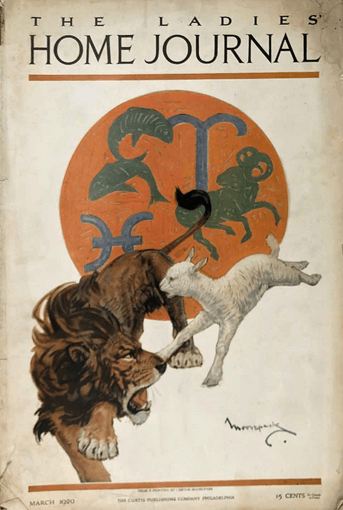
And it wouldn’t be March without a lion and a lamb, courtesy of Carton Moore-Park:*******

Carton Moore-Park Ladies' Home Journal cover, March 1920, lion and lamb with astrological signs.

Carton Moore-Park

Counting the days until spring!

squiggle

*Google him if you don’t want to take my word for it. Just don’t do it at the office.

**According to the go-to site for Norman Rockwell cover information, this was Rockwell’s fourth and last cover for Red Cross, which folded in late 1920. Rockwell turned to smaller magazines when large-circulation magazines passed on his illustrations.

***I always thought you couldn’t ride African, as opposed to Asian, elephants. Apparently you can, although, according to animal rights advocates, you shouldn’t.

****As far as I can tell, this is Meserole’s first Vogue cover other than this February 1919 one, which is mostly white space:

Harriet Meserole Vogue cover, March 15, 1920

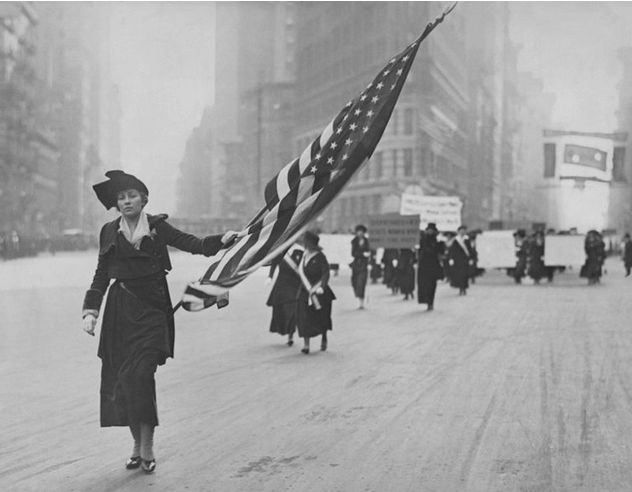
*****Also, the cover artist, Neysa McMein, was a woman and an ardent supporter of gender equality. Here she is marching in a suffragist parade in 1917.

Neysa McMein marching in a suffragist parade, 1917.

New York Times, November 4, 1917

******Excerpt:

Excerpt from March 1920 Photoplay article "If Christ Went to the Movies."

*******Moore-Park also drew the “is it a lady or a parrot?” August 1919 LHJ cover.

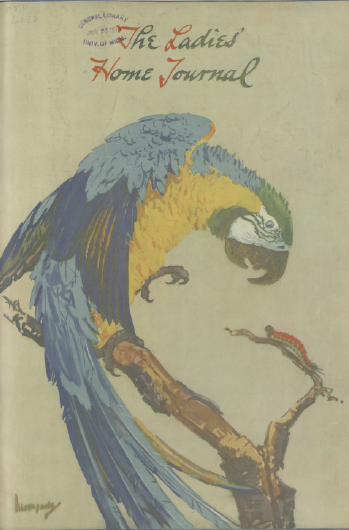
Carton Moore-Park August 1919 Ladies' Home Journal cover, parrot looking at caterpiller.